How To Grow On Substack in 2 languages: Strategis and Tips to grow faster
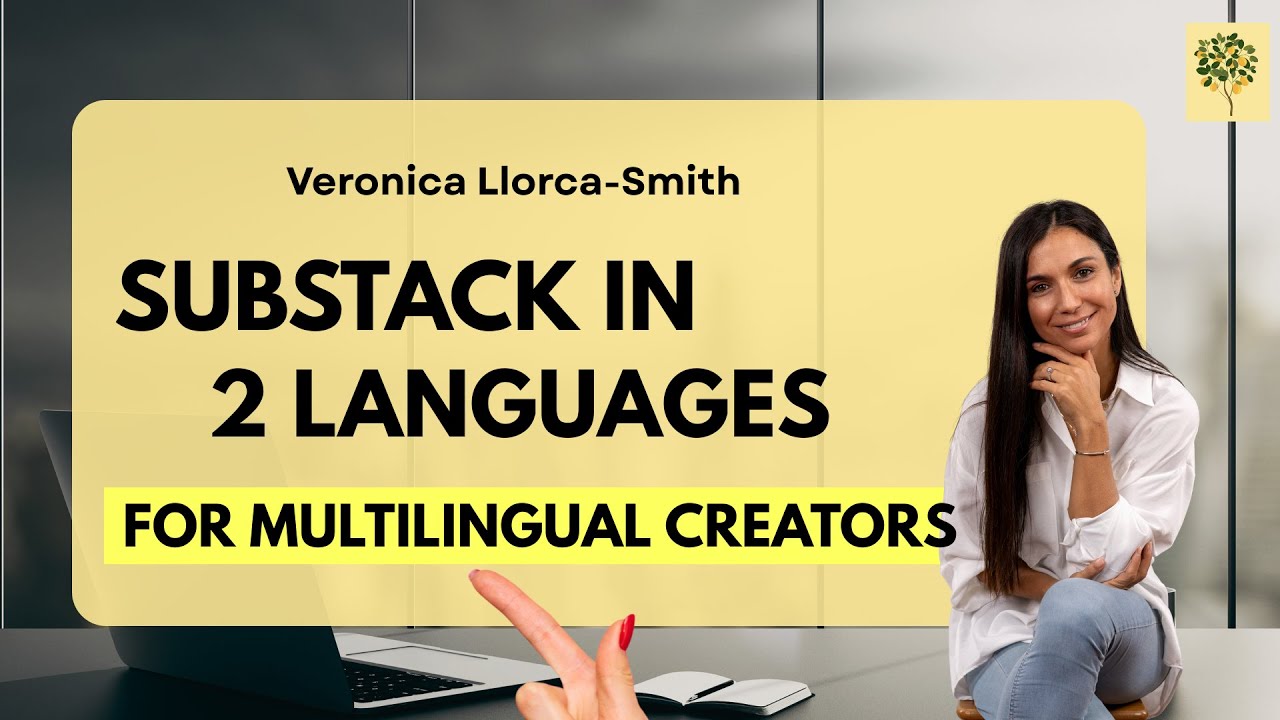
Veronica LLorca-Smith shares how to launch and scale bilingual Substack publications in English and Spanish. Start with the language that matches your existing network, wait 18 months before adding a second language, and keep them in separate publications under one author profile. Cross-promote through homepage links and email, and offer the other language free to paid subscribers.
Chapters
This is Veronica from Substack, The Lemon Tree Mindset, and I'm super excited to talk to you today about Substack, but not just Substack in general, but how to publish content in 2 different languages. And it doesn't matter what they are. In my case, it's English and Spanish, but this is really to help writers and creators who are considering or perhaps even already have a publication in 2 languages. And so the goal of today is really to help you launch right in 2 languages on Substack. I want to share my experience, I want to share the obstacles that I had, the journey, but more so the strategies and the tips that have helped me grow 2 successful lemon trees, el limonero in Spanish, on Substack. And so let's get started a little bit with the journey. I'm actually celebrating 3 years on Substack. I still feel like a rookie. I don't know where time went. And so during these 3 years, I just want to explain a little bit what happened in terms of different languages. I'm originally from Spain, but I launched my first publication, The Lemon Tree Mindset, in English. So one of the questions that I get very often is, which one should I go for first? So my answer is, it really depends on where you have more leverage. And by leverage, I mean, where do you have more connections, Where do you have a bigger network? Perhaps you even have a digital footprint somewhere. So in my case, although I'm Spanish, my entire career has been in English. I previously worked for Apple, for Estée Lauder, American companies. On LinkedIn, I have much more of an English presence. I have never really written or done anything in Spanish, so that's why it made sense for me to start in English. So that's one of the first things for you to consider. Where do you have leverage? Where do you already have some type of legacy that can give you a little push. So I started with the English one, and the first year was extremely slow, and it's only in the second year when I started to get momentum. And so after I started growing, after I had a strategy, after I had like a nice system of having new subscribers into my publication, then and only then is when I decided to launch the Spanish one. So to give you a little bit of a timeline, It took me 18 months to go from the English one to the Spanish one. The reason why I did this, and this is a question that I get very often as well, is when should I launch the second one? And this is my personal opinion, different people might have a different point of view. When you're starting something new, no matter what it is, it could be a new business, it could be a restaurant, my mom has a restaurant, it could be a language, the beginning is always very hard. And it's going to be frustrating as well. It was for me for sure. And so if you're adding a second project to that, it's probably going to add more frustration. So what worked very well for me is to have frustration only once. And so that first year in English, very frustrating, very slow growth, but I learned a lot. In fact, after a year and a few months, I became a Substack bestseller in English. And so once I knew what I was doing, once I had the strategy, once I knew what the building blocks were to grow on Substack— in my case, it was notes, it was recommendations, it was collaboration, doing live sessions— then I already had the roadmap to be able to grow much faster. And to give you some context in terms of numbers as well, it took me a whole year to gain my first 1,000 subscribers in the English publication because I had absolutely no clue what I was doing. Do you know how long it took me in the Spanish one? So basically in 1 year I'm almost at 3,000 subscribers, and the main reason is because I already had a roadmap. So I started growing from month 1. So when you're thinking about whether you should do both at the same time, I definitely recommend that you start with one. You see what works, what doesn't. You find your own voice, your style, and you start to build your own pillars and your own building blocks. And then you can use the same to grow your second publication. One thing that's very interesting is to give a context also on Substack and languages. As you will see, and especially if you write in a second language, Substack is very English-centric. It's a very American-centric platform, and so you will find that most of it is actually in English. And so that can be discouraging for people like us who are trying to go for a second language, I actually have a different way of looking at it, which is opportunity. Because we are less in English, Spanish, Portuguese, Dutch, Arabic, whatever that might be, it's actually easier to stand out. And so you have a bit of the first mover advantage. So don't disregard that. It's not because you have fewer people or the market is smaller that you can't grow. And in fact, it also means that it's less saturated. You have less people doing live sessions in other languages. So I do see it as an opportunity, and I think that's partly why I'm able to grow in Spanish much faster than in English, even though there are many, many more users in English. So that's a little encouragement for you to keep in mind if you want to write in Arabic or Portuguese or whatever that might be. Second data point that's interesting, I don't know if you know which are the main languages on Substack. So Obviously English is the first one, but I wasn't too sure about the second and the third. There's not a lot of official data, but if you look around, you'll see that the second one is actually Portuguese. And the reason why is because there are a lot of Brazilian publications. Apparently Substack is quite big in Brazil, which is actually where I grew up in Rio de Janeiro. And the third one is actually Spanish. This takes me to the why. Why would you want to write in a second language? I think it's always important to start with a vision, the why. And there are many reasons, and this has to be something personal that really comes from your heart. In my case, I'm Spanish, but I spent my entire life outside my own country. I grew up in Brazil, in France, in the Netherlands, and I've been in China and Hong Kong for the past 20 years. And I've always been very detached from my culture physically, and as a result, I haven't been able to speak Spanish much. And so for me personally, to be able to build a global community around my language is deeper than just the business, it's really connecting with my roots. For some other people, it might be because maybe you want to grow a business in a second language, so you might have many different reasons why you want to do it, and I think they are all super valid. So now this takes me to a few of the other questions, and this is more practical, that people ask me. So we've already covered when and which one you should launch first, and I do suggest that you start with one and then you go with the other. So tactical things, and I have a list of questions here. Should we go for an entire brand new publication or should we have a section inside your current publication? You can have different sections inside your Substack. I definitely 100% recommend that you have your own publication because otherwise it does get messy. It is easier if you start just with one section. For example, in the Elementary Mindset, I could have Spanish section, and that would get me going. Now, the problem is when you think long-term and when you start to scale, the sub-publications are not bilingual. And so, for example, if you're going to do a live session, you can't divide, you can't decide this live session is for Spanish and this one is for English. So that's a challenge. Same with the chat. If you have a section in Spanish inside your publication, the chat is going to go to everyone, so you can't differentiate. Also, it's very likely that you will have subscribers who by mistake start getting newsletters in different languages, and that would be a pretty terrible experience. The chances are they would unsubscribe. So I definitely recommend that you start with 2 publications. It is much more work, but as I said before, once you have a system that works, once you know exactly how the backend works, how you do your welcome emails, how you do the layout of the publication, and so on, is actually not that much more work. It's really about localizing it and tweaking it to make it relevant. So that's about sections. Another very common question that I get is, should I have one profile or should I create a different profile for Spanish Veronica? Again, I do recommend that you stick to one profile, and the reason is this: the way that Substack is built It actually helps you build synergies if you have multiple publications. And I'm not even talking about languages. Let's say that I have my Elementary Mindset and I have a fiction publication and I have a third one. When you look at my profile, you're actually going to see the consolidation of all of those in my number of subscribers, for example, which is actually something that's positive because it helps you boost your profile. Let me give you an example. When I started the Spanish one and I had at the beginning 15 subscribers, when people actually clicked into my profile, if they were interested, they wouldn't see that I had 15 subscribers. They would see that I had back then over 5,000 because it was showing the total number of subscribers. And unconsciously, that is sending a positive signal. Oh, this person knows what she's doing, she has a following, and so on. So that's one of the reasons. The other one is also much more practical. I can't imagine the hassle of having to log out of one app and then log again with a different profile, with a different username, password that I would probably forget, to try to post a note in the second language. So Notes is a bit of a challenge because you can't really choose, now I'm going to post in English and now I want to swap the platform into Spanish. Everything is kind of mixed there. And so there are different approaches that you can take, and honestly, I don't know which one works better, but I'll share a couple of options that you have. In my case, what I do when I'm publishing notes is I do them in both languages, but I do them separate. So I usually do the English ones to catch my English-speaking audience, so I try to do it when it's the evening in the US and when it's the morning in Europe. So try to make sure that you post when that particular audience is awake. Now, for example, my Spanish audience, most of them They're sleeping, so that's not my moment to start doing a live session in Spanish, and that's why I don't do it. So that's one approach. The other one that's very interesting, and is what Rosemary, and she's in this call, actually does, and very often in the same note, she starts writing in English, and she has a little bracket that says Spanish underneath, or español abajo. And so that is actually helping you talk to two audiences at the same time. Look, I don't know about the algorithm, I don't know how things work, but I do think that it's interesting to experiment with different approaches to see what works for you and also to keep very present when your audience is awake because you want to make sure that you're talking to the right people when they're actually online. So that's something about Notes that can be useful. Another question that I get very often: is there a way where I can create synergies between both publications so that in my case, for example, the English one helps me boost the Spanish one or vice versa. And actually there are a lot of things that you can do. And so I'm going to share some of the best practices that have helped me grow both of them without having to do a lot of extra work. So the first time is in your publication, you can actually add external links so that when someone visits, for example, the Elementary Mindset, you can check that I have a few links. One of them is to my latest book, The Anti-Procrastinator. Another one is to my course on Substack, and the last one is to my Spanish publication. So you have opportunities to use different digital touchpoints in your publication to promote the other one and make sure that when someone lands in your publication, maybe it's someone from Argentina, and she might be like, oh, actually she has a Spanish version, I might prefer that one. Or I might want to subscribe to both. So you can do little things like utilizing, for example, the homepage. That's one. You could also have it in your welcome email. Hey, by the way, if you prefer to follow me in Spanish, here is my publication. So you can also do it in the welcome email. One other thing that I've done and I continue to do every month is having segmented campaigns. So at the end of each month, I look at all the subscribers who have subscribed to my English publication, and I see which country they come from. And I manually select the Spanish-speaking countries, so mostly Spain and a bunch in South America. I select only those, and I send them personalized email letting them know, hey, thank you for subscribing to the Lemon Tree Mindset. By the way, I saw that you signed up from a Spanish-speaking speaking country. If you're more interested in following me in Spanish, here is El Limonero. And so that's actually a really nice way of making sure that you offer something that is very customized to the people from that language. And especially, for example, if you are talking about something that relates to languages, or for example today this live session, I will make sure that I also share it with my Spanish subscribers. And when I send the post, I will have a link So be strategic, and instead of treating it like 2 complete publications, you can create this ecosystem. You can create like these connections between both. This applies not only to multilingual Substacks, but to Substacks from different themes. If you're a nonfiction author, but you also write fiction, you can definitely have a call to action. Hey, if you'd like to see my latest book on mystery in Hong Kong. And so one last topic is the monetization. And whether I have any tips or strategies that have worked for me. Personally, I've done one thing that works quite well, and it's if you are a subscriber, annual subscriber, or founding member at the Lemon Tree Mindset, for example, I actually give you for free the Spanish one. Because my goal honestly is not to make one person pay much more, it's to make one person be very happy so that they can become a promoter and invite, of course, many other people. To come to the Lemon Tree Mindset. So if you are one of my paid subscribers or founding members and you're not yet on the Spanish one, let me know and I'll give you that complimentary. So that works well. And I do that vice versa as well. If someone signs up in the Spanish one, I also offer them the English one for free. So I'll do a little bit of summary. To launch a second publication, I do suggest that you have a strong foundation, that the engine is already going, that you have like a strong infrastructure. Please don't rush it because otherwise it's going to be frustration times 2. So whatever feels a comfortable timeline for you. For me, it was a bit longer, 18 months. For you, it might be 6 months, it might be a year or so, but make sure that you have the software working right, like you have the operating system in place. Then we talked about those more functional things. Definitely have a separate publication, have a single profile so that you can really create synergies. And when people see your profile, they actually see the overall number of subscribers that you have. Then we talked about how to create synergies leveraging all the different touchpoints that you have— your home publication, your homepage. You can have call to actions that are inviting to visit the other publication. You can have different segmented campaigns as well to let people know that you have your second publication. So all of these can help you. So let's talk a little bit about translation, because one of the things that I personally find very important when I'm translating my content into Spanish is that it's actually not a translation. I tried that, going to AI or Grok or whatever and have it translated, and it's much more a localization than it is a translation. So it honestly, if you want to do a good job, it takes much more than just putting it in an automatic translator. Because of many reasons. If many of you, I suppose, speak a bit of a second language, at least language translations are never a copy. So this session that I'll probably do in Spanish will sound very different because we have different expressions, because we have different words, the tone is different. And so the first thing is that you really come across the same way. So I, in my case, for example, I don't just translate. I make sure that I localize, I change the expressions. Something that's very important as well is the context. If I'm talking to an English-speaking audience, my context is going to be based on that world. So I might be talking about other creators who also write in English. I might be talking about references that make sense in that community. However, if I'm now talking about the same topic in Spanish, I localize it. I talk about creators who are Spanish. I make references that make sense for that community. So it's not an easy one. The cheap way, the fast way is to just go for a translator, but the result is not going to be high quality, to be honest. I just want to share with you a couple of extra resources that I have for those of you who are considering writing in a second language or perhaps already are, but you're feeling a little bit stuck. So I do have some posts where I talk about things to consider, very similar to what I discussed today, but I think if you see it in the written format, it will help. I also have a live session that I did with a German-speaking creator called Katja Grusser. We did that a few months ago, and that can give you different perspectives on how we are approaching it, the challenges that we are having. And for those of you who really want to go a step further, I do have coaching sessions for my founding members at the Lemon Tree Mindset. In Substack, so you can check it out and see if you'd like to have a one-to-one session with me. Feel free to reach out to me, and I'm always happy to answer any questions that you might have. So muchas gracias. Thank you very much from Hong Kong, and I wish you all the best in your bilingual journey on Substack. Ciao!
More from Veronica



How Much Speakers Charge And Where To Find Paid Gigs [Public Speaking Bootcamp]







