Substack Crash Course: How to Gain Subscribers Through Connection
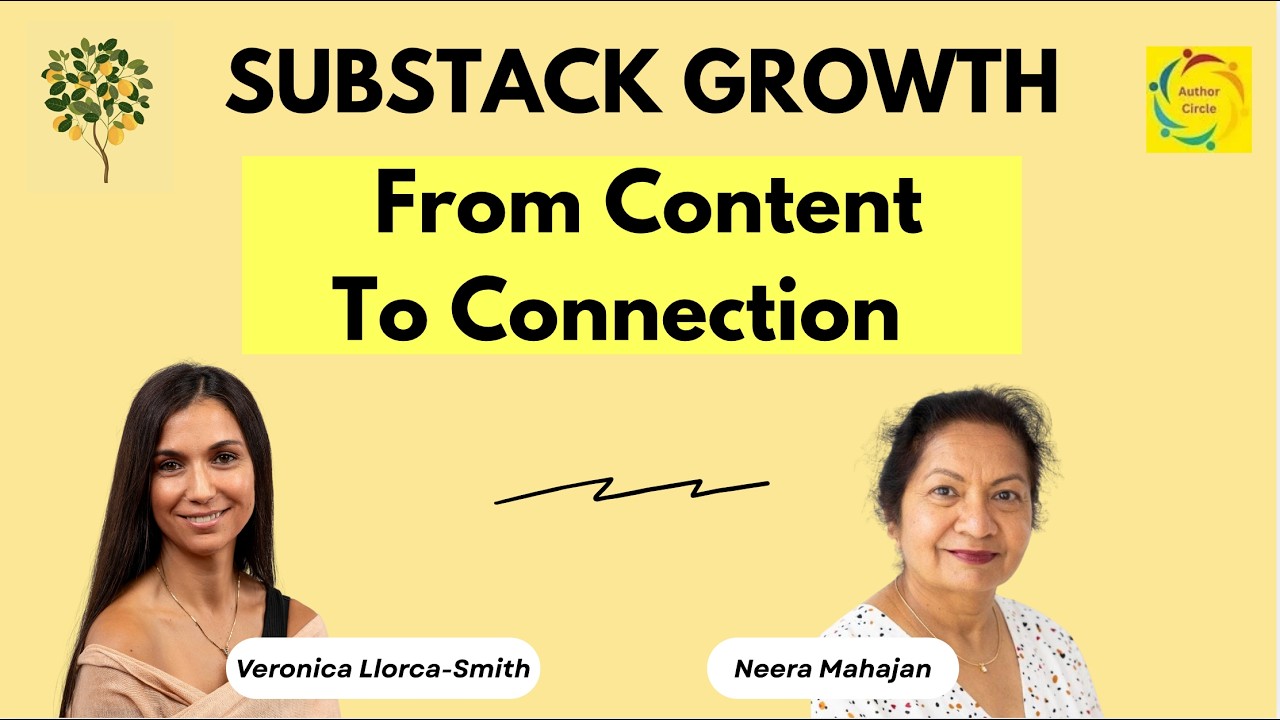
Nira and Veronica Llorca-Smith show how to grow a Substack by building real connections instead of just publishing. Ask new subscribers a personal question, reply daily to notes and comments, segment your most engaged readers, and send them personalized resources. Real connection drives collaborations and conversions, typically 2-3%.
Chapters
So today, Veronica and I are going to talk about something which many of us, I think, struggle with, which is to make connections or make, do more engagement while most of our, our focus in on creating content. So we thought we'd do a crash course about this particular venue of growth. I think the real work on Substack is actually making connections. So Veronica, tell us, how do you manage them?
We're here to have an open conversation on how we can unlock this connection thing. And I think it's healthy maybe to talk openly about the issue. Why are we talking about this in the first place? I'm going to talk about something that was a challenge for me for months when I started. And I think a lot of people can relate, which is the focus on just creating content. And this is how it goes. You send a newsletter, you put a lot of focus and a lot of effort into your post, and then it goes out and it doesn't have the success that you're expecting, whatever that bar might be. And then what do we do? Instead of actually finding ways to connect with people, we then go like, I'm going to send another one. And we start almost overloading people with a lot of content without going deeper. Into that. I do find, and I've been on Substack since early 2023, and from 2024 and particularly 2025, I saw a big shift. And I really saw that whereas in the past sending information was good and people wanted to consume because we didn't have this amount of information that we have now with AI, there's really been a change. And I think people are not—
Mm-hmm.
looking to consume more and more because that's what we're already doing every single day. ChatGPT, Netflix, whatever that might be, we're consuming so much. And what I did find is that people are really looking for this community, for this connection. And so that's the issue, right? Is how to go from just overloading people with content to actually forums, but finding ways where you can let people in. And my strategy, so you're going to remember this, is Let them in. You don't have to like group chat. That's okay. You don't have to do live sessions. That's okay. But find your own ways to let people in. So remember these 3 words from today, and that's my key in terms of how you can build that connection. And now we can go into the more strategic stuff and the more tactical stuff, but the high-level picture is what are we doing today to really let people in and not just you getting out?
That's an amazing, simplest way of putting such a complex topic. So let people in. So far we have been seeing Substack and any other platform as a broadcasting platform where we come and we say our thing, and then we expect people to come back to us with either comments or if they agree with us or they disagree with us, we wait. Now you're saying let people in. My question is how? Give us examples, please.
Well, I love examples because it's the only way where we can really match this concept that can seem a little bit abstract. So let's start from the very beginning, and this can be a bit of homework for everyone, including ourselves. The very first piece of content that you're going to send your subscribers when they first sign up is your welcome email. For me, the most boring piece of information out there, and I know because it used to be mine, make sure that I don't fall into spam. Your first email is an amazing opportunity for connection, but you have to create. You asked me, it's not just about telling what the elementary mindset is about, but letting people, maybe asking them a question. What is a project that you're excited about?
Where do you—
doesn't have to be a connection about something technical. It can be something about, hey, I'm in Hong Kong. I'm Spanish. I'm a mom. I'd love to hear something from you. So that's one little piece of content where you have an opportunity already to bring people in. Now, I'm not going to say that every single person replies to my welcome email. Absolutely not. But it's definitely more than when it was just the sterile, welcome to my publication. This is what you can expect. So that's number one example, using your, your welcome email. And I'm going to throw the ball back at you, Nira. What are some of them? ways or channels to create that connection with very simple how-to examples?
Okay. So first of all, I'll actually answer to your suggestion that have a question in your welcome email. I do have a question in welcome email. And in fact, whenever I have someone subscribe to my newsletter, I ask them one question. What is your number one struggle at the moment? And many people come back. With that answer. So that's an amazing tip. But while you were suggesting this, I came up with another question which all of us can use and which is probably much less thought-provoking, but something people will take up very quickly. Why not ask them, tell me about yourself and what are you doing on Substack?
Love it.
So that way it's not threatening, it's not making them think For an answer, but I'm, I'm struggling at the moment. It is just, tell me about yourself, which is what we do when we meet new people and we want to ask them, okay, tell me about yourself. And that is the question. So if you are looking for a tip to let people in, ask in your welcome email to people, tell me about yourself and what are you doing on Substack? Or you can also ask them. Tell me about yourself and what brought you to subscribe to my Substack. Simple question. Okay. So your question was, what am I doing letting people in? I think there is an opportunity for us when we do not have too many people joining our subscribing to our Substack. And I go through phases when there is only 3, 4, 5 people joining. I actually get to know them by going to their Substacks and see what, what they have written, what is their field. And if they're new, then I write to them, welcome to Substack. I see you are new. I'm so grateful you subscribed to me. Is there any way I can help you? And that starts the conversation. But you can't do that, obviously, when you have 20, 30 people subscribing to you. Maybe you can. If you have a script and we, you can send it automated way. But even if you can do it once a week, go through the people who have subscribed to your Substack in that week and have some way of personal connection, getting to know them. That opens many doors for you than sending more posts and sending more content. What did you think?
Absolutely. And I think you mentioned a point that's key. You said, if you have the bandwidth, because something that's very interesting about connection is that it's hard to scale. And so it's important about scalability and how you're going to be adjusting your strategy. So in my case, the Lemon Tree Mindset is now sizable publication of over 10,000 subscribers. So obviously I don't have the bandwidth to do that. It wouldn't be sustainable. My Spanish one is 3,000. So there I have more. Room to play, but some people might have under 200. And I actually think that when you have a smaller publication, it's a really, really good opportunity to have this connection of what you're saying. If you're having 1 or 2 subscribers a day, doesn't sound like a lot, but actually that allows you to create that connection. Now, when you go into the next phase, which is, well, how do I scale? There's one strategy that not many people use. And in fact, not many people even know, which is the segmentation of your emails. And I know that you have done, I do it as well. And basically, if you go to your dashboard in subscribers, you can find there one of the fields, actually the stars, to see who are your most engaged subscribers. And what you can do is extract, for example, the 4 stars and 5 stars. So these are people who are reading what you're saying, who are connected in a way. And I just— Hey, thank you so much for being one of my most engaged readers. I would love to hear from you. Uh, please reply to my email. I even ask, let me know what you're struggling with and I will send you a personalized resource to help you with your journey. It's to scale that connection while keeping it personal. It's still Veronica, it's not automated, and it gives people that opportunity to have proximity. So again, think of where you are today and how you can make that connection scalable as you grow.
That's a great point you have just made because I have used that A number of times. So they, I have written a couple of posts about it, how I started having quite frequent conversations with my most engaged subscribers. It's very easy to extract them from that backend, from the settings that you go and look at activity and who are 4-star and 5-star subscribers. And in fact, they are your actual readers. They are the meat. How about connecting with people on notes and chats and what should one write on a note? Because which usually notes are very small and you're only saying one thought at a time or one tiny story at a note. How can you invite people in? Because now you're not only just talking to your own subscriber, you're talking to the people outside your subscriber base.
So the approach is actually very similar, this idea of let them in. And one of the things that I see very often in notes is that people focus a lot on output and putting a lot of content out there and expecting people to reply. And then I see 2 things and I'm going to talk about those. The first is I look at these notes that don't necessarily have a lot of engagement, but they might have a couple of comments. And then the author never got back to those comments or Got back with a, thank you, Nira, I appreciate you. And what a missed opportunity because very often it depends, of course, on the comment. Oh, this is great. I tried it. And, uh, I also noticed that the group chat works or whatever that might be. If you just say, oh, thank you for your comment, that's the end of the connection. If instead you say, hey, Nira, tell me more about it. Feel free to share your chat here. Then. Hmm. Connection to the next level, but you have to have this abundance mindset that is not just about getting a lot of likes and a lot of vanity metrics, but really engaging with the 2 or 3 people who actually put in the effort as one of the quick fixes. And the same applies to comments on posts. I see these posts that have 3 or 4 comments and the author didn't even say a thank you, no, didn't even take that opportunity to reply. Many of my paid subscribers, it actually starts with a comment that then evolves into a conversation. And very often from that conversation, I will say, hey, now that I know what that person is struggling with or what they want to achieve, here is a free resource. I don't try to sell them anything, but they see that it's trying to send them something that helps. And ultimately they're like, oh, I want to explore more. I want to know what, what else you have. So that's the beginning of the journey, but we have to let them in.
So I think that you mentioned a very fair point that people don't respond back to the comment. I think what lacking in there is, and it has happened to me a couple of times, is if you don't immediately respond to that, it goes out of your notifications and somehow you lose track unless until you go and really spend time on Your desktop and go and look for who has written to you previously, and check each and every note and each and every of your post. Remedy to that is every day set aside 15 to 20 minutes in the morning and 15 to 20 minutes in the evening, and sit in front of the desktop, not phone, because most of time we read our notes, our comments on phone, and. People like me who can't type fast enough on the phone, they say, okay, I'll respond to that later. And then later never comes. So now I have built myself this system that every day in the morning and in the evening, 15 to 20 minutes, just responding to notes and writing to people I need to connect with. What is your schedule? Of commenting and engaging with people. How do you do it?
So, Nir, I'm smiling because I don't know if you were watching me this morning, but when I woke up at 5 AM, I was having my coffee and that's exactly what I was doing. Not from my phone, from my computer. I was actually just making sure that I replied to everyone. And if relevant, I send a resource or I make sure to keep up with those connections. So that's exactly what I do instead of doing it scattered throughout the day. on the phone, which is very disruptive and it really takes away. I try to put my phone away during the day so that I can focus on work. And I do. Having this system of, for me, because I have kids and it's quieter in the morning, taking that 30 minutes to reply to everyone is something that really helps you with that connection. Of course, sometimes you're going to miss it, but that said, it's a principle. It's this principle of someone took time of their day. To leave a comment, share something, I want to take time off my day to get back to that person. That's the principle. And sometimes you might miss it. It's okay. It's like the idea of I exercise every day. If you miss the workout one day, it doesn't matter, but it is a principle. And it's kind of like, I want to give you back.
That's amazing. And I like this point that if you miss a day, no big deal, just like exercise. If you miss a day, no big deal. But if you're doing it continuously, I found another thing. If when I was just going there now and then and checking my feed, I was getting feed from the, mostly from the same people I have been communicating with. But once I have gone through all that, next day, many of people have not written a note or post. Then I started seeing feed from, or notes or posts from People I have not connected with ever. So all of a sudden, that little consistency has brought me in contact with the people who I have not yet connected with. And they, these are new people and they were writing beautiful stuff. You are very good in raising discussion topics for your chat. I've been participating in that quite a lot. How do you come up those questions? And how do you tell people to do it in their chats? How can they find those kinds of nuggets for discussions?
So to be honest, you know, I think the key to the chat is more than actually picking a topic that is really interesting, is building so that people actually want to participate in the chat. It does take so long. So the key advice that I would give is don't be afraid to talk to the wall. I've talked to the wall so many times of putting a topic in the chat and not a single person replied. And even there was one hard is because it was probably. And so I think a lot of people, they give up very quickly because maybe the chat won't, they have a small community. So obviously the engagement is going to be very small and it takes time to build traction, but I think you have to keep up. And even nowadays with a bigger community, some of my chats, they don't really get a lot of traction. So I think this idea of talk to the wall, it's fine. I always give an example that kind of helps me breathe and be a little bit relieved. And it's a bit like.
Mm-hmm.
When you're having a dinner conversation and some points they lead to a great conversation and some others they die down. Don't take it personally. Some lead to something because people are interested, there's momentum, and others don't really. And more tactical in terms of what topics. I can tell you what doesn't work because I have done a lot of things that don't work. And it's, for example, using the chat to ask generic, hi everyone, uh, let me know what are you interested in? What would you like me to talk about next? People ask my family, what do you want to eat? My daughters are like, I don't even care. And I said, oh, fish or chicken?
No fish, no fish.
Because you're giving them very specific options of having like this very generic conversation. Try to make it more— let me give you some, some examples that can be relevant. If we're talking, for example, about people who want to grow their newsletters, I know that a topic that's very interesting is what do you think is the ideal cadence? to send a newsletter. And I actually did that a few months ago. And it's something that I'm sure every single one of the 47 people who are watching today, they're thinking, what is the ideal cadence? I didn't just— when are you sending your newsletter? It was more specific, but try to put yourself in the shoes of your audience and what are some topics that you think are going to be relevant for them and make it in a way that you're already planting the seed.
So my last question to you, Veronica, is Have you got an example where a connection led to an opportunity for you?
I have so many, and I would say that pretty much every single opportunity was actually born from a connection. I have one that is very, is from last week. Every week I post a thread in my group chat at the Lemon Tree Mindset to invite people to collaborate. There's no agenda. Come here, pitch your idea, find your next guest. Find your next life partner like Nira and I are doing today. And last week I actually found 3 opportunities to collaborate that came from my own chat. So one was Victoria Verde, who just became a bestseller. She's one of my paid subscribers and she talks about languages, which is something that I'm very passionate about, even though it's not a topic I cover at The Language of Mindset. So I wrote a guest post for her publication that went out a couple of Oh, uh, second one was a woman called Katherine Gallagher who features people who have transitioned from the corporate world to the solopreneur. And I was like, oh, that's me. I'd love to. Yeah. But all of that started from connections. And in fact, even you and I, everything that we're doing here today, this is like our 3rd or 4th live together is because we've connected previously. It wasn't just, I'm sending a newsletter. So it really—
Mm-hmm.
Close the loop and say, hey, actually everything that you're going to create probably comes from this initial seed of connection.
That's amazing. And also, since there are a few questions, I think we'll jump into those so that we don't miss them. The most recent one is from Lena, and she says, how many subscribers did you have when you started monetizing? So would you want to give a quick answer, Veronica?
I think when I started monetizing was a few months into my Substack, but it was very, very marginal. When I really started to see a bit of scaling monetization was around the 1,000 mark or so. What I think can be more helpful is to give a percentage of what is usually the conversion rate that is expected. In my case, around 2 to 3%. I know that, uh, Substack likes to say that it's more 5 to 10%. I have not seen those numbers in my community. Yeah, 5%, I think you're doing extremely well. So I think from there you can work your math. And, uh, what I will say is that if you have this very small community, the numbers are not gonna work to your advantage. It doesn't mean that you cannot turn on the paywall. Mm-hmm. But just keep those numbers in mind so that you manage expectations. 2 to 3%, I would say is fair.
And my quick 2-cent worth is. Turn your pledge on right from the beginning. When you feel there are a few people who have taken the pledge and you feel comfortable with that, turn the paid one on. So that's the best way of having both, both things. Next question is from Kathleen. Do each of you have a standard way of responding to a nice comment on a post or note? So What do you say, Veronica?
I will go first and I don't have a framework as such, but I have something that I always try to avoid and is how can I go beyond the, thank you, Kathleen. That was a great comment. I appreciate you. That's my only framework is try to go beyond. If I don't know what to say, I might sometimes even go into Kathleen's profile. In this case, for example, I see what she's writing about. I said, oh, I see that you write about these. Great to connect or something that is just deeper. So the trick is to find a way to connect more than just the thank you. That's my strategy. There's no sophisticated way, but it is about finding a way to building connection.
I think you put the finger on the nerve here. I too always go back and check that person's profile and their Substack when they've sent me a nice comment, because now I want to know them. They have my attention now. Okay. Mike is asking. On liking our own content, yes or no, and why? Oh, so do you like your own content?
Always. I always like it, but it's a, it's not so much about having an extra like. For me, it's the mindset. And I actually wrote this book, The Lemon Juice Mindset. One of the lessons here is be your best ambassador. And I strongly believe that you have to be the person who is cheering for you. You have to be the person who likes. You can do this, you know, good job. And so for me, more about actual putting the like or not is this mindset of be your own supporter. So for me, absolutely, yes. I have no shame. As I said, if you see one heart only, it's probably mine. So I'm the best ambassador.
Oh, I'm exact opposite. I never like my own content. So I need to now start doing that. That's another point we haven't discussed. Do you repost your content?
Yes, but with strategy. For example, there is a post that I want to share, then I might add a context or a question. For example, let me give you an example that we make it more practical. Every month I issue a monthly report. And by the way, practice is great. It really helps people understand everything that, that you're doing in a more holistic way. And so I did restart the post afterwards and I did say, Exactly what I just told you. The monthly report is a great practice. It helps you connect with people, be more strategic, be more critical as well. Do you do report? And so it's not me resharing content, but it's actually trying to open a conversation, trying to explain why this is important.
I borrowed that idea from you. I think it was last year. I read one of your monthly reports and in which I think you said that you should write a monthly report post always. And I took it from that month and every month I'm writing a monthly report and I'm loving it because it's not only just for the audience or your readers who get to know what you have covered in that month. For me also, I'm finding that I have no idea how much I have grown in that month. And that going back 30 days and talking about the things I have already talked about. Talking about my own feeling, growth, everything helps me actually wonder at my own progress. For me, that is the real aim of a monthly report is because most of the time we put ourselves down. We haven't done this. We haven't reached to the point we wanted to reach. But no, if you go back just 30 days and write about it, you'll find how much you have achieved. I've gone back and there is one comment from Chad, which I wanted to share. I'm finding it easier to meet and build relationship on Substack than any other platform, especially X. I agree with him.
I agree. I think that's why so many people are coming to Substack because they're finding a type of online community that is unlike any others. I love I did find that it was very toxic and the way that people grow there, I found, is just by trying to be very conflictive. And it's not that really resonates with me. I'm very active on LinkedIn, but you find that it's very performative in the sense that everyone is very niche and, and everything seems to be very restrained and inside a box and you can't really be more of yourself and be more creative. And I think on Substack, it's a place where people go and sometimes I'm talking about the lemon tree mindset and sometimes I'm talking about my daughters and I don't really have to measure or be afraid of showing who I really am. I think it's really the writer's platform by excellence. And that's why I think a lot of people are finding that it's a great place to connect.
On LinkedIn, when you get a DM from someone, mostly it is someone trying to sell you something. On Substack, when you get a DM from someone, mostly it is Complimenting you on your work and wanting to make a connection. So that is the difference between other platforms and Substack. People really want to know you, and it's much easier to know other people over here because you can go and read their content, and then you can reach them without any barriers. You can just write a simple message. It's not stopped by any of the algorithm. Okay, so. Thank you very much, Veronica, for sharing your knowledge and experience.
And I would like to invite the participants today to join today's chat where it's a collaboration day. So if you want to find a partner, I think it's a great place to do that. And I can tell you many of the people who have joined today have actually found partners there and need a person to go to for everything that is around books. But in a very strong way and how to build your system around the book.
Yes. And you have given me just an idea that I'm going to go start the participation day or collaboration day on Author Circle as well. Just authors or want-to-be authors, just come over, introduce yourself, talk to us about your book project. I would love to start that same tradition. Thank you very much.
Thank you everyone.
Bye-bye.
More from Veronica



How Much Speakers Charge And Where To Find Paid Gigs [Public Speaking Bootcamp]







