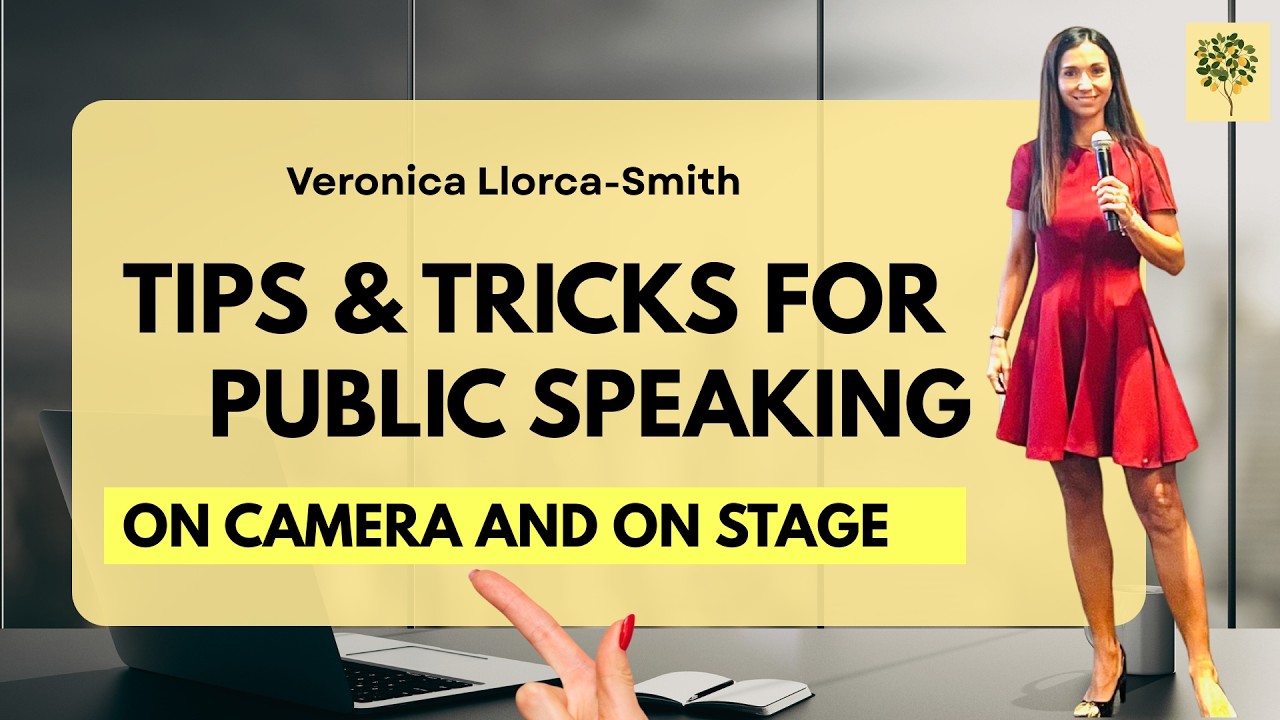
Veronica, a former introvert, breaks down public speaking into three phases: prep work like testing tech, in-session moves like strategic silence and varied tone, and strong closes with a clear call-to-action. She emphasizes authenticity over perfection and shows how to replace filler words with purposeful pauses.
Chapters
Hi, this is Veronica, and today we're going to talk about public speaking. My goal is to give you some actionable tips that can help you speak in public with confidence. Whether you want to speak on stage, host a webinar for your community, or perhaps do a live session, I hope that today's tips really help you in your journey. A little bit about my own journey: I only started speaking in public around 3 years ago. Up to that point, I'm an introvert, so I was always the person listening in the back of the room, and speaking in public sounded absolutely dreadful. Yet here I am today. I'm a public speaker. That's my main income stream as a solopreneur, and I speak for global organizations like UBS, AIA, Michael Page. Next week I'm speaking for the EU here in Hong Kong. Super exciting. I go to international conferences as well. And it all started with a change in mindset. So that's the first thing that we're going to talk about today. What is the mindset in order to speak in public? Very often we focus on the tips: speak slower, try to remove the ums and the ands. But really what's much more helpful is instead of focusing on the issue, try to find the root cause. Why are we so nervous? Why do we have all these filler words? And very often it comes back to the mindset, our limiting beliefs. We might think that we're not an expert, we might think that we're not eloquent enough, we might think that an accent is an issue. And so because of all these issues, we start then to get nervous and to add filler words and so on. So the first thing is to really focus on your mindset, and here are a few tips that can help you. Be authentic. In my case, this is my story. I started speaking 3 years ago. I'm not pretending to be anything that I'm not, really sharing my story and also some tips that have helped me personally, and therefore I think they will help you. So you don't have to be an expert, you just have to come from a place of experience, from a place of authenticity. And second, don't look for perfection. Just try to be helpful. Try to think Think, how can I make this session really valuable for the other person? What are some tips that I can share? How can I make my experience relatable to someone else? And that would really set you up for success. And last tip about that mindset is the positive self-talk. Before you go into a session, it doesn't matter what it is, it might be a mastermind, a mini-mind, a webinar, a live session, really tell yourself a positive story. I'm gonna do this great, it's gonna be a great session, I'm going to be my best, I want to have fun. So really try to encourage yourself because those words are really going to help you set you up for a great session. And then in terms of how you can look at public speaking, I wanted to frame this session with 3 different parts. The first one is what you can do before, how you can prepare ahead so that you really have a great session. Then we're going to talk about what you do during the session to make sure that it's engaging, that it's fun, that it's adding value to your audience. And last but not least, how do you actually end it on a high? Because it's really important to bring it home and make sure that it's actionable. So what can you do beforehand? And of course, it's going to change a lot depending on whether it's a session in person, perhaps it's a big stage, a big conference, it might be a Zoom session or a live session. But I'll give you some tips that you can apply depending on the context. If you're going to speak in person, the first thing is check the space. If you're going to be on a stage, check the microphone, check the height, make sure that you have a good vision of what the room looks like so that you can really feel what it is like and you can really put yourself in that space. It also helps you to do a tech check, and this applies to everything. Make sure that your technology works. If you are on a live session, you can clean the lenses. If you're gonna use a presentation, make sure that it's connecting properly, that you can share the slides. If you have a video, make sure that the sound plays well. Another thing that helps a lot, and this is for virtual meetings, is to be centered in the screen. If you are on a Zoom session, make sure that you are in the middle of the screen. Same if you're going to go on a live session. Or you're going to be recording from the phone. What happens very often is that we end up either too low, and so we kind of have a floating head, or we might be not really centered. And so just logging in a few minutes before the session is really going to help you to make sure that everything is set up in the most professional and engaging way. Now we are in our session. We're going to start, and one of the things that's very important is start on a high. Very often what we do is we go straight into the conversation, we go straight into the topic. However, it's really important to set the tone, so start in a positive way. And here are some tips that can help you. You can use an icebreaker, you can use humor, perhaps you want to share a joke, maybe you can do a connection exercise. If I'm doing a live session, I very often ask the audience, where do you come from? Where are you dialing from? What are you having for breakfast? If it's a more formal session and it's more one-way, you can ask a question: Did you know that over 40% of people suffer from glossophobia, the fear of speaking in public? You can share some stats. You can make them think. You can ask them a question, for example: What does success look like to you when you think about speaking in public? So there are many different ways that you can think on how to start your session and make sure that it's intentional. Make sure that you've thought about it. What is the first thing that you're going to say? Because that is going to set the scene and the tone for the entire session. So this is when we are starting and now the conversation begins and what's very important is to find ways to engage the audience. So one tip that I've used and I recommend to everyone who wants to improve their public speaking skills is to record yourself speaking. You can be alone at home and record a video, and you're going to replay it and you're going to watch it 3 times. The first time, you're only going to focus on the verbal language, so you're going to remove the sound and just see what you look like when you're speaking. Pay attention to your body language, your hands. Are you straight in the camera? Are you looking into the audience and things like this? The second time you're going to focus only on the audio, so you remove or don't look at the screen and you focus on what you sound. Is there intonation? Are you sounding very flat? Are you speaking fast? Are you adding a lot of filler words, a lot of hmm? And is there silence? Are you trying to fill every single word in the presentation. And the last one is, how do you come when everything is together? So now you're looking at yourself holistically as a speaker— how you sound, what you look like, are you moving, and so on. That is honestly the best self-awareness exercise you can do to improve your public speaking. It's mortifying, it's awkward, it feels a bit cringy, but it's definitely very effective. So let me know how you go with this exercise. And so the tips that I'm sharing today, they're actually based on all the things that I saw that I was not doing right and what I'm doing to fix it. So let's get started. First, very often we are very flat. When I was looking at myself speaking— and first, let's talk about the body language— I was feeling very flat. My body language was very flat. I was not really using my hands. And when you're speaking, you want to create engagement with your body language as well. If you're in a room, you might want to move around the room and make sure that you're engaging everyone. If you're in a live session, you can smile, you can make sure that you're using your hands, that you're engaging with your entire body to transmit the message. So, are you flat when you're speaking? The same applies to actual verbal language. Do you sound very flat? Flat when you're speaking? Is it all like very monotonous, or are you actually adding emphasis? Are you stressing certain words? Are you perhaps asking a question? That helps you bring a little bit of energy, a little bit of power into your presentation. I talked a little bit about the hands, and I wanted to go deeper into this topic because our hands help us share a story. If you're presenting, especially if it's in person, make sure that you always have your hands visible. By default, because we don't know what to do with our hands, we very often hide them behind our back or we cross them. Try to avoid that position. Why? Because our hands build trust. When we see them, we're connecting with people. We are really able to have like deeper connection. However, when we put them behind, we're not really building trust or connection. We're building a barrier. Same when we cross So hands are very important. Another tip, try to smile. Not all the time, but as you see in this video, I'm trying to smile because when we smile, we create this connection with the other person. And it doesn't feel very natural at first, but it definitely helps, and it will make people feel warm and feel much more connected to you. So smiling is another great tip. Now let's go into a typical issue that most people have when they speak in public, and I have that myself as well, is the um and the ah, all these filler words that we put when we don't know what to say. A good practice to get rid of them is simply to have a bit of silence instead of trying to make the words really long. Just have a pause. Think about what's next, move on, it doesn't matter. And that takes me to one of my favorite topics, which is silence. I encourage you to look at your favorite public speakers, big celebrities, Obama, Oprah, and so on. They master silence. They are not afraid of having a quiet room. They might ask a question and then there's silence. They might make a point And then there's silence. In fact, Steve Jobs once took 18 seconds before replying to a question from a journalist. So silence is actually your ally. Don't be afraid to use it. It can be extremely powerful. And so with this, I've given you quite a few tips that can help you with the voice, that can help you with the body language, I have one more little tip that I wanted to share with you as well, and this is before you start the session, make sure that you hydrate. And not only with water, but actually warm water is better than cold water because it helps you moisten the throat and the vocal cords. So it's really going to help you have a smoother, clearer voice. And this takes me to the end of the session, which is How do we close on a high? We talked about starting on a high, icebreakers, and so on, and now we want to close the session. So one thing that works extremely well is to summarize. Today we've talked about public speaking. I shared my journey, I gave you some tips for the mindset, how to set you up for success. I talked about body language, I talked about verbal language, and how to bring everything together. Now is the moment to wrap. So I want to wrap with a challenge for you. What is one new challenge that you're gonna take when it comes to public speaking? Is it a webinar? Is it a session for your community? Is it a mastermind, a mini-mind? I would love to hear in the comments. But that's not it. It's always important to think about the call to action. What do you want the audience to do next? Do you want them to get in touch with you? Do you want them to subscribe to your newsletter? Are you perhaps selling a product? That's the perfect opportunity to share the final message. Many speakers, they end the presentation and they forget about the call to action. So my call to action today: if you like this video, you can subscribe to get many other tips to help you grow your writing speaking business. If you would like to go deeper into public speaking, you can check my course Speak to Scale. And of course, if you want a one-to-one session with me, Get in touch with me at Veronica at the Lemon Tree Mindset on Substack. Thank you. Gracias.
More from Veronica



How Much Speakers Charge And Where To Find Paid Gigs [Public Speaking Bootcamp]







