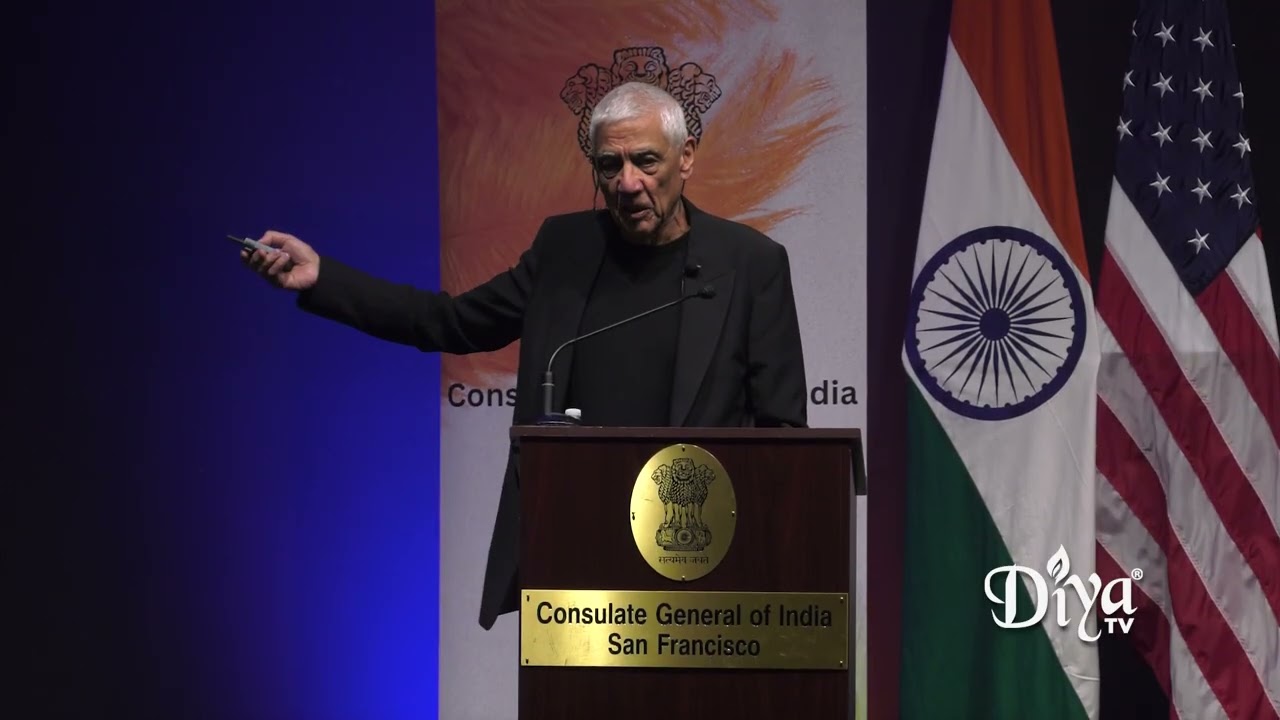
In this keynote, Vinod Khosla outlines a bold, time‑phased vision for how artificial intelligence will transform India and the world. He argues that within the next decade AI will make virtually all expertise—education, healthcare, legal, financial advice, and scientific research—effectively free and accessible via voice in any language, dramatically raising equity for the un‑educated and low‑income populations. Leveraging India’s existing digital public infrastructure (Aadhaar, UPI, India Stack), Khosla sees a rapid rollout of near‑free AI tutors, doctors, and legal assistants by 2030, followed by a deflationary economy where $10,000 will buy the purchasing power of $30‑50k today, leading to abundant prosperity by 2050. He stresses that policy, not technology, will determine whether these benefits materialize, calling for smart regulation of security, deepfakes, and labor transition. Khosla highlights AI‑driven public transit as a high‑impact infrastructure, predicts fusion and geothermal energy will dominate by 2040, and warns of massive workforce disruption, especially in BPO and entry‑level jobs, requiring proactive policy. He frames the geopolitical stakes: India can export free AI services, gaining global influence, but must keep pace with China’s aggressive AI research. The talk balances optimism about near‑term welfare gains with caution about disruption, positioning AI as a great equalizer if guided by effective policy.
Chapters
It's nice to see so many people interested in AI's impact in India. It is in fact the largest opportunity I could have ever imagined even 10 or 15 years ago, the rate at which AI is progressing. I'll walk you through a whirlwind tour of my opinion on this. Before I was asked, I'd written this summer a piece on what impact AI can have in India and why it may be the great equalizer. AI has both benefits and dangers. I'll mostly touch on the benefits today, briefly refer to the dangers. But I want to walk you through the vision which I think is highly probable. This is not speculative at all. So within the next 15 years, almost all expertise on the planet will be free. All expertise, which includes all of you. The expertise you have. There is very little— and this is something people have a hard time accepting— there is very little AI won't be able to do that humans can do. Labor will also be almost free. And it raises lots of questions I won't go into today. For those of you interested, I'd written a 25-page document on all the implications Last September, I normally write in August. The thing that's most exciting for India and from my point of view is people always talk of the people who have no access to digital services. But because in the AI world you won't have to learn computers, computers will learn humans, all you need is voice in your language. You don't need any other skills to access AI. And that bodes really well for the people who don't have an education. And that's where it can have the most impact. First, I'm gonna warn you, I don't think GDP will be a good measure because so many services we think of as part of GDP will be free. I won't spend much time on the economics of AI. Likely by before— by 2035 or 2040, we will have a hugely deflationary economy. $10,000, even in the West, will buy more than $30,000, $40,000, $50,000 buys today. So we will have a deflationary economy. That's not for— today. The— we don't precisely know what's possible, but what's possible by 2030 is very, very clear. What happens in the 2030s, the decade from 2030 to 2040, is very hazy and very hard to predict because it's hard to predict what AI how AI will manifest itself. So we have to understand that it will be true. But by 2050, a really abundant economy globally, not just in India or in the US, is possible. This is what's really, really exciting to me, the level of welfare we can have, the level of equity we can have, and frankly, for India, an opportunity to have real global influence is there using AI with the right policy. What it mostly needs is good policy. The technology development will happen. The application will depend on policy. And the rest of it, the welfare, will depend on policy. So let me talk really short term. What's possible in the next 5 years? The next 5-year plan, almost certainly every kid in India before 2030 can have very affordably free personal tutors. Much better than if they could afford a personal tutor for their kids that the rich people do, do have in India today. That's available for every child. Near-free doctors 24/7 in your home, in your village, at 10 PM at night when your child is sick, at 3 AM in the morning when you need mental health. All of it will be near-free. You know, people don't worry about the law, but most people in a country like India don't have access to legal services. They can't assert the rights they have. That will be near-free. Of course, scientists will be near-free. Imagine a million extra scientists in India doing research and globally, millions more engineers. I won't keep going, I could go on and on, but people need entertainment that will be near-free. So let's start with personalized education. An AI today— today, not in 2030— can do much better than if you had a full-time human tutor teaching your children. And it doesn't matter whether you're in the US or in India. Why? Because an AI can understand your child with infinite patience, understand what they know, understand the gaps in their knowledge and actually tutor to the gaps in your knowledge so no child is left behind, irrespective of their language, their economic strata. This is really exciting and it's happening today. And it's cheap enough, by the way. My, my wife's nonprofit costs about $0.20 per month per student for about 2 million students a month. That's today. It'll be much cheaper than that. The healthcare solution, that's entirely possible to offer almost everything that human doctors can if you had an infinite number of them. And at much better level than human doctors can. In fact, almost certainly today, the right systems can provide much better care than human doctors, doctors can in the US. In fact, almost for everything I need a doctor, I only use AI. I use the human doctor to write the prescription, but I check their work with an AI today. Even if I have access to the best doctors, it's still— AI is the best doctor. I've talked about this. Legal access is important for people to assert rights and for equity and for not having long delays in the court system so you effectively have justice denied because it's delayed. And in many of these systems, whether it's doctors or humans, if you don't have trust in the system, you will have an appeal to human individuals as a backup. But they will never be as good as the AI systems. And this can be done. For a fraction of what is spent today in India on education, in education, on healthcare, in India, in healthcare, between central and state spending, whether it's $20 or $30 billion, it'll be a fraction of that to provide these services at a much higher quality level and accessibility By the way, the same is true of financial advice. Almost certainly Goldman Sachs cannot provide the level of advice personalized to an individual anywhere in the world, let alone to a poor person in India who needs financial help the most and advice the most. And India has already done the hard work. The hardest part of instituting these systems is an identity system that is well tested in India. It should be the portal for essential— for all essential services. It is already an infrastructure provider for payment services like the UPI system in India, which has eliminated the tax of MasterCard and Visa. Which is a couple of percent tax on the whole economy, all the whole consumer economy in the US. It's for free in India. And it serves as the infrastructure on which new services like healthcare provision tied to your health records, like education provision can all be done on the India stack. ChatGPT-like access to knowledge can be provided to anybody who can speak. And for the hearing impaired, there's going to be other solutions. So real services and knowledge services without needing to say we need to educate them first. These services can come first before we come to education. There's also lots of issues around security and other things that can be done. And those are policy questions. They're not technology questions. There will be other implications. I've seen some ideas that might— will no longer be how the national defense works. AI intelligence. There's no question with the right AI, Ukraine could easily beat Russia in the current war. I won't get into the politics of that, but both national defense and cybersecurity and internal security will benefit dramatically from these services. So I'm pretty excited about how equalizing AI can be in areas where there's a lot of uncertainty among countries today. It's nice when everybody can— when security is driven by AI competence, not by might. I do believe Taiwan will be able to defend itself against China if it has access to the best AI. Entertainment will be near-free. Everybody needs entertainment too. One of the other things I'm interested in is transformation of services. I do believe the best system for public transportation is an AI-driven, self-driving, public transit system, not self-driving cars. So self-driving cars will almost certainly, like Uber and Lyft did, increase congestion. What matters is how you get 10 times the throughput because we are not changing our streets. Street widths in most cities are fixed. AI transit can dramatically increase capacity of streets 10 times. As if you had 10 times the street width. So I'm very excited by both the cost of public transit based on AI and increased passenger throughput. And public transit is measured by number of people transported, passengers per hour per meter of lane width that you have. It should have the ability to eliminate most cars in most cities by 2050. It's an unusual infrastructure opportunity. When you get transit, you also solve housing costs because you can go further out from the city for the same commute time. So this is really what— AI enables for us. So there will be role for industry. Almost certainly entertainment will be industrial roles. But it will be so plentiful, so easy to produce, and so personalizable, it will be very inexpensive. But essential services like healthcare, like national security, like education, should be free at every level, part of an Aadhaar-like portal for every Indian, and frankly, in other parts of the world, for every citizen in other parts of the world. I'm a big supporter of— there's an effort in India for digital public infrastructure outside of India. India has done a fabulous job of DPI. But that service as a nonprofit is going to be available to other countries to adapt. And I'm involved with an effort to do that also out of India. But AI won't solve everything. So there's still a lot of role. The hardest thing that today is housing. If you look at essential services that won't be affected by AI as much, housing is the biggest one. So it depends on some of you entrepreneurs to solve the housing problem. I'm very optimistic about energy. By 2040, almost certainly fusion will be global. And the principal source of new energy. It will not be oil, almost certainly, in 15 years. All new energy sources will be built with fusion, possibly super hot geothermal and other technologies. I suspect it won't be solar and wind, though both of those have large roles to play. I think people focus too much on the short term. You want power when the sun isn't shining and the wind isn't blowing. And Fusion is that solution. So there's a unique opportunity, especially as short-term as 2030, to deliver a substantial upleveling, especially for the people in the bottom half of the economic strata. That's where these free services matter the most. And where we can have the largest impact. And they're the people who are least able to help themselves. There is a danger if you don't adapt AI. I do think in the global competition, countries that don't adapt AI will lose to countries that do adapt AI. And so this is not only nice to have, it is essential to have. There will be large workforce disruption. There's no two ways about it. Countries that adapt AI— my funniest example is today in 2025, robots in retail in Germany are not allowed to work on Sundays. It's actually true. That's what you call stupid policy. Because the labor unions have such a large role in Germany. So this will differ dramatically country by country. I think China is being very aggressive, which creates a problem. Entry-level workers, which means the younger workers, are most affected by this. And so it becomes very important to have the right AI policies. But the big opportunity for India, in my view, with something like, I don't know the exact numbers, 20 million new job seekers coming on the market every year in India, is to provide these services for the rest of the world too. So during this chaotic time, that is the business opportunity. And the politics, the geopolitics of exporting free doctors, free tutors to the rest of the world, I think India is very well equipped to do not only for its own population, but export it, help other countries, and have geopolitical advantage. There's also both dangers and export opportunity. This is the service opportunity that I think will make a large, large difference on what India can do short term. Almost certainly the entire BPO business and the IT services business in India will go away. That is a massive problem for the economy unless it's turned into an export of transformation services. So doing what we are doing today will not work. It'll be very, very disruptive. One of the things I notice here in the US, the fastest adoption of AI services is where the service is outsourced. If you tell them we'll replace your accounting department to a major corporation in the US, there's lots of fears about laying off people. You tell them we will replace customer support or BPO or IT services that are already outsourced and cut the cost by 70%, that's very easy. That will happen first. So it's both a danger and an opportunity. So let me look a little bit beyond the 2030 timeframe, which is very, very exciting. Education will be very, very different. Education won't be the way to get better employment because most productivity in services are going to be provided by AI or AI robotics. Even food production costs will decline. That's a huge disruption. By the way, something to keep in mind. In the US, in 1900, it was the majority of US employment, more than 50%. By 1970, It was down to 4%. So a very large percentage of the jobs in the US were displaced in agriculture. It will happen in India too. It has already happened here. Now we found ways to take care of people, and we will have the opportunity to take care of people and take advantage of all the expertise that is free now. The other large question I worry about is, do we have any— enough steel, enough iron, enough copper, enough lithium? The fact is we are, I believe, in a place in time where we haven't started to look for these resources. We mine them and look for them in a very silly way, very naive way. In 1960, the world declared peak oil. We would run out of oil. And the reason was we didn't know how to look for oil. I would suggest we are just beginning to develop the technologies that look for these resources. And I think by 2040, we will have much more resources on the planet than we will consume between now and 2040 if we develop the technologies for— to look for new sources of copper, iron, all the essential things we need that are hard physical goods and services. So this is both an opportunity and a danger if we don't set up our economy for this. I've talked about energy and housing a little bit. I do think electricity will be— fusion and wind and solar will continue to play a role. They won't be obsolete. But fusion and geothermal will be the stable dispatchable sources of energy. There is some things to be done in housing, but it's probably the largest unsolved problem to really create a deflationary economy. I view a deflationary economy as good, not bad. In the past, deflationary economies have been bad. But because the assumptions were wrong or the environment was wrong. When everything's near free, that's a good thing, especially for equality and equity in the population. And it will result in that. So just a few more comments. The workforce transition is going to be very, very disruptive. I already gave you the example of Germany. I think it's the biggest problem Europe will face is the transitions. There's security challenges, deepfake challenges. I won't go into all of them. I do believe China is being very, very aggressive. In fact, there's more research papers in AI published today in China or with Chinese authors than with Western authors or American authors. That's not a bad thing, but it is a call that India needs to also catch up. So summarizing, Near-term, free essential services. Mid-term, lots of disruption in the 2030s. And adjusting policy in the face especially of democratic policies. And this is where China, I believe, has a large advantage. The Western world less so. Handling those will be hard. And then long-term abundances. Very, very clear. And by 2050, we could have a very different planet. I hope I'm still working by then. I'll be 95. But this is the opportunity and the vision I'm excited about and I think can happen. So this won't happen. It will be made to happen, especially in a country like India. So these are essential components. So let me stop there. Thank you all very much.