How to Give a Presentation | Vinod Khosla
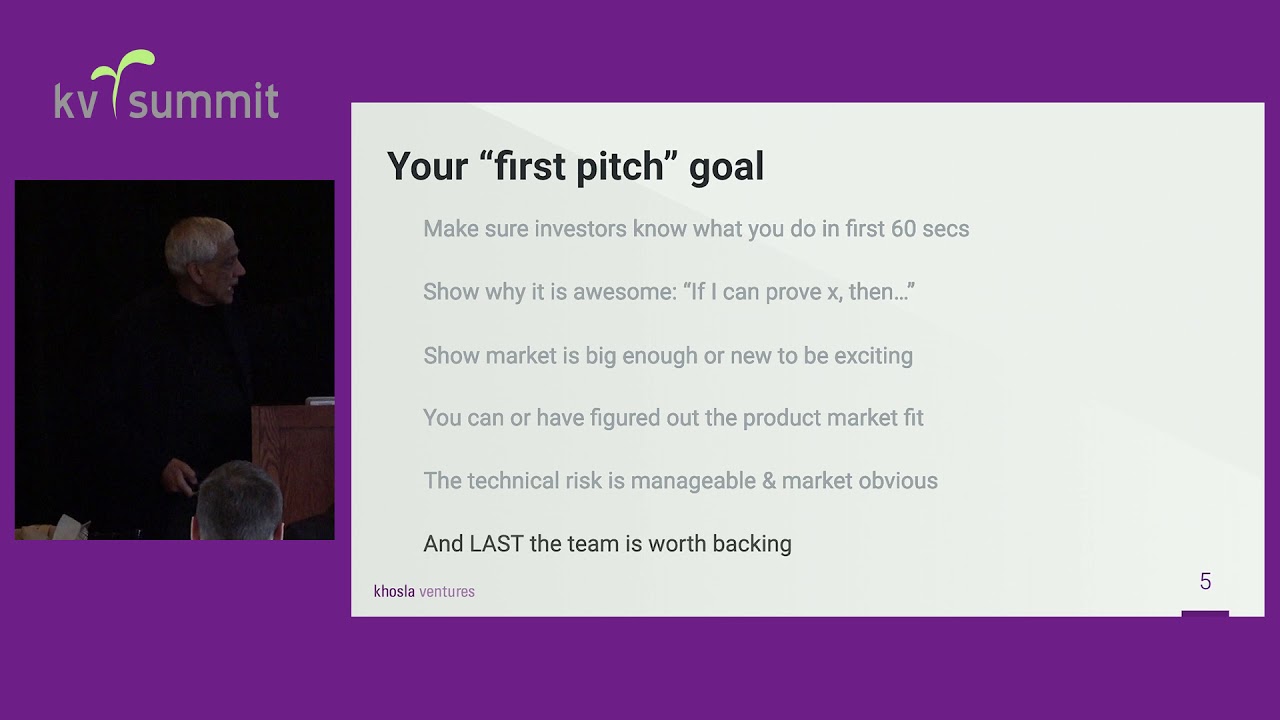
Vinod Khosla breaks down how to pitch investors by addressing their core emotions: fear and greed. He argues investors judge the founder more than the deck, so authenticity matters most. Practical tactics include simplifying slides to one message each, brainstorming objections before the pitch, and testing with low-priority investors first.
Chapters
I'm gonna quickly go through a lot of slides as I usually do, but there's one objective, uh, it's to give you the perspective of an investor like us. And I've tried to at the end collect 3 or 4 different investors who I think do a very good job of the presentation they want to see. And there's some blogs that— there's some referrals there. The most important thing to remember is there's only two emotions with the general investor. Fear for the reasons that things could go wrong. And then what could go right. And I call it fear and greed. And think of investors as bouncing between these two walls. Most of the reasons to invest— and you see this when you say, oh, that company, they got that valuation, that much money, why? It's because of emotion, not facts. So rationale is the reason to either not invest, uh, and I'll come back to this, or to explain the investment. Most people make emotional decisions before they go explain that decision rationally, uh, and come up with a story. Complexity scares investors. I'll come back to more of that because even visual complexity scares investors because they cannot— the human brain cannot separate usual complexity, visual complexity, from complexity of a business. Also, jargon does not work because we hear 100 pitches, and every time somebody puts world-class team on their deck, I say, so I've never gotten a deck that doesn't have a world-class team. Nobody's ever said we don't have a world-class team. I pay much more respect to an entrepreneur who says, this is what's missing. Here's the team members we are missing because they're being much more authentic and honest. If you play games and hide things, it's so easy to tell. It's the common message I get back. I didn't trust them to really know what they're doing or to disclose what they're doing. It's a very easy— human beings are particularly good at this. And investors get used to BS. The other thing that investors do that you may not realize is more than anything, they're judging you, not your deck. So you have to be confident. But if you're not transparent, the previous bullet comes in play. Like, they don't trust you. People who have too much hubris or too much BS, uh, or are not being transparent, those are signals to avoid the team. So, um, obviously this deck will be available. Um, I presume we are recording this. So some surprising truths. Often what you're saying is not what the investor receives. So just keep in mind, just because you're saying something, message sent, more often than not is not the message received. There's an interpretation filter every investor has, and frankly, it's different for each investor depending upon the type of investor. You will perceive differently. In fact, there's a guy, Jerry Weissman, who's a very good presentation coach. If any of you need one, he actually took this particular thing from me and wrote a blog about how important this is, that the message you send is not necessarily the message received. So you have to be extra careful to craft the message. The other thing I noticed, people get to complexity too quickly. Unless I fundamentally believe I'm interested, it's too much mental work for me as an investor to start looking at the details. The job of your first pitch, especially, is to get people interested enough to do work. It's not to sell them on the investment. If they have objections, Your job, in this quote from Reid Hoffman, is to steer into those objections. If I have 10 things I heard this week, and there's more than 10 pitches I'll hear in a typical week, I'm trying to say, which one shouldn't I pay attention to? And if I'm suspicious that you didn't actually deal with real problems, or didn't recognize them, or aren't transparent about them, I'm going to put you at the bottom of the stack. So steer into people's objections, don't avoid them. And too often I see people trying to avoid them or hide them or skip them. And this is again a Reid Hoffman quote: if there's thousands of startups this year, there's a few which will make it worth talking about in 7 years. The thing you have to convince investors upon is you have a reasonable probability. If you say certainty, you lose credibility, but a reasonable probability at being one of those shots. So your goal, as I already said, is get to the next stage. And that's what you should be shooting for in each meeting. What's the goal? And there will come a time when your goal is to close. So, um, the other question that gets asked is, in many ways I can monetize many different business models. Um, be clear, it's okay to be a startup that knows what your business model is, but it's also okay to not know yet. But if you don't know, you have to be intelligent about why or how you might discover that business model. And depends, uh, if you're very early stages, the second is perfectly okay. Uh, if you're a technical startup, people focus more on the technical risk, uh, and you want to present it as lower market risk. If you cascade 3 or 4 risks, you're going to create more nervousness in the investor. So investors look at risk and cascaded risk. Very often people say, oh, this other startup's doing this other thing, and so we'll rely on that and build our company on that. Well, that's another risk you've cascaded. So every risk cascade matters. And as you go from seed to A to B to C, you have to get to increasing specificity and more risks eliminated. I'll come back to this issue of whenever you ask for money, what are you doing for the investor? And it's almost always which risk are you eliminating for the investor in the next round. By the way, one of the principal jobs of a founder CEO is to balance risks. Uh, you can raise a lot of money and spend a lot more in engineering. Then you reduce the feature risk— what do you need? But you've taken on financial risk and probably a higher burn rate. You could spend more on marketing and you could spend less on engineering. You're changing the risk structure. More product risk, less marketing risk. So risk balancing is one of the fundamental things you think about. And in the course of eliminating risks, you build a successful company. So what's the pair goal of your first pitch? The first 60 seconds is what's really, really important. In fact, most of the time, people have already decided And if you see people pull out their phone and start looking at their email in the first 60 seconds, you know you've lost them. The way to engage is say, if I— if this were true, if X were true, would it be interesting to you? Like, that's one approach. That engages investors because now they have something specific to look forward to. You've defined this great thing. Yeah, I can do that. I'm going to try and prove I can do this. Let me prove to you it's possible. That's a really good story compared to— you have to show that this is interesting enough. And I'll come back to this market issue because sometimes it gets so boring. And new markets are okay. Twitter didn't have a market. There was no such thing as a market for Twitter. In other places, there are existing markets. You prove it's big enough. You— if you figured out product-market fit, that's awesome. Funding becomes much easier once you know you can deliver traction. You just need money to acquire customers. But if you can't, and very early on it's impossible to prove, then your goal is to prove to people that you can figure it out, that you have the capability and the team to figure it out. Or in the case of technical startups, technical risk is manageable. You address these issues, uh, you will convince an investor to take the next meeting. Teams, uh, I generally prefer talking about it last, not first. Why? Because unless there's something special about a team, it's not part of the engaging first 60 seconds. So be clear what your goals are for a pitch. The other thing to keep in mind when you're working with an investor, they really are your agent to the rest of the partnership. You've got to give them all the ammunition when you're not there and they're discussing it with their partners. Keep in mind other partners have lots going on, and everybody is trying to find reasons not to invest. And so they'll be raising objections when you're not there, and your job is to empower the person who's your sponsor. And that view is seldom adopted by people, like arming them with all the objections that they will have to face. Part of that, by the way, is picking the right investor. Somebody who will support you in fighting for you in the partnership when you're not there. What is the goal? Almost always when one of you gives a pitch, some email goes out from the sponsoring partner to the others. Here's what I like. Here's the risk. Here's the reasons to invest. Your job is to engineer this email. It's not to give your pitch. It's to engineer this email. Right? When I was talking about this conference, after— in deciding every speaker, I had in my head not what the speaker would say. Yeah, that was important, but I was trying to engineer what the notes you would take after the speaker finished or when he was talking, because that's your takeaway. And I was trying in every speaker to engineer the takeaway. And very often, like for example, there's plenty of big names we could have gotten who wouldn't have said something relevant to entrepreneurs. And so very, very important to engineer this email. How are we doing for time? So preparing to design a deck, and I'm going to get very tactical. So this is just set up the mindset psychology you should have. I always say put all— everything you want to say. Very, very important to find every possible reason somebody might come up do not want to invest. And this is a long list. But on the left— and I'll come back to the right in a minute— you can't say everything you want to say, because when you're engineering that email, there'll be 3 things on it. So This is a good piece of advice in coming up with that list. Brainstorm with people on what should be on their list, all the reasons to invest, but also all the objections. There's real value in being prepared for a presentation, but there's something even more important. Before I go there, Use people who are not familiar with your company to brainstorm that list with. Why? Because you know your business so well, you will overlook things, details. Somebody looking at it with a fresh pair of eyes will say, "Oh, this is confusing. I didn't get it." Everybody on your team already knows this stuff. So easy to be confusing. And not clear. So this is important as part of the brainstorm because somebody smart is taking a fresh look without knowing a lot about your business in coming up with that list. And this is the piece that I find unusually valuable. The number of times going through a session like this, a team gets on the same page and they didn't know what the other one was really thinking. Till you got down to writing each reason to invest or not invest. Oh, I thought we were doing that. It really makes a team cohesive. Now, when a team is presenting and different people are on different pages, it becomes very, very clear. But this is valuable to do even if you're not fundraising to get the team on the same place. It's— is Alex here? Alex is in the back. We went through this branding exercise, and Alex had hired an agency to do the branding. And I said, you lose a lot if you use an agency, not only the $300,000 you were going to pay. And I think after 3 months of trying to do it inside, Alex came back and said, I think our team better understands what we are doing. And that happens in most startups, not just Alex's. You get on the same page, you actually explore the details, and you do it in a safe place. By the way, First Round has a really good deck on presenting that I refer to later. Now comes the hard part. Since 16 messages, will be confusing. You want to get the team on the same page. Every time we'll pitch these 3 things. This is KISS, keep it simple. Don't try and we are also that and we are also that. Very, very tempting, especially for technical founders. Really important to simplify. Whatever those are, and in parentheses, When you come up with these, I have sort of like, what's your objective? You want to appeal to greed or a wow factor, or you want to talk about some technical advantage you have or something. Come up with the 3 to 5 that actually will entice. Your goal is enticing an investor to go to the next step with you. It's not to elicit every reason. So your goal is to fascinate, and you can only fascinate by doing it specifically, not generically. But doing it specifically with a lot of detail is a really bad idea because it's mostly confusing. You have to buy into the concepts before you start going into detail. This is, uh, Reed's advice to steer into investors' fears directly. So you have to do the same process, and this list can be much longer because this comes from the investor side. What you— reasons to invest is what you're trying to sell an investor on, and you can tweak it a little based on the personality of the investor you're approaching. This side could come from any investor or any of their partners. So you have to be prepared for every eventuality. The other thing that's important, it says to an investor group that you've thought about all the problems. This is where transparency really helps. It says you've contingency planned for every bad outcome that's possible. And most investors know Murphy's Law applies. It shows the level of preparedness. Whenever I ask a question and somebody already has a slide in the appendix that answers that question, it's incredibly— it's way more impressive than just answering that same question. It shows that they've actually gone, done the work to be prepared to answer every objection that might come up. And sometimes I raise objections I actually don't believe in, just to see how they would, uh, how an entrepreneur would respond. So I fake this often just to test the personality of an investor. Roughly budget your presentation. There's many ways to budget it, and there isn't a cardinal rule of only have 20 slides or 25 slides, but by and large, if much more than that, you're going to lose the investor's interest. Now, there are exceptions. Scott's sitting here, Vicarious, is a very good way to go through many more slides. But as I did in my presentation yesterday morning, every slide was 15 seconds. It wasn't meant to be any detail, just a concept in your head. And I wasn't trying to convince you of any one startup, just the idea that there's diversity of technologies and scope and Wow, this is exciting. There's an exciting group here was what my objective was. And so I wanted to eliminate all the detail and fuzz it up. And I'll come back to fuzzing up details in just a minute. This is really, really good advice by a guy called Eric Paley at Founders Collective. Write— if you budgeted 20 slides, Write all the headlines before you fill in anything on the slide. As he says, and this is my beef, you never want a title for a slide like market. It is factual, it's topical, it's like a table of contents. You want something emotional. So you don't say team, that's a title. Team prepared for this opportunity is an absolute message. And somebody might ask you why you prepared, and then the slide detail can answer that. The 20 slide headlines without any content— and try it on people— should tell a story. It should be a narrative. It should appeal to emotion. And if it by itself isn't sufficient to sell an investor, the details won't. So it becomes really, really important to be emotional, to have an emotional story that just the headlines tell. And where each headline is not a title, it's a message. It's not dry, it's emotional, it's visceral. And I'll have some examples. So pitch by analogy. Because associating with very large markets, like, that happened in that market, we are like that, is really good association. And human beings are very bad at separating associations in their brain. But the flip part of that is don't reason by analogy, because when people start to carry an analogy further and get into an argument with an investor, it's a losing battle. Because analogies aren't precise. You're better off saying, hey, the analogy is not meant to be precise. The market's— the characteristics are the same, but here's the reasoning in our market which is rational. Because now you're overcoming an objection, not luring people. And then facts help in overcoming objections. There's more than one way to pitch a deck. You can start with an investment thesis. Reid Hoffman has a great example of what the investment thesis at LinkedIn was and what he thought he did wrong when he pitched it, and what in retrospect he feels he should have done as his investment thesis. So that's why that particular blog is very interesting. Or the problem you're solving. Top-down bullshit, when the first 5 slides are about Dataquest projections, or this sort of like $20 billion market, nobody cares. They care you can get to the first $10 million in revenue, and then the next $100 million. And beyond that, it's all— you want to prove option value, not specifics. So top-down, people generally hate projections. And most entrepreneurs use these. So presenting with confident— confidence. Is something that comes from practice. One simple thing, if I'm saying something to you, I can look you in the eye. That changes your level of confidence in me. And it engages you. The number of times people are looking somewhere else or down, it just exudes, I'm not confident of what I'm saying. And confidence doesn't mean hubris. And there is room for hubris if you separate the long-term from the short-term. The short-term always has to be tactical and real. And you can't have so much hubris that people lose confidence in you. So don't ever trigger the BS meter, the bullshit meter. Once it triggers, it's very, very hard to recover because people stop paying attention, stop believing what you have to say next. I really like this advice from Eric Paley: write a 30-second commercial. He says in his blog, movies can reduce a 2-hour movie to a 30-second Teaser, do that. Make it substantial enough where I as an investor want to know more. Not just BS statements. Making a statement doesn't make it true. Keep that in mind. And most investors know that. But still enticing enough, and this is why I'm sort of keep using these emotional words, narrative, stories, visceral. Write this commercial. And if you're going to take back the— take the first 60 seconds and engage a whole audience to— and put them in the mindset of, oh, I should put my phone down, not look at my email. I should be engaging, finding out why this story is true, interesting enough. And this gets— should be practiced over and again. Start with a splash, something engaging. I almost would suggest that first 30 seconds of what you're going to do, uh, is really important. Uh, this is that same idea as the headline story. Write the headlines, add images last. 'Cause then you know you have a narrative. I normally don't recommend it, but if you look at any tutorial on writing narrative fiction, it's a good tutorial. Your backup. You can have all the details, all the complexity in your backup. Convey preparedness. Any question, any metric, always have a slide available. If you have 25 slides, it's okay to have 50 in the appendix, because you know— don't know which 5 any one investor will ask. Here's the other thing, and I think Sam Altman was saying, try your worst VCs first. Vinod Khosla. Oh no, Jack Dorsey said that. I always say test the idea, your pitch, with a couple of VCs that are not that important to you, that are lower on your priority list. And see the kinds of objections they raise. And after every pitch, revise your deck to answer those objections. See what went wrong and how you could engage them more, how you could overcome objections. Iterate the deck. So this is really important. The mindset in presenting. Watch the cadence in the engagement. Watch your audience. See what they're doing. Email. If they're doing email, you have a hard problem. If you take 5 slides to get into what, what you're doing. If you're not telling me what you're doing, I've lost interest. I'm checking email. And the number of times there's 5 slides that convey very little unique information. The one slide I hate, every healthcare company comes with, first slide, healthcare is broken. Okay, I've wasted now 2 minutes of my life listening to something I knew 10 years ago, right? The first 60 seconds— this is the Cadence argument— is far more important than any other time. The last 60 is also important. I'll come back to that. Substance over any generic— world-class team, just— we've seen it in every deck. It doesn't matter. Why is the team world-class is much more emotional, visceral answer that might engage me. Or you have this person who's done this unique thing and others won't be able to replicate it if they're competitors. And platitudes, like healthcare is broken, is just a real killer for interest. This is also good advice from Reid. Your last slide should be the key message you're conveying. And I'll come back to that on my last slide. What VCs value. VCs value geeks, especially in today's environment. Or people who are really a marketing force. Or people who are just entrepreneurial. It could be any of these. These are the things about your team. Real geeks, suitability for a purpose, marketing force, really entrepreneurial, just hackers as Jack Dorsey called them. Those are valuable. Competition. Transparency is really important. When you say nobody believes you, you have no competition, I don't believe you. On the flip side, if you show me a chart with 16 competitors and why you're better with that tick mark. If a deck has 16 competitors, I, I actually stop reading. Like, too much uncertainty for me to decode this matrix. Elevator pitches should have no jargon. They should be really punchy. And they should be really simple. But simple without being generic. So, Every word has to be picked carefully to meet these tests. So credibility means you're ambitious, you have big goals, but not too good to be true. Sort of almost a practical reach kind of target. This is just this, the same idea of the level at which a founder has to operate. I won't repeat it. Proving what your mission is, is a real pain for somebody, not a, uh, vitamin. People forget to emphasize this.. And one or two changes in wording can actually change this, or change the perception of what you're saying, change the message received independent of the message you sent. Again, emotional. So this is the VC's thought process. This is what you're responding to: an emotional reason to invest, a rational reason to mitigate their risk. Seems impressive only for a plan. And I always say engineer your gene pool. And I have a blog on that on my website. But it's— in an investment pitch, you're trying to explain what's special about your gene pool versus just names and titles. Financials with cash flow. If the basics are missing, and I'll come back to the level of detail, you, you, people say you're not thoughtful, you're not covering your bases, you're not thinking about the obvious things people will want to know. Um, so this was an exercise, a test. Uh, I won't go through it, but it says the following. You notice what I just did. There's a lot of detail there and complexity there. I skipped it. I didn't give you enough time to read it, because I don't want you to read it. I want you to read the implication. So I used a little trick, even though this slide is more complex than it should be. I used a little trick to focus on if your font's different, if you're visually complex, people will perceive the task as being much more difficult, not just the font. So what this study did is actually change the font on a description of a task, and people's estimate of how long it would take them to do this changed by more than a factor of 2. So the perceived complexity of the actual task went up based on the font it was written in. And this is just human beings, and you— Talking to human beings. So visual emotion, and some slide decks do it beautifully. I just went back and looked at the Square deck that Jack had sent me. And I actually had asked one of the associates in the firm to find the deck to me. Yeah, because I want to look at it. And they sent it to me and they added the words, Pure seduction. The deck was just seduction. And it had visual simplicity, not a visual mess. No details, no too many messages, font sizes, complex 6 pictures per slide. It had visual oomph through simplicity. This is another thing that just meat and potatoes. The number of times an entrepreneur will have different numbers in different parts of the deck— a CAC, a customer acquisition cost in the marketing slide, with the marketing spend in your financials. Like, if all the numbers aren't consistent, then you're going to run into a credibility problem. You don't care about details. You can't build a company without caring about the details. So command your numbers. It really adds to your credibility. Know your numbers and be clear about what you don't know. Don't try and make that up. Say, this is not what we know today, but here's how we're going to figure this out in the next year. There is also a difference in conceptual startups and data-driven startups. So, but if you only have concepts, then you want to talk about how you're going to test those concepts and the validity of those concepts. And be honest about what kind of startup you are. I apologize, first time I'm presenting this deck, I actually didn't go through it. So some of the builds aren't exactly right, but, uh, so the, the deck— I've talked about this. Be specific but not obtuse. Don't be generic. Focus on compelling pain. New market creation is okay.. But those are larger, riskier bets. This is obvious. Other details, no clutter. One of the simplest rules, and I'll talk about it, is I— is the 5-second rule. I'll talk about in a minute. But when you put up a deck, where does this viewer's eye go? You should have a goal of where the eye goes first. 'Cause that's— and by the way, if their eye hops around between 3 places in your slide, and you can test this with one practice user, it's very confusing. The perceived difficulty goes up. The visual messiness goes up. Don't go to all the edges. Leaving a little bit of white space on the side. The first version of this deck, I actually had to say, redo the white space. Even though I have a lot of text because I'm— my subject demands a lot of text, redo the complexity. I look at every word and say, can I delete it and not lose meaning? I don't even use bullets because it adds to visual complexity. Ask, is it necessary for every single thing on the slide? So de-wording, I think many of you who did preps for this summit got back a message from me, said, please de-word. It's the most common advice I give people is de-word. Reduce the number of— I'll bet you many of you got this— reduce the number of words by 80%. And then again, messages in titles. So if you do the following test after you've done your slides, put up a slide for 5 seconds and then take it down before people have a time to read. One, you know where the eyes went. Two, If the message that you intended in your headline isn't clear, they won't know what the slide's about. That means their eyes wandered. So I love putting slides up for 5 seconds, taking them down, saying, "What did you get out of it?" It's a really important test. Superlatives are not proof. Show, don't tell. Just because you say something doesn't make it true. You want to know always what your hook is and repeat it in— throughout the story. So, state the problem clearly. I'll give you a couple of quick examples. I know we are sort of running out of time. This is a deck I got, and I just deleted everything and made it this. Less information content, more impact, more visceral. If you're eliminating finger pricks for blood glucose testing, that should be your message. This is data, complex data. This is a message. State the reasons to invest. You might say to an investor, here's the reasons you should invest. And then walk them through one at a time. And remind them— and there's many ways to do this also, this is one format— remind them where they are. By the time you're on the fourth billet, they won't remember all six. So you have to remind them, "Now I'm going to..." so they don't feel lost. How is not a message. A validated low-cost satellite, that's massive. And the emotional word here is validated. The word validated makes this 10 times more impactful as a headline by adding one word. And what you're saying— and somebody says, how did you validate it? It says space-tested camera. And because there's not all the clutter of this, You— that shows up easily. More— less is more in many of these cases. You can have a subject like satellite comparison. I much prefer 96% lower data cost. Now I— you're luring me into investing. I don't even have to have the slide. And if you ask me to prove it, and I can, And I can have a very detailed slide in the appendix. Now I have you hooked. The diabetes problem. There's one way to explain it. It just— you don't know where I should go or what it says. A simpler way, it's a large enough market. Move on. If it's billions of dollars, I can get to $100 million pretty easily or the first 10 very easily. Don't worry about whether it's— 50 billion or 70 billion, who cares? Uh, this is another, uh, de-wording example. You could reduce that to— so it has a lot of detail, has the same things as this slide says, and I would even remove all the specifics of the oncology test. This does say there's oncology test, there's infectious disease, There's a bunch of these tests. And yeah, that's okay. If you just said, "Here's 3 important sample applications," and only had 3, that might be even more impactful. This another example, very confusing. If I took it down in 5 seconds, you wouldn't know what to tell me because it has extra colors, lines, boxes. This is a much better way to say the same thing. Now you can ask me to prove it later. You say, I can go through the detail with you, and you'll say, okay, let's do it later. But now at least you know I can answer your question. I'm confident I can answer your question. Top-down, really bad idea. Projections. Bottom-up, like, this makes sense, it's big enough, much more credibility. Sometimes you have to use top-down, But mostly, if you can do bottoms up, one, it informs your strategy of what you're going after specifically, not generically. Top down is almost always generic. Bottoms up tells you how you're defining your problem. These financials, simplify it into something like this. For the next 8 quarters, This is what our cash flow looks like. There's no more than 7 rows, hopefully only 5. But it still answers my COGS question, my OpEx question, and what my bottom line looks like and what my cash flow looks like. Uh, and then you do the same thing annually, and you've covered both these fairly well. This is a team description. What does it say to me that there's a guy called Dan? That's not information. If it was John instead, would it matter to me? If it says what's the special sauce for Dan, that's really impactful. Say you have a team designed for a problem. So titles and logos just confuse all these logos. Just confusing. The specifics, the one or two lines, and do it only for 3 or 4 people. Don't do it for 7 or 10. That gets confusing. Risk is one of the big things investors look at. How you managing your risk should be not only a question for investors, but you should be asking your whole team, getting on the same page. All the time. And always talk about, if you're raising money, what will you deliver for it? What you've completed, what the next series will do, and what you'll do afterwards. If you have unfair advantages, which almost always you should, restate them again and again. And finish with a flourish. This is somewhat generic, massive potential, but if you already prove it, then it'll be credible. In your appendix, answer all the questions, all the questions you might possibly get, all the metrics you might have questions on. One question for the slide is, okay, here complexity is a good thing, not a bad thing. Flip to appendix when answering questions. If you don't have an answer, offer to get back. Don't try and make it up. Bad answers are worse than no answers. So some questions entrepreneurs always ask me: How much do I fake focused on the big lofty vision versus the current offering. I always like this analogy. Yes, this is our vision, and vision, here's how we get to the top of Everest, but nobody got there without getting to base camp. Base vision says you're ambitious. Base camp says you have— you're pragmatic, you have tactical ways to get to the first place where you can rest, get to cash flow breakeven, or something else. Or get to revenue. And then there's all these camps along the way. And by the way, they're not in a straight line. You don't get to Everest if you start at the bottom and went straight towards it. So this idea of reducing risk at every step and being pragmatic about the risks and flexible about your tactics. I think Sam said this. I'm always recommending be obstinate about your vision, Be flexible about your tactics. As you learn, iterate, discover. And go one step at a time. Don't try and climb Everest in one stop. Other qu— How many business models? If I have three possible revenue streams, should I present them? One business model drives the business. If you list many, revenue streams, it generally is a flag for investors. This is Reid Hoffman. He says the charitable interpretation is the team doesn't know. The bad interpretation is the team lacks focus. But it's okay to also say you don't know because there's many paths to Everest. There are many paths, and part of your goal for a new round, next round, could be discovering which path works. And this is the experimentation phase. It only works when your burn rate is low. You can't have a very high burn rate and be experimenting with which path you're pursuing. At very low burn rate, it works. What are the metrics? What are the financials? Simplify visually. Answer the essence, the critical questions in what you present. Leave the details for the appendix and the questions. Show preparedness. Those are your goals in the metrics slide. Show that you're thoughtful, not that you have answers to everything. Kevin Systrom talked about how you want to really prove you build a company as problem-solving machine. Prove that to investors, you'll make a lot of progress. Because most investors know most of the problems you'll actually face cannot be predefined. There's unknown unknown. How much should I ask for? Talk about— think about what risk reduction you can deliver. Ask for just enough capital to get to this milestone. If you ask for $10 million, you're much more likely to get $20 million than if you ask for $20 million. If you slip from $20 million to $15 million, you're very likely going to have investors bailing, so you'll only get to $6 million or $7 million. Most common mistake I see in the ask. Ask for too much, you can't justify why you're asking or what risks you're delivering. What benefits are you delivering for that ask? So I like to think in raising in 15-month increments. So you can deliver in 12 months and then use the next 3 months to raise. I like short cycles if you do it this way. Often entrepreneurs ask for too much. I think that's a quote from Reid Hoffman. And if you ask for less, you'll get more. How should I best show the product offering tech? The story. The narrative is way more important than the details. That's how you explain the value. Which investors should I approach? Who likes what type of investments? The number of times people have long lists and go reach all of them, bad idea. Do your test investors first, the ones you don't care about. And then fine-tune your pitch. You can get an introduction, but one of the blogs I'll refer to in— and talks about how to do a thoughtful email if you're doing a cold email. Literally, when I read 3 lines, I've actually decided whether I'm going to look at the deck or not. That's the hook to get to the next stage of getting me to look at a deck. So what would— what special sauce do you have that investors don't believe, that you believe you can prove? Like, if that's your 3 lines, and if it's 3 paragraphs, you're taking up too much of my time. For an unknown benefit, I'm not gonna read 3 paragraphs. Should I do a demo? Generally, things do go wrong in demos. They take too much time. Things don't work in the switchover. I recommend video demos, even accelerated video demos. But if you are entirely certain it's going to work and simple and it's already prepped and tested, then okay to do a demo. I generally do a video demo and do a real-time voiceover. Summarizing the guidelines, I'm not gonna— I've talked about this. Emotion over details in stating the problem. Every title should be a message, not a statement or topic. Lots of white space. Make it visually simple. Don't need full sentences. Says, "Company XYZ does the—" Don't need those words. They already know you're talking about Company XYZ. Don't repeat that. De-word as much as possible. I try and delete every word and say, what does the rest look like or feel like? Or is it missing critical information? One line per bullet. And graphics over text. But if you don't have too many graphics, the user's eyes should not wander when you put up a slide. Your eye is in one place. It's on generating confidence. And you notice how in doing my deck, because if I put all my bullets up, it gets visually complex, I'm fading the old one. So you— I'm telling you where to focus. Avoid declarations without proof. Avoid generic statements. You're not confused by the previous text anymore. Look, feel, whitespace, designers help. Put the details somewhere else. On the details, fonts, extra words really matter in visual complexity. Less is more, 5-second rule, absolutely critical. Minimum font size for titles, it should be 24. For bullets, at least 18, if not higher. Now there are tricks in 18. Sometimes I'll jump from If it's not fitting, I'll go from 20-point font to 10-point font. Now I've made it so hard you won't even attempt to read it. And I've reduced visual complexity. And when you have the deck later, you can read the 12-point font or the 10-point font. But I made it— and that was true of my very first deck where I said, "Reasons to Invest" or "Reasons to Not Invest." I made it 12-point font because I didn't intend you to read it. But I did intend you to say, "I'll come back and read it." That was my lore. No more than 5, 4 lines per page, maybe 5, maybe 1 picture or graphic. 6 sometimes, sometimes it just doesn't fit. There's no absolute rules. Less than 10 words per line, less than 50 words per total slide. Generally a good idea. So engineering your takeaway is the visual story and steering to the reasons to invest or not invest. Cover all the risks. And these are emotions that should— the emotions of the investors should be the takeaways. Be clear what you're asking for and why, or what you're going to deliver for it, and engineer the takeaways. I've already talked about eye contact for credibility. Look at people. Look at your audience. Good blogs to read. I promise these— highly recommend reading all of them. They have slightly different opinions, and that just says it's okay to have any one of those. That's my last slide. But again, the thing I'm leaving on is story, not facts, lure investors. I'm trying to remind you, this is sort of finish with a flourish. I'm trying to remind you, I'm open to questions. I probably should have put questions in small font to emphasize that that's the message I'm trying to give you. I started there, I'm ending there. So let me stop there. It's 4:58. One or two quick questions. Yes. I have a question about sort of pre-meet decks versus presentation decks. Often the investor will say, send your deck in advance, which I hate doing. But what do you think about that? And what's the best way to do that? Well, so I won't take a meeting without a deck generally. Now, if Jack Dorsey calls me up and says, you really got to meet with this guy, I'll meet him without a deck. But generally, my time's too valuable to take a meeting or a call. So the deck has to convince me it's worth doing, meeting somebody. Often I do a 2-minute scan of a deck. But if I'm doing 5,000 decks, That's a lot of minutes. You know, so I generally think it should be the same deck, because if you send me a lot more detail in my pre-read, then I'm not— I'm going to be lazy. Investors fundamentally lazy, they move on to the next deck that's easier to read. It is okay, and to put in the notes section all the notes and remind people to look at the notes for any of the details they have questions on. So if you're going to make a pre-read, make a pre-read out of the notes section of the deck and remind them to read it. Yes. Thank you. And one of your advice is if there is a specific question that is answered in the appendix, go to the appendix. And that shows seriousness and you thought about it and it's prepared, but you kind of open the door to a rat hole that's gonna, you're gonna lose the flow of the conversation. So how do you balance this? So you don't wanna lose flow. And very often I'd recommend you say, I have an answer to that. Can I come back to it, or would you like it addressed now? Now, you don't want to be evasive because you don't want them to think you're avoiding the question. And if you forgot to come back to it, uh, they go back when they're thinking about it, they'll say, oh, he avoided that question, even if you just forgot. So you have to be very careful to keep the cadence and the flow of the story because you are telling a story. Yeah, but it's okay to add the credibility element anywhere by saying, I have details on that, I can answer it now or later. Gotcha. Okay. Yes. Um, so one thing you said was, uh, the first few meetings should be with the investors you want to test with, Right. Uh, the one thing that I've experienced at least is that the test investors normally don't ask the same questions as really good investors, so they don't really set you up sometimes. No, it is a hard problem, right? They cover probably 80% of the, uh, questions a real investor would raise. Uh, and, and then even when you have like a targeted list of 6 people you really would like, one of them Test with 2 of them after you've tested with the test investors. So progressively, as Jack said, he went to his— he ordered his investors in the reverse order of his warning them. But at the same time, don't feel overshopped. Because if you've gone to 25 investors, nobody wants to invest if they know you've gone to 25 investors. You can go to every investor and say, here's why you approach them. It's a little hard with test investors. Yo, you're in my test, uh, so you have to be careful. But, uh, yes, go, go in order and be thoughtful about how you approach them. At some point, if you're not getting funded, you have to start going to the long list. I hope somebody bites. Other questions? Yes. Do you recommend actually adding a slide about the risks, about what can go wrong, and how does that not break the narrative or destroy the story? I think you can do it without destroying the narrative. I do think raising the risks explicitly shows establishes credibility for you, and it's part of establishing credibility. So you can do it. I would absolutely risk the— define the risk, but have appendix— in the appendix, things you're going to do to address those risks. I have a separate paper on engineering the gene pool of a company. I think that the team you build shouldn't be who you know, but designed to address the specific risks you're going after. Yes. Oh, let's go back there. Okay. Um, any recommendations for pitching when you're not in person, so either on the phone or in video, when you don't necessarily get a lot of that in-person information? You know, video presentations or phone presentations just lose too much emotion. I can't remember the last time somebody was doing a call with me, I didn't look at my email. It's just so much easier for me to be lazy and be— try and be productive. So I would generally avoid it because you're not going to engage people over the phone. They want to look at your facial expressions, your actions, whether you look at them. There's just too many things that can go wrong. Having said that, if there's a specific call on a specific topic, like let's go through your financials, you could do that over video because you're mostly talking about detail. Yes. Uh, sometimes I've been in, I've been in pitches where I'm pitching a group of people, maybe 5 or 6 people around the table, and like halfway through, maybe a quarter of the way through, there's a sort of key point or a few key points, but someone in the group is checking their phone. Maybe they just got a text message, maybe it's urgent and they're just sort of maybe sort of half paying attention. And I don't know whether to— because I'm in a key moment, I don't know whether to stop and let them do the thing and then come back or just— You notice what I did? She was checking her phone. I looked— okay, she was taking notes. I looked her in the eye and spoke to her. "Are you uncomfortable?" That's a little trick. Okay? You don't have to offend them. But if he's checking his phone and you start addressing him, he would walk over. I walked over to her, right? And looked into her eyes. "Did you notice how excited the people were to see you?" Other questions? Yes. What valuation are you looking for? Like, how do you answer that? There's two ways to answer that. Uh, one which works very fairly well— it's uncomfortable for the investor, but I think it's okay to make an investment— we're talking to a couple of people, we'll let the market decide. That's perfectly reasonable answer. Any smart entrepreneur will want to shop the market and say, we won't necessarily go with the highest offer. That's a very good thing, like you're going to look for quality investors, but we are going to get— let the market decide. The other way is to do it by analogy. XYZ got this for this ARR, uh and ABC got this. Now you've established a range. So there's a well-known fact about human beings. Um, what's the last two digits of your Social Security number? 97. What's the last two digits of yours? 27. How much would you pay me for this Coke? It turns out if you've just mentioned a lower number than she has, you're more likely to bid lower because your brain is primed. This experiment in psychology is repeated 100 times. If you prime a number, even if it's completely irrelevant— what your Social Security number is, it's completely irrelevant to the price of this— but Repeatedly, people who mention the lower number bid lower on unrelated items. So association, this is why I said reason by analogy or establish association by analogy. But don't, sorry, establish association. You're priming somebody's brain for a range, but don't reason that way. So those are two possible answers. Now, I, I do say if you're happy with the number and say that's a reasonable number and, and say this is our target, we think we'll get offers in this range or higher, but we want to pick the best investor who meets— like, that kind of transparency also works sometimes if you're truly happy with that number and willing to walk away if they negotiate with you with a lower number. I personally prefer that slide style. I hate— if somebody first mentions a reasonable number, I tend not to negotiate. I just use that number. If they stretch high, then I'll stretch low. Yes. Yeah, when you say you, you're going to dilute not more than X, You're giving them a number. So they're smart enough to know you're giving them a number. But if you say, hey, we're trying to raise $10 million, we want the usual range of valuations or dilution, then they might think it's 18% or 25%. That's what you're saying. They always ask who else you're talking to. You want to build trust. I think it's perfectly okay to say you're smart enough to not disclose who they're talking to. You don't have to give an answer. So, we didn't push you. Okay. Yes. I'm going to take 2 weeks and I'm having as many presentations as possible, whatever it is, and at the end of the 2 weeks I'm going to make a choice. And I generally think it's a bad strategy unless you're very confident you're going to get term sheets that you find acceptable. As soon as you box yourself in The day you get out of the box and haven't done it, your valuation is going down and it keeps sliding down. So I much prefer the idea of we are expecting a term sheet in this time frame. Yeah, it's sort of a soft bar, very soft box. Okay, thank you all very much. I hope that was useful.
More from Vinod




EXCLUSIVE: Vinod Khosla warns AI will upend jobs and healthcare sooner than expected | GSIF 2026




Vinod Khosla: AI Tutors, Doctors & Farmer Experts For 1.5B Indians | AI Summit 2026

India AI Impact Summit: Vinod Khosla on Why 2047 Could Free Every Indian from Survival Work


‘There Will Be A Lot Fewer Jobs In 20 Years…’: Billionaire Entrepreneur Vinod Khosla On Impact Of AI