SOSV Climate Tech Summit | Vinod Khosla: The Climate OG VC Is Undaunted
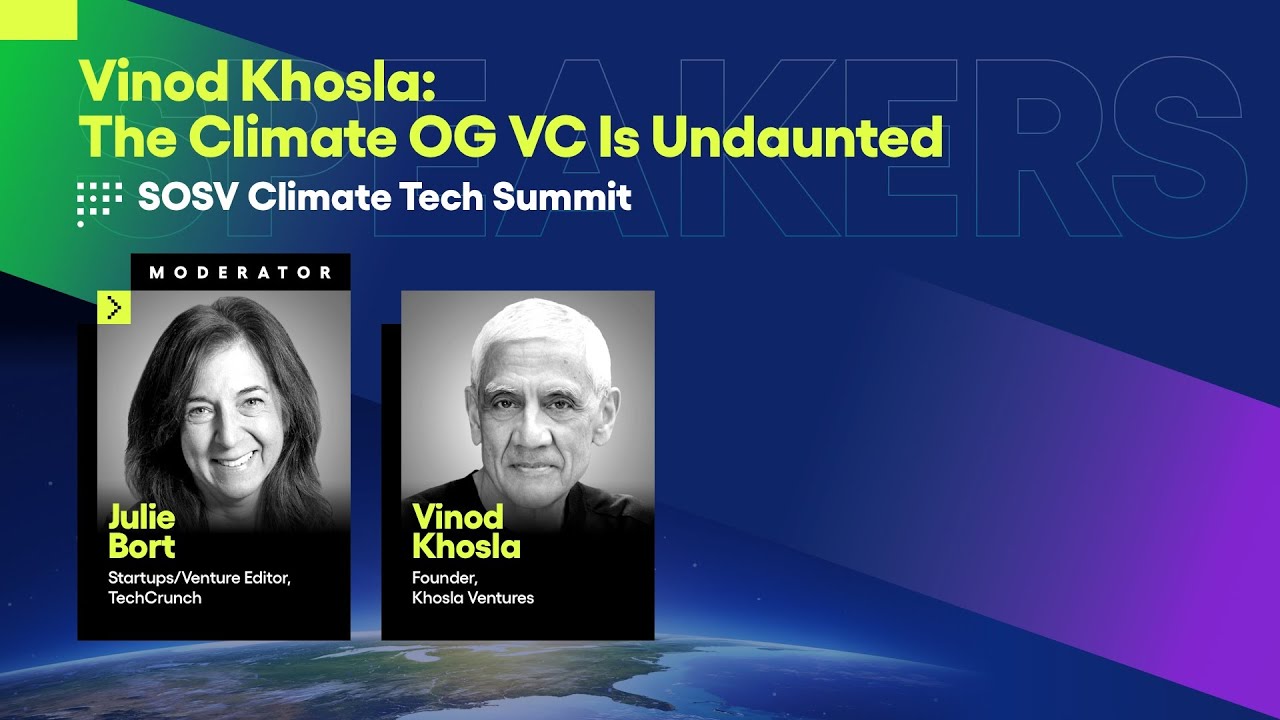
Vinod Khosla argues that Trump's anti-climate stance could push U.S. startups to build solutions that work without subsidies. He focuses on twelve critical sectors and uses the "Chindia price"—the cost at which clean tech beats fossil fuels in India and China—to identify truly transformative investments worth backing.
Chapters
Thanks, SOSV. So happy to be here with you, Vinod Khosla.
Well, it's great to be here.
Let's jump right in. Like, the Trump administration, which I'm pretty sure you are prepared for me to ask about this right off the bat. So the Trump administration has been openly hostile to climate science, and he recently called climate change like a con job. So they've been enacting various barrier policies such as gutting Biden's Inflation Reduction Act. But you recently argued in an op-ed in The Economist that the administration's sort of obstructionism might actually be a blessing in disguise for American climate startups. So can you tell us a little bit more about those thoughts.
Well, climate generally pertains to really large markets. Um, about 2 or 3 years ago, I wrote a blog, um, saying there's only 12 critical areas in climate. If we solve them, we've solved the climate problem. And if we haven't solved them, uh, then we won't have solve the climate problem no longer, no matter what else we do. So there's a lot of money and time today spent on things that don't matter, in my view, in climate solutions among startups, among policy, around among actions. So, um, I'll be an optimist. Obviously, I wish Trump was more less of an ignoramus about climate and about science in general. He just has a hostility to any level of knowledge or depth of knowledge. But leaving that aside, my view is we have in this administration to look at what can we do given the constraints they've imposed. So that's the point of view my op-ed was set from. And it may have some benefits.
So what kinds of benefits? Like what, so when, when resources are constrained and the government isn't subsidizing things, how, how does that benefit climate startups?
So my personal view, as I started to say earlier, Vinod Khosla: There's a lot of stuff the climate community is doing that is not a prudent use of resources. So there's a long tail of stuff that makes no difference. And we should be very focused on the dozen things I talked about that actually matter. It's steel, it's cement, it's electric cars. It's stuff like that. It's fusion energy. So do I believe, for example, we need solar subsidies or wind subsidies? I have said for the last 5 years, it's time for those to decline. Now, climate advocates will hate that, but I actually think that money can be spent for larger breakthroughs in areas to achieve the critical metric in any of these dozen areas. And that critical metric is what I call the Chindya price. The price at which these new low-carbon technologies are cheap enough where they will be broadly adapted in India and China, uh, and everywhere else in the world. At that price, we don't have to worry about whether something is a climate technology or not, because it's the cheapest technology when we can achieve it. I do believe people avoid technical risk and hence achieve technologies that are higher cost than their fossil competitors, when in fact you want to go for the cheapest price, so it's adapted broadly without any compromises, without green premiums, and without subsidies when possible. All right.
Well, that makes sense. You certainly are not averse to technical risks, and you've been a climate investor for decades. You've seen quite a few boom and bust cycles. People really like to dwell on the last bust cycle, what went wrong, you know, what we should avoid. But I want to ask you about the upside. So which of your climate investments over all of this time that you've been investing have done the best so far over the years? And why do you think that is? What could founders learn from the things that have done well?
Vinod Khosla: So let me suggest, clean tech 1.0, which is what you were, I think, were referring to, wasn't as much of a bust as people think. If you're an investor in QuantumScape, it's worth somewhere close to $10 billion. No matter what price you entered at, what the interim valuations were, you made money and we made a fair amount of money in that. In plant proteins, we made money because we entered early, not in the hype phase. There's other areas we are still working on. One of the keys to Cleantech 1.0 was to be persistent. Things have taken much longer than I anticipated, than anybody else anticipated. But take the example of a cement company like Calera. Today, there's a spinoff from Calera that produces cement cheaper than traditional cement with a pathway initially to 50% reduction., and later to a much larger 95% reduction in carbon emissions. What do they do? They take carbon dioxide emitted by cement kilns and turn it into more product. For every cement plant, which every environmentalist is calling to shut down, I don't know how they're going to have any economic growth if they do. And this is where the environmentalists go wrong. Let's reuse those plants, capture that carbon, and turn it into more product. Our processes increase the output without needing more quarrying of limestone and reduce the cost per ton. That's true in cement. I can give you the same example in steel. Our production methodologies aren't the best technology for low carbon. It's the best technology, period. So we can produce low carbon steel cheaper than coal-based processes. Those are technology breakthroughs we should be doing. Uh, obviously very few people were attempting fusion. 2018, we invested in fusion, but at the same time we invested in OpenAI. So, uh, we were thinking about large-scale use of power. If you make fusion work, and Commonwealth Fusion, the effort we started almost as a seed, and Bob Mumgaard was a senior fellow at the MIT Plasma Fusion Lab when I met him, and we worked together to get Commonwealth Fusion going. If you solve the problem, you don't have to worry about coal and natural gas. You'll be cheaper than that. And this low-carbon technology will be adapted everywhere. Let me give you my favorite, favorite example of egregious use of money. Geothermal. It's a— almost all geothermal in the country is a bad idea today, the way it is practiced. We get excited about Eavor or Ferbo or others. None of them ever get to beat natural gas in the cost per megawatt hour. If we take the technical risk to say, instead of going from 200 degrees to 225 or 250 degrees centigrade, we go to 400 degrees centigrade or 450 degrees centigrade. You get 10 times the power per well, 10 times, 80% fewer wells, 80% fewer, less water, and a cost lower than natural gas. Why aren't we attempting it? As far as I know, there's no startup focused just on that other than in our portfolio. So my point is the following. You have to take the larger risk. So the success, if it happens, and you can fail because you're taking larger risks, the successes are consequential. Today, geothermal is an example of almost everything is inconsequential to the needs of the U.S. energy supply. And that's one area I think the Trump administration's right. We need a lot more energy. Efficiency isn't the answer. Growth and more energy is the answer. But it works if you can get cheaper and you take the risks to make green technologies cheaper. When it can't, it should only need these subsidies for a short period of time.
So besides creating new ways to generate energy itself, you know, fusion and super hot geothermal, like you've been discussing, are there ways for startups to participate in a new energy economy? You know, around the edges, new types of other kinds of support systems they'll need. Are you seeing any of that? Are you investing in startups offering this kind of support?
No, I don't want to help with startups rearranging deck chairs on the Titanic. Right? That's, you know, we are making things marginally efficient. I won't invest in building efficiency. I haven't seen one project that says we can take 50 gigawatts or 100 gigawatts of power out of the system if we apply this cost-effectively at a cost-effective cost per ton. Direct air capture, same problem. People are talking about $500 getting down to $300, $200, maybe to $100. When you start squinting your eyes and make unrealistic assumptions, that's the wrong way to do direct air capture. I will only do projects that have a direct identifiable way and identifiable metrics to get well below $50 a ton. At that point, the carbon tax is small. Um, in fact, we have one project to get down to below $5 a ton. It may not work, most probably won't, but it doesn't matter. You have to take these larger risks to get to the right goal. So it's broadly adapted. If 5% of the market adapts it because they care about climate, we're not going to solve the problem. Oh, by the way, I should say, once technologies are developed like solar and wind, there's plenty of startups that we don't invest in that are doing project financing, project execution. Those are all good things once a technology is cheaper than fossil, and solar and wind are there.
So there'll be plenty of opportunity. It's not where you're focused. You're focused on the big swings. But there'll be plenty of opportunity, and you're encouraging that, it sounds like. But I, I, I wanna go back to just a little bit about, yeah, so sometimes there's a swing and a miss, right? Like you think it's going to work out and it doesn't. Are there any areas where you won't invest again, or maybe you're even advising startups to to pivot from if they're working on?
Well, I don't think there's any areas we won't invest in, but we won't invest in anything that's a marginal improvement. We won't invest in anything when it gets to scale, 5 or 10% of its market, it's not cheaper than fossil compared to unsubsidized. That's the Chindia price. That's the only thing we'll invest in. If something is 20% carbon reduction and it stagnates there, we are less interested in that. Somebody else might want to do it to go get carbon credits and make the economics work. You can make the economics work, but you're making the economics work by sucking on government money, which is the wrong thing to do. And that's again, another place. I agree with the Trump administration. I just wish they believed in climate and said we'd fund the technologies that have a path to being cheaper and abundant. Now, geothermal is 0.4% of U.S. energy. If it becomes 0.8%, who cares? We have one project, if it succeeds, will be large, twice as large as all U.S. Geothermal production, that matters. Um, and I do think geothermal has to get to hundreds of gigawatts, um, maybe more globally before it works. So it's not just in one local area or an island. Those are fine economics if an island is producing electricity at 35 cents a kilowatt hour or 50 cents a kilowatt hour. You can make some money, but that doesn't solve the climate problem.
Yeah, it has to stand on its own, on its own as a financial alternative. Convince, if they can convince you of that, you might be interested in investing.
Oh, in every area.
But I, so you mentioned before, you talked a little bit about promising new green building materials. So can you talk a little bit more about the most exciting advances you've seen there? What challenges still need to be solved too?
Well, look, the biggest building materials in the world are cement and steel. I suspect we are not going to change that. And so I'm focused on those two. On the margin, can you union some area because you have a specialty deposit of A particular mineral make a different kind of cement? Yeah, but it's, will it scale? Can you build thousands of mines like that to supply the whole planet, every major city in the world with a local source of building materials? It has to be likely cement. Now, somebody may come up with something great. And I'll be happy to take that risk. But, uh, I, I think it's at this point, I'd say somewhat unlikely, but I've been wrong before.
Well, you know, that's okay.
It—
maybe someone else will pick that up. Um, but if they can convince you, that's a good start too.
Well, we are always open. Look, a long time ago, I thought biofuels was the easiest way to get the car fleet switched over to renewable fuel. That got hijacked by the corn ethanol lobby, which was always a bad idea. And Elon Musk did a great job of electric vehicles, far better than any big player could, far better than Toyota or General Motors or Volkswagen could. And he changed the world to accept electric cars. Uh, so I was wrong. By the way, all that biofuel effort is very, very valuable still because I still see the same problem in aviation fuel and possibly in shipping fuel. Those are big areas. I haven't seen— I don't buy hydrogen and obsoleting a few trillion dollars of CapEx of aircraft in operation today. Electric aircraft will work in very small regional or haul transport, but we have to find a compatible fuel for the tens of thousands, if not hundreds of thousands of aircraft out in operation that we won't obsolete anytime soon. And these have 50-year lives.
And possibly from there, those fuels will make it into the everyday consumer automobile. So you might be proven right. I haven't given up hope.
At this point, it's clear the consumer automobile will be an electric vehicle. No question in my mind. Too much momentum, too much investment going in, and prices converging. If you look at what companies like BYD are doing for the cost effectiveness of EVs, I think that'll work. Now, consumer vehicles may be obsoleted by Um, robotaxis, I think they'll be obsoleted by public transit built on autonomous driving and electric vehicles. And I think there's a path to eliminating most cars on this planet in the next 25 years.
Oh, interesting. I'm not sure I agree with you, but I want to move on to food tech. Okay. Because you were, uh, famously an early investor in Impossible. The makers of plant-based meat, right? So, are you still much involved in food tech or ag tech or watching this space? I'm just wondering what's exciting to you in this, in that arena.
Well, there's two big problems in food tech, right? You can grow, grow greens in greenhouses, but protein production is a big deal., and I think cattle is the wrong way to do protein production. Uh, unfortunately, funding for food tech, uh, dried up, but I'm still very bullish. Impossible is still a growing company. They're not declining in revenue. There was too many excesses in the food business, high valuations, marginal technologies. That disillusioned investors to investing in food tech. So it's hard to raise money in that area. I hope that's temporary. But if you can use a pro— create a product better tasting and cheaper than your regular burger from cattle, which I believe is relatively easy to do at this point, given what we know. Then the world should go that way, but not enough people working on it. The other part of food tech is fertilizer. So there's protein production. You know, we grow a lot of corn and soy for that, for cattle and animal husbandry. And the other part is fertilizer. And, you know, it's sad that in this day and age, in 2025, we are relying principally on a technology from the 1800s, the Haber-Bosch process. That's sad. So we are investing in alternatives to Haber-Bosch. We have nitrogen production, one of my fun projects. We produce nitrogen out of thin air. Kenya.
Yeah.
There's nitrogen in the air, there's water in the air, and there's— you all you need to do using solar energy, solar power, is to create a plasma and out comes fertilizer. So we are working on that. We are already far cheaper than organic fertilizer and we are organic fertilizer. But I hope we can get to cheaper than regular fertilizer in the Hibberdosh process, but it takes, again, taking these large risks.
Any other thoughts on countries that actually are doing climate support well? What would you like to see? How would you like to see US model their climate support?
Well, there's a lot of support for climate in Europe, of course, And I'm glad for that because that's a market our entrepreneurs and technology breakthroughs can start in. Part of the problem is they'll fund climate at any cost, and that's a problem. Unless you look at the trajectory of cost and gets competitive, market competitive, and reaches that Chindia price with fossil alternatives, We shouldn't be doing it. And, and the Europeans have paid less attention to that. The US was going in that direction. And that's where, um, the Trump administration has caused a setback, but it may actually be a blessing in disguise for to focus the climate entrepreneurs on economic solutions. Even if, uh, at least when they get to scale, some scale.
Uh, so I'm curious, uh, you, you mentioned and, um, the research shows that you invested in Commonwealth Fusion in the same year that you invested in a little company now known as OpenAI. What I'm curious about, like, you've been a vocal supporter of OpenAI. They're experiencing unprecedented growth. What they're doing, um, is phenomenal. But there's a voracious need for data centers, and data centers still have a pretty bad track record for their environmental impacts. So I'm wondering what you're thinking the solution is there.
It's about producing more power. That's what we need. And fortunately, the companies doing data centers are more inclined towards climate than the industry at large. And so they will drive some of these newer technologies. You know, Microsoft trying to get fission back, doing fusion projects. Those are all good incentives for entrepreneurs in fusion. I don't think 5 years from now we'll be debating what the source of power on this planet is. It's going to be fusion and super hot geothermal. With solar and wind playing a role, but they're probably not getting above 40% of global production of power for the variable renewables, non-dispatchable renewables. I wanna watch my football game when the game is on, not when the wind's blowing or the sun's shining.
So you're sort of seeing a marrying of two. This need for data centers is actually gonna prove, uh, provide a proving point for some of these alternative technologies.
I do believe so.
All right. Well, that is a hopeful thought. And with that, I'll say thank you for your time. I've enjoyed speaking with you today.
Thank you very much, and good luck to all the entrepreneurs out there.
More from Vinod




EXCLUSIVE: Vinod Khosla warns AI will upend jobs and healthcare sooner than expected | GSIF 2026




Vinod Khosla: AI Tutors, Doctors & Farmer Experts For 1.5B Indians | AI Summit 2026

India AI Impact Summit: Vinod Khosla on Why 2047 Could Free Every Indian from Survival Work


‘There Will Be A Lot Fewer Jobs In 20 Years…’: Billionaire Entrepreneur Vinod Khosla On Impact Of AI