The Coming AI Clash: Utopia or Dystopia? | Vinod Khosla
Vinod Khosla argues AI will be as transformative as electricity, amplifying human intellect across medicine, education, and law. He predicts 80% of known jobs could be done by AI by 2030 and a deflationary economy where money goes far further. The utopian or dystopian outcome depends on policy choices, not inevitability.
Chapters
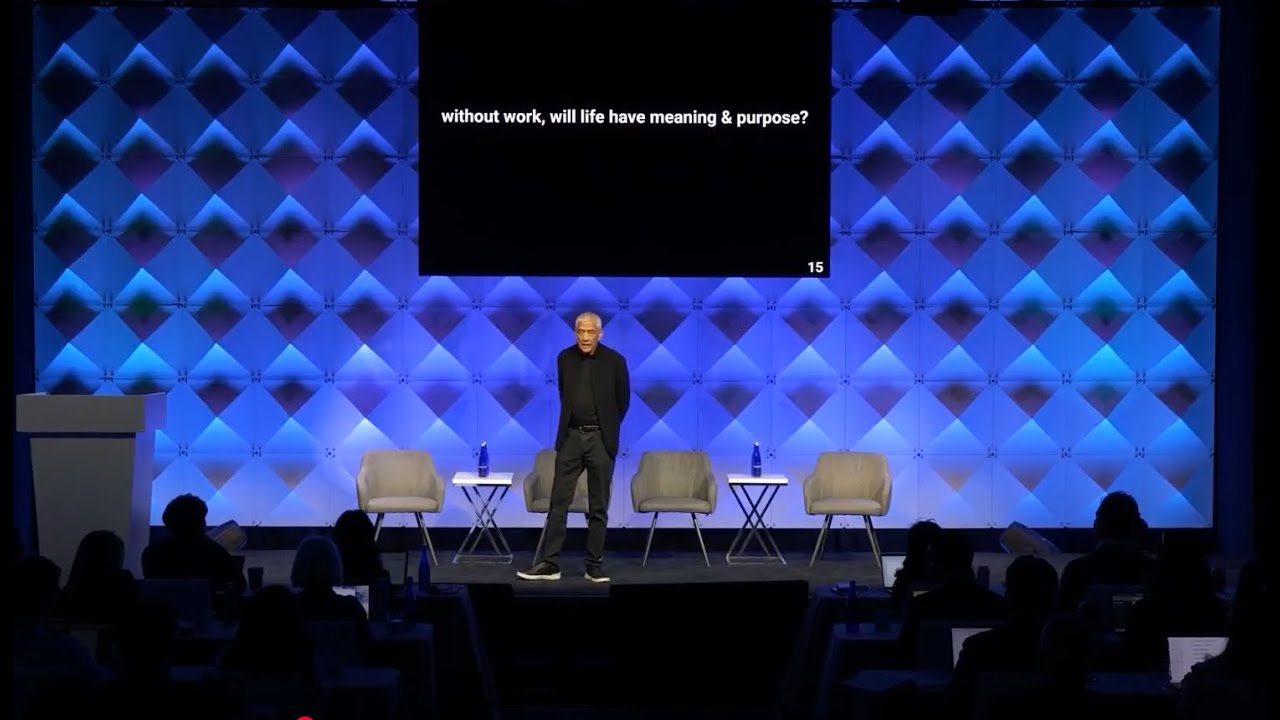
Ladies and gentlemen, please welcome Vinod Khosla. Good afternoon. Really appreciate all of you coming here and all our entrepreneurs. It always gives me the heebie-jeebies when I look at the portfolio and what our entrepreneurs are doing and how large a technology impact they're having on society. And the topic that I get asked a lot about is, will AI lead to dystopia or utopia? I have a point of view, and hopefully that'll come through. How many people have seen this paper written by an OpenAI researcher? A few hands. I recommend everybody read it. The hypothesis is, Only a few hundred people really understand the rate of progress and the acceleration. And you heard a view of that from Sam. There's a lot of change to come. Will it be good or bad is up to us. We can do two things. What I see happening a lot is rearranging deck chairs on the Titanic. Many corporations adding efficiency here or there, not thinking about how to fundamentally reinvent their business. Or we can build, plan on the utopia we think is coming. This was a recent headline last week from Anthropic. AI workers next year. My whole life has been about platform shifts. Started with microprocessors. Many valuable companies got created there. With the internet, many valuable companies got created with that platform. With mobile, when the iPhone came out. And now AI. This is the opportunity before us. For the next decade or so. But shifts always come with fearmongering. This is an actual cartoon from 1889 when electricity was introduced. What will electricity do to humanity? And we are hearing some of that on AI too. But to me, AI is much more. Like a multiplier. The steam engine, then electric power and electric motors multiplied what human muscle could do before. We were limited to human muscle power, and then we amplified that. And AI will amplify the brain or the mind. And that's what gets me super excited. But let me address most of the people Talking about dystopia first. People raise all sorts of objections. I have a bias that there are many risks humanity's— humans face. An asteroid could hit the planet. Last night, Bill Gates was saying the last pandemic was sort of a small to medium pandemic. It could be much, much worse. There's, of course, nuclear and other threats. So the question is, is sentient AI destroying humanity the biggest risk to humans? And I would say, in the basket of risks humans face, it's not the risk I worry about. The dystopian narrative is powerful AI in the hands of people I don't trust and we shouldn't trust. Especially when used with Tiananmen Square type tactics. People talk about big corporations. Which fight would you pick? Somebody with an economic incentive or a not so transparent objective? It's very clear to me. Moving on to other dystopian scenarios, I will suggest that almost all of them are societal choices that we can make. They will be made by society differently in each country around the world. So we will see much discordance in the rate and way in which AI is adopted. Job loss and economic inequality is among the biggest risks. It's a legitimate fear. But I do believe we have the tools in a world where GDP growth far exceeds 5% globally. We will have enough abundance to share. And what level of redistribution we do and how will be a societal choice. And as you heard from Sam, and I'm a huge believer in this, how many people have seen a piece I wrote in November of last year, November 2024, about the AI and the inflation-deflationary aspects of AI? Okay, a few nods. I do think we will have a hugely deflationary economy. I suspect $10,000 in 2024 or 2040 will buy more than $100,000 does today. And frankly, I think measures of GDP will just plain be wrong because GDP was designed for physical goods— more cars, more refrigerators, things that don't have deflationary cycles. But the other question that gets asked is, without work, will life have meaning? I would suggest for most people on the planet today, jobs is not jobs, it's servitude to survival. If you're a farm worker working in 100-degree heat for 8 hours a day for 40 years, If you're a General Motors assembly line worker mounting a tire on a car for 8 hours a day for 40 years, that is what the majority of jobs on the planet look like. Not the ones we are used to among our peers. And that, I think, will become optional. Social manipulation is another dystopian view. But I do think it can be mitigated by policy. Laws can give us this safety without Big Brother. So many of these are subject to regulatory control. Bias is another one that comes up. To me, bias is mostly human. And when the bias shows up in AI systems, it's detectable. And because of that, it's correctable. Some of the data on bias is stunningly good on bias in AI. For example, in mental health therapy and others. Happy to talk about it. And to me, ethics is a failure of human beings, which will be reduced in its magnitude by the close monitoring AI can do. Cultural homogenization. Machine learning is another one of these that comes up a lot. I think only the less creative people worry about the loss of creativity because so many more tools to enhance our creativity are possible, both humans with AI and AI alone. And for those of us And I consider myself in the bottom 1% of musical talents in the world. We will have ways to be creative. I do think we should give people an opt-out choice. We do today. The Amish do pretty well with their lifestyle, and they're happy with it. And there will be non-AI natives who want to live life a different way. And that should be a choice. Society affords. But we shouldn't hold back the benefits of AI for everyone else. I'm very bullish on what AI does for creativity of human beings. I won't say too much about this. And then this question, it's a vague question I get asked a lot. Will we lose humanness? And I want to come back to this towards the end of this talk. I do think we should overfund safety. We were talking about some of the risks of AI. And I do think this is something we should do somewhat urgently, but not at the, uh, not stop progress in this process. What is not a societal choice? Treaties. Why not? Most previous treaties were done around technologies like nuclear or biowarfare that were verifiable when used. AI will not be verifiable. And I'm not prepared to trust President Xi or President Putin to do the right thing. And hence I don't think treaties are possible. But I do want to focus on the world we can build. I do think most of the doomsday talk is talk of Ivy League academics. That don't have to deal with the luxury or the necessity of getting basic primary care or basic food, basic education. And we should look past those few and talk about the utopia we can create. What does that look like? To me, 800 million people live a rich lifestyle. There was a piece I wrote on this that many of you have seen when I turned 60, which was 10 years ago. 800 million people, 10% of the planet that has a rich lifestyle in housing, in healthcare, in transportation, in entertainment, energy, education, consumption, you get it. 8 billion people want it. And I didn't think it was possible to have 10 times the number of cars, 10 times the number of houses, 10 times the amount of steel, 10 times the amount of mining. We couldn't do it the old way. And this is the problem I was excited about working on 10 years ago. It's much more conceivable how we do this in the age of AI. And that's what will make this new world possible. Almost all expertise will be near-free. We will be capable of every person on the planet, all 7 or 8 billion, having free doctors. I don't think it should cost more than a dollar a month to provide free primary care, free specialty care to every human being. A free AI tutor to every person. And I first wrote a blog on these two ideas in 2012. It was a dozen years ago. It's so obvious now that this is a certainty, not a possibility. In addition, 80% of, 80% of all jobs we know will be done by an AI before 2030. Doctors, therapists, chip designers, structural engineers, accountants, software engineers. These are all things that our portfolio of companies is working on today. And many more professions. And I think they will be very mature in 3 to 5 years. That will create a new world. And what will happen before then, people are very afraid of this model. Is between now and 2030, most of these AI workers will act like interns to human oversight. When we do an AI accountant, we are treating it as an intern accountant. Because CPA firms have senior accountants that hire fresh kids out of college and they train them. These AI accountants will be trained the same way. The same happens to an AI doctor. It'll be treated like an intern under the supervision of a human doctor, the way they would manage a fresh graduate from medical school today. That'll be the paradigm for the next 5 years in almost every area. Onto this issue of without work, will life have meaning? I fundamentally believe AI can free humanity, and I'll talk a lot more about this. You know, up till now, when I saw somebody telling a kid, "Pursue your passion," I said, "As long as you don't mind starving as an artist or a musician or a basketball player, as long as you're okay not providing for your family and paying your mortgage." Go pursue your passion. You can make that choice. I think that choice will really be possible for kids who are going to kindergarten in 2035. I will finally change my advice to these kids. We'll work on what we want to work on, not what we need to work on. Human labor will be near-free. I suspect we will have a billion bipedal robots or other forms of robots by 2040 or so, freeing most humans from manual labor, most work that is done by humans manually. I'm excited about that freedom. Only a matter of time, and we talked about the this at lunch, before more science is done by AI scientists. Imagine 1,000 times more scientists doing research for us and what that does to the rate of progress in science. Scientists will be supercharged. We'll do 100x, 1,000x more work. AI will play, play a huge role in entertainment and design. Almost every area of entertainment. And we're investing heavily in lots of different experimental modes of consumer entertainment. It's not that the Taylor Swifts or the celebrities will go away. That will still exist. There'll be touring musicians, but a lot more music, entertainment, drama, personalized content, and creativity. I do believe creativity gets a jetpack. Everybody— artists, tinkerers, scientists— all level up. We'll have blockbusters created in bedrooms. And as for the consumer, they'll be protected by a personal AI. In a world where Facebook can hack anybody's brain, getting you to click on things you don't want to click on, getting you to buy things you didn't want to buy, we'll have an AI protecting us against marketeers, provide free legal services, do tasks on the web for us. AI robots will manage work at home. We'll have AI judges, free AI legal help for everybody. I think society becomes, in this vision of the world, much more equitable. Justice will be a cloud service, I think. Here's an interesting question. Will a farm worker of today get the same pay as an oncologist? Because they will be both leveled up to the level of education and intelligence of an AI. I don't know the answer to this question, but I think about it. Will AI be this great equalizer? I do think AI will shift a societal focus from economic growth to well-being, from GDP to Gjoy-P, a focus on passion as I just talked about, not on a paycheck. You can unleash your imagination. On how humanity will be unleashed. My favorite, I think we are well on our way to solving climate change. Today, I believe we will produce cheaper clean power than coal and natural gas power. We are well on our way to both fusion and super hot geothermal. We are well on our way to producing cement cheaper than traditional high-carbon emission cement. We are well on our way, and I think there may be an ignote of steel outside, produced cheaper than traditional steel, but zero emission. Power, of course, will be clean and much, much cheaper. And maybe intelligence will converge with the price of power. Our plan is not to build new fusion power plants, but to retrofit every existing coal and natural gas plant with a fusion boiler. Can happen rapidly. My favorite story, not far from here at the San Ramón Iron Works, In the Second World War, when we had only built 5 Liberty warships in the 10 years before the Second World War started, we built 5,000 of them in the 5 years after the war started. We only need to build 5,000 fusion boilers to upgrade every coal and natural gas plant worth upgrading in this country. I think it'll only take 5 years after we mature the technology. So one caveat. We will have new food and fertilizer. I've talked about it in other places. We are producing today fertilizer from thin air. No inputs other than solar power, air, and water. Nitrate fertilizer today. Resources will be plentiful. I argue we haven't started to develop the sensors. Sensors with fancy names like quantum sensors or atomionics or other kinds of sensors to look a kilometer under the earth. We mostly do mining for minerals where it's on the surface. That's a pretty silly thing to do. We had this with oil when in the '60s we declared we had reached peak oil. I think we are far from peak minerals, and I would conjecture in the next 15, 20 years, we will discover much more nickel and lithium and cobalt and manganese and copper than we will consume. Even in the most optimistic GDP growth scenarios. Drugs will be personalized. I don't think it'll take that much. We are starting to look at what we call n=1 medicine, drugs for one person. If they're fully automated, they will be affordable. And for things like sickle cell anemia, we are fast approaching single-shot cures through gene therapy of one sort or another, or cellular therapy in some way. I've talked about carbon will have solutions. There are many obstacles. Many things will get in the way. Regulated industries will have a hard time moving faster. And the AMA is strongly against AI practicing medicine when it is proven again and again that AI today is better than humans in complex diagnosis. Just a study out of Stanford by Arnie Milstein, who's probably the one expert in the country on quality of care. He did a study, multi-center study, on complex diagnostic reasoning. Humans had 73% accuracy, which means 27% of the patients, when it mattered in complex cases, got the wrong diagnosis. AI alone was 88%. And when you gave the AI to humans to use, their performance improved from 73% to 76%. But it degraded AI alone from 88% to 76%. There's half a dozen studies like that I could point to. So there will be obstacles. The AMA only wants medicine to be reimbursed based on the number of minutes the physician spends. Not on the quality of care. I've written a separate piece on this, uh, if anybody's interested, on AI in healthcare that I wrote in, uh, January of this year. So in conclusion, imagine a world where passions emerge, where people have the opportunity to pursue the life they want. What does humanness mean? It's redefining the human experience free of necessity, indulging in the passions and interests of every human being. AI will free humanity, I contend, redefine the human experience. And I have an interview with the New York Times in the year 2000, that I say somewhat vaguely because I was embarrassed to elaborate on it in the year 2000, that AI will have us redefine what it means to be human. I think 25 years later, we are here today. And we can build the future we want, and the ending is up to us. And each country will do it differently. And I hope it's for everyone. Thank you very much.
More from Vinod




EXCLUSIVE: Vinod Khosla warns AI will upend jobs and healthcare sooner than expected | GSIF 2026




Vinod Khosla: AI Tutors, Doctors & Farmer Experts For 1.5B Indians | AI Summit 2026

India AI Impact Summit: Vinod Khosla on Why 2047 Could Free Every Indian from Survival Work


‘There Will Be A Lot Fewer Jobs In 20 Years…’: Billionaire Entrepreneur Vinod Khosla On Impact Of AI