Venturing into the Future: In-Conversation with Vinod Khosla
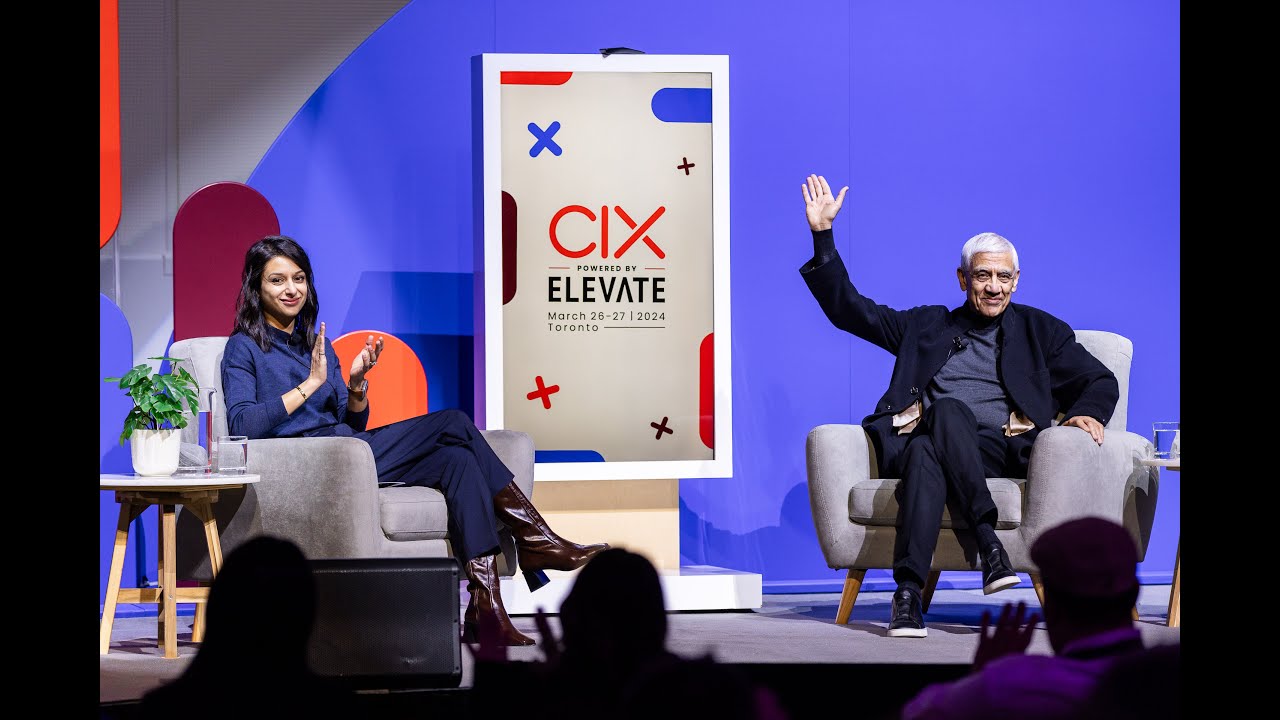
Vinod Khosla, an early OpenAI investor, joins the 17th annual CIX conference. The event drew a record 450 startup applications and 125 investors. Despite a recent downturn, VC activity remains higher than pre-pandemic levels, with AI and cleantech showing strength.
Chapters
Hello everybody. Welcome to the 17th annual CIX.
How are we doing today?
Woo-hoo! All right. I'm going to need a little more from you on that, but that's why I brought the pink suit. I'll be loud enough for the both of us until you guys meet me at this level. I really can't believe that it has been 17 years, and I've sort of lost count of the number of times that I've hosted CIX. You know, between the pandemic, I had 3 kids, I— time has just like lost all meaning at this point. But it truly has been, uh, 17 years, and it's so incredible to see how far this has come. And as I said, I've been the MC before. I honestly though don't know how much longer I'm going to be able to do this. Because as we know, AI is coming for my job. Later on, we're going to hear from Vinod Khosla, who was the first VC to invest in OpenAI. And he says that in 20 to 25 years, AI will do 80% of the work of 80% of the jobs. He thinks doctors are toast, like in the next 5 years. So if doctors don't have a chance, I, as a humble journalist, I don't stand a chance against ChatGPT. So I'm looking for what I have to pivot, right? To use your code words. I think I might try comedy because I asked ChatGPT to write me a joke about venture capitalists. And this is what it came up with. Why did the venture capitalist bring a calculator to the comedy club? Because they wanted to crunch the numbers on how many laughs per investment they could get. Zero. And this is low-hanging fruit. I'm telling it to make fun of venture capitalists. Like, I can't tell if I'm at CIX or a Patagonia pop-up. It's easy. I know you guys love numbers, so we have got a blowout from many different perspectives. First of all, for CIX, the applications that we got—450 applications—that is a new record for CIX. There's over 125 investors that will be with us over the next 2 days, 200 startups, and 100 people from our advisor community. 70 startups will be featured, and you might notice There's something different about CIX this year. She got a bit of a glow up, maybe a little elevated. In 2023, Elevate acquired CIX. And why not? Big tech is getting bigger. Big tech conference should grow along with it. Now, as we are here today as global innovators to talk about the future, I would be remiss if we didn't acknowledge our traditions and the unceded territory that we sit on, including lands that belong to the Mississaugas of the New Credit, the Anishinaabe, the Wendat, the Haudenosaunee people. We also recognize that Toronto is covered by Treaty 13 with the Mississaugas of the Credit. And today, this meeting place is home to many Indigenous people from across Turtle Island, and we are grateful to have the opportunity to work and build community on this land as we work towards reconciliation. This area that you're in right now is called the Summit Stage, and this is where all of the evening's programming will happen. This is also going to be where we hear tomorrow from our top 20 startups and our top 10 growth companies. That will take place tomorrow. On the second floor, there is the Discovery Stage. There we're going to have workshops, rocket pitches, and some VIP ask me anything. So there's a lot happening on both this floor as well as the Discovery Stage. As I mentioned, the core, even though this event has evolved over the last 17 years, the core has always been about featuring incredible people who had incredible bold ideas and look to change our country. This year is no different. We are going to hear from 20 early-stage companies and 10 growth-stage companies. As I mentioned, that's just 30, right? There were 450 applications, and it took a team of 140 investors that since the beginning of this year have been reviewing a very long list of applicants to narrow it down to this very worthy group that we're going to hear from over the next couple of days. You also have a chance to meet and greet. This is all about social networking in real life. The meeting exchanges are back. We're gonna have one-on-one meetings with entrepreneurs and capital providers. If you have a startup pass and you haven't pre-booked your meetings, you can visit the signup station in the lobby. There are 52 investor hosts that are participating, so a lot of ears to get your ideas across. You can learn about the agenda online or I think there's printed pamphlets on those who are at table. And of course, if you don't Instagram it, it's like this whole thing never happened. So please hashtag #ElevateCIX2024. None of this would be possible without our partners and our sponsors who've been with us every year. So a round of applause please for the sponsors that made this happen. We are going to hear from legendary Silicon Valley investor Vinod Khosla, who, as I said, was the first investor of OpenAI in 2018 when we were all sort of thinking about social media. Our Innovator of the Year, aptly with the theme that we see today, is Cohere, a huge— I don't know if you can call it startup. You can definitely call it a unicorn. In this country when it comes to AI. We're also going to hear from AI leader tomorrow, Raquel Urtasun. We're going to hear from Lightspeed's Dax Da Silva, who was the founder, the CEO, left, and now he's back. We're going to find out about that journey and what his plans are for the future. And we have got Gradient Ventures' Darian Shirazi, who will also be joining on stage. So That's the housekeeping. Now is the fun stuff. We get to the great ideas, the great innovations. And to help kick off the event, I'd like to bring in our CIX Advisory Board co-chairs, Allison Nankivel, former Senior Vice President of Fund Investments at BDC Capital, incoming CEO of Mars, and Laura Linz, partner at Omers Ventures.
Ladies.
Oh, we have our pictures so we can actually see where we're supposed to sit. Excellent. What a great group. Lovely to see everybody. As you guys had a chance to find out, you're looking at two women who've been around this ecosystem for a while. Laura on the direct side. I represent the institutional investor side, at least for the next couple of days before I move over as CEO of Mars. But In the interim, I think we're here to talk to you about our sense, right, of what the ecosystem and our sense of what that's going to look like, both from the LP perspective and the GP. So maybe I'll start off talking on the big picture. You know, at BDC, obviously we have a big GP portfolio. We spend a lot of time thinking about what's happening to our GPs, what's happening to partners, and how can we get funds scaled to the size they need to be to really go after opportunities. I think everyone knows it's been a tough time. In the VC market. But, and certainly there's been a decline over the last couple of years as we've seen. But I would point out to people that in the last 5 years, our level of activity is still really, really significantly higher than it had in the previous. So from a pre-pandemic to post-pandemic, this is still a better market. We had a crazy 2001 that makes everyone feel things have gone down, but in reality we're still dealing with a very healthy market. I think overall compared to where we were, you know, 5 years ago. You know, we do know that it's hard times with a macro environment, interest rates still uncertain, economic outlook, trying to figure out when liquidity exits are gonna come back. It's making a challenge in the dialogue between GPs and LPs and also for companies to understand where they get their next fundraising. But I do think that there is some sense, and I'll ask, I'm sure Laura's gonna have more on this, of when we might see a return of the IPO market, M&A activity. Certainly from the private equity side, we're seeing a little bit of hint of that, and I think that's going to come down over the next few months into the venture. From the LP side, many of you know who come to our door, it's tough fundraising environment at the moment. A lot of LPs have been constrained from a capital allocation perspective with overexposure to the VC asset class. I think that has made vintages a little longer than we've planned. People a little slower in how they're getting to first close. But I do feel that as an asset class, we are getting a new category of people. And I think many of you might have seen the news. Kelpers is coming back out into the market in venture in a very significant way. And our expectation and hope is that some of that interest from US investors who either maybe underplayed venture as an asset class are going to come back and visit the Canadian market, which is really important given that US is such a big part. I know a lot of you out there are first-time managers, and one thing I really want to point out that I've been really impressed over the last few years is the diversity and the range of managers we see, both women, people of color, Indigenous. It's incredible to see that this is a much more inclusive VC ecosystem than it used to be. It's hard, we know, as first-time managers to get to that critical mass, but be persistent. There is a chance for everybody with a good thesis to find those investors that really fit your style. Valuations, I think we all know there's still somewhere that maybe we don't— not sure if we've hit bottom or not. But I do think certainly valuations on the later stage have declined about 47% last year. It has made it tough for growth capital, and that's a real concern in Canada where we've had high-growth companies who really need that growth capital to continue to scale into new markets. I think we are seeing the end of that. And certainly within BDC, we have a great hope that we will see some significant funds coming to market, of which we're going to be a part of, to really start to scale and help those Canadian companies. And certainly foreign investors who've been 60% of the market, I think will continue to be there, especially the US. We have some sense of that coming back. We all know ICT has been a tougher sector, but pockets like AI have done well. Cleantech has done well. I just want to point out, for maybe there are fewer life science investors in this, in this community here that we're talking to, but some of you guys have had some great exits over the last 6 months. So congratulations. I know Lumira, CTI, Genesis, you've done some great exits. And I think that's promising to see that the life science sector is getting some signs of, of revival. And hopefully that means that that in tandem with other segments of the VCU market overall will, like I said in that second half, really see some uptick. As we said before, BDC, and I still have my hat on for a couple more days on that front, we want our GPs and our portfolio companies to go the distance. We're there. We want to be part of the dialogue with you. We know it takes a village to raise a fund or to raise a syndicate for a company. So don't out there not stop in your persistence, in your tenacity to have those dialogues with partners like ourselves and others like Omers. And, you know, understand that there's a, you know, we are heading towards, I think, a much brighter direction as we get into the latter half. And certainly from a portfolio company, I'll turn it over to Laura to talk a bit more about her take on how they should be thinking about the year.
Great. Thank you, Allison. So you heard from Allison that it's a pretty challenging fundraising market out there, both for founders as well as fund managers. But I think if history tells us anything, it can show us that great companies can raise capital in this environment. Over the next day and a half, please take the time to listen and learn from some visionary leaders like Vinod Khosla and Dax Da Silva, and some early-stage founders like Raquel from Wabi and Mo from Work. Had to put a little bit of an Omers Ventures plug in there. But I'll start with some real talk and some practical advice. This might be one of the most difficult fundraising environments over the last couple of decades. But if you've got a good business, I would urge you to think about these 3 fundraising traps that people can often get themselves in and to try to avoid them as much as possible. Trap number 1, spending time talking to a fund at the end of its investment cycle. Why? Because the bar for investment at the end of a cycle is far higher than at the start. And it makes it even harder for you in this tough fundraising environment to raise more money. Ask the fund how much capital they have left to deploy and how many investments they have left in this particular fund before you spend any more time with them. Once a fund starts fundraising, the team is often distracted and has less time to spend with you as a result. If engagement from your investors matters to you, ask what the fund plan is and the next fundraising goal and, and to determine whether or not they're going to have time to spend with you. Fund cycle also matters. When it comes to follow-on investment. You raise your first round from a VC, you hope that they follow on. You need to ask that fund where they are on follow-on capital, what their reserve management program is like, and how they set aside follow-on capital for particular investments that they make. This will directly impact your fundraising opportunities in the future by that fund, so it's important. Trap number 2. Negotiating complicated deal structures. Why? Well, strong businesses can always raise on clean terms. I know this because we're doing this at Omers. But structuring a deal should matter to you because it can mean misalignment in your board and on your cap table, which makes it more difficult to get a transaction done, whether it's a future investment or even an exit. Typically, a VC fund will add structure to a deal to protect its downside. That can be often at the expense of a founder and some common shareholders. Understand how the different structure that is in this term sheet that you're receiving will impact your personal gain in the long run. Deal structures put in place can compound over time. You're setting a precedent, the A, then the B, then the C. So make sure it's as clean as possible so that you as a founder can reap the benefits on an exit. Trap number 3, assuming all money is good money. And I know that sounds sinister, and I don't mean it to, but the truth is founders should be doing as much diligence on investors as we do on the founding team. Every VC will say that they're value-add. That's our tagline. But don't take their word for it. Speak to founders that they work with, the ones who've succeeded as well as the ones who have failed, because it's often in failures that you learn the most about people. The last thing you want is one of your investors showing up or not showing up at all to your board meeting. When they do show up, they show up with biases and unfiltered advice. So do your references on VCs. And finally, don't be afraid to look failure in the face. This is part of our ecosystem. Great ideas can sometimes fail. They often do. And it's a hard call to wind up your business, but sometimes it needs to be done to go on to that next business and that next idea that you might have. And there's no shame in failure. We need to be celebrating failure in this community because again, we often learn from those failures. Over some of our successes. And then maybe I'll just wrap up by saying that despite some of the doom and gloom in these opening remarks, some of the best businesses can be created and sustained in down times. It actually causes you to think about every dollar allocated and how it's allocated and if it's allocated in the right way. You've all seen the names Airbnb, Netflix, Slack, WhatsApp, Uber, et cetera. The list goes on. There are great companies that are formed in down markets. Make sure your business is one of them. Ask the critical questions. The IPO window, with the Reddit IPO last week, it feels like it's maybe opening a little bit. I think we need to see some really strong names come out with good aftermarket performance to have that window open completely. But when it does, I know that there's some great Canadian stories maybe in the room tonight. That, that will be part of that, that IPO window opening, which is great. And then you're going to hear Vinod probably talk about GenAI. You— and I think given the movement in AI that's happening today, it's causing all of our companies to have so much more innovation and excitement. Lots of great investment opportunities coming out of AI. We always need to look for a problem that GenAI is solving, not just the technology. But more than ever, I'm excited about being an investor in Canada, and I look forward to meeting many of you over the next couple of days. We're around, and I hope you enjoy the conference. Thanks. Thank you.
More from Vinod




EXCLUSIVE: Vinod Khosla warns AI will upend jobs and healthcare sooner than expected | GSIF 2026




Vinod Khosla: AI Tutors, Doctors & Farmer Experts For 1.5B Indians | AI Summit 2026

India AI Impact Summit: Vinod Khosla on Why 2047 Could Free Every Indian from Survival Work


‘There Will Be A Lot Fewer Jobs In 20 Years…’: Billionaire Entrepreneur Vinod Khosla On Impact Of AI