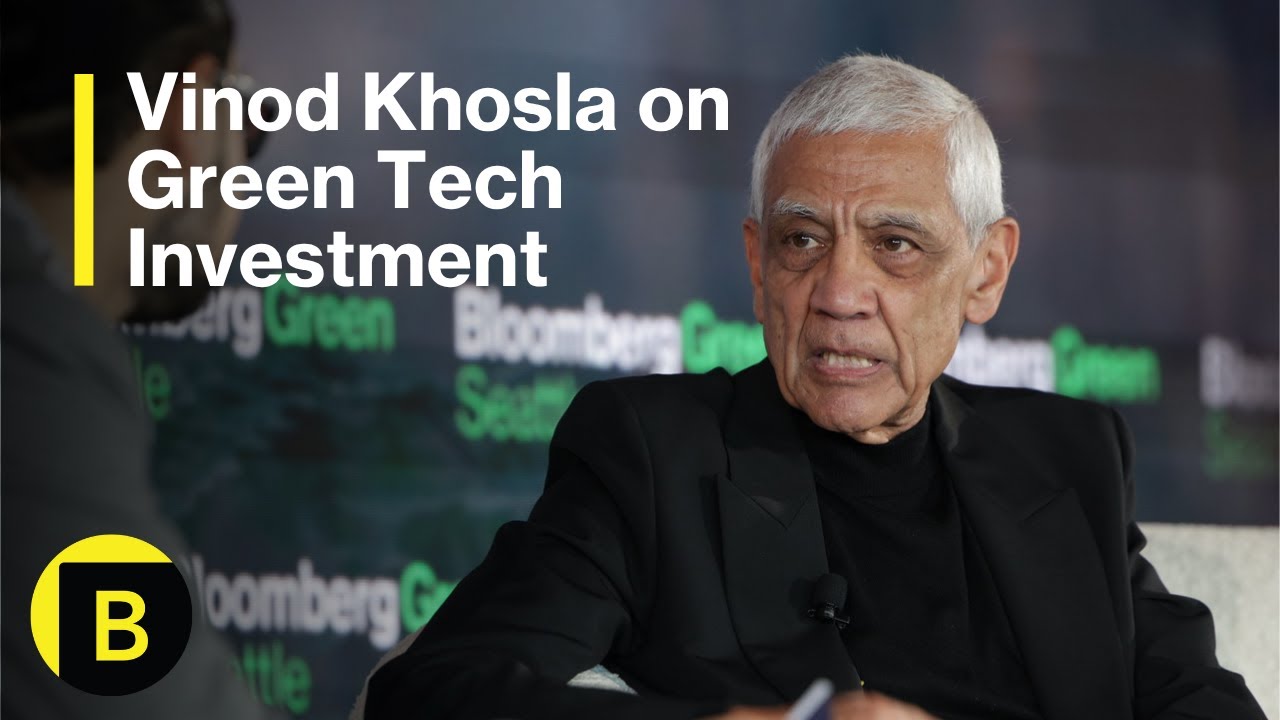
In a live taping of The Zero Podcast at Bloomberg Green in Seattle, venture capitalist Vinod Khosla discusses the implications of the U.S. tax‑and‑spending bill that slashes clean‑energy tax credits, arguing that subsidies should be high initially but phase out once a technology reaches a few percent market share. He critiques the bill’s cuts to wind, solar, and EV credits, suggesting the money is better spent elsewhere. Khosla highlights the main barriers to nuclear power—chiefly NIMBY opposition—and notes that advanced nuclear still lacks policy support. He explains "super‑hot" geothermal, emphasizing the need for drilling technology that can reach 450 °C to unlock far higher energy density, and points out that current geothermal efforts focus on easier, lower‑temperature wells. He expresses strong optimism about fusion, predicting a demonstrable, economically viable plant by 2029, and stresses that only one successful effort among many is needed to transform the energy system. Khosla links rising electricity prices to surging AI data‑center demand and equipment bottlenecks (transformers, cables), arguing that the demand shock, not solar subsidies, drives price spikes. He argues intermittent renewables are still the cheapest source for hydrogen production, but criticizes the "net‑zero for homes" narrative as economically irrational. On talent, Khosla condemns the Trump administration’s immigration stance, warning that reduced inflow of PhDs and engineers will cripple U.S. climate‑tech innovation. He notes that venture capital will increasingly source talent globally, citing examples of relocating Russian scientists to Turkey and the attractiveness of hubs in India and Canada. Regarding investment strategy, Khosla distinguishes between incremental climate‑tech funding (which he sees as largely irrelevant) and breakthrough, high‑risk projects that can achieve cost parity or superiority over fossil alternatives. He cites his portfolio’s work on green steel and cement that aim to be cheaper than conventional products, arguing that only technologies that win on cost will achieve scale. He also critiques fossil‑fuel subsidies and policy bias that favor carbon‑intensive industries, questioning how clean‑tech firms can compete in such an environment. Finally, Khosla reflects on a perceived slowdown in transformational scientific breakthroughs, asserting that venture capital should prioritize high‑impact, high‑risk bets rather than deploying sub‑optimal technologies to meet near‑term climate targets. He warns that the lasting damage of the current administration will be a slowdown in global talent immigration, which will impede the breakthroughs needed for both climate mitigation and economic growth.
Chapters
Good morning, Vinod Khosla. Welcome to this live taping of The Zero Podcast. We are in beautiful Seattle at the Bloomberg Green event.
It is beautiful. It is.
And there's going to be a lot of discussion today about climate change, about what needs to be done to tackle it. But we should start with the headline, which is the tax and spending bill that President Trump signed into law. Is going to reduce clean energy spending by— one estimate— by $500 billion over the next 5 years. And as a result, all estimates show that the U.S. is going to miss its 2030 climate goals. There is much that climate advocates don't like about the bill. But you wrote in a recent op-ed that you are happy that the tax credits that were going to wind, solar and electric vehicles have been cut.
Why? Because there's better uses for the money, very simply. You know, these subsidies, once they start, perpetuate. And there isn't— energy is a serious business. You can't subsidize all of energy at scale. So when do you stop them? I think by the time there are a few percent less than 5% of the market they're serving. Subsidies in every industry should always start, be high, be declining over time, and by the time they are a few percent of a segment, they should be stopped. And the money should go to better uses.
Right. So, you know, the Trump administration has made it clear it doesn't care very much about climate change. But the US Congress, before the bill passed, did protect some clean energy tax credits. So there are tax credits that remain for nuclear, for geothermal. Do you think those tax credits would be enough to get nuclear— well, nuclear, traditional nuclear is already at a high percentage, but we are talking about advanced nuclear, which doesn't really exist today, and geothermal, which again, traditional version is in small amounts, but advanced geothermal doesn't really exist today. Do you think that the tax credits that we do have in the bill will be enough to get nuclear and geothermal to the level you want it to reach?
So each technology is a little bit different. Nuclear's problem isn't that it doesn't have enough subsidies. Nuclear's problem is NIMBYism has held it back. Every pro— nuclear project Takes 10 years longer than you think it will because people like Jane Fonda sue the thing. I always joke environmentalists got more coal plants to be built in this country than anybody else by stopping nuclear in the '70s and '80s. And that is very unfortunate because they're not thoughtful about what's the replacement. So nuclear's problem is NIMBYism, right? Super hot geothermal. There's old geothermal, and I include companies like Fervo and others in old geothermal, essentially below what's called supercritical steam. Steam above a certain temperature, which is around 400 degrees, has way more energy content. So 450 degrees centigrade, well, will have 5 times the amount of energy that a 250-degree centigrade well will. And we have to be realistic about it. So the problem isn't geothermal. The problem is the economics of geothermal. So subsidies will help. But what really helps is developing technology to drill to 450 degrees because normal metal drill bits collapse well before that temperature. So it's getting to the right temperature and the right technical breakthroughs And nobody's doing that today. We have a couple of efforts in our portfolio, hard efforts to go at that. But if you do that, you don't have to worry about climate because geothermal will be cheaper than natural gas, unsubsidized. Subsidies will help, but in fact, it's really not a problem in geothermal. It's just not enough people have worked on the hard problem. They've worked on hand-wavy problems.
And so let's take them one by one because you've invested in nuclear.
By the way, we didn't talk about fusion, which I'm actually very bullish on. I think 5 years from now, nobody will be talking about alternatives to fusion as a power source for the planet for the next 50 years.
Well, you were on the podcast last year and you said in 5 years Yeah, from 2024, there will be a nuclear fusion plant. It's 4 years now left.
Yeah. Okay.
There will be a nuclear—
Well, no, I think I very precisely said nobody will debate whether fusion will work, which means we will have demonstrated positive energy and we will have very clear idea of the economics of a fusion plant.
Right.
And scaling of fusion plants. All those are very, very doable. I expect it'll happen much before 2028. Or 2029, um, uh, uh, uh, 5 years from last year would be 2029. I'm, I'm pretty sure one of the dozen reasonable efforts will prove out that it is going to be a viable energy source. And there's a dozen efforts and only one needs to work to solve the planet's energy problem. Only one geothermal technology needs to work. Vinod Khosla. And I'm a big fan of nuclear, too. It just— it has these social problems of NIMBYism.
But we are talking here within very tight timelines. So if you go back to the bill, again, estimates show that price of electricity is going to go up as a result of these tax credit cuts, but also because of shortages of equipment, simple stuff like transformers, like cables, things that we've covered here at Bloomberg Green. That are becoming a bottleneck to build out the grid for all the electricity demand, especially from AI that's coming. So if electricity prices go up, building power, regardless of where it's coming from, new technologies, old technologies, is hard. Do you think that becomes the bottleneck for the AI ambitions that America has? It's not researchers, it's not startups, it's not investors putting money, Yeah, so I think you're confusing a number of things.
The solar subsidies have nothing to do with electricity prices going up, right? Solar subsidies will slow down the deployment of solar, agreed, but it's still cheaper for intermittent power than any other source of energy.
Yes.
So if you're trying to use intermittent power and come up with clever strategies, for example, production of hydrogen Hydrogen can be done with intermittent power. You want the cheapest power, you want solar and wind to produce hydrogen, but you don't want solar and wind to power a home, uh, because you want to watch the football game when it's on, not when the wind's blowing or the sun's shining. Uh, this is silliness. There's related concepts. Net zero is the worst idea I've ever heard for homes. But environmentalists keep pushing this bad, uneconomic idea as if economics don't matter.
But prices of electricity will go up, not just because of the tax credits, but because of all these bottlenecks that have been created.
So I think the price of electricity will go up because the demand has surprised us and demand projections for the next 5, 10 years have surprised us with the advent of AI. AI is 2 years old. You know, AI didn't have any deployment 2 years ago or minimal deployment, and suddenly it's going to be the large consumer of power. So the change in demand is what has caused the problem. Now, nimbyism, like grid again, is going to be a problem, but data centers don't need the grid. You can put the data center where the power source is. If you— so I do think grid helps, but the demand problem is created by the projected increase in demand from AI data centers, which can be located near power sources.
But the challenge with the AI data centers is that they want power all the time. And so you're going to build solar next to the data center. You're not going to be able to run it all the time. And that's why they're relying on gas, which is getting harder to build because gas turbines are difficult. So the question is, do you worry about the fact that America's competitiveness on AI will be held back because of energy issues broadly, not just renewables or not? It's price and the ability to—
I do worry. Talked about data centers a lot. Um, I think the answer to that is scaling capacity. I do think super hot geothermal is a perfect technology for that. 2035 on, it'll all be fusion as the scaling technology and super hot geothermal, hopefully nuclear too. Uh, but again, citing nuclear is very hard. So But you can put a data center right next to a nuclear plant without needing a grid because that's the right way to do data. So data center demand is different because it doesn't put as much of a tax on the grid if it's not attached to the grid and if it's attached to a power plant on its own. Yeah. Now, or close by.
Yeah. Now you invest in a lot of companies that are American, that are started here, that are startups over here. Those companies are created by people, often, who have come to this country, like you came to this country, and there have been, over the past 6 months, difficulties. University funding has been cut. This bill cuts a lot of science funding. Do you think— do you worry that the level of ideas that you are able to get hold of to be able to invest in these companies is going to reduce, and that, again, affects America's competitiveness?
Yeah, look, most of you should know I'm— vehemently against Trump and the current administration and its value system. So, you know, even though I agree with certain things they've done, I mostly disagree with their policies, immigration being one of them. So they will shut down the import of talent, which is the key to growth. So if I were to look at— and I had an op-ed in The Economist a week ago, and just this week Chris Wright, the Energy Secretary, had another op-ed. You know, he said all we need is energy. I do think we need energy, but we need more importantly talent. And talent they're shutting off with their approach to immigration. Even the people who will legally immigrate don't like a hostile environment to go into. So we will reduce talented immigration of PhDs and people equipped to solve climate and other technology problems into this country, unfortunately.
And what will you do as a result? You're an investor. You invest in companies. You have capital that you want to put towards these ideas. Do you just go outside America?
Well, absolutely. I look, people are anyway going outside America. And so most companies have multiple locations within America and outside America to go seek the talent. You know, when Russia became a pariah with the Ukraine attack, people set up new offices in Turkey to get Russian scientists to move from Moscow to Turkey. So they could take advantage of them because the scientists didn't want to work aligned with Putin's regime. So talent will flow to wherever they're welcomed and they're very much in demand. I mean, the, some of the salaries in this AI space, $250 million a year, it's a million dollars a day. Uh, those numbers aren't unheard of. In fact, they're sort of becoming more common than I'd like to see. But talent drives everything, maybe even more than energy.
And so are you starting to do that? Are you looking at startups in other countries?
Well, we've always looked at startups in all countries. Yeah.
And which countries are—
I think the bulk of our effort is in the U.S. still and will continue to be. But we look at talent everywhere.
And where do you think are the emerging hubs?
Well, leaving aside China, because I'm very hawkish on China, I think there's some evil regimes on this planet. India's a great hub. Canada's a great hub. You know, there's a lot of talent in Canada. AI started around Toronto, in that area. So a lot of talent there. But frankly, talent everywhere is being repurposed into this AI domain.
Now, if we stick to climate tech, the level of investment has been going down. Just total investment in climate tech has been going down for quite some years. The latest figures that we have for the first half of this year is $13.2 billion invested in climate tech. That's down about 19%. You invest in a lot more than climate. Has your own spending in climate tech gone down as well?
No, I think it's been pretty consistent. The thing you have to forget is these aggregated numbers are mostly irrelevant to somebody in my part of the climate world, which is breakthrough technologies. So my personal view, unless you have breakthrough technologies, you're not going to get broad deployment. Even if you did regulation in the EU and you got shut down all their steel mills, um, they're going to get steel from somewhere. And that's not going to come from a country that's adapted green steel at twice the price. So most of the efforts on steel, are relatively poor efforts. This— in Sweden, there's a green steel effort. There's a couple of steel— green steel efforts in this area. I think they're generally poor efforts. Why? Because when they're successful, they are not cheaper than regular steel. We have efforts whose only attempt is to get cheaper than regular steel and have low carbon emissions. And it's an and, not or. And that's what's key for broad deployment of any of these technologies. So my point, and that doesn't come for free. We have a much higher risk of failing because we are taking much more technical risk. In steel, we are taking way more technical risk than anybody. But I'm pretty certain we have steel solved. Our steel will be cheaper than coal-based steel in this country or in China. If that's the case, there's no reason whether you care about climate or not, uh, to build anything but the cheapest steel. And we can use the cheapest ores. The low enrichment ores are what matter because they're cheap. And they make your steel cheaper. Same thing in cement. Our cement plants, and we are repurposing cement, are actually cost less per ton for far lower carbon. But the far lower carbon comes for free. And that is my point. Taking more technical risk is not about billions. It's about millions. Taking small amounts of money on projects that most likely will fail, but if they succeed, they change the world, versus things that are incrementally better or better than anything else, but not good enough to compete with fossil.
So I want to come to breakthrough technologies. But there's one point that you make. So in your op-ed, you talk about green steel, green cement. You talk about geothermal and nuclear. But these products require a market that, you know, if it's cheaper than the alternative, you don't need to worry.
It wins.
It will sell. But you are also entering a space in the Trump administration that is biasing the market for more carbon. So, there are tax credits for oil and gas drilling. There are tax credits for metallurgical coal in this bill. Now, venture capitalists, not just you, but others, have told me, like, "We don't invest in companies based on government policy." We'd like the companies to, you know, succeed on their own. But when the market is being biased for carbon, how do you compete?
And how— Yeah, no question the fossil industry is on the in in Washington, D.C., and they've received trillions of dollars of subsidies over time. Whether you're talking about a favorable tax policy like MLPs or master limited partnerships or advantaged tax treatment. Or the billions and billions or hundreds of billions we spend providing security for oil in the Middle East. That's a subsidy because we are providing security to oil lanes. Those are all subsidies in my view, but the current administration won't acknowledge that. So what, what can you do?
So then let's come to the breakthrough technologies part, because, you know, one reason you won't invest in a company is it's not going to be profitable. But another and a more intriguing explanation— this is something you've talked about, but also your fellow Silicon Valley billionaire Peter Thiel has talked about— that regardless of the politics, the pace of truly transformational breakthroughs in science and technology has been slowing down. Do you agree?
Um, I do generally agree. Uh, and people are looking for easier. So mostly in business, people look for lowering the probability of failure, even if it lowers the consequences of success. My personal entire life is dedicated to— I don't mind the probability of failure, but I want the consequences of success to be consequential. If I have a cheaper steel, if I have 10 efforts and one of them produces cheaper steel, uh, it makes up for all the other losses. Now, this is the technology that not only is the steel for the world that's low carbon, but it's also American manufacturing prowess, uh, in, in exports and all the good things any traditional business person would recognize. I think we have that in steel done. I think we have that done in cement. I think fusion will get there very likely. Super hot geothermal will get there. These are core technologies. And, you know, as much as I'm not a fan of Elon, he's done a good job with EVs. There's no chance any policy would have achieved what he achieved by just betting on EVs.
So if we take, you know, you talked about some environmentalists who have, you know, stopped nuclear plants and as a result have ended up building more coal power plants. You know, you could break up the environmental movement in many parts. There are, you know, different philosophies. One of the philosophies is what is yours, which is you have breakthrough technologies and because they are cheaper, the market for those technologies wins out. There's another philosophy, which is we already have most of the technologies, not all of them, but most of the technologies that we need. We just need to build them out and build them out quickly. Now, if you are worried about breakthroughs declining or slowing down, would you be betting on, well, let's double down on what exists and deploy?
No, that's a silly notion. And a few people have pushed that idea and it's a bad idea. In fact, 2 years ago for, I think, 2022, I had an op-ed in The Economist that fundamentally argued that to get to zero carbon emissions by 2050, we'd have to give up the goal, give up the goal for lower emissions by 2030. Because if you're deploying poor technologies more broadly, we have less money to deploy breakthrough technologies and less money to invest in breakthrough technologies. So we can shoot for 2030 goals or 2050, much better for the planet. And of course we don't know how much time we have on, on the planet before we get exponential increase in temperatures and climate effects. It's better to develop the right technologies and deploy them broadly than take what we have and try and deploy them. We saw the disaster in Spain's electric grid not very long ago. That can happen here too. So I do think we need to be very thoughtful and very business-like. Even if we do it, India is not going to do it today. India is one of the fastest growing solar markets, but coal is growing faster. More coal is being deployed than is ever being deployed before. And that same is true, I think, similarly of China. And so we can look at the solar numbers, which have been climbing, but it's because total demand for energy is large. And some things work with intermittent power, and we— it's cheaper to do intermittent power, so we should do that with intermittent power. Other things have to have reliable power.
So Spain and Portugal are spectacular examples of countrywide blackout and, you know, make headlines around the world. But there's an OECD ranking of countries that suffer outages and the number of hours that are lost because of blackouts. The US ranks 5 ranks higher than Spain when it comes to just reliability of power. But let's take the last question. Our time is running out. What do you think is the kind of lasting damage that will come from this Trump administration?
We've had—
this is the second term. And if there is a more climate-positive president at some point, what can be undone?
I think the biggest damage is the slowdown in the import of talent from all parts of the world. That's immigration. Because that reduces our ability to have the kinds of breakthroughs that make the economics possible that will give us the technologies that can solve climate and economic growth together.