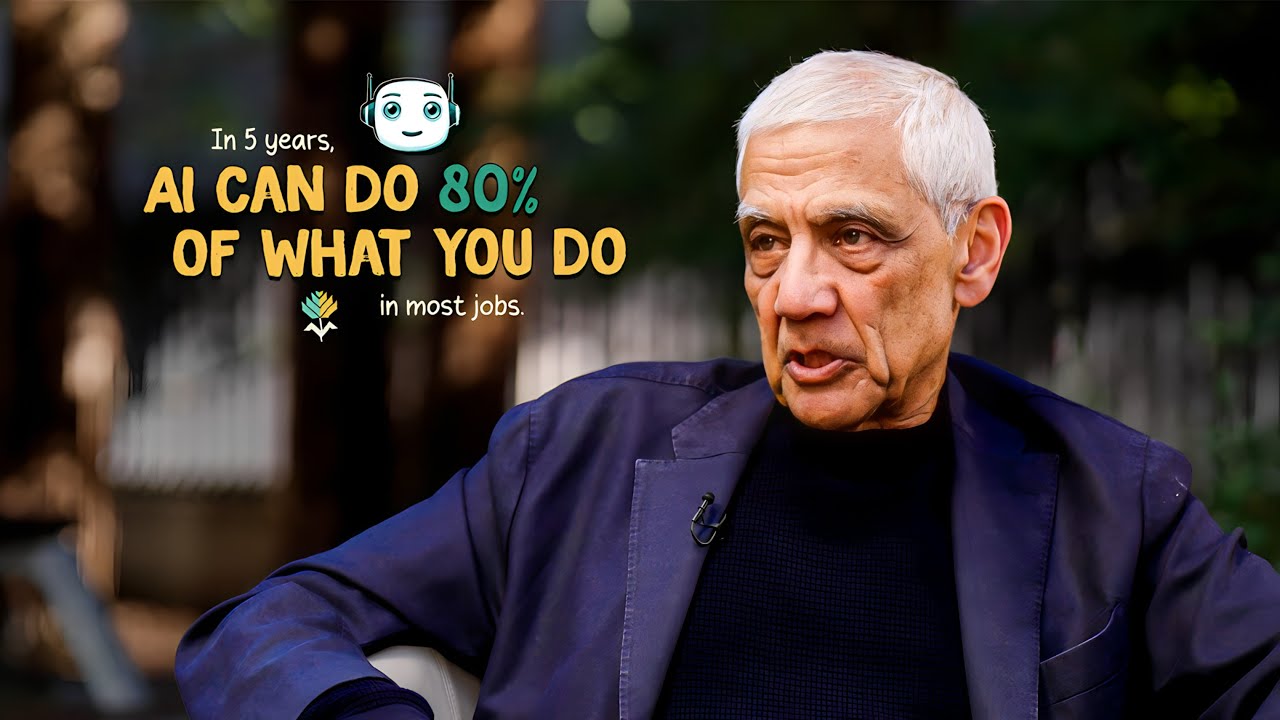
Vinod Khosla tells a 22-year-old that AI will handle 80% of tasks in 80% of jobs within three to five years, making specialization in a single domain obsolete. The only skill that matters is learning how to learn and thinking from first principles. Your first job barely matters; what counts is staying flexible and building the ability to adapt.
Chapters
Assume I'm a 22-year-old boy or girl in India. I want to learn from Vinod, who has done a spectacular job of calling what industries might do well tomorrow. I want help from you in figuring out where I should spend the next 10 or 20 years of my life. Which industry should I work in, in terms of a job, or which industry should I start a company in?
So now you come to a very hard question. You know, if I'm 20, by the time I'm 35— Yeah. —the year 2040, the world will be more different from today in 15 years. Well within the lifetime— if you go into medical school and take 5, 6 years doing that, you waste half that time. Than the world is today from 1970. So you'd have to look back 55 years, 50 years or more.
Why don't you call 5 years for me? I want to learn from you in making my career choice today. So if 10, 15 years are too far ahead to extrapolate, I'm 22 today. Tell me for when I'm 27, 5 years from now. So the answer is the same for both.
Right. Sorry, long-winded, Vinod Khosla.
Right.
The point I was making is we'll see more change in the next 15 years than we've seen the last 50. And 50 years ago, the world, especially in India, was a very, very different world. You know, in 1970, I never had a TV at home or a telephone at home. Like, even when I left India, I'd never had a telephone or a TV at home. Right. Right. It wasn't something that was in most homes. In India, or running water or very basic things. And that's how different the world will be in 15 years. Almost certainly, with no doubt, there isn't a job where AI won't be able to do 80% of 80% of all jobs. So 80% of all jobs, AI will be able to do most of it within the next 3 to 5 years. So now I'm getting really in. So if you look 10 or 15 years out, there's no chance there's a job that humans do that AI can't do almost as well, with some minor exceptions, which I I think today I have a hard time saying will happen for sure for regulatory or other reasons, like a heart surgeon or a brain surgeon. But even those, AI will be able to do it better than a human, but regulation may not allow it. Right. But leaving aside those exceptions, the vast majority of jobs will be done will be capable of being done by an AI. Mm-hmm. And that's what today's 20 or 22-year-old has to take for granted. So what matters? The first, the single most important thing that matters is not specialization in an area. I don't learn welding. Or I don't learn finance. I learned the ability to learn, be able to move around rapidly as the world evolves and learn rapidly. And I have to say today at age 70, I'm learning at a much faster pace than I've ever learned in my whole life, ever. And every 20-year-old should strive for this ability jump into any new area, whether it's a physics problem or a biology problem or a finance problem. Just this ability to think from first principles and learning new areas, 'cause ChatGPT can teach you any new areas. Mm-hmm. And AI will have that capability to be able to leverage these things well. So I would say you have to optimize your career for flexibility, not a single profession. Okay. That's the most important advice because you don't know what will be around. Almost certainly this interview could be done without us physically meeting on real video generated by an AI. And the AI may be directed with what camera angle somebody wants.
I hear you, Vinod, when you say the rate of change will be faster. I'm going to, as a 22-year-old, be more adaptable and flexible. I still need to make a choice today. Do I work in an IT services company? Do I work in a nuclear fusion company? Do I work in a data center? I still need to pick.
Yeah, so I do think it almost doesn't matter where you start. Right. Okay, I'm saying first, education is going to be valuable to have, to learn how to learn, not to be good at one thing like being an accountant or a chartered accountant. Right. That's not going to be important. But that education, the process of learning how to learn. And in fact, one of the best things about computer science isn't that you can learn, you know, programming. Because, you know, Google's gone from 0% AI-generated code to, I think, the last claim, 35% of all code being written in Google. Is being written by an AI. But it's the process of thinking that computer science teaches you really well. And learning architectures and systems and system— some of those things are about learning to learn. But you can do it in a number of areas. So it's not just computer science. So I would say there's a wide range of things, but keeping your lens zoomed out for the widest angle is sort of the way to think about how you should go about your career.
So you're saying don't be a specialist, be a generalist.
Be a generalist, not a specialist. Absolutely. Right. And learn how to be a generalist. Learn how to use AI the best. And we may be, you know, maybe it'll eliminate all jobs, AI will. But the fact is for certain, the people who don't know how to use AI will be obsoleted by people who know how to use AI first. Right. And there, if you're dynamic and learning, then you can move with whatever's happening in the world. I would say the following. It's just because we can't predict the future doesn't mean it won't be dramatically different. We just don't know what it will be. I like to say something else, which is most people, most of the time, assume improbables are not important. Mm-hmm. I've always assumed the exact opposite. Only the improbables are important. We just don't know which of 1,000 improbables is important. So what do you do in that case? You go for agility. You follow trends, you move around, you be more adaptable and flexible. You do most— more first principles thinking. It's a very different way of growing up, whether you're 20 or you're 60 or 70. And, you know, clearly I'm learning more now, as I said. And so today I feel like I can have an intelligent conversation around cell therapy in biology or about fusion. I can do both. Or about Carnot efficiency in steam engines, which we discussed today for some aesthetic reason, you know, um, certain fundamental things, uh, you, you have a broad knowledge on which you can build other knowledge. So what is that pedestal of knowledge you acquire, and how do you keep expanding it, is very, very important. Most people stop learning, and I think I would say, you know, if you get a job as a waiter at a restaurant, 20 years later, you haven't gained a lot more expertise that you didn't gain in the first year as a waiter at a restaurant. You're not exponential compounding of your capability. But other jobs, if I pick the right one, your knowledge compounds and your capability compounds over time. So I would look at basic principle of financial compounding in, in knowledge and job capability as a young individual. What will make it compound? And then you have to intersect that with what's interesting to me. What do I have passion for?