Vinod Khosla’s View on the Global Race in AI
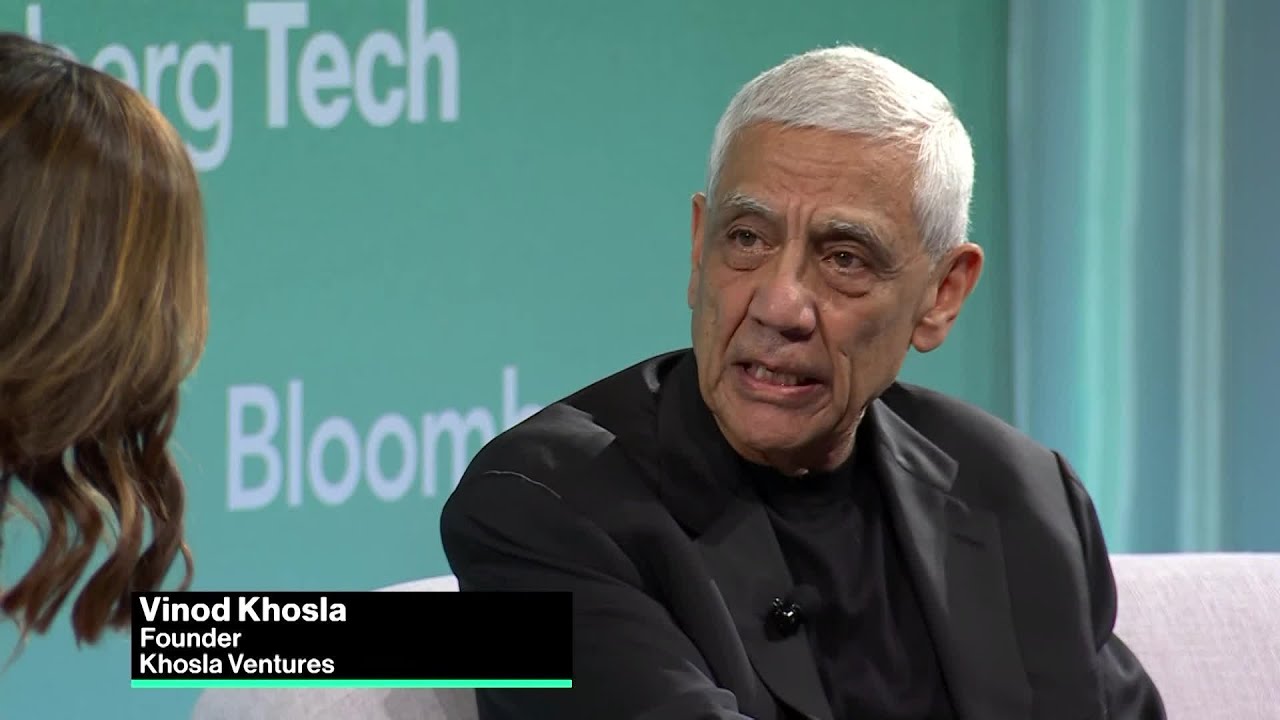
Vinod Khosla predicts AI tutors for every child and free AI doctors for all Americans, warns that open-sourcing models like Llama 3 lets China weaponize them, and sees a global race between frontier models and localized AI systems in Japan, India, and elsewhere.
Chapters
Please welcome to the stage Vinod Khosla, founder of Khosla Ventures, for a conversation with Bloomberg's Emily Chang. Good morning. All right. We're going to get right into it because you have a very special guest coming to your house tomorrow. You are hosting a fundraiser for President Biden. What is your message to the president?
Well, Of course, my message to the general public is I'm a huge supporter of President Biden, and we have to absolutely at any cost make sure that that donkey's rump, Trump, doesn't get elected and destroy democracy. It's not Republicans versus Democrats. It's Republicans, Democrats, and assholes.
Good thing we're not on live television. I think we would have been fined for that by the FCC. Well, clearly you're worried about the outcome of this election.
It's a close election. Mm-hmm.
The polls are a little worrying if you're a Biden supporter.
I think they're pretty even and they're very, very nuanced on the narrow states. You know, last time I mostly got involved in this, in the election in Wisconsin. Michigan and Pennsylvania, only targeting a very narrow segment of above-50 white male voters. That was the only thing I got involved in. And I think 10,000 votes here or there makes a difference. And so it'll be that kind of pincer approach.
What's the message about AI?
The message about AI is it has great possibilities and we ought to leverage it. One of my messages to the president should be that every person in the US should have free primary care offered by an AI, not by a physician, and complementing physicians 24/7. Every child in this country should have a personal tutor that will do more for both healthcare and for education than any other single policy period. And this can be done during the next term.
That leads me by what's on the menu. Is this a lobster or rubber chicken kind of a—
I have no idea.
Well, that leads me to your 12 predictions. You just put out this really fascinating list of predictions. I highly encourage everyone to read it. We don't have time to talk about all of them, but I do want to start with the first one.
Ted will be publishing the video very soon.
Okay, good. 24/7 free doctors and tutors on demand.
Not free doctors, free primary care 24/7.
And, and to me, AI doctors, by the way.
Okay. Yeah.
But how accurate and reliable will these doctors and teachers be? And will they replace real doctors and teachers?
So one of the things about AI systems is the more you use them, the better they get. Think Tesla self-driving, which I love now. It was pretty erratic 4 years ago. Almost certainly they'll be much, much better than the median doctor, especially if they're complemented by doctors and they are under the oversight of doctors, at least for the next decade. I think we will have human oversight over AI systems, whether you're building a doctor. And my general view is All expertise will be free. So we will see doctors, human doctors oversee the diagnosis, the prescriptions, all that for patients. And we will have much more frequent contact with the patient. In this country, we do one patient visit per, per citizen per year with a primary care doctor. Australia does 4. So we had to multiply it by a factor of 4 or 5. We need AI to do that level of care.
Now, you are not only— were you the first investor in OpenAI, you are investing a lot in different AI models around the world. So we're going to talk about that. But it actually means it's a good opportunity for a poll. Which country is the biggest competitor to the US for AI development? So please, everyone vote. China, India, the UK, or Canada. And we're going to wait for the results. But what we're seeing is a number of different countries develop their own AI models in their own natural native languages, sort of sovereign AI models, if you will. So my question is not a surprise. Folks think China is the biggest competitor. Will each country have their own version of OpenAI or whatever AI, or will there be one world dominant leader?
I think there will be world dominant models, frontier models, state-of-the-art models that everybody will use, and there will be models in countries. So we are investors in Sakana, which is a kanji-based model for Japan. We investors in Sarvam, which is focused on the 13 scripts in regional Indian languages, and there's a couple of hundred languages capturing the culture and context of those local countries. I think we will see regional nuances to the model.
So I guess my question is like Google is sort of the search engine for the world, except in China and maybe Russia. Like, will there be a Google for AI or will it be more distributed than that?
So my hope is there'll be 3 or 4 or 5 frontier models, state-of-the-art, very large models that cost billions of dollars to train and work, and everybody will use them. And there'll be regional models and regional script, regional storytelling, regional factors. And there'll be 20 of those.
I'm curious how worried you are about China and our ability to compete, the US ability to compete with China. You were very vocal about the TikTok divestiture and you see this as sort of a small part of this looming techno-economic war. What is the role that TikTok plays specifically and what are you most worried about?
You know, the funny story is I think it was a couple of years ago I first talked about the techno-economic war with China on Bloomberg. I was supposed to speak to the UN about technology benefiting humanity, and some nation— we can guess which— vetoed me speaking at the week before I was supposed to speak. They don't like talking about techno-economic wars.
China.
China. Yes, there's no question. Who dominates technology in the 20 years from now will depend upon which country has the best AI models. And so we are in a war. And this is not about war. It's not about weapons. It's not about cybersecurity.
It's—
I was opposed to TikTok because persuasive AI in the hands of the Chinese Communist Party influencing teens in this country is a very long-term important play for them, which is why they said, why would any nation— algorithm for TikTok is a state secret or something like that. So we are in this war. Whoever wins the AI war, and let's not make any bones about it, will win the economic war globally. And because of winning the economic war, socially influence the rest of the world. So the political system for the planet is probably dependent on this risk. And that's why I think open sourcing state-of-the-art models like Llama 3 should not be open source. It's a national security hazard to open source.
Hang on. I think Chris Cox, the CEO of Facebook, is actually here. Would you like to say Did you say anything to him? Meta, meta.
We were talking backstage about this.
Does he share your concern?
I won't comment. I'll tell you my view.
Right. Well, okay. So what are the consequences of open sourcing Llama or AI in general to the world?
You know, the Chinese can catch up, take advantage of open source. Mistral essentially copied what Llama 3 had done. I'm almost certain the Chinese did the same, and I won't mention another area of technology, uh, in the area that I'm very familiar with, that's deep technology, uh, and I won't name names. They were publishing their research and China duplicated that program within China. When— and Anne, who spoke before me, should pay attention— when they stopped publishing, the number of cyberattacks on their company went through the roof. So China is using these— this tradition of open-sourcing knowledge to their advantage, and we shouldn't let that happen.
You were one of the—
sorry, I'm very direct.
I know that's why you're here. One, you were—
by the way, I did give Zhao a heads up I'd be publishing the op-ed I published in the Financial Times on why TikTok should be banned. He did give me a response.
But what was the response?
Let's just say we agreed to disagree.
Okay. So you were one of the earliest investors in Google and We're actually going to see my 1998— not exactly. You're— I know you're close to Larry and Sergey. You're going to see my interview with Sundar Pichai a bit later. But now you're also very close to Microsoft and you're an investor in OpenAI. I know you and Satya are close. Who wins in generative AI? Is it Google or Microsoft?
I believe this field is too large for any one company to win. I do think there'll be multiple players. And people lament that only the big guys are doing these frontier models. Clearly, there'll be multiple winners in frontier models and then there'll be lots and lots of winners in application areas. So we probably have 50, close to 50 investments in AI that don't get railroaded by frontier models as they advance. And people aren't being very thoughtful. But I'm very, very focused on what's enabling for AI. You know, I have my Rabbit device.
Oh yeah. By the way, let's talk about this. So because— wait, before you go on, because I asked Sundar about AI-powered hardware and he really doubled down on smartphones and glasses and didn't seem so psyched about new form factors.
Well, you know, they may be focused on those and they They've been focused on glasses, and glasses will be an important form factor. But it's— we shouldn't think of these as hardware. I wrote an op-ed in The Information on that. We should be focused on the fact that when Steve Jobs introduced the iPhone, touch became a viable way to build an interface for humans. I think what is fundamentally going to happen is in the past, humans have had to learn computers, learn how to run SAP, learn how to insert a row in Excel or do an Excel macro. I think the next generation, computers through AI learn humans. And so I'll be talking to a device like this and saying, do this for me. I'm going to X place next. In fact, I have a meeting in the city. Just make sure I'm on time. It has to look up my calendar, know where I'm going, look up Google Maps for traffic, look up Uber to say what's the time that Uber takes to arrive here, and then all that puts it together and make sure I'm not late. So that kind of advice is what's going to be important. Let me put it this way. We often talk about haves and have-nots in technology. And technology has been disenfranchising for a lot of people. AI-based voice interfaces will be— it will be a new form of enfranchisement, even though that's not a word for people. It'll be a whole different level. You know, older people don't have to adjust. They'll just talk to devices like this. Also, new formats will be available. One of the formats that's— I know we are almost out of time.
Yeah, it says zero, it's flashing, really.
Yeah. I'll ignore it. Look, one of the formats taking off in Asia is watches for kids. Kids should have a watch, not a full cell phone.
I agree.
For example.
Totally agree, absolutely.
Will this kind of a device show up in a watch that you talk to in voice? Yes. Mm-hmm.
Okay. Now I'm going to get in trouble because I have one last question. You have had some words for Elon aside from what he's done in electric cars and space. Is he going to be a real player in AI or not?
Well, I'm a huge fan of Elon. I believe electric cars on the planet would not have happened if he hadn't pushed his unreasonable views. And all human progress depends depends on unreasonable people. So I'm a huge fan of that. Look, no, that's not an original. I think who— George Bernard Shaw said reasonable people adapt themselves to the world. Unreasonable people try and adapt the world to them. Hence human progress depends on the unreasonable man, he said. He should have said, will he do it again in AI? It's possible. I mean, look, guys achieved a lot in a lot of different areas.
He's got some things right, of course, but some things wrong, as you've said loudly on Twitter.
Vinod Khosla, right. He's gotten right SpaceX. He's gotten right. We compete with them at Rocket Labs. But I think the Boring Company is poorly thought out, for example. So he has done things right and wrong. More than not, I would suspect he can achieve what he wants. So I'd give anything he attempts some probability greater than 2/3.
Even Grok.
I don't know enough about the specifics of Grok and how committed he is to the kind of AI we need. Now, Tesla full self-driving is amazing AI. I can go from anywhere to anywhere by just telling it to take over. I love that product.
Vinod, we'll have to leave it there. Now we're really getting yelled at. Thank you so much for joining us. Good luck at your fundraiser with the president tomorrow.
Great to be here. Thank you, everybody.
More from Vinod




EXCLUSIVE: Vinod Khosla warns AI will upend jobs and healthcare sooner than expected | GSIF 2026




Vinod Khosla: AI Tutors, Doctors & Farmer Experts For 1.5B Indians | AI Summit 2026

India AI Impact Summit: Vinod Khosla on Why 2047 Could Free Every Indian from Survival Work


‘There Will Be A Lot Fewer Jobs In 20 Years…’: Billionaire Entrepreneur Vinod Khosla On Impact Of AI