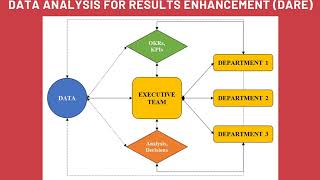
In this segment, the speaker expands on how data should be the foundational element of any business’s strategic planning, especially within the healthcare sector. The discussion begins with the importance of reviewing historical and market data to understand past successes and failures, and to ensure alignment with the organization’s vision. The speaker emphasizes the need for collaboration between a data science officer, the CFO, and the CTO to translate data insights into actionable strategy, rather than treating data as an afterthought. Specific attention is given to healthcare data privacy and policy constraints, warning against using data without proper authorization. The speaker references a model (and a related blog post) that positions data at the base of decision‑making, supporting executive teams with quantifiable, SMART‑goal‑driven insights. A cyclical process is described where data quality and insights are continuously refined, enabling the organization to identify low‑hanging fruit, understand why successes occur, diagnose failures, and iteratively improve performance.
Chapters
—on what Virginie Glaenzer and Michelle have laid out. One of the things that I'm sure you all heard coming up multiple times is data-related terms. And I'm trying not to make this super boring because we could keep talking about ROIs and deciding which people need to be retrained, moved around. But the point is that at the bottom of any business, whether it is successful or whether it has failures in it, is data that captures this information meaningful? So the first step that I would do if I was, you know, working with Dama Dama would be to look at their historical data. What were their successes? What were their failures? Why did they succeed? Why did they fail? Look at the market data. Is it connecting with what their vision is? Kind of going back to what Michelle and Virginie said, we, they, if you're strategizing, if you're planning, it is important to look at who you are serving, right? Looking at marginal costs and benefits. Is a service or a product that is being used by the company working? Because sometimes you can hire a service thinking it's the most efficient way to do it. You haven't considered what else could be out there. Financial data typically is handled by the CFO, but that's where a data science officer would go in and work with the CFO, the CTO, be like, all right, what does this mean for us? How do we go from here? Where do we go? And making the recommendations as a part of the strategy and the planning rather than an afterthought. Right? And most importantly, because this is the healthcare industry, what needs to be considered is you might have data on people or customers or clients, but does the policy allow you to use that data? Because if you're using data that you're not allowed to use, you are exposing yourself to a lot of other risks. So taking all of that into account, My data model, and Ikorno has a wonderful blog post explaining this in more detail, is where it takes the data and places it at the base, at the foundation of a lot of the decision-making. And the reason that is the case is this is where the treasure is. All the strategies, all this brilliance that is in the executive team, requires access to something that can help them quantify, help them measure, going back to the SMART goals, going back to the categorizing and prioritizing, finding what is the low-hanging fruit and making those decisions. So let the executive team be in the center, but with data on the one side and the departments on the other, And there's a cyclical circular process that can be followed to continuously improve quality of data, improve what insights we are getting from the data, and making the decisions that are data-driven, not only because we want to call them data-driven decisions or, oh, we use Google Analytics. No, but because you want to know why you're succeeding when you succeed, and why you're failing when you don't succeed, and how to get past those failures with the help of this treasure of information that your company already has.