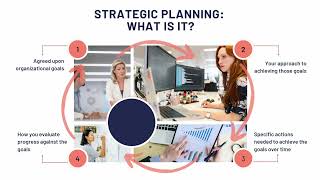
The speaker outlines strategic planning as a four‑step, ongoing process. First, an organization formally agrees on a set of goals, which may stem from a founder’s vision or a discovery process. Second, it develops a strategy that translates those goals into overall priorities and approaches. Third, it creates a detailed plan that documents specific actions, timelines, and responsibilities. Fourth, it establishes measures to evaluate progress against the goals and the plan, using those insights to refine both the plan and the goals themselves. By repeatedly cycling through these steps—approach, action, measurement, and reflection—teams become more efficient, gain clearer vision, and learn purposefully, continuously improving their strategic alignment.
Chapters
In its essence, it's really just 4 things going on on a continuing basis. And so one is the organization formally agrees on a set of goals, and these can be dictated top-down from the vision of the founder, It could be done through some sort of strategy discovery process where you do a lot of different research, but you have goals and you agree on them. And then you develop an approach for how you're gonna achieve those goals. And that's the strategy piece of it is going from the goals to the how are we gonna think about overall, what is it that we're gonna prioritize? And then making that into specific actions that need to be taken over time, which is your plan. It's actually writing down, documenting, and being very clear on how you're going to go about when you're going to do what. And last but absolutely not least is also agreeing on how are you going to evaluate your progress against those goals, not just in terms of your plan, but also other measures that you're going to be putting in place to see whether or not your plan is working. And as you go through the cyclicality of this, so you figure out an approach, you start to take action against it, you measure if it's working against your overall goals, you start to now discover not only is your plan and approach the right plan and approach to get you to your goals, but also are your goals actually the goals that your organization benefits from the most? And so if you do this process continuously over time, your team gets really good at actually being more efficient and having better vision about the things that they're doing. Learning from the experience in a purposeful way. So that's really the essence of strategic planning.