Full Episode #3: Rethinking our Gender Identities in The Age of Fluidity
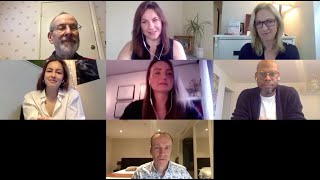
Virginie Glaenzer hosts Jennifer Brown, Mark Sherman, Leah Glaenzer, Jason Rosario, and Michael Flood discussing how gender identities are shifting. Martina Albertova calls it a "meaning crisis" from the collapse of old cultural foundations. The panel examines how media, workplaces, and toxic masculinity shape gender norms, and explores frameworks like gender justice and degendering society.
Chapters
Okay, well, welcome to Pass the Mic podcast with Martina Albertova, who will lead our conversation on the topic of gender identities with one key question: how can we rethink our gender identities in the age of fluidity. Now, Pass the Mic podcast is not only about sharing different perspectives on a specific topic to help us expand our understanding of the world, but also maybe explore new ways of looking at it. My name is Virginie Glaenzer, and I'm your host with a million questions. Before we start our conversation, let's begin as we always do with what I call a tour de table and have each of you tell us your name, what you do, and why you're interested in this topic. Let's try to be brief and keep your comments to 1 minute. So let's start with Jennifer.
Hi, everybody. It's Jennifer Brown. I run a consulting company called Jennifer Brown Consulting. And I have 2 books. My latest is behind me, How to Be an Inclusive Leader. We focus on organizational diversity and inclusion strategies. And my interest in the topic of gender as a member of the LGBTQ+ community is, and as a woman, is, you know, how can we move beyond the binary definitions of gender and have a truly inclusive framework and language to use when we refer to our gender identity and also our gender expression. And it's something that I think about a lot. I think about how my gender expression is perceived in the world and how it impacts the message that I'm here to deliver, as well as how it affects others in terms of our credibility and our confidence and how we need to role model an inclusive definition of all of these things. So I'm really excited for the conversation today. Thanks for having me.
Thank you, Jennifer. Mark.
Oh, me. OK. And if I don't seem to be looking right at people, it's because my camera's in a different spot than I'm used to. I'm Mark Sherman. I am an emeritus professor of psychology at the State University of New York at New Paltz. And I became interested in gender probably in the mid-1970s. My first interest was on an aspect of sexuality that had never been really discussed before. Resulted in a book by a male colleague and I called After Play: A Key to Intimacy. And it was an example, by the way, the fact that a couple of men knowing pretty much nothing began to understand something that women were very well aware of, the importance in sexual activity of what comes after, so-called after. I then became very interested in male-female communication and wrote a paper in Psychology Today that had a lot of attention. And I was always fascinated by what was going on with women. Now what happened fortunately, is in the early 1990s, I began in my research and observation to see that boys and young men were struggling. And what I also noticed is that nobody seemed to be noticing that at all. And it really troubled me deeply. It's now been 25 years. I have not seen a radical change. In that interim, through a genetic quirk, I have had— my first son was born in 1964 in my first marriage. I have had 3 sons, um, I have 3 sons and I have 5 grandsons. So I have to admit that along with my academic interest, um, there's a very heartfelt human interest in the well-being of my children and my grandchildren, all of whom happen to be male. And so that's a problem I have, is that males these days, it seems to me, my observation is, are really not talked about in a very becoming way, and it troubles me. I also will say one more thing very quickly. Unfortunately, this is a difficult field because I see the other side, and I realize, being probably the oldest person in the meeting here, that things were really not good at all in the '60s and '70s. I think they've improved, but where these concerns came from for minorities, whether it's racial or gender, is well felt and very— I really do understand this. So it puts me in a difficult position, but very important stuff.
Great.
Thank you, Mark. Leah?
Hi everyone. I am— is this loud enough?
Yes.
I am Leah Glaenzer. You might recognize the name from the host of the podcast. I am Virginie's first daughter, eldest of three, so I am a junior at Bard College right now, which is in upstate New York in the Hudson Valley area. My interest with gender, I suppose, is not as purposeful as some of the other people present here, because I feel like I— it's a question that a lot of people in my generation are asking themselves already. So I work for Bard's Office for Gender Equity, which deals with gender misconduct policy and the Title IX policy, so I've become quite familiar with how to continue education about gender and sexuality on a college campus. And that's my experience thus far.
Thank you very much. Jason?
Yeah, well, good morning everyone. Thanks again for having me, Virginie Glaenzer. This is, this is incredible. My name is Jason Rosario. I rolled my Rs on purpose. I am from the Dominican Republic, born here in New York City, and I run a social impact and creative agency called The Lives of Men, which essentially does Men's Work, we work with brands to help unlock the best of their brand from the inside out. Externally, helping them think through product design and strategy with modern masculinity insights in mind. And internally, helping them think through diversity and inclusion and using the conversation around masculinity to have broader conversations around gender equity, racial equity, etc. So I also do a lot of work with young men. So Mark, I'm interested in talking to you about that a little bit more. I created a curriculum that I partnered with the Department of Education here in New York City to deliver with their young boys across the more underrepresented school districts throughout New York City. And I'm excited. This is work that I think is necessary. Whether you're male identified, female identified, what have you, I think this is a humanity issue. And I'm interested in helping explore what that looks like broadly.
Thank you very much, Jason. Michael?
And thank you. My name is Michael Flood. I'm an academic, a researcher at the Queensland University of Technology in Brisbane, which is in the, I suppose, on the east coast of Australia. And I've had a long involvement in research on men and masculinities, but I've also had obviously a personal involvement as, you know, as someone living as a man and sort of figuring out how to be a man in today's world. But also I've had a kind of activist and community involvement. So, my first sort of explorations in men's issues were, I was in a men's group. I was in an anti-sexist men's group for about 2 years that was sort of questioning men and masculinities. I was going out with feminist women and being challenged on my sexism. I was involved in student politics and we, the men in the group, were being challenged on our sexism in various ways. And I really developed a fascination with issues of gender and sexuality. And so I've done a number of different forms of research on men, masculinities, gender, sexuality. For the last few years, I've been involved particularly in work on the positive roles men can play in stopping violence against women. So, stopping what is some of the kind of bluntest expressions of gender inequality, and I've written a book, Engaging Men and Boys in Violence Prevention, and also written a number of other things about the positive roles men can play in workplaces, about the impacts of pornography on boys and men, and so on. So, I'm an academic, I'm also, I would say, an activist and an educator, and absolutely fascinated by these issues and delighted to be part of this conversation.
Great, fantastic, thank you so much. So this morning I was doing a little bit of research and I'm not sure if you remember, but the activist Tarana Burke first used the phrase #MeToo on MySpace in 2006 to expose her sexual harassment, which since then has unleashed a global movement. The challenge that I found with this topic is that it's a very personal topic, so it makes it difficult to understand others' feelings and experiences. Which is why I'm so pleased to have all the generations represented today. So let's start. Martina, let's begin with the context. If you can please share about, you know, who you are and what you're interested in this topic, I'd love for you to lead the conversation perhaps by defining the context. You know, what is happening in our culture today? Why is the gender and identity debate becoming so prominent.
Sure, okay. I have to say I'm really happy to have the conversation with so many diverse speakers. It's brilliant. I've been meaning to really have this conversation for many, many years as my interest in gender and identity is actually quite multi-dimensional. So it's personal, it's also academic, and it's also professional. I'll tell you a little bit more about who I am. So I am a social scientist, brand consultant, cultural strategist, also a semiotician. So what I normally talk about is more sort of brand related, but I'm really happy to finally have the chance to unleash my inner social scientist a bit more and talk about things that really matter. So I have my own consultancy called Meaning Global, which essentially reacts to what is happening in our culture today and helps brands and businesses sort of adapt to the quickly changing cultural context and adapt to the changing meanings, cultural meaning, symbolic meanings, in order to become more relevant in the world today and create new value. So that's what I'm interested in business-wise. Personally, my interest in this topic is quite simple. Ever since I was a little girl, I sort of felt that I wasn't really standing up to the social norms of what femininity is supposed to look like. To me, it was always sort of presented as a very restrictive set of rules and gender norms, and I really, as my own sort of identity and energy is very expansive and kind of not really loud, but sort of big, you know, populating a lot of space, I didn't really feel sort of allowed to be myself authentically. It sort of felt like having a size 2 little clothes on that you sort of have to fit in and it sort of represses who you are as a person. So that to me has been always sort of an ongoing struggle with how to be myself and myself first and then populating sort of a gender identity at the same time. And academically, I also have an interest in gender identity because my doctoral dissertation was on the topic of gender and media in the age of postmodernity. And I was looking at specifically gender stereotypes, so masculinity stereotypes, but also femininity stereotypes in advertising and understanding how the social reality and the media reality that's presented back to us sort of affect each other. And where gender stereotyping actually comes from. So that's a short sort of introduction why I am leading this debate, why I'm interested in this topic. And then I will, right, I will reply to Virginie's question. So what is happening in our culture today? It's very sort of related to the business proposition that I have. So what I'm observing right now is that the sort of cultural foundations and the solid pieces that we were able to rely on historically are sort of disintegrated and being destabilized. And as the cultural foundations are being destabilized, the sort of meanings that we would normally ascribe to things, be it identity or gender or other other sort of solid pieces in our culture are shifting their meanings. And as they are shifting their meanings, the culture is sort of disembedding. This is actually a term used by cognitive scientist and University of Toronto professor Dr. John Vervaeke, who specifically talks about the cultural disembedding as the primary reason why we are now facing this crisis of meaning and what he calls the meaning crisis. And what I'm also seeing in relation to that is that the sort of grand cultural narrative of our time is broken, basically, and how that how that reflects into our own gender identities is in a way that we are now feeling the need to increasingly sort of differentiate on an individual level and create new identities that sort of take us out of the box of what gender used to look like and what we used to sort of ascribe to what femininity is and what masculinity is. In order to allow us to become more of who we are as authentic human beings.
So you're saying that the crisis that is happening today is mostly due to where we come from, is that the meaning and the identities that were built in the last, I don't know, 100 years those are crumbling down for no reason.
Yes, yes, they are crumbling down. So it's not only that they would be crumbling down sort of randomly, it's because there is this counter-tension. Because obviously the society and culture is evolving much faster, we are evolving much faster, our energies are expanding, our cognition is expanding, our ideas of what is possible and who we are and how to authentically sort of express ourselves is expanding much faster and on a much bigger scale than basically the residual boxes of identity and gender are able to encapsulate. And that's why we are sort of hitting on this, like we are hitting the limits of the cultural narrative. And that's why people are sort of taking their own personal agency and striving to sort of express themselves in a in different ways. And that's why we see this explosion of different ways to sort of differentiate on an individual level right now.
So who wants to comment on overcoming the past? I think we're talking about nature versus nurture, and, you know, what belief and cultural stereotypes about gender are being carried around from our culture and past experiences.
I'll say something. Why not? Thank you very much, Marina— Martina, I'm sorry. So many names, so little time. You made very good points, and I struggle with this myself, but again, I think generational stuff is very, very important. And I mean, I'm just— I'm the age I am, and I could say it, but it's past 75, let's put it that way. Not way past, but past. So I've seen the world change a lot. But I do, because I've been an academic for many, many years, I do think the nature-nurture thing is important, but nature is part of it. And I do believe evolutionary psychology has a lot to say. I don't think you just dismiss it. And one of the things that troubles me about boys and young men not doing so well academically, which is one of my major concerns, it's like there's a lot of attention to boys being different, men being good men, and I'm all for that. And I'm proud to say my sons in every way I can see, are good men. But at the same time, I think it's important that boys and men achieve. And over the last 30 years or so, it's been girls and women who are achieving overall far more than boys or men. And one of the things is that for— and not everyone's heterosexual, but a lot of people are— and for people who are and planning perhaps a relationship and a marriage, the fact is that men who aren't doing much and aren't achieving much are not all that desirable for women. In other words, if you're a high-achieving woman and around you are males who aren't doing a whole lot, what do you do? And I think that's a problem. So I think by not encouraging our boys and men the way for so many years, at least in the US, we have encouraged our daughters, I think we are causing problems already and down the road even more. Women talk about nice guys, they like nice guys, but they want men who aren't nasty and unpleasant. They don't want Me Too kinds of guys, but they do want guys who are often high achievers. And I think we are not encouraging that in our boys, and that troubles me, and I think it bodes poorly for the future.
If I may, you know, one of the things, just kind of to take it a little bit further back to, you know, the genesis of this idea of gender and masculine versus feminine, boys and girls, I've, you know, just started to kind of dig into the research and look at where did this all begin. And when you look at indigenous societies in North America and Latin America or South America and even Africa, they've always been, or a lot of them have been, matriarchal, right? And so where was this idea of patriarchal society, gender, male, female introduced? And I think A lot of that came through when religion kind of swept throughout the continents, when certain European influences swept throughout the continent, a lot of that stuff was introduced. But what I'd like to see is for all of us that are doing this work and on this call, is if we can start to analyze what a decoupling of gender from sex looks like. Gender being a social construct we're taught boy-ness or maleness. We're taught what it means to be a woman, and that's different than sex, right? You're not born a boy or a girl. You're assigned that gender at some point, and I would argue that that starts as soon as the woman says she's pregnant. You know, what are you having? You're having a boy or girl? And then everything from there kind of starts to kind of socialize that child as a boy or girl, whether it's a baby shower, a gender reveal, so all these rites of passages that reinforce what we are and what we wind up performing, I think is what I'd like to start to challenge, right? Do we even need some of those rites of passage to begin with? And I think you make a good point as far as what the disparity in terms of education, in terms of economic success, that exists right now between quote-unquote men and women or male-identified versus female-identified. But I think there's a deeper issue here that needs to be addressed, and that is, what does that even mean, and how do we address the human, the very basic human need of education and kind of closing that gap? And I think it starts with the way we socialize young people, young humans, from the very beginning that starts us off with this big wedge in between us, and then we're spending the rest of our lives trying to kind of bring that, close that gap.
If I can comment, I mean, for me, I think it's a really exciting time in terms of gender because we've had, you know, 40 years of fairly rapid change, rapid change in men's and women's economic roles and their social roles and so on, very much in the wake of the women's movements and feminism. And I think there's been a really productive opening up of other possibilities for women's and men's lives. And I think one of the things that's complicated is figuring out the implications of that for boys and men in particular. And in media discussion, in popular discussion, there's lots more attention to, for example, that notion of toxic masculinity. And while I don't really like that phrase, I do like the fact that there's growing cultural and social attention to the narrow messages we give boys and men about what it means to be a man, growing attention to the harms of that for boys and men themselves, and growing attention to the harms of that that play out for girls and women in terms of domestic violence, sexual violence, absence from parenting, and so on. And so, you know, we are living in a time of change in terms of gender, and that's hardly new. There have been other periods in history when there was rapid change in gender and there was, I think, what Martina called that cultural disembedding. And I suppose the challenge is to steer that in productive ways. And I see both positive and negative change looking at men's lives, for example. So among men in Australia, in the US, there's growing support for norms of gender equality. There's a growing sense that you should always make sure your partner is consenting to sex. There's been a radical change in our vision of fatherhood. Fatherhood now is about being at the birth and changing nappies or diapers and being a nurturant or involved father. But other things haven't changed. Other things haven't changed so much in terms of, for example, men's comfort with women as political leaders or men's comfort with women as economic leaders. And some patterns to do with sexuality, for example, haven't changed much at all or even got worse. I'm concerned about pornography, for example. I think that while there might be good ways in which to show sex and bodies and so on, most of what's called pornography these days teaches boys and men a fairly callous and hostile view of girls and women. So, I think looking around among men and women in the US, in Australia, and other countries, we can see both progress and regress. And really, I think there's an important kind of moment here, an opportunity to try to steer that flux, that instability in gender roles and relations in productive ways.
And maybe I could comment on the workplace. So, Michael just talked about the progress and the the backlash, I guess. And it's interesting to notice that for all of the progress around the transparency that we're seeing of the way we discuss our workplace experience, right, that the empowerment that some of us feel, there's still a tremendous backlash to our own careers and our career progress and sort of the implications of honesty and transparency, particularly as they impact women still. And so net-net, you know, speaking up, actually, when you track people's lives after they speak up in the context of harmful behaviors, actually, net-net, it's actually— you're sort of negatively impacted. You might have done something incredibly important for progress, but you might have personally sacrificed a lot. And we also see a chilling effect in the workplace that was documented by Lean In. A chilling effect between men and women in their professional one-on-one relationships. And so you'll, you'll see, you'll read the research around men pulling away from those one-on-one relationships that are actually incredibly critical in the workplace because men hold proportionally more power. And so what those relationships are about actually is the sharing of professional capital. And so when you see a pulling away of that and a fear of that kind of relationship because of the alleged environment that the MeToo conversation has created, there's actually a greater isolation for not just women, but for anybody who's underrepresented in the workplace. I would put people of color there. I would put LGBTQ people, who, by the way, are mostly closeted in the workplace still. So I think that my challenge to male leaders in particular is to lean in. It's actually to to investigate how the workplace has been formed around masculine norms in every conceivable way, and to not opt out because of fear that I will say the wrong thing or that I might be inappropriate. And I always say, if you have something to worry about, then you should be worried. But other than that, being a good leader, being a good human means, you know, actually sort of changing that workplace, challenging the norms, speaking up when you hear inappropriate jokes and comments and where you see inappropriate behavior. And being a part of the voice, not leaving all the work to women to choose to challenge the systems that we are unfortunately kind of trapped in, in terms of needing to perform in. But, you know, I think there are some men as allies, and many of you on this call I would probably put in that category that are saying, hey, I don't think this is all women's jobs to fix. You know, I think that I have to show up differently so that I set a different norm, because it's going to change because we decide that we're going to behave differently and we're going to hold each other accountable differently and more consistently and more publicly. So I do have hope. You know, Jason and I were just at a Men as Allies conference, and it was an entire group of 200 mostly men really applying themselves to understand, you know, how do I behave? How do I— how am I complicit in certain behaviors? And norms, and who is that harmful to, and how can I then use my voice to create a different reality, if not today, then in the future, because we are laying the groundwork for a better future workplace that's more inclusive for all of us. So there is— it's an interesting time indeed, like you said, Michael.
You know, I have a question for you, Jennifer, and for Marc. And Jennifer, we've spoken about this very loosely, but Mark, also to you, just because you talked about the disparity— sorry, can't speak this morning— between kind of what male-identified individuals are experiencing in terms of success versus female-identified. But I'm interested, especially in the workplace, how do we create environments where men and women, to put it simply, can actually compete with one another, right? If we're all wanting to achieve success and be the to be the best, our best selves, our best professional selves, what needs to happen inside of corporate spaces or in the educational realm to allow men and women to compete with one another in a healthy way, in a way that doesn't feel like men are losing anything, right, if men are afraid of that, and that women are just kind of stepping into their natural opportunities to succeed. Are there frameworks that we can explore? What questions should we be asking ourselves to create those spaces?
So before we go into that answer— Oh, I'm sorry, I didn't ask one. No, this is great because this is really about looking at the present and really talking about how can we create a better future. Before we dive into that second segment, I'd love to ask Leah about what she thinks about this first discussion that we had about the past. Where do we come from? You know, nature versus nurture. What is it about nature what is natural about our gender versus what is conditioned into us? What is her— how do you see it from your age and experience?
This, I feel, is maybe too strong of an answer, but I definitely think that the gender norms that are imposed on both men and women like you said, from the moment that they're born, they completely change the way that someone grows up. And the fact that they exist will change the way that people realize themselves as humans. I think a lot of the counter-reaction to this now in breaking down the norms are an expression of autonomy over how one can express oneself, what one can or cannot do in this society. So I think I would go for the argument that it is mostly nurture, and that if one is raised without these preconceived notions of gender, then there would not be an innate difference between men and women other than a physical appearance even. And of course, this affects negatively both of the genders. On this binary, but simply because male gender has been in power institutionally and governmentally, it's important for them to see, like Jennifer was saying, that it's a lot of the responsibility on them to make sure that this binary collapses and that it cannot be from the genders that are less in power in society to break down that norm.
Interesting. So we have one point of view of nature versus nurture. Fascinating. Go ahead.
Oh yeah, no, because I, I tried to remember what Jason said. Now, now, uh, Leah, um, I mean, I just disagree about— I think nurture is important, of course I do, but I think nature is very important too. And I think— I know with my sons, how I raised them was, uh, they're good guys and, and good men, and They treat women quite respectfully. They weren't into fighting. I have 5 grandsons, as I said, and 2 of them are brothers. I grew up with 2 sets of 2 brothers and one only child. But in California, where my middle son lives, he has 2 sons who are now 13 and 10. And I've watched them grow up, and we have sometimes taken care of them for a couple of nights. And there's an expression, boys will be boys, that's used now very negatively This is also often about boys doing violence and not treating girls or women right. Watching these young boys, trying to keep them from fighting or whatever they were doing, took everything we could do. And it takes everything that my son and daughter-in-law can do. Nobody told these boys when they, when they were young, well, you're boys, you've got to act wild. We do everything we can to calm them down. Now, are there Sisters who do that? I'm certain there are. I would bet, and we don't have the research, and I've always been into research, we don't have the research. My guess, I would bet all my life savings that in families with brothers and sisters, the degree of that kind of roughhousing among brothers is much more than it is among sisters. But what I'm saying is nobody has told these boys, um, you're boys, you want to act that way. We do what we can to calm them down. And it's not— but we, on the other hand, I'm not going to punish them for being, for roughhousing as long as they're not hurting each other. So I think that's a problem. I want to say one other thing in reference to what Jason was saying. He made some very good points, really good points, and about men, how they feel too. One of the problems I think we have, my research from the 1976 through really well into the 1980s was mostly about how do women feel. I asked them, I listened. I absolutely listened without any preconceptions. I learned a huge amount by listening to women. I'm in a writing group where now there's another man, but for a long time it was me and 6 women. Now it's 2 men and there's 6 women. I listen, I listen, I listen. I really do not believe that most women are listening to how men really feel. And I think men are ashamed often of how they feel. And so we're getting— we're not getting the real picture. Men are human beings. We talk about men with power. Most men, most men have very little power. Is it true that the majority, the vast majority of people with power are male? Yes, it is. Is that right? No, it's not. But look around at the homeless. How many people talk about the proportion of the homeless who are male? Do they have power? They don't have power. And a vast majority of the homeless, as far as I know— I don't know the research, but when I look around in the cities, are males. And so I think we have to realize that human beings— men, women, transgender people, whoever they are— are fully human. And when people are treated like some sort of evil force— that's maybe overextending it— when masculinity is used as a negative term, I don't think it helps the conversation, to be honest with you. And I'm a guy, by the way, who was never a fighter or anything. I was kind of a nice guy. I think I still am. So, but I just look and I say, this is not so great.
Nature versus nurture is not an easy topic because when you say that your boys were fighting more than the girls, you would have to have the same example. I remember fighting as a girl and I was immediately told girls don't fight, even though I love fighting.
Good point.
And there's definitely some on nurture, right? Yeah, good point. But I mean, that's the reality. But I think the impact of nurture is way more important in our conditioned self and the way we behave.
I would also say that perhaps, Marc, you know, you didn't send those messages directly, but, you know, your boys probably watch TV, they're probably policed by other boys, they're probably kind of, you know, even the toys and the video games that they're using on a daily basis are sending those messages in a very indirect way. And so the roughhousing, the violence, all of that stuff tends to come from, you know, if not directly from other adults telling them boys will be boys, you don't cry, you need to be hard, man up, and all those things, I can also guarantee that society is sending us those messages. And so that's why I wanted to, you know, Martina, your research around how media and the role of advertising specifically what that industry has done to kind of send us these messages and get us to this point. I'm interested in hearing from you at some point about the role of advertising and marketing and media in helping us change this narrative and what needs to happen from an advertising standpoint to help us do that.
So that's a great segue to go into the second, you know, topic around seeing the present, what is happening today. And really, you know, the question that you've asked earlier around, Jason, around how do we create an environment where men and women can compete fairly and from a healthy standpoint. And maybe we can go into, you know, what's the impact of media in those environments. So anyone wants to take the lead on that?
I just want to say one thing very quickly, only because I didn't hear anything. I'll stop. This will be very quick. I really appreciate what you said about girls as a girl fighting and what Jason said. I do think, again, and I could be wrong, I mean, I— but I know with my grandsons this was happening when they were too young to even be watching television. We're talking about little, little kids who weren't getting much in the way of messages. But I think— I'm not saying— I think nurture is very, very important. But I think nature plays a role too. That's all.
In response to the question that Jason brought up though, I think a lot of it that would be key to making a more equal business and the economic opportunity among the genders is treating it as if there's no difference, right? There should be no separate marketing campaign targeted towards women versus one targeted towards men. And sometimes this is difficult based on the product, but the more we see gender fluidity and transgender people have it, it would just apply to all the genders. There shouldn't be a definitive difference between like, this is an advertising campaign for this gender, because any gender should be able to use this product and would be interested in this product. Is that how I view it?
So that's a lot of pressure for—
Great point.
And you're starting to see a lot of brands do that actually. So I don't know if you saw Beyoncé's new line, but she's— her entire line is gender neutral.
And there is a kind of blurring of gender boundaries. There is a blurring of gender boundaries, you know, obviously in terms of identity, but also in terms of of marketing as you've heard, and there are certainly a growing number of examples of the breaking down of the kind of rigid marketing of products to men and to women on the one hand. On the other, that's not true across the board. So toys, for example, toys have become more gender-typed in some ways in the last decade than they were, say, in the '70s, when, for example, Lego marketed in very kind of non-sexist ways to boys and girls alike, whereas contemporary toy marketing is much more gender-segregated. So, I think there's really contradictory trends, but it is heartening, I think, that growing numbers of young men, for example, are less invested in having to prove their manhood or less invested in having to prove that they're heterosexual or indeed less invested in being a man per se. But I do see contradictory trends because there's also ways in which, in some countries in the world, we see the rise of really aggressively patriarchal movements, religious movements, political movements, that really are wanting to take us back to very rigid dominating models of how to be a man. So, taking a global perspective, there are things going on all over the place.
I also think those varying movements, those contradicting movements, can be seen as a push and pull against each other, as there's always been this conversation of whether to move into modernity or remain in the traditional structure that people are familiar with, people are used to. And it's really hard to make the transition, and I think there's always going to be a sort of fight between the two where you see these contradicting movements, as you were saying, result from that.
I might argue the LGBTQ community is right in the middle of that push and pull because it's the community that's holding the space the most about What is gender? Is it a binary? What does non-binary gender and fluidity mean if we assume, which is true, that our gender identity is on a continuum and it's not a binary yes or no, trans or cis? Even the understanding of the word cisgender and the normalization of that, of the conversation about gender identity, is so powerful. There's honestly nothing I speak about in my keynotes that's more eye-catching for the audience. People are very so curious about what is this thing, what is this thing about pronouns? You know, what does that mean for me? What are my pronouns? Why is it important that I share my pronouns? Why is it important to not assume cisgender-ness and heterosexuality around us every day, even though we may identify that way? The inclusion that the LGBTQ community is trying to, I think, live every day and walk in their truth is showing, I think, the rest of the world that we are on a continuum in terms of identities and we always have been. It's never been a binary.
But one thing I'd say too is I think it's important to turn up the volume, to turn up the volume on the diversity among heterosexual men, for example.
Agreed.
So men who take for granted male pronouns, who've never considered sexual attraction to men, who are, if you like, quote unquote, ordinary straight men, because the research among heterosexual men documents an extraordinary kind of diversity in how they do their heterosexuality and what that means. And so turning up the volume on that is really valuable, I think, as part of kind of opening up what it means to be a man, what it means to be a woman, and those categories themselves.
There's tremendous diversity within the straight, you know, what we might have called straight white men. There's diversity within those groups of people. And it's very radical for me to point that out and say that I believe that, and that I've seen evidence of it over and over again in my work. Because traditionally, nobody in that cohort has thought they had any knowledge about diversity. Like, it just hasn't been spoken about. And you're right, the way men express their gender The way that heterosexual cisgender men express their gender is on a giant continuum. You're absolutely right. That's always been true. Then you have intersectionality within men's communities, right? We have men of color. We have queer men of color. There's huge diversity to explore within this sort of, you know, incorrect monolith that we talk about. And we haven't really been talking about that. We've talked a lot about, you know, more relatively about intersectional you know, women. We've talked more about the impact of multiple overlapping stigmatized identities, which is the definition of intersectionality by Kimberlé Crenshaw. But I think that the men's conversation about the same thing is in its infancy, in my experience. And I think that we've got to start to not view any group as a monolith, because that's not true. It's not accurate. It's not inclusive. And so, you know, I, as much as, as a woman, when I walk into an all-male room, and I have certain reactions to that from— I think it's very conditioned in me. I have to literally not have a bias against that group and say, hold on, I'm having a bias. Let me think about all the diversity dimensions that exist in this group of people that I might have this sort of, you know, initial reaction or initial bias. I might see those individuals through a certain lens, and I try to challenge that every day in my work. That's really revolutionary, honestly. And for a woman, it's very revolutionary because we have major safety issues, clearly. You know, we walk through this world and we're used to being doubted and having our credibility questioned and having to manage our gender and all the stereotypes that it triggers. And yet to push through that and say, you know what, I'm going to give people a new chance every single time to show me who they really are. And to be inclusive of all of the parts of who they are and acknowledge that they are also covering, they are also hiding, they are also passing, they are also having to assimilate and go through that very painful dance of conforming to a very narrow definition of what is okay to be as a man. We have to have compassion for that as well as do our own work.
Thank you. This is Mark. I just want to say—
Mark, sorry to interrupt, but we're We're going to be at the end of the hour, and so I'd like to end this discussion with the way that it began, with a tour de table. And I think you're gonna, you're gonna be great for that. One of the premises of this podcast is that there's too much talking and not enough doing. So let's pass the mic and tell us what you've heard today that either will inspire you to do something differently than the way you did it prior to this conversation, or if there's not a particular action, tell us something that you would like others to do, or things that you do in your personal life, like Jennifer was sharing already a lot of things that will help others and maybe potentially is helping you to improve this conversation and, you know, make the gender equality more a reality. And I'm gonna start so you can collect your thoughts. And as soon as I'm done, Mark, you can go ahead. So my two takeaways— I actually have two takeaways from this discussion, and I really want to thank everyone because that was really interesting, and I could spend hours and hours, and I had so many questions that I wanted to ask, but I knew that the time was limited. The first one is I actually want, right after this conversation, I want to ask myself questions around doing marketing as a marketer, doing advertising that we're not gender-focused. I think Leah, you brought a very good point where when I create marketing campaigns, I always have this persona in my head about, and it includes their gender, and I want to challenge myself and see what would happen if I did remove this criteria of the gender? What kind of content would I create? What kind of process would I create? So that's one thing. And then on a more personal level, one of the things that I'm taking away is that meaning is crumbling. Being a woman had a lot of meaning for myself, being raised in the '70s and being a mother and a sister, etc. And I want to reconsider the meaning. That I've taken for granted, and those meanings have created this box that I'm in, and, you know, that's the behavior, you know, the way that I react to things, or based on those meanings that I thought as truth. And I do want to take the time to almost take a piece of paper and write a list of what does it mean to be a woman.
Good.
That's it. That's my takeaways. So thank you. Mark, would you like to share?
Yeah, well, as I said, I'm an emeritus professor. I mostly write, you know, that's my thing. I've written a lot for Psychology Today. And what I've taken away from this is something I'm aware of, but it's hard, is the realization that, you know, I see the world a certain way. Part of it's generational, part of it's gender, but other people see it differently. I think the generational differences are very, very important. And so I will continue as best I can to be open-minded. It is difficult. I really think I'm a person who has been involved with different groups who are really on different sides of things, and that's tough. That's really tough. It's much easier to be, this is how it is, period. And I may sound that way, but, but I do really listen, and I really look at my, my ideas, and I will still continue to, I guess, advocate for boys and men, because I do think in today's world, they are, you know, their concerns, their needs are not necessarily addressed. And I think, again, you know, some of us are mostly heterosexual male, and that's who we are, and they're human too. And I think we are all different, and that's another part which I will continue to try to stress that each of us, you know, there's this great Tom Petty song has a line, "You don't know how it feels to be me." And that's a great— he's a great songwriter, and that's a great line. And that's just something I think we all should be aware of.
Thank you very much, Mark. Leah?
I think one of my greatest takeaways from this podcast session has been what Michael and Jennifer have said about the diversity within systems. Men. And like Jennifer was saying, the recognizing that— allowing someone to introduce themselves to you without any biases for the first time. And I think that's definitely important going forward, just because the way that this conversation about gender is framed, especially in popular media, is that there is a bad guy when there shouldn't be, because we're all subjected to the same system. I think that was it for me.
Thank you very much. Thanks, Jennifer.
That was great. Thank you, Leah. I would say, so revisiting that gender neutrality is really important, like we've talked about. I would— the counterpart to that is seeing all genders proactively. So at the same time as we want to perhaps be inclusive by erasing the differences, there are so many differences that haven't been seen and acknowledged. And so there needs to be in our approach, I think, a balance, because it's a bit similar to saying, well, I don't see color. You know, in the old days, that sounded like equality. That was what we were taught to say to indicate that, oh, I'm not racist. But when I say I don't see color, it is experienced as erasure of difference, which is very real and very present for people of color. So similarly, to erase gender differences, I think, can have an unintended consequence of not actually seeing the differences that want and need to be seen and to be talked about and to be named. Because to be named is the most holy experience that an individual can have. And so when we refer— when somebody tells us their pronouns are they/them and we say, they/them/theirs, like, that, well, that's grammatically incorrect. You know, I can't get, I just can't get used to calling you that. I'm so sorry. You know, we have all these conditions on our inclusion of others and how they want to be referred to and seen and heard. So I would say be careful about making everything the same, because there is still so much work to do in terms of being seen for our difference. And referred to in the way and acknowledged in advertising. You know, I was just speaking to somebody at Banana Republic and Gap, and they're working on being size inclusive, and they're working on including people at the table making decisions about clothing design for size 14 and up and making sure that that's in the inventory and not in a separate section in store. But so it's the— it's this balance of inclusion and weaving ourselves together in this fabric, but it's also making sure that we're paying special attention and we are including all voices and all experiences and all sizes and all identities and actually saying, you are welcome here. I am going to name this because if we don't name it, the assumption is we're not included and that's the problem. And so naming is very, very important. And this is why every company we counsel has a diversity statement that includes, we are, you know, our our belief system, our values. It names sexual orientation, and it didn't in the past. It didn't say anything about it. And people assumed everything was inclusive because, oh, I'm a good person. Of course we're a good company. Everybody feels good here. No, it actually has to be stated. And that actually allows a lot of us to say, I matter because I'm important enough to be talked about. And so that's a really important nuance I would leave everybody with.
Thank you very much. Michael?
Yeah, look, for me, this has made me think more about what it is that I want, and what it is that we want. That is, what is the future that we work towards? And I'm particularly interested in, I think, developing accessible, palatable, inspiring visions of the kinds of world to do with gender that we want. And so, you know, the phrase that comes to mind is really gender multiculturalism. I don't know if multiculturalism is a phrase that means much in the North American context, but it's been an important phrase in Australia for a kind of respectful inclusion of diverse ethnic and cultural backgrounds. But thinking in gender terms, gender multiculturalism is the kind of respectful inclusivity towards a range of different ways of enacting, performing, being gendered. So I think gender multiculturalism— I'm sort of thinking about our vision. So gender multiculturalism is one thing. I also think, in fact, we want gender to matter less. We want our sexed bodies and the meaning attached to having male or female bodies to matter much less in terms of how we organize work, how we organize who cares for children, how we sell things to people. So I think part of our work is also to degender society, to actually make gender matter less. Perhaps not quite as little as the shape of your elbows, but to matter less in our social world. And third, obviously, I think, I come back to questions of ethics and justice and so on, it has to be gender justice. It can't be the case anymore that we have a world where being born female means that you are systematically disadvantaged in ways that aren't the case if you're born male. And just to give a nod to Mark, there are important ways in which men too are disadvantaged. And I think often they are shaped in fact by the messages about being a man that we give to boys. So, gender multiculturalism, degendering, and gender justice seems to me part of what it is we might strive for.
Very nice. Thank you. Jason.
That last point that you made, Michael, 100%. When we think about toxic masculinity, I also hate that term, we often tend to forget that it harms men first and foremost, and then that causes behaviors that extend outward. But, and Jennifer, I'd love to see big and tall stores across the country be done away with. So thank you for the work that you're doing with Banana Republic. And Mark, you, I gotta commend you because of your courage to be able to sit and admit that, you know, you have been receptive and it's hard, but you're still pushing through. I gotta give you that, those kudos. For me, the takeaway is for all of us to really take the time to examine our privilege. And where we are on the privilege continuum and then acting from there, right? And so if we are doing the work of gender equity, racial equity, masculinity, redefining what that means, I think oftentimes that's going to require us to actually physically give up space on a panel, in a meeting, and examine what it is that— what is the level of sacrifice that we're willing to make in order to actually demonstrate that allyship, as opposed to kind of just talking about the importance of allyship. And oftentimes that is physical space. So for me, I'd like for us to think about what that looks like and then really get honest with ourselves and see where we're acting in that spirit in our personal and professional lives.
Very nice. Those are a lot of great insight. Thank you so much. Martina, you have the last word. 4 minutes all by yourself.
Okay, okay, excellent.
For the last words.
I have 3 points, and actually a lot of the things that I want to react to came up in this last session of takeaways. What Jason said right now is really, really important. I was just asked to speak at a diversity in communication conference next year, and one of the things that I immediately was thinking about is this ongoing Cindy Gallup argument that diversity really, and being like bringing more visibility to diversity in business really isn't about talking about diversity. It is about diverse speakers talking. So the fact that you are able to represent people who are naturally diverse and then they speak about their authentic experience is actually much more diverse than the same people talking about why diversity is important. So that's first thing. And that sort of comes back to what Jennifer was talking about earlier about sort of naming things correctly and being seen in the world for who you are for the first time. And I think this is really important for businesses, especially, and for the strategies that they create. Because we sort of have— what I see in business is that we have almost like a representation problem. And the representation problem really isn't just about physical diversity in terms of equity and representation, you know, of different people, but also about sort of symbolic representation. So what do we actually think about different people? What do these things mean? And how to sort of think about new concepts. So there's always this— there are two levels to diversity. One is the physical and one is the cognitive. And the cognitive is actually much more important to sort of expand our minds and start seeing things in a different way because we cannot really move forward unless we know where we're going to. So if we are not able to sort of visualize and understand what things mean, we cannot really create new identities because without that space existing, we cannot sort of become what we don't see. And the third point being this, this sort of nature versus nurture argument. I sort of see it as the nature is the inner essence of your, of your being that you're born with. And the nurture is sort of the filter from the outside that then sort of informs the essence and how that sort of takes shape in the world around you. So obviously, both are important. And what I think is really important for the diversity debate is that to understand that culture is completely malleable. And it doesn't really come from the top down. It doesn't come from the outside in. It's up to us as individuals to sort of populate more space and really be seen for who we are and have more courage and authenticity to express ourselves as individuals and without the fear, you know, to be subjected to public shaming. But we have to take the stand, like each and every one of us. So that we can show the society what is possible. And then the society will change as a sort of byproduct of that. You know, you cannot really change things by pushing against them because with every push, as Leah said, with every push there's a pull and it's a constant struggle because the more you progress, the more you regress. It's an ecosystem after all. So, you know, each and every one of us sort of needs to needs to work on becoming our own authentic being.
Exactly, and I think 2020 is going to be a very interesting year where people finally understand that this is about becoming a conscious, self-authoring individual, and you're free to redesign the various meanings that we're giving to you. It's going to be interesting. Thank you so much, everyone, for spending an hour with, with me and the rest of us. I think it was insightful.
So thank you.
Thank you, Virginie. Thank you, everyone.
Thanks to everyone.
More from Virginie











Unlocking Fintech Success: Strategic Trends for Profitable Growth: Webinar Leadership Series