Full Episode #4: Pass The Mic on What can Existentialism teach us about anxiety and depression?
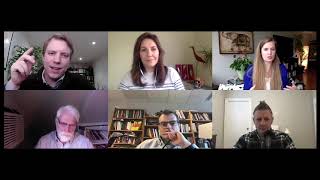
Virginie Glaenzer hosts philosophers, coaches, and writers including Gordon Marino and Scott Stossel on how existentialism addresses anxiety and depression. Kierkegaard called anxiety the "dizziness of freedom," while Sartre saw emotions as interpretive choices. The panel weighs meaning-making and personal agency against medication and therapy, sharing practices like boxing, journaling, and narrative reframing.
Chapters
Welcome to Pass the Mic podcast with Melissa Nadia Viviana, who will lead our conversation on the topic of existentialism with one key question: can existentialism teach us What can existentialism teach us about anxiety and depression? My name is Virginie Glaenzer, and I'm your host with a million questions. Pass the Mic podcast is about sharing different perspectives on specific topics, but it's also a way to help us expand our understanding of the world and perhaps explore new ways of looking at it. So before we begin, this discussion, let's start as we always do with a, what I call, a tour de table, which is each of you will tell us your name, what you do, and why you're interested in that topic. Please try to be brief and keep it to about a minute. So why don't we begin with Yannick?
Of course, bien sûr, thank you very much. My name is Yannick. I have a French name. I'm not French, I'm German. So philosophically very much related to many of the existentialists. I'm an existential coach, I'm a positive psychologist, I used to run the MSc Coaching Psychology here at the University of East London, and I do a bunch of other things. I'm a bit of a multi-potentialite with a portfolio career, but I won't mention it all. Existentialism gave me personally a foundation in which I can ground my work with people. What I liked about it is that coming from a positive psychology background where a lot of people were a little bit too positive for my sense, they appreciated and acknowledged all of the difficult and challenging stuff that life throws at you. So it is very relatable to people navigating life. So in that sense, it gave me a foundation to base all of my coaching work in and relate to other people and also relate to my own life more. And I think in the interest of time, I'll just leave it as that.
Wonderful.
Thank you, Yannick. Gordon, why don't you continue?
Yeah, hi, I'm Gordon Marino, and I'm a professor of philosophy at St. Olaf College and director of the Hong Kierkegaard Library, and also a boxing trainer, professional and amateur. And I came to this subject because I struggle with a lot of the inner demons and My belief is that in order for us to be loving, good human beings, we have to be able to deal with those. And the existentialists, especially Kierkegaard, were helpful in that regard.
Wonderful. Thank you, Gordon. Eric.
Yeah, my name is Eric Zimmer. I'm the host of the One You Feed podcast and a behavior coach. And I'm interested in these topics mainly because they've applied to my own life. You know, a recovering heroin addict, I've dealt with depression, depression. The show talks about a lot of these things. So they're just topics that are kind of close to my heart in my own life and in the lives of lots of people I care about.
Wonderful. Thank you. Scott.
Hi, I'm Scott Stossel. I'm the national editor of The Atlantic magazine, and I'm the author of this book about anxiety, which I wrote— that emanated out of my own lifelong struggle with anxiety personally in my intellectual interest in exploring what the psychological and biological and spiritual and philosophical roots of anxiety are. And in the book, I try to look at anxiety, you know, across all those dimensions. But the areas where I'm sort of most well— most familiar with are the medical and the psychological. I'm very interested in the philosophical, but I'm very interested to learn more from you guys who all know more about it than I do.
Wonderful. Thank you. I was reading this morning that in 2018, so less than 2 years ago, more than 300 million individuals of all ages were suffering from depression. And the global anxiety disorder and depression treatment market is forecast to reach $18 billion by 2026. So I'm glad that we're tackling this problem and this topic. Not sure where this discussion is going to go, but why don't we begin to discuss philosophy and depression. So Melissa, after you tell us a little bit about who you are and what you do, why don't you also start the conversation by setting up the context and answering this question: How did the existentialists such as Kierkegaard or Jean-Paul Sartre create philosophies around anxiety, freedom, Freedom, Authenticity, Depression, and Meaning.
Well, that's a lot. I'm Melissa Viviana, and I actually write philosophy of the mind, so I don't work with pragmatic psychology. I work with abstract psychology, which is my favorite. But like The One You Feed, I apply it to myself, and I believe that subjectively we can test out our theories, which is very unlike academia, who says it has to be objective, you have to take yourself out of the picture and have no bias. I put all the bias back in because our minds are completely metaphysical and the only way to access them is by experiencing ourselves. So I start with, I start all my theories with myself.
So existentialism for me is a little bit different than both psychology and philosophy, which is good. It's I probably could have had a really long career in either philosophy or psychology. I did not know of existentialism when I was in college, so I decided to change my career and be a rogue writer, which I call a beat philosopher. I basically go off script and discuss ideas that people who are academically conformed to rules and regulations that they have to, for example, take bias out of the picture. I don't have to take bias out of the picture.
So I'm a rogue philosopher, and that was before I found existentialism. Once I found existentialism, I realized there were many other people in history who had done the same, who had tried to explore introspectively and also How do you say, objectively subjectively? So in other words, that you would, metacognition, that you would observe yourself, that you would observe your psychology introspectively. So it's kind of existentialism is in between. It's, you know, you are a philosopher, you are taking due diligence to really abstractly understand and break down concepts, but it's so personal. And especially the first existentialist, Kierkegaard, and even Dostoevsky, who, for them, it was the fact that we live in a disaster of humanity and can we use this intellectual brain that we have to turn it on itself, to turn on the disaster and try to get some clarity. I was always a little upset with people who had never suffered, people who had never had any disorders, people who had never had any chaos, who would very calmly and stoically talk about chaos and talk about the explanations for chaos.
And I like the more AA model, which is that the people who lead are the people who know what it feels like to be at the bottom. So existentialism, you know, for me is just this place where you use your intellect to really dig deep without restrictions, very much like a rogue philosopher, a rogue psychologist, and explore existence.
Great, interesting. So let me ask you another question, and this is an unscripted discussion, so anyone who wants to jump in, you know, make a movement or anything, or just jump in to what Melissa just said. The thing that triggers me is when you say that life— you start with the premise that life is a disaster. You have this understanding it's a disaster, and therefore I'm going to use my mind and my brain to overcome those negative emotions, those whatever happens. But isn't that an assumption? What if life naturally, by default, was not a disaster, was well created, well thought, and we're making it a disaster. So really, we're trying to go back to that place, maybe.
Yeah, I mean, that's, that's what we're philosophically asking. I think probably the difference between existentialism and spirituality is that spirituality probably begins with a more idealistic image that we started out good and then we changed. Science obviously begins with we started out as a microbe and then we changed. Existentialism, you know, I said actually Gordon might remember this because I recently did Gordon Marino's book in our book club, and one of the first things I said was that existentialism was the first people who wanted to philosophically discuss mental illness. You think back to when these first existentialists were writing, mental illness was not a discussed thing, and neither was mental health, which is the other side of it.
And I think that, as I said at the time when I was reading Gordon's book, that there's a base level of anxiety that we live with all the time. There's a base level of unhappiness or depression that we live with all the time. I think that there's this, you know, with mental health, it's like, oh, everybody's happy or you have something wrong with you. Existentialism, as I see it, is everybody has this base disaster, and it is pessimistic in a way that you're saying everybody is suffering, but it's also like Buddhism where you say the entire existence of the mind is crafted around the capacity to suffer. We transform everything into suffering. I mean, we can take anything fantastic and turn it into crap. And the, you know, that model, both Buddhism and existentialism, of starting out with a pessimism, I think it helps people who actually deal with mental illness to to understand that if they were like everybody else and if they were normal, they would still be suffering a lot. You know, so normal, you know, normal is suffering. Sorry, go ahead, Janis.
Yeah, it's interesting when I hear the word disaster. It sounds like something horrible, something horrendous, something to be avoided, when actually I think it's about our relationship with the human condition. This is what the existentialists offered. They say there is literally no being human without a base level of anxiety, as you just said. I don't call that a disaster, I call that being human. Yes, it can be very uncomfortable. You could argue that we often suffer from it. But I have learned to embrace those moments when I got face to face with my human condition. It doesn't feel good, but I can, I've learned to value it. So the other thing I wanted to pick up as well that was interesting is that there is a spectrum of mental health where at the extreme ends of the spectrum are extreme happiness, if you want to call it that, and extreme suffering, which you might call a disorder. Or even a disease. As an existentialist, I don't really believe in a lot of that spectrum being a disease or a disorder. I really like that quote that if you want to call something a disorder, you have to have an idea of what order is. The thing is that in those, I think a lot of that spectrum that doesn't go to the very extreme is often miscalled a disorder or disease or disaster. Because that's just part of the human condition that many people would like to avoid. We would like to avoid not feeling pleasant or comfortable, and then we try to medicate it, or we try to make it go away. So we exist more often at the more, let's call it, positive end of the spectrum, the more pleasant end of the spectrum, as I would rather say, you know. So I think that's what existentialists have to offer. They have to offer this this relationship with that lower end of the mental health spectrum as often just part of being human, which includes suffering necessarily?
I think we have to be careful about who we call— the existentialists are such a motley crew, and I've done an anthology on existentialism, and you wouldn't believe the different anthologies, who's included and who's not. I mean, if you take someone like Kierkegaard, whose whole life was a meditation on faith, versus Nietzsche, who, although they had much in common, very, very different kinds of thinkers. And so the roster of existentialists differ a great deal. But certainly someone like Kierkegaard knew about— did have a notion— talks about madness sometimes. So they did have an idea of— and he anticipates an age in which anxiety will be treated with pills and powders, he says. But he says for Kierkegaard it's a sign that we're spirits. It's an anxiety that we appropriate our freedom, right? So unlike some other philosophers, Kierkegaard would say that most philosophers think of the emotions, or at least rationalist philosophers, as getting in the way of our thinking process. For Kierkegaard, something like anxiety has a cognitive content. It's an appropriation of our being free. It's a sign that we're spirits. He also recognizes that it's intensely dangerous, right? He said to learn to be anxious in the right way is to learn the ultimate lesson in life. On the other hand, he's clear that it can lead to suicide. So I think there is a lot of overlap with our current understandings of that. He sees anxiety as dangerous, but also fundamental to being a human being.
Yeah, I think that fundamental question about is it a disorder or is it being human is something that animates a lot of my thought and a lot of my work. Because as somebody who is— I never know the right word to use. I've dealt with depression, I've wrestled with depression, I've had depression, I've been an alcoholic. I don't know what to say about it, right? I find myself at a loss for words, but I find that question to be a really useful question for me. And if I'm not careful, I adopt the current medical model of it all the time. And I think there's value in that. I've gotten a lot of value out of the fact that we have medical treatments for depressions. I think they've, they've added greatly to my life. But if that's the only lens that I'm seeing it through, I think I'm missing the richness and the availability that can also be there. And, um, and I think that, you know, I'm, I'm not, I don't know existentialism really, really well, but one of the things I think that is common in that I see is that we get to make our own meaning about what this is. And one of the things that we know about looking at lots of resilience, looking at a lot of people who are resilient, one of the key questions is what makes some people come out stronger from events and what makes other people crumble under events. And among other things, one of them is to create, and I do use the word create, a meaning or a narrative that makes sense out of what's happening. And I think that's what the medical model, for all its benefit, can miss, is creating any sort of valuable meaning.
That's right. It doesn't address the meaning. The issue— it talks about the causes. So we have this important distinction, I think, between causes and meaning. And it doesn't address the causes, and it invites us to think of ourselves as objects in that sense. You know, that it's just— there's something wrong with my machinery up there. You know, and it doesn't, it doesn't address the fact is I had a student a few years ago, uh, he, you know, he comes, came, came to me and, uh, uh, of course at the end of the semester, I can't write the paper, Doc, you know, I'm suffering with clinical, you know, anxiety and all that stuff. He pulls out a handful of, uh, things. Just, I said, well, what's, what's wrong? And he said, oh, nothing, I just need my medications titrated. Then a couple minutes later he said, well, my parents are getting divorced, but that shouldn't matter. So he didn't want to reflect at all on his experience. And there's a really strong invitation out there to not think of our— and it's really, I mean, the way the categories that we think about our inner life, and are all important, whether it's, you know, has the suffering has meaning, or set of spiritual categories, psychological, neurochemical. And so there's a strong invitation out there to just think of these these perturbations of the inner world as neurochemical reactions.
I find this a really interesting and complicated set of questions and I don't know ultimately where I come down on them. But you know, when you are having a mental state, any kind of feeling or distress or suffering, there is a neurochemical correlate to that. Something is happening at the biological level and where it gets complicated, you know, for me too, that Is there— you're saying there is no disorder. I mean, it's true. If we stipulate that there is something that is disorder, we are arbitrarily drawing the line. But you can actually— people do. I have derived clinical benefit from treatments and prescriptions that have been developed for disorders, for clinically defined disorders. So I think there is some— utility to it. But I also agree that it can become completely reductionist, and we are more than simply the movements of our neurochemicals in our brain. Getting back to what Melissa said about life being a disaster, my superficial understanding of existentialism is that that's the starting point. I mean, it is at some objective level a disaster. We're going to decay and die and cease to be. Given that if you don't subscribe to some kind of religious faith, then we are living in a chaotic and meaningless universe. And what I take from the existential is that you have to create your own meaning to kind of create some kind of bulwark against that disastrous awfulness. And one interesting question that I took from reading like Rollo May, who was kind of an existentialist psychologist at the middle of the last century, is to what degree is anxiety, and various forms of mental illness actually not illness, but adaptive response to the way the world is. Is there in fact— is mental health an adaptive delusion that makes you more content but less able to wrestle with important philosophical and spiritual questions?
So that brings—
Just one comment there, though. For example, if you take Kierkegaard and Nietzsche, Sartre, they didn't think of life as a disaster. They saw it as involving a lot of suffering, but it's one thing to say there's a great deal of suffering in life, maybe even more suffering than pleasure. It's another thing to say life is an absolute disaster. Someone like Iain Shurann would say that.
And there's also a big difference between life is inherently meaningless versus life is inherently meaningless to me. You know, because we cannot say that there is absolutely no meaning in life. Meaning is often, uh, it's a very under-researched topic in academia, but like, generally we need to make a big distinction between we can know the ultimate meaning of what existence is about versus my life can be inherently full of meaning. I can feel a very meaningful existence in an overarching meaningless world just because I attach meaning to it and I choose life to be meaningful.
Purpose, yeah.
So some of the major themes of existential therapy or responsibility and freedom. So I want to ask you, how does the idea that we're responsible to create our own meaning build a foundation to positive mental health? And let's try to be practical, because although I agree with everything everyone, you know, what, with whatever everyone has said, but too abstract for you? It is when you're in the midst of this attack from your mind, negative thinking to the point that you actually have physical symptoms, right? The sweaty palms, you can have an anxiety attack, so you feel it and you don't, let's say, you don't go to drugs to calm you down. What do you do? You know, yes, I'm responsible, I'm free, you know, share a little bit about this.
Maybe we should go around the table and ask what we do in our own lives when we get anxiety.
That'd be great.
What are our coping techniques?
That's great. I'll let someone else start because I—
And it's interesting that you talk about coping mechanisms. Coping, yeah.
I think first of all, it's important to, for me at least, there is something like, there's a spectrum where there is a disorder. There's something, there can be something wrong with our brains and we might need to fix it. You know, there is a certain bell curve, yes, it's a bit more complex, but I think some people, they benefit massively from medication just to get into a state where they can do some of these more pragmatic things. And for me, a lot of those things are about taking responsibility for where your life is going and how your life is working out. I think there's a trend to push responsibility away. We like to have freedom, but with freedom inherently comes responsibility. We cannot have one without the other. But we like to be super free but not push away responsibility for our actions and particularly important lack of action. So it's like often people then is like, oh, but you can't blame the victims because sometimes we can't, we're in a state where we can't just form a positive thought. You know, somebody who's, let's call it clinically depressed, often they just can't form a positive thought about the future or go out into the woods and take a walk. Or get into some mindfulness meditation. But beyond that spectrum, where something might actually be wrong, you know, where we might need some medication, I think there's a huge spectrum where we can take responsibility and we can very pragmatically have the courage to open our eyes and face what we do and what we don't do, and then take responsibility. It's something that can be taken in most cases. And say, I'm responsible for doing something or not doing something, for being courageous enough to go out there and fear, take the fear of failure and do something and fail again and have the anxiety and perhaps learn to embrace the anxiety, but in any way feel it as a part of this human experience. You know, and so I think a lot of that is about responsibility and how we're either avoiding it or facing it.
Well, to be a loving human being, you've got to be able to reach through anxiety and depression a lot of times, for most of us, you know. But I think we also need to recognize that the threshold for what people consider like clinical anxiety or clinical depression, at least judging from my students, is going down and down and down. So whatever's happened, the medicalization of experiences has suggested to me that it's our tolerance for dealing with difficult emotions has diminished. Radically. I mean, you think, given a quiz, you think these people were going to Normandy sometimes. I mean, really, I mean, like, sometimes I've had to say, get a grip, baby, you know. You know, this is so— this tendency to see even the slightest anxiety as—
Gordon, you, you talk about depression in your book. What did you do to cope?
Well, some of the, some of the things were very maladaptive, you know. Alcohol abuse at various times. But a big insight for me was a distinction between depression and despair that I think I derived from Kierkegaard. That it's one thing that depression is a mood that colors things, it's an interpretation of life that moves through us, but one of the most important factors of life is how you relate to your depression, how you interpret it. And I tried to see that I had some I had a call to try to be a loving human being, even though I felt like at certain times that life didn't matter. So this meta-relationship we have with our emotions. So someone like Sartre, Nietzsche would say our emotions are all interpretations, right? That we can interpret, and I think Sartre goes a little bit far with that, but I think how we interpret our emotions, how we understand them, what categories we look at them in, is very important. And the categories we're looking at, most people are looking at today, are very much, or it's kind of more biological. They're very, you know, and that has its ups and downs. I mean, it used to be medication was used in order to help people get into therapy and talk about their experience. Now it's just, give me the pills. You know, just give me the pills and let's titrate the medication. And believe me, my wife's a neuropharmacologist, and there's no free rides with drugs. Whatever people say, whatever Peter what's-his-name said, we're listening to Prozac. I don't think there's any free rides with drugs.
I wrote down a quote for this video. It's from the song "In the Year 2525." Yeah. And it says, "Everything we think, do, and say is in the pill we took today." But of course he's saying this is a robotic future. But yeah, it's very interesting that we are managing to reduce our thoughts and feelings to pills or even even trying to cultivate our thoughts and feelings by taking pills. And you guys have already covered a lot of the notes that I was going to say. I had written down a bunch of things I was going to say, and you had said various things throughout this conversation. For example, the word narrative. I don't know if you've seen Lisa Feldman Barrett's TED Talk where she talks about narrative.
Actually, she talks about predictions. But for her, she says we're the architects of our lives, the architects of our emotions, because she doesn't believe that from her cognitive research with the brain that there are emotional maps where emotions really substantively exist in our brain. She says instead the brain crafts a narrative around physiological symptoms. So for example, if we're Her example is when you're taking a test and you have anxiety, you might have sort of butterflies in your stomach. And she says the brain then goes back to previous experiences and says, what happened in similar circumstances? And so with people who failed previous tests, they would develop test anxiety because their brain would craft a narrative about why these butterflies exist and what it what it all means and would kind of set themselves up. So anyway, I just wanted to point to the fact that even though there are a lot of people right now talking about the way that we relate and the way that we craft a narrative around our experiences, science is even coming to that point. I know science is traditionally never at that point.
They're the last people to ever get to that point, but they are.
And so I think it's really important to understand what actually exists and what is our freedom to relate. And you know what, that's what existentialism is about, is how do we craft our own meaning. But even within our lives, what is our freedom to relate?
Does she include all emotions? Sorry, Skor, does she include all emotions? Because I would draw a distinction between anxiety that happens as, for example, preceding a test, or anxiety that comes from sitting still in your human condition and that eeriness comes up that we feel, you know. It's like, yes, we can to some extent still construct a narrative around that that changes the experience of that anxiety, but I think at some point there's an existential anxiety which— we can't change the experience of it because the experience is that eerie feeling of being human. And so I'm questioning whether we can always construct that narrative to change emotions.
I don't think she— in her explanation, it's actually not emotion itself, it's physiological symptoms.
So she basically interprets it that our body has a response that we craft a psychological narrative around.
But there's actually a mode of therapy that works with that very principle where if you're experiencing butterflies in your stomach before a test or in anticipation of anything, you're—
it's—
and it sounds a little bit like what Gordon says, you're putting an interpretive valence over it. Saying my stomach hurts, therefore I am feeling anxiety. This therapeutic technique says, well, no, train yourself to think I am feeling excitement and you're changing the narrative around that physiological experience and turning it from something negative into something positive. In practice, it's sometimes harder to do that. And I think this relates to what you were saying, Annika, but there's something quite liberating and terrifying about the freedom to architect your own narrative. I mean, once you try to do that, you are taking responsibility, and therefore you are responsible for it and can take the blame. It's the dizziness of freedom, I guess, right, that Kierkegaard talks about.
Absolutely.
And I think back to the question about how do we cope with these things and how do we make this stuff practical. Something I'm I'm very focused on. And I think depending on whether it's depression or anxiety, I actually cope differently. Depression to me is a complete loss of meaning and feeling and just anything. It's a deadness. And I can't seem— there seems to be no thinking my way out of that in any way, shape, or form. I usually try and act my way out of it. As we talked about, things like exercise or going in nature or Lots of different things that I do. And, and Yannick, I think it was important you stated like we need to be careful when we're talking about mental illness not to, not to generalize because I know people who are so far into chronic depression that for me to say, well, exercise might help is just, right? And so I'm kind of talking about my own experience. I often have used the phrase depression hates a moving target, right? Like for me, depression is about how do I get in some kind of motion? It almost doesn't matter what kind. I just need to infuse some sort of energy. Anxiety, on the other hand, for me is something that I find wrestling with meaning to be more useful. Because if I can, if I can sort of get back to— I find anxiety responds a little bit better for me if I can get back to core meaning. What really matters to me? What's really important? What matters deeply. And when I do that, I tend to get anxious about things that are happening in the world. And I know Kierkegaard said that that's a cover for a deeper existential anxiety, and I believe that to be true to some degree. But I find that anxiety responds to cognitive restructuring to some degree, whereas depression for me just doesn't. And I find myself needing to be in action. Although, and as unglamorous as it is, I still find like exercise to be the best treatment I know for both those for me. They seem to be very physical. And then the other thing I've thought about, I said earlier on about how these things are often a question of meaning, and we've talked about how the medical model often oversimplifies things. And yet I found a lot of comfort sometimes, particularly in depression, when I just go, you know what, I'm not gonna chalk this up to an existential crisis. I'm not gonna think my whole life sucks. I'm just gonna treat it like I've got the emotional flu for a few days and hope it blows over. And actually that that works. Because what I used to do when I was younger is depression would just throw me into this.
And I think that's also why it leads to suicide sometimes, because at least with younger people, they lose a temporal perspective.
Yes.
It's going to last, it's going to be like this forever. And it, it, it's an internal kind of weather that generally moves on, you know. And, um, yeah, so I think you're absolutely right there. And, uh, um, but, but one of the things that— one of the reasons, uh, uh, things I do with coaching boxing a lot is I feel there's very few, uh, workshops on places where people can get some practice at dealing with fear and anxiety. And one of the big lessons in boxing, you would say, with boxers, you want to, you want a certain level of anxiety. I get really nervous when I have a guy going into a fight or a woman going into a fight and, you know, no big deal. They're not alert. Anxiety is an alertness there. But the thing is not to panic over your anxiety. That's an important lesson I've gotten from training fighters is, you know, that OK, you're anxious. Don't panic about it. It's appropriate. As opposed to some people who go, oh my god, I'm anxious, I'm anxious. And I see the students, right?
Oh my god.
And it really kind of turns into a forest fire.
I just want to add, I completely agree with Eric that exercise, as sort of cliché as it is, is the most effective medication that I have both as a kind of protection against anxiety and depression. And then once I'm in it as a way of kind of clawing my way out. And the thing that that raised for me is if exercise is so effective, there's no philosophical quality to that. That's simply moving my body and triggering endorphins or creating, again, physiological reactions in my body. Isn't that a kind of challenge to the idea that this is a a problem of meaning or of philosophy. I don't know the answer to that, but I, but I struggle with that because again, pills, exercise more than the pills, more effective than having changing my philosophical perspective.
Don't you think it's weird that it took the medical community so long to recognize that anxiety is useful in treating depression? I mean, that's only, that's a relatively recent phenomenon. You know, and I find it comical that it took that long for people to start recognizing that as a form of self-soothing, you know, of helping it, you know.
And it's clear.
I guess, I mean, exercise does so much good for the human body and the mind, but there's also an element of exercise being a distraction. When you talk about anxiety as useful, as a teacher, as something that keeps you alert to things that matter, I think it's particularly important for people to sit in that. You know, the— I mean, in coaching, very often the response to anxiety is to make it go away, you know, and the existential, or like my existential stance towards it is to sit with the client in that anxiety for a little bit and see if it might teach us something because it points us to something. And sometimes it just points us to perhaps the nothingness of existence, and that just like maybe there's a dead end. But most of the time it gets us closer to the human experience, and if we then just get into our body and do some exercise, then we move away from that, which is okay, but I think it needs to be a choice. Sometimes we just need to get out there and do something, and sometimes it's useful to sit in it for a while and see what we can learn from it, just experience it. And I think either way is fine as long as we consciously make this decision.
Yeah, that's a great—
sorry, you want to add something, Melissa?
Yeah, I just wanted to say that that's a good difference of conceptual, you know, how we conceptualize it. Do we conceptualize it as a problem or do we conceptualize it as a message? And I have to say that I'm with Yannick, that I— did I pronounce it correctly? Yannick?
Yeah, that's fine. I'm used to all the different—
Yeah, I see my emotions as messages, and I, you know, to be honest, my psychology has been such— that's why I use the word disaster, because I exist within a disaster. I mean, I've felt every emotion in the book, but at the same time, there's something about the way that other people currently identify and feel that the descriptions that are going around that are pervading relate to them because I don't feel that. So I'm kind of wondering if I had such disastrous feelings for so many years, what were they if they weren't XYZ? And I just wanted to say two things, which is that as you guys were talking, I was thinking that one of the differences is that my both anxiety and depression actually was felt as anger.
I had many years where I was extremely, extremely, extremely angry, even very hostile and confrontational. And so I think there's a difference in personality in how you respond to your own emotions, whether you either submit to them or whether you fight them tooth and nail, you know, like, how dare you tell me to be unhappy. And also when other people would upset me, that was one of the things you know, my mom was the biggest upsetting factor in my life. And there was something to the fact that she was so upsetting to me that I felt like if she was upsetting to me for the rest of my life, she would win. So there's kind of this need to, how do you say, like prove the anxiety or the depression or the anger or whatever negative chaotic feeling, prove it wrong. And so it's a very different, you know, people conceptualize their relationship to their own emotions, whether you take it seriously and listen to it. The whole idea of just giving it a couple days to pass, I think that's very important. And I went through that with my own depression. I used to take it so seriously. If I had depression, I would listen to it like it was like some sign from God, like, oh my God, life is terrible, you know, and my emotions are here to tell me that life is terrible.
And then after a while, I was like, what are you guys telling me?
What are you talking about? Just like, get over yourselves. And so the sign would come, you know, the sign from God.
And I'd be like, okay, like, just move along.
Let's just get past this. And a few days later, you know, it does get better. So all of these things are sort of these relationship— I know that we talk about relationships between us and the world, but these are all meta relationships. These are us and our emotions. And it's kind of like the glass half empty. And it reminds me of the distinction between So there are a lot of people who don't know the difference between nihilism, existentialism, and absurdism. And when you hear the differences, basically it's like, okay, we all think that you have to make your own meaning, but nihilists are like, okay, so there's no meaning. And then existentialists are like, you have to make your own meaning, it's a responsibility, you have choice, you have freedom. And then the absurdist are like, life is absurd, but you can just kind of enjoy it. And that's the glass half empty, half full, whatever, where it's, if we all deal with some anxiety, it's not just the fact that it exists, but it's also what do we do with it? How do we respond to it? How do we feel? It's the meta feeling. Do we have anxiety about our anxiety? Why are you here? Why do I have to feel this? I want you to go away. Or do we accept it? And listen to it, which is what Janick was saying and what I also felt in my life where for some reason I thought, you know, maybe it has something to tell me. So I'm a writer and I spent many, many, many years letting my emotions have a voice and they did actually have something to tell me and that's why they're not here anymore because I listened. So it's a meta relationship between the emotions and that's really significant. It's all conceptual, it's all personal, individual. It's not just the fact that something is there, but it's also how we feel about it being there, how we deal with it being there.
So here's another pragmatic one for you, Virginie Glaenzer, because writing them down, listening to them, giving them a voice, making some space to be heard is a really, really good pragmatic way to process some of this stuff. And sometimes they stop as a result. And sometimes you can befriend them as a result, or at least understand them better. And that can change our relationship with them. You know, a perceived enemy, once we get to know them a little bit and figure out why they are screaming so loudly or seem so aggressive or are so scary, we get to know somebody like that, or a voice like that, or a part of us like that, it becomes a lot less scary and we have the chance to build a different relationship. Right.
I do like what you said about, you know, being angry. I mean, I relate to what you just said, Melissa. I've had this experience as well of being angry, but it also went into a feeling of victimization after the anger was out. It was— and it was going back and forth. The way that I coped, in addition to moving, I think Moving body is great. And actually what I do even to this day when I have a negative feeling, when I feel unease, is to rub my arm. And the meaning that I give to it is that we are energy and the vibration around us, whether you call it aura or whatever it is, you literally are injecting a different forces or vibration, and it changes and disrupts the thought. So I think moving definitely disrupts the thought, and that's one way to cope with it. I think it's interesting, this discussion around finding meaning or giving meaning to our existentialist crisis or anxiety, and it definitely helped, and I've done that a number of years, but it's— to me, it's still not satisfying. And, you know, we talked briefly about the narrative, the story we tell ourselves about, you know, why do I feel that way? Oh, it must be— and so we kind of peel the onion, go back and look at the past and try to understand, to, you know, remove some of the knots. And that can work for a number of people. It did work for me. I had some really big clarity when I went into my past and understand why I was having this repeat negative pattern. Journaling also and writing. I mean, I wrote like 200 poems which are really existential poems where I was crying, and it felt good. You know, it's all good. What I'm finding now being a limitation is this belief. And so the question that I have for you is, by teaching people to accept the absurdity of existence, and cultivate the capacity to create our own meaning, can existentialism become a form of learned optimism? And really, to me, sure, I can stay in that realm of applying meaning to my entire life, but I found actually rather recently that the real freedom happens when I forget about myself. When I actually don't pay attention anymore to those feelings. And when I focus on, you know, life is short, I'm gonna die, what is it that I want to do? What kind of creation? And focusing on that creation, like, you know, this podcast started one morning and I, you know, boom, I just felt like it. Now, very quickly, the loud voice in my head was, you know, very quickly came to me and asked me, what have you thought of that? What about if this, you know, and who are you to that?
That.
I know all kinds of doubts. But this impulse of creation, which I think is lacking, this desire to create anything, that's what's lacking in depression. But when you're not in depression and you do have creation, I think we're, we're making life hard because we're listening to this constant voice in our head that just wants to make life a disaster. But if we quiet down and something else comes up. So I don't know if it's this absurdity of existence, but when I look at this absurdity of existence, that to me is my coping mechanism, to let the thoughts go by like clouds in the sky, you know, or going into a movement and therefore cutting the thought process of this negative negativity.
Not to use a bad word here, but I think Freud had a tremendous insight in his Morning in Melancholia essay when he illuminates the fact that— so that about the rage and depression, the absolute rage, the raging at the self. And I think it even helps— I've found it helpful to, when talking with students who are depressed, to tell them, you know, man, the way to distinguish between the way they talk to themselves and the way they talk to other people right? So this element of anger that's involved in depression and rage, raging at the self— people are sometimes very kind to others and they're like pit bulls with themselves, you know. And I think it's helpful for people to recognize that self-directed rage and try to unplug it there, you know, that can help unplug it, to recognize that it's some kind of maniac inside you, you know. I think that's a really important insight I'm for its part, about rage and depression.
I love that notion of existentialism as a form of learned optimism, because the, the term learned optimism is very much in my positive psychology background, but as a, as a way of making sense of something that happened, that is happening now, or that has happened in an optimistic or pessimistic way. So optimism as an explanatory style. That's the learned part, because we can learn how to make sense differently of things that are happening to us, rather than the kind of optimism where we are optimistic about the future and we have a positive future outlook. So I think in that way it is related, because I think when we develop an existential understanding of what it means to be alive in the world with other people, and once we understand through that philosophy that a certain amount of anxiety is inevitable. We cannot be sustainably free from anxiety just because we are human beings and in the world with others. And we have all these inner conflicts and paradoxes and dilemmas that we live with as part of our condition. But what we can learn is once we know that, we can learn to, yes, tell ourselves a different story or build different relationships with the things that are happening to us or with the things that are happening generally. Because generally things are not happening to us, they're just happening. And I think this is where a door opens that we can walk through quite positively, you know. This is where the meeting points between positive psychology and existentialism are, because we do have a lot of, a lot of, we have a lot of power to influence how we experience this condition, how we experience our human existence.
So we also need to recognize how difficult that is. I mean, for example, the other day I had a very difficult time with an editor about an article, and I was furious, woke up at 4 in the morning, like, wanting to punch the guy out, you know. And I'm thinking, this is just ridiculous. And I tried all these things. Well, you know, it's really important to think that such and such could be going on with his or her like, you know, blah, blah, blah. It's important. It's important to change. It's, it's, it's hard to change those narratives. You know, it's not—
I'm not saying it's easy.
And we can hold on to different interpretations, but we— I think if we're going to be existentialists, we want to be realistic.
And so at least it opens the door, you know, it opens that door to a possibility. And it's not always possible.
That's right. No, I agree. I agree. But just want to underline the difficulty with some of them.
I think that's important.
Virginie, you— some things you said conjured up some things that have been really helpful for me lately in trying to deal with my anxiety. And one of them is writing things down and kind of compulsively almost recording, just journaling basically, which is a term I hate. But I actually find that by writing it down and then looking at it, it changes the relationship between between subjectivity and objectivity. And when I'm inhabiting my life, it's almost like I'm too much in my perspective, which is not necessarily a healthy perspective on myself. Simply the act of writing it down and then reading an account of it on paper, it puts me outside myself. And that vantage point outside myself actually enables me to see the absurdity and to see the ridiculousness and sometimes to see it in a more positive light or in a more amusing light. And it is inherently therapeutic. I also think that you talk about, you know, the clouds going by and this sort of just acceptance. I mean, it's something I really suck at, but I know that this is a sort of Buddhist and mindfulness principle of, you know, if you can accept, you know, emotions as just things that happen and that pass through and that— and not globalize from them and catastrophize that this thing that I'm feeling now is not how I will feel until the end of time. It's just, you accept that suffering is part of life. This emotion I'm experiencing right now is a passing kind of phenomenon or epiphenomenon that will move through. Again, I'm really bad at it, but I do think that that kind of Zen radical acceptance can be a very useful tool to managing this stuff and to putting, again, imposing a different kind of meaning on these moments of pain and suffering that we experience.
Interesting.
And I think I want to go a little bit further just to use that silence, because I hear that often about managing and accepting and kind of coping with the anxiety. And yes, I also know we are talking about the lower end of the mental health spectrum in this podcast particularly. But there are two coaches here, and we also established that a lot of what is being defined as in the lower end maybe often isn't. So I think we can often go beyond. If we're not at the extreme end of the spectrum, many people can go beyond accepting and managing and coping, and they can go to embracing. Because I've seen a lot of people learn to embrace this human condition and the, the difficult, uncomfortable feelings that come from it. You know, and yes, we can distract ourselves in the most productive and positive ways, but we can also learn to embrace our human condition and the difficult emotions as part of what makes life worth living. You mentioned excitement earlier that we can also call stressful or nervous or anxious, you know.
Okay, somebody asked you a question.
They can be excited. It's the same thing.
Though, okay, so suppose that depression has something to do with a lot of self-hatred, and at certain— what, the really pitch of that cold fire, you really just find yourself a miserable human being and hate yourself and all that stuff. Could you put some flesh on the idea of what it would mean to embrace that?
That's my first thought, is that's the kind of— that's the kind of area of the spectrum that is very difficult to embrace. But even that, I can— I could start from this. I mean, I haven't suffered from the kind of clinical spectrum of depression.
You know those moments, imagine telling someone embrace that feeling.
No, I wouldn't, I wouldn't want to try to. It's like, hey look, if you feel this bad, without feeling this bad you couldn't appreciate so much when you don't feel this way. I wouldn't want to say that.
And perhaps one way is just to cope with it, just to accept the idea that there's nothing to do. You can go to medication and pretend it's not there, But you can also just say, I'm depressed, I don't have any desire. That's all. My husband had some depression. There was no desire whatsoever. He didn't want to do anything. Nothing. There's nothing you can do. Just wait.
Yeah, but what do you do when you have to function?
Well, but that's the good thing about humans is that we are creatures of habits. And even if you're in a profound, you know, depression, You have bills to pay, you have a job to go to, and you'll function. That's the beauty and the fact that we're so strong and resilient. We accept really—
But when you're down enough, anxiety and depression so often go together, right? And when you're really down, you're certainly often terrified about not being able to function.
Yeah, it is. And then you do, and then you find a support group, but it is very difficult.
I think there's a sort of a paradox in human nature that I've been trying to put my finger on for a while, and I think I'm getting there, but it's taking a while. And one of the things that I realized was that, you know, and if you could just let me parse out my thoughts, because I'm using the word parse correctly, I believe that we as humans have a capacity for mind over matter. Which I actually would say mind over mind.
It's the idea that we have some substantive mediation of ourselves, of our experience, that we have some top-down causation where we can influence backwards what's happening. Neuroscience, there's one book called The Body Has a Mind of Its Own, and it's a really interesting book because I had this theory, um, actually, uh, about the subconscious being sort of a submarine underneath the surface that the subconscious does not have access to raw data. It doesn't have ears, it doesn't have eyes. The conscious mind is the only aspect of our psychology that filters any information to the subconscious. When people are lacking responsibility in their lives, they often deflect and allow their subconscious to make decisions for them. They go back to old patterns, things that they learned in their childhood, and they, and they allow their subconscious to dominate their reactions to life. That's completely normal. And it's a shortcut actually that we take to function in the world. If we had to make a raw conscious decision every second of every day, we would be really slow. So we use our subconscious. But my theory was that the subconscious was a submarine. So the subconscious can't understand that the world has changed. So imagine that your subconscious gets some program in your childhood and for the rest of your life you feel, let me just reuse that subconscious programming over and over and over again. But the fact of the matter is that life has changed. You know, circumstances are different, you're different, you've grown up, you have different relationships. Maybe now you're married, maybe now you're a parent instead of having parents. And the only thing that will reprogram the subconscious is you making the decision to give your subconscious information. So this was this theory that I had come up with, and I later read in a neuroscientific book that said that, um, the way information goes in and out, it actually happens at the same time. So we don't just accept information. We don't just put out information. We do both. And for me, that was that apex between the conscious mind and the subconscious mind in that we take in information. And also at the same time, our subconscious is using predictive information to push out and project onto our circumstances around us. And so, you know, I love it when neuroscience has parallel theories that go along with what I actually experience in my subjective self. But this was one of the theories that was confirmed. And so in that, I just wanted to say that that opportunity to take the information that's going on around us, raw information, and with our conscious mind analyze and assess that raw information so that we can tell the subconscious subconscious. What the hell is going on? That for me is mind over mind or mind over matter. It's that little glimpse of time when we can mitigate and reassess, you know, what, what is, what is reality and what are we feeling? The subconscious is going to keep rebooting those old programs because that's all it can do.
So I just think that, um, this is what a healthy individual is doing.
It's what the healthy psychology does when it functions. The question is, if you're unhealthy, if you get into the rain of depression and deep, deep, deep depression, deep anxiety, why is that not working? And the only thing that I can think is it's actually the conscious mind that for some reason can't tell the subconscious mind what's going on. In other words, you wake up in the morning and your subconscious says, don't get out of bed. Life sucks. It's terrible. And everybody hates you and don't go to work. Because you're going to embarrass yourself. That's the subconscious programming. But your conscious mind also should have the capacity to say, okay, but my boss did give me a compliment and tell me that I'm really invaluable. And it's mitigated, you know, have that conversation. So I think that people who suffer really— and Gordon, this is addressed to you— because people who suffer really deep, deep depression, I think that they are allowing the subconscious to dominate decision-making, dominate the feeling, the state of mind, which everybody allows their subconscious to do a certain amount, but not all of it.
So thank you so much, Melissa, for this wonderful opportunity to share your theory. And I think this is a good thing that we have a recording because we're going to be able to listen to it again and really ponder on the question, which I think may have one or multiple answers. And I wish we could continue this conversation, but as we're coming to the end of the hour, I'd like to end this discussion the way it began, with a tour de table, which you can use by answering Melissa or just sharing whatever you'd like. One of the premises of this podcast is that there's too much talking and not enough doing. So, which is why we've tried to be very practical. So let's pass the mic and tell us what you've heard today that will inspire you to start doing something differently than the way you did it prior to this conversation, or any thought that you want to end the conversation with. And I'm gonna start by sharing my own takeaways to give you guys a moment to collect your thoughts. So there's two things that I really found really interesting, more than two things, but two things that I noted. One is, I think it was Yannick when you said think things happened. Things doesn't happen to us, things happened. And we create all those stories like if things happens to us. And I think that's really a key differentiation. And it goes really well with this struggle that I had with victimization. When something happens to you and you take it personally, not necessarily because you have a big ego, but just because that's how you were programmed or, you know, based on your past experiences. The second thing is this being human, this idea that the human condition and being human is painful. Not, you know, something— Melissa, you said disaster— but the fact that it's human. And I've always agreed with that. I think so far I've kind of resisted to the idea that it should not be, but I want to try tomorrow, even maybe today, to ponder the idea that what if human condition was difficult? And next time that I do have an attack in my brain with negative thoughts or some negative feelings that I have, I want to be able to recognize them and almost to a point of like I'm giving a badge to myself, like, oh my God, I don't feel good. I'm thinking really things that are scary.
Scary, or whatever it is.
And instead of letting them pass, detaching myself from them, and, you know, which I've been doing, and looking at the absurdity of life and the fact that I'm gonna die, and, you know, and then that works. This time what I want to do is look at them objectively but with applying some sort of meaning, as this is you being human, and good for you. 'And you're brave.' And, 'Wow, look at those negative feelings, you know, here's a medal,' without entertaining them but just applying a different meaning. And then the third thing is, even though I just said the word meaning, I would like to practice not having any narrative or story or meaning. I would actually, would like to go through life based on experiences and and not have so much time, not waste so much time in looking at what I'm doing and trying to understand why and the meaning and the story. And I would like to free myself from that and just do whatever I feel like doing. So that's my takeaways, and thank you so much everyone for sharing your thoughts. Why don't we begin with Eric, if that's okay with Sure.
Yeah.
I mean, I think, I thought this was a really interesting discussion. And I think when we discuss things like mental health, anxiety, depression, sadness, and, you know, all these different things, we're not talking about like a thing, like I can, here's a pen, right? It's, it makes me think a little bit of addiction, right? Addiction we talk about, but it, when you understand addiction more deeply, you realize it's a syndrome of lots of different things. And lots of different things can help. And so I've found it always useful to— and that's why I liked what a lot of what I heard here. I love to be able to put up different lenses and look at the situation or my challenges through a lens. Does that lens help? Does that tell me something that I can use? And if it doesn't, then I go, okay, well, you know, all right, that's not useful for me. And so I, you know, I think there's a lot of useful lenses we discussed today. I really like this idea of I think I tend sometimes, since I've had it for so long with depression, to just go, it's just this thing over here and I'm just going to get through it. Whereas I think some more exploration— what, what is it? What am I being told here? Is there something I can learn? And I think I did that for a long time too much. And then like, as typical, I think I've swung to the other extreme a little bit where I'm like, eh, doesn't mean anything. It's just something that happens, right? And I think maybe moving back to Towards the middle. And I love the idea of, you know, the subconscious and the conscious interaction, right? Because I often think in the same way, I think that all this stuff is finding a balance. Like we talk about on one hand being mindful, accepting and seeing what comes up and just letting it be, which is really helpful. But then there are also things that our subconscious just throws up that are decidedly And instead of just going, well, there it is again, there are times where questioning it or working with it or reframing it or reprogramming it can be useful. And so I think for me, I find all these things, I find these discussions useful because they, they help me calibrate my approach a little bit from, okay, this was where I was before, but now maybe I'm over here. I'm going to move back here. And I found this discussion really helpful in giving me some different ways to calibrate.
Thank you, Eric. Scott?
Well, I thought this was really interesting, and I learned a lot from all of it. I think I learned that I should probably get therapy from Yanique or Eric, particularly to try to improve my glass half full lens on the world. I was struck, Virginie, by the idea that you want to just not impose meaning on things. I feel like that's almost an impossibility. We're meaning-making creatures. And as we go, we are always telling ourselves little stories, even if we're not aware of it, to kind of put things in context. But we do have some control over the meaning that we impose on. And that gets to the idea, Melissa and Eric, you're just picking up on this paradox that we are sort of machines made of meat. Ultimately, we are only ever at some irreducible level our bodies, and yet we can use our bodies to exert control over our bodies. I mean, if we believe that we have any free will and even beyond the idea of free will, can we impose top-down change on those kind of the subroutines or underlying programs that Melissa was talking about. Can we overwhelm them? And those, for me, the kind of negative self-talk, the schema that everything sucks, I am awful, learning to, through top-down imposition of meaning and then just through imposing new habits of thought to to kind of push them down. I also think I was reminded of something that I have been trying to get better at too, that also Virginie Glaenzer said earlier about taking ourselves out of ourselves. We are least anxious when we are thinking— or at least, speaking for myself, I am least anxious when I'm thinking about other people, when I'm trying to help other people. It's sort of a truism. But putting others before yourself or getting out of your head— I mean, in some ways, maybe this is the worst— why therapy is terrible. You're paying someone for the privilege of just talking endlessly about yourself when really the therapeutic thing is to get out and actually help someone else. And this conversation helped me think about that. And then also just think about the importance of— part of my negative thinking, and I think this relates to my depression sometimes and my anxiety, is feeling like I'm a cork floating on the surface of the water. And I think there are two ways that you can adaptively recast that. One is just accepting that I'm a cork floating along and being OK with that. Or trying to take control of agency and saying, I have autonomy. I can make meaning. I can determine the shape of my own life. What's clearly completely maladaptive is to be that cork floating on the water and being unhappy about it. So I either need to be a happy cork or stop being a quirk.
Very wise word. Gordon, a few last words? I don't know about last words, but today at least.
Very lively, very wonderful discussion, always different perspectives. A couple things, I think Eric is right that the inner life is not like a bunch of tables and chairs that we can define precisely, like the difference between anxiety and depression as though they were things. I think that, that's important to remember. And we talked a lot about, you know, trying to reframe things. Well, but there comes times in life— like, I got a friend who's, I think, going to get deported after 20 years here, family here, just absolute nuclear weapon. Another one, his friend, his son committed suicide. I've dealt with a lot of illness in my family. There's certain ones— life's not a disaster, But there comes times when it's hard to reframe them in some positive way. I mean, so I think we need to recognize that. And so I think that's important. And yeah, and I think what Scott was saying about other people, yeah, I see the important thing in life is holding hands. I mean, Thich Nhat Hanh said, it's all a matter of holding hands and walking home together and relationships. And I think the medical model, model that really underplays that, the importance of that, this kind of the reducing everything to neurochemistry as opposed to relationships, you know. And, but I mean, my aim is when I go through those periods, the inexplicable sadness and numbness and everything, is I want to be a loving person. That's my goal in life, be a caring person. I haven't always been that, but to be able to care about people when you just feel like shit, You know, I think it's— I think that's my criteria. So thanks for a wonderful discussion.
Thank you for sharing, Gordon. Yannick.
Yes, lots of super interesting points. I want to thank everybody here for just like making me think about certain relationships and how things connect. A couple of things that I would like to pick out is thanks, Erik, for depression hates a moving target. I think I'm gonna cite that often. And it's related to what you said, Virginie, in terms of, well, I just want to experience the moment and not make so much sense of things. And I think it was Jason Silva who once said that the only cure for existential anxiety are flow states and being so engaged and so in the moment, so challenged by what's happening in the moment that we simply don't have time to sit in our human condition and, you know, feel the anxiety of just sitting in the void and tuning into the subtle anxiety that sits underneath. You know, some anxiety hits us in the face, and this is where at the extreme, more extreme end of the spectrum, we sit there and we're in a deep depression. But I think for most of the people, most of the time, it's not like that. You know, the depression kind of is in the subtext and we can very consciously and positively distract ourselves by tuning into what's happening in the moment and really engaging all of our senses, it still remains a distraction. It can help to some degree, but there's certainly an area where life is just horrible and we're suffering. And the question that still comes up for me a lot is is where does coaching end and therapy begin? And that's a very complex question, and I think there's no one answer to that. But at what point do we need to intervene with medication to help us, and what kind of anxiety and depression can we actually help tackle with tools that don't need medication that we can access with certain forms of therapy or even coaching? And that will remain a point that I think about So thank you for that.
Very well, very, very well said. The limits between therapy and— what was the other one you said? Therapy and coaching. Yeah. Melissa.
Well, I just want to thank everybody for sharing their personal experiences.
Oh, sorry, that was my microphone.
You know, when I was thinking about what— it's funny because actually Gordon and I asked Virginie to do this. And to do existentialism. And I actually gave a couple of the names here, like Scott, you're my pick. And, and the—
I think you gave me Yannick too.
Yeah, I think I did actually. And, and so I was actually, you know, this, this topic is very, very important to me and I spend a lot of hours of the day going over all these concepts, and I do very abstractly use them and also very, very, very subjectively use them. So in a way, they're both inaccessibly abstract and also so personal that maybe it only applies to me. And I think that's again one of the paradoxes of humanity, is that we like to take our own experiences and assume that other people are experiencing the same thing in the very same way that we're experiencing it. And the one thing that occurred to me is that in the explanation of depression being, you know, a serotonin mishap in the brain, I thought, wouldn't it be just lovely if everybody's depression had one reason?
Everybody's in the entire world.
Wouldn't it be lovely? And that's what we would all hope for, is that there's only one answer, there's one solution. If we can just give you know, enough studies to prove that this is the decisive factor. And so I didn't want to come into this audio with any of my own explanations of anxiety or depression, particularly because I didn't want to steamroll over other people's narratives. In other words, I didn't want to say, well, this is the way that depression is supposed to be felt, and this is the way that anxiety is is supposed to be dealt with because I think it is honestly one of the most subjective things that it just individually is felt, experienced, made sense of, suffered through individually. And so yes, I have so many answers of how I deal with depression and how I deal with anxiety and all the other amount of emotions that go through my existence, but I just, wanted to make it clear that everybody else's experiences are, you know, king in their lives. You know, that we have our narrative is the most significant thing in our lives. We look for confirmation of our narratives. So if anybody goes to Janik, it's because they already kind of have that idea that, you know, that—
I mean, positive psychology has a very specific slant. If anybody goes straight for the medication, that's because they already have this idea, you know. So we seek out solutions that reaffirm the narratives that we're already telling ourselves. And so I, I really want everybody to get the help that they need in the way that they need and to understand themselves the way that makes sense to them and not impose, you know, even if a solution works for me, very much works, that doesn't necessarily mean that it's the solution for everybody. So I just wanted to say thanks for everybody sharing their experiences and their own techniques and etc. It's really, really useful to have a wide variety of perspectives on mental health instead of one answer.
Yeah, and thank you for this openness and this call to personal freedom. And I think 2020 is going to be an interesting year where really it comes down to becoming individual, conscious, self-authoring people and, you know, make the right choices for ourselves instead of asking other people, what should I be doing? And maybe that's the, the anxiety also is to make the right choices, to make choices in general. Thank you very much everyone for joining and for sharing your perspective. That was really, really insightful. Thank you.
Thank you.
Thank you for hosting.
Thank you.
Thank you. It was a pleasure to meet you all.
More from Virginie











Unlocking Fintech Success: Strategic Trends for Profitable Growth: Webinar Leadership Series