Interview with CEO, Bruno Larvol - Running a company in the Metaverse
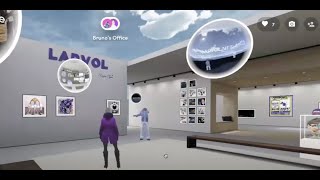
Bruno Larvol, CEO of a healthcare data company, spent a year running his business entirely in the metaverse. He found that VR creates a sense of proximity that strengthens human interaction and team camaraderie, though hardware discomfort and software bugs remain challenges. His advice to founders: build virtual to access global talent, give every employee a headset, and don't force VR on people who haven't consented.
Chapters
Day 365 running a business in the metaverse, it's quite a unique experience. I would love to learn what was your biggest challenge looking back at those 365 days running a company in a metaverse. What was your biggest challenge?
Well, first, there was a lot of challenges. And challenges for me, but I would say even more challenges for the people working with me. And the reason is that for me, it was my choice to spend 1 year in the metaverse and to run the company from the metaverse, but for people working with me, it wasn't their choice. So the biggest challenge for me was to make sure that it is a team, I would say, adventure and not viewed as an imposition that is an inconvenience on everybody else. And it can be an inconvenience because it's not easy. The metaverse is not quite ready for us to move in. It's ready at the margin, and it's gonna get ready. To me, there's no doubt, but today it's not easy. The hardware is not easy, it's heavy, the foam on your face is a little bit irritating if you keep it for more than an hour, as the software is buggy, even though software from Mark Zuckerberg, so he's spending $10 billion a year, but it's a little buggy, Zach. Right now. So, so the biggest, the biggest challenge I would say is to make sure that my colleagues are not inconvenienced too much by, by doing that experiment with me because the metaverse is not easy today.
Fantastic. And so what, what did you do to make them excited? To go into this experimentation?
So the first time you have a meeting in the metaverse, it's not hard to be excited because of the novelty, because of the sense of being in a sci-fi movie. It's not hard. The second time, it's not hard either. The third, the fourth, the fifth, the tenth time, it becomes a little bit hard. Because of all the inconvenience that comes with it, especially if you're not at your desk or you're not, you don't have your headset ready and so on. So for me, the thing I tried to do, and I think it worked to a point, but it tried to do is to explain how as a company that is a pioneer in the field, how we're doing an experiment together, we're proving that it's possible. And obviously the first people going to Mars is not going to be possible, is not going to be easy, it's not going to be easy. They're trying to prove that it's possible to do something new. But the first people, the pioneers, in this case us, things are not going to be easy, but we're going to make a point and prove something that I'm convinced, and I think as a team we are convinced, is going to be the future of human interaction, or one future. Not all of our life is going to be in the metaverse, but a big chunk of it. And so the more we are on the forefront of this huge transformation, the more we'll be ready and the more we can help shape it so that we are part of the future ourselves.
What was your why for doing this experimentation? Why did you want it to be involved in VR in the first place?
As many adventures, it started with something unexpected. The reason I bought the headset and got into VR was not to be the first company doing business in the metaverse. It was to try to analyze complex cancer data using virtual reality. At Lovell, we are analyzing a lot of interesting healthcare data, notably cancer data. And I felt that we could find new patterns in the data. That did not work. We couldn't see any patterns. Now, the patterns are there, and at some point we'll be able to use virtual reality to find patterns in cancer data, but that program did not work for us. Now, as we did that, we realized there was something else, and it's a fact that when you put a headset on, you are much closer to someone than when you're just on a Zoom call because you share a given space. Your brain is tricked into a proxy of proximity in a sense. And that's what led me to decide to try that as a company, to try to make virtual reality and the metaverse our office. So that was an accident of sort.
How has VR influenced your design and development process and your team became more well-versed?
That's a nice expression, by the way, well-versed in the metaverse. I think we found a new slogan. You can become well-versed in the miniverse as opposed to the converse. So I wouldn't say that the way we design things has changed. I would say the way we interact with each other, the way we enjoy each other's presence, the way we create memories, virtual memories anchored into a commonplace that has changed. And indirectly, I believe that our teams is stronger. Our team is more, is closer. There's more camaraderie, there's more personal bond, maybe more empathy and trust. And the impact on the way we design our products is derived from that, so it's indirect. So I would say the biggest impact is the way we relate to each other as humans. And I'm excited about that more than the process of designing, per se.
What is the most important lesson that you've learned while running your business?
Well, there is a lesson that is, that has to do with dealing with people who are not, who did not sign up for the experiment. So for example, early in the year, I would interview people for position and I will be there parading in my avatar, while they will be there in Zoom. And I thought, well, they find this is interesting, innovative, maybe cute. No, they did not find it cute at all. They left messages on Glassdoor saying that they got interviewed by a cartoon character. They were not amused by my experiment. They were not. They thought that was maybe weird, certainly imposing, and not good. Why is that? Well, they didn't sign up for that. And I would say even same with my customers. I had a couple of customers call where I would parade in my avatar, I would, instead of my Zoom video, it would be me in the metaverse talking. And so what I learned is that this whole metaverse is not necessarily welcomed unless people signed up for it., and I should not impose it to people. And if I interview someone and I come up as an avatar, I'm imposing an experience or an experiment on someone. I shouldn't do that. If I go to a meeting with a customer and I explain what we do and I'm here as an avatar, I'm distracting to them and I'm bragging about how cool I am here in the metaverse and they're not. It's not a good communication. So that was my biggest learning in the first part of my experience in the metaverse, is that I should not impose it to people who have not signed up for it.
Very, very well. Yeah, having the buy-in of people is a huge, has a huge impact on how people receive this experience.
Yeah.
Yes. So as a follow-up question, how do you think the metaverse will change the way people interact with each other, those who have the buy-in?
Yes. So I, first, I think we are, we are still early. We're like '95 internet time, and I cannot wait. To see in, in one year. So there's going to be a couple of more headsets coming in, in one year. Also notably the one from Apple and the new one from Meta, maybe other headsets as well. And then the hardware is going to be better and better. And very soon your avatar will be photorealistic if you choose it to be. You will choose your, your appearance, your age, your physical attribute, your gender, your ethnic group if you want to, certainly your hair and your style. But you will not be able to see at some point if it's reality or not. It would be a deepfake of yourself or someone else. So I do expect that the impact on us is going to be surprisingly profound. Because, and you know I like to be a little bit dramatic, this is the end of reality. This is, I mean, if we spend most of our time in a simulation, we enter the simulation knowingly, so it's not that whole Matrix dystopia, but we entering a simulation on our own decision. And most of our days is spent in a virtual environment, if that virtual environment takes all of our senses pretty much and is becoming as precise as reality, that's the end of reality. It means that reality becomes a second place where we spend our time. Our first screen, our first place where we interact with each other becomes a metaverse. And it is It should be scary as a proposition, right? It should get us very nervous. It should be a little bit like in 2001: Space Odyssey, when the, the great apes are touching the monolith, right? It's a big deal. We are now inside the machine. We're now inside the machine. We're part of the machine. We're cyborg. We are part of the machine. And we cannot escape. Well, we can. If you just leave the metaverse, but all of your friends are there. Your job even requires you to commute to the metaverse. Imagine that. In a way, that's already the case for me. Now that's gonna scare people off. In a way, to work with me, to meet with me, to have a meeting with me, if you work in my company, you need to come inside the metaverse. Well, that's kind of imposing. Now you would say, well, that, you know, it's less inconvenient than commuting and we accept commuting, but it is an imposition. You cannot work for Larval as a manager today unless you accept to commute to the metaverse. Well, some people could say, well, that's a big ask. What if I just philosophically speaking or practically speaking or psychologically speaking or technologically speaking, I don't want to. Right? That should be a question. Should you be, should the condition of employment be you need to commute to the metaverse? That's what I'm doing today, right? Should it be legal even for me to say you cannot work for me You cannot work for Larval unless you accept to commute in the metaverse. Well, many people would say, well, of course it should be legal because it's like saying, well, you have to use, I don't know, Zoom. Oh, I refuse to use Zoom. So I cannot. Well, everybody would say, well, that's reasonable. Now, what about, okay, but your next step, you have to put a headset on. All right. So what if I'm dizzy? What if I have a medical condition, or what if I just out of preference, I really hate it. I'm dizzy, I'm not comfortable, that headset is heavy, I don't want to. Should it be legal for a company to say, either you commute to the metaverse to meet with your manager, or we're not a right fit for you? I think we're probably gonna be the first company where these questions I got to be asked.
These are wonderful questions, and yes, the reality is a little bit scary when your reality becomes obsolete and the metaverse becomes your new reality. So it is, it is, it is a bit scary. Since you were talking a little bit broader about this entrepreneurship experience, this starting a company and as a leader, What do you think is the most important advice that you as a CEO could give to someone starting their own company in that context?
Well, the first advice is to, is to go ahead and to jump and to start your own company and not to listen to your family who might say, don't do it, right? So that's the first advice, do it. The second advice is, is gonna be extremely, extremely hard, okay? And you're probably gonna fail. So you need to do something that you'll be excited doing, even if it's the hardest thing you've done in your life, and even if at the end of the day it fails. Because unless you have these two conditions, then you should do something else. That's the first advice and the second advice. The third advice is to do a completely virtual company. Like I did, because you tap into such an amazing pool of talent, wonderful people all over the world. If you accept that proximity is optional, is optional, you don't need to be close physically with someone to be close emotionally, to be close from a working relationship standpoint, psychologically, in terms of empathy, in terms of trust. And so my next advice is to say, yes, everybody in your company should have a Quest 2, $300 in most places. That's absolutely worth the cost. It's like, you don't need an office, so you're saving on an office. Buy everybody a headset. Buy everybody a headset. And the last advice is that, in order to make it work, you need to nudge people into using the headset. And it's hard today because the technology is not quite there. But if you sort of nudge yourself and your colleagues to use it, they're gonna develop the skills and the habits to be productive. In a virtual environment, in a metaverse type office, and you're gonna be one of the very first company and team that has mastered that skill. And that's a super skill, that's a superpower. So go do it, go virtual.
Exactly, it's all about doing it, not being afraid of failure and finding fun and play as we do it. Thank you so much, Bruno. This was a really interesting conversation, and I think it's gonna inspire a lot of people people who are maybe on the edge or not quite sure to take a leap of faith and just do it.
Thank you. Thank you very much, Virginie.
More from Virginie











Unlocking Fintech Success: Strategic Trends for Profitable Growth: Webinar Leadership Series