Masculinity & Femininity - Ep. #16: Increased Creativity by Rebalancing Masculine & Feminine Traits
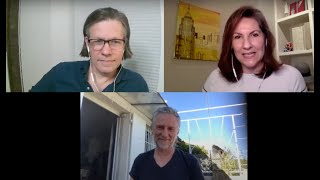
Marc Green and Jean-François Noubel argue that integrating both masculine and feminine traits within each person unlocks creativity and collective intelligence. Green discovered this through caregiving his son; Noubel through psychotherapy and shifting toward veganism. They critique the "man-box" culture that forces men to suppress empathy, and suggest redesigning organizations to be lateral and inclusive instead of hierarchical.
Chapters
Welcome to Pass the Mic podcast, a production of Econoc Studio and music by Benjamin Schleds. My name is Virginie Glaenzer and I'm your host with a million questions. Today we'll be discussing masculinity and femininity. With Jean-François Noubel and Mark Green. In this discussion, we'll try to understand how we can increase creativity by rebalancing the masculine and feminine traits within us. For those tuning in for the first time, Pass the Mic is a podcast about sharing different perspectives on a specific topic, not only to expand our understanding of the world, but also to explore new ways of looking at it. Before we start this conversation, let's begin as we as we always do, with a tour de table and have each of you tell us your name, what you do, and why you're interested in this topic. So why don't we begin with you, Marc?
My name is Marc Green. I'm an author and a speaker. I do diversity and inclusion work for organizations worldwide, and my interest for the last 10 years as a senior editor at the Goodman Project is to better understand, write about, and speak about masculinity.
Thank you very much, excited for you to be here. Thank you for being here. Jean-François?
So, Jean-François Noubel, speaking from this beautiful part of France called Provence, with a very beautiful sky as you can see behind me. I consider myself as an open source Earthling. That would really define the most essential things for me is, you know, Earthling first and then open source as a choice to not consider myself as owning anything but more as living space of flow and connection. I do research and development on a new research field called collective intelligence, which means to understand how living systems work, not just human living systems, but ecosystems and life in general. To understand the emergent process. You know, when, when you have cells together, what does it make? A body. When you have people together, what does it make? Something called a startup or a sports team or a nation or, or nothing. And that research, I do it in kind of two ways. One, kind of more classical way, like, you know, just doing R&D, talking publicly, publishing papers, you know, writing, doing videos on my YouTube channel and all the things. And the other part goes also in the inner side, because the whole human society and the whole culture also exists in me. So the collective exists in me. I exist as a part of the collective, but also the collective exists in me as a hologram. And so I can also do what I call transpersonal growth or transpersonal development, which means, you know, questioning collective things like language or gender, or belief systems or social codes or foods and all these collective things that I perpetuate through my education and through the matrix in which I live. So I also question those things. And that one of the deep aspects of that goes into, yeah, masculinity, femininity, gender, just the yin-yang aspect of, you know, ultimate reality.
Well, thank you for being here, and thank you for joining us so we can question the status quo. So let me begin by thanking you for being brave to help me break the status quo of our understanding of genders. I spoke with several men on that topic, and I realize now that it takes courage to go back in and sort things out. Mark, you wrote a book called The Little Me Too Book for Men that is profoundly changing the story of manhood And Jean-François, you're an inspiration because you're truly living what you preach by being, for example, in the gifting economy and building relationship on a different level. So thank you to both. In the last few years, we've witnessed in countless books and articles a major trend on calling on more feminine influence, asking women in particular to take on leadership roles to fix our system. And I have a problem with that. I don't think that's enough. I mean, don't get me wrong, we definitely need more women in leadership roles to arrive at a more balanced world. But what do we expect, that men nicely line up on the side and just wait for their turn to come back? That's ridiculous. Instead, I think we need to break the stereotypes of what it means to be a man and what it means to be a woman. I believe it's time for all of us to realize that masculinity and femininity are not characteristics associated with gender, but to be balanced and better people, we need both. So why don't we begin this discussion by defining what are those characteristic considered as feminine and masculine that we actually have within us.
François?
Well, I think if we just observe inside and observe outside, we do see a masculine and a feminine side in everything, whatever the level. And, you know, quantum physics, you have the wave and the particle. So the particle has what represents the masculine, as you know, separated, the direction, it hits other particles, it breaks things, it goes through, it has a vector in it. While the wave talks about circles, about the feminine, and waves can embrace and merge together. So we have this yin and yang, masculine and feminine, at every level of the reality, whether we look at the physiosphere, that means, you know, the physics, the physical world, the stones, the mountains, the moon, and the sun, and all the things, particles. Whether we look at it in the biosphere, where we can see, you know, our hormonal systems, for instance, we have both masculine and feminine hormones in our bodies, not just, you know, one or the other, but a composition of both. Whether we look at the noosphere, That means the world of culture, and where we also will see the yin and yang, the masculine and the feminine, and the theosphere, you know, the spiritual realm and experience, where we will also have that deep experience of the masculine and feminine. So I don't, I don't think I can talk too much about a definition, because just like, you know, words like consciousness or intelligence, we can't define those things, we can't enclose them. In a, you know, in a small definition. But we can always say when we see a manifestation of them. I can see when I see a manifestation of intelligence or a manifestation of the masculine or the feminine, either inside me or outside me. So I talk more about an experience of those things than just rather a definition. What would you say, Mark?
Um, you know, I, a lot of my work in masculinity is around the question of our culture, masculinity. And I think whatever view we have of gender has been badly distorted by a culture of masculinity which is based on domination and on hierarchical expression of masculinity. So for hundreds of years, our definition of being masculine has been primarily based on how well we can dominate those around us. And this, a lot of A lot of the ideas that I have around gender are born out of work of a guy named Paul Kivel in the early '80s in California. And he talks about what he called the— he conceptualized what he called the act like a man box. And this is a very narrow set of rules for how to be a real man that he came up with. And one of the primary rules is— I mean, these rules are familiar to us as men, especially in Western culture. Rules like don't show your emotions, make a lot of money, always be in control, be in control of women and girls, be heterosexual, don't be homosexual. And these rules in man box culture are enforced in order to create this hierarchical domination-based version of masculinity. So this has distorted everything we understand about gender by making it instead of a collaborative connecting relationship-based expression of masculinity, a masculinity of connection, if you will. It's a masculinity of dominance. And one of the things that's really important to understand is how we go about training boys into this. And the primary way that we train boys into this begins very early, right shortly after they come out of the crib, is that we denigrate the feminine whenever boys express in ways that are theoretically not masculine. So if a boy shows empathy, if a boy If a boy shows emotional expression, if a boy shows too much need for connection, we say, "What are you, a girl? What are you, a sissy? What are you, gay?" And these microaggressions go on hourly for young boys. Ultimately, what it does is it shuts down our emotional expression, which emotional expression is of course born out of relationships. It's not something that just appears inside of us. It's born in the back and forth of relating. So when you tell a boy, don't show your emotions, you're essentially ending his ability to form authentic relationships and to do these things which are wrongly gendered as feminine, which is show empathy, connection across difference, caregiving, all of these things. And ultimately the only thing he's left with is the expression of dominance. So whatever gender really is for us, we have a long way to go to get rid of all of these rules, these dominance-based rules of masculinity, and lean into connection enough that we can truly even begin to see that.
I like this idea, Jean-François, of gender being an experience. And actually, it reminds me when I asked my 15-year-old daughter, how are you? How do you express femininity? How do you express masculinity? She looked at me and she said, that's a very sexist question. I don't know, and I don't care. So Mark, you mentioned some traits that society associate with those genders. So for example, masculine, masculinity, some of the traits as you mentioned are dominant, strong, independent, assertive, brave, innovative. And then the feminine one are emotional, collaborative, nurturing, vulnerable, caring, and humble. I have a— I want to dive into the real meat of this discussion, if you let me say that. I have a personal question that I would like to ask you both, which when I've asked it, I've had fascinating answers. So can you share with us what was your personal journey in becoming aware of these two characteristics? And how did you embrace your own femininity as a man? And I'm asking for my husband.
Um, my, my experience of growing up in a culture, dominance culture of masculinity, was that I spent 5 decades, um, struggling to meet the expectations of a sort of traditional masculinity and failing at it. And by failing at it, I mean, I made some money, I got a family, I bought some property, I did all the things that supposedly represent success as a man in America. And during that entire time, I felt intense anxiety. I felt like I didn't fit in. I felt like I wasn't doing it well enough. This is all a manifestation of trying to operate in ways that hide aspects of myself that didn't fit into that sort of narrow performance of masculinity. The end product of that was deep uncertainty, and that began to end when my son was born. And what I discovered in that moment that I began to care for him and hold him— and I, I've been an independent contractor for a long, long time. So I was at home working all the time after he was born. And he ended up being in my lap and being involved in my life. And I ended up being a primary caregiver for him. Uh, and that changed my perception of myself because my hand, I discovered that my hands knew how to care for him. I, I knew how to hold him close. I knew how to be in connection with him in ways that I had no idea come naturally to me, uh, as a man. And so in that moment, it began to wake up my awareness that my true validation as a person was not making money or having power or having authority. And I just want to note the list you gave us for masculine traits versus feminine. Every masculine trait that you named there is absolutely on display with the U.S. women's soccer team. So I don't buy the idea that those are masculine traits. I buy the idea that those are human traits. And those ideas about caregiving and kindness and connecting across difference and all those, which are typically gendered as feminine, I found myself doing with my son. And in that moment, I became fully validated and began this pursuit of why is masculinity what we define it as instead of this richer, more abundant experience.
Fascinating. Thank you. What about you, Jean-François? What was your experience and your journey becoming aware?
I grew up with a mother who really helped me to value the feminine and to, you know, do things. So a very traditional couple from the past generation when, you know, the man works and the woman takes care of the children. But they chose that, they had this choice. But they belong to this generation who doesn't really know the other, the opposite. So my dad does not and hasn't really understood what the feminine means, and my mom hasn't really understood what the masculine means, and they don't really know each other. So they belong to this generation, which I've seen too, you know, with so many couples, but just kind of living with one another. They still live together, but not knowing deeply one another and having a kind of, you know, love-hate kind of relationship. Like, mutual support, no doubt, deep love, no doubt, and also sometimes very, very violent confrontations. And so I grew up in that kind of thing. So on the one hand, I have deep respect for women. I never— I think I never had an issue of dominating or disrespecting women or having, you know, any sexist behavior. However, I had not integrated in myself the feminine side of myself, and I really learned that by, with the life I shared with the woman who became the mother of our boy. So we live separated today, but we had this 12 years where we had this journey of she learning how to live with a super masculine guy, having a masculine behavior unconsciously, and me learning how the feminine side, because she really had a very polarized side on the feminine side,, and I had a very polarized side of the masculine side without any gender issues. Again, not, you know, claiming any form of domination, but we had to learn, mutually learn, and we really had this journey of learning that. Also, you know, reading this bestseller, you know, Men from Mars and Women from Venus, it doesn't go very deep in psychology and analysis, but it has very practical understandings and tips that really became an eye-opener for me a long time ago, to really understand just how to process, you know, those things, how to go in the feminine side, how to open up to that. And then, you know, psychotherapy and all sorts of things in personal development really helped. And today I think I can honestly consider myself as androgynous. I don't know if I said the word correctly in English, kind of hard to pronounce in English, but having really integrated both sides in myself. I remember, you know, as a young man rejecting very highly any form of sexism. Like, I tried, for instance, I explored my gay side. For instance, I had gay experiences. I did not enjoy them. I really consider myself as a perfectly conventional heterosexual person, but I really wanted to explore what it means to have, you know, gay homosexual relationship, just to try it, to taste that, have a taste of the experience. And so I think it also helped me to have this, this opening, and I have integrated that, of course, in myself today.
Thank you so much for sharing. It's really interesting to hear how the past has molded us. In our choices, and, and that through experiences we open up to a whole new world. So let's continue this with the topic of creativity, because I think that could be an opener or a way for a lot of people who are listening or hearing to feel, if I can get more creative I'm willing to step up or to step into the unknown and maybe this weird and bizarre idea that I have to join masculinity and femininity within me. And what does it really mean? So can you share a little bit about how does rebalancing your masculinity and femininity led you to become more creative? Can you give us an example of what what it looks like in your work or in your life.
I want to go back to some of the language that Jean-François has already used in this conversation, because that language is also central to my better understanding of gender and a lot of other aspects of my life. He talked about emergence, and he also has spoken about a larger web of relationships, whether that is at the at the microbial level or at the social level. I think that one of the things, one of the damaging aspects of what I refer to as man box culture is that in this process of stripping connection away from boys, we have a very isolating, individualizing culture, right? Men are expected to know the answer when they walk into the room, they're expected to be in control all the time, and what this strips away is is the possibility for not knowing, for holding uncertainty, and for what emerges out of a collective creative process, right? So everything that we know about organizations and corporations now in terms of research that's coming out from folks like Deloitte and other organizations is that when you have a fully diverse and inclusive leadership at the top levels of organizations, and this can be BIPOC, it can be women, whatever. When you have that fully diversified, you get dramatically higher levels of creativity, innovation, long-term value creation, profitability. Everything goes through the roof in terms of performance. So what we're actually understanding now is that what emerges out of a process of collaboration where men bring all of their gifts and capacities, but they hold some uncertainty, they hold their ideas more lightly, They wait for a moment and see what everybody else is bringing as well, and they find out where they fit in that process. In other words, we take our isolation and our individualized programming and we set it aside, and we begin to understand what it is to be in a network of connection. That's where creativity resides for us. And in the moment that we find that creativity, we also find social connection, which is key to living a happier, richer life.
So are you saying that this ability to navigate into uncertainty is a form of a feminine experience?
It may be. It may also simply be setting aside this idea that men always— that men are unable to say, I don't know the answer, or I don't— it's very liberating to say, I'm sorry, I don't know the answer, let's talk about it. Let's find out what emerges between us. Because in our work, my partner, Dr. Saleh Habbaab, and I also do work around what's called relational practices, which came out of social work and psychology in the '50s. But it's the idea that whatever is happening, even between you and I in this momentary conversation, is happening in a third relational space between us. We're co-creating something. And how we view that and whether we choose to care for the relationship over our roles is one way in which we more readily co-create and get creative. That is, I'm going to center our relationship and see what emerges out of that. If that's feminine or masculine, right now I can tell you it's definitely viewed as feminine because men are punished for seeking to do that.
Interesting. What about you, Jean-François? How do you express your creativity or your femininity and masculinity into your work in the creation that you do?
I can definitely, definitely witness within myself those polarities. Like, I can have the masculine mind and the masculine posture that would take me into a problem-solution kind of dialectics, you know, like, oh, I have a problem, I gotta go through, I have to put my manhood into this and solve this thing. And I like it. It has some very beautiful things in this. However, I would, if I just do that, I would leave aside the inner process of empathy. What kind of emotions do I feel right now? Do I feel happy about it? What if I connect with myself, with my vulnerability? What if I connect with others? What if I give myself some, some good time, resting time, good care? What if I give myself tolerance, you know, compassion, and all these things? And that will open up all sorts of connections, exactly as Mark said, like external connections with other people through empathy, through suggestions, through influence in all those things, but also within myself by connecting to my emotional intelligence as well, where so many things can happen. And then I have that experience that if I allow those sides, those polarities, the masculine and the feminine, to flow, to dance within me, then emergence can happen. Emergence— that means where the masculine and the feminine really dance together, integrate either socially with others or internally in my subjective self, then emergence can happen. And then I don't need to just stick into, you know, problem-solving kind of mindset. It has its own power, but it does not suffice. We need more, much more than this. And by the way, I often, you know, begin my conferences today because people ask me to talk a lot about, you know, the next world and all these things, and I keep saying, you know, if we keep stuck into the masculine mind of problem-solving, you know, trying to fix the world, we remain stuck in the masculine mind as well, and we remain in the same level of understanding of the world. So maybe we also want to nurture, to create conditions, nurturing conditions for emergence, for things we don't know what will happen. It doesn't play in the problem-solving kind of mindset, it operates into just nurturing possibilities for new forms of emergence in life, and that requires a lot of the feminine side as well, inside, of taking care. So you see, I can't talk about creativity without embracing both, not one or the other, one not against the other, but really having both play inside me in my subjective self as well in the objective world in relationship with others and with the world. Does that make any sense?
Yes, most certainly. I want to note that when we talk about man box culture, these rules of masculinity, some of the rules of man box culture are clearly just, they're not acceptable. Controlling women would be one, be heterosexual, not homosexual. But some of the rules of man box culture represent a version of being human that men or women can do, which is be a strong leader, be clear, be tough, stay with something. Those rules in and of themselves are not problematic. The problem with man box culture is that they are the only allowable performances of masculinity. So they strip away what Jean-François is talking about, which is this other set of capabilities, which when you take these traditional ideas of masculinity and these ideas which we, in my opinion, misgender as feminine, but when you put them together, you get a whole human being. And it is in this way that we also strip half of the human capacities away from girls and women, because girls and women traditionally have been restricted from showing tough leadership. I mean, you look at American politics right now, anytime a woman shows tough leadership, she's viewed as being too aggressive, as wanting power too much, all assets which would be considered viable in a male politician. So we're still playing this game where women are stripped of these strong leadership capabilities and men are stripped of the other half of being human. So we have men and women walking around in the world who are not allowed to be fully human and to resource themselves in all the ways that Jean-François was talking about in terms of his balance to reach creativity, to reach optimal human connection, to create community, to do all the things that clearly we need in order to solve the problems of the world.
You're right. It almost feels like we are both walking on eggshells. So Jean-François, you talked about the new world. Let's talk about the new world, the future. So my 20-year-old daughter told me, people think that a woman who's masculine is powerful, but a man who's feminine, weak. And that breaks my heart. And I think, as we were discussing, her and I, We ended up talking about this whole pronoun social thing with the he, me, and them. And I finally understood what it meant, or at least one possible understanding of this whole movement, which is that those people who are doing it, they actually, they want to step outside those gender boxes. And they don't want to be associated with the expectations and the predefined roles that we've created. So do you think that this feminine and masculine challenge and struggle, is it a generational issue? You know, with on one hand you have baby boomers and Gen X that seems to be more struggling with it than the Millennium and Gen Z. What do you think?
I don't know if you have much of a generational thing, but I would say more like an evolutionary question here, and maybe it happens right in this time. Just, you know, putting back my hat as a researcher in collective intelligence, I noticed that, I mean, that this research field shows that we start to end a 5,000-year cycle of pyramidal collective intelligence. The only way it seems, you know, human nature has found to build big collectives could only go through hierarchical, top-down, pyramidal structures. Nature has done that. I don't know if we could have done otherwise. I can't revisit the past, reinvent the past. It has worked this way, and that means through a very strong emphasis on the masculine values. It happened this way. If you have a pyramidal structure, that means centralized power, command and control structure, labor division, and a scarce currency, which means also scarcity philosophy built in every aspect of human fabric, from the way we language reality, from our social codes, from the philosophies of the world, and all those things. So we start to, you know, this kind of collectives now have reached its limits. It has worked well since the invention of the writing, the writing and enabled that, and now it seems that it hits a wall of systemic complexity, and it opens the path to what we call holomidal collective intelligence, holos, holistic, you know, distributed, which now requires people to step out, to free themselves from this prison, in this ontological jail of, you know, the gender roles like either man or woman based on your genitals and all these things. So I find it fascinating to see how some cultures in the world try to reinvent the multi-dimensional space to integrate, to map the reality. Like, as a biological being, yes, you may have a penis or a vagina, but on the hormonal level, you probably have, you know, a continuum between the two. And you have the right to stand in every, you know, level of this masculine and feminine side. And then also, what about your sexual preference? What about your social, you know, social persona? Who do you want to exist as, you know, with the others in the social field? And what also on a more spiritual side. So we have a kind of multidimensional space. Where, you know, you can have a feminine body but a drive towards either the feminine or the masculine or anything in between or outside of the box. And you may also want to appear as a non-gendered person or very masculine or very feminine or anything you may invent. So we need an ontology, we need a language to do that, and I feel really fascinated that it happens. So my research has shown, you know, how language Language plays a crucial role. Many other invisible architectures do as well, but language plays a crucial role. So as a French person and speaking a Latin language, we don't have the neutral thing. We have either a he or a she. You know, a she for a table, you know, and a she for a car and a he for a fridge, you know, those kinds of things. So we live in a very, very binary world. And the English-speaking people have a neutral thing. So I think that language offers today more evolutionary capacities to invent a new repertoire of words, but not just, you know, the neutral thing. We also need to address the constructs, like how we describe the world. And I can share more maybe about that, like why do I speak, for instance, not exactly in English, but in E prime. English prime, a derivative of English, or what I speak in French with F prime, a derivative of French, because I try to address, to hack the language that I can speak in order to build a different matrix inside myself and with others. What would you want to share, Mark, about that question?
It's such a hopeful message that you're speaking here, and I do believe that younger Younger people are buying into this because they simply don't— they don't want to be held accountable to what is basically a tyrannical, binary, domination-based view of gender. And the terrifying thing about this older model of gender, these rules of masculinity, are that when you raise boys and say, I don't care who you are authentically, here's how you have to perform masculinity, but you say to them the reason you have value is not who you are, but that you are not a girl, that you are better than girls. When you raise boys in that way, it's a very short step to say, oh, and by the way, you're also better than people of color, you're better than immigrants, you're better than people of that other religion. So our domination-based masculinity is a gateway to all of the bigotry and bias that's damaging our culture and ruining human lives and killing people. The long and short of what younger people are saying and what my son, who's 15, is saying to me is, Dad, nobody cares about that binary anymore. And I also, earlier in the conversation, Jean-François, you broke Two important rules of the man box, and I'd like to join you in that. I appreciate you calling yourself androgynous. I refer to myself as gender fluid, and I always have been, and I've always hidden that part of myself. And when I have shown it in personal relationships, I've always had great shame in the moment that I shared that. So it took a lot, and there was no language for that when I was growing up. There was no way to frame that in a positive way, and there was no community that was saying, hey, it's okay to be that. So I've gotten to a place now where I, where I share that I'm gender fluid. And like you, I tried being with men when I was young for a very similar reason. It wasn't that so much— I wanted to make sure that I wasn't like programmed out of something that might have been really rewarding for me. And the joke I tell is that apparently I don't like stubble. It didn't fit for me. It wasn't quite, you know, I was like, hmm, I think I'm, you know, but in that moment I was completely open to the possibility that something would awaken in me. And I hope that we as human beings can live in a world where we're free to try things and say, well, okay, that didn't fit for me, but it was beautiful. And I, you know, it's an interesting thing. And I think younger people are done with the rules of what they can or cannot try. And God willing, it's a tipping point where, and we see so much rage directed at them when they do this. Culturally in America, we have this— there's a direct correlation between the white nationalists and the neo-Nazis and the men who represent this masculinity extremism here, which are MRAs and incels and this sort of twisted, distorted version of masculinity which aims all this anger and rage at women and especially at feminists. So the binary is becoming more superheated as it's coming under stress, as the culture is shifting. And we have a big fight ahead of us to make sure that we protect people who are pushing against the gender binary and performing masculinity or femininity in a more gender-fluid way.
It's not an easy topic because it touches on so many intimate subjects, whether it's sexuality, whether it's your identity, whether it's your religion. So how do we— what would you say— I mean, how do we teach people how to reconcile themselves with the two sides of themselves? What can we do?
Can I just jump in again here?
Yeah, yeah.
One of the other things that comes up for me is that these narrow constructs of masculinity are internalized by not only by men but by women as well. So there's a study that came out from Harvard in the business world that said, you know, men who show up as allies for women are viewed as weaker leaders by not only a large percentage of men in those companies but by women as well. So when your daughter said, you know, men who don't perform this toughness thing are weaker, this is because when you talk about what Jean-François called a pyramidal version of power, whenever anyone voluntarily gives up dominance, everyone gets alarmed. Because that runs counter to what we've all internalized about how— so if you're married to a man and he begins to perform gender in ways that might cost him status or power, we become frightened that our partner is somehow going to either become a victim of violence or lose their job or lose the security that we've so carefully constructed in this pyramid. Often we're still raising our sons in this man box culture, not because we're not woke, but because we know what's out there waiting for them if they don't perform it in a certain way. Because if they get picked as the 10% or so that get bullied and othered, they could easily be punished and bullied and even murdered. So to break this system and to move toward this more collective network of relationships. The only solution I have for this is to encourage our children's skills to connect in relationship. So these relational capacities we talk about, relational intelligence, and that can be born out of how we speak to them, how we talk to them, how we help them process what they're dealing with, what we model for them, and how we encourage this less binary expression of gender.
Last week ago, we had another podcast on the connection between emotions and stories and how the two are related. And someone said emotions are stories, in that we have— we don't have the knowledge of our own emotions. We have very few. We're able to identify very few emotions. Emotions, and therefore when we feel something— and that was a man, Jonathan Cook, describing a book called How Emotions Are Made, and that most people can only describe less than 15 emotions when there is actually more than 100. And therefore when we go through an experience that is negative and we feel something, we're going to attach it to the only emotion that we're aware of, and one of the emotions that men are allowed in society to express, is anger. When in fact it could be grief, it could be so many underlying emotions. So there's definitely a need for language and a need for recognizing and allowing our children to express emotion, to go not just to lash out, but to go to ask, you know, what is it? How do you feel?
What do we say to men about emotions? Don't talk about them. And for me, if you want to understand an emotion, that takes place in relating, in the back and forth of relating with someone else, because an emotion isn't static. So you say something to me and I might become a little uncomfortable, and then I say something back and you clarify that and I become a little more interested, but I'm also slightly irritated, and we go back and forth and that emotion is emerging and evolving in relating and back and forth. Emotions emerge out of relationships. So if you tell men don't talk about your emotion, they never learn to name it because it gets co-created and named in relating. At least that's my experience of understanding my own emotions. It's only in the back and forth.
Right. Emotion emerges in the relations.
It's very true.
What do you think, Jean-François, what needs to be done to help people understand that they have to rebalance those two, to be more creative and just be who they truly are?
Well, I don't have an ultimate recipe for that. I can only talk about my own belief and what I have chosen to do. First, to become that, to allow myself to evolve as much and as far as I can. And with gentleness and kindness, because I could also put myself a kind of masculine pressure to become this or that, and to put kind of super masculine way, evolutionary way, and fall back into the usual trap of running after someone you haven't embodied yet. So it has to go both in the masculine of kind of conquering new spaces, you know, shedding light inside and understanding new things and welcoming my emotions as to have some kind of masculinity in this, or masculine dynamics in this. And at the same time, just, you know, taking good care of myself and giving myself time to nurture, to rebuild, to give kindness, gentleness, and all those things. And if I do that to myself, I'll do it to others, no doubt about it. The other thing that I noticed, you know, when you become someone, when that makes you a happier person, someone more creative, someone with a better socially consistent and all these things, well, it seems that it inspires other people. I don't have to tell people what they should do or to give advice and all these things unless people ask me. But just, you know, people ask me just like today, why don't— why, Jeff, why don't you share your experience? And I've seen that it happens a lot. I speak a lot publicly online or in the media here in France. The other thing about evolution goes into creativity, and that connects to my work as a researcher. It goes into this question: what conditions for emergence can I create? I can't force people, but I can create conditions for emergence, and that goes into this very deep field that we call invisible architectures. To understand that, you can understand that through visible architecture. Like if you wanted to create a space where people will go into empathy and mutual care and all those things, you don't go to McDonald's or a corporate environment. You will go into a specific architecture where people can sit in circle and when they have, you know, very nice place, inviting place that will facilitate this process. It doesn't mean everyone will go there. It will create the conditions for emergence for that. Architecture does that. Well, why can't we do it also with designing new currency systems? Why don't we do it with designing new forms of language and new ontological structures? Why don't we do it with the way we relate with other beings? For instance, I've seen that deactivating the pattern, you know, that Mark described so well of masculinity, you know, the one imposed by society evolved greatly when I left the speciesism, you know, the thinking that our species has every possible right to dominate all the other species on earth. And so I became a vegan person. And that, you know, people usually confuse veganism with food. No, I mean, veganism means that you've also stepped out of speciesism. That means to consider you as the master of the world that has every possible right to dominate, just like we did with other categories of human beings, you know, whether because of the skin color, because of their gender, because whatever reason, cultural reason we may find to justify that. Speciesism works the same way. And so stepping out of this ideology as well really helped me a lot, and I see more and more people also making this this amazing step. And, you know, jumping into veganism, that means stepping out of speciesism, stepping out of the— how we say— the word will come back to me. Anyway, so we have many ways to create conditions for emergence, and you don't force people in doing that. You create possibilities for emergence, and I find it very, very, very powerful And I can share more, of course, anytime if you're interested in that. It's beautiful.
It is, it is. Yeah, well, we're almost at the end of the hour, so as a timekeeper, I want to thank you for this insightful conversation. And I'd like to end this discussion the way it began, with a tour de table. The intention for for this podcast is to help each of us to become the self-authoring leader of our own lives through meaningful actions. So let's pass the mic and share what you've heard today that would either inspire you to do something differently than the way you did it prior to this conversation, or anything that you feel was left unsaid. And I'm going to start by sharing my own takeaways to give you a moment to collect your thoughts. So first of all, I really enjoyed this discussion. I've been struggling in my own life as a woman because I was, you know, raised with classical model of the woman staying home and beautiful example of mothers or grandmothers either working as teachers or not working and being stayed at home and enjoying themselves, and then father and grandfather working. And I was always attracted to the men's world, traveling, working. I love working. And when I look at those adjectives that I described that is associated with gender, you know, assertive and combative and competitive, that's me, and I'm not a man. So I It was really frustrating as a woman to be in a man's world because the expectations were not who I thought I was. And when I look at the young generation, I'm hopeful because I think they are letting go of this. I appreciated what you said, Jean-François, about the fact that being human is really It's not so much about being men and women, but it's really the experience that change ourselves and that really defines us. And I also liked what you said, Mark, about how emotions emerge within the relations. So whether it is through the language, finding new words to describe ourselves, or creating a new type of organization, I'm part of Coopérative, which is really in that search of finding a structure that allows me to be who I am and not who I was told to be. And I can feel a lot more creative, actually. I've created in the last 6 months to a point that it's almost like in the last 10 years. It's really interesting. There was a— the poet Ronye Maria Rilker writes, and I've seen her— I've seen people tweeting about her in the last few days. She writes— he writes, the deepest experience of the Creator is feminine, for it is the experience of receiving and bearing. And I find it interesting, and I'm hoping that, you know, we can start disassociating us, ourselves, with a gender. Because, you know, yes, I may have a physical body that looks like a woman, but deep down I'm much more than just a woman. And I hope that same way that my husband is on the outside a man, but deep down he's much more than just a man. And I think if we had another word to describe maybe human, maybe being, I don't know, that would, you know, bring the two together and stop this fighting. But it's just exhausting, I think, and we're missing so much. So thank you to both. Really appreciate this difficult discussion. So why don't we pass the mic? And Mark, is there something that you would like to leave us with?
Yeah, I shared some numbers earlier about what happens in fully diverse and inclusive organizations when all different kinds of human beings are given equal leadership power and roles, and you flatten the structure, and you begin to go more lateral. The productivity is massive. And I think we need to understand what it has cost us thus far to not operate in that way. Because if these numbers are correct, that it's 6 times higher levels of long-term value creation, 4 times higher innovation, what has 600 or 800 years of male-dominated leadership cost us in terms of additional solutions and creativity around the problems that face mankind?. And we can no longer just spin our wheels allowing a male-based domination hierarchical system to cheat us out of this vast set of additional innovation, creativity, solutions for what's challenging us. That said, what I came away with that's going to stick with me is Jean-François' talk about speciesism. I think that's going to I think that's gonna make a change for me. So thank you for that, Jean-François.
Wonderful. What about you, Jean-François? What are your last thoughts, or before dying?
Well, don't we always die anyway? Well, the great gift comes as both of you this connection that we have, you know, meeting peers and human beings expressing each of them in their own way, their multidimensionality in their own way with their own language. And that represents a great gift for me, an experiential gift that I really want to acknowledge and feel grateful, express my gratefulness for.
Wonderful, thank you very much. Well, you know, maybe the next generation of leaders thriving in this new world might be the one who consciously learn to balance their femininity and masculinity within themselves, or perhaps it could also be those who decide to kill those stories once and for all and just be who they truly are. Thank you so much. I'd like to end by asking viewers and listeners to like this video, video and subscribe to the podcast, but more importantly, to tell us in the comments what are the feminine and masculine traits and characteristics that you have that you can recognize within yourself, and see what comes up. Thank you very much.
More from Virginie











Unlocking Fintech Success: Strategic Trends for Profitable Growth: Webinar Leadership Series