Navigating the New Era of Brand Identity | Virginie Glaenzer | TBCY
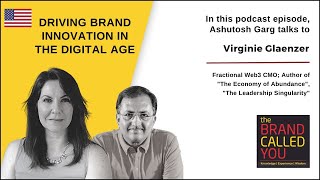
In this episode of The Brand Called You, host Ashutosh Garg interviews Virginie Glaenzer—a French‑born marketer, Web3 fractional CMO, co‑founder of Acorn Oak Agency, and author of The Leadership Singularity and The Economy of Abundance. Virginie shares her career journey from tech startups in San Francisco to VP of Marketing roles in New York and her current work helping multiple organizations as a fractional CMO. She explains how working across diverse industries fuels creativity and informs cutting‑edge brand strategy, emphasizing authenticity and the shift from audience to community. The conversation explores two core challenges brands face today: crafting compelling, customer‑centric stories and pinpointing the right audience for growth. Virginie discusses the data overload dilemma, the need to balance quantitative metrics with qualitative questioning, and how digital evangelism has evolved from pure technology scouting to collaborative sense‑making, especially in the Web3 era. She offers practical advice on standing out amid content saturation, debunks common misconceptions about digital transformation (it’s a shared, not C‑level‑only, responsibility), and outlines the emerging role of AI/ML in content creation, personalization, predictive analytics, and fraud detection. The interview concludes with insights from her books—The Leadership Singularity (re‑thinking marketing’s purpose) and The Economy of Abundance (shifting from scarcity to an abundance mindset)—and three entrepreneurial lessons: embed genuine community in the brand DNA, adopt an abundance perspective, and embrace the evolving, community‑centric brand model.
Chapters
Welcome to another episode of The Brand Called You, a vodcast and podcast show that brings you leadership lessons, knowledge, experience, and wisdom from thousands of successful individuals from around the world. I'm your host, Ashutosh Garg, and today I'm privileged to welcome a very accomplished professional and an author, From New York City, USA, Virginie Glanzer. Virginie, welcome to the show.
Thank you very much, Ashutosh. I'm excited to be here. You have such a wonderful podcast with a wide variety of discussion. It's been really impressive.
Thank you. Virginie is the co-author of a book titled The Leadership Singularity. She's also the author of a book titled The Economy of Abundance. She's a Web3 fractional CMO, the co-founder of Acorn Oak Agency, and Virginie designs digital marketing and sales funnel strategies to drive sustainability. So Virginie, before we start talking marketing, tell me a little bit about your own background in brief.
Sure. Well, I'm originally from France. I moved in 1998 to San Francisco Bay Area. I co-founded a couple of tech startups, and I spent most of my career in the tech world. And then about 10 years ago, I moved to New York City. I became VP of marketing for a few organizations, really enjoyed the New York City lifestyle and craziness. And over the years, you know, going up the ladder, the corporate ladder, and also creating different companies, I've deep dived into you know, challenging the status quo in terms of what is marketing. If it's not the marketing engine of organization, then what's the purpose? And I've had some amazing random encounters that allowed me to write these books and, you know, help me understand and find my passion.
Wonderful. So When you now talk about a fractional CMO, digital evangelist, marketing technologist, and an innovation thought leader, let me start with a fractional CMO. You get to work with multiple businesses. How does this diversity in your role impact your approach to brand strategy?
That's— I love that question, because that's one of the benefits of being a fractional CMO is to be in multiple industries. So this diversity is really important for my own creativity. And in fact, by staying informed about the global economy and understanding the mindset of customers across different industries, I gain real valuable insight on emerging trends. So that way, when I look at cutting-edge brand strategy, I can effectively help my clients innovate the way they reach in the market. And recently, you know, just To give you some example of various trends that I've been looking at recently in fashion, Gap, which used to define this, this, uh, uh, closing a brand used to define an era and has been declining for years, is now trying a new collaboration with Kanye West. Uh, in cosmetic, the Bubble, the new Gen Z skincare brand, is making waves on TikTok. And in right now where I'm working for a client in the technology SaaS, I can see a trend using existing communities to reach out and find customers. So Slack channels, podcasts is a big deal, advertising in small individual newsletters. So all those which are great tactics can help organizations build a brand.
Wonderful, great response. Thank you. And why do you— what do you believe is the most important element in establishing a brand's identity?
So I don't know if there's one key element, but I can share two things that I'm thinking of. So first, one of the most important elements in establishing a brand identity comes from authenticity. By embracing authenticity, the team will be able to stand up with confidence, for what their brand represents when the need arises. People today can tell when something or someone is fake or insincere. So it's really important to drive decision and action with authenticity. And then the second thing, if you dig deeper into what is a brand identity, a brand identity is actually a brand is an experience in the mind. Of your customers. And most brand stories will take the founder, founding team's experience and string them together and make meaning out of it. That's very limiting and that can only work for so long. Brands who will thrive at some point will have to let go their own story to create space for the narrative that their customers want to craft together. So another element in establishing a brand identity is actually to grow a community, not just an audience, so you can build that narrative.
Very interesting. And, you know, I've been working with brands for the last 4 and a half decades, but there are some changes, significant changes taking place in the world of marketing today. And therefore, my question is, what are some of the key challenges that brands are facing today, And how are you helping them to navigate these challenges?
Yes, the landscape has tremendously changed, not just from a technology standpoint, but also from a culture standpoint. In every industry, as a fractional CMO, I see businesses facing primary— actually, primary two challenges, two primary challenges. The first one is that they need to find a compelling story. That resonates with our customers and employees, which will allow them to raise their brand awareness. So for example, going back to the SaaS solution, if you're selling a SaaS solution and you're selling to manufacturing companies to help their field agent, your story is not just about speed, affordability, or ease of use. It's actually about empowering the field agent and bridging the technology gap. So crafting a good story into a relevant value prop leads to brand awareness. That would be the first key challenge. Now, the second key challenge that brands are facing today, I would say, is in the growth and lead generation process, selling. And that involves identifying the right audience, which is in itself a difficult challenge because most organizations want to serve the world instead of focusing on one audience at a time. And also effectively catering to their need. You know, when founders and team truly desire to serve their audience and help their clients, they are more successful. But unfortunately, in a lot of industry, I'm seeing a lot of businesses who do not want to help people. They're just serving their own needs, which is making money. I can give you a name of brands like Avis or banks that are awful. From a customer experience. And yet, you know, they're making a lot of money.
Well said. Well said. And also, there is a huge focus on analytics and data. So I wanted to ask you, how do you balance quantitative analysis with qualitative insights?
The data challenge for marketers, that's, that's a big one. So As a fractional CMO, I see data being a challenge in twofold. First, we are often lost with overwhelming amount of data, which makes it very difficult to extract meaningful insight. There's just too much data nowadays. And the second is that, and that's the most interesting one, usually data supports preexisting belief and narrative. So we need to be cautious and we need to ask questions before we jump into conclusion. Right. Asking questions will help us use data more effectively with qualitative insights. For example, if you see people spending 20 seconds on a web page versus 3 minutes on another, correct? If we ask questions, we could gain valuable understanding instead of rushing to the conclusion that the first page should be optimized to increase the time spent.
Well said. So let's now talk a little bit about your role as a digital evangelist. How would you say the role of a digital evangelist has evolved in recent years, especially given the plethora of digital platforms that's available now?
Well, in my bio on Econoach's website, I It is written that I'm not just a storyteller, but I'm a sense maker. And I think digital transformation back in the very beginning was around researching the technology, narrowing down what was making sense for the company and implementing those technologies. Nowadays, it's a lot more collaborating, It's about finding authenticity. And it's looking at Web3, which we haven't talked yet. But I think in Web3, there's technology that are coming with a set of values.
Correct. Correct. Well said. And, you know, when you talk about so much online content that's available, How can businesses make their brands stand out and reach their target audience?
That's, that's a really good question. So first of all, we humans are natural storytellers, right? And communication is the foundation of our relationship. So, however, So we're naturally, you know, communicating and creating content. However, content becomes really effective when it reaches the right person at the right time. And that's not easy. So testing is crucial. Maintaining close relationship with people is also paramount because then you know what keeps them up at night, why they wake up in the morning. And then I would add that from a digital perspective, staying on top of trend is also vital. You know, I was talking about this bubble Gen Z skincare that is making a splash on TikTok. Maybe instead of traditional phone calls, opting for texting could be more impactful, or leveraging a platform like Instagram to create a compelling visual story that resonates with our audience.
Well said. And You know, I've spoken to so many startup leaders, so many other corporate leaders, and there seems to be a lot of misconceptions about digital transformation that their brands and their organizations have to go through. How do you as a fractional CMO address a lot of these?
Yes, I can remember the very first time I was hired to do digital transformation. It's It was quite a challenge. People were really, even though they were excited for the change and were raising their hand, when it came to actually changing, they were threatened. So I think one of the biggest misconceptions that businesses have about digital transformation is that they believe that the responsibility of driving this falls into the CMO, but it's incorrect. It's not only the CMO, but Everyone within the organization, the most, actually, when I think about it, the most effective approach of digital transformation that I've witnessed is when the CEO takes charge and delegate the task to individuals, creating a collaborative effort. So it's both a top-down and bottom-up combined strategies that really makes it a success.
Well said. My next question is on artificial intelligence. You know, how do you think AI and machine learning will affect marketing in the future?
That's a big, big question. So the clear answer, or the short answer is I don't know. Who knows what the future will bring? I can tell you that I'm excited. By some of the possibility. What most people forget is that we are already extremely integrated with artificial intelligence and machine learning. It's already there, whether it's on automated content creation. I mean, if you are not using ChatGPT to create content, then what are you doing? Chatbot, virtual assistant, you know, all those are handling customer inquiries 24/7 days a week. But of course, it could be in other areas, like customer enhancing customer personalization. So AI data analysis will— can help us create personalized marketing message or customer segmentation. And there's also a wide range of technology like predictive analytics that can optimize marketing strategies or predict customer behaviors. Fraud, and you know, in the financial industry and even in the business world, fraud detection and security, that's another big one. Real-time data analysis. I mean, we could talk for hours about—
No, I understand.
The challenge for most people is to keep up because I think there has— I've seen an acceleration of tools that are either built on AI engine or not, but it's quite— it has become a race. And I think that's why as marketers, it's really important to be part of a community. So other people can help you stay current. Otherwise, you know, you're gonna get lost.
Well said. So, Virginie, I'm now going to move to your books. And I always enjoy talking to authors. And as I've often said, I'm very partial to authors. You're an author of two books. One book is The Economy of Abundance. And the second, you're a co-author of a book titled The Leadership Singularity. Tell me a little bit about both these books.
Sure. So the Leadership Singularity was written during the pandemic. I randomly, you know, I, yes, randomly met 3 amazing individuals on Twitter. And we were all coming from different angles. And we were all fed up, or not just fed up, but we also realized that we could not continue to do what we were doing in the same way. Marketing, selling stuff to people that they don't need while consuming the planet. There was just a lack of responsibility. It's almost like we were caught up in our own ability to sell, to mass produce. So we got together, and at first it was just conversation that we were having that slowly became a book. We put down our idea and we challenge the idea that marketing is the growth engine of organization. And if it's not, if it can no longer be the growth engine of organization, then what's the purpose? So that was this, and it was an amazing experience. The second book, The Economy of Abundance, was a personal, you know, I've been challenging myself by questioning my own belief. And one of the big beliefs that I think rules the world is that we see the world through the lens of scarcity. It explains why we do what we do in our individual behavior and collective behaviors. And so there was more— I was feeling that we were on the wrong path. So I challenged myself and I assumed for a while that the world is a world of abundance. And what would happen if we were to see the world through the lens of abundance? Now, most people understand a little bit about the economy of abundance because one of the aspects is that it's pretty obvious in the marketplace. Today's economy is not just a recession with disrupted supply chain or inflation. It's the end of an era. And we find ourselves at the emergence of intelligent distributed organizations. So what's interesting is that we came— technology and social networks have empowered abundance to appear. You know, we have an abundance of information, ideas, access to people, products. For any product, you have hundreds of options. Right? And that actually is causing some challenge for organizations because they're lost in a sea of options.
Correct.
So that side of the economy of abundance, I think most people understand it. There's another side of this economy of abundance which relates to our own lifestyle. And it's, it's that to live in abundance or in an abundant world, we need to be to challenge the word, the meaning that we give to the word abundance. We need to redefine because most people understand abundance of having more of what we need. When in fact, abundance to me means having enough. There is enough on this planet for everyone. And so the first step in changing this scarcity filter into an abundance filter is to ask ourselves one question. How much is enough? How much money do you need in your bank account to sleep well at night? How much stuff do you need around you? How many pairs of shoes, right? How many space? And that's a very individual question because what matters to you may not be the same to me. So this book was a journey into challenging my own worldview because we can only see what we believe, to explore a new worldview. And I'm still to this day practicing.
Well, it's such a great response, you know, and I completely agree with you. The economy of abundance is so important because I've often said, at different stages in life, and at the stage that I am in now, one more zero added to my net worth is not going to change my life at all. So, you know, I'm going to ask all our viewers and listeners to go and check out Virginie Glanes's books on Amazon, The Leadership Singularity and The Economy of Abundance. I'll go and check out these books myself. So I now have time for one more question. And I'm going to come back to you as a fractional CMO. And I'm going to ask you to give me 3 lessons for a lot of startup entrepreneurs who will be listening to our conversation?
So when I meet an entrepreneur and we have a chance to discuss their pain and challenges, we usually end up talking about Web3 and the opportunities that Web3 is embedding. And one of those opportunities is community. I think the brand of the future, the brand that will thrive in this new economy will be the one with a community embedded in their DNA. And the word community is misused. People think it's a bunch of followers, but it's not. It's really people who are believing in the mission of the organization. So I really invite business owners to think of their organization as, you know, what would happen if they embedded some sort of community. And that means they have to let go some of their own thought and vision, because as soon as you work with a community, you're losing some of your control. And that's not easy. So that would be the first one. The second one is, of course, I want— I'm having so much joy and pleasure in looking at the world through the lens of abundance. Because it's so relaxing. Can you imagine you wake up in the morning and you know that you will have everything that you need because there's enough? It's quite, um, it's almost like healing one of our, one of our deepest trauma that comes from past generation of not having enough and this behavior of hoarding, of having more because you're afraid of Lacking. So I invite everyone not just to read the book, but also to question what if the world was— what if we had enough for everyone, and what would that mean for me? What does that mean to have enough for me? That would be the second one. And then the third, I don't know what would be the third. That's the only thing that I can think of.
No, no, no, no, this is perfectly okay, but On that note, thank you for these two amazing lessons. You know, I love the way you've said embed the community in your brand. You know, there's so much talk about ESG, there is so much talk about giving back. And if we can build these into our brands, and I think our Gen Zs and a lot of the younger people are very conscious of brands that are conscious of communities. And the second one you said, which is so powerful is look at the world through the lens of abundance. I think that is so amazing. Thank you, Varjini, for speaking to me about your own journey. Thank you for speaking to me about so many different aspects of marketing, of technology in marketing. And thank you for talking to me about both your books. Thank you again, and good luck.
Thank you so much.
Thank you for listening to The Brand Called You videocast and podcast. A platform that brings you knowledge, experience, and wisdom of hundreds of successful individuals from around the world. Do visit our website www.tbcy.in to watch and listen to the stories of many more individuals. You can also follow us on YouTube, Facebook, Instagram, and Twitter. Just search for The Brand Called You.
More from Virginie











Unlocking Fintech Success: Strategic Trends for Profitable Growth: Webinar Leadership Series