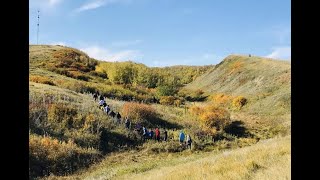
In this interview segment, Virginie Glaenzer asks high‑school teacher Kristin about the impact of taking students out of the traditional classroom and into outdoor, experiential settings. Kristin describes a dramatic shift in student demeanor: from quiet, desk‑bound, competitive behavior to joyful, verbal, collaborative, and playful interaction when the same group works outdoors. She notes that teenagers retain a child‑like capacity for imagination and fun, which is suppressed by rigid classroom structures. The outdoor environment reduces competition, fostering mutual support and shared problem‑solving. Kristin expresses a desire to bring school administrators into these experiences so they can witness the contrast firsthand, believing that such exposure can spark broader systemic change. Virginie reflects that a small percentage of educators can catalyze wider adoption, emphasizing the need to accept discomfort as a pathway to transformation.
What about you, Kristin? What changes in personality or behavior have you seen in the kids that came through your program?
About a 180-degree difference from what I see in the classroom. I mean, to look at general classroom classroom behavior. I mean, kids come in, they sit in desks. I've got large classes, you know, 30 usually in a classroom, and so there's not room to spread out. There's not really room to do different formations of desks. And as soon as you make kids do that, it's very military-like. And so they just automatically, they can be visiting in the hallway, and as soon as they come in and sit in their desk, they are quiet. And, you know, it's just, it's very off-putting. And so when I take the same group outside, you can just watch the transformation. It's, they're happier, they're more verbal, they're very communicative, they, there's joy. And I don't, everyone always assumes that high school kids are like these moody creatures that don't like to do anything. And that's that's not right. There's a lot of happiness and I mean, there's a lot of things going on with most teenagers too, but there's a lot of joy and a lot of fun and they like to play just as much as little kids do. And when you take away the formal structures that kind of hold them into formal education, it is mind-blowing listening to them. And I just, I love listening to them because it's almost like watching them become kids again. So they'll go and they'll play with something and they'll find something and somebody uses their imagination and all of a sudden they're off and they're laughing and they're in different groups and they're like, it's just so joy is the, is the big thing. Very collaborative. I find that schools are very competitive. Like even right now, kids are starting to talk about getting into universities and scholarships and things like that. And when we're outside, it's not a competition. It's, I mean, there might be some friendly little banter and whatever else, but it's, you know, let's do this together. How can we help each other? What do you need? Oh, I can do that for you. I know how to do that. And there's just such a different feel that it is, I really wish that I could bring some some of our upper, you know, our ministry people and our high-level administrators and bring them out and say, what do you see? Because they would see something that is totally different than a normal classroom. Totally different.
And I think that's, that's how changes will happen. You know, 5% of the education population is going to make some changes. People like you, that's going to inspire another 20%. And after that, by looking at the positive by looking at what we can get. Once we accept that it is uncomfortable to change, then that might lead people to wanting this. So this is, this is amazing.
I know that I've been sort of set aside as the, as the teacher that has fun senior science classes, which I mean, senior biology and senior chemistry, they are academic. They're, they're very, they're what kids need to get into the upper science programs like nursing, medicine, whatever else. But that doesn't mean that we can't play, and we do play. And that doesn't mean that a student in grade 12 is not undergoing the same rigor— and I detest that word with every ounce of my being— that my class is not as rigorous as some other class that needs to memorize all the enzymes of photosynthesis. Like, it's just It's, it's a mindset that has to change sort of within the system and outside the system and all over the place.