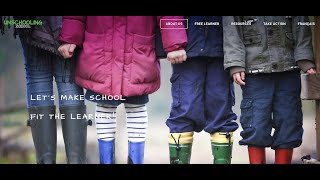
In this episode, Virginie Glaenzer explains the Unschooling School initiative, which repositions public education as a system owned by learners, families, and parents rather than administrators and teachers. She argues that schools should adapt to each child’s needs, allowing “free learners” to decide what they attend, when, and how they learn. The program offers a family‑crafted “Free Learner IEP,” mirroring traditional Individualized Education Plans but authored by parents and students to specify preferred activities, accommodations, and flexible attendance. Glaenzer describes how groups of parents can negotiate with schools to secure dedicated spaces and volunteer teachers, creating multi‑age, student‑driven learning environments that gradually influence the broader school culture. The initiative emerged during COVID, founded by a core team of six educators whose combined experience totals 229 years, underscoring insider expertise. The episode highlights practical tools available on unschoolingschool.com, examples of implementation across ages, and the vision of a more learner‑centered public education system.
Chapters
What unschooling school is about is the idea that the system belongs to the learners. It belongs to the kids and it belongs to the families and the parents. We pay for public education. We are the boss. The system, the teachers, the administrators, they're actually not the boss. They work for us, and the idea of unschooling school is let's remember this. Let's remember that it's our system and we should be able to have it fit each individual child. So we all know, and we've probably had, and I certainly have, kids who we say they don't fit the system, and what do we say to them? Well, it's just the way it is, tough it up, learn to play the game, and you'll survive. Why do we say— I said it myself, and I look back and I so wish that I'd kind of figured this out, you know, 10, 15, 20 years ago, because we shouldn't have to do that. We should say, sorry, system, teacher, administrator, whoever, this is what my child needs, and these are the things they're going to participate in, and these are the things that they're going to say no thank you to. If they're not wanting to be with what the class is doing and they can go do something else, they're not going to cause a fuss or, you know, set fire to the gym. They're just going to go and do something else. Like maybe they want to stay in the library, or maybe they want to spend more time in the gym, or maybe they want to go work while they're in school and only come to school for 2 or 3 classes a week. Because this is a crazy thing that we, we fill kids', teenagers' time up with so much school that they barely have time for a part-time job. And then those opportunities are so limited when, yeah, why not be starting your own business, running your own business, figuring out, job shadowing. You think you want to be a dentist? Okay, go hang out with the dentist for 3 months and see, do you really like looking in people's mouths all day long? Before they waste all that time going to university and then realizing, okay, it's not actually what I want to do. So the, the term that we often use is something that we think kids should be able to be designated free learners, which really means they're in charge of what they do and what they don't do. And on unschoolingschool.com, we have created all kinds of forms and and sheets and tools that parents and families can use. So for example, we're familiar, most people are familiar with the term that children that are designated with a learning disability can have an IEP, an individual education plan, and that means there's going to be accommodations for that child. So we've created the free learner IEP. It's not designated by an expert other than the child and the parent themselves being the expert on that kid. And so it is filled out by the family to say, here's the things that I'm going to do, and here's the things I'm not going to do, and here's what I'm going to do instead, and here's how my parents agree that I can come and go from school, and what all that would look like. And it looks alarmingly like an actual IEP, which we did on purpose. Because we're trying to say, let's take some— the tools of the schools and of the system are amazing. We've got, you know, here's Max creating this whole amazing structure there. But so many of those things exist in schools that we are already paying for, but we have to use it in such a prescribed way. And what we're saying with unschooling school is, no, let's use it in a way that works for the kid. So the hope is that groups of parents, families get together and they say, you know what, we like this idea because school as it is not working for our kids. Let's go and have a meeting with the school and tell them that this is how we're going to operate. And what we hope is that they meet teachers like Kristin who go, yeah, that sounds fantastic. Okay, who wants to do this? And you know, you get to the point where you've got 10-15% of the school, so the school says, all right, we're going to give you this empty classroom. You can go there. Any teacher want to volunteer and hang out there when they're not in class? Teachers like Kristin say, me. And then you go and you hang out and you facilitate and you talk. And it's multi-ages and kids come and go from there. And then that slowly and surely starts infecting in a positive way the rest of the school. And we've got examples of what that might look like and examples of what an individual free learner might look like at different ages on the website. And this has been a little, I would say it's been a bit slowed by COVID. It started because of COVID A group of us came together to kind of form this. And that, I think I was telling Max the other day, that the core group of 6 educators who started Unschooling School, we combined have 229 years in the education system, not including when we were students, like actual, actual leadership time. So it's, you know, it's not just from the outside, it's people from within the systems, you know, that say this thing needs to change.