Regenerative - Ep. #12: Moving our collective narrative from separation to a ReGenerative culture
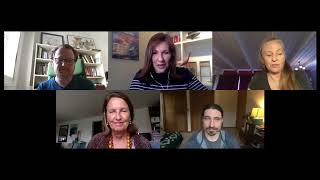
Nora Bateson, Daniel Wahl, May East, and Gregory Landwehr discuss how COVID-19 exposed the fragility of our growth-obsessed systems and opened space for regenerative culture. They argue for slowing down, building local supply networks like Mallorca's food cooperatives, and practicing what they call non-solutioning: sitting in uncertainty to let new possibilities emerge.
Chapters
Welcome to Pass the Mic podcast with Danielle Christian Wall, who will lead our conversation on moving our collective narrative from separation to a regenerative culture. My name is Virginie Glaenzer, and I'm your host with a million questions. Pass the Mic podcast is about sharing different perspectives on a specific topic, not only to help us expand our understanding of the world, but also to explore new ways of looking at it. Before we start our conversation, let's begin as we always do with a tour de table and have each of you tell us your name, what you do, and why you're interested in this topic. Please try to be brief and keep your introduction to about a minute. So why don't we begin with Nora? And you're muted.
Hi, I'm Nora Bateson, and I am, I'm an author and a teacher and a filmmaker, a mother, about 400 trillion organisms, you know, basically a complex system. And I am interested in this subject because we are, as I see it, in a moment where there's a kind of liminality and a possibility for some deep and maybe dangerous changes. Maybe they're beautiful in the long run, and I'm interested in exploring that.
Wonderful, thank you. Daniel?
Unmute. Thanks for inviting me, and yeah, my name is Daniel Wahl, also an author, biologist, evolutionary theorist, designer. And I've been, maybe for 20 years, a little longer, I've been on this journey, having initially started as a biologist and then realized that the best way to serve life was to maybe work with my own species a little more and the way that we affect the wider community of life at this point in our history. And so I've asked myself for a long time, what does it mean to participate appropriately in this collective? Complexity that surrounds us and that brings us forth. And I find that this particular time we're in now, with everybody in lockdown getting to reflect on patterns that served and that no longer serve, we're really given an opportunity to all reflect a little bit more what it would mean to participate appropriately. And I would say appropriately in my reading is aligned with Aldo Leopold's, "A thing is right if it protects the vitality, abundance, and diversity of the biotic community. It is wrong if it does otherwise," as a starting point of kind of defining what it might mean to participate appropriately.
Wonderful. Well, thank you for being here. May?
I'm an edge worker, been working the edges between systems for a long time, and this time that we're facing right now, it looks like really a threshold, a very rich time that we can work in edges as larger systems, megatrends. And so therefore I'm very interested in this conversation because I also think that innovation happens in the intersection. So whatever I think, or my experience being a reflective practitioner working with design in communities, 54 countries, education, and, and spatial planner, many other aspects of my work. But I guess what I know, it's kind of boring for me. I'm more interested in testing what I What are my trends in thinking vis-à-vis to the what Daniel, Nora, and Gregory know? So maybe something in the intersection of our thinking, something new can happen today.
Very nice. Well, thank you for being here. And finally, Gregory.
Hello everyone, my name is Gregory Landwehr. I'm the Chief Regeneration Officer at Regen Network and My background is permaculture, regenerative agriculture design. I also spend a lot of time living in intentional community. Right now I'm isolated in a single-family home, but definitely have a lot of intersections with the ecovillage movement. And yeah, I'm bringing a lot of curiosity to this conversation and excited to see what emerges. I think I'm very passionate about reconnecting human culture to its place as a keystone species that actively regenerates our biosphere directly through the way we practice agriculture and land stewardship. And so at Regen Network, we primarily focus on, I would say, sense-making, decision-making, and valuing ecological health, to kind of reweave that into our economic system and our society.
Great, well, thank you very much. So if we were having this discussion 6 months ago, when I first read the book Permaculture, which introduced me to this field, I would have invited you, a brilliant group of complexity thinkers, to expose your theory, your knowledge, and explain why or how these practices can create a better future. But today, in the context of this global pandemic, when almost everyone is being asked to stop their lives and stay home, I think it might be more important to talk about the present. And it is heartbreaking to know that some people are losing their loved ones, others adjusting with balancing work and kids. For a lot also feeling the hardship through the lack of money, the lack of food, or even struggling with emotional and physical abuse. But I hope that our discussion will offer beautiful, beautiful simple ideas that can be heard and used by regular people while being in the middle of their own personal chaos. So in that spirit, before Danielle leads our conversation, I'd like to share my own understanding as an outsider of this field, if that's okay with everyone. So, and it's most likely for the rest of the conversation I'm going to be more listening than anything else. So here's my understanding of this regenerative practice. For the last 200 to 300 years, we've been part of an industrial globalized fossil fuel civilization, which we see as our normal. And we got caught up with our amazing capacity to produce. It led us to value materialistic success, to create money-driven organization, and it resulted in a very small number of people actually owning the world and huge inequalities. Along the way, we forgot the relationship that one little action has on the entire ecosystem. And for example, how some materials used to build product can damage the rainforest, or how buying cheap labor to drive price down sometimes resulted in child labor. And while many people think that the coronavirus is disrupting our way of life, which we've earned by working hard, we're actually already in the midst of profound change. Just look at the lifelong jobs being replaced by short-term freelance work, and I'm in it, or technologies driving people out of their jobs, and then nature acting out with catastrophic behaviors. And that's when regenerative practices come into play. So my understanding is that regenerative cultures are the unique expression of a local ecosystem that has found a way to cultivate the soil in harmony with the rest of nature. And applied to business, which is really what I'm interested in, regenerative economics is an economic system that works to regenerate capital assets by recognizing that the Earth is the original capital assets. So to me, the future looks a lot like interdependence, using local communities for food, Building products that have not only a positive impact on nature, but also that are 100% recycled. And perhaps, and I'll finish with this, learning to use skills that we barely know, such as improvisation. We had a podcast on that. Co-creation and compassion, because really regenerative practices go beyond our education and current way of thinking. So with that said, and that's my way of dumbing down this field that I find fascinating but really complicated to understand, I'm going to turn it over to you, Danielle, and let you drive the discussion, and hopefully we'll get some answers to the following main question, which is: how do we move our collective narrative from separation to regenerative culture?
I feel like I need to sort of start with a preamble. This is day 33 of being locked in an apartment without any access to wild nature, walking around in the mountains or in the forests, or sticking my feet into the sand of the Mediterranean, which is where I draw a lot of my sustenance from. And so I'm well, but I'm in a tender space. And yes, I can pick up from where you started, Virginie, is this change in era from an industrial growth society that was exploitative, extractive, and degenerative in impact and was colonializing all other types of culture on the planet for a long history now, we're now also seeing a new culture being born that I would say is like, in the words of Joanna Macy, a life-sustaining society. And Joanna put it beautifully quite a while ago that we're one at the same time hospice workers of this dying system that we're all somehow involved in and that we're part of, and we're midwives of this new system. And what I like about that framing, and what really struck me just recently about the part of being hospice workers when I got to hospice my own father to death, was that in the moment of hospicing, you forgive everything. You're not there trying to keep saying you did this or that, you with your industrial growth imperative and all that. You just forgive the politicians, the CEOs, the people driven in a system that somehow forced them to act in a certain way. And that is ultimately, you're framing it with the story of separation, like yeah, it is that myth that we are somehow separate from that complexity that we come out of and that sustains us. And so what I think what we're midwifing is we're midwifing diverse regenerative cultures. It is a culture that sustains the— like that aims to participate in this complexity in a way that health emerges on all levels, from cellular to individual to family to community, to city, to bioregion, to ecosystem, to planetary health. And I wasn't so comfortable with the way that you described nature as the original capital asset, but I could reframe it as saying it is the original source of all value creation. It is what has brought us forth and what— we're an epiphenomenon of it. And so for me, Right now in this point in time where suddenly that conversation has, last year the conversation around awareness with regard to climate change and the climate emergency really hit the mainstream in a whole step change with Greta Thunberg and with Extinction Rebellion. And this year somehow this crisis is pushing us much harder into seeing the brittleness of our global system of international supply lines, supply on demand, and how all of that is starting to break down. So breakdown isn't some environmental activist's prophecy anymore, it's real and people can feel it now everywhere. And the reality is people were feeling it for decades in the Global South and we were just sheltered from it with our privileged northern lifestyles. And so for me, I observe my allies, the people that I feel that have been like me, like everybody on this call, like I've been working with Mae for 20 years, we've been trying to help create that healthier type of culture through education and through the interventions that we've done in other systems, and suddenly there is a real a hunger to listen to how can we do it differently. But what I feel a little bit uneasy, and this is where I would love to take our conversation and I'll shut up now, is I've had invitations in the last 3 weeks to so many, we are gonna have the World Solutions Summit and we're bringing the world's social entrepreneurs together to create the solutions in the crisis so we're ready when we come out of lockdown, or we're doing a hackathon and then we're gonna solve the climate crisis in this hackathon. And I'm kind of going, excuse me, like, sit in the mess for a while. Let it work on you. Let it strip all patterns of even the frames, the organizing ideas that we think we need to rebuild the new from. Some of them don't serve anymore. We need to let them melt enough so we can really listen to what wants to be born. Right now. And so yeah, it's this bizarre— and that runs through the core of my book, this, because I kind of felt that very early on when I sat down to write it, that there's something about this extreme focus on solutions. Of course we need solutions, of course we need answers, but they are transitory means to get better questions. And in a situation like this, we shouldn't rush to solutions, but we should really sit with what are the questions we should ask ourselves to really let the transformation be complete. Yeah, I think I'll leave it at that.
So who wants to jump in and share their own perspective?
I can take one of the lines of Daniel, the one that's saying, are we rushing with solutions? And remembering that the ancient ones would say the importance of the lesson of the threshold in rites of passage when you move moving from one stage in development or human journey to the next one. The threshold is where you, you learn most of your lessons, and if you rush with the threshold into solutions, you don't learn the lesson and you need to repeat that threshold. So it's very important to slow down And slowing down, the second point that I want to weave in is this question of the new narratives that were, I think, embedded in the question, how do we move our collective narrative? And I think that discourse creates frameworks which structure social life, to which power is exercised. So, in this threshold time, I think it's important that we spend time, you know, developing this critical analysis on the current frameworks that can either structure or hinder the systemic capabilities for us to come to the next phase. And so, time for thinking of the— what are they? Because very, very easy we can say, wow, we have the SDGs framework, we have now all the ministers of environment in EU is saying, okay, so now that we're pumping new funds to the system, where these funds are going to— where the funds are going to energize. So yes, threshold time to question the the frameworks before we assume these are the frameworks that will frame the discourse and how we're going to design our societies and how power is going to be exercised.
So, I'm appreciating and resonating with what's been said so far, and I'm going to maybe make either friendly sort of amendment, or it may even turn into sort of a counterpoint, which I don't hold as like an opposite or that the other perspective is wrong necessarily. So I want to sort of bring up a theme, which is syncopated rhythm. And I think it's important to understand that different societies, different people, different organizations, different ecosystems are at different places in their developmental cycles. And I don't think that— and I think it's worth asking the question, Are there movements, organizations, or groups who are in sort of in syncopated time where this sort of disruption serves less as an initiation and more as some other part of a developmental cycle? And what would that other part be? And how does that relate to how some people are behaving or solutioning? And so that's sort of like question number one, and I would sort of say that isn't to— I also feel uncomfortable with what appears to oftentimes be sort of blatant opportunism. So I'm not trying to sort of offer an apologia for that, but I do want that question of you know, how does the syncopation of different developmental cycles and, you know, in place and in sort of human society land, and what might that add as an extra dimension to the conversation and understanding when is it appropriate to sort of be solid with a set of assumptions that you feel have been born out of some other cycle, and when is the moment where you are in a complete disillusion and waiting and listening. And I think For me, the answer is going to be different in different circumstances, in different contexts.
I think, you know, listening to you all, I, of course, you know, there's so much that's here and been said. And I just, I had this experience in the last couple days that was really revealing to me. And maybe there's something in this that can be useful. Where I have been working with a group of people that I just absolutely adore, and they wanted to make a partnership, and so I said, oh yes, of course, let's do that. And then I got a document that was a contract for a partnership And I read the document, and if I had read that document a month ago, it would have been read into a context in which the premises of the document, the legalities, the, the, the kind of sealing of all the back doors of what a partnership contract would have in it, that all of those things might have felt that they were, they were somehow justified and reasonable, and, you know, of course not maybe the way I would do it, but nevertheless something that would be normal. But getting that contract this week, I read it and I looked at all those paragraphs and thought, what is this? This is so last system. I have no use for this whatsoever, because everything that I need to do right now exists in parallel to the system that's developing these documents. There's something so inherently out of relationship, out of complexity, out of what I would call the warm data, out of— there's nothing in that document that allows the vitality to take place. And so something has happened. I mean, you know, I've been at this for a long time, as all of us have, so I'm also curious as to what new insights are coming to all of you, because I think if there's one thing that I'm really certain of right now, it's that our old scripts, no matter how good they were, are actually not as useful right now as we might have thought they would be. The way in which these trans-contextual changes are taking place are surprising, and I think that that has been— that's been, for me, what brought me deep into this regenerative space of recognizing everything I want to do right now has to do with building relationships that build relationships. And the way that last system was set up was about building relationships that were separated from other relationships. So I'm not really interested in that first order set of deliverables. It's more at the relationships that build relationships that build relationships level. It's like the soil, right? The apple core that's rotting in the soil that becomes the forest, and you're walking through the forest with a friend and you have an idea. Where'd the idea come from? And that's— that piece of real complexity has been, you know, it's been strangled by so much, you know, just KPI nonsense and ways of even mapping or thinking about complex solutions, that they were at an order that didn't really hold those relationships, relationships, relationships, relationships level.
So how do you change, when you look at the contract, how do you change the system without removing the positive that previous generations have achieved through this ordered society? When you look at the contract?
Oh, are you talking to me?
Yes, yes, or anyone. What are the filters?
What I had to do was just actually talk to the people and say, my commitment is with you, not this organization. This is a human-to-human loyalty and commitment. I am willing to invest in your complexity But I know this organization can't hold it, so I just sidestepped the whole thing and said, you know, who knows, you know, in 6 months which of these organizations will be standing. So the relationships that I want to build right now are relationships with other complex living systems, and not to the systems, and not to the systems that were devitalizing those very same relationships, right? Everything in that contract was about systems hold back. It was about don't give what you're not willing to have taken from you. That's what basically the whole contract said. Nature doesn't work that way, right? That's systems hold back. It's, it's that thing of saying, I'm not gonna give what I could give because I know you're not gonna give I'm not going to give what you could give, and you're not going to give what you could give because you know that I'm not going to give what I could give. And pretty soon we've devitalized the relationship, right? So how do we start to build into a new way of living something that is much more sourced through generosity and integrity?
Did you have a chance to express that point of view to the people who draw the contract And we can all unmute yourself. This is really dive in, unscripted.
I had a similar experience that for a long time, like I have of course this academic past, and for a long time I thought, wouldn't it be nice to have a professorship somewhere? And a couple of weeks ago I was invited to take up a professorship, and when I looked at what that would entail, I looked at the role of how I would be in a new department funded by a little foundation surrounded by these established dons, professors of whole disciplines, having to, like, having been positioned there to transform their thinking, but it would have been fighting the windmills of the old system. And I really surprised myself how quickly I said no to something that was quite something I would have previously entertained, and exactly for the reasons that Maura just gave, that it just felt so much not aligned with midwifing the new, and it felt even somewhat presumptuous to think that those structures will continue as the transformation that we've now kicked in with this pandemic and the cascading failures around the system. That we don't really know how deep and how transformative they will be. But then there's like, I've heard Nora say this a number of times, like the old scripts won't serve as much anymore. And every time she says that, I wanna tug on my own mask and say, well, I mustn't say this, that, and the other thing anymore because that's an old script of mine. But at the same time, I also like, I appreciate what Gregory brought in, that there is a sort of, people are at different places of deepening into this journey, which is a developmental evolutionary journey of realigning with life's impulse of creating conditions conducive to life. And maybe if I understood syncopation and your point correctly, Gregory, it was also about maybe for some people it is about the rite of passage and the transformation in their own views, and for others who've been trying to, in Schumacher's terms, set the sails so when the wind comes we're ready to come together and say, actually, hey, we've got a flotilla going, and in which way are we sailing? And I feel that is also happening. I see wonderful alignments of the people, and this is where I come back to my old script. Like, I think that re-inhabitation, re-indigenization, coming back to place, becoming Native again in place and becoming an expression and a part of it again, manifesting our individual potential as people in service to self, community, and world, but to do so in relationship to a particular place in a particular region. That has been a theme that— that's my old script, that's what I've been working on for 20 years, but I believe it's also the new script. I think that it is now in this situation blatantly obvious that if we want to avoid the brittleness and the breakdown that we're now seeing of the global system in response to the pandemic, we need to re-regionalize our systems of production and consumption. And we need to do so in ways that we redesign this whole economic system that has us running in a treadmill at the moment in such ways that it actually incentivizes collaborative advantage rather than competitive advantage, that it incentivizes healing the system, that farmers get paid not just for their produce but for regenerating the land they're on. And I know that Gregory's work is all about enabling the mechanisms to do that kind of thing. And Mei and I have been working on so many different educational initiatives, and so I feel that we've also prepared scripts that were radical 10 years, 15 years ago, but have now found an open ear with a lot more institutions. And it's more about aligning around how do we listen to life's patterns. Like one of the questions you had us frame was sort of what are the, what was it, the structures and and systems that need changing. And when I read it, I thought, actually, the structures and systems, and this is something that I learned from a friend of Gregory's, Joel Glansberg, they're really just tracks, like tracking in the forest. They're just leftover structures and systems, our economic system, the buildings we build, but there are underlying processes and patterns that if we pay attention to them, then we can nurture something that we might not know exactly how it will look, but we enable a process of how it can unfold. I don't know if that makes any sense to any of the others of you.
Yeah, I mean, what you're talking about is sort of the second-order phenomena, like the clouds. Clouds are an emergence of the water cycle and the wind and all these different things, and you look up and you see the cloud, but it's— and that's sort of what Nora was talking about with the forest, where does your thought come from when you're walking through a forest and you're— so one thing I want to say is, I just emphatically, I would say, don't— now is not the time to participate in a disillusionment of all, in my opinion, that if you think— I am always thinking in ecological metaphors. This is a disruptive event. This is like a forest fire or something. The ecosystem to rebound needs the seeds that have lain dormant in the soil from the last time that a cycle like this happened, and they went those seeds have an epigenetic intelligence, they're not going to just do the old thing, but they're going to sprout forth in the now with a particular version of a pattern. And there's sort of these meta-patterns that are important, and it's okay, I think, to hold them loosely and to have sort of metacognitive experience of understanding when they do plan, when they don't. But at least for me, I'm a very practical person, just sort of like, just now is the time to keep the rhythm. And everybody else may lose their rhythm, just keep the rhythm and keep moving, you know. Support relocalization, support local supply-producer webs, support mutual aid with simple devices that reconnect people's relationship to one another. These are all these are the seeds that are, and now may not, I mean, it may not be a big enough disruption that they sprout and they are so, and I mean, let's also not push away competition. The competition of the moment is to out-cooperate the competition. So we do have to compete. We have to compete with heart and warm data and coordination and a new arithmetic of reciprocity and mutualism to serve needs, to serve basic economic needs, to serve the needs of meaning and hope. And you know, it is, you know, there is an element of evolutionary competition right now, and it's a plurality. It isn't just one system versus another or something. It's many many things happening all at once. And so in times like this, I sort of want to, you know, like, first, can we self-reflect and understand where we might be in our own cycle as individuals or communities? My sense is probably most of us and many of the listeners, my judgment would be that probably this isn't the time to sort of like go all in on a disillusion of your own personal perspective around themes that you maybe have been working on your whole life, feeling that you're running against the current or something like this, now is a moment, you know, take a breath with it, but, you know, tune into the rhythm and just move, because the world will attune and attenuate to these latent seeds of potential, and they will grow out of the disruption. And that's an important thing to have moving. We can't sort of, you know, we don't want to be seeds that burrow further and further down, or, you know, and there's a role for that too, and some people will have instincts to do that, and I guess who am I to second-guess that really, but from my subjective experience, this is a moment to sort of start sprouting. Like, this is the— the sun is hitting where it didn't, and so let's move.
The issue there, that because I agree with you, it's, you know, depending on what level you're working at, right? Because if you're working with the soil and the seasons and the, you know, that's one thing, but if I guess where this gets tricky is that there are these epistemological traps, and very often what seemed like you know, complexity and systems thinking and development of really sound ideas is later revealed as an extension of existing system processes that were actually dressed up like systems ideas. And that's what I'm talking about, is that there's that piece, and then there's also the piece of the being in the liquification liminal moment right now where things are changing and people are having responses so that it's like all the characters in the play just changed costumes. And, you know, things are just not behaving the way you might have predicted because they are not on their script. And so there's a— this disruption is happening across lots of contexts. And, you know, who knew we were going to have to lock up the elders? I'm constantly on the lookout to keep my father's— my husband's father from stealing the car keys and escaping. You know, like, where did this piece of intergenerational relationship come from? So that kind of stuff Stuff is just suddenly super alive and requires, yes, you know, the depth of all that we have been working for. And I absolutely agree with that, Gregory, but also this need to have fresh eyes and stay awake. Don't just like go on autopilot because no matter how well thought out they were, these notions, they are now, they're in another place. Okay. Thanks.
I want to bring my experience right now, how the disruption carried the seeds for regeneration in itself without doing too much effort. So I run something called PBL, project-based learning, in 54 countries over the years. Where, like a Freirian educator, we create a learning environment, the solutions come from the field and things like that. So a group of us met because I'm from Brazil, we're very concerned what's happening to the traditional villages in the Amazon, because they have been eradicated historically. When new virus come, they don't have the immune system, they don't have the system. So we gathered together and say, what are we going— how are we going to support the system to strengthen itself? And after lots of conversations, the idea that emerged, let's work from the edges, let's work with those communities that are between the cities like Manaus and Belém do Pará and the villages where you have indigenous people working on that piece of land, because they are the transmitters. We cannot work with the loggers and the miners, but we can work with those indigenous people that are in the suburban part of it. So here I was, the Brazilian one, intuitively coming, never met any suburban indigenous groups, collectives in Manaus, and okay, but the intention was there, let's work in the edge so that we can try to working from a nested perspective of local, proximate, and greater whole, let's see if this works in this moment of disruption. As we were getting more information from the villages, the first case of coronavirus, and they all live in collective houses and things like that, there is no soap. So I found a group of indigenous craftswomen anyway, and I said, okay, how can you start? How can we support you? Can we buy? So we bought their crafts for 2 months, and then in the conversation we We said, what are you doing with your craft skills? Okay, maybe you can— we can support you into buying, you know, sewing machines and things like that. And then we heard that they needed hygiene, they needed soap, so we got a group of women who make soaps and things. And then suddenly the women who do crafts start doing masks for— and we got another organization asking for 5,000 masks and then the women who make soaps, they were invited to come to the villages and help to this. And then suddenly the system is working with masks and soaps, and I'm just watching how they're feeding into one another. And of course, I'm not sure if this has any huge impact, but at least the system is intelligent in itself when you have the intention to work in a nested way and you start doing a small intervention. This is Artist Project Earth. We don't have too much money, but we don't have— no, we didn't have any contracts. Was like about, you know, give me your bank details and PayPal money here and trusting without— and then suddenly somebody else heard, Mei, do you know somebody that can do masks? 'Oh, I have the right group. They just got machines and they are learning how to.' So then suddenly, so I say the regeneration seeds are within the disruption. And so the questions like how we as designers and enablers and citizens embedded in this convergence of multiple crises, what is our attitude? For life to start unfolding through us and the systems reveal themselves.
You think that the success of this particular example that you brought to us, is it because of the shared purpose, the shared values that those people had deep down, deep down originally in common?
It's just because we decided to work from a different perspective. We didn't use the old scripts, which was to develop a project. It was like, let's work in the edge. So when we found one piece of the edge, it started unfolding another one, another one, another one. And now we have a group of elderly women teaching indigenous people how to do soaps, another group of women making masks, and And this is a whole region of the Rio Negro, the Black River. We're talking about 18,000 villages starting with these women, you know, a group of collective reverberating there. And I'm not— now it's going by itself. You don't even be activating because it's already been activated something, the regenerative potential. Has already been activated and is unfolding. And you may need a little bit here, a connection here, and, and another piece of information that I've really experienced this concept of grass tops, because I'm somebody that's always been working with grassroots and also UN, but this grass tops, which is those who are grassroots leaders, but they also, they are tops because they are working with these larger frameworks or the cooperative or the Federation of all Indigenous. So working with the grass tops, it's very interesting, it's new for me. Anyway, pass on.
Anyone wants to jump on this to kind of complete the discussion? Because we're getting close to the end of the hour, so we may have one last question that may last 10 minutes. So now is the time to jump in.
Just what Mei said reminded me of what's been going on here in Mallorca, where basically the entire industry of the island just died. Tourism is no more, at least for this year. It's really unlikely that it will happen, and probably not next year, and even if it comes back, it will be back very reduced. So there's a huge amount of unemployment, and there was so much of this— one kind of strapline for what is social innovation is to connect unmet needs with spare capacity, and that's what I heard Mae talk about, and that's what I see everywhere. And that's what I also feel like, yes, of course there's a fine-tuning through competitive dimensions of how life evolves, but I think it's really important to hold and see how life is really fundamentally collaborative and how in this response to the pandemic we have seen people spring up and, like here on the island, we connected the one 3D printer that could print at the quality necessary to the people who had designed how to print respirator parts, and lots of people producing masks. And when all the farmers who had all the lamb that they wanted to sell to the Easter tourists said, we don't have any fridges, then the local business that normally takes all the alcohol to the to the tourist hotels said, well, we've got the furgonetas, we've got the little lorries to drive the lambs around and we've got the fridges. And so suddenly the whole system sprang to action across boundaries to just solve for a higher common good issues that just needed solving there. And they didn't have time to say, wait a minute, what's your contract? And people didn't have time to even read a contract. Never mind write one. And yeah, so that's— but I think that is speaking to what all of us have said, that it's just— there's a fertile potential in crisis. And the ancient ones that Mae mentioned earlier, that the fact that we do learn deeply and transformatively in crisis situations, I think that's on the individual and the collective level. I'm actually quite impressed how we've chosen the world over to hold our elders and our weak above the economy. Because for 20 years, I just couldn't believe how people would say, "For the sake of the economy, we're doing this," killing thousands of people every day. Suddenly, we were able to say, "No, we can hit the stop button on this." It's interesting that—
so what you're saying is that if we allow ourselves to sit in the mess long enough, something magical happens, something that we have inside of us.
Yeah.
So I, you know, we're close to the end of the hour, so I want to thank everyone for this insightful conversation. And I'd like to end this conversation the way it began, with a tour de table. One of the premises of this podcast is that there's Not enough— there's too much talking and not enough doing. So let's pass the mic, and I would usually tell people to share what they've heard today that will inspire them to do something differently than the way they did it prior to this conversation. And if you did, feel free to share, but I'm also tempted to ask you to share how in your daily life you are in alignment with regenerative practices and what it means to you truly, individually. You don't have to take my word for it, you can share any thought, but I'm going to start by sharing my own takeaways to give you guys a moment to collect your thoughts. First of all, I heard so many insightful that I'm a little bit overwhelmed. We're going to write a blog post because it helps me digest this conversation. I'm definitely gonna have to listen to it again, but I really loved the fact that Danielle, you talked about— and I have some notes here— this crisis for me personally is a great reset. It's a time of reflection, and I love the fact that you said to forgive while sitting in the mess and slowing down. And I Now I realize how much I had some anger towards the true capitalists, even to this day, people who want to go back to business. There's that anger, and that's not helpful. And there's also a little bit of anger towards environmentalists who since the '60s have, you know, said and talked about that type of crisis. And here we are. And we've not listened. And I think if I give myself permission to forgive while I'm in that mess, it actually— something positive might come out. In that reset, I am actually doing— I've realized that there's two things that I will never, ever, ever do. One is I will never, ever, ever have a coffee on the go. It might be tiny, right? But going to Starbucks and taking a cup, that's it, I'm done. And it took, you know, it's little, but I'm thinking if there's millions of people who may have the same idea. Same thing, eating strawberries in December, living in New York, that's it, I'm done. Now, I can't control what my daughters buy, but I can certainly control what I do. And I think giving myself permission to step outside this narrative of who I think I am and my behavior is also a wonderful opportunity to make different decisions. So using food, buying my fruit and vegetable from my local places, which I've tried, but it was just easier to go to the supermarket and get all those wonderful, beautiful products. And then the last thing that I'm hearing over and over again is that we are, as individuals, looking for leaders to tell us what to do.? And as to me, you guys have some answers, but I'm also realizing that I can't wait for you to tell me exactly what to do because you're not in my shoes. So I have to step up. I have to decide to follow my own heart. And as someone said about the leaders, the grass tops, I think changes will come from leaders leading from their heart, but also individuals. And I— that's my own takeaway, is that it's, it's on me, it's on my shoulders to change. So thank you so much for sharing those perspectives. It was really revealing. So why don't we continue the tour de table and unmute yourself, and Danielle, you'll be the last one to close this discussion. But May, do you want to share your last thoughts? Any idea, or how you personally— oh, and then you are muted. You have to unmute.
Yes. Many insights, but one is related to— I'm not sure even if I can— it's still so fresh that I'm not sure if I can consolidate in coherent thinking, but I'll try. So there was something around this insight that I have, the regeneration contains the— the disruption contains the seed for regeneration was an insight that I had I didn't have before. So that was a good one that we co-created together. The other one is about staying awake and staying awake from a transpersonal perspective, staying awake within the crisis, embedded in the crisis, and outside, looking at the crisis from outside, but also in between. I like to see if the in-between is possible, which is not looking at the crisis from an observer or being inside of the crisis, but I'd like to see how is to be in between the changes. So that's something that I want to explore from this conversation here. And in terms of concrete steps. I think I mentioned to you before we start the conversation, in UK, daily exercise allotments are considered daily exercise. So I've been going every day around this time, 5, 6 o'clock, I go to my allotment, which is about 12 minutes walking from my home, and I am very much, you know, I'm always in awe when you put one little seed of beetroot and then 7 days later you see it sprouting from the soil. So I'll keep doing my food growing and being celebrating every sprout that comes in that will turn in nourishment so I can continue to serve the world.
Beautiful, thank you very much. Gregory, Do you want to share your last thoughts or idea?
Sure. Well, I'm— some things that moved and emerged for me were, yeah, I mean, I think this conversation about how do you— how are we the seeds that may be sprouting at this moment And at the same time, how do you— sort of Nora's invitation around how do you be real, be present with the context that is, instead of bringing a whole sort of set of assumptions from maybe worlds that don't exist at the moment anymore. So I was thinking about, you know, as a tech startup, as a bit, you know, our business right now, we're building software essentially. How do we bring into our process the moment of non-solutioning? How do we bring in Daniel's invitation to just sort of sit in the mess for a moment so that everyone who's on the team just has the invitation and the opportunity to just be with that? And also shift back into, you know, our rhythm and our coordination and the ways that we get things done. So that's something I'm going to be thinking about moving forward. As far as the reflection about how I, my family and I are or are not sort of coherent with sort of the regenerative imperative at the moment, I mean, I think there's one thing that's been really powerful and useful for me over the last couple of weeks is attending Carol Sanford's open— she's been doing an open sort of regenerative life 30 minutes every morning, which is really powerful, and I would totally encourage folks to tune into that. I can— and it's just reflection, right? Rigorous reflection and using living system frameworks. So So that's one thing that, you know, I really value from a sort of a personal, how am I living into the moment and creating spaciousness to reflect and understand and engage. Other reflections for me is just the way in which this shock to our supply chain, it feels like it's exacerbated, you know, I'm sort of a reluctant Amazon Prime subscriber, right? And so it's sort of exacerbated my reliance and my gratitude and my understanding of that, of the role of the sort of coordination potential and, you know, of that sort of thing. And at the same time, it sort of like jostled me into a much— the relationships were already there, but a much firmer sort of relationship with CSAs and local farms and very tight supply systems. So, it's sort of like made me go opposite directions in our purchasing behaviors and the way that we sort of are managing our household. And I'm just holding that tension and I'm wondering what that informs us about the sort of cosmo-local world in an ideal way, how we achieve global coordination and interconnectivity while sort of having tight mutually regenerative relationships with our landscape and our communities. So that's just something that I'm holding right now, and an admission of my guilt of being an Amazon Prime member. With that, I'll pass it over to Nora.
Very nice, thank you very much. Lots of to impact.
Nora? Love your confession, Gregory. I mean, I think we've all got some of those, and I was thinking it would be really fun to make this list of like, it took a pandemic before I— dot, dot, dot, right? And there's been so many of those, those huge shifts that could have happened, so many things that could have happened 6 weeks ago, but they didn't. It took a pandemic. Like my garden, I could have been working on that, but I didn't until it was, you know, nick of time. I'm making the nick of time farm here. But in reflecting on our conversation, I just want to say, I guess what I feel so deeply right now is the importance of these kind of conversations being a place where there is insight that is generated between us. And I've been sad because I felt that somehow even in the whatever we want to call it, the changemaker world, the eco-activism world, the systems and complexity world, there's been a lot of rivalry and ambition that has leveraged, you know, how many likes did you get? Which one of your Medium articles got the most viral? Like this nonsense. And really, you know, like Gregory, what you were saying resonated so deeply with me that, that we've been working on this a long time. These things that— these seeds that we're carrying, they're not throwaways. At the same time, we have never really been able to— it's like we've been in a flight simulator and now we're in the air. And there's this opportunity to embody and engage with a completely different kind of generosity of ideas and being present with each other, not knowing together, confessing together, you know, there's no need in this time to, um, to be looking for those leverages. And so I just wanted to reflect all the way around in the whole regenerative conversation here how important that is, uh, because that's so last system, right? It's so last system, and, and I don't want to do last system anymore. I don't want to do that. I really want to be in the vitality that we can generate together and that goes from this conversation out into the world, that other people sense that and can, you know, send us random emails that we don't have time to answer, but we will anyway. And, you know, that's good. That's the good stuff. So, It gives opportunity to see things we haven't seen before, and when you see things you haven't seen before, the first thing that I know about that is that they're very difficult to recognize, and or to name, or to find a place for, or, and so that makes the importance of having friends and having relationships to bring those insights alive through, just absolutely vital to find the edges and to play with those edges like you were talking about, May. And so that's, I think, what I'm resonating with. And then in my own life, there's so much happening that it's very difficult to pinpoint one thing, but, but I will say this, that I have found— we were talking about this before we turned the record button on, and, and I think I want to come back to it— that I have found that I have been really angry, and then I've been so full of love and inspiration for humanity, and in the next moment I have been absolutely heartbroken. And then within that same heartbrokenness, there is this incredible fear for what's happening to people that I love. And then boom comes the rage of, I just wanna, you know, I cannot believe which of these numbers are real. Why doesn't anyone tell the truth? Where is the truth?
And what is the truth?
This kind of movement through and simultaneous, like you were saying, Gregory, that there's a tension, there's this simultaneous multi-emotional response going on, and it's— I just want to bring that into the notion of soil and how those different pieces coming together form the capacities to actually sense and perceive in new ways. And in order to sense and perceive in new ways, we have to be willing to feel the things that are coming up there, not to indulge them, not to, you know, billboard them. It's not a pity party, it's not that. It's about what is this feeling and how does it tie to the other experiences of life, as I haven't known them, right? So anyway, that's what I want to bring in.
Thank you very much, Noha. It makes— what you say is making me think that we are almost like people with addiction, and this crisis, this confinement, is bringing all our addiction to life, and we're in rehab. And that's why maybe it's painful. So anyway, Daniel, would you leave us with your last thoughts, comment, and reflection?
Yeah, I mean, living here in Spain for 33 days, not allowed out of the apartment, and having police patrolling the streets and finding you if you take a long route back from the shop or something, I've realized I have a severe addiction to forests and and oceans and mountains, and I'm on cold turkey. And as much as I try to tell myself nature is everywhere, and I have my few seeds up on the planter on my roof terrace that also like Nora, I wasn't doing before. It took a pandemic for me to have my huerto urbano on my roof again. But it's also like this, the Amazon confession made me think of how the local farmers cooperative here on Mallorca announced shortly after the pandemic, like the curfew was pronounced, that they were going to be the Amazon of fruit and vegetables on the island. And everybody is suddenly buying local. I've been getting a local organic veg box for years, but Now people are actually beginning to be aware of what is local and what is not. The local milk factory that used to sell 60% of its milk to the tourism industry is saying, we've got far too much milk, don't buy the milk coming in from France, buy the Mallorcan milk. And people are responding. And so partially of these seeds that we were talking about, like, I've always seen my role not as the guy who knows about regeneration. I listen, I look at, I map, I listen with all the emotions, all the dimensions of my being that Nora was expressing, with my rage, my fear, my anger, my enthusiasm, my hope, to what somehow resonates as being aligned with life-creating conditions conducive to life. And then I try to help people see each other in that. And there's that— some people say it's a Hopi prophecy of a time of like, we are the ones we've been waiting for. You've heard it. And in that prophecy, it also mentions, look around and see who's in there with you and keep your head above water. And I feel like this is the opportunity, and this is also part of the work we need to do. We need to make the system visible to itself and see to see how everywhere in the crisis there's already the new life springing up, all the shoots that we've got in our gardens coming up right now. And in many ways, it's trusting that we are just part of life's evolutionary, like, immune response to the current crisis, as Paul Hawken suggested many years ago. And to do our bit, and for me, my bit there is that I've, for about 2 or 3 years now, I've felt a very strong, almost like a dilemma or a tension of at what scale of this nested complexity to really put my energy. How much do I weave global networks and make the global players on the different continents visible to each other as being part of a larger regenerative impulse that really wants to be brought and manifested in this world? And how much do I really practice what I preach or connect to my local community again and actually use— why I came here to Mallorca 10 years ago was because as an island, I saw it as a great place to experiment with bioregional, that kind of scale. Transition towards a more regenerative system. And I've been doing social acupuncture for 10 years and building deep relationships, and now I feel my commitment now is, is to really watch where I put my energy in the future as soon as I come out of this lockdown situation, and to really serve my local community. And then if there's any lessons to be learned from that process, communicate that with the wider communities of people doing that elsewhere. And that brings it really back to why in designing regenerative cultures, there's a plural. It's really vital, that plural. For me, it's because it isn't— there isn't one person who can give you the answer. It's that there's a set of questions that if we all live them with our communities in our region, with sensitivity to our our history, honoring some of the seeds and those who have come before us, picking up the babies that we've thrown out with the bathwater of ancient wisdom and place-based wisdom that we've ignored for 200 years or longer, and at the same time combining it with everything that these 250 years of fossil fuel binge and technological extravaganza have given us and somehow find a new normal. It's too soon to know the new normal with what's happening right now, and that's why I keep coming back that regenerative cultures is about living the questions together and seeing each other and celebrating that we are the ones we've been waiting for.
Absolutely, that was beautiful. I love the fact that you're really inviting everyone to find their own voice, and that's really maybe the ultimate opportunity during this crisis, whether it's to connect with other people on this topic of regenerative practices or any others, but finding your own voice, that's really about going deep. So I'd like to end by asking viewers and listeners to explore the other episodes that we had on philosophy, on ethical leadership, on improvisation, And then to also let us know, how do you see the impact and the power of regenerative practices in your own life? You can leave the answers in the comment section. Thank you again for making up time and for your really insightful experience and insight.
Thank you.
Thank you.
More from Virginie











Unlocking Fintech Success: Strategic Trends for Profitable Growth: Webinar Leadership Series