The Power of Narratives - Ep. #15: Are emotions the culprit of our addiction to our narratives?
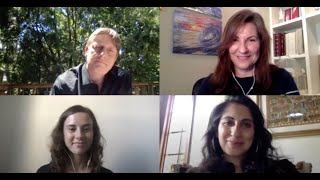
In this hour‑long Pass the Mic podcast, host Virginie Glaenzer leads a round‑table with author Aditi Khurana, organizational coach Lisa Gill, and cultural researcher Jonathan Cook to explore how emotions and narratives intertwine and why we seem addicted to the stories we tell ourselves. The conversation begins with a tour‑de‑table, then moves into a neuroscience‑backed description of storytelling as a brain‑synchronizing technology that builds empathy but can also manipulate. Participants argue that emotions are not "guilty" but serve as data about bodily safety, especially under patriarchal‑capitalist pressures that teach us to suppress feeling. The group critiques the dominant hero‑journey paradigm, introducing concepts such as ego‑death, loss, grief, and the need for plural, non‑heroic narratives that reconnect us to body, nature, and community. Lisa brings in trauma‑in‑the‑body research (Levine, van der Kolk) and the idea that we are conditioned to "shut down" emotions, while Jonathan highlights emotional granularity (Lisa Feldman Barrett) and the limits of willpower‑based change. Aditi expands the critique to cultural myths (Odyssey, Lilith) and calls for a shift from linear, acquisition‑focused stories to web‑like, interdependent narratives (The Overstory, mycelial metaphors). The episode ends with each guest reflecting on personal take‑aways, emphasizing the need to sit with anxiety, embrace loss, and experiment with new story‑forms that are embodied, collective, and less ego‑centric.
Chapters
Welcome to Pass the Mic podcast, a production from Acorn Oak Studio and music from Benjamin Schleds. My name is Virginie Glaenzer and I'm your host with a million questions. Today we'll be discussing emotion and narratives. Aditi Khurana and our group will explore the power of narratives and how those narratives shape our understanding of the world. For the listeners and viewers who don't know Paz de Mike, our podcast is about sharing different perspectives on a specific topic, not only to help us expand our understanding of the world, but also to explore new ways of looking at it. Before we start our conversation, let's begin as we always do with a tour de table and have each of you introduce introduce yourself by telling us your name, what you do, and why you're interested in this topic. Try to be brief and keep it under a minute. So why don't we begin with Lisa?
Hi, thank you so much for having me on this podcast. Really excited to have this conversation. My name is Lisa Gill. I am an organizational self-management coach. So I work with organizations and people that want to work without managers primarily, but really I'm interested in helping people to find new ways of working and being together. So I think my interest in this topic is really about helping people, us, myself included, to find new stories about work and organizing that better serve us. That mean that we can have more human workplaces. And the kind of emotion piece for me is about bringing our whole selves to work and what that looks like and what becomes possible when we can really do that.
Thank you, Leda. That sounds really exciting. Aditi?
I'm Aditi Khurana. I'm an author. I write fiction mostly. I have a background in journalism and also entertainment marketing, and I am fascinated with narrative and language and how it shapes the social order and how it creates the world that we live in.
Great, fantastic. Thank you for being here. Jonathan?
Hi, I'm Jonathan Cook, and I am a researcher of commercial culture. And culture is, I think, material, but it's also all the strange good human stuff, like rituals and like emotions. And the stories that we tell, and most beautifully, the ways that they don't make clear sense, and yet they seem true at the same time.
Fascinating. So that's definitely something we are going to be talking about. Thank you, Jonathan, for being here. Since last November, we've covered many topics in this podcast, from how to be an activist, how to use mindfulness to be authentic, and even how to lead from our hearts. Every time, there seems to be one central a very central narrative at the very center of all these discussions, something that I've noticed, and it's the hero story, trying either to embrace a new role or to shake off an identity that no longer serves us. I heard you, Aditi, in your TED Talk telling the mythological story of Lily, a hero who must let go of her identities and her roles to find the secret alphabet, a new language that allows her to find her true self, through a very emotional journey. So why don't we begin this discussion by trying to answer these two fascinating questions: How are emotions tied to our narratives? And are those emotions guilty of our addiction to our stories?
And I'll let you begin.
I wouldn't say that emotions are guilty exactly, but I think stories are— before we were writing stories, we were telling stories. People would sit around a campfire and they would tell stories. And if you look at sort of brain research in terms of how we— what happens to our brains when we're telling a story and what happens to our brains when we're listening to a story, the insula, the frontal cortex all light up. And the mirror neurons in your brain, if you're sitting with a friend and they're telling you a story, the mirror neurons in your brain begin to mimic the mirror neurons in your brain. So your brains essentially start to mirror one another. And this is just kind of like a function of the brain. You have to ask yourself, why does this happen? And it really happens because we're trying to cultivate— humans know that we operate well as a collective when we're able to work well cohesively. So the brain understands this. The brain understands that the technology, that storytelling is a really powerful technology to bind people together. And to cultivate empathy as an emotion. That being said, stories can also lead us astray. Stories can also manipulate us. We've been manipulated by stories. We've been taken down the wrong path by stories. So I don't think stories themselves are sort of guilty for manipulating our emotions. But I think it's like a neutral technology that can be used in many different ways. And I think of it as a technology that is constantly shifting and changing. With whatever era we're living in, whatever the social constructs are that we're operating within.
Interesting. Okay, so emotions are not bad if they are used or put in use for good stories.
I think emotion— first of all, I don't want to look at it in a binary way of like good or bad, but I tend to think of emotions as— I think emotions tell us the state of our body, the state of are we safe, are we not safe, Emotions are sort of a tool that we, I think at least living within the constructs that we're living in right now under capitalism, in these patriarchal structures, we're often told, I'm a woman, I'm brown, I'm an immigrant, to deny our emotions and to go with sort of rational logic. But I think emotions are really powerful in conveying to us what reality we're actually living in, what reality our bodies are perceiving. So I think emotions are, in my opinion at least, a good thing. They're informative data points. I think Jonathan can speak about this because he does talk a lot about data and emotions too.
I do. But I would say that data offer us the worst kinds of stories, the kinds of stories that would tell us all about the factual details of the characters and the settings, and then nothing would happen that makes any sense or makes us feel anything or transforms us, gives us any hope or even any despair. If we only go with the data, we see patterns, but we, we don't know what they mean. And in terms of the connection of emotion to story, I think emotions are stories. They're very short little stories because the human experience is that yes, we have the data, we understand what reality is, but then we have to choose how to interpret that. What does it mean? And there's more than one choice and they're both valid, or many of them are valid. So we choose that emotion. The emotion tells us the story of whether we're to be hopeful because everything in our lives has changed and we've lost everything, and that's an opportunity, or whether we've lost everything and everything has changed and we despair. And Viktor Frankl is a guy who has been coming back into my head all year long with COVID-19 because we're all struggling. To find that story and to figure out every day how to feel about what's going on and where it's taking us. Because we have to know about that. We can't know because so much is— the word of the year is unpredictable. We can't know what's going to happen, but we have to every day get back on our feet. So Viktor Frankl said that despair is suffering minus meaning. And we are going to have suffering in life. That is inevitable. But if we can find meaning, it doesn't have to bring us to despair. And story and emotion are the tools that we have, as Aditi put it. Those are the tools we have to find meaning and to keep going. And so I don't want to give up on emotion or story, but I do think that we have to change the kinds of stories perhaps that we're telling.
Okay, thank you. Lisa, what do you think as a coach? What's the relationship between stories and emotion? Who comes first?
And yeah, it's interesting. I think in a lot of the trainings that I lead, one of the places that I start is talking about paradigms. And I think when a story becomes a collective story that's so strong and that we are conditioned in or that we inherit, it becomes a paradigm. So, for example, I think a really strong collective story or a paradigm that we're in at the moment is a paradigm of leadership, which is, you could say, a bit parent-child, like a dynamic that's a bit like a parent towards a child. And I think the movements that we're seeing, many different movements in kind of new ways of working, the future of work, are all moving towards, I would say, a more adult-to-adult style of relating, which is kind of— it's kind of a process that I often coach people through, which is, you know, first acknowledge that we're in a paradigm and in many ways we're blind to it. And there are many other paradigms that we're in as well, kind of dominant paradigms. But the first step is to see it. And then you have a choice, right? You can act more from choice rather than automatically, and you can choose and create other stories. So you can choose to relate to someone's potential, for example, if you realize that, oh, actually my giving advice automatically is in part because I've had a story that I know better, or that person isn't fully capable, or, you know, and it's not always, you know, bad intentions or conscious, but I think recognizing that we have these stories is really useful. And I think as I was listening to both of you talk just then, I'm thinking about the pandemic and a lot of the big issues that we're facing today, like climate change is another one. Thinking about this hero's journey, another model that I like is the crisis curve or the grief curve, it's sometimes called, which is sort of like, if you imagine the hero's journey as a circle, it's the same shape really. It's like a U. Otto Scharmer and his work of Theory U is a similar idea where when we're faced with a story that's confronting, like your quote, your Viktor Frankl quote, despair, when there's no meaning, I think we can be a bit scared to stay in the bottom of the U, to sort of embrace feelings of grief and sadness and loss and fear, because of the way our brains are wired. And a book that was really influential for me was a book called "Social: Why Our Brains Are Wired to Connect" by Matthew Lieberman.. And I was really struck by what he said about how the brain knows no difference between social pain and actual pain. So, you know, when we have feelings of lack of meaning or isolation or fear of rejection or I don't belong, our brain is designed to protect itself. And our brain is always designed to find the path of least resistance and shortcuts and habits. So what becomes dangerous then, thinking about what you were saying, Aditi, is that when we see fake news stories, for example, that confirm something that makes my life easier— oh good, if I believe that, that's much simpler, or that gives some meaning and I don't need to confront anything difficult— then I'll go for that. And if there are people in that tribe, even better. Now I feel like I belong, I'm not alone, I'm not stupid. So I find that really interesting, that it's much easier to do that than what I think is really needed, the shift that's really needed, which is for us to be much more willing to stay in the bottom of the curve, to sit with those feelings, which is painful and difficult and takes courage. Because if we can do that, I think we can start to come out the other side with a new story, reorienting, finding some meaning. And then we can take action. But I really think that change and finding another story, for that to really work, I'm feeling more and more that it needs to be emotional and embodied. So it can't be an intellectual thing. And I have to give credit to Meg Lightheart, whose work I really admire. And it was her that said that first to me, that if we're not, if the changes or the shifts that we're looking to make are not emotional and embodied, then I really question whether we're going deep enough.
You think that—
go ahead.
I was just going to say you bring up such a fascinating point about the embodiment, because the story of the moment, I think, is ego death. And ego death is experienced in the body because we literally feel like we are dying. And if you talk to people right now, as individuals, as a collective, there is a massive die-off going on. And this is something that the hero's journey does not address. In all my writing classes, I teach I basically teach, you know, the Odyssey as an example of propaganda, and I teach it as the critical example of the hero's journey, which has shaped the Western canon of literature. Every film that you see, every book that you read, essentially is based on this linear story that always ends with a victory. And I don't think there's as much of an emphasis on ego death as there should be. It's part of the cycle of life. If you haven't experienced ego death in your life, I don't know that you've really fully lived. But this idea also of stories having— becoming a paradigm and having a utility and a social function. If you look again at The Odyssey, which was sort of a product of its time— think about this. This was an era when young men were— trade routes were being established. Young men were being encouraged to get on ships, go into unfamiliar lands, venture into unfamiliar territory, interact with unfamiliar people, and most of them were probably going to die. This was like a death mission, right? And you had to be sort of courageous and have enough moxie, the kind of moxie that only like a 14, 15-year-old would have. But the story served a social function in that it got men on ships. It got them to explore foreign lands. We established trade routes. The entire sort of like global economy was built. And stories like the Odyssey, there were multiple variations of it all across the globe because every culture or across the globe was having this experience of expanding trade. But when we live in an era which before the pandemic, we were living in an era where there were like, I think 100,000 flights a day, that story loses its utility. It doesn't have like a function anymore. We've reached the end of that story. We've maxed it out. And now we have to experience ego death in order to sort of find the new one or rebirth a new one out of that one that is frankly, a dangerous one to hold on to. I gave a talk in Lisbon where Jonathan and I go every year for this conference, House of Beautiful Business, and I talked about the fact that, you know, Donald Trump is essentially like an Odysseus-like figure, extremely arrogant, doesn't really apologize, believes in his own reality. These young boys getting on ships and traveling the world. I mean, you think about why did it take them 10 years to return home? It's because they kept on messing up because they were teen boys. They were not really experts at this, but we call it an adventure. If it took you 10 years to take a trip or a journey that should have taken a year or two, we would not call you an expert or a hero. We would call you incompetent, you know. But that's— we glorified the story and it's become dangerous.
I want to go back to this ego death and the choices that we have.
So what—
how do we change when we feel stuck, right? Do we have— is that an emotional work where we have to sit down and work on the emotions, or do we have to expand the story that we're in? What comes first?
From my research, what I've seen is that people can't change through willpower alone. And that's the lie of all these stories that Aditi was talking about, that you just need— that courage is effort and it's muscular strength and it's what you do to bash the world to make it fit your vision. But actually, we've discovered that that doesn't work. And as I was listening to Aditi, it occurred to me that maybe when this started to change was after the 1960s and '70s, when we had Star Trek and Star Wars, where you would go out and meet all these really interesting green people on other planets, and you would recreate colonization, the experience that Aditi was talking about. Only it turned out there's nobody out there. What there is in space is a whole bunch of empty, dark coldness that will kill you and not heroically, but just because you're going to be irradiated and can't breathe. So that changed the way that we look at our world. I think it's beginning to, and we're still grappling with it because we've had to begin to reconsider what courage means. You may hear behind me, I don't know how good your audio is, but the cicadas are out. And there's a courage in being a cicada because you live underground for 17 years in darkness, you know, sucking on the sap of a tree root or something like that. And then you've got to emerge and punch your way through the soil. And you've got to grow wings and fly and start that all over again. But that's the story of the cicada is not about defeating enemies. It's about, um, finding the energy and the determination within yourself to transform. And that's not something that a cicada thinks through. So in my research, what I find is that people go through patterns of ritual behavior in many different ways, um, to act out the transformation and change themselves through sacrifice that hurts. Not necessarily sacrificing other people, but sacrificing from within themselves. And what you're doing through that is living through a story. And it doesn't have to be the hero's journey. It can be something quiet. That nobody else sees. And yet there is courage within that.
There is heart. This is such an interesting point that you're bringing up because science— Lynn Margulis was a microbiologist. She was married to Carl Sagan, and actually Carl Sagan is way more famous than her. But she was a microbiologist who, during sort of this Darwinian era of science where there was this hierarchy in science with humans being at the top, she was this person who was saying, well, it's actually not a hierarchy. It's not linear. It's more of a tree of life. And really microbes are the most powerful organism in this entire system. But you don't see them, you don't think about, you don't go about your day thinking about microbes. And no one listened to her because she was a woman. And this was, you know, like the '60s and the '70s. Now scientists are saying, actually, she had it right. There was all this activity going on, but because it wasn't, you know, front and center. I think we have inhabited this story of the hero's journey for so long, we don't really think about how it influences other sort of systems, and in terms of our social networks, in terms of our political systems, in terms of our social structures, in terms of how we look at science. Story kind of infiltrates everything. And so we are right now graduating out of one story and into another. But this is— and the other point I want to bring up in terms of how real ego death happens, I do think exactly what you're saying, Jonathan. We can't do it through willpower and courage. It is, as Lisa said, an embodied experience. You have to make those changes within your nervous system, which is why it feels like a die-off. It feels like ego death. It feels literally like your body is dying. Because parts of your brain is changing, your body is changing to sort of adapt to new norms. And once that process happens, you can start building a story around it. But it's not a rational process. And I think we put too much emphasis and importance on this idea of rationality too, when it comes to making changes. I don't think the rational is actually real. I don't think it actually exists.
So, so we see a lot of people in these days having a high anxiety level, right? And so anxiety, we know, you know, the body produces those chemicals, whether it's love or any kind of emotion, and the body literally becomes addicted to our emotions. So I don't think anyone is going dispute the fact that we are addicted to our emotions. When those emotions are negative, that's when you want to find a way out. And what I'm looking in within society and organization, that people will wait until it's so painful, they will wait until they're on their knees to change. And so I'm still— I still want to go back to that original question, which is the The choice that we have when we acknowledge, which is a whole, you know, whole process in itself, once we acknowledge that we're addicted, that this is it, I don't want to feel anxiety anymore, and I'm not going to go take my pills or go into alcohol, what is fundamentally my choice? Is it to sit with my anxiety and dwell on it and go deeper, or is it to tell myself a story? Or is it both? And because I think that's what people are struggling with, is what, you know, what do I do when I feel that anxiety coming up? And because I'm going— I'm losing myself into that story of job-related, relationship-related.
I think, if I can come in there, I What— something I've become interested in recently is studying trauma, and there's a body of work about somatic therapy and how trauma is stored in the body, and a book called Waking the Tiger by Peter Levine. And to me, it was very enlightening to learn that if you compare animals and humans, when animals— if you see like a cat pounce on a mouse, and the mouse manages to get free, you'll see it sort of shake, and then it kind of pulls itself together, and then it kind of goes back to normal. And you see this all the time with animals of prey. And Peter Levine says that humans are the—
sorry?
Fall out of trees, like little babies, they shake themselves out. Yes.
Yeah. Yeah. And I think in terms of stories, I think as from quite a young age, we're conditioned to, in different ways, to kind of pull ourselves together, to calm down. If a child falls over, we're so quick to be like, "It's okay, it's okay, don't worry, don't cry, it's okay." But actually, if we allow our body to do what it's designed to do, that shaking process is really important. And there's another book, I think it's called "The Body Keeps the Score," where this trauma therapist actually gets hit by a car. And because they study trauma, they understand what their body needs to do in order to not get PTSD. And so this person who's sort of telling them to keep still and, you know, all of this stuff is not helping. So I think we have been conditioned to resist and repress emotions and feelings or anything that doesn't present as rational or masculine perhaps. And that's true for both men and women, I think, in a patriarchal society. But, you know, if we look at mindfulness and meditation practices and things like that, my understanding is it's not— it's kind of— it's both and, like, you know, neither nor. But it seems to me that if we could allow emotions to be, so it's not about dwelling in them per se, but if we could allow them to be, notice them, be with them, and then sort of reorient, then I think we'll find that it's not so much that we're addicted to emotions, I think. I think it's more that we're addicted to avoiding or distracting ourselves from emotions. Often, when people get burnout, for example, I think there have been so many moments where your body's been knocking on the door, and we don't really listen. We're not tuned into it, and then suddenly, we just hit rock bottom, and we have to stop. So I think it's really interesting in my field where people are talking about wholeness at work, and really listening to and bringing emotions and our personal lives and kind of masculine and feminine and all parts of ourselves, that when we do that, you know, it doesn't mean that we don't get anything done because we're all sitting around crying or anxious. It's actually the opposite. It's sort of allowing things to be, and then they're not. It's like, you know, having your emotions instead of them having you.
So you are bringing up such an important point, and also the body keeps the The Body Language Score is such a fantastic book. I think everybody should read it. I think one of our biggest issues is we actually lie to our bodies, and then we allow sort of other people's stories to hijack our own nervous system. So one of the most taxing activities apparently for the brain to do is to identify an emotion and then to be able to tell a story around it. And if you look at brain scans of men and women as they're doing this, this is really fascinating. Because telling a story is a right brain— or I always forget, like, right brain, left brain, but one is sort of the narrative one, and one is like the holistic feeling one. Men have typically, on average, 25% fewer connections between— neural connections between their left brain and their right brain. And it's not because they're born this way. It's because they're socialized to sort of bury their emotions and not talk about them. So they never develop those links that would allow them to identify an emotion and be able to tell a story around it. And if you're not able to do this, then it's like other people's stories will kind of like hijack your brain. You can continue to exactly what you're saying, you know, like your body is telling you the burnout, it's knocking on your door, but you have a story about yourself that you're the hero, you are powerful, you can do anything. And we cling on to the story rather than the reality of our embodied somatic experience.
There's something really important in what you just talked about. I'll say this as a man, but I do think that every single human being struggles with emotion because emotion is slippery and every emotion is more than its dictionary definition. You know, And they confuse us because I think they actually go beyond language, although language tells us things about them. Um, I do believe that men are taught that there are a few acceptable emotions, and the most acceptable of them all is anger. Um, but the problem is that when you only have a few words for your emotions, they all go back to the same places. You only have a few tools for dealing with reality because you only have a few stories about what's happening in reality. And so with men, it becomes, I'm feeling a discomfort, a thing of wrongness. There's something not right, and therefore there must be something out there in the world that is to blame for that. And it's making me hurt. And I feel like I want to go destroy it right now because that's the only way I'm going to make it better. Uh, Dr. Lisa Feldman Barrett has come up with a really important concept when it comes to emotions, and that is emotional granularity. And you can think of this as like the pixels on a screen, on a computer screen, and the more pixels you have on that screen, screen, the more you're going to see an accurate picture of reality. Emotional granularity is the ability to name many different emotions. And some people can name, oh, say 150 off the top of their heads if you give them enough time. Some people can name only 3. And what's been found through wonderful psychological research is that those people who have low emotional granularity are more likely to engage in addictive behavior. And that's emotionally addictive as well as, you know, in terms of substances. But those people who have more emotions that they can name, a higher number, they're going to be more flexible. They can deal with adversity because they can recognize what's happening to them. In detail. And know that not everything is anger. Sometimes underneath anger is fear and pain and loss, and oh, 100 different kinds of that. And each one has its own appropriate self-care, an appropriate response to that, that isn't just what Odysseus does, which is to get out his sword or his bow and arrow and kill it, and then get in the boat and go away. We need to have a masculinity, but also a humanity that is capable of having many different emotional stories. The more that we have, the better off we are.
So I'm hearing that the stories are both liberating and constraining. Now let me ask you this: when we construct a story based on our emotions, there's a high likelihood to be wrong, either because we don't have the right definition of emotion, or because the story that we're constraining, constructing, is going to make us feel stuck. So is it possible to go through life without a personal narrative?
Jonathan, do you want to jump in?
I sure do, because I think that the idea that we can live without stories, although it's very popular in departments of English in our university, I think that itself is a story. It's a story of transcending all of the, oh, pre-modern everything, and now we're all new and we don't have to pay attention to human reality and we can just be strange and confused. And I think in people's lives as they're actually lived, you can go through, and it's important to go through periods of shadow and uncertainty and unknown. However, unless you are born wealthy, you cannot stay there. You can stay there for a while and that is important. You have to respect that emotion. But, um, I think story is inevitable and emotion is inevitable for the same reason, because it's addictive in the same way that water is addictive to fish. And we can only interpret our reality according to emotion and story. In America, we have seen on the left the reaction to Donald Trump in a rational sense being kind of a trap, where every day we list 25 different ways that he's lied and he's not used the right facts. And we say, if only he would, you know, have the right facts, everything would be okay. If only his supporters would understand that the facts are not what he says they are, that everything would be different and he would lose power and order would be restored. But that has failed over and over again. We have to have story because there's no way to move forward because it's talking about what matters. So what we need are new stories without heroes like Donald Trump or Odysseus. And we need new storytellers. And George Floyd, the protests here have been one way for us to wake up to that, that we can't have people who look like me and sound like me telling all the stories all the time. You can listen to me sometimes, and that's okay. But them too, because Black lives matter. Black stories matter. All kinds of stories matter. And we need a universe of many different kinds of stories.
Aditi, what do you think? Can we live without a personal narrative?
I don't think we can, but I think this becomes— this is an issue of emotional literacy, which we don't really teach in schools. We teach Hemingway instead, which I don't think we should do anymore. I think people need to be able to identify their own stories. And often you will hear a story and it will resonate with you so deeply, again, like on the embodied level, level, and you will be, you know, the sense will be like, this is my story. I am— we spoke a little bit earlier, Virginie, you brought up the Lilith myth, and I keep— I've been asking myself for the past couple of years, why am I so drawn to this story? It's a story about a woman who is constantly looking for an exit strategy. It's a story about escape. She's always trying to escape. And, you know, why does the story resonate with me? Because that's been the story of my life. I'm constantly sort of— I feel like I'm trying to find myself at various junctures of my life where I feel trapped in a cage and I need to find the exit. I need to sort of find the escape. And then I get out there and I realize, well, you know, that's okay for a while. And then I find I'm locked in another cage and now I have to escape this one. If we can identify— now I might live out that story for the rest of my life. I might— my story might change. I don't know. But that is a story that deeply resonates with with my past experiences. I grew up with a dad who worked for the United Nations. Every couple of years I was moving. So it was like every— it was like being dropped into a place and then having to sort of pull yourself together, manage it, and then there was an escape. It was always kind of like being on the run. That's what it felt like when I was a kid. This particular pattern has found its way into my brain. It's found its way into like the narrative structure that I'm drawn to. It has become my story. I think if we can— and there are a few narratives that I think we live with our entire lives. If we can identify what those stories are, we can have a deeper understanding of ourselves. We can have a deeper understanding of the world that we inhabit. But it's exactly what Jonathan is saying. There's a plurality of stories out there. And the problem is if we're all expected to conform to one sort of monolithic story of the hero's journey, it doesn't resonate with a lot of people. It never resonated with me. I don't think that that's— I'm at a stage of my life now where I know— we all know life is not linear and it doesn't end with victories. It's a little bit more complex than that, thankfully. But that's a story that has sort of held us captive for a very long time as individuals and as a society.
Very true. What about you, Lisanne? I'm dying to ask you, can Can we go through life without a personal narrative?
Well, I mean, my hunch is no, because there is no reality besides, you know, there's no reality besides, for me, what I experience through a Lisa lens of experience and, you know, brain connections and all kinds of things. There's no objective reality but what I experience as reality. So In that sense, reality is a story, and my story is different to all of your stories. And I think it's very confronting for people to, to realize that what they've experienced or know to be fact is, is just a story, and that there's multiple perspectives on something which might seem to them completely black and white and factual. And I think about— I went on this course called the Landmark Forum. Perhaps some of you know about it. It has a bit of a controversial nature. But a big kind of tenet of that course is that we live inside stories. And in this course, you watch a lot of people who are very reluctant to let go of their stories, especially if you've experienced trauma. You know, if you've been abused, for example, you know, 20 years ago, and someone says, you know, that's a story. Because yes, that happened to you, but the suffering that you're living in today is not what happened to you because that's not happening anymore. The suffering you're experiencing is the story that you've told about that. And when, when we can really accept that, it's very liberating. Because then I can choose another story. But it can become, you know, back to this ego death idea. I think even our stories that are painful or traumatic can become part of our identity and part of who I am. You know, I am this person because I survived that, or I endured that, or because that person oppressed me. And to let go of that can be very scary. Like, what am I if I'm not that? That's shaped so much of who I am. So even unpleasant things that have happened to us, unpleasant stories, can be very safe to kind of hold on to. So it's not easy, this business of kind of confronting what stories have been running our lives, really.
It's not an easy business, absolutely. Being human is not an easy business. So in your TED Talk, Aditi, you tell again this mythological story of Lilia, a hero who goes on a quest to find her true self. And in this story, the hero faces the unknown. You also mentioned that we've been taught since we were children that the unknown is something to avoid at all costs, but it's so wired in our system that we have structured our lives in a way that outsmarts uncertainty, granting us a false sense of security. Feeling secure is an emotion. And in the first part of this discussion, we've explored how we're addicted to our emotion that leads to creating stories in our mind. So I'd love to ask you to help me wrap my head around this puzzle: if narratives shape our understanding and connection to the world, is there a story that could re-establish our lost connection to our body, to nature, to our tribe, and to ourselves, or the trust in ourselves? What is that story? How does it look like? And how would it feel?
I think this is— I mean, that's a big question. I think, first of all, the unknown is actually ego death, and I don't think there's a singular story that's going to— I think that is part of the thing. It's the hero's journey is a singular story, and that's the problem. With it. We need multiple stories, we need a plurality of stories, and we need to sort of take ourselves out of the equation a little bit. Richard Powers' book The Overstory is like a book about trees, you know, like we have to sort of look around the world and sort of see protagonists everywhere we go. And not just in human beings, see like your pet dog or your cat as a protagonist, see the plants outside your house, see the trees as protagonists. And once you do that, I think you realize that this linear story is again something that has hijacked our minds. And we live in a much more— we live in a world of webs. And I think that is sort of the new story. And I think we need to place more of an emphasis on that. But I think the process of ego death, you know, you're killing off the the hero's narrative, the individual journey. And this is something that we're experiencing right now too, in the middle of pandemic, where first of all, the two polarities that we're dealing with, it's like we're rethinking our notions of safety because we're all locked in our houses. There's this pandemic, raging pandemic, especially in America. But also the opposite of safety on the other end of the spectrum is life. You know, so how do you exist between the two? How do you negotiate these two? And It's really hard to hold on to these dualistic ideas in our brain. We're having to juggle both for the first time in a really complex way. We're having to think about things in a really complex way. What is a good way to be a global citizen right now? It's not by going out into the world and going out for conquest, winning things, winning riches. It is more about like staying in makes you a good global citizen. Staying in and staying inside your house and not going anywhere actually makes you a better— so it's again that story of individual versus collective that is shifting too. How are we operating as individuals? How do we play a role in that large collective structure? And this is, by the way, a story that we need to sort of get a handle on right now because COVID-19 is like a— it's like a pop quiz that comes before climate change and various other pandemics that are going to come up. So the skills that we're learning now, our ability to shape narrative in this moment, which if you don't have a set narrative, that's okay. This is going to take some time. We're still going through the process. But we need to be armed with a different kind of narrative that we're going to build over the course of this experience that is going to sort of allow us to survive as a species moving into the various other challenges that we're going to move into.
Yeah, Aditi, I want to follow up on what you just said because there is a kind of story that is implicit in what you're saying that has not been told, that in the dominant culture we have been busy avoiding, uh, and that is the story of loss. Tim Leberecht, who is the co-founder of the House of Beautiful business, is coming out with a book about how we all need to accept that we're going to be losers. Even Jeff Bezos is going to be a loser eventually. Some of us more than others. Oh, it's true. He's going to lose his Prime membership in the end. But okay, what are the stories that we hear? They're the stories that Donald Trump tells about how he always wins the deals. Never mind if they're lies. It's a story. It's the story of acquisition. When I study commercial culture, it's always about getting and getting and taking, seizing, grabbing, holding onto and keeping, keeping, keeping that thing. In the movies, a whole genre is there of romantic comedy. And it ends when they get married. And I want to say to my younger self, I just wish I could go back in time and say, sweetheart, that's just the beginning. That's the opening scene. Okay. There are stories that go beyond that, but we don't tell them. We don't tell the stories of loss. We don't tell the stories that go beyond youth, past the age of 30. And there's a reason for that. It's because those are the most important stories. And they're the most important stories because they rock us to our foundations. They take everything away and they challenge us to become something more. Instead, we have this story that you get married, you get the job of your dreams, and then the rest of your life is just a sort of denouement. And every, you know, That's— there's more to it. And so I want to hear more of what Tim is saying. And I want us to find ways to stand up and say that you're a loser, that you've lost, but not have it be like Donald Trump's insult to say that that makes you somebody who is worthless. Instead, I think the loser is the person who has gained through amazing sacrifice, like Lilith, some real wisdom, some insight into something more than just the happily ever after fairy story of our childhood.
That was very inspiring. I got goosebumps. Very inspiring. Anything, Lisa, that you want to add on this idea of— what was—
I forgot even I think this thread of loss and grief has been coming up a lot for me as well. It came up in particular when I was interviewing Skeena Rathore from the Extinction Rebellion movement, and she was saying that, yeah, a key piece of the Extinction Rebellion philosophy is really feeling together grief, and they have grief circles. Because it's only by feeling that and moving through that, I think, that we can then start to take action. And I think paradoxes are so beautiful in life, that it's only by experiencing grief that we can experience pure joy, I think. And, you know, life is meaningful because it ends at some point. And, you know, love and grief are also intertwined. And so I think it's a really interesting piece. And again, in my work, so many of the, so many of the leaders that have transformed their organizations have done so because they've had some kind of epiphany, some kind of life crisis, you know, a near-death experience or some profound experience of loss. And I think about Robert Keegan's adult development research about consciousness. And I mean, this is a story, of course. He has some research, but I guess you could say all research is stories as well. But the idea that if we can start to develop, then we reach a stage of consciousness which is much more about an interdependent lens. So I think if there is a story or a narrative, and I agree with you, Aditi, I think they need to be plural, you know, plurality in our stories, because to have one again would be this kind of colonial sort of idea, I think, you know, one story to rule them all. But I think if there's a theme for me, it's something about the paradox of the idea that, you know, I as an individual, I'm important and not important at the same time, that what I do matters and it's interdependent and it I have an impact on the planet and other people in my community. Now in the pandemic, my health suddenly is not my own health, it's everyone's health around me. And at the same time, I'm not important. I'm part of this huge ecosystem. And so this, again, ego death, this idea that, you know, the thing— and again, the pandemic I think has brought this into light. The things that sometimes we preoccupy ourselves with and worry about, you know, money or material things. When something like this happens, it really puts things into perspective, doesn't it? You know, when you realise what really matters. So I think that connection, reconnecting to that paradox, is perhaps like a meta-theme of a story that could be more helpful, which is very different I think about you all based in the States, the kind of the American dream story and the individualist, that if you work hard enough, it's individuals who succeed and we have these idols, but it's really, we're a social species, we do things together, we're so interconnected. I think finding our tribes and being together in new ways is what's going to make the difference.
I think this is so true. And what you're saying, Lisa, I mean, the real loss, in my opinion, is the disillusionment of learning that you were living inside of fiction all along. You know, so like, for all of us in America right now, the American dream, we know that this American exceptionalism, we know that these are fictions now. Some of us knew this, have known this for a while. But I mean, I think of the Lilith myth a lot because So Lilith was Adam's first wife in the Garden of Eden before Eve, and so she was placed in the Garden of Eden and told, "This is your marriage and this is a paradise." And it didn't take her very long to realize this was not a paradise, this was a prison, and this was not a marriage, this was not a partnership, it was not an equal arrangement. So it was the real loss happens when she recognizes that she's been gaslit, when she recognizes that this the story she's been told does not conform with the reality that she's living. And it's exactly what you were talking about, Jonathan, about Tim's book and about sort of, you know, what we thought was the end of the story, the happy ending, is actually the beginning. Because that's the beginning for her. She sprouts a pair of wings and decides to get out of there, get out of this lie. And for doing that, Adam curses her. You leave the Garden of Eden, you're going to have 100 babies every day, and every day they're going to die. So it's kind of like you, you can't survive within the structure, but even if you leave, you know, there's a price that you're going to have to pay. This is a really difficult conundrum, and I think this is sort of what we're living through right now. We know that we can no longer live in this old fiction, but we know that if we leave there's a major sacrifice that we're gonna have to make. In the end, Lilith takes on a demon as her lover, has 100 babies every day. Every day these babies die, and then she has to learn how to break the curse through learning this language called the sacred alphabet. So the story doesn't end for a very, very long time. It's, it's, you know, she has to go through a series of challenges before she reaches the other end. And so as a collective, particularly in America, but all over the world, I think, we're sort of exiting the old story that was always a fiction. And that is heartbreaking, knowing that we were living inside this lie. Of course there's going to be grief. The death of a story is a really, really painful thing.
So on that note of the death of a story, we are almost at the end of the hour. So I want to thank everyone for this insightful conversation. We can talk for hours on this fascinating topic, but I'd like to end this discussion the way we began, with a tour de table. And the intention for this podcast is to help each other become the self-authoring leader of our lives through meaningful action. So let's pass the mic and share what you've heard today that will perhaps inspire you to do something differently than the way you did it prior to this conversation, or anything that you feel was left unsaid, or any last thoughts. And I'm going to start by sharing my own takeaways to give you a moment to collect your thoughts, and Aditi, you'll be the last one to end this conversation. I've learned a lot. I really enjoyed how, Aditi, you mentioned that we're hijacking our body and our brain by not allowing emotions. I also really strongly related to this escape story. I'm personally, I feel that I'm on the run, and this is why I've arrived to this question about can I live without a personal narrative. And although I recognize that stories have a lot of values when it comes to bringing people together together and creating a collective story, whether it's a family relationship or a group of people working together. But I think my aha moment was when a few of you clearly said that the hero story that we've been told since we were children and generation from generation, this is the story that needs to be rewritten. And in the last podcast, I think We were talking about the power of communities, and the whole group were talking about how do we move the me to the we. And again, I'm finding this thread again on that particular topic, and that makes me very excited. Not only because I've been trying to let go my own story, I've tried to wake up in the morning and not focus on who I'm, who I think I am, And that was liberating, but I didn't know there was a space. It was empty. And I think this egoless work, which really comes through the acceptance that we're a nobody, is very challenging because we haven't been raised by thinking that we were nobodies. We thought we were important, but it is definitely liberating, and I'm gonna take this loser story with me a little bit more deeper and see how I feel to tell myself, you're a loser. So, so thank you. I really enjoyed this discussion. So why don't we pass the mic? And Lisa, if you'd like to go first.
Yeah, there's so many beautiful threads in this conversation. It's hard to choose. I think that last point you brought up again about what Jonathan was saying about, you know, learning to be a loser and embracing being a loser, I think it's really powerful. And I also really like this idea of what you were saying, Aditi, about, you know, wouldn't it be funny if I wasn't the protagonist in my life? But it was my pet cat or something. Wouldn't that be brilliant? Or the mycelium, some kind of minute thing in nature, and it's really not even to do with us. So I think, yeah, this— I also am really struck by this idea of the death of story and ego death, and again reminded of how how challenging and how painful it can be to kind of move through that. And I believe that conversations, dialogues like these are a currency for change. And so I'm really touched by the opportunity to be part of a conversation like this and for people listening to a conversation like this, and perhaps it will help spark a new perspective for people listening as well in terms of, wow, what stories have been running my life? And could there be a different story that might better serve who I want to be or the kind of life that I want to live? So yeah, I'm leaving with lots of rich thoughts.
Thank you.
Wonderful.
Thank you very much, Lisa.
Jonathan? There are A lot of illusions in story. I don't mean allusions, but illusions— things that we believe to be true and we discover are not true. Because truth isn't about the facts, it's about what we can hold on to. It's about what endures even when we lose things. And the thing that I've heard in this conversation is that we have been going collectively and individually through a process of disillusionment. And it hurts because we imagine that the illusion is who we are. If we are like Lilith, however, we have no choice but to find out what we are not. And to give up those things piece by piece, one by one, until we see who we're left with. This is happening for a lot of people right now in terms of their jobs, their businesses closing down. Um, but this doesn't mean that we're going to achieve some kind of reality and great enlightenment about how things actually are. Because in the end, we're going to have to take up a new story, a new feeling. We're going to have to adopt new illusions because that's the way you live. You step forward believing that the ground will hold you up. What I would like to see us doing is to learn to live in a way, having lost so much, to understand that what we're doing is an illusion. It's a play. It's a role. It's a pretend. And to go forward anyway, but without that rigid certainty that this must be and must always be.
I like this idea of living your life as a play. Definitely brings some perspective.
Yeah.
Thank you so much, Jonathan.
Aditi? I love this idea, Jonathan, that we still hang on to story, but we acknowledge that it serves a slightly different function than we initially thought. And there was something— I mean, when you said the thing about maybe the end of the story is actually the beginning, I think we have to acknowledge that these cycles of death and rebirth are just a part of being human. And that is something that we have been denying for a really, really long time. We don't want to acknowledge that darkness. We don't want to acknowledge the death and loss and grief are a part of the cycle and we will emerge on the other side of that with a new rebirth. And then Lisa, the thing that you brought up that has been coming up in my mind so much, what you said about the mouse shaking off the trauma, I think living through this embodied experience, when I'm stuck with something, when I have emotions that are really intense like rage or sadness, I have learned, you know, this teacher Kate Shela, who's a somatic shaman and dancer, and I just like dance it out of my system. And that's because I live in a world of words that just can really corrode your brain. Words, language, story. One of my friends refers to it as story pollution. We're just constantly inundated with stories, our own, others, and sometimes you have to remove yourself from story and just go to go directly with the body into a world, wordless place, to get to the heart of whatever truth you're trying to get to.
Very well. That was— and on that note, I would like to invite listeners of yours to really reflect on this discussion and maybe ask themselves what emotion could they be addicted to when they look at the repeating stories of their own lives. And hopefully they may find something out of it. So thank you again very much for this wonderful discussion. Really appreciated it.
More from Virginie











Unlocking Fintech Success: Strategic Trends for Profitable Growth: Webinar Leadership Series