What is Love, after all? - Ep. #17 with Mark C. Crowley
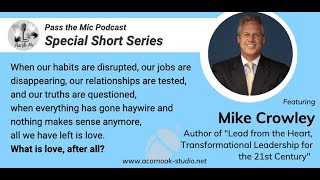
In this Pass the Mic podcast episode, host Virginie Glaenzer interviews leadership author and consultant Mark C. Crowley about the nature of love and its role in business, especially during the COVID‑19 pandemic. Crowley frames love as both a verb (caring, nurturing, coaching) and a noun (the feeling that arises when we sense we matter to someone). He argues that modern leaders must actively practice love by listening, holding weekly one‑on‑ones, and adapting work expectations to employees’ home realities. The conversation moves from the challenges of isolation—loss of routine, loneliness, and the need for intentional connection—to concrete actions such as phone calls, empathy, and generosity. Crowley shares personal anecdotes, including his long‑term friendship disrupted by the pandemic and a poignant NICU birth story that illustrates love in action. He stresses that love must be authentic, rooted in self‑knowledge, and that organizations can even measure emotional climate (e.g., positive‑to‑negative emotion ratios) to gauge love. Throughout, he emphasizes that love is the most powerful energy for thriving teams, and that leaders who fail to love their people will not succeed.
Chapters
Welcome to Pass the Mic podcast, a production of Econoques Studio and music by Benjamin Schleds. My name is Virginie Glaenzer and I'm your host with a million questions. If you're tuning in for the very first time, Pass the Mic is a podcast where we share different perspectives on a specific topic, not only to help us expand our understanding of the world, but also to explore new ways of looking at it. In this very special series that we're doing during the summer, this particular summer, actually, we're shifting from our usual unscripted group exploration to a one-on-one interview. We sent 6 questions to our guests ahead of time and asked them to come prepared to share their answers. Today I'm talking with Mark Crawley about one of the most iconic and fascinating ideas in history, an idea so strong it can change our world in crisis: love. Before we begin, let me introduce you to our speaker today. Mark Crawley is the best-selling author of the book Lead from the Heart: Transformational Leadership for the 21st Century. Mark is a leadership consultant and speaker with a goal to change how we lead and manage people in the workplace. He believes that the workplace should be more supportive of human needs. Mark is also the host of the acclaimed Lead from the Heart podcast. Welcome, Mark.
Well, thank you so much, Virginie. Nice to see you again.
Nice to see you too, and happy to have you. So I usually start this series with a reminder that we're all living in a time that none of us ever expected to see outside a dystopian new movie or novel. And when our habits are disrupted, our jobs are disappearing, our relationships are tested, and our truthful questions, when everything has gone haywire and nothing makes sense anymore, all we have left is love. So Mark, how do you define love?
Well, obviously that is one colossal question, right? So I think as I boil it down, it comes down to two things. One, it's a verb. So I'm coming from a leadership mindset, so I'm not thinking so much about the romantic side of love, although that may be an aspect aspect that we talk about. But when I thought about the question, I realized that as a verb, it's about caring. It's about nurturing. It's about coaching. It's about wanting the best for somebody else. That's what love is. So from a leadership standpoint, if you work for me, my love to you is teaching you what I know, giving you what I know, encouraging you, supporting you, not exploiting you in a way where I try to pay you as little as possible and make you work long hours to even squeeze a little bit out of you. That's not love. Love is saying, I value this person. I chose this person for my team, and I'm going to do everything that I can to help that person thrive and help that person succeed. That's what I think love is from a verb standpoint. On the other side, you have the noun. And the noun is really about things like it's our experience of it. So when people are being thoughtful to us and kind to us, we have this feeling, this instinctive feeling inside of us that translates to love. When somebody does something kind for us, we feel it. It's not an intellectual exercise. Oh, that person paid my toll. Oh, that person brought me a sandwich or cookies from home. That's a very nice thing. We feel it. And then the mind goes to work and says, what a lovely thing that was. So love as a noun is really any act that makes us feel like we matter to somebody else, that somebody had us in mind and wanted to do something that made us feel that. That's love.
I like that you're taking the approach of the leadership standpoint, because I don't think that a lot of leaders ask themselves the question, how do I love my people? So we are in this incredible, difficult time. What do you think during this time of isolation and unrest, how do we as humans find love? And you can take it from the workplace standpoint.
Yeah, I mean, obviously, it's difficult to have relationships, right? It's, it's difficult to have any relationships, friendships. I have my best friend for over 30 years, we met every single Sunday for 30 years, if we weren't traveling, if our kids weren't doing something, or if we weren't sick. So, you know, probably 40+ weeks out of the year for 30 years, we've met to go for runs or walks, something where we connect. And because of Because of COVID he's just a little bit more anxious than I am. I'm at a point now where I'm willing to put a mask on, keep 6 feet of separation. He's just not there yet. So I've lost that. So I've lost that continuity, and that's love, right? That's my best friend. So I feel that, but I also see it from a work standpoint, which is that I really think that people are missing their colleagues in a tremendous way. That's the heart. The heart needs connection. People might not believe this, but the heart is wired for connection. It thrives on it. And when we don't get it, something goes awry and our bodies tell us because we have these feelings of loneliness. And feelings of loneliness are, go out, go out with people, go see people, go connect. That's what loneliness is about. Well, we're kind of trumped because we can't really go out and do that as much. Can't go to restaurants or bars or wherever from a personal relationship. And we're not seeing the people that we work with. So interestingly, my whole view, you know, boil down my whole philosophy, it would be that we reap what we sow in leadership and in life. So if you want love, you have to give love. So it's pick up the phone and call people, stay in contact with people, send them a note and just say, hey, I'm thinking of you right now. I'd love to talk to you, get a connection with you. People are lonely right now because we're all sort of like locked into our own isolation. And we're not thinking everybody else is isolated. We're just like, this is weird. But it's less weird and there's more love to be felt when you give love. So my recommendation is to give it. Seek people out. Reach out to people you haven't talked to in years and just say, you know what, I have a little extra time on my hands and I was thinking about you. And I just wanted to, you know, say hi and see how you're doing. The interesting thing is that love is reciprocal. So when we give it, we get it, just like kindness. Every time we give kindness, we actually get more. And that's how the universe works. It was meant to be that way. The more generous we are, the more caring we are, the more caring, generous people are with us. So my answer is give it.
That's a great opportunity for a lot of people in business starting their own company or just trying to build up. Their organization.
Even if you've got a large team, it's get— have a one-on-one. Like, I believe that every manager should be having at least one conversation a week that's explicitly, how are you doing? What's going on with you?
You know, we'll—
I'll email you about projects, I'll email you about work. If you want to talk to me about work afterwards, that's fine, but this call is just to see how are you, what's going on in your life, do you have enough equipment, is your house working all right with you, what are the interferences, do you have kids you're teaching, are you sharing the space with a spouse or a partner, you know, is there noise, just tell me what's going on and how are you feeling. This is, you know, we just want to go where are you on this, where are you on this, where are you on this, when will you get this to me, and this is not a normal period. So if we lose sight of that and we just treat people as if they're working from home in a normal situation, you're going to lose people because what they really need from you is that, you know, they need that love from you.
That's a great point. So not only we can use phone and connection to people we don't know, but as a team leader, having this one-on-one over the phone and really going into the listening mode, perhaps.
Listening. Great word, because that's really what it's about. And interestingly, not to trip on your own intention, right? So if I have a call with you and I set it up where my goal is just to see how you're doing, and 10 minutes into the call, I start looking at my watch and I go, well, okay, that sounds like everything's going great. So where are you on this? And then we go back into that mode. So it's hard on some people to actually have that conversation. What's going on in your life? Because they never had it before. It never seemed like something that was important. So it's sort of awkward and stiff. And you say, you start telling me about your kids and how, you know, what's going on with your apartment and your daughters and their college and their dating experiences, things you and I were talking about before this started. And it's like, well, you know, this is too much for me. And so some people are going to have a struggle with that. But if you can't get over that hurdle and truly connect with people on that level and not go in into where are you on the project, you're not going to succeed as a leader, I don't believe, much longer. It's just not going to work.
It's interesting that you're saying that because in the previous— some of the previous guests have shared that finding love was going inward, which completely makes sense. But now you're bringing up another way of finding love by giving love and going outside and calling on your employees and your team members and just asking, how are you doing? And exploring this listening that we don't do as often as we should, perhaps. So I like that. In your view, how has isolation changed our access to and attitude about love? I think you already touched a little bit on it, but I don't know if you want to add something else.
Well, I'll just add that I think what's happened is this actually piggybacks on what we were just talking about a second ago, which is this idea idea that if you haven't been able to feel and display empathy through this entire process, you're sort of a, you know, subhuman. You know, there's like, there's a missing link because all this experience does is draw out concern. How are people doing? How are people enduring this, right? I mean, I admire the people that you were just describing that can go into themselves and be content with being themselves. And I'm, I'm happy being by myself right right now, and I love myself, and I'm content with that, right? But the truth is, is that what people need from their managers is somebody to say, I know this is a struggle for you, and I care for you, and I want to support you in every way I can possibly do that. So for example, if I call you and you've got little kids at home, and I can hear them in the background, and I just go, where are you on the project? I'm ignoring one of the most important parts of your life right now, which is to support your children. So if I were to say to you, is this a good time to talk? You know, could we talk maybe in half an hour from now? I can hear the kids in the background. Would it be better if— that is like one of those pieces of he or she thinks that much about what's going on with me that they would alter their own schedule and have me call them back so that I can have my children taking their naps or with their father or whatever. That is the difference, right? But if you just plow on and you just ignore it and you just say, that's her problem, she's got the kids, that's not mine, I need to get to what I'm getting to, you know, this is, this is not where we're at anymore. And I think people need their manager to be to behave in the way that I just described, and it's binary. So if you, if you're there, they expect it, they're grateful for it, but it's also like an amplifier. Like, I feel better working for you knowing that you did it even though I'm expecting it. But it's the inverse over here. If, if you can't make that hurdle and you're not sensitive to what's going on in my life and thoughtful around it and caring around it, I'm done with you. That's kind of where people are.
And I think it's a good thing that it's binary, because now we have to make the choices of how do we want to live our lives and the type of organization we want to create.
So that means organizations are going to have to decide who they put in leadership roles, right? Because if this person over here can't make that, if they can't do that, then they really shouldn't be in those roles. So we've never really— I'm keeping this sort of hand ridiculous metaphor thing going here, but you get the idea— this person Over here is what we all want now, and that wasn't important before COVID It was in my mind, it was in your mind, but it wasn't in terms of how companies, you know, chose managers. Now this person isn't going to be able to even be considered if you don't care about people and you don't really care about their well-being and see them thriving and you thriving in their success, where you're not competing with them and you're not threatened by them. Then you're going to be the person that we're going to be needing for leadership. And there's— Gallup has actually shown that like only one-third of people on the planet have that kind of caring gene. So we've got a lot of people in leadership roles that probably won't endure much longer.
Right. Or they can adapt. And what you're saying— right. And what you're saying is that because if you look at the business world, there is a majority of men in leadership roles. And so they're being asked to express their emotions which has been extremely difficult because the conditioning of society, you know, as a man you have to be strong, you can't allow yourself to be emotional. But how can you not be emotional if you, when you don't, when you ask someone else how they are feeling? You have to be okay with being emotional. So it's an amazing opportunity. And Mark Greene, who is in this company called Remaking Menhood, is coming up with a new narrative for men to allow themselves to be emotional. And the reason why on this short series we have only one woman out of 8 participants, guests, all of them are men, it's, you know, I think it's not like we've planned it, but I think asking men how do you, you know, what is love after all, that might be, you know, might not be random. I don't know. So let's go into a more personal side of this topic and with the next two questions. How do you personally experience love in your own life today?
Well, you know, it's, it's, I, I know the next question and so I'll give you part one, okay? Because there's two aspects. The first aspect obviously is I'm married and I have a son and a daughter-in-law and a 5-year-old granddaughter and 1-year-old twin a boy and a girl. And so that kind of consumes me in terms of where my energy is going right now on a personal level. You know, my wife and I are sort of, you know, quarantining alone, you know, and that's going fine. You know, we haven't wanted to kill each other or anything like that, so that's good, right? So they're saying when Italy happened, that right after they started to recover, they started see this massive increase in divorces, but also marriages, interestingly. So I think that, you know, where my love goes is to my family. And then you'll have your second question, and I'll tell you it's much more expansive than that.
Okay. So you're— okay, got it.
What's—
so now, yes, let's go to the next question. What is the biggest act of love that you've personally witnessed?
So this happened a year ago, and my son and his daughter— his wife, rather— had these twins. And on the day they were born, the little girl Ava had a health issue, and that they told her— they told the parents that she was going to have to stay in intensive care and everybody was fine with that. And then they came in, so you've just been, you've just been given these two babies, right? And the doctors came in and said, your daughter is going to have to stay in the NICU unit. And they were fine with that. And then they came back an hour later and said, we don't have the technology here to support her. So we're going to take her away. We're going to take her to another hospital, Children's Hospital in Los Angeles. So we went to the NICU where these tiny little babies are, you know, intensive care. And I was holding Ava, my wife was holding Anthony, and his mom was nursing. And all of a sudden these paramedics came in with— looked like, you know, like an incubator. And they went up to her and they said, we're here to take your baby. Now she had just given birth like 4 hours earlier. So to take these babies away, one of them was, you know, it felt crushing to me. You know? And so she lifted the baby up, she gave her a kiss, she handed her off to the paramedic, and she said, "Have a wonderful adventure, little Ava." And I just couldn't believe the graciousness, the poise, the love. Like, you're going to be okay. You're just going with these people and they're going to take care of it. It's going to be an adventure. There was no tears. There was no, "You're taking my baby from me." There was no victimhood. It was To this day, the most beautiful thing I've ever seen. To be able to pull that off in that moment, incredible. Really incredible.
As you said, it was not about her, it was about the baby going into on a journey.
Mm-hmm.
Sending positive—
I think the baby could feel that. Mom's okay with this, you know? Not fearful, terrified, crying, any of that, you know? She passed her off with wonderful energy. It was just beautiful.
Yeah, it is beautiful the way you said it. Thank you for sharing that. Thank you very much. Wow. And yeah, having given birth to 3 daughters, it reminded me, you know, how giving birth at that very moment is so already emotional and incredible. So I can't imagine your daughter going through that. So let's focus on— let's go back to how we begin this conversation with the looking at the business world, because you're such a big voice in that space. The last question is related to the business life, and we talked just a little bit before we started recording. Can you share with us a bit more how in your job and in the work that you do, how does this work help others find, connect with, or share, or express love?
So this is the other side of the, you know, the other side of the question. You know, how are you experiencing love? And I don't know that I ever have thought about this. I think I felt it. I think there's a knowing inside of me that I knew what I was doing. But I will say to you that your question prompted me to think about, like, what is— how is my work affecting people?. And I think they can feel the energy. I'm giving people love with the stuff that I put out, like with my tweets. I, you know, I spend a lot of time. I'm just not sending out, you know, anything just to fill the space. I'm sending out information that really expresses my message, my whole theme around leadership and why we need to bring more heart into it, which is caring and support and nurturing. It all sounds weak until you understand the science, which says that As you were saying, we're emotional beings and we've pushed that aside for decades and we can't because they influence us in a really profound way. So when I send out a tweet, I know that it's going to affect people. I want people to be moved by the stuff that I put out there. And that's love. If you're sitting in your home and you're reading it and you're having a feeling, a sensation of Wow, like that hit me, then I've done my job. And I think I have, you know, you mentioned I have a podcast and I think, I hope that people can tell how much love I put into them to make them the very best that they can be. I'm not phoning that in either. The people that I pick, the questions that I ask, the whole energy that consumes them. What I want people to feel is like there's— like he's speaking truth, he's speaking authentically. I'm getting to know this person and I'm learning because of the work that that person has done with love. So I have my own personal relationships with my wife and my family, but, you know, I have like 135,000+ Twitter connections and I feel them. Like I know what they're like. I know I have a sense of who these people are that are responding and I respond back and I have connections with them. It's not superficial. So you can actually, you know, from a social media standpoint, it's not just putting content out there. I think you can actually make a real connection with people. And when I've talked to some people, they go, I really feel like I know you. And I think, okay, then I've done my job, you know.
So you think it's more related to the topic because that's what you talk about, bringing your heart in the workplace that your job is helping others connect to and express?
I think people like the message. Um, you know, some people like the message, but I think there's an energy that I bring to it that is differentiated. Like people can feel that like this has become, you know, I, my book came out 9 years ago today. It was a bestseller again on Amazon. Like I woke up and looked, I couldn't even believe it. So that's telling me people are moving back into this. But in the interim, the 9-year period, there were many years, not just months, where people weren't paying any interest to this at all. They thought it was a soft and weak idea. And so I'm grateful to COVID because COVID has sort of forced, as we've been talking about, sort of a shift in consciousness. And now people are like, how do I get there? You know, but so What that means is that there are a lot of people talking about this now, and they're talking about it without a whole lot of experience around it. They're talking about it intellectually, like, hey, we should be doing that. And because I've lived my whole life like this, this is how I've managed people my whole life, and I've written a book about it and spent the next 10 years researching it further and expounding it with my podcast. I'm just marinating in this, and I think that comes through. I think I convey that energy, that knowledge, the wherewithal, the authenticity, and the interest of helping people. So when they get it, they're like, hey, that was really cool that he tweeted this out because now I can apply this, I can use this, I've learned from this. That's kind of— so there's a lot going on there. It's not just, you know, tweeting something out just to get it out there. And I think people can feel that.
Right, right. Yeah, and I was, you know, the same way that this question prompt an inquiry as a marketer myself. How do I bring love into the work? Not just doing a job that I love, but how is the outcome love for other people? And it's not an easy question because we've never chosen a job to have other people express love. But I think what you were saying is that in addition to the topic that brings people to a place where they will find love, The way you're actually doing it as a speaker, as a writer, as a consultant, the relationship that you build, the time you invest, as you were talking earlier, you know, calling someone, asking how you're doing, this, these type of act of love is a way of showing others an appreciation for who they are. I see. Yeah. Okay, great. Well, I'm excited. I'm glad. I'm glad because, you know, as we have different people from different walks of life, it's such an interesting question to take on your glasses or your lens of love and look at the business world and see what you see instead of efficiency and productivity, etc.
You know, like it or not, it's the most powerful energy on the planet. Right? And so you can be a man like me and marginalize the heart, marginalize love, and say that really has no place in the business world. And yet, ask anybody to describe like the best boss that they ever had, somebody that they worked for, and what were the behaviors that were the common denominator? And you would find they're all related to the heart. It's not like they, you know, taught me algebra, you know, or, you know, I learned how to, you know, how to put, you know, new, new data together on Excel, you know. That's not what anybody would come up with. They would say they saw me, they saw my potential, they taught me, they believed in me, they reinforced that in me, they gave me challenging opportunities so that I could grow, they, you know, they pushed me in ways I didn't believe that I I could actually accomplish. Those are the kinds of things that, that when leaders do it, affect hearts and people. And the funny thing is, when you ask those same people, well, how do you want to lead? They can't access the fact that all they need to do is replicate what made that guy or that woman a great boss, and they too will get the same reaction. For some reason, men especially, we think we got to be hard-charging, demanding, keep your troubles at the door. I don't need to know what's going on in your life. Let's keep it professional. You get a paycheck. You know what the rewards are. If you don't do a good job, you're out the door. That's the deal. And that's all we want. And nobody wants that on the other side. Nobody wants that anymore. Life is too short and work is too important. And so we sort of end where we started, which is if you don't love your people, you're not going to succeed in leadership. Simple as that. That's the very last thing I say to people. I say I have one last thing to leave you with. If you remember anything from the whole hour and 15 minutes, been here with you, it's this: love your people. And you know what happens? People start crying. They start crying because that's not what they're getting. And they're like, that's what I need, that's what I want, you know. And it affects me every time. And I know it's coming because it's like this— we've just got it wrong for so long, you know. We've just seriously had it wrong for so long.
But don't you think that to love your people, you have to love yourself first?
Yeah, I mean, you got to do a lot of work. To love yourself is a really hard thing for a lot of people. I had a very disruptive upbringing that destroyed many of my family members. I write about this in my book. I don't really talk about anybody else in my family because it's their personal lives. But, you know, I'm just willing to say today that, you know, I come from a large family and one of the few that kind of made it out, if you will. And the way that you come out of it is you have to confront all that pain. And I think, you know, when I speak, I tell the story of how I grew up and how I was influenced to lead this way. And people come up to me afterwards and they say, I had your upbringing. Well, no way you had mine. Right? But you had something. People relate to their upbringings with pain and disappointment. And, you know, whether it was divorce or parent— what, you know, parent died or abusive, you know, whatever, didn't have money, alcoholic, whatever. People have universally challenges. And so you get into leading, we don't realize how much our childhood behavior, our whole childhood selves are influencing us in terms of how we manage people. So to your point, if you don't do that inner work and get to know what's driving you and motivating you and understanding— like, for, I was always like, work ridiculous hours, and, you know, I mean, ridiculous hours, you know. And when I finally got off that gofer wheel and I started to write the book, I started to reflect on it, and I realized that I had been motivated to prove prove, prove, prove my whole life to my father because of his abusiveness and his doubt in me. I was like, on an unconscious level, I'm going to prove to him that I'm better, that I'm great, you know, that I'm good, I'm talented, I'm worthy, I have value. That's a really bad motivation. So, you know, it's okay to do it for the sense that you want to achieve, but if you're doing it because you're trying to prove to somebody, that's That's a perverse motivation. So when I learned that, I dropped that. I don't have that anymore. So you have to do the work, and the work is painful. You know, you have to relive it, and a lot of people aren't willing to do it. So they just keep living and doing the same things and making the same mistakes. But the more you know yourself, to your point, know thyself, the better a manager you are. Because I know what my limitations are, and I can tell people right up front. They ask me for something that I don't know how to do, like, that's not my area of expertise. But earlier in my career, I would have faked it because I don't want people thinking I've got weakness. That's a limitation, right? So you've got to do that work, and the more you know yourself and know what motivates you, drives you, limits you, the better you're going to be, you know.
And I think with this COVID and what's happening in the world, we can see that the only thing that we have control over is this understanding of ourselves. It's this inward work. That's the only thing we really truly control, because it's a choice. True.
And it's a wonderful time to do the work, right? You know, you're not commuting, you're not on subways, you're not on buses, you're not in your cars, you're not dressing up. There's extra time. Now we know in America people are working like 3 hours a day longer than they normally would. And I'm hoping that managers start to say, hey, you know, when it's 5 o'clock, 6 o'clock, call it a day and go be with your family and have a glass of wine and do whatever you want to do, but stop working. But I do believe that people have that time to do this work when nobody's, you know, there's just extra time for people to do it. And you're not around a lot of people so you can do it, you know.
And maybe it's not so much time, but it's also having access to coaches, online programs, you know, articles you can actually read. And, you know, you can find people who will shine a light. The resources are there, but it has— whereas, yes, whereas in the, in the '80s or in the '70s, it was just definitely not as available. You're right, you're right, you're right. Wow. Okay, that was, uh, thank you so much for sharing all those insights, not just from a business leadership standpoint, but also from your personal life. Really appreciate it. You're very welcome. So as a way to wrap up this conversation, we're gonna end with a little game with 4 questions that we didn't send you. And so we've got some fill-in-the-blanks statements for you to complete, and you can always say pass if you don't have the answers. There's no thinking, just the first thing that comes to mind. And it's only 4 questions. So the first one is The color of love is blank because blank.
I think it has to be red because the heart is red. You know, the heart is sort of like, like in your background, you know, it's different colors of red. If you've ever seen a real human heart, it's, it's all red and rose and pinks. It's It's kind of a beautiful thing. So yeah, so I would say literally the color of love is red.
Very nice. Second question is, I love someone when blank.
When they're generous. Generosity stands out for me. You know, when people are truly generous, that's a courageous act. You know, I'm willing to give something to somebody just to give to somebody. I love that in people.
Being a giver, more than a taker. The third question is: We think we all know what love is, yet when we dive a little deeper, love is not blank.
Hmm, I hope you can edit this because I'm struggling with this one. Inauthentic. You can't fake it. You can't fake love. People can feel it, you know. You can like act as if you love someone, but if it's not coming from here, people can't feel it in here. And when they can't feel it in here, they go, wait a minute, there's something wrong here and it's not real. And then they lose trust in you. So it has to be real.
I love it. And then we'll end on that final statement. Love is blank.
I'll say what I said earlier. It's the most powerful energy on the planet. And people are thriving in it. That's what makes people thrive. Any positive emotion, I believe, is an expression of love. So when you're seeing a sunset, the feeling that you get, that's awe, that's love. Somebody giving you attention or appreciation or interest, that's love. So any experience of positive emotions is ultimately going to make you feel love. So at the end of the day, it's, we are looking for those and no emotion lasts very long. So we need it all the time. This is another thing. It's like, I can't just say, hey, I love you. And then not show it to you for a week and then come back and go, I love you. It's like, hey, I had a whole week without any love. It's not going to work. So we have to demonstrate it constantly. You know, there's all these measures, 4 to 1, 5 to 1, you know, more more positive emotions to negative emotions that drive positive relationships, marriages. There's John Gottman who said that the most successful relationships, like the marriages that last the longest, their relationship gives one another 5 positive emotions for every 1 negative. So we have to lean into that. That's love. That's love. So it's, it's 5 love, 1 not so much. Argument, you know, or plate throwing, whatever you want to have, you know, but you can have, you know, something, you do something unthoughtful, ungenerous, something that makes the other person mad or angry or disappointed. For every one of those, you need 5 positive ones. That's, that's what, that's how badly we need love. Because if you don't get that, and by the way, it goes into sanity too. We also know that like people who have, you know, the most depression— that's not biological, it's not chemical— but people who are leaning into depression, they have a lower balance. So it's like 1 to 1, or maybe even 2 to 1. So 2 to 1 positive, 1 negative. It's not enough. You've got to be leaning into the 3, 4, and 5 for people to be getting enough love.
That's how much we need. We should have another podcast and discussion just around what makes relationships successful, because I don't know if saying to someone, "I love you," or giving love is a guarantee of success. You don't know what the other person thinks.
It's not expressing it, you know, and even from a leadership standpoint, men hearing me think, "Oh, I got to go around and tell people I love them." You never ever have to use those words. Just show it to them. Just send them an article that you read and said, I thought of you because you and I were talking about this the other day. Or here's a book that I think will help you in the things that you're working towards right now. Or I understand your kid's playing in a Little League tournament this weekend. I hope he does well. Let me know on Monday. Those are the kinds of ways that a manager can show love to people without ever saying it. People feel it. They know it. They don't even have to articulate it. They don't have to go, oh, my boss must love me. Feel it and it just goes away, you know, but you've had the impact. So I think that's the same thing in relationships. You know, I've been married for 30-plus years. I don't go up to my wife all the time, "I love you, I love you, I love you." I say it, but it's all the little things that I do for her that she sees it, you know, every day.
It's in the doing. It would be interesting to try to measure love within an organization and to be accountable on that particular set of values of the data.
I do know I had just recent podcast guests tell me that emotions are measurable, so they can actually measure emotions in an organization, which means you probably can measure love in an organization too, or the absence of love, which is probably more true, you know.
An interesting discussion as well. Well, thank you very much, Mark, for sharing your personal view on love and how your work brings more love into the world, which is much needed. I really appreciate our conversation. Thank you so much.
Thank you so much today. Thank you very much. Have a wonderful weekend.
More from Virginie











Unlocking Fintech Success: Strategic Trends for Profitable Growth: Webinar Leadership Series