What is Love, after all? - Ep. #17 with Aaron Force
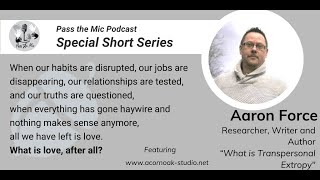
In this Pass the Mic podcast episode, host Virginie Glaenzer interviews independent researcher and author Aaron Force about the nature of love. Aaron defines love as a foundational, universal force that binds and drives the evolution of the cosmos, likening it to consciousness and describing it as the motivating energy behind creation. He argues that during times of crisis and isolation, love must be sought inward through brief mindfulness moments that reveal a deeper wholeness, rather than through external relationships. Aaron shares his personal experience of feeling greater love by turning inward, describing short meditative flashes that dissolve the ego and reveal love as wholeness. He expands the concept of love to include creation itself, viewing artistic and natural creation as the greatest act of love because it invites participation in the universe’s ongoing co‑creative process. Aaron explains how his professional work—writing, research, and public speaking—aims to inspire a shift in human consciousness toward this wholeness, helping others reconnect with love even if he only recently labeled it explicitly. The conversation concludes with a rapid fill‑in‑the‑blank game where Aaron offers spontaneous reflections on love’s color, conditions, and essence, ultimately stating that love is wholeness. Throughout, biblical analogies (God as love, Jesus as the bridegroom) and references to thinkers like Barbara Marx Hubbard are used to frame love as a non‑local, energetic, and evolutionary principle.
Chapters
Welcome to Pass the Mic podcast, a production of Acorn Oak Studio and music by Benjamin Schleds. My name is Virginie Glaenzer and I'm your host with a million questions. If you're tuning in for the very first time Pass the Mic is a podcast where we share different perspectives on a specific topic, not only to expand our understanding of the world, but also to look— to explore new ways of looking at it. In this special series, we're shifting from our usual unscripted group exploration to one-on-one interviews. We sent 6 questions to our guests ahead of time and ask them to come prepared to share the answers. Today I'm talking with Aaron Force about one of the most iconic and fascinating ideas in history, an idea so strong it can change our world in crisis: love. Aaron Force is an independent researcher and a writer exploring the concept of a global awakening or shift within humanity. He experienced his own spiritual awakening in 2015, an event that has led him to develop and discuss ideas about ego and the nature of an expanded state of consciousness to impact humanity's future. He is also the author of a book, What Is the Transpersonal Extropy? Available on Amazon. Welcome, Aaron.
Oh, good morning. Thank you so much for having me.
Happy to have you.
Wonderful.
We're living in a time none of us, and I'm sure you'll agree with me, have ever expected to see outside a dystopian movie or novel. When our habits are disrupted, our jobs are disappearing, our relationships are tested, And our truth all questioned when everything has gone haywire and nothing makes sense anymore. All we have left is love. So Aaron, how do you define love?
Well, love is one of those incredible mysteries, isn't it, that has been discussed throughout the ages and history and artists and poets and everyone, philosophers have tried to get their mind around what love is. And so I think it's going to be a little bit difficult to find a complete catch-all in every circumstance of what love is because it is so multifaceted. In a lot of ways it's like consciousness. So I do a lot of research at a sort of a layman's level on consciousness. I'm not a scientific researcher on that as much, but there are so many facets to that. And so to find one catch-all, definition can be a little, a little difficult. And I mentioned to you, and you know me enough a little bit, that some of my perspectives, uh, having come out of my personal spiritual awakening, my personal experience with some of these, uh, more developed concepts of the universe that we have, some of my concepts are a little, um, outside of the normal a little bit. So in terms of, love, there are a lot of probably pat answers in terms of what society thinks that love is. Love is something that is thrown about in movies and in songs and so-and-so loves me or I love so-and-so. Um, you know, those types of things that are kind of ooey-gooey and somewhat temporal passing, uh, thoughts about love. But to me, love is something that is much more foundational to the universe itself, to everything. As a base quality that exists and that it is something that is a driver of how the universe itself expresses itself. So what I mean by that is that love is a motivating force, something that attracts together binds disparate parts of life. And that makes sense, I think, on an intuitive level, that when two people, let's say, fall in love, they are somehow inexplicably drawn to each other, that nobody can describe it. And that's part of the mystery of it, and therefore all of the love songs and so forth and everything else. But to me, the universe itself, at a very foundational level, is as a, as an evolutionary concept that, that the universe has been evolving and expressing itself in numerous ways ever since the Big Bang in our physical realm of time and space. And we went from a, a condition of absolute apparent chaos at the Big Bang of things just going everywhere to a point now in our life that we can see even amidst the chaos that we, currently are perceiving in our lives that there is still an amazing order in the universe that we live in, that, that they're in, in nature, in the organization and order of how our bodies are completely ordered and organized in terms of the multiple systems within. There's a great order within the universe. And to me, love is, that motivating force that draws and binds things together. Now think of it, think of it this way in terms of if we take the biblical analogy of God. God in the Bible is described directly as love. God is love, the Bible says. And we also see in the New Testament, we see that, um, uh, theologically Jesus is described basically as God. In the New Testament. Okay, so he's described— he's referenced as the Son of God, which in the cultural unit of that time was to basically equate himself with the Father. So we have those two things in a biblical analogy of God actually is love. We have the idea of Jesus as God. And then there's a— there's another term or theory in the— in the Bible that states that Jesus is that which holds all things together. Which is a very interesting thought. So then you have God is love, Jesus is God, and love holds, or Jesus holds all things together. So basically in terms of that analogy, I think it's a really good one in terms of a more general spiritual approach that if we look at the, the, the universe itself as something that is driving a greater wholeness within all things. That it is actually love that does that, that the universe itself is consisting of love. Love draws all things together and love holds all things together. It's an interesting way to take a look at it. And in terms of our human experience, I think there are some things that are intuitive about that. It's just how it happens. My perspective happens to be a little deeper than probably the average person.
Great, thank you. Love is the universe. So during these times of isolation and unrest, how do we as humans find love?
Mm-hmm. Well, that's a great point, and the idea of finding love in a time which is a period of somewhat of a unrest for us, somewhat chaotic in our personal experience, is the idea of actually going inward. I believe, I believe that our spiritual experience, which is not to be sort of too woo-woo or too mystical about it, in the, in the essence of spirituality is basically to go inward and to find our more truer nature and self. Which by the way, I think ties right back to the universe. I think we are the expression of the universe itself in time and space. And so I think so many of us, when we look at the chaos of the world around us, we feel like it's falling apart. We're looking to the outside things. It is the human ego that looks outward. The ego always looks to out there for salvation. And we can see that's not a very good place to look right now. Right now, for the idea of peace and joy, which are intimately related to love. And so love, by the way, is this idea of wholeness, right? Of coming together and becoming more than two, becoming more of one. And the more that we try to look outward for our experience of love, the more elusive. That's going to be— we certainly find love in human partnerships and relationships, and that's— I understand that totally. That's not exactly in this discussion what I'm referring to so much. I think more foundationally, as a foundation to our external relationships, we go inward first, especially in these times of chaos. We find the peace, the joy, and the corresponding love that that produces those. We find those within. And so, yeah, maybe a little difficult of an idea for some people because we are so conditioned to look for love, joy, peace, any of those spiritual qualities outside of us, but they're found inside. And so that I think is a very important perspective to take in this particular time, that we find the wholeness that love is, that love brings, which takes all the disparate parts of everything and drives them into one, which is, which is ultimately the whole goal. The whole grand plan of the universe itself, I believe, is a greater and greater evolution of wholeness, which includes us. And we have been invited to that process as co-creators. And so that, uh, that the universe itself does not do this by its own will or volition alone. It doesn't force us to do anything. But that we are invited and that we are drawn and we are loved into that entire process of wholeness is a very incredible thing to sit back and think. But it all begins inward. We don't find that outward. And as we go inward, the outward will correspondingly adjust itself to it. So in other words, so within, So without. So if we are whole, we find that love, and we know that wholeness inside, that will become more apparent externally. But we start inward and it appears outward.
I'll take that invitation to go inward. So in your view, how has isolation change our access to an attitude about love?
Well, I think it forces us to re-examine, or at least it unsettles our previous perspectives. And that's, that's one thing about crisis, if you will. The crisis— Barbara Marx Hubbard, who was one of the most influential women on the subject of conscious evolution One of her big driving major points was the fact that crisis always precedes evolution, that there is something that produces a need to re-examine, to rise above former limitation. And while we can look at the chaos of our time, there are people, of course, that have experienced serious implications out of it. I don't downplay that at all. People have lost their lives and people have lost loved ones and people have lost their livelihoods. And I get all of that. But in the grander scheme of things, we also need to maintain that perspective that there is a higher process going on here. I really do believe in this idea of this universal grand plan that we are a part of and that, uh, sometimes It is the introduction of crisis that, that precedes the shift into the next stage, which for a lot of us will be a greater sense of love, uh, because we may lose our attachments to the external ego desires where we're always looking externally to ourselves. And it's tough, but we need to maintain that greater perspective that there is always purpose in the pain and that it does lead somewhere. And we can know that because of love itself. We've seen historically love has always prevailed. It has always moved us into greater wholeness. And that's how I perceive this time. And yes, it's difficult, but it does force us to literally wake up and re-examine in some ways. For a lot of people, maybe they're not going to, to understand which way to go, but hopefully there is a homing beacon inside of us that is calling us to say, hey, go, go inward, go deeper. And that's, that's where your wholeness is. That's where you find love. And as you go there, it's going to express itself outwardly because as within, so without.
So yeah. So the direction is known. It's within.
Yeah. Inward. I believe so. Yeah.
Let's be a little more personal with these two next questions if we can.
Okay.
How do you personally experience love in your own life today?
Okay, so personally for myself, the greatest experience of love— and I'm going to sound a little bit like a broken record, but that's just because it's so, so viable and so important and part of who I am— but is the idea of finding a greater love and wholeness within. And this has been something that over the last couple of years I've really begun— actually, just in the last maybe year at the most, probably— that I've really begun to hone in on that all of the love, all the peace, all the joy, all the things that we need Uh, for anything, whether that be our own fulfillment or our advancement, right? Either personally or collectively as a species. I believe everything is within that. We have that abundance. Uh, and it's all, it's all part of our essential nature that as we go deeper in, we find that. And that has been really my most personal experience. And I, I wonder if you're kind of drawing for more of a relationship kind of orientation of how I'm finding love that way. But I really am in this stage of life right now where the deeper I go, I find that there is a greater experience of love personally. And it brings an incredible love of life actually, so that even despite all of the chaos, I'm still smiling bright inside because it radiates within and into my exterior world. And I think as that happens more, I think, I think there is this general tendency of love, which is, I believe it's, it's really part of consciousness, consciousness itself. I think it's one little facet of consciousness that we experience as human beings. I think consciousness itself has this radiating tendency of order and organization and You mentioned my little book of Transpersonal Extropy, and I believe that as we transcend our egos, the surface level of us that is not really us, but as we find our truer selves, things tend to order and organize and improve and increase and involve. And in love, it's the same way. I think as we're really rooted and grounded internally and have that experience, it just tends to organize everything around us. Our experience outward is one more of love. And so our individual relationships are with family and coworkers and whoever it may be. I think we find greater love. Um, some might call it the law of attraction. I don't know. But remember, love is a bond. It is an attraction literally between two people or a person and, uh, you know, a greater universal context of self. Uh, so attraction is actually a very good word. But, um, yeah, I think as we go inward, it affects outward in so many ways. And that has been my current experience in all of this. Yeah.
So you said in the last year you felt a lot more love coming from the within. Do you sit? How does that manifest? Manifest? Do you meditate? Do you have moments where you are, uh, sitting down, not thinking, just feeling it? How does it emerge? How does it show up to you?
Yeah, that is probably the next greatest important question that could probably be asked about that. And in terms of the idea of love, and I said maybe the last year or so, maybe it's not even been that long, honestly. So when we talk about the idea of love, this might blow you away, as me as kind of a really spiritual person, it's always been low on my list for some reason in terms of what I pay attention to and what I've delved into researching and just getting a better experience for. And I don't know why, I guess I just always felt there were, there were deeper things to the universe than love, which, which actually sounds totally backwards now, but I've only recently paid more attention to the idea as a concept. And now I'm really beginning to see that it is much more foundational to everything. But yeah, in answer to your question, I do spend some times in meditation and that's probably not even a good word for it. More of a mindfulness moment where I just am quiet and I've settled down into a greater ground of my own being. Right. I just, I feel my way into who I truly am, which is far more than Aaron Forrest sitting right here on a spiritual level. And these are just, these are moments, these are flashes of time throughout the day. You know, maybe 30 seconds here, a couple minutes there where I just find that space. And as the ego and everything about this surface world kind of dissipates for a little bit, it's kind of, it's just kind of like a vapor that clears a little bit and it then you get a truer opening experience. You can kind of almost breathe a little bit. You just, ah, you know, this is, this is kind of who I really am. And in that nature is, I'm finding that that is love because that is wholeness. And so I think love and wholeness are really equated. Love is a whole drive to taking the disparate, the fractured, the splintered, and making it whole again. And that's the whole universal drive. I think this grand plan is to take everything and make it more whole. And as we just settle for a few minutes at a time, doesn't have to be, in my opinion or my experience, doesn't have to be an hour of, you know, sitting cross-legged on a yoga mat and trying to get there to that place. It's just retouching at various points. Yeah, in the moment. And the moments reveal themselves. There are times when it's not appropriate, when like right now, or other times where we need to be engaged in this time and space reality that we're in, uh, at times we have, you know, we have to be engaged, but other times, and they seem to present themselves, it's just a moment here or there. I think that's so powerful. Anybody can do that. Once they understand that it's just, um, you know, walking on the way to the water cooler or, uh, the drive home or whatever, you know, it's just to let some of that go and go inward. Anytime we can go inward, we're going to have a greater experience of love.
I feel love right now about you talking about love.
It has that quality, doesn't it? There's, there's an energy to love, right? So we know all things are energy and that's not, that's not super mystical. Scientists will tell us, Einstein would have told us everything is actually energy. And that's a fascinating discussion on its own point. But in terms of energy, there are different wavelengths, right? They're really dark, depressing energies. And then there's love, right? Which is the top of that list. There's just joy and peace and love and it radiates. So I'm in Seattle, you're in New York and it's just there non-locally as if we were sitting in the same room. And that's, that's one of the experiences of love. So think about how powerful that is. The more that people begin to feel love, express love, even just talk about it and bring awareness and attention to it globally. To me, that has an effect. And there are researchers that study issues of consciousness and things like that that say it is non-local. It affects everywhere across the globe. And I think it's just so powerful for us as humans in our stage.
Right. So that leads me to the other question. What is the biggest act of love? That you've personally witnessed?
Yes. Okay, so for me to see that, uh, so, so a lot of people will say that one of the, the greatest expressions of love is the act of creation, creating, because by creating we invite something new. We usually invite people to participate. The universe itself is about creation, right? So we've gone from this Big Bang to everything that we've seen constantly ordering and organizing. It wasn't just an initial creation, an initial genesis. It is still unfolding and it's a constant creation process. Every one of us, you and I, we've in our personal lives, we're, we're creating or co-creating with the universe on a daily basis of who we are and becoming more and hopefully following our callings and contributing to that overall grand plan of the universe that I keep talking about. So in this idea of one of the greatest expressions of love being creation, I see that. I actually believe that because I think it's always an opening to something greater. And so this is probably skirting the issue a little bit, but I still feel like every time that I look around to the beautiful nature that's outside of my house, for instance, that we were talking about before the recording, there is creation everywhere. And I think being a part, being aware of and paying attention to the universal creation that's all around us, to me, is the greatest experience of love that I've seen. So no, I know that is not like an interpersonal relationship of love, but to me, I warned you, some of my perspectives are a little different. So I see that idea of creation, and we have been created ourselves, and we have been invited in the ongoing process of it. There's no greater expression of love to me than that invitation, right? Because again, the universe could be very impersonal if it wanted to. It could just say, this is the way it's going to be and make it happen. But we as humans have been given free will. And so you can't force free will. And so there's where love comes in. Love is going to be that very personal draw that invites us and beckons us and woos us like lovers, right? To come and be a part of that creation. Which, you know, you look at marriage or other relationships and it's a perfect example of that. In fact, again, going back to a biblical analogy, the idea that God used the idea of Jesus as the groom and the church as the bride, right? This idea of marriage has always been kind of a metaphor, and it is perfect because there's this mystical draw together there's a union, there's creation in the sex process, there's all of those ideas that express love on a level that we can understand the greater cosmic plan. I believe that we have been invited to— we could have, we could have been ignored or we could have been forced, but no, we were fashioned and called. Yeah, creation to me is love. Yeah, and I, I think a lot of artists would say that there's probably some truth to that. Maybe they didn't understand that at first, but I think a lot of artists, people who just create, would understand that that is love in some fashion expressing itself through them. So that would be— yeah.
Okay, now let's focus on your professional life. And so this last question is related to the work you do, the writing, but also your work, your job. How does the work you do help others find, connect with, or even express love? Tell us a little bit more.
Yeah, okay, no, that's perfect. And so again, you know, I'm sort of ashamedly admitting that I haven't really paid a whole lot of direct attention to the concept of love until more recently. And, um, but I think probably it's still been coming through in what I do a little bit. Because, because I really believe that, that my call in life is this idea of, of educating people and inspiring people and bringing new perspectives to this, this shift in human consciousness. I believe that we are experiencing. And so because in my opinion, that is bringing about a greater wholeness, we're finding a reconnection with spirit, with who we are. With something greater than ourselves. We have an incredible future and hope ahead of us. I know a lot of people right now see the dismal and the apocalypse and a lot of things like that. Again, I think those are just the labor pains to a really beautiful birth that's coming. And so I think as we look forward to that, we find a greater wholeness. Again, that's creation. That's something new. Transformation is, in a sense, a part of creation. Is a form, is a frequency of it, whatever you want to call it. And so I think with what I do, I'm, I'm really drawn to this idea of a greater wholeness of reconnecting people to something far deeper, a more essential nature and a more essential purpose and drive that's happening in the universe. And it just so happens I'm finding out, you know, that, that love is a very big part of that, uh, in terms of what we are reconnecting. Too. But yeah, so I would say it is, it is part and parcel. It is all through what I do. I just never really gave it a name or gave it as much thought as I do at this time. Honestly, Virginie, when you asked me to be a part of this, I jumped right on it because I knew that I had not been giving enough credence to the idea of love and that this was going to help tip me in that direction and get me to be thinking more about it and clarifying that in my life. And I'm so glad the timing was absolutely perfect because now it's really a new direction and a new, a new focus for me because I think it sums everything up so perfectly. I think it is the glue that keeps everything together, including our drive towards a more perfect future, our higher potential. So I think it's derivative of what I do.
Yeah. I think you're right. When we pay attention to what we do with the lens of love, It changes our perspective and even our intention sometimes. Yeah, that's wonderful. Thank you. So as a way to wrap up this conversation, let's do a little game with 4 questions that were not answered.
I forgot about this. You told me you're gonna do this. Yeah, okay.
So we've got some fill-in-the-blank statements for you to complete. So it's just one or few words, no reasoning behind. Just—
okay, just fill in the blank? Yes, without explanation. Okay, got it.
First thing that comes to mind. And if you don't have the answer, say pass.
Okay.
All right, so first one: the color of love is blank because blank.
Oh, oh, the color of love. I don't know that it's red. I think the color of love is blue because— I don't know. So anatomically, our blood, our veins, we have the veins and then we have the arteries. One is red and one is blue, right, for, for the blood in our bodies. But it's all flow, right? There's flow that goes out and there's flow that goes in. So people think of love as red, but I think blue may be equally as valid.
Interesting. Okay, very nice. Second one: I love someone when blank.
Oh, now that's a tough one because that sounds conditional. Oh, I love someone when blank. Well, if truth be known, because I am completely human, I love someone maybe when they pay more attention to who I am or respect who I am. That is conditional. We should be more unconditional. But if I was to be brutally honest, which I'm willing to be here on your wonderful episode, I would say That might be the case sometimes. It's just, it's human nature, isn't it? That we are who we are. Yeah, we tend to love maybe when we're loved first. So I'm going with it, even though I hesitantly put that out there.
And I like the fact that you said it's conditioning. The question, the sentence is conditioning. Third one. So this one is a little bit more You might find it even more complex. We think we all know what love is. Yet, when we dive a little deeper, love is not blank.
Love is not— well, love is not conditional. How about that for hypocrisy?
That's very good.
Love is unconditional.
Okay, and so we'll end on that final statement: love is blank.
Love is wholeness.
Wonderful. And I think we, we kind of went to the, uh, all the way through because I think when you started asking, answering the first question, what love is, that's what you I think originally shared about universe, the wholeness idea. So thank you, Aaron, for sharing your personal view on how your work brings more love into the world. Thank you very much.
Oh, thank you so much for having me. I appreciate it.
More from Virginie











Unlocking Fintech Success: Strategic Trends for Profitable Growth: Webinar Leadership Series