What is Love, after all? - Ep. #17 with Dr. Gary Gruber
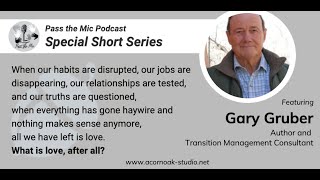
In this Pass the Mic podcast episode, host Virginie Glaenzer interviews Dr. Gary Gruber, an educator, author, and lifelong learner, to explore the nature of love amid the upheavals of the COVID‑19 pandemic and broader historical crises. Gruber defines love as more than a feeling or concept, pointing to its highest expression in self‑sacrifice—citing the ultimate sacrifice of soldiers in World War II and the civil‑rights activists who risked their lives for justice. He reflects on personal practice of love, describing daily gratitude for being alive as "amazing grace" and emphasizing that love persists even through hardship. Gruber shares his teaching philosophy, using the Socratic "5 Whys" technique to help others uncover deeper motivations, and he discusses how isolation has reshaped how people seek connection, urging the building of bridges through technology and community. As a self‑identified contrarian, he challenges complacency, encouraging people to "rock the boat" and view learning, growth, and change as acts of love. The conversation also touches on creating metaphorical "makerspaces for lovemakers," the role of love in professional work, and concludes with a playful fill‑in‑the‑blank exercise that reveals Gruber’s poetic view of love as a rainbow, an open‑hearted stance, and ultimately, "Love is period."
Chapters
Welcome to Pass the Mic podcast, a production of Acorn Oak Studio and music by Benjamin Schleds. My name is Virginie Glaenzer and I'm your host with a million questions. If you're tuning in for the very first time, Pass the Mic is a podcast where we share different perspectives on a specific topic, not only to help us expand our understanding of the world, but also to explore new ways of looking at it. In this special summer series, we're shifting from our usual unscripted group exploration to a one-on-one interview. We sent 6 questions ahead of time to our guests and ask them to come prepared to share their answers. Today I'm talking with Dr. Gary Gruber, one about one of the most iconic and fascinating ideas in history, an idea so strong it can change our world in crisis: love. Let me introduce our guest before we begin this conversation. Dr. Gary Gruber has served in leadership roles for many years He has taught in college and university settings, co-authored a book, Understanding and Enjoying Adolescence, in 1988, and published two recent ones, Seven Decades: A Learning Memoir, 2013, and Your Child, Your Choice: Finding the Right School for Your Child, from 2014. Gary served as a chaplain and department head at Coates Rosemary Hall, was the head of school at the Shipley School in Bryn Mawr, Pennsylvania, and was the founding head at Bosque School in Albuquerque, where he served as the interim head of school during 2010 and 2011 school year. As the founder of a nonprofit group called the Southwest Institute for Educational Research and Professional Teacher Development, Gary was instrumental in that entity evolving into the Santa Fe Leadership Center. You have an upcoming book called Pearls from an Irritated Mind, which I'd love to read. And I want to add one other thing from your Twitter bio that caught my eye. You write, I'm a long-life learner, elder, and and a contrarian. And I love the word contrarian, not sure why, but I love it. Welcome, Gary.
Thank you very much, Virginie. It's an honor to be here with you and with the other guests in this series. Thank you so much.
I'm very happy to have you, and thank you for accepting to come here and share your own experience. So I usually start by saying that we're all living in a time that none of us ever expected to see outside a dystopian movie or novel. When our habits are disrupted, our jobs are disappearing, and our relationships are tested, and our truths are questioned, when everything has gone haywire and nothing makes sense anymore, all we have left is love. So Gary, how do you define love?
Such a big question, and I don't presume to have any answers. I think I would start by saying I like the way you put it when you say, "What is love after all?" And I love the "after all" part, because after all is said and done and after all is tried, and failed, and after all has been examined and approached, after all we have is love. And it's— what kind of love? It's certainly more than an idea, and I think it's more than— so much more than a concept, or even more than an experience. Because we experience it in different ways, in different times in our lives, from the beginning when we were loved into existence. And when I say that, I mean it from a larger perspective than people who have made a baby. But we know that's one kind of love, certainly. And as we march through our life, and we have these experiences that we label as loving experiences. And what do we make of those? And how do they contribute to our life? And how do we regard love every day, especially now, these days, these crazy days? I go back And I ask myself, where do you see love most of all? And I have to say that there's a quotation that greater love has no one than this, that a person lay down his life for his friends. So I would say, what do you love so much that you are willing to die for? When I walked through Normandy for the first time, I was overwhelmed knowing the sacrifice, the ultimate sacrifice that was made by all of those people in that cemetery. And I was moved to tears knowing they had paid the price so that we could continue to be free. And that may be the greatest love of all, that you are willing to lay down your life in order to defend and protect that which you believe is of greatest value. So there were somewhere near close to 35 million people killed in World War II. That was 4— that was 3% of the world's population in 1940. 435,000 American soldiers gave their lives and paid the ultimate price. Now to me, that— I know of no love that speaks more clearly than that, that you are willing willing to give up your life. So what do you love most of all that you would be willing to lay down your life in order to protect and defend and so that others could live in joy and happiness? To me, that's, that's love personified. And it's powerful. So that's one example. It's one example. The other love that— that you can have to look at love as a noun or a verb, as an action or as an experience— but universal love, the creative power that brought into being this creation of which we are part. And we are— I don't know where I first picked up this little phrase about we are so much more than an itch on the epidermis of the pygmy planet Earth. You know, in this cosmos, in this great cosmos, where is our place as part of this loving creation? And in these days, in these crazy days, How do we reach out in loving acts to support and lift up others? And then I, again, I think about the 165,000 people who've died because of the virus, and I think about their families and knowing the suffering that they have gone through because how much they miss this loved person. Now to me, that speaks of love in ways that nothing else can.
Yeah, we're talking about love and here we are connecting it to suffering and death, and although it could—
It is. But, but, but the joy of being alive and loving life, and loving it so much. Every day, every day for me is amazing grace. Every day is amazing grace. It's a gift, and I want to live fully in this day and bring to it whatever I can, whatever I am given, to share with others, to be who I am most of all, without really giving a whole lot of thought about what I'm doing. It's more about what I am being today, and how are we being.
So yeah, we'll talk a little bit more about your being in your work. But before that, I love the fact that you said that you insisted on what's love after all. And to me, that's— I woke up in the morning and I had this question, what's love after all? And I think you've given it context. After all what, right? And I think that's an interesting and deep inquiry. So you talked a little bit about what's love after all, when there's suffering. How do you, you know, during this time of isolation and unrest, and we've talked a little bit about COVID how do we as humans find love?
Well, sometimes I like to answer a question with a question. It's like, where are you looking? Finding and looking and seeking. And I mean, I go back to again thinking about how you look. Where do you seek? You may be looking in the wrong place. You know the story about the man who is down on his hands and knees at night looking and looking, and someone stops him and says, what are you looking for? And he said, "Well, I dropped some money here." And they said, "Well, why don't you go where the light is, where there's more light?" And he said, "That's not where I dropped it." So you have to look where you expect to find it and where you expect that you might touch, find a response So what are your expectations? And when you are looking, I think of this question about what do you want to have happen by what you are seeking? In other words, why? Why are you looking for this love at this particular time in this place? Do you feel bad? Do you feel good? Do you have something to offer? Do you have a need? So why, why is it you are looking? Are you not content in yourself? Maybe there's some unmet, even unspoken need, and that's fine. Maybe it's even unconscious, and that's okay too. So when we reach out and we communicate and we have communion with someone and we share our stories and our experiences and we make a connection, maybe it becomes a friendship. I mean, there are all kinds of possibilities.
I can see the teacher in you as you're asking questions. Right? Thinking that perhaps the answers are within the person.
Yeah. Do you know the exercise of the 5 whys?
No.
Well, you ask, "Why are you looking?" And you respond with, "Why are you looking?" And you say, "Well, why are you doing that? Why are you looking there?" And you respond, and the third why, and the fourth why. And by the fifth why, you have gotten much deeper into the essence of the experience.
It's almost like a Socratic approach.
Yeah, very much so.
So do you think that during this isolation we've changed our access and our attitude about love? Do you think people have changed the way they see love?
I don't really know how much, how many people have changed their— maybe they do not feel as much access because of feeling cut off and how we bridge, how we build a bridge back. If we feel cut off, what do you feel cut off from? Or you feel cut off from another person? Yes. Cut off from your family maybe? Yes. So what are the bridges that you can build? And I mean, families like ours, very large extended family, have Zoom meetings and certainly see each other and talk with each other and on the telephone more often, I think, than we might otherwise. That's one kind, one way that we connect during this time of isolation and quarantine and lack of or travel, perhaps, not as easy. So build bridges.
Very nice. So let's be a little bit more personal with these two next questions, if you don't mind. Can you share how you personally experience love in your life today?
Today?
These days, around these days, this time of August 12th.
Well, I experienced it today by waking up and being alive and being extraordinarily grateful for the gift, for this gift. And I, I just feel that I'm experiencing the opportunity to be fully alive and in love with this day that has been given to me. And what, what I describe for people is that this is a gift waiting to be received, embraced, opened, and celebrated. And how you do that It's certainly up to you and your preferences and your choices and your lifestyle. And I guess I have lived long enough to practice this, and I'm hopefully getting better at it over time.
Are you able to practice that when you go through hardship?
Absolutely. Maybe more so then than any other time. And I mean, some of the hardships personally that I've been through would go back to not only World War II, because I was alive, although I was a young child, I remember the impact on my family and on our communities during those years. And I wrote about that in that little book that you mentioned. The war years. And then I was a, I was pretty much a social activist in the '60s. And the hardships there were very reminiscent of the, some of the protests today. And kind of putting your life on the line because that you believe in— if you believe in peace, then you better work for justice. And that's something we learned early on. And one of my heroes and one of my mentors, and we were just about the same age, was John Lewis. And I remember when John and I were working in civil rights back in the '60s, and he was the president of the Student Nonviolent Coordinating Committee, and we were organizing all kinds of activities. And you, when you cut to the chase and you say, why were you doing this? It was because we loved our fellow human beings enough to want a better life. And so we worked our tails off in the '60s for equal, equal opportunities for people in education, in housing, and in jobs. And that was in the '60s, and it was hard. It was hard as anything you can imagine. Blood, sweat, and tears. It was so hard. And, uh, so yeah, that's— and I experienced the love of all kinds of people during that time that helped carry me forward to the next day, the next year. I did develop some battle fatigue in 1968, '69, and dropped out for about 3 or 4 years.
So today you experience love through just the, the fact or the act of being alive?
Yes, for what purpose? The same ones that we were fighting for in the '60s. For justice, for peace, for equity, for inclusion. And all the schools that I've worked in over the years were— those were always things that we held up as values that we wanted to exhibit in our practice. And I've always believed that if you keep practicing, you get better, whether you're playing the piano, basketball, or practicing love. You get better.
It's interesting when you say fight for peace, you know, how those two opposite words can be next to one another. But I just find it ironic in a sense. So tell me more about— can you share one of the One of the biggest acts of love that you've personally witnessed in your life?
Well, I spent a couple days with Martin Luther King in 1960, and he was one of the biggest acts of love I've witnessed and been privileged to be part of. And I was with him that month for a couple of days a month before he was assassinated. And so that had a great impact on my life and has ever since. And yeah.
Do you remember what you felt next to him? I mean, he displayed an act of love, but what was it? A lack of fear? Was it— he must have been somehow irrational to step outside.
It was a lack of fear, absolutely a lack of fear, and knowing that he believed so strongly in what he was about and in the cause that he championed and was willing— in fact, it cost him his life, not obviously not by natural causes, as in the case of John Lewis. I couldn't— I don't know if we die of natural causes ever. I always like that when you read somebody's obituary and said he died of natural causes. What the hell does that mean? He died of natural causes. Well, he came to the end of the road.
That's all.
Well, that's the other thing. If you have love, if you are love, You don't fear dying. Not at all. Not at all.
Is it because you believe that something else comes after, or?
I have no idea what comes after. I just know it's not the least bit frightening. However it comes, whenever it comes. I mean, I might have some preferences, but that's not up to me.
So you think that not fearing death is somehow connected to being in love, being love, loving life? Well, but here's the thing. If you love life, you could be attached to it.
Well, but it erases the fear of death. You're free to live. Once the fear of death is removed, you are free, free, free to love. Makes sense. You know, I remember another saying back in the '60s, because not only did I have World War II, of course I had Korea, Vietnam, um, you know, Afghanistan, Iraq, and all of these things. But I remember a saying in the '60s. Now you have to— I want to expand it from what the original meaning was.
It was "make love, not war." Yeah, I read that in the history books.
It came out of the flower children and the hippies, but they were talking about a different kind of make love, not war. But I would like to expand that to a different kind of love, a bigger love than lovemaking. But maybe we ought to be about a different kind of lovemaking now and create makerspace for lovemaking. One of your guests about creating space— was that Mike Watson?
Yes.
About creating space. Let's create— let's create makerspace for lovemakers. And when we reach out, I mean, I think of— I not only think of, but I have worked with, and you work with people who are homeless. You work with people who are hungry, and people who are sick and dying. And I've had both the benefit and the burden of being with people who are dying and who are losing their loved ones in death. I spent a number of years in ministry. And so I had that opportunity to walk with others through that experience. And help hold them up. I just lost a dear friend of 60 years who died a couple of weeks ago, and it was, you know, it was a great loss to me personally, but he had a good long life. He was 96, and, you know, I'm only 83. I'm—
You're young.
Yes. Yeah. And here's something else I read. I think it was Abraham Lincoln was given the credit for the quote. It's not how many years you have lived, it's how much life is in your years.
Oh, that's beautiful.
And I think my life is so full and rich, and I am so extraordinarily grateful for all that I am, as well as what I have, but I'm more grateful about who and what I am and what I have become over the years. And I don't mean to sound smug about that because I am humbled day after day when I stand, you know, in the stream of those who have gone before me. And when I stand in that stream of the giants of today as well, I'm really blessed.
I'm wondering if this idea and feeling of gratefulness is something that comes with age, unless you go through a traumatic experience. I don't know if you, when you're 20, you're really grateful. Anyway, let's focus on your professional life. And your busy life. So the next question is related to the business life or your, your work and your job. So in the work and in the job that you do, how does your work help others find, connect with, or express love? Can you tell us more?
Well, my intention is to help them help themselves. And I often say at the beginning, there's really nothing I can do to help you. I might be able to create an atmosphere or condition where you can help yourself, or where you can make the change that you want or need to make. But I have no magic. I have no formula or recipe. But together we may be able to figure out what you can do to get to where you want to be, where you may believe you aren't right now. So that's a matter of change, and you have to start looking at what you are willing to perhaps give up in order to take on something new. That's one. Question. I have a lot more questions than I do answers, as you just discussed.
Like me, all I have is questions. So you're almost like a Sherpa in a sense. You're holding people's hand to go where they want to go.
Yes, yes. And I'm here. I'm very much here. And, um, and some people end up not, not doing what they thought they wanted to do originally, because as we've gone through the process, they've discovered something else that they may not have expected to find along the way, along this journey of change, of learning, growth, and change. That's kind of the mantra: learn, grow, change, for me as a teacher.
And you think that learning, growing, and changing is a way of finding love, experiencing love?
I think it's a way of loving. If you love to learn, you may learn to love to grow. But so many people are resistant to change because they are kind of comfortable with the status quo. Don't rock the boat. I love rocking the boat.
Well, you're a contrarian. Do you think people don't like to rock the boat because they've been conditioned and there's a lack of habits and confidence? Or is it because it's in their nature and they're fearful and they actually don't want to rock the boat, even if they're being taught?
Yeah, I think it's about their security. They feel safe and secure where they are. So please do not disrupt that. And guess what? A lot of it's been disrupted lately. That's exactly what has happened. Now, the sad The very sad part of that is that so many million people have lost their jobs. And so many more people, you know, need help. And so that's that kind of change. And if you see my, the little tagline on, I guess it's on Twitter, it's on my webpage for sure. That there are two kinds of change: planned and unplanned. Certainly nobody planned this virus, as far as we know.
So as a way to wrap up this conversation, and thank you for the beautiful insights and thoughts and history lesson almost, and I wish I had another episode on just I don't know how I would call it, but diving into the head and the mind and the heart of people who've gone through big events, like, you know, whether it's— anyway. So let's wrap up this conversation and let's do a little game with 4 questions that were not sent to you. We've got some fill-in-the-blank statements for you to complete, and you can always say pass if nothing comes to mind. So number 1 is: The color of love is blank because blank.
The color of love is blank because blank. I believe the color of love which I found as a child and still carry it with me today. The color of love is rainbow. And rainbow is a color. There is a rainbow palette that Lakshmi Bhavani put together with a code. And it is a color. When you look at the rainbow, you see— well, Lakshmi Bhavani reduced it to 6 colors and not 7. I mean, as kids we learned ROYGBIV, right? Red, orange, yellow, blue, indigo, violet. ROYGBIV. Red, orange, yellow, green, blue, indigo, violet. So he took the colors red, orange, yellow, green, blue, violet and left out indigo. And if you look at the rainbow, That's the color of love. And it still is.
I love the answer. Number 2: I love someone when—
I love someone when they are open to love.
I'll take it. The third one: We all think we know what love is, yet when we dive a little deeper, love is not blank.
When we dive a little deeper, love is not just a feeling.
Goes back to what you were saying.
Yes.
And then we'll end on that final statement. Love is blank.
Love is period.
Oh, I love it. Love is.
That was the title of that recent blog. That you posted. Thank you very much. Love is.
That's wonderful. Thank you so much, Gary, for your personal view and for the work that you do that brings more love into the world. Thank you.
Thank you, Virginie. It was wonderful being with you and having this conversation.
More from Virginie











Unlocking Fintech Success: Strategic Trends for Profitable Growth: Webinar Leadership Series