What is Love, after all? - Ep. #17 with Dr. Mike Watson
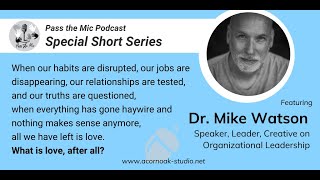
In this Pass the Mic podcast episode, host Virginie Glaenzer interviews Dr. Mike Watson, a senior leadership professional and educator, to explore the nature of love amid the COVID‑19 pandemic. Watson defines love as an intentional act of "allowing"—creating internal and external space for safe, authentic connection with the divine and with others. He links love to vulnerability, arguing that true courage stems from opening the heart. The conversation examines how pandemic‑driven isolation both expands access to love (by forcing introspection) and obscures it beneath fear and distraction. Watson describes personal practices for cultivating love, such as silently affirming "I love you" to strangers, and reflects on the biggest acts of love he has witnessed: the miracle of daily existence and his wife's consistent support. He then connects these ideas to his professional work, emphasizing the creation of safe spaces in education, consulting, and retail design that enable people to be seen, heard, and thus express love, which in turn drives confidence, innovation, and profitability. The episode concludes with a playful fill‑in‑the‑blank game revealing Watson’s metaphoric views: love is the white light of all colors, felt when safe to be oneself, not found in a relationship but internally discovered, and ultimately "allowing others to be."
Chapters
Welcome to Pass the Mic podcast, a production of Acon Oak Studio and music by Benjamin Schleds. My name is Virginie Glaenzer and I'm your host with a million questions. If you're tuning in for the very first time, Pass the Mic is a podcast where we share different perspectives on a specific topic, not only to help us expand our understanding of the world, but also to explore new ways of looking at it. In this very special summer series, we're shifting from our usual unscripted group exploration to a one-on-one interview. We sent 6 questions to our guests ahead of time and asked them to come prepared to share their answers. Today I'm talking with Dr. Mike Watson about one of the most iconic and fascinating ideas in history, an idea so strong it can change our world in crisis: love. Before we dive into this conversation, let me introduce our guest. Dr. Mike Watson is a proven leader facilitator, speaker, and educator with expertise in integrative thinking, ethical leadership, communication, marketing, and instructional design. He's a senior leadership professional specializing in the construction, design, and implementation of innovative strategic organizational initiatives and graduate online leadership courses. He is a recognized industry and academic leader with the ability to pers— purfully— very difficult word to say— pers— purfully guide and inspire collaboration and interdependent teamwork to accomplish challenging goals. Dr. Watson believes in working with individuals and leaders who are inclined towards worthy goals guided by core human values and in relationship with all stakeholders. He believes in the power of purposeful tension, active patience, diversity, working collaboratively, and the development of personal insight as a tool for prosperity. Mike Watson has partnered with a wide range of professionals from CEO to creative. He's been a subject matter expert on Huffington Post Live, MC and the host for multiple TEDx events, shaped a national retail company visual footprint and brand image, as well as designed retail stores. What a career. Welcome, Mike.
Thank you so much. And that was beautifully done. I really appreciate it. Hearing it is always different than writing it. And so it's nice to hear another voice acknowledge you. And so thank you for that. It was a gift.
My pleasure, and we're so happy to have you. So we're living in a time that none of us ever expected to see outside a dystopian movie or novel. When our habits are disrupted, our jobs are disappearing, our relationships are tested, and our truths are questioned. When everything has gone haywire and nothing makes sense anymore, all we have left is love. So Mike, how do you define love?
Yeah. What's beautiful about the question beyond just the topic is the fact that by default it causes introspection. Because an outward search for meaning of such a word or a concept like love is going to get you nowhere fast. I think you discover very quickly that you will be searching quite a while if your solution to defining love is to look outside of yourself. Um, so for me, when I boil it down to one word and then I'll expand upon that, for me, love is defined by allowing. And, and, and if, if we don't allow, for ourselves or for others, then there is no possibility to fully express what we may define as love. So love is that intentional decision to create space in yourself so that you allow for a deeper connection with the divine. And it's also that decision to create space for another so that they feel safe to be their truest self. And the beauty of that is then I can see myself in you and they can see themselves in me. And for me, that allowance, that intentional decision to create that space is what love is all about, because otherwise I can't find it if I don't feel safe to explore it. So love is internally crafted and externally expressed.
It's beautiful. I love it. It reminds me of opening our heart. Allowing means that you have to open your heart.
Yeah. And I think we'll probably get into it later, but, you know, it's a clear sentiment and instruction to open our heart. And I've never found anybody that doubted that the knowledge or the wisdom behind that concept. But many people are afraid to embrace it because it brings up issues that they potentially don't want to see or deal with. And so vulnerability is part of love. And if you're not willing to be vulnerable, open, open your heart, then it's very difficult to fully love. But I think that comes up later in another question that we were going to discuss, so we can go into that a little bit later.
Yeah, vulnerability is such an interesting experience, and I think we're really— we've mislearned what it truly means. I think people stay at this level of the possibility of being hurt, but if you truly have your heart open You don't have to be hurt. You can just sit with this outside reaction. Fascinating.
Thank you. Yeah, I think I find it so interesting that in Western society especially, we've so narrowly defined what vulnerability means, and it's this negative connotation of a weakness and something to be worried about, as opposed to it truly is something very courageous, and it is truly the only way to be. And courage, of course, the Latin root comes from heart. You know, "cor" is to speak from or to be from the heart. So when we speak of being courageous, it's not about our power, you know, to force another and to overcome. It's more about are we willing to be vulnerable enough to be open and use our hearts in that way?
Way.
I like that we already answered other questions. I love it.
Yeah, courage. So let's go back to this unsettling time that we're living, and in your view, how has isolation changed our access to and attitudes about love?
Yeah, you know, it's interesting, and we were briefly talking about this before we started recording, and how isolation has reshaped our world. And so if something becomes reshaped, by default, our perspective and perception about our access to it is reshaped or redefined. And so isolation has been this impetus that has shifted the meaning of what it means to be alive and to access love, in my opinion. And first of all, what I would like to emphasize to everybody and a reminder to myself is that love is always accessible. It's never not accessible. So the fact that we would ever say it's more or less accessible or it's being changed, the reality is it's always there for us. But isolation has on one hand allowed the accessibility to love to expand. Because by default we've been forced to be with ourself. And so to be with ourself means for many of us that I need to explore deeper into who I am, my relationships that exist with myself, with others. And so if that's true, then isolation has actually been this force that has expanded my ability to find access to love. On the other hand, attitudes about and access to love during isolation and unrest have become buried underneath fear and anxiety and hatred. All these things we see on the news or hear about, that negative dark side of humanity, you know, that has been thrust and illuminated during the pandemic and during isolation. But what's critically important to remember is although we label it or quantify it as the dark side of human nature, which it is negative, but it is parts of who we are. And I believe that that is just as much a purpose to explore as love is from a positive light-filled sense. So, on one hand, isolation expands my ability to seek and access love. On the other hand, the negatives that I see in myself and in human nature allows me to explore why that is happening and therefore to learn to love as well. If I don't explore myself holistically, my whole self, not just the beautiful side, not just the great side, not just all the fabulous things I have done for people, but if I don't also acknowledge acknowledge the jealousies or the judgments that I have had over the things that I have intentionally or unintentionally when I have hurt other people. If I don't explore and acknowledge those, then I am also not fully accessing love because I can't fully love or fully express love if I only acknowledge part of who I am. For many people, isolation is the first time they have got to live with themselves. You know, they are so used to being with others that this is interesting is that our society and our economic system is built upon this idea of consumption and experiencing and doing. So, most people live their entire lives through and for distraction. It is how they cope. It is how they find love. It is how they define success. It's always out there. It's always externally driven. And this isolation has held a mirror up to us and reversed the accessibility to who we are and what love is by reflecting it back to us. An interesting study was done where over 700 people were given the option of 15 minutes of being with themselves or producing an electric shock to themselves. Many, many people, I can't remember the exact percentage, I apologize, but many people chose to receive an electric shock rather than to force themselves, so to speak, to be with themselves. They would much rather not listen to their own lives and thoughts and be introspective. They would much rather be shocked. That's how, that's how addicted people are to distraction.
I heard about this experience and I'm wondering if it's perhaps connected to the fact that really we don't like ourselves. And it's not, you know, on one hand it could be the fact that we are so addictive that it becomes an anxiety when the movement stops. But I think there's, if it stops all of a sudden and you find something that is even more beautiful than what you were doing, you wouldn't have any problem. But I think the real issue is that once this movement, this constant entertainment stops, you are finding something that you don't like. And I was talking with someone else about epigenetics and all those emotions that could potentially not be ours but more transmitted from generation to generation. And if you look at the way people behave and society's values in the, you know, since the beginning of 3 or 4 generations that we can remember vividly from the stories we've been told by our grandparents those people back then were not doing pretty things, and we're connected to them through our, you know, relationship, family ties, etc. So I don't know, maybe we just don't like ourselves.
Yeah, but what a great way to enter into searching about yourself.
Yes.
And deciding to love yourself first of all where you are so that you can like yourself better, right? Distraction served its purpose. It distracted you from who you were, right? So, what is really being held up for many people is that what runs the world doesn't need to run their life. You know, like that and for many people, that is a newfound freedom and anytime you give people a lot of space or freedom, they say they want it, but they also freak out. Because it's a lot and they feel the responsibility is overwhelming. People like guidelines. People prefer to be told what to do. Option A, option B.
Right. They've been told. They've been conditioned. That's the thing.
Yeah. We've created a society in which we, you know, celebrate the following of rules and the staying in your lane, you know, or any of the other phrases you want to use. But the problem with that, of course, is that you lead a narrowly defined life in which you don't get to fully express yourself or your love. And so what's nice about this isolation is that it's not allowing us to falsely live in that myth.
So that brings me to a couple of questions that are a little bit more personal. Since that's where we're going. In your life today, how do you personally experience love yourself?
Yeah. Um, well, personally, the being by myself and being isolated these past 4 or 5 months has forced me to go internally even deeper than I am used to. I have my own practice and I am at a point in my life where I encourage myself to look at myself, but then the ego tells me I am doing such an amazing job and then it takes 5 seconds of a pandemic and isolation to realize, wow, I got a long way to go. So, what is beautiful about this is that I have been forced to go even deeper into introspection, and it's deepened my understanding about love as a space we create versus a thing we find or express. It's a space we create in ourselves versus something I externally discover in another or a place. So whether I'm by myself or with my wife or on a virtual call or at the grocery store, I find that I am experiencing love by intentionally projecting love out to others. So I've created the space and now I have space in which I can share. It's very difficult for me to share love if I have no room in myself for that love first.
So does that mean that as you go about your day and you've created this space intellectually, and maybe you start feeling that there is space, you feel lighter. How do you send out love? Do you think good things about other people in the grocery store? Do you— how does that work?
Yeah, so yes to all of that. A lot of times the easiest, and I find the most powerful way that I've done it, is that I just intentionally And but silently, anybody I see, whether I am driving or I happen to interact with, I just say, "I love you." And it is literally, that is it. And so, I am projecting outward, but it is also a beautiful reminder to yourself that you are loved and that we are all connected. Like, no matter how much we want to compartmentalize or segment our societies, at the end of the day, we're connected. Isolation is not separation. You know, so there's a difference there, right? And so that ability to be silent can be powerful in terms of communicating love because it removes the desire to express myself correctly with words. So instead, I get to organically communicate through intention. So the intention and then the expression is silently delivered, but I honestly believe it is physically and emotionally received. Right. Yeah.
Isolation is not separation. That's beautiful. And so tell us, what is the biggest act of love that you've personally witnessed in your life?
So I have two, and I thought of this both from a holistic, like, macro perspective, and then as a very micro personal perspective. So from a macro holistic universal perspective, the biggest act of love I've witnessed is the fact that I wake up every day I mean, somehow, some way I got here and I've been given this opportunity to, to express myself and provide space for others so they may stand in their brilliance and know love. And that is a miracle to me. Like that my body knows to breathe and it knows to wake up and, and that I'm able to do this work on a very personal micro kind of level, my biggest act of love that I have witnessed is the willingness with which my wife supports me and allows me to be me every day. Her consistency of love is a thread that runs through and in my life that I am grateful every day to bear witness to and receive. And to me, that's a miracle.
Very nice. Thank you for sharing those, those moments. So let's focus on your professional life. Okay. So this last question is more related to the business world. So in your job and in the work that you do, how does your work help others find, connect with, or express love? Can you tell us more?
Sure. And this is very intentional on my part. I love this question, and I was thrilled that it was in here because so often when we talk about subjects like love or consciousness or anything like that, we fail to reconnect it to the day-to-day. And I think it's important to know that that's where it lives as well. It's not something that is always outside of ourselves or or reserved for the home. So regardless of what I'm doing, if I'm educating at the university, if I'm consulting from a leadership perspective, if I'm designing stores, it doesn't matter because my work, first of all, must be in service to someone else and in service to something greater than myself. So a foundational component part of my work is to create spaces in which other people can feel safe to express themselves and be seen. So it doesn't matter what topic I'm lecturing on at the university or the location of my workplace, the fact is that people want to be seen and heard. And so my intentional creation of safe spaces allows people to connect more authentically with themselves and with others, which in turn creates a pathway for them to travel inwardly to connect with their own love, self-love, and externally through shared expression with their peers or others. So what I see a lot is when I create the— when I do a good job of creating these safe spaces, is that people start to become more self-confident. They become more willing to share. They take more risks. And all of these personal changes are what we, from an organizational perspective, want people to do. We want confident people. We want people to feel safe to express and to innovate and to be able to collaborate beyond where we are so that we could always grow as a business and as a person, right? But unless they feel safe, seen, and heard, they're not going to do that. They're going to partially commit. They'll partially engage, but they're always, on the other hand, looking for security. And if they're searching for security, then they're not engaging and they're not really loving then, right? Because if I feel safe, I'm going to remove barriers within myself and I will then be able to love myself better because I have removed these barriers that I had erected in the false sense of safety as a way to protect myself from being hurt. A lot of people construct not boundaries, but barriers in this false sense of wanting to protect themselves. So, You know, love is revealed from within. It has always existed. It's always there. So my way of doing this at work is to create a space so they can be seen and heard and feel that love for themselves.
That's beautiful. I love this question too, because I think very often when we look at the business world, we're looking through the lens of efficiency, productivity, compliance, as we were discussing prior to the recording, and when you change the lens and you add love, it's not just why do I love my job, it's how do I impact other people to find, express love. And it's, it's a whole shift, as you said, and I think creating space is such a beautiful, not only metaphor but also practical way of going about your job.
Yeah, it's easy for people to wrap their head around.
Yeah.
So the practicality of it leads to the, you know, to the expression of it in a way that they could never even thought of. But what's nice is that, and research proves this, is that the more that we do this, it does positively impact bottom line profitability, higher levels of engagement, greater innovation. Sustainability. Like, and so if your only motivation is those traditional goals that we've emphasized in an organizational setting, well, by introducing love, you're going to do better. So like, even just from a practical standpoint, it's a win. And then there's so much greater benefit to it, of course, beyond that. But yeah.
Beautiful. Well, as a way to wrap up this conversation, we're gonna do a little game. There's 4 questions that were not shared to you, so we've got some fill-in-the-blank statements for you to complete, and you can always say pass if nothing comes to mind. So here's the first one: the color of love is blank because blank.
The color of love. Where I'm at now, part of this is my background is I also used to do graphic design and I was a fine artist. So part of this answer is already being formed through that lens, which is funny. So when you, when you take all the different colors of light and mix them together, you just end up with white. And so for me, that's what love is, is that absence of color, that idea that we don't need to define it that narrowly and that it is all in everything.
Very nice. Second question: I love someone when blank.
I love someone when I feel safe to be myself. Kind of a selfish-like way to look at it, but again, if we don't feel safe to express it, it's going to be difficult for me to give to others as well fully. Yeah, we've got to give and receive both. It can't just be a one-way. Mm-hmm.
The third one: We all think we know what love is, yet when we dive a little deeper, love is not blank.
Love is not found in a relationship or a thing, but is always internally discovered.
That would make sense. And we'll end on the final statement: Love is blank.
Love is allowing others to be.
It's beautiful. It definitely changes the way that most people view love, which is something that they think they receive. We think of love as something we receive, of course giving, but it's— I think it's beautiful. Well, thank you very much, Mike, for sharing your personal view and sharing how your work brings more love into the world. Which is much needed.
Thank you. It's such a great time, and I am so happy that you invited me, and I cannot wait to share this with the world. So thank you so much.
Thank you, Mike.
More from Virginie











Unlocking Fintech Success: Strategic Trends for Profitable Growth: Webinar Leadership Series