What is Love, after all? - Ep. #17 with Rashmir Balasubramaniam
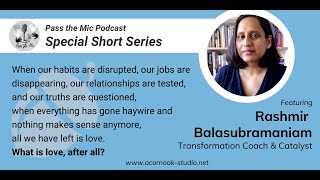
Rashmir Balasubramanian explores why "love" has become overused while humans still crave real connection. She maps Greek and Christian typologies of love, shares how the pandemic deepened her hunger for authentic bonds, and describes her coaching work as creating spaces where unconditional love enables transformation.
Chapters
Welcome to Pass the Mic podcast, a production of Econoques Studio and music by Benjamin Schleds. My name is Virginie Glaenzer and I'm your host with a million questions. If you're tuning in for the very first time, Pass the Mic is is a podcast where we share different perspectives on a specific topic, not only to help us expand our understanding of the world, but also to explore new ways of looking at it. In this special summer series, we're going a little bit more informal, and we're shifting from this usual unscripted group exploration to a one-on-one interview. We sent 6 questions to our guests ahead of time and asked them to come prepared to share their answers. Today I'm talking with Rashmir Balasubramanian, such a beautiful name, about one of the most iconic and fascinating ideas in history, an idea so strong it can change our world in crisis: love. Before we begin this discussion, let me introduce you to Rashmir Balasubramanian. And I'm sorry, I'm sure I butchered it. So Rashmir is a thought partner, coach, and strategic advisor who helps leaders of transformational system change and their teams harness rapid change and uncertainty to learn, grow, and lead with presence, purpose, creativity, and joy. She has worked with some of the poorest and wealthiest people on the planet, including the Bill and Melinda Gates Foundation, NESTA, the National Health Service, the World Bank, and the Rapid Results Institute. She has taught and mentored graduate students and entrepreneurs at the University of Washington's Foster School of Business, Presidio Graduate School, and Fledge, a conscious company incubator. With over 25 years of experience across the public, private, and nonprofit sectors, including 6 years in international finance, Rashmir has a proven ability to build trust and consensus, work strategically, generate tangible results, and unleash confidence. Creativity, and capabilities amongst diverse cultural and multidisciplinary groups. Welcome, Rashmi.
Thank you, Virginie Glaenzer.
Glad to have you here. So when we look around, I think it's pretty easy to see that we're all living in a time none of us ever expected to see outside a dystopian movie or novel. When our habits are disrupted, our jobs are disappearing, our relationships are tested, and our truths are questioned, when everything has gone haywire and nothing makes sense anymore, all we have left is love. So Rashmi, how do you define love?
Such a tough question to begin with, but thank you, Virginie Glaenzer, for inviting me on the podcast and for for posing these really interesting questions. As I thought about this one, the definition of love, a couple of things came to mind. And, you know, one is the fact that we— and I do it myself, right? We toss around the word love a lot nowadays, at least. There was a time where we didn't, and it was almost an embarrassing thing to say. You know, you don't raise love in public, you don't talk about it in public. In the workplace. And now it's almost the opposite. You know, I love this, I love that. It's become almost superficial in quality, the way that we use it. But what's interesting to me is that even though we toss it around so much, we're all searching for love, aren't we? And for a really deep sense of love and connection and being loved. And I actually wrote an article with Minesh Kashyap, who you've met, during lockdown on love. Which I must share afterwards. But it's in the article, we did a couple of things. We compared the Greeks' definition of love, and they sort of, they list out, enumerate different types of love, and they have 8 types of love in particular that they talk about. And we compared that with C.S. Lewis's 4 loves. I'm a big fan of C.S. Lewis, and his 4 loves for me are a much simpler categorization, but he still differentiates essentially 3 of the more earthly human loves, things like friendship, companionate love, you know, these much more tangible forms of love. In fact, let me give you the full definition. His 4 are: 'storge,' so similar to the Greeks, which is affection. And this is, you know, the love we have for friends, for family. Friendship, 'philia,' we're all very familiar with that. And there's a lot being written about companionate love these days. Romantic love, again, I think something that there's a lot of craving for in the world. And then he talks about 'agape,' similar to the Greeks, or charity, which really is more of a divine love. And that, I have to say, is where, when I think of love, that for me epitomizes what we are aspiring for and aspiring to be as humans. And I think C.S. Lewis really, he's reflecting something that in Hinduism and in South Asia they talk about as well, bhakti it's called, which is the divine form of love, again, as opposed to the human form of love. I mean, this is a long-winded way of saying I don't know what the definition of love is, but I think there are lots of shades or aspects of love that as humans we experience and we aspire to, and we often get confused between because it's, you know, we fall so easily into one form or one type of loving to another. But there is one other thing that I want to say about the definition of love, and it's You know, when we think of love, we often think of soft, romantic, slushy, you know, kind of comforting type love. But actually, love can also be very, very fiery. And it's the fiery love that I think is particularly powerful. That doesn't mean it's not— it doesn't have a warm aspect to it, but fiery love can be purifying and transformative. And I'm intrigued by that aspect of love. And for me, that aspect of love, it's sort of exemplified in unconditional love to some extent, right? So with unconditional love, and we're not very good at this as humans, because there's usually conditionality or transactionally built into our loves, even the love of a mother for a child, unless the mother is, you know, evolved enough to be able to let go there's still need often baked in. And so unconditional love is when there's purity of intent and the desire for pure growth, for pure expression. And that's where I think fiery love can be very powerful, because that love may be wrapped in any number of things, but the purity of intent is about expression, growth, allowing, evolving, enabling. And I don't know, I think if we're okay on time, there's a story about this that I'd like to share, which is, it's from a meditation teacher of mine. It's really a story he tells about his meditation teacher that exemplifies this kind of unconditional fiery love. And his teacher, and I'll cut it just short so it's just very brief, but basically his teacher was having real trouble with one of his students because the students kept coming out of the meditation cell and just having having a hard time focusing and sitting down, and meditation is not easy for anyone, especially, you know, a relatively beginner student. But what the teacher realized was needed in this particular case was a sharp shock. And so the next time the student came out of the cell, he shouted at him, you know, and shocked him into kind of waking up and going back in and sitting down and focusing with determination. On the meditation practice. And the teacher then turned to my teacher with a big grin on his face, and they basically had a conversation about how, you know, that anger, which might be misinterpreted if one didn't know that there was this pure intent of love behind it, was what was needed in the moment. And so that kind of pure, unconditional, fiery love is a love of wisdom, right? There's wisdom in it that I think then helps you know what is required in the moment. That is the kind of love I aspire to, if I can.
Yeah, that's interesting that you started by reminding us that in the early 1900s you were not allowed to express your emotions. And nowadays, as you said, it's like, "I love, I love, I love, I love." Now, the spiring— you said spiring. Fiery love is not passion, not the kind I'm talking about, no.
So passion for me would fall more into a human love, the lust, whereas fiery love— and it's, it's— let me share a quote actually. I was, I was thinking I would end on it, but now feels like a better time. So you may have heard this, it's by Teilhard de Chardin, and he said— and I still ponder this quote because I think it's deep and profound. The day will come when, after harnessing space, the winds, the tides, and gravitation, we shall harness for God the energies of love. And on that day, for the second time in the history of the world, we shall have discovered fire.
Beautiful. It reminds me— I've had this word in my mind for the last week— jolted. And I'm wondering if there is some sort of idea of jolted or jolting someone with love, or maybe it's the consequence of the effect of true love is you're jolting someone.
Yeah, interesting. And I wonder if it's a case of if that's what's needed, because there's also the kind of pure unconditional love that is profoundly peaceful and profoundly healing. And that feels very different, right, to the fiery love. But nevertheless, there's still purity of intent in both those loves.
It's beautiful. Thank you for sharing your definition. So what do you think during this time of isolation and unrest, how do we as humans find love?
Yes, this is an interesting question. When I was sitting with this question, Virginie, I found myself sort of bifurcating in two directions, because the personality side of me, the very human personality, sort of wants to go to, well, how do I find connection, right? How do I connect with other people, with friends, with family, with the usual places and ways in which I might seek love? And that's been hard, obviously, with what's going on with lockdown, with isolation. At the same time, everything that's been happening and our inability to have physical connection with each other has really amplified our awareness and our understanding for and desire for deep connection. Deep connection that is authentic, that is personal, that gives us a space and a place to express, to explore, to grumble, to, you know, whatever it is that we're needing. I think it's heightened our sense that that quality of connection matters. And so we, you know, we do all the usual things. We reach out to the people we know. What's been fascinating though is the number of people that are reaching out very openly to complete strangers. So I've met so many interesting people during the last several months because there's been space, time, a place, a chance to pause, and a chance to really have a different kind of a conversation. And I'm excited about what that is making possible. Now, we might not speak about that in love, as love in a traditional sense, and yet, because it's coming from a different place, a different quality of being, I would say the impulse there is love. So that's sort of one thing I wanted to share there. The other is I think that that call for deeper authentic connection is actually a reminder that we are also wanting to connect with ourselves at a deeper level. And in the busyness of our usual lives, you know, with the kinds of schedules we've established for ourselves with work and families and kids, most people haven't had the time for that kind of inner connection. And that I think is incredibly important at this time. I recognize it's also very scary for a lot of people, especially those that don't don't have a contemplative practice of some kind. And yet, for me, that's the transformative piece, because I think the more that people take the time to connect with themselves, with who they are, and to almost learn to love themselves, that is going to drive authentic connection outside of ourselves.
So it's fascinating. So connection and networking during this time of isolation. Now, in your view, let's go a little bit deeper into how has isolation changed our access to an attitude about love. You were starting, I think, to say about, well, it might be an inward process.
Yeah, and this one again, it's— I think I wish that I could say that it has changed our attitudes. I think it has for some, but there's still many that are trying to do things the way that they've always done them, right? Then there are many that are eager to return to whatever their normal was before the pandemic. And that does worry me, but at the same time, I'm somewhat hopeful because I think enough people are questioning deeply what matters in life, what's really important. And then those that have a reflective quality to them or maybe have the resources or the tools or the people around them that can point them inwards I think are taking those steps and saying, okay, who am I really? Why am I here? You know, and that's exciting because when you start asking those questions, you do start reconnecting to the self. And that hopefully leads to self-care, self-love, self-nurturing, but also the kind of presence that will lead us forward in a new way.
Beautiful.
I'm not sure if I actually answered your question there.
No, it's beautiful. It's on the opposite, it's a beautiful answer. So let's be a little bit more personal now, if you allow me. Can you tell me, how do you personally experience love in your own life today?
Yeah, so this is an interesting question for me. As I was pondering this, It was interesting. I kind of watched myself exploring it because the classic answer, of course, is, you know, relationships, you know, family and friends. And right now I'm not in a relationship and I don't have kids. So I'm missing those aspects, if you like, of love and connection. But I do have family and a lot of friends. And so You know, and both of those have different qualities to them. So family is tricky. I love my family. You know, we have an always evolving relationship, you know, much better than it's ever been. And so there, the opportunity to express and receive love is different, right? It's conditioned by the ways we've been brought up, how we communicate or don't communicate with each other. I really You know, one book that I read decades ago that was— maybe not decades, but probably about 15 years ago— that was really transformative for me was The Love Languages by, I think, Gary Chapman, because it really helped me sort of see and recognize, actually, I, you know, I was being loved and love was being expressed, but just not necessarily in the ways that I thought I needed or wanted at the time. And that's been really transformative for family. Friends, of course, is wonderful. I love particularly those friends, you know, who you have a connection with that goes beyond time and space and even words, you know, and you pick up after you as though you've never left off, even if you've reconnected after years and years. There's something special about those friendships. And then I have a couple of friends here in Cornwall, similarly, you know, they're always there if I just need to vent or vice versa, or if I need a helping hand, or, you know, if I'm frustrated being locked up in lockdown, you know, they're the ones you pick up the phone to. And so those are wonderful wonderful experiences of love in my life. But I would say the more common experiences of love for me nowadays at this point in my life, and I particularly, you know, particularly after many years of meditation practice, are the small moments. You know, it's sitting down at home with a glass of wine with my cat curled up on my lap, or it's out walking by the beach, or it's, you know, being out in nature and just having having a sense of wonder and connection to something much bigger than myself. It's those kinds of moments that I most value and appreciate, even though it's, it's funny because even though those are not usually with people, for me it's those quieter, smaller moments that somehow seem to feed me at this point in time. I don't know, maybe that will change in a few years. Yeah.
It's inspiring because it means that those moments are available to everyone. And I think very often we think, as you started, we think of love as coming from other people, so being dependent on others. So what is the biggest act of love that you've witnessed personally? I'm curious.
Yeah, it's— I'm not sure that there is one. There's a couple of things. I mean, I know that I often tear up when I see people connect at a deep level, connect with, you know, re-find each other or connect in this— it's difficult to describe, but it just brings tears to my eyes, and it could be, you know, it's coming together in a moment of forgiveness, it could be coming together after years of being apart, you know, it's kind of clichés, but I think, what was that film? I think it was, I don't know, it was one of the Hugh Grant films where they had that, they played, you know, that scene from Heathrow Airport where you just watch people arriving and you see the expressions on people's faces, they're connecting, you know, with loved ones. It's— how can you not be moved, right, by that kind of connection? And it's not big, but it's deeply powerful. And everything about love, connection, what's important is encapsulated, I think, in those moments. Beyond that though, I was also thinking about experiences in my life that have been transformative in that way, and one that really struck me was— so I was born in Africa, in Zambia, and Zambia was kind of an interesting country. So the first Zambian president after colonialism was a man called Kenneth Kaunda, and Kaunda was a really interesting leader because Zambia, like some of the other African countries, did have people of many races. Right? So they had, you know, white Brits, there were South Asians, I'm Sri Lankan, but there were also some Indians there, and of course there were numerous tribes from within kind of the boundaries of Zambia. And Kawanda was very interesting because he really embraced unity and promoted a message of unity, which is one of the reasons Zambia didn't have some of the kind of racial tensions that Uganda, for example, or Kenya had. And so Kalenda was, was an interesting man, and I had a very interesting experience of meeting him when I was doing my MBA in the States. I took an international relations seminar, and he was one of the speakers, and I was lucky enough to have dinner with him. And so I got to share that I'd been born in Zambia in a town called Ndola, and he just, he looked at me with you know, it was almost like the feeling of fatherly love, and called me Ndolo girl. And Virginia, it sounds like such a little thing, but for someone who had been born in that country and had left it quite young— I was 10, I think, when my parents moved to the UK— there was something profoundly healing in that interaction. And that is one of my most profound experiences of of love.
Interesting. Yeah, thank you for sharing, appreciate it. So now let's shift gears and focus a little bit off on your professional life. And so the last question is really related to your business work. So in the work that you do, how would you say your work helps others find, connect with, or express love? Can you tell us a little bit more?
Yeah, so how do I answer that question? So, so what I would say is, so I mean, on a very practical basis, there's, there's different aspects to my work. There's the coaching, there's some consulting, there's— I quite often do group work, so there's facilitation involved. And then I love sort of helping start up new projects or new initiatives. So there's kind of a catalyzing startup component that I sometimes do as well. But what's been interesting as I reflect on when I've done some of my best work is I have been able to engage from my best self, right? Or from a place beyond the personality with its, you know, focus on self-needs and how I'm doing. And what's wonderful about those moments when I can engage from that place, is that creates possibilities with others for true co-creation. And so in my coaching work, for an example, you know, sometimes that can create a healing field or a transformative field in which it's easier for my clients to tap into their best selves and into their highest aspirations and to start to move and grow towards that. With groups, it's similar. It's Again, if I can get into that space and work with the emergent field of the group, we're more likely to get into a place of co-creative flow, which is such a felt, palpable experience, right? I mean, there's joy in that, there is presence, there's creation, there's elevation. So, so the connection here to love is a combination of things. I think it's, it's It's loving and trusting myself enough to get out of the way. It's loving the work enough to get into that state of being fully present and ready to serve from a place of, you know, a higher place of purpose and intent, loving intent. And it's also that, you know, human approximating to unconditional love, right? Where it's not about me, it's about the larger purpose of what's evolving with my clients, whether it's an individual or a group, and doing whatever is called for in that moment to support the emergence of what is wanting to emerge. And usually that's often something about ever greater and truer essence expression of the individual or the group or the possibility or the organization. And it's great, but here's the challenge: I don't do it every time. I'm getting better, but you know, there's still times I get caught up and bound up in the personality. And in a way, that's useful because it helps me also know where and how others get caught and stuck. But, but there's something profound about being able to bring that, that pure presence of love and, and higher purpose. It's, it's extraordinary transformative, really.
I love that. That's such a fantastic answer, and it really reminds me of the fact that when we do something and we let go of the idea of ourselves, this social identity that, you know, the stories that we have in our mind, and we just are, we have this opportunity of bringing our whole self to work, and magic happens. And as you said, it's about getting out of our own way. Yeah, because we're so needy constantly looking for approval. But it's so, so inspiring. Wow, thank you.
You're welcome. And to be clear, I mean, I'm not there 100% of the time, but it's interesting because it brings us back full circle to the importance of going within, right? Because when we go within and learn who we truly are, then we engage from a place of true confidence, true presence, But also, we've probably done enough to— and I say this particularly for women because we have this tendency, me anyway, and many I know, I don't know if you have it, but we tend to give and give and give and always be nurturing and caring, but not doing the same for ourselves. And if we get depleted, we're not able to give that way. So, you know, we have to invest in ourselves, knowing who we are, taking care of our needs, so that we can really engage from this higher place of possibility.
And that makes me think of the word purpose, because a lot of people are struggling with this idea of purpose. We've been sold that we all have a purpose, and it's when, you know, we often associate the idea of purpose with being in, you know, doing something passionately. But really, when you do your work, whatever the work is, and you're able to stay away from your own needy self and you're in that flow of love, isn't that the real purpose of life? You know, so, so as a way to wrap up this conversation, we'll do a little game and it's gonna be quick and painless with 4 questions that were not shared to you. So we have some fill-in-the-blank statements for you to complete. So just first thing that comes to mind. So here we go. Number 1: The color of love is blank because blank.
Oh, I'm torn. I'm conflicted. I've got, I've got 2 colors going on. I've got blue and I've got just, just light, you know, the full spectrum of light. Because Oh, I don't know. Blue is expansive and the full spectrum of light is complete.
Very nice, I'll take that. Thank you. Number 2: I love someone when blank.
Hmm, now you see, I must have a split personality because I've got 2 answers again. The personality is saying I love I love someone, you know, the personality is saying I love someone who I love to be around, right? So there's something about, you know, being happy together, the sense of connection. But there's another part of me that's saying I love someone when I get out of the way. So it's, yeah, I don't know. There you go.
Thank you. The third one is, we all think we know what love is, Yet when we dive a little deeper, love is not blank.
So what the first thing that came to mind is Not What It Seems.
And we'll end on that final statement: love is blank.
Love is the fabric of the universe.
Oh, that's beautiful.
Love that.
Thank you so much, Rashmi, for sharing your personal view and the way that your work expresses love in the world. Thank you very much.
Thank you, Virginie. It's been so fun. I'm loving these questions, so thank you for prompting me to, to think about them.
My pleasure. Thank you.
More from Virginie











Unlocking Fintech Success: Strategic Trends for Profitable Growth: Webinar Leadership Series