What is Love, after all? - Ep. #17 with John Poehler
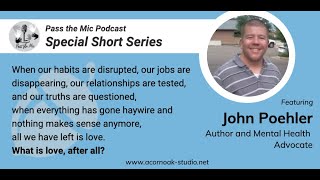
In this Pass the Mic podcast episode, host Virginie Glaenzer interviews mental‑health advocate, author, and podcaster John Pehler about the nature of love. Pehler describes how his definition of love has shifted from a simple feeling to an active practice of putting others first while maintaining his own mental‑health stability, especially as someone living with bipolar disorder. He explains that love manifests through helping and empowering others, volunteering, and nurturing family relationships, sharing personal stories about the births of his children and a NICU experience as profound acts of love. The conversation explores how COVID‑19 isolation redirected expressions of love toward digital connections and creative outlets like blogging and podcasting. Pehler emphasizes that love is an experience, not merely a feeling, referencing the Five Love Languages and describing love as humanity. The episode concludes with a light‑hearted fill‑in‑the‑blank game where Pehler offers his personal reflections on love’s color, conditions, and essence.
Chapters
Welcome to Pass the Mic podcast, a production of Acorn Oak Studio and music by Benjamin Schleds. My name is Virginie Glaenzer and I'm your host with a million questions, which sometimes feels exhausting. But today, if you're tuning in for the very first time, Pass the Mic is a podcast where we share different perspectives on a specific topic, not only to help us expand our understanding of the world, but also to explore new ways of looking at it. In this special summer series, we're shifting from our usual unscripted group exploration to one-on-one interview. We sent 6 questions to our guests ahead of time and ask them to come prepared to share the answers. Today I'm talking with John Pehler about one of the most iconic and fascinating ideas in history, an idea so strong it can change our world in crisis, love. Before we begin this conversation, let me introduce you to our guest. So John Pehler is the creator of the award-winning blog The Bipolar Battle. John is the author of the book This War Within My Mind and the host of the podcast The Bipolar Battle, helping those living with bipolar disorder. And he's also the winner of WEGO Health Award. He was recognized as the voice bringing empathy back into healthcare and helping to create a better tomorrow as a mental health advocate. Advocate. As someone living with bipolar disorder, John has firsthand experience managing it on a daily basis. He sees himself as a warrior and bipolar disorder as the battle, an empowering perspective that he adopts in all areas of his life. Welcome, John.
Thanks for having me. I really appreciate it. Thanks.
My pleasure. Happy to have you. So I usually start this series, which we're close to ending with about 8 to 9 guesses. I usually start with saying that we're all living in a time none of us ever expected to see outside a dystopian movie or novel. When our habits are disrupted, our jobs are disappearing, and our relationships are tested, when our truths or questions when everything has gone haywire and nothing makes sense anymore, all we have left is love. So John, how do you define love?
Well, with love, it's interesting. I love the questions that you sent to me because they really got me thinking, especially the whole idea of a definition of love. Because my definition has evolved over so many years. I remember when I was younger and I just thought love is a feeling that you have, just, you know, just this, this feeling. And I can't really tell you what happened between that time, but now for me, love is more about what not necessarily the activities or the things I do for others, but it's putting them ahead of me sort of thing. Not to the point where I'm sacrificing my own mental health, because with bipolar disorder, I have to be so careful with my own mental health. And so that is extremely important to take care of with my meds, exercise, all those things. To make sure I'm stable. But when it comes to helping others, I feel like that's a way to show those around me that I love them, how I love my wife, my kids. And the thing is, is they're kind of like a different type of love, you know, with, you know, the wife or your partner. In terms of intimacy and how you are with them. But the whole idea about love and what's in your heart, I felt this so much because that's why I love doing what I do and I continue to do. Because you said that one of your other guests said about follow— I think you said following with love. That's basically the whole premise that the definition that I believe myself, because I am— for me, I feel like I'm spreading love when I empower others to live their best life. And that's a way, not necessarily just putting positive energy out into the universe, but spreading love into the universe. So for me, basically helping others is a form of love. And, but not to take care or not to say that, like I was saying with myself, with my mental health, I have to love myself as well to the point where I do have to put myself first because if I'm in a hospital or I'm in an episode and I can't do anything there, I don't even have the capacity to look at other people anyways. So I think with bipolar disorder or a mental illness, it gives me a unique perspective because it's almost a requirement if I want to be proactive in my own life and care for the others in my life as well. So if that makes sense, because the other thing I was thinking about is You know, when I became a father and I felt like the way that I needed to be, you know, I could show love to my family is providing and bringing home money and providing the house and a car and all this stuff. And I mentioned to you that, you know, now I'm disabled now. And so that kind of conflicted with my views because I was thinking, That doesn't mean I love my family any less. In fact, I love them so much more, but I'm able to show them love in a different way. Like now I'm going to show love to my son by teaching him school at home and being with him, spending time. And same with my wife. You know, I think some people are not— they aren't used to having so much time together. And although I think this has been a big ripple in the whole world, at the same time, I think it's kind of opening up people's eyes to what's important, right? In the relationship we have with our partner, it might seem like it's being tested, but to me, I don't think it's a matter of being tested. It's opening your heart more to allow them more in and to be more vulnerable with them. Right. That's long-winded.
Yeah, I love this idea of expressing love is giving to other people, and I was discussing with my daughter who reminded me that during the junior or senior year in high school, you're supposed to do 25 hours of volunteering. And I'm thinking that if we had carried that over to adulthood or within your job and ask people to volunteer a couple of hours per week or per month, it could actually reduce anxiety because it is known that the more you give to people, especially through volunteering without really expecting anything, you are giving back some sort of peace.
I totally agree with you. I wholeheartedly agree with you because I think too, you know, when we're kids, we haven't developed enough to understand that whole concept. But like you said, as you get older, like as adults, that would be huge. That'd be like a game changer with so many people because then they would be able to interpret it more. I mean, not to say that kids don't, of course, but it just, our brains are so matured by adulthood that we could bring it into our own lives to a greater capacity, I think. So that's a good point.
So you were starting to share a little bit your experience, but let me ask you this other question. In your view, how has isolation changed our access to and attitude about love?
Oh, well, you know, I think it's not necessarily changing our attitude. I think it's mainly, it's redirecting how we do express love through the different forms of connecting. Because to me, like I said, I think helping other people and showing other people is a way to show our love. And I think a lot of people though feel that the way you show love is by touch and hugs, which I completely, I love hugs. I love holding hands, you know, all that stuff. But at a time where we're not able to, I think it's important to connect in whatever capacity we can. Like with me, with you, just chatting with you, for instance. I—
we're fine.
This is the first time I'm chatting with you kind of person to person digitally, but this sort of contact is for me a way to express love. And I think that we are doing that. Because especially talking about it with your podcast and these awesome mediums that we can utilize right now, I think that it's given us some more momentum to do things in a creative way. Like, I published my book in March, and I don't think I would have been able to publish it then if it hadn't been with all the time off that I had. So I think it— so I mean, I think the whole COVID thing is definitely one of the scariest things we've, as a world, we've ever experienced. But at the same time, we do have to live and move forward, go on from day to day. We can't just not do anything, you know, we have to just kind of make changes to help us get through if this makes sense.
Yeah, absolutely. So let's be a little bit more personal with the next two questions.
Okay.
It's one thing to intellectualize love, but it's another to actually experience it. And you've said it before the recording, what is the biggest act of love? And I'm gonna actually start with this particular one. What is the biggest act of love that you've personally witnessed Okay.
I, I have to say that there's two, and let me give you a little background story first, because as I mentioned with you beforehand, I was diagnosed with bipolar back in 1999, and those first 10 years, they were horrendous. I was on and off meds, changing them. I went through a treatment called ECT, which is electroconvulsive therapy. And I don't know if you've heard of that, but basically they anesthetize you and they put a muscle relaxant in. And so you're knocked out completely and they put an electrode up here, electrode right up here. And then they, hook it up to a machine that sends electricity through your brain and it induces a seizure. And that's an ECT treatment. And then they wake you up from it and there's just a lot of bad side effects and it's, it's really scary. But anyways, I, the reason why I say that is because to show you how much of a scary place I was in because I was so depressed. And then I would get manic and then I'd get mixed, which is a combination of both, which is even scarier in itself. And so I started believing in myself, in my mind that I wouldn't last after 30. Like by the time I'm, I would never reach 30 years old, I would be dead. And so what ended up happening right around 20, when I was 29, my daughter was born. And seeing her come out and her little red, bright red face and her jet black hair screaming at the top of her lungs, that just completely changed me. I just— the way that that feeling, that horrible feeling that I had of depression and that this is— I was like, now I have a reason. I brought someone into this world and I have a duty I have— she is my daughter and I'm a father now, so I have got to take that role. So that literally changed my perspective and the amount of love. I mean, you said you have a daughter and it sounds like you have some other kids too. And I know you can attest to how you can love something so incredibly much in that that feeling of just wanting to be there for them and protect them and do everything in your power in that, like, an instant. I've never been flooded with so much emotion in my life. And the same thing happened when my son was born. That's why I said two, because it's my kids. But with my son though, he was born a month early because my wife had some issues with the pregnancy. And so much so that there was a NICU, like a group of 4 or 5 NICU nurses that came in, and there were 4 or 5 doctors that were there in addition to an anesthesiologist. And I just remember when they took him out of my wife's, you know, stomach, where they did a C-section, and I saw his little body and it was kind of purplish blue. And they were trying to get him to go and move, and he started screaming and everybody started clapping. They were like, yeah, you know, because they wanted to hear and make sure. And then they, you know, they took him right over to the nurses. And the amount of love there, that's the— like I was telling you, the love showing for another person or, you know, I mean, you can show love to a dog, a cat, whatever it is. But for my kiddos, I never felt so to the point where I just give to make things better for them. The whole idea, the whole idea of my blog too, which is to empower people. I want to empower people so they don't have to go through the negative events that I have to.
Right, that makes sense. So the birth is one of the, or the biggest act of love you've witnessed. It's beautiful.
Yeah.
What about now, today? How do you personally experience love in your own life?
In my own life? I, for me, love is Spending time with my son. He loves to watch YouTube. He loves to draw. He, you know, he loves to run around, kick the soccer ball, toss a baseball. So he just— spending time for me is something that I really am trying my best to focus on. And same with my wife. Usually we don't have much time by ourselves, you know, but after he goes to sleep each night, I have about an hour or so before we have to go to bed. And then I also, I talked to like my dad on Zoom or Skype most every day. And those are just ways that I, that I express love. And I think the biggest to, not the biggest, but I do quite consistently is getting on my social media accounts and writing for my blog, hosting my podcast. So as I told you, the mission—
I'm sorry, you're almost going too fast, but I'm excited to learn more. Yes. So I want to focus a bit more on your professional life. And I want to know not just how much you love your work, which you seems to be passionate, and really it seems that it's very meaningful because you're giving to others something that you've experienced, and it's— it carries a lot of value and love. But how does your work help others find connect with or express love? Can you share more?
I think when I, when I interact with people on social media, especially today since we're inside so much and we're not able to go out as much, our connections are a lot on social media or through text. Through phone or other mediums too, like podcasts or blogs and so forth. And the way that I feel like I can help others, I actually just had somebody tell me this today. He texted me and I met him on Twitter and he said, you are a shining example of love and how to live with this illness. And it's— I just thought it was interesting because I knew I was going to talk to you today and I'm like, wait, why? Like, they're telling me how I'm like this example of love and how I'm showing love to others. But my way is showing ways to improve your life so then you can actually Show love, because the thing is, I think I told you with bipolar disorder, if it's not under control, you get extreme. You can go extreme depression down or mania, which is up. And when you're in those moods, you can't function at all. There's no capacity to feel love, but If I can show them or anybody, like, do these things, and if you can get your illness under control and you're in between those extremes, then you have the capacity to show love to those around you, to your friends, your family, everybody. So I think that's a way that it's kind of I kind of show them, teach them, so then they are able to experience it themselves. And that's what my hope is anyways. That's one of the many hopes with that, because being stable is something I think anybody with a mental illness, whether you have bipolar disorder or depression or anxiety, we We all, I think, strive for stability so we can live and feel those normal range of emotions. Because just real quick, with bipolar disorder, people do think it's completely a mood disorder because that's what it's called, right? Well, it impacts our functionality, our energy level, and our motivation. And when those are out of whack, then we can experience like you were asking me about love and how to express it. If those things are out of whack, we won't be able to do that.
You have a big impact on other people's lives, that's for sure. I mean, it's almost like black and white, and I think all jobs related to health have a direct impact. Well, and yet well-being is a little bit different than love. So I think in, in the work you do, it's not just helping people be in a, find a place of being well and functioning, but it's also realizing.
Yeah, yeah, it's the whole balance, like getting somebody in a balanced state so you can feel the normal range of emotions. Because I told you, when like, when you get manic, your libido goes through the roof, you feel emotions like 100 times, and somebody who doesn't have bipolar I can explain it to them, but they will never get it unless you actually feel. Well, the only thing I've been able to make it comparable to is taking, getting high on a real fast-paced drug, like an illegal drug where you're just, it's going through the roof, you know? So when you have that extreme, determining what love is and showing love, it, it, you're, not in a state to be able to do that at all. You know what I mean? Does that make sense? Yeah.
Well, I guess you're in a way helping people who have this particular disorder to find love of life again. Yeah. Because, you know, the first love of life is actually to be able to enjoy life, to be rational and being able to make decision that has positive long-term or short-term effect.
Yes, that's perfect. That's exactly it. I think you hit the nail on the head completely.
Great. Well, I really appreciate— thank you for sharing your experience and your challenge. As a way to wrap up this conversation, we're going to do just a little game, 4 questions that were not shared to you, although some people now who have heard other guests may know the answers, and that's all fine.
Oh gosh, I should have listened.
So we've got some fill-in-the-blank statements for you to complete, and just, you know, you can always say pass if you don't have the answer, but it's just whatever comes to mind. Okay, so the first question is: the color of love is blank because blank.
I would say the color of love is orange because it's a mixture of red and yellow. For me, in my experience, those two poles. So that's for me.
I know it might not be the right answer, but there's no right or wrong answer.
Oh, there is? Oh, I thought you—
No, no, it's— there's your answer. That's all that There is. Okay. The second one is, I love someone when blank.
I love someone when they spend time with me, quality time. That's huge for me.
The third one is, we think we know what love is, yet when we dive a little deeper, love is not is not blank.
Love is not just a feeling. I think people equate love to just how we feel. And I'm sure, I don't know if you're familiar with the Five Love Languages at all, that book. You know, there's supposed, you know, there's different, they say there's 5 ways that you show love. Love, like physical touch, quality time, all this stuff. But, um, I totally lost my train of thought again. I'm so bad at this. I really am. I had a point and I was coming back to it, but I just don't remember what it was.
It will come back. It will come back. So love is not— you see, yes, love is not What was your answer?
Just a feeling. Just a feeling. It's not just a feeling. There's so much more to it. I think that— I think experience—
didn't you mention before we started recording that it was an experience?
Yes, love is an experience. That's exactly what it is. And that's what makes it so unique to all of us, because the ability for me to feel love is We both can feel love, you and I, from— I believe we can, but it might be in a different way, a different state of mind, because you're from a completely different background than me, and so forth, you know?
So, and the last question will end on that final statement: love is blank.
Love is blank. That's a good question. I would probably say, to be honest, I would probably say love is humanity for me because I love people. I love the world. We all come from such unique experiences, and I think we all have something completely wonderful to offer. Like I was just saying, Virginie Glaenzer, you and me are completely different background. You're from a different country and I'm from a different state and we're, it just, we're completely different, but we all can add to the world and whatever we add, I'm hoping that it's love.
Beautiful. I will share, um, As we bring this podcast on social media, I will share the link so people can find your blog and your book and hopefully spread the word a little bit further around. Thanks. Have other people find their balance and find the love of life again.
I really like that, how you said that, because I think that's what it is, is the love of life. Because once we are balanced, we can experience that that. And that's how we can. Yeah. Wow. Well, you're awesome. You're awesome.
Thank you so much, John, for sharing your personal view and for, you know, the work that you do that brings more love into the world. So thank you very much.
Well, thank you so much for having me. It was such a pleasure. I had so much fun chatting with you. I knew it would, it would too, after messaging you doing stuff. So thank you for having me.
More from Virginie











Unlocking Fintech Success: Strategic Trends for Profitable Growth: Webinar Leadership Series