What is Love, after all? - Ep. #17 with Dan Rockwell
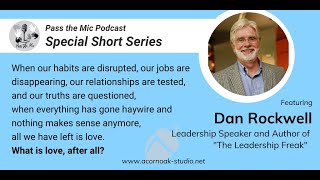
In this Pass the Mic episode, host Virginie Glaenzer interviews leadership expert Dan Rockwell to explore the nature of love and its relevance to personal life and leadership. Rockwell frames love as the pursuit of another’s advantage— a self‑less, service‑oriented stance that can include self‑love when it means caring for one’s own well‑being. He distinguishes self‑love (prioritizing personal well‑being) from other‑love (seeking others’ benefit), noting that true love often requires putting another’s advantage ahead of one’s own, even when uncomfortable. Vulnerability, humility, and the ability to receive love without feeling the need to earn it emerge as critical themes. Rockwell illustrates his ideas with stories about Edmund Hillary’s post‑climbing service, Elizabeth Barrett Browning’s sonnets, and a coaching session where a leader’s “dad hat” reshaped his view of accountability. He discusses personal experiences of love as respect and appreciation, especially in marriage, and highlights the power of steadfast relationships that stay through disappointment. The conversation concludes with playful fill‑in‑the‑blank reflections that reinforce love as disinterested service. Throughout, Rockwell connects these insights to his work coaching leaders, emphasizing that helping people see and respect themselves enables them to serve others more authentically.
Chapters
Welcome to Pass the Mic podcast, a production of Equinox Studio and music by Benjamin Schleds. My name is Virginie Glaenzer and I'm your host with a million questions. If you're tuning in for the very first time, Pass the Mic is a podcast where we share different perspectives on a specific topic, not only to help us expand our understanding of the world, but also to explore new ways of looking at it. In this special summer series, we're shifting from our usual unscripted group exploration to a one-on-one interview. We sent 6 questions to our guests ahead of time and asked them to come prepared to share their answers. Today I'm talking with Dan Rockwell about one of the most iconic and fascinating ideas in history, an idea so strong it can change our world in crisis. Before we begin this conversation, let me introduce you to our speaker. Dan Rockwell is listed in the top 50 leadership and management experts and the top 100 great leadership speakers by Inc. magazine. And he's the author behind the Leadership Freak blog, which according to the Center for Management and Organization Effectiveness is the most socially shared leadership blog on the internet. Dan started his career in the nonprofit world and has earned an MBA and undergraduate degrees in theology, pastoral ministry, and construction and design. He owned 2 businesses and served 15 years as a workforce development consultant for a Penn State University special affiliate. In that capacity, he designed courses, hired and mentored instructors, and delivered hundreds of presentations for local, regional, and global organizations. Today, Dan coaches leaders, consults with organizations, and delivers corporate and community presentations. Welcome, Dan.
Thank you. It's good to be here, Virginie Glaenzer.
Happy to have you. So we're all living in a time none of us ever expected to see outside a dystopian movie or novel. Because when our habits are disrupted, our jobs are disappearing, our relationships are tested, and our truths are questioned, when everything has gone haywire and nothing makes sense anymore, All we have left is love. So Dan, how do you define love?
Well, thanks for asking that question, Virginie, and I just want to say thank you for the invitation, being part of your podcast. I do appreciate it. I love how you ended that introduction because it seems like love is the greatest, right? I mean, the greatest thing in the world. Paul writes in 1 Corinthians 13, which is this piece of literature that is studied in universities all over all over the world, you know, you don't have to be a churchgoer or Christian or anything to appreciate 1 Corinthians 13, basically says what you said. Love is the greatest, and without love, life is meaningless. So it's a great question. How do you define love? And thanks for sending it early. I got up early this morning, I was thinking about our conversation, and I thought, well, self-love is part of our world today. And we talk about self-love, and I think maybe we can understand love by thinking about self-love. What do we mean when we say self-love? We mean I want to take care of myself. I have a regard for my own well-being. I want to be good to myself. I want to take care of myself. I want to— if I have to, when push comes to shove, I'm going to serve my interest over your interest. That's kind of like self-love. Now, you may or may not agree, or, you know, you may find that troubling. But I guess what I want to say is when we think about love in general, I think what we're thinking, what it is, is the pursuit of the advantage of another. It's serving others. And we say take care of myself. Well, love in general without a person in it is taking care of something or someone. When we love others, we have a high regard for their well-being. When we love ourselves, we have a high regard for our well-being. So I think love is seeking the advantage of another. And sometimes, and here's maybe, well, sometimes I think it's even if it disadvantages me or us. Sometimes parents will do this. Sometimes leaders will do this. When you, I'm working with a leader right now who is giving away his influence. He has about 5 years to go in his company and he's a corporate member of the corporate team. And now he's giving away all this influence that he has acquired over the years. And that can feel kind of awkward, right? It can feel like, oh, I want to control things. And so he's serving the advantage of his company. He's serving the advantage of the people around him. And he's not necessarily elevating himself. Right, but elevating others. And I just find that exciting. I find it challenging, you know, this concept of love. I'm kind of in pursuit of it. I'm not sure I have it mastered, if you know what I'm saying. But it's— I think it's, it's serving something outside of yourself. I think it's giving yourself to something. Edmund Hillary, one of my favorite characters in history, climbed Mount Everest in 1953 with with Tenzing Norgay, his Sherpa guide, and he says of his own life toward the end, he said he had no idea what climbing Mount Everest would do for him, and it wasn't climbing Mount Everest that gave him the most satisfaction. Edmund Hillary spent 40 years of his life serving the Sherpa people, building schools, hospitals, airstrips, bridges, and he said that's the most satisfying part of my life. So I think love is this idea of serving the interest of others, not— and sometimes even when it's a disadvantage to ourselves.
I like the way you frame it. So self-care, but I can sense that in that self-care, when it's applied to others, there's some sense of loss. When you don't apply it to yourself but to others? Do you feel—
I think it can be, and this may be awkward for us, right? But so, so for example, self-love. I make myself a priority. Well, if I love you, sometimes maybe I'm going to make you a priority, and that means you'll get the advantage and I won't get the advantage. So sometimes, and I don't mean that we should go around, oh, life sucks, but I'm so miserable, I have to give everything, or what, you know, I don't mean this martyr thing. What I mean is there, I think love steps outside of us. And sometimes that means your advantage will take precedence over my own advantage. I don't think it has to feel like, oh, life is terrible. Although I would say this, this part of love, I think, is really tough. Because it's natural for us to seek our own best interest. And so leaders I work with grapple with this when they, when they, when they work with someone on their team and someone on their team starts to do better in that area than they do. Now, boy, you got to really deal with that. And it's so— it can be a challenge.
And the loss of identity or loss, loss of— I think when we lose ourselves to love others, that's truly the greatest impact we can do for others. So during this time of isolation and unrest, how do you, how do we as humans find love?
Yeah, well, I think the pursuit of love and being loved is human. It's normal. It's what we want. I mean, I want to be loved. I'm kind of needy sometimes, right? I'm a people pleaser because I want to be loved, you know. I don't— so, and I'm not saying that that's all good. I'm just saying it's true and it's natural for us to to want to be loved and pursue love, right? I think the issue here is how do we really find it? How do we really seek it? And there's a certain neediness that we want to avoid. Do you love me? Do you love me? You know, am I good enough? And all of that, you know, pursuing love and finding love that way is, I think, disappointing and never really satisfies us. I think finding love I think maybe we find love in vulnerability when we're our true selves, and that can help us experience love and help other people experience love as well. I think maybe we reach out to people in service, and in doing so without strings attached, we find love. And we find it in ourselves and we find it from others. You know what I mean? And so I have a coach, I coach leaders and I have a coach. And he reached out to me some years ago and he said, Dan, do you have a coach? I said, nah, nah, I don't, you know, I'm, I was too, I don't need a coach. Right. And, and he was just humble and he continued occasionally to reach out. And, and now we're like, you know, fast friends, we coach each other. And, and he taught me about giving away. Your service, your influence. And so I'm always coaching 1 or 2 young leaders who couldn't afford to have coaching, and I do that for free. I don't announce that on the internet. Now I just did, I guess, but I do it. And I think that's a way of finding love, both in ourselves. It kind of expands me a little bit. I wouldn't have normally thought of that, but my coach kind of— he was practicing it and he helped me. So I think we find love by giving love and serving people. And but also, you know, you got to receive it, right? You got to open up your heart and let people love you too. And sometimes that earning mentality, that can be a bit of a challenge for us. You got to— and I have to tell you, so this morning I was thinking about Elizabeth Barrett Browning. And the Sonnets of the Portuguese. So years ago, I bought a copy of this. There are 44 sonnets, you know, "How do I love thee? Let me count the ways." Everybody knows the, you know, that part of it, but there are 44 sonnets. And for years, I would read them to my wife, and she had to grapple with receiving love. She had a very dominant dad. She was not really robust as a person. She was physically not well. And I— if you don't— so here's the first sonnet, it's so good. She said, I thought once how Theocritus had sung of the sweet years. I'm looking off to the side, I have a screen off to the side here. I thought once how Theocritus had sung of the sweet years, the dear and wished-for years, who each one in a gracious hand appears to bear a gift for mortals old or young. And as I mused it in his ancient tongue, I saw in gradual vision through my tears the sweet sad years, the melancholy years, those of my life, who by turns had flung a shadow 'cross me. Straightway I was ware, so weeping, how a mystic shape did move behind me and drew me backward by the hair. And a voice said in mastery while I strove, 'Guess now who holds thee.' 'Death,' I said. But there the silver answer rang, 'Not death, but love.' And, you know, she fought against Robert Browning's love for her. It was a struggle for her to be loved. And he, his love overcame her resistance. And they, you know, they had this amazing relationship. But I think it's so powerful, and learning to receive it is, I think, part of learning to give it.
Why do you think people struggle with receiving love?
The first thing that comes to— great question— the first thing that comes to mind is It's difficult to be loved for no good reason. I think we want to be loved for reasons. And so to receive love, we feel like we have to earn it. And earning it almost blocks it. And so the idea of receiving love— she talked— it's a gift. It's something that comes to us. Now, we love people because they have talents. I get that. We, you know, we love their talents. We love their results. We— whatever it is. But Deep down, I think there's a need to have a love that is not based on performance, right? But it's about who we are and who the other person is. And honestly, yeah, I think my own arrogance says I'd almost rather earn it. And then I realize maybe I'm not worthy. So for me, arrogance and humility kind of come to play there. That's my initial thought.
I was going to say, in a sense, what you're saying is that to be loved, we need to be— to feel humble, which might sound counterintuitive.
I'm fascinated with the quality or concept of humility. The reason I'm fascinated with it is It's distant from me so often, but I think it is so valuable. And humility, I think, is part of receiving. So that's where I think humble people have difficulty— I mean, arrogant people have difficulty not demanding and receiving, but receiving things that they feel they haven't earned. They want to bolster their their pride or whatever.
And yeah, maybe because love was always conditioned.
It could be. I mean, we grew up that way, right? We grew up to pleasing our teachers, pleasing our parents, you know, all that kind of stuff.
Fascinating. Thank you. That was, that was deep. So let's do now, let's be a little more personal. With these two next questions, if you don't mind. I'd love to know, how do you personally experience love in your own life today? And you talked about being married, but if you want to expand on that, how do you experience love today?
Yes, love. The experience of love for me has a lot to do with feeling respected. You know, I love the, you know, the Greek culture has 6 or 7 words for love. I mean, you got Philadelphia, like the city of brotherly love, that's a phileo, that's a Greek word for friendship, love, brotherly love. You know, I think there are like 6 or 7 words. There's eros, which you hear the word erotic, sensual love. There's all different kinds of love. And so if we kind of narrow it down and think about the business world, what makes me feel love is respect and appreciation. When someone respects what I'm doing, notices what I'm doing, when they appreciate what I'm doing, that makes me feel love. Now at home, I've been married for a long time. I married my high school sweetheart. And I have one thing I want from my wife. And she knows, if you were to ask her, if she was here right now, she'd say, what does your husband want from you? And I have one thing, I want her to smile at me. And she has this, she just wraps me around her finger when she smiles at me. Her smile, her eyes, her, she, I can feel her admiration. I can feel, that when she smiles at me and I experience it that way too.
Yeah. There's nothing like a smile from someone you love looking at you.
Right.
Yeah. I can sense that. Yeah. Um, and so can you, can you also share what is the biggest act of love that you've personally witnessed?
Yeah. I think the people who have who stick with others when others are disappointing. I think this is a real act of love, and I've received that kind of love in my life. I have a few relationships I've had for a very long time. Those people have stuck with me through thick and thin, and I was glad to think about your question and realize that there are some people I have, I have been disappointing sometimes, more than I would like, but they have loved me, and that is a very powerful, a very powerful thing. You know, I mentioned Edmund Hillary, and, you know, he loved mountain climbing, and that, you know, that was his big thing, but, you know, he got out of himself and he loved others who couldn't necessarily return And you see this. So I think there have been people, and I thought about this from a personal point of view, who have stood beside me and been my friend, or even during, even when I was disappointing, even when they had to say, you know, Dan, that's just not good for you. So that's been powerful in my life.
Interesting. So people were disappointing in you, and yet they stick around. So in other words, they had— they were able to not judge you, but you also stick around with them. So your ego got hurt somehow, and you overcome you overcame this ego and you stayed friend. You could have said, what the heck, you know, move away.
Yeah, very powerful observation, you know, because I think this is true. People have stuck with me when I've been disappointing, and I've stuck with others when they have been disappointing, and have friends in my life like that. But what you're bringing out is so true. We're back to humility again. We're thinking about when you are disappointing to others, So what do we want to do? We want to blame them, we want to pull away, we want to put them out of our lives because, you know, they're bringing something up that feels awkward. And if you can be humble and listen and say, well, what if they're right? Ow! You know, and then you realize that what they did was a genuine act of love where they weren't necessarily seeking their own interest. Or their own advantage, but they were seeking your advantage.
Right, right. Yeah, I've had a few rocky friendships, and I can recall a moment where you thought, this is it, he's not my friend anymore. And then you looked at what was said in a different way, and with time our ability to come back and almost forget and not judge, um, is definitely an act of love and on both ends.
Yeah. It makes me think about, I think we sometimes we think of love as a feeling and emotion, and obviously there is an emotional side to love. It's, it's wonderful. I love the feeling of love, but when you're into what we're talking about, I'm not sure that we always feel, I don't think we always feel the feeling of love, if you know what I'm saying.
So let's focus now on your professional life. That's really, as I was describing to you before we started this conversation, you know, looking where we've been looking at the world through efficiency, productivity, especially in the leadership world, in the business world. And we thought with this unusual experiment, looking at what we do, the work that we do, through love really brings up whole new world, if you will. So in your job and in the work that you do, how does your work help others find, connect with, or express love? And feel free to remind us what your work— what do you do on a daily basis— and then go and expand it to that particular question.
Sure, thanks. You know, I appreciate you asking this, Virginie. I Well, I coach leaders and I give presentations. That's the basic. I write every day. And, you know, but in the coaching side of things, it's very personal. It's one-on-one, generally one-on-one. And I think, you know, let's go back to self-love versus loving others. And when it comes to coaching leaders, helping a leader see themselves more clearly Helping a leader appreciate their talent and what they have to offer is, I think, a way in. It fits in that self-love bucket, and I don't mean selfish love. I mean taking care of yourself, appreciating yourself, respecting what you have to give. That's what I mean. And so I was working with a leader in Las Vegas, very kind of— he was very discouraged. Matter of fact, when he contacted me, He said, Dan, I feel like I'm on the interstate highway in Texas. And I've been, you know, it's very flat, very long. It's 2 AM. There are no exits. I'm just like, I'm exhausted. I'm at the end of my rope. And anyway, we did enter into a coaching engagement. I flew out a few days later and had a conversation with him. And we had dinner. That evening, me, he, and his wife. And so during dinner, something happened that really helps illustrate this idea of finding and then expressing love. So he started talking about his children. So he had 4 of his own children, and then after his own family grew up, they adopted 4 more kids, which they have today. Little kids like first grade, second grade, third grade kids. So they're raising another whole family. And as he talked, he lit up, and it was the first time I really saw his energy. So I'm listening, I'm watching, and by the way, this is how you help people find love and express love, is to watch their energy. And so he's just lit up, and I said to him, What is going on with you? You know, we've been kind of serious all day long and here, you know, and he said, I love being a dad. So I said to him, said his name, I said, let me ask you a question. What happens in your thinking if you take off the leader hat tomorrow morning when you go into the office and you put the dad hat on? And you walk in with your father hat on. Now, you can't tell other people this. You can't go like, Daddy's home, right? That's not going to work. But this is who you are. So what happens for you in your thinking when you show up, you got your dad hat on? It completely changed the way he looked at his organization and leading. And actually, when I asked him that about what would you do differently, So surprising. You might think, oh, I would be more caring, I would like this, that. He said, I think I would hold people more accountable. And we had a conversation about that. It was so fascinating. So here's the point. I think when we help people see who they are and respect who they are so that they can bring their best self, you know, that's that self-love side of things. And then they're better able That's my opinion here, right? They're better able to serve others and to seek advantage for others. So help people see themselves so that— I gotta be careful here because I get a little tired of this, you know, a self-centered life— but help people see themselves so that they're better able to serve others.
Yeah, that's powerful. That was a great story too. Demonstrate how we can be of service to others as leaders.
That's a great— I have to tell you, Virginie, that is the great privilege of my life. And when moments like that happen and you can't manipulate them, right? You know, nobody's trying to manipulate them, but all you gotta do is watch the energy. When people shrink, you say, what's happening? When people lift up, you say, what's going on for you? And they start to see themselves more clearly. And as they find themselves, right, they see their strengths and weaknesses and can respect themselves. And then they are better able to bring their best self to others and stop trying to be what they're not. You know what I mean? That just doesn't work.
Definitely. As a whole society, it definitely doesn't work to not be who we are. Yet we've been conditioned to not be who we are. So we have. Re-education in a sense. Wonderful. Well, thank you so much for sharing all your deeper thoughts and experiences through your experiences. As a way to wrap up this conversation, let's do a little game with 4 questions that were not shared with you, and we've got some fill-in-the-blank statements for you to complete. Just a way of ending on a lighter side of this conversation. So here you go. Number 1: The color of love is blank because blank.
Purple, because it is deep and sustaining.
That was a fast answer. Well, we didn't get there, this color, yet.
Interesting.
Thank you. Number 2: I love someone when blank.
Well, I have to say this, you know, I love someone when they look at me with admiration.
Who wouldn't, right? Number 3: We think we all know what love is, yet when we dive a little deeper, love is not blank.
Love is not about what I receive. But what I give. And I think that's a huge shift for us.
Yeah, definitely makes the 360-degree— we're coming back to this receiving idea of inhumanity. That's beautiful. And so the last one is, we'll end with that final statement: love is blank.
Love is serving the interests of others. Yes, love is, love is serving, love is a disinterested serving of the interest of others. Now this is not a selfish kind of thing. Now that's an aspiration.
You gotta have an inspiration. Yeah.
Wonderful.
Well, thank you very much for sharing your personal view on how your work brings more love into the world.
Thank you very much. Thank you for the invitation. I so appreciate it, Virginie Glaenzer.
More from Virginie











Unlocking Fintech Success: Strategic Trends for Profitable Growth: Webinar Leadership Series