What Is Love, After All, with Pádraig Ó Tuama
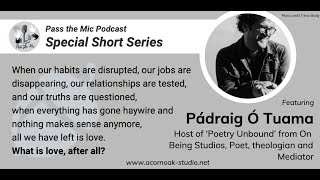
Poet-theologian Pádraig Ó Tuama refuses to define love neatly, instead offering stories: Jo Berry reconciling with an IRA bomber, Michelle Alexander exposing systemic injustice, a decade with his partner Paul. Love, he says, is paying attention to warning voices, maintaining contact, and being willing to change your mind.
Chapters
Welcome to Pass the Mic podcast, a production of Econoxx Studio and music by Benjamin Schleeb. My name is Virginie Glaenzer and I'm your host with a million questions. If you're tuning in for the very first time, Pass the Mic is a podcast where we share different perspectives on specific a specific topic, not only to help us expand our understanding of the world, but also to explore new ways of looking at it. In this special summer series, we're shifting from our usual unscripted group exploration to one-on-one interview. We sent 6 questions to our guests ahead of time and asked them to come prepared to share their answers. Today I'm talking with Pradeep Padikk— and I'm sorry, you're gonna have to pronounce your name, I forgot to ask you ahead of time. We were having such a lovely conversation So would you mind telling me your name? Because it's so beautiful.
Padraig O Tuama.
Padraig O Tuama. And we could have a conversation around the origin of your name, about one of the most iconic— so we're going to be discussing one of the most iconic and fascinating ideas in history, an idea so strong it can change our world in crisis: love. Before we begin this conversation, let me introduce you to our speaker. Pádraig O Tuama is the host of Poetry Unbound from On Being Studios. He's a poet and theologian, and his work centers around themes of language, power, conflict, and religion. From 2014 to 2019, he was the leader of the Corrymeelan Community, Ireland's oldest peace and reconciliation community. Padre's published work incorporates poetry such as "Reading from the Book of Exile," "Sorry for Your Trouble," and theology, daily prayers. And I think you have an upcoming book called "Borders and Belonging," which is scheduled for November 2021.
That's right.
Wonderful.
Nice research.
Yes. Well, Padre, thank you for being here and welcome.
My pleasure. Thanks for having me.
So I usually start this short interview by bringing up some context. We're living in a time none of us ever expected to see outside a dystopian movie or novel, because when our habits are disrupted, our jobs are disappearing, our relationships are tested, and our truth are questions, when everything has gone haywire and nothing makes sense anymore, All we have left is love. So Padraig, can you define love for us?
I was thinking about this as you sent the questions in advance, and there's a quick answer, which is no, I can't. And there's a less quick answer, which is just to tell you some quick stories. And because I think love is seen and observed rather than defined. There's a woman, Jo Berry, And her father was murdered by the IRA in a bomb in Brighton. He was a politician in the Tory Party. And her father was murdered by the IRA in that bomb. And in the last 15, 20 years, she has gone on public speaking tours around Ireland and Britain and further afield too, with the man from the IRA who planted that bomb. And they're careful not— they don't use the word forgiveness. They're not really interested in forgiveness. They're interested in saying, how can this terrible grievous experience and anger, how can they not let that guide them? But how can they do something in public that's different and surprising, that's creating a different present, and from that a different future? So that's a living definition of love. A friend of mine died recently in June, and I loved him dearly, and I have cried every single day. So that's the definition of love. And then another friend, Raymond, who I didn't know very well, texted me and said, "Podrick, I love you, and I'm sorry for your sadness." That's the definition of love. Couldn't do much, but he could do that. And I think of, in the United States, Michelle Alexander, who did a long historical and legal exploration into the Jim Crow laws and the ways that the current incarceration system in the US maintains some of those laws, and she wrote a book called The New Jim Crow. And that's the definition of love too, to expose and to seek, to name the powers that are creating terror for people. So there's all kinds of stories of love, and those are some of them.
I like this idea of love being an expression, an action. Very true. So going back to that context, unique context that we are living in, during these times of isolation and unrest, how do we as humans find love? What are your thoughts on that?
So part of me wants to always say that when we speak about a unique time, I'm not sure we are in a unique time. It's unique to people, to some people. Other people have been living through wars for a very long time, and this is just the latest definition of this. The refugee camp on Lesbos was burnt down the other day. Technically supposed to only have 3,000 people, it has 12,000 people. 3 died. And people in refugee camps have known unprecedented times for as long as there's been refugee camps and people seeking asylum. So I think there's, and it looks like every 100 years or so there's a pandemic, and some epidemiologists have been saying we need to be prepared for this. They didn't know coronavirus, but they knew preparation. And so partly I think one of the ways that we can find love is by paying attention to the people who give warnings. Sometimes they're artists, sometimes they're scientists, sometimes they're the people seeking asylum, sometimes they're the people shouting out about injustice. And I think that is a demonstration of love in public, to pay attention to those things. And then there's other things that we can do individually, of course, keeping in contact with each other. I've started writing letters to friends and sending them in the post. The Irish Post Office gave everybody in the country 2 free postcards and said, 'Write it, put it in the post, it's free.' And I got a few of them sent to me. It was so lovely just to get that. Of course, they could have texted or phoned or sent a message, but no, they sent a postcard. That was nice. I also think that donating in terms of blood or in terms of organs or in terms of money or in terms of time, that's a form of love. And we can find always all kinds of ways to donate. And listening and then changing and Changing your mind, I think, is a magnificent form of love. When we hear something that we struggle with and pay attention to it and go, I have been wrong until now, that's a form of love as well.
That's a lot to unpack. That's what you just described. There's so many things that we could dive into. It's wonderful. I appreciate the fact that you said that this moment is in time is actually not unique. It might be unique to us, but it's certainly not unique for other generations. And that raises the question, you know, why do we accept? Why don't we do something? Why have we never done anything? So removing our blinds, I think, is also a form of love. Wonderful. So Let's be a little bit more personal with these two next questions. How do you personally— and you mentioned a few examples— but how do you personally experience love in your own life today?
I suppose I think of friends who've been in touch and people who I love. My partner's name is Paul, and of course that's an important element of love. We've been together 10 years and he's a magnificence. We share a lot of love for stories and we have little routines and habits, and then also the need to find space apart as well. I think people who've been together for a while realize that the quality of your time together is nurtured by, you know, being able to sit quietly and read for an evening too without always having to talk. So love is spoken and love is done and love is made and love is also silent at times, and all of those different things. So we have great love there. Strangely, during lockdown, because I have been staying in the same place for months and months like lots of people, and I have for 20 years traveled for work, I have always been moving around, you know, so strangely I have found great love in looking at birds, small birds all around, and I I feed them. And it feels so small and silly, but I feel like it's important too. And I think that's an interesting thing to think about, the small things that are important. And the birds are small things and they're important. And of course, to pay attention to birds is to pay attention to trees, is to pay attention to shelter, is to pay attention to oxygen, is to pay attention to the earth. And what does it mean to be present in a world where there are fires burning and strange times of climate change. And for me, I'm always interested in how the small is a little window into the big. And for me, a deepening love of the birds— I had never disliked them, but I now know the names of them— a deepening love of them has also contributed to a deepening anxiety about the question of trees and the question of oxygen and the question of environmental sustainability.
So love is, as you pointed out, it's not just action and expression, but it's also a way of nurturing ourselves.
Yeah.
With ways that— yeah, like the birds for you.
Yeah, I don't think I can get through a day really without reading poetry or writing poetry. For me, the presence of poetry in my life has been a reminder of the power of language and what you can do with your imagination and what typical words can do when they're placed in certain truth-telling or artistic combinations. And for me, a demonstration about paying attention of love to yourself is making time for reading poetry, 'cause I know that when I do that, I just breathe a bit better. It's not the perfect antidote or answer to everything. Of course not. But it does help me to live my life a little bit better, tapping into some kind of stream of poetry that keeps a part of my mind nurtured and a part of my life nurtured. And I think that keeps a part of love nurtured as well, to know that there is this horizon of language that lifts me to it, to tell the truth, to learn the truth, to change, and to be aware about what language can do.
Right, right. Yeah, and I would definitely— I want to spend time on this, on your work and how poetry empowers people, connect them to love. But before that, let's go back to your own experience. And can you share the biggest act of love that you've witnessed personally?
You know, you sent me that question in advance, and I found myself trying to think about what I kept on stumbling over biggest because sometimes a really small thing is really important as well. So a friend is visiting this week and we're writing together. That's really nice. And that's been a lovely connection. So my friend, my partner Paul, and I the other night sat around the table and we each shared something that we'd written that day. And it was just a quiet moment of 3 men sitting around talking. Sharing something that we'd created that day. But with each one of us, some of it was funny, some of it was really serious, some of it was in between. With each one of us, there was something really important and something meaningful. We're making meaning, and that was a very simple but really nurturing and sustaining experience of this last week. Yeah, I think that's the, that's the main one that I'd want to think about because I like thinking about something that seems small and it's not important to anybody else, but it was really important for us.
Yeah, that almost makes me think that the example that you gave was in the near past, you know, close to the present. Do you feel that you're living through poetry or because of poetry in the moment present? Well, one of the More than living in the past, like many people living in the past, remembering, or living in the future and having a focus in the future.
Yeah. I, uh, we'll go down another little pathway here because I don't believe in the future because it hasn't happened yet. So the future can be many things. Unfortunately, we can predict it if we keep on doing in the present the things we've done in the past. So what I'm interested in is knowing the past and trying, where possible, to do something different and surprising and more loving in the present. And then something different might happen in the future. But if we keep on acting the way we've always acted, well, then the future is unfortunately predictable: war and environmental destruction. And I'd like us all to pay less attention to the future and to pay a lot of attention to what can I say or do differently now? How, if I have been addicted to power, can I begin to change that? How, if I have been used to being at the center of things, can I move myself from the center? How, if I have been privileged by my entire life and my entire circumstance, can I begin to find new ways to hold that privilege for sharing rather than for hoarding? So those are interesting things for me about the present. They do require a knowledge of the past, but it doesn't require a prediction of the future, because I I think the sacrament is now, and that's what we're being asked to do, something new, make a new sacrament of presence to each other.
Right, right, that makes sense. So your biggest act of love was something personal and that had meaning for you.
Yeah.
Yeah, that makes sense. So let's focus on your professional life as a writer. We were having this discussion prior to recording it of how you used, or using, how you're using poetry in your work. Would you mind telling us a little bit more about your work and sharing how you came about to use poetry in your work?
Well, I have a few jobs. I'm self-employed, so The job that takes up a lot of my time with great love is presenting Poetry Unbound with the On Being Project. So the On Being Project is a media and public life initiative that seeks to nurture the human spirit and the common good by producing radio programs and podcasts, but by also supporting communities and being in conversation. It's a two-way conversation, not just broadcasting to, but also learning from and responding to. So I present Poetry Unbound, which is a short podcast, 12 minutes long, and it happens for 2 seasons a year, Monday and Friday, and we take in every episode one poem, and I read the poem, reflect on the poem, and read the poem. That's it, really simple, and it's always the same, that format. It's beautifully produced by my colleagues, and we created it together too. So Liliana Maria Percy Ruiz and Krista Tippett were 2 people foundational in the imagination about what that program looks like. I contributed to it, but really they shaped so much of it, as well as the other colleagues. And it's this creation of collaboration together where we believe that offering a poem on Monday and Friday can help anchor people's week, can be a little ritual. And so I suppose I might read maybe 300 or 400 books of poetry a year in order to make sure to read, to have lots of poems from which to choose. Obviously we get permissions from the publishers, so that takes time too, and producing it all. So that's a great joy. I'm doing a PhD at the moment on poetry and prayer, and so that's a creative PhD from the University of Glasgow, so I'm spending a lot of time thinking about old prayers and seeing them in the light of poetry. One of the— that's nothing new either, I mean there's an old book written in Irish 100 years ago called Daunta Dé, meaning the poems of God, and it's full of hymns, all in the Irish language. And so calling prayer poetry is nothing new, it's something very, very old. What else am I doing? I have been working with an organization in Scotland called Vox Liminus, which means voices on the margins, and they do arts projects with people in prison or who have recently left prison. And use the arts to raise the narratives of that experience of being in, and also the experience of being released and what that's like. And so I've been working closely with some people in terms of writing poetry together to look at that. I'm poet in residence for a church in Manhattan in New York City, the Church of Heavenly Rest. So that's a 6-month residency that's just starting this week. I was supposed to be there in person, but obviously I'm not. But there's loads. I mean, there's some book projects as well. I've got a variety of book projects on the go. I'm always writing, so there's never an end to the work, but the work gives me life, so I love it.
And what do you think, or why do you think, that poetry helps others find, connect, or express love? What is it about poetry?
Um, what is it about poetry? It's such an interesting question. I'm so glad you asked it because, um, there's some people who turn to poetry because they've studied it or they might teach it, okay, or they might write it, and so they know a lot of technicalities about it. But so many other people also turn to poetry intuitively from the spirit, and because they feel the need for something that says you matter You're not alone. People write poetry when they can't find a poem that has been written for them. When I was 16, I sat next to my friend in chemistry class in school, and he had just broken up from his girlfriend, and they had been together for 6 months, which at 16 was a very long time. And in chemistry class, he turned to the back of his book and he wrote a poem. I never read it, of course, but I could see him next to me writing this poem, and he needed to have something to express his pain and his heartbreak, and it was melodramatic. They were 16, and it felt like the end of the world, and he turned to poetry. So, so many people do. I think maybe because we're looking for a language that can have both truth and lament and promise and pain all in it there together, and poetry does that. And to hold it together in form or some kind of music I think there can be a lullaby or balm nature that can help us there, or it can also help us to rise up, to be focused on something, some injustice that's happening. So I think we turn to poetry like we turn to all the arts for some kind of echo, for some kind of noticing, for some kind of desire that the mark-making we make, whether that's a poem we write or a hand on an ancient wall in a cave, we want to say, we've been here and this is what we've experienced. And we find an echo in making that for ourselves and hope that maybe some other people, maybe just one other person, maybe a million other people, will also find some echo in that piece of making.
Interesting. Yes, poetry was for me a salvation when I was going through an existential crisis. I was able to use poetry to express my own angst, and it was a relief. I definitely found a relief. Yeah. It's interesting how language allows us to express our emotions, and at the same time, as you mentioned, it could also be inspiring.
Yeah, Marie Howe is an American poet based in New York City, and I heard her once ask the question, what was the first poem? And she said, probably a mother feeding her child, singing to her child. You know, there's the da da da there, there's the um um, there is the fact that we, in the midst of having nothing to say, often use sounds that have some kind of percussion, some kind of music, some kind of rhyme, and some kind of space in between it. It's saying much more than it's saying. And that might have been the first poem. We don't know, it was never written down, writing hadn't been invented. But we have been turning to poetry ever since that first woman, sang that first poem to someone she loved.
It's beautiful. And there's definitely, like in music, we know there's a rhythm, there is a sound that comes from the word. And I think when you say, when you read a poem out loud, it has an effect that is really a lot more powerful than if you just read it in your head.
Yeah, there's been a long association between music and poetry, and in some situations You can find the same word used for lyrics of song and a poem on the page and a hymn and a prayer. In Irish, you can use the word "dán" for poetry in a variety of different circumstances. So yeah, it's— we do so much to turn to that, and it turns to us as we do it.
Have you seen an increase of interest and desire of people with poetry in the past few years?
Well, I, yeah, I hear so, but I'm always suspicious about how we describe what's happening right now because I'm never entirely sure that we're entirely right. So yeah, I mean, poetry sales in Great Britain across the water, poetry sales there have really increased. So from that measurement, that's the case. And I think in the United States too, that there has been an increase in the selling of poetry. Magnificent, and I think that's fantastic. That's only one measurement about poetry. It's not to say that people haven't been turning to poetry for a long time. When you look at so many school curricula, depends what country you're in, but certainly in Ireland we were learning 2 poems off by heart every single week from the age of 5 to 17 in different languages, Irish and English. And so that has been— that demonstrates the fact that poetry is part of the heart of a a politic as well as a culture and a people and a public. And so when we say that poetry is increasing, I hear, I see articles in the New York Times or in The Guardian speaking about that, and I'm glad because they're indicating a trend, but I'm not entirely sure that poetry has ever gone down. Maybe we're just talking about it more rather than— so maybe that's the case, or maybe people are having to pay attention to its economic impact because of the profits from publishing houses, so maybe that's why it's in the news, and that's good. I'm delighted, and I'm so glad for publishing houses, the small ones and the larger ones. Thank God for them. They do great work. But, um, the poetry is a lot older than the question of its profitability.
Sure. I, like in France, being raised in France, I had as a young age to learn 2 poems per week. But having my children in California, uh, 20 years ago, I've never heard them learn a poem. So I don't know if it's Europe versus America, but they didn't— they were not reciting. And I remember clearly, like you, we had to come up— we had to learn by heart poetry, stand up and recite. Yeah, exactly.
Yeah, I've been reading some French poetry lately. Hélène Cixous.
I don't know.
Oh, she's amazing. Yeah, yeah. And, and Paul Celan also. Hélène Cixous is in her 90s, I think. She's amazing. She's a philosopher and a theater writer and a poet and a critic. She's amazing.
And perhaps if we see an increase of interest in peoples, it might also— and that's just me applying some meaning— but it might just also be a reflection of this stressful time, and we're trying to find ways to alleviate this stress, those fears. And as you said, poetry is a way to express our emotions and be inspired. So interesting. Well, I want to be mindful of your time, and as a way to wrap up this conversation, we'd like to do a little game with 4 questions that were not shared with you ahead of time.
I am slightly nervous, Virginie, I need to tell you. You told me about this.
This is very easy. So we've got some fill-in-the-blank statements for you to complete. There's no right or wrong answers. So here you go. Number 1, the color of love is blank because blank.
The color of love is wide because it is important.
I love it. Number 2, and I'm not gonna— there's no, again, wrong and right, so no discussion. I'll take whatever you give me. Number 2: I love someone when blank.
I love someone when we're around a table sharing a meal, talking and deepening our friendship.
Number 3: We all think we know what love is, yet when we dive a little deeper, love is not Black.
A single thing.
And then we'll end on that final statement: love is blank.
Necessary.
Well, thank you very much, Padraig, for sharing your personal view on How Your Work Brings More Love into the World. It was wonderful and makes me want to go back to poetry, discover some of the authors that you mentioned, and listen definitely to the On Being podcast, which, as you said, you know, who wouldn't want to have a weekly ritual with poetry begin and end your week? How amazing would that be?
Oh, thank you. Yeah, such a pleasure to meet you.
Thank you.
More from Virginie











Unlocking Fintech Success: Strategic Trends for Profitable Growth: Webinar Leadership Series