When Should You Bring on a Fractional? Timing and Considerations. Episode 28
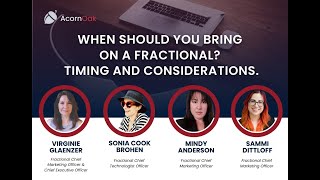
Four fractional executives discuss when companies need part-time leaders and how they differ from consultants. Fractional CMOs and CTOs typically cost $200-$300 hourly or $1,500-$2,000 daily, work on foundational projects like brand manuals and process design, and stay for three to nine months. They embed into teams, transfer knowledge, and measure success through internal KPIs and performance reviews.
Chapters
Welcome to A Corner. We are a marketplace and a community of fractional executive women where you can find fractional excellence from a few hours a month to 30+ hours a week. Today with 4 of our members, we are discussing one of the main trends of the future of work, which is fractional executives. In our last blog post, we wrote about the gig economy. And for those who are not familiar with this term, the gig economy is also known as the task-based labor, which started to become very popular after the 2008 financial crisis. We saw freelancers offering multiple services, data entry, content writing, logo design. And today it has now expanded to include executive-level jobs. In fact, according to the CEO of Intuit, the gig economy will make up 43% of the US workforce by 2024. So this is really a trend to not avoid. And we can see it in this post-COVID era how many individuals are now opting for part-time freelance or even consulting work as a way to achieve better work-life balance. So of course technologies are enabling this kind of collaboration, and a lot of businesses who want to retain their workforce or appeal to the youngest generation are starting to implement flexible work arrangements such as remote work. So during this conversation, we're going to look at the specific functions and responsibilities of executive fractional work, and we'll talk about what can be expected of a fractional executive. We'll also talk about the current market rates and how long should you hire a fractional executive. Before we start our conversation, let's begin as we always do with a tour de table and have each of you tell us your name, how long you've been a fractional executive, if you're just starting or it's been 20 years, and also your domain expertise, and of course all that in about a minute. So why don't we begin with you, Sami?
Sounds good. So I'm Sami. I've been a fractional executive for not very much time, but I have been a marketing director and held roles that are very similar to responsibilities held by a fractional executive for many years. I've also been in marketing, advertising, promotions, writing, you name it, for about 16, 17 years now. And my domain expertise really lies in writing. I love writing. I love strategy. And I also had 5 years of experience in data analytics. So I like having— making data-driven decisions.
Fantastic. Thank you, Samia. Excited to have you during this conversation. Sonya, would you like to tell us a little bit about you?
Absolutely. Thank you, Virginie Glaenzer. My name is Sonya Cook-Bruin. I'm a software engineer with about a decade of experience in large tech firms. And then before that, I was actually working as a consultant in, and in smaller companies. So before fractional was really a term that was used, I suppose I was in some sense doing this kind of work, but since I've left large tech, I've decided to pivot towards fractional as my full-time focus and really distill the offering that I'm bringing, which is around bringing creative thinking and process design to tech as a fractional CTO.
Exciting. I think the fractional CTO is one of those new, really new cutting-edge positions. So I'm excited to have you with us. And last but not least, Mindy.
Hi, my name is Mindy Anderson. I have been leading marketing strategies for 22 years now. But I have been a fractional CMO for 13 months. I started out working in very large financial services companies, and like you, Sonia, I also was a consultant for about 5 years for well-known financial services companies and investment banking and wealth management. Then I transitioned into consulting companies, including EY, And now for the past year and a half, I would say it's been largely providing fractional CMO work for startup companies as well as small companies who really want to aggressively scale.
Fantastic. Well, thank you so much, Mindy, for being here today. So I'd like to start this conversation by taking the elephant out of the room. That's an expression, right? Because many people confuse consultants with fractional executives. So why don't we go around the table and share what is for you a fractional executive versus a consultant? And you can also expand on what are the duties and responsibilities of a fractional executive. Mindy, let's start with you.
All right, great. So I would say a consultant is more advising a company on the gap analysis that they're seeing. And it could be on any strategy. It could be for marketing, it could be operations, it could be on rev ops. For a fractional CMO role, I have gone in, I have set the marketing strategy, the global go-to-market strategy for different countries, which has to be very nuanced to the culture and way of life there. Bringing in agencies, also scaling high-performance marketing teams because the roles and responsibilities that go into marketing are so layered. Oftentimes I find that the part of fractional CMO world not only has to set the strategy and set a high-level marketing strategy that lends itself to lead generation,, right? To bring in net new acquisition logos. The other part is, is really bringing awareness to the rest of the company on what marketing is doing, how they're driving impact, how they're scaling the company, the channels that they're utilizing to really brand that company through and through. And what are the touchpoints showing us month after month? And the data, going back to what you said, Sonia, is so imperative to have the right data trackers in place. Without data, you're not really making data-backed decisions and informed insights on what the customer is doing. And, you know, the layers of marketing can get so involved. So I would say for any fractional CMO, it's critical to establish the high-level strategy in the first 30 days after you get to uncover what that company has, what they don't have, and the strategy needed to be put in place in addition to the talent that they also need to put into place.
Thank you, Mindy. So the consultant stays focused on a particular challenge versus the fractional is really part of the team. And does the work or the job of any team member.
Sounds good. Yeah, and I think it definitely depends on the personality. I'm a relationship-driven person as well. So for me, I find it fulfilling to feel like I'm part of the fabric of the company, even though I'm not. But that's my personality. I like to feel like I'm part of the team, I'm part of the company's vision.. And so I don't want there to feel like there is a disconnect between a fractional versus an internal employee. But that's just— I, I think part of that is based who I am as a person.
Thank you. What about you, Sonia? What do you think is the— are the differences between consultant and fractional, and what are their duties and responsibilities?
Sure, um, thank you, Virginie. And Mindy, I think I will tack on to what you were saying, um, is basically it's how deep that I would go with a client versus I would imagine as a consultant, I would usually go in and it would be a sort of task-driven engagement. But in particular with the work I'm doing with technical teams and their leadership, there really has to be a strong sense of trust and embeddedness. And I wouldn't really have too many clients in parallel because the amount of focus that is required of me for that engagement is quite a lot because, you know, I really need to build trust with both the leadership and the technical members of various teams in order to understand what kind of process design we need to do. Do we need to do RACI, you know, roles and responsibility, which is often missing? I'm not going to tell the engineers how to change their tech stack and things like that unless there's some glaring issue. But typically it's around creating better dynamics in the working teams that are existing. And that's a multi-tiered process, which I'll get into later. And I just think it's a much more deep level of engagement. That's the way I would differentiate it in a nutshell.
Fantastic. Thank you, Sonia. That was very clear. What about you, Sami? What is your view on, on that difference between consultants and fractional executives?
Yeah, I agree with a lot of what Sonia and Mindy said, so I won't repeat everything they said, but I really like what you said, Sonia, about embeddedness and depth. I think that's really what I think about a lot with the difference between a consultant and a fractional executive. You know, as a fractional CMO versus a consultant, I would say usually as a consultant, someone's coming to me with a specific question. You know, maybe there's one thing that they need to fix, or they just want someone to kind of have a overview of what they're doing and I'm coming in and helping them. It's something that's easier to package, I would say. And I've put together consulting packages where it's like, are you stuck? Do you need to get unstuck? I can help you do that. But it doesn't necessarily mean that I'm sticking around. You know, maybe I tell them, all right, these are the people you need to hire or this is who you need to look for. Let me— you know, I've, I've vetted people, I've evaluated developers for people, things like that. I would say that those are more consultative roles. With a fractional executive role, maybe they don't know the questions to ask, and they're just really looking for someone to dive deep and understand the overall structure of the company, where it's going, and how they can kind of alter their direction, grow more, change a trajectory, you know, something like that. I feel like I get more down and dirty and I start asking more detailed questions and organizing more and, and kind of sorting through complexity that— so it is really, yeah, like the, the depth of it is something that, that speaks to me and usually a longer-term commitment than being a consultant where you might just come in, help with something and leave.
Fantastic, thank you. So yes, asking for guidance requires a fractional executive who naturally will be more connected to the execution and implementation versus a consultant who's just here to hire a particular problem that has been identified. So fantastic. Let's stay with you and let's take a higher-level view for a moment. What does a day look like for you as a fractional executive?
Sure. So when I was just starting out, I had a mentor call me a Swiss Army knife, which was really flattering. And now I just try to live that every day. And try to come up with as many things as possible that I can bring to the table to attack a problem or, or solve a question that a client might not even know that they have. So when I start working with a client, I'm building the foundational structure that everything else will, will grow from. So I'll ask questions like, you know, what does your— do you have a brand personality? What's your brand voice? Do you have a target persona? What are— what do you want to accomplish in the next few months to a year. And we sit down and we take the time and document all of that stuff. So it's not just, you know, well, I'd like to make more money, or whatever, you know, the generic answer you get from clients sometimes. And that's something that has really paid off with clients where they're like, I don't have to think about that, recreate the wheel every time I come back to these things. We have a place that is our touchstone that we can go back to. And that's something that I've seen that's been missing from a lot of organizations that I've worked with. So as a fractional CMO, that's something that I ensure that we put in place, you know, we're going to have some kind of foundational document and then have agreed upon, you know, times that we revisit it, that we check back in, that we're having regular meetings that we both you know, or all agree on what progress looks like and how we're measuring that. And, you know, depending on what the client's capacity is, their budget, you know, how many times per week, per month I'm there, you know, it could be getting the ball rolling on some pieces and then bringing in other people to help. So I'm working with a client right now where, you know, I started the social media, we're working on blogs, we're working on video editing, you name it, I'm doing it. But now we're— we've created job descriptions for all the people that we want to bring in so that I can focus on bigger pieces. We can leave the smaller pieces to other folks, um, but kind of getting the training wheels on and then pushing them down the road a little bit. And, um, you know, with me, I've done everything in the role from long-form content writing, uh, developing strategic documents, building monthly reports, documenting processes, designing assets, like I said, editing video, ordering merch for events. But, but that's kind of— we lay the groundwork and then when we have a better idea of what the day-to-day needs are, we'll resource accordingly.
It's interesting that you're also pointing out that a fractional executive is here to transfer their expertise and their knowledge and pass on to the existing team, you know, their own experiences versus, again, a consultant is just here on a mission to fix a particular problem. So there's a long-term.
Interesting.
Thank you for sharing that. What about you, Mindy? What does a day look like for you as a fractional executive?
I look at, I think the first part is their brand strength, brand equity, brand marketing, and brand identity. I've uncovered this one identifier, I'd say across the board, and it doesn't really matter what industry the company seems to be in, that when I ask different people in the company, subject matter experts or otherwise, there, there's not that strong, this is our brand, this is why we do what we do, this is a problem that we're solving, this is how we're different from our competitors. And I often find myself defining that for companies because without that, they're just another company in the market. And, and then I say, well, you know, your goal for this year, 2023, is to, you know, drive X amount of revenue, right? The whole— and I agree with you, Sammy, that that's really their blanket answer. But they don't know that on the flip side of that, they don't know how to create a differentiation in the marketplace. And part of this is with a very saturated market that's so noisy that how will that buyer or customer of whatever their ICP is understand that they are the right company for them to even go, go forward with. So I find that as a fractional CMO, I'm seeing that we create those milestones and the stepping stones for the prospect to become nurtured, and to have those digital experiences and touchpoints from end to end, that is more meaningful and and aligns really with what they need from, from that brand. I think that a lot of companies still struggle with talking about themselves over and over and over again instead of talking about their customers or talking about the problems that they're solving. So I think a lot of our mission initially has to be about how can we be the go-to company that solves the problem that your customers are having right now? And how do we get in front of them and which channels will, will move the needle on that? So a lot of it— there's a book called You Ask, We Answer that kind of addresses the content marketing needs of answering what your prospects are asking, asking you as a company, or at— or addressing through thought leadership pieces or case studies or email marketing and, and all the other pieces that can be put together on addressing what your clients are also asking. So is there Is there a process in place for creating the questionnaires, even for surveying your prospects and your clients, which will be very different questions and very different answers. So I would say that's my, my analysis for the first 30 days has a lot to do with uncovering the brand and uncovering what are we really trying to solve as a brand? And do we really have a clear idea on is, is the ICP the right ICP even for your company? And I've also seen a mismatch in that as well, where they'll say C-suite and I'm like, well, which of the C-suite are we delving into? Because they will all have different pain points and they all cannot be addressed with the same messaging because that means you're boiling the ocean. You're really not going to get very far.
Yeah. So you're very sales-oriented. Fantastic. So it's interesting to see that the day looks differently based on the scope of work and the expertise that as a fractional will bring to the organization. Thank you. What about you, Sonia? What does a day look like for you as a fractional technologist officer?
Yes, I was sort of silently smiling as Mindy was talking about. I think you were getting at how important a company having a strong why is and that everybody in the company believe and understand that why. So I will say for the technical side, whether it's the engineering teams in a product building capacity or an IT team in a large enterprise firm, if the why has become disconnected from the technical teams and their leadership, it can be very hard to unify everybody around a central purpose. So if the engagement— basically, first, I will always start with conducting series of interviews and trying to get to the the pain points and the problem statement, because it's not always actually very clear what the problem statement is in my case. And so once I have a better understanding of that, if it does touch on the why has become removed from the technical teams and their leadership, then it's a matter of actually more research and more interviews with the leadership of the company and maybe some of the sales folks and people who really get it if they do, and then bringing those people together so that they can have more conversations and get everybody united around this. Because once we have a central purpose to unite around, then we can drive everybody together. Otherwise, we're in separate cars on different roads. So that's the initial phase. And then there's multiple phases of the projects that I would work on with the team. And those are all clearly defined upfront and agreed upon. But after that initial discovery phase, let's call it, which my cycles mirror very much the software development lifecycle process because I am an engineer by trade. So that just This works for me and it tends to work with the technical teams that I work with. After that, then it could be a series of, if it's a remote team, we might work together remotely depending on the company's budget. I like to have an in-person session at least once to get everybody together to do some exercises, which really like lower the guard and get everybody on the same page with each other. So there's not one answer to that. It sort of depends on what phase in the project I'm in, but it could be anywhere from conducting surveys interviews and researching on behalf of the client to just getting people together and doing workshops with them.
What I'm hearing also is that fractional executives are asking tough questions. They're making the, the rest of the executive accountable. So these are not people who just come in and fix problems. These are people who are digging through and really getting their hands dirty, but not with, you know, being brave enough to face the real challenge, the deeper challenge. So fantastic. Thank you for sharing that. So let's stay with you because, you know, many businesses thinking about hiring a fractional executive might be wondering what they can expect when working with a fractional executive. So how do you measure your success as a fractional executive? What success look like for your clients? And what are the performance expectations for fractional executives? I'd love to know your thoughts on that.
Not to give a vague answer here, but the capacity of a fractional CTO to measure everything is going to be a little more challenging because again, I'm looking at some of the immeasurable qualities of teams. And some of those are things like roles and responsibilities. Do you have clearly drawn up races so that everybody knows what they're supposed to be doing? You know, that's a long-term gain once you do have those in place. So you're not going to see that gain initially. I would say for me personally, the way that I measure my success is do my clients want to engage with me again? Do they keep me on retainer? And really the energy in a team shifts when they start to work together differently, which the leadership feels immediately. And there But there is one key metric that I would use for both identifying problems and also proving that our processes have worked well to help remedy them. And that is in the software development lifecycle, there's a period after the development is done and the testing is done by the QA engineers that's called UAT, which is a user acceptance period where you have users test the software. And it, at this point, there should be no actual bugs. But if you're discovering feature issues, then you have a disconnect between the intake process or the user requirements gathering phase and the developers and what they should be doing because they don't fully understand what they're delivering and some, somewhere something has gone wrong. So this is one of those areas where you can measure performance gains that naturally happen when teams start to collaborate more effectively, thrive together towards a shared purpose. And so there are measurable areas, but it's not all discretely measurable, unfortunately.
But yeah, I would say overall culture alignment is the big one we're looking for.
Interesting.
Thank you for sharing that. What about you, Sami? When you focused on brand positioning, content development, how do you measure your success as a fractional? And what does success look like for your clients?
Sure. So for me, you know, performance expectations, we lay that out pretty early on in, you know, I've been developing this brand manual for 4 years now, and it came out of a need to identify where are we going and what are we trying to accomplish and what does success look like for us. So to sit down and lay out, you know, if you want to get a certain number of leads, if you want to nurture your community, what are certain tools that we have in place that where, you know, that we can help make this happen? What are our tactics around this and how often are we committing to them? And based on past performance, if they don't have that, based on industry performance, you know, best practices, what can we try to shoot for? And I would say, you know, I am the last person who would ever go to a client and say, I'm going to 5x, 10x your results. That's just not me. You know, I'm more like, let's set something up. Let's make an educated prediction about what we think is going to happen based on the amount of effort we're putting into this and what we're trying to achieve. And then let's check in, especially more regularly at the beginning, to see if we're heading in the right direction. And if we're not, then let's talk about what we need to change. Is it budget? Is it effort? Is it our expectations were too high? Maybe we're just not hitting the right people. Maybe there's more research we need to do. I'm very much about, you know, not just sticking to a specific goal. And if we don't hit it, we've failed. What can we learn from not getting where we expected to go or something going in an unexpected direction? Also, you know, one thing that I lay out with clients is it is a two-way street. A lot of the times if we're going to achieve this success, we have to achieve it together. There are certain things that I need on the client side in order to make that happen. For example, I've been working a lot on thought leadership with certain members of an organization. So then I need to be able to interview you X number of times to get your thoughts. You've gotta be active on these platforms. You've gotta be advocating for yourself so I can get you this far and then you've gotta go the rest of the way. So making sure we set expectations for what does the partnership look like. If they wanna be hands-off, then we might do a different kind of campaign, you know, but if they are excited about getting involved, then you know, those metrics are going to look different. But I start with, You know, what are we trying to accomplish? And, you know, it, it's kind of, I feel like everyone talks about SMART goals, but I'll sit and break down a goal into all of those categories and then talk about where it is on the flywheel. You could do on the funnel, sales journey, whatever, whatever you've got, Candyland board. And then, you know, are we getting there? Are we achieving those things? So that's really how I look at it and I'll use whatever we've got— HubSpot, Google Analytics, you know, any, any kind of like backend tools. Like I said, I love data, so thank you.
Yes, shared responsibility. I think that's a great way to introduce the how we're going to measure our success. What about you, Mindy? How do you measure your success?
I am a big fan of EOS, which is a framework, and it really is a trackable scoring system. And it's not— what I like about it is you don't get into why something is off track or on track. You just— what I like with it is if you see something is not going from a performance standpoint, you're thinking about what am I going to do to course correct, or what is the person who's managing that deliverable going to do to course correct? And I think it gives everybody a North Star And with marketing in general, we always have to kind of work backwards. If we're running events or running a revamp of a website, or we want to get a leadership piece out the door, or we want to create an email cadence, we kind of have to think, well, how long is this going to take me? What is the review process in the company? And then how many— people will have to have their hand touch this before it goes live. And then, you know, what is their internal process? Do they have a digital web person, or do we have to hire a freelancer? Or, you know, so, yes, with small companies, there's not always these, these people in place like the larger companies I've worked for. So that can be interesting. And then maybe you have somebody that now you're like, okay, now I gotta hire somebody too for, for the company. So I find as a fractional CMO, I kind of get my hands dirty and all parts of the digital strategy and the marketing strategy, and even an operational or revenue strategy standpoint. And maybe marketing is like the glue, right? That kind of keeps it all kind of going together. But EOS, going back to EOS, is a marker. And they're the OKRs for really everybody assessing, are we even going in the right direction, to your point, Sami? And things in market will come to light. Light on whether you are going in the right direction or not going in the right direction because we're living in, in times where things may change. And with EOS, it gives you an opportunity to say, we're going to throw away these deliverables and we're going to redo them too. And so that's, that's kind of how I keep myself honest and accountable. And I think everyone else enjoys using that system as accountability for themselves too.
Fantastic. Thank you. So using internal KPIs is a great way to measure our success as a fractional, and it goes back to we are part of the team more than an outsider. Thank you so much for sharing your perspective. So let's finish this conversation with some very practical tips and advice. What is the best time to hire a fractional executive? You want to give a few examples? How long should be the engagement, and finally, maybe some pointers around compensation. That would be wonderful. So why don't we begin with you, Mindy?
So I actually wrote a blog about the 5 signs to know when it's time to hire a fractional CMO, but I would say overriding to me is it Is your company throwing out marketing and sales tactics and is nothing sticking? I mean, if you're kind of just hoping that one of those things will stick and then you're not really moving into the market with the strategy and aligning the marketplace trends and ebbs and flows with your brand, then you're, you know, it's kind of like shooting an arrow and then hoping it's just going to land on the bullseye. It doesn't work. So we have to get more strategic. And so if you don't have someone who can see the higher level areas in which that you really need to embark on, because you can't boil the ocean, you can't do everything. So you need someone who can pull back the onion and say, of all the things you can do, I recommend you do the following, you know, and then it's going to be a short high-level list of what is going to get you there faster and making your brand more of a powerhouse rather than diluting your brand or even worse, potentially ruining your brand. So I would say you want someone who's high level, who's going to keep your brand strength going with a fractional CMO. So if you're seeing your company's internals showing signs of weakness, then it's time to get somebody who can give you that brand strength back.
So hire someone when you're stuck. What would be the ideal duration or ballpark?
I think that really is depending on, um, the company's, um, problems. Some, some companies come to me when they're really in a pickle and, and they are— they don't know when their next business is, is going to come from. And then there's other people who are more proactive and say, I know I need my brand to be out there all the time. Otherwise people will forget about my brand. So the question is, how proactive is your company with marketing itself? And so I think that answer depends on the company's mindset of whether marketing is a business imperative or whether they're just reacting to the fact that they're not getting enough business.
So if they're fast, if market, if marketing is a priority, maybe a 4 or 5 months assignment is enough. If, if it's on the back burner and it, the company is not reacting fast enough, then the assignment can actually take longer because of the time that it takes the organization to change, adapt, and launch new campaigns. So maybe 6, 9 months. Is that what you're saying?
I think it could even go longer. You know, when, when you're in a company that sees the impact that you're making and they can no longer live without that impact, then to me, you're doing your job as a fractional CMO and you're, you're integrated into the culture as well. And I think for me, that's, that's also why I like to be part of the culture. I want to be something that really helps them create the impact that they're looking for. And it's not going to be overnight, but I can help them get there. But as soon as you let the foot off the gas with marketing, people forget about you. Out of sight, out of mind. That's the whole thing with marketing. So if you don't have anyone to have that continuity for your brand, then it's something that a brand may want to consider having on a longer-term basis.
Okay, that makes sense. What about any pointer you want to share on the compensation side?
I think when it comes to the compensation, it's going to depend also on, on how many years have you been doing this for a living. So there's going to be somebody who could be doing marketing for 10 years. I've been doing marketing for more than 20 years, so I'm more seasoned, and I've worked for huge Fortune 100 companies as well as startups. So I have different experience. So, and in addition, you may have a longer contract. If you have a contract for, say, 9 months, you will likely go on retainer. And so I think it can range anywhere from $200 to $300 an hour, but that can also be a sliding scale, or it can be curtailed to a much less amount if, you know, as a fractional CMO, this is a commitment for 9 months. That makes sense. So it's a give and take situation. Yeah.
Thank you so much, Mindy. What do you think, Sonia, in terms of what's the best time to hire, the duration, and the compensation for a fractional technologist officer?
Yeah, it's a great question. I think certainly a company might even have a CTO and want to hire somebody who does the work I do as a fractional CTO because I'm not, in that case, I'm not looking to replace the CTO, but I'm bringing something that you touched on earlier, Virginie. Being able to ask hard questions is not something that's easy for someone inside of a company to do because there's culture, there's politics, you know, there's sometimes it's just hard to see a problem when you're inside of it. In fact, I would say 9 times out of 10, it's very hard to do that. So I think it is when there seems to be an issue with the working structures or the performance. And even though, you know, you've hired great people, morale is really low, burnout is high, your team, your, your very well-paid technical talent are perhaps you're seeing a lot of attrition. That would be a time to consider bringing in an outside eye as a fractional CTO to help with your technical team's processes. And workflows. As far as engagement duration, really, I mean, I would say most likely it would be more than this, but you could have as little as a month if it's a, you know, maybe more clear target problem that we just want to kind of hone in and like maybe it's something about, you know, we have this process we like a lot, but we feel like there's something missing. So, you know, I might be able to help them work through that and then be done after a month. But I would say typically for the kinds of bigger, deeper engagements where we're really going in and analyzing how the team is working today, are they centralized around the company's mission? You know, are we seeing a lot of UAT bugs? You know, are the stakeholders or end users happy with the products that the technical team is making? How is the technical team's morale? That's probably going to be something like 3 to 6 months. And then, you know, potentially, again, the end goal here is to teach the team how to fish, not to just give them fish. So my goal is always to be able to pull back. And if they do want to hire me on a retainer, you know, to just be basically like a coach kind of capacity when they run up against issues, they can have buckets of hours like that as a kind of ongoing thing. And then the other thing too, of course, is existing clients will have first priority if they would like to engage with me the following fiscal year. And again, price-wise, it's always hard to talk specifics about numbers to a degree because every project is so different. But what we're looking at improving here is the morale of your top talent, of very highly paid talent. So it is— there is a cost associated with that. But again, are we booking with retainer and then maybe only a few hours a month? Versus several days a week for several months, that's just going to look very different. But I would say somewhere in line with what Mindy was quoting as well for the CMO range. But again, it's very dependent upon. And then of course, with what I do, we might need to travel and get together with the team. So there will be costs incurred there as well.
That makes sense. Wonderful. Thank you, Sonia. What about you, Sami? What is the best time to hire, the duration and the compensation that you've seen, you've experienced yourself?
Sure thing. So yeah, I mean, the word impasse keeps coming to me. Like if you're at an impasse and you don't know where to go and you're looking for that direction, like I said before, you don't even know what question you need to ask, but you know that you need help with marketing. Hiring a fractional CMO is a great way to do it. I worked for an accounting firm for a few years in my past life, one of my past lives. And we used to serve— do outsourced accounting services. And I think it's very similar where the way we would pitch it is, you know, if you don't need to have accountants in-house, you know, a CFO in-house, we can serve as your outsourced CFO and you can try it out. You know, if you've got a smaller team or you're just not sure you want the level of commitment of a full-time hire, but you want to see what you can get from that kind of service, I think that's a great way to go about it is by hiring a fractional executive. And, you know, like Mindy, I've worked with some larger companies and a lot of scrappy startups. And, you know, with a startup, it's, you know, usually coming more in the beginning, I would say, like, okay, we, we've started some processes, maybe we got a website built, and now we know we need somebody to to create the overall marketing strategy that's gonna get us to the next level so we can hire some people versus, you know, I've come in and worked with companies that are, you know, 50+ years old, 100-something years old, and they know, okay, we need to do things in a way that's different from how we've been doing them. Maybe they're still relying on referral networks and handshakes and they know that they need SEO. So that's gonna look really different. And you're coming in, you know, they've probably got some established processes, but you're kind of coming in and retooling them and analyzing them and deciding, you know, what to keep and what to toss. In terms of engagement level, that's also going to depend on where the company is, where they're starting from, how much you need to sort out. Um, and so, you know, I— when I was thinking about this before, I thought, okay, 3 months is kind of pushing it. I would say that's on the very low end. I wouldn't want to work with a client any less than that because I I feel like I could really make progress in less than a quarter, that does feel more like a consulting role at that point. Um, but like Mindy said, if you're like weaving yourself into the fabric of the company and they're still looking for that guidance, I don't necessarily think that there's a required endpoint. If they feel like this fractional basis is, is what we're going to need until we hit 'X size, X employees,' and then we would want someone full-time in-house, then you can hand that off. So it all kind of depends on where they're hoping to go and what their eventual goal is with that. And then compensation, I mean, I— yeah, I— my favorite term is 'it depends.' I am the 'it depends' person for sure. Um, but yeah, if there's, if there's a retainer, if there's a regular expectation for we're coming in, you know, X amount of times a week for you know, this many hours on those days, that's going to look different from, you know, you're trying me out. And it's hard to say that that ongoing engagement is going to affect what the compensation looks like. But yeah, I wouldn't disagree with Mindy or Sonya. I would say, you know, I'm, I'm maybe the newbie here having 16, 17 years. So I would obviously keep that in mind when I'm, when I'm quoting with clients. But I've also done the whole tear everything down, build everything up again, you know, process with more than one client as well.
That makes sense. Yes. And what I'm hearing is that it's really engagement rate and compensation and duration, or really like a rainbow. There's many colors depending on the reason of bringing someone in. I've been a fractional for about 4 years and I've seen very missions such as 3 months, and same as you, Sami, I wouldn't do less than 3 months, to replace a, you know, someone going on a maternity leave and still being there to manage the operation, to 6, 9 months when it was about bringing someone full-time, but hiring someone full-time really can take up to a year to find the right individual. So in the meantime, you do need someone to keep marketing flowing and leads coming in and brand being, you know, experienced online. And the rate also depends on the complexity of the project. The rate that you mentioned, Mindy, around, you know, $200 to $300 is absolutely the norm. I mean, I personally charge $1,500 to $2,000 a day depending on the size of the company, because if it's a larger organization, then and it will typically require more strategy, more complex collaboration scope versus a startup where they are really looking for basic stuff. But again, it depends on the project, on the scope, on the complexity, and also as a fractional on the expertise, fractional CTO versus fractional HR, fractional COO might have all, you know, different nuance. I want to add one last topic because I saw a conversation on LinkedIn that Mindy, you shared recently with me about what are the key questions to ask professional executives when you hire them. So I want to take the perspective of a prospective client, and I want to share 4 questions before I open up to you guys if you have other questions to suggest to a CEO hiring. So I found that there's 4 key questions that over time proved to be critical for a good relationship and work collaboration. And these questions work both ways. So the number 1 would be, what is your level of participation in strategy compared to implementation work? And for a hiring CEO, it helps them understand how much the executive will be hands-on. And for us as Fractional, it also will help us understand their, you know, what is their internal resources and what is expected. The second question would be, what is your area of expertise? I think we talked about that earlier, specifically in regards to marketing, finance, or even HR, where there's a large scope for these departments. So it's really a question that helps me set up the right expectation and truly understand the expertise that they, that is needed. The third question is, how often will we meet and how? And this is really to understand the preferred method of communication and their— the availability of the fractional, but also the expectation of the client. Do we want to meet once a month, or do we want to meet twice a week, which is very different? And then the last question, once we have a good understanding of the objective and the scope of work, would be How much time do you estimate that you'll need to successfully contribute to our team and for how long? So as we talked earlier, fractional or very flexible, they can, you know, engage 5 hours per month or 2 days per week, and in the same way it could be 3 months to 2 years of engagement. So I think this question really for CEO will help the fractional, you know, provide a clear view of now that I understand why I'm coming into the team, here's what I will need in order to be successful. Is there any other question that you think CEOs who want to hire an executive need to ask? And just open, you know, Open mic.
I've got one. Um, I would love to have, you know, a CEO ask, what do you need from me to be successful? I think that would be real, you know, then I can kind of take an inventory and, you know, set expectations with them, like I talked about, that two-way street.
I like that. Any other question, Sonia?
Yeah, yeah, with what I do, um, I would want to be able to share that the— I'm sorry, I'm not sure how to phrase this as a question, but I would want to be very upfront, or I am very upfront with leadership, that they are going to need to allocate a certain percentage of their team's time if we're going to create process improvement and do real design work. And I don't mean design in a graphic design way, I mean in a strategic way. And I would also want them to know, the leadership to know that any surveys or conversations that I might have with team members and with themselves are strictly for me because I'm working on behalf of the company, not either the developers or the leadership. So everything is confidential and is in here. It doesn't get shared between, uh, so that's very important for me in my process. And I would want them to know that upfront.
Got it. Thank you so much.
I think, um, also one other, um, key area for marketing and data that's critical for us to know is what systems are in place and, um, are they open to applying budget towards new, new systems if they do not have the proper data trackers? I hear a lot of clients asking about lead generation, but many of them don't have any lead generation trackers and they don't have any sort of process in place for creating lead generation processes. And that requires some systems and potentially even outsourcing some, some tasks that would need to be implemented.
Right, right. And this is a great question for the discovery. What is your tech stack? Sales and marketing tech stack and how flexible are you to change it or modify it in order to achieve the goals. I like that. I want to thank everyone for this insightful conversation. As we come to the end of the hour, I'm not sure we spent an hour, but close, maybe 45 minutes. I'd like to finish this discussion the way it began with another tour de table. The intention for this discussion is to help each of us become the self-authoring leader of our own lives through meaningful action. So whether you are a busy fractional executive or a new fractional executive, or if you're a business leader looking to enhance your team with someone like us, let's pass the mic and share any reflections that have emerged from our conversation. Or any last thoughts that you feel was left unsaid that you'd like to leave us with. And I'm going to share my notes to give you some time to collect your thoughts. First of all, I truly enjoyed this conversation. I definitely want to listen to it again. It will be on our podcast as well as on the YouTube channel because there was a lot of good nuggets and I We're going to write a blog post also for those who like to write. From what I'm hearing as I reflect on this conversation and what I'm seeing in the market, it's clear to me that the way that we are building organizations and hiring people is profoundly changing. I mean, there's no doubt about that. And it has accelerated since post-COVID. Fractional executive or clearly not consultant. But they're really the next generation or the new generation of executive management. They actually allow businesses to tap into skills and experiences that they previously would not have been able to retain, which is an amazing opportunity. But it also empowers the full-time teams with someone who is not playing politics and instead someone who's focusing on transferring their experience as as we talked about, to the team through new processes and also excellence. So that's, that's what I'm taking away from that conversation. So let's pass the time, the mic, and start with you, Sunny. Is there any last thought that you want to leave us with?
Yeah, I think, you know, hearing everybody talk about how important foundation is in different capacities, that's really stuck with me. I heard all of us have a united front on that and taking the time to do it. I would say, you know, I've worked with a lot of clients in freelance capacities, short-term capacities where I'm asking them questions about some of the things that they have in place. And sometimes there's one piece that I'm looking for to do my job well and not every piece I could use. And so when I come in as a fractional executive, that's something that I'm very intentional about. Addressing right at the outset. I want to make sure we take the time at the beginning to set these pieces so that when people come in, they are prepared, they have what they need to do their best work for you, because that saves them time and money in the long run. I think, you know, sometimes the, the budgets, the initial time commitment, that upfront investment can feel daunting. But we've all seen the payoff that comes from taking that time to be intentional in the beginning. And so I appreciated that everybody said something in that vein.
Yeah, the foundation is key. Thank you so much for sharing that, that reflection. What about you, Sonia?
Any last thoughts? I agree also. Yes, I think that was interesting that we all mirrored the foundation aspect, Sami. I think it's something important to consider in this new age of the way we work, how we work, where we work, and also the kinds of work we do. We know that all jobs are tech jobs now, and that's only going to increase. And we don't know what machine learning and AI are going to have as a long-term impact upon development teams But we do know that the piece that those tools can't answer for as of yet, and hopefully it's a little bit down the road, is real human innovation and creativity. So it's more important now than ever for companies to think about unlocking the full potential of their teams. And that's really what we're about when we come in as an outside fractional leadership capacity. We can bring that. And it's something that's, I think, to be more and more needed as we move forward.
That's a very good point.
Coach.
I think we are coaches by essence. Thank you for that. Mindy, any last thoughts?
I think that the fractional CMO role is really most effective when the CEO really sees this relationship as an alliance in order to hit their goals. That's kind of what I kind of go into these relationships with the mindset of I'm here to help you win. I'm here to help you gain market share. I'm here to help you determine your brand differentiation. And I'm here to make sure that any gaps that are present, I can help you fill and then really test, learn, and iterate because marketing is never one and done. Marketing is always responsive to the ebbs and flows of the trends in the market. And as we know, we're having a lot of trends and a lot of changes. So I would say, um, anyone who interviews a fractional should always kind of bear in mind that we're all here to respond to the marketplace in the best way that we can, with the end goal of helping the client win.
Fantastic. I like last thought. We're here, we're all here to help clients and, and the like. Thank you so much. So thank you again for spending time on this fantastic and fascinating discussion. And then for those who are watching this video or listening to the podcast, please like it and share it with other people. And then finally, for all the business owners looking to reach their next phase of Growth with a fractional executive woman, go to acornoak.net, fill out our inquiry form, and you'll receive, uh, the profile of 3 amazing fractional executives. So thank you so much for being here.
More from Virginie











Unlocking Fintech Success: Strategic Trends for Profitable Growth: Webinar Leadership Series