An Interview with monk Gelong Thubten on Compassion and Mindfulness
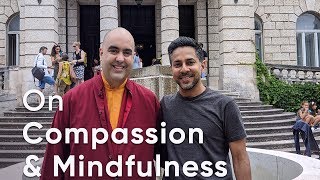
Gelong Thubten argues that compassion and kindness are skills you can train through mindfulness. He claims that focusing beyond yourself shrinks your problems, that mindfulness in schools and prisons reduces fear and manipulation, and that teaching contentment over greed is key to solving climate change.
Chapters
Hi everyone. I'm with my friend Geilong Thupten. So if you haven't heard of Geylong Thupten, you should. He is the monk that was brought in to train the cast of Doctor Strange, Benedict Cumberbatch and so on on Eastern Philosophy. He is a former British actor with a very cool British accent who decided to spend four years in a Scottish island in solitude, meditating and discovering yourself. And Geylon has become one of the most prominent speakers on mindfulness in the world. He's an upcoming Mindvalley author, a big hit at Mindvalley University. So Tuptan, what will be your in all your incredible wisdom, what would be a key idea, a key message for everyone watching?
I think the key point is that we can develop compassion. I think kindness and compassion are skills that we need more than ever. We're all connected. There's so much misery and unhappiness and stress in the world. But we can make a difference. If we train ourselves to be less obsessed with the self and more interested in community and how we can reach out, we can become kind, we can benefit others. These are trainable skills and we can learn that through mindfulness.
So you're saying compassion is a trainable skill. Why is that important? Why should we develop compassion? Why should we train ourselves to be kinder? What does that do for us? Because there are so many people out there who are struggling. Who, whether they are struggling with money or they are. They, you know, they are. They are struggling with the economic situation. What is trading compassion and kindness going to do for themselves?
I think the more we focus on the self, the more we always look at what's missing or what's wrong. It's like we put our problems under a microscope. So the more self obsessed we become, the bigger our problems seem. When we think of others, our problems actually are more in perspective. We have more objectivity. Yes, I have problems. Yes, there's stuff wrong in my life. But there's so much more out there. So it gives a wider scope. It's like you become the sky instead of the clouds.
What you're saying is when you live from a purpose of what Maslow would call self transcendence, the desire to serve the world, your individual problems shrink. That's a beautiful thought. Now let's take a broader societal aspect of that. So if you look at the world today, now you are in Britain, nationalist politics is on the rise and politicians vilify the other. They vilify the Mexicans or the Muslims in Estonia, which is where I'm a resident. A nationalist politician won 18% of the votes, and his platform was, if you're black, stay back. That women mommies should go home and not bother running for politics. That gay rights was wrong, that abortion rights was wrong. He won 18% of the votes. For those of us who are concerned, seeing men like him come to power, seeing men like Nigel Farage seduce your nation into voting for Brexit, seeing men like Trump take over the United States, what can we do?
I think it's true that these people are becoming stronger because they know how to manipulate people's fears. So I think we need to bring our own fear down and we need to exist from a place of compassion. So instead of constantly judging that what they're doing is wrong and how do we get rid of them, actually, what we can do is do good in our own neighborhood. We can do good to the world around us and everything spreads like ripples. We have a role in this world to do something positive to our neighbour, for the children around us, for nature, for the climate.
But how can we help other people see the importance of expanding their kindness and compassion? Because isn't this also an education problem? A lot of people operate from a place of fear. They. And that fear is what governs their decisions. And in a society where we're all existing as one, if there's large groups of people in fear and making decisions from fear that may lead that society to vote or move in the wrong way, is there anything we can do to reduce the fear?
Yeah, obviously, I think it starts with education. So I think the more we can get mindfulness into schools, the better. Because if we teach children how to manage their emotions better, how to manage their stress, manage depression, manage anxiety, those people are going to grow up and be tomorrow's leaders. So we have an influence right now. And I think getting mindfulness into schools, getting mindfulness into hospitals, into prisons, that's the way you start to change society.
Now you're working on changing society in a broader way. Right. And I think that's very admirable. One of the things you are focused on is climate change. Tell us about what's going on there and your message for everyone on this.
Yes, I'm doing a lot of work with the UN at the moment, attending conferences and trying to bring knowledge about Buddhist philosophy and mindfulness to that discussion. And I think climate change is both a societal problem and a philosophical problem. In that, yes, we need to recycle, yes, we need to do things to protect the environment. But it will only really change if we teach people how to reduce greed. Because the problem stems from people thinking happiness comes from material things. And if we constantly are abusing the planet thinking, I need this, I need that, and I don't care about the consequences. That's why climate change and that's why the environmental crisis has happened. So we need to teach people how to be happy. There's no point just telling them off for what they're doing. Teach them how to be happy, how to feel content, and then the climate will start to improve because people will be destroying the planet less.
What have you found to be one of the most powerful personal practices that anybody could bring into their lives?
2.
To be more compassionate, to be happier.
I feel that the more we try and search for happiness, the harder it becomes because we're always trying to feel good, that trying to feel good makes us constantly feel bad. So for me, the most important thing is to learn to accept everything. So if you feel bad, you feel bad. You don't need to try and make yourself feel better. Just have compassion for yourself in that moment and for others who are feeling the same way. So, in fact, your own personal suffering can be the very thing that makes you into a kinder person, and it changes your relationship with that.
Your own personal suffering can be the very thing that makes you into a kinder person. Okay, so that's a captivating quote. How.
How does that happen when you're suffering? If you can think, this is not just me, it's the human condition and others are suffering in the same way or even worse. Somehow your own suffering has opened you up to thinking about the sufferings of others. And you can, in a way, feel that your suffering has made you wiser, made you less selfish, more compassionate, and connecting with others. That's how you build empathy. So I think to accept our pain and see it as the catalyst for compassion means the pain actually becomes useful. You turn your pain into meditation. Whatever you meditate on is something that you're using for spiritual growth. Use pain for spiritual growth. It's there anyway. You can either sink or swim.
I love that. I love that. It's such a beautiful spin on how to see our own internal pain and use that as fuel for us to be more empathetic and compassionate to other people. Closing words. Message to the people watching. What advice would you like people to take away from this?
I think the most important thing is to realize that you can choose happiness. Happiness doesn't have to choose you. You choose it through choosing how to relate to your thoughts differently. Happiness is all about a state of mind. If you relate to your thoughts and emotions differently, you can become free.
So I want you to check out this book on Amazon. It's called A Monk's Guide to Happiness. It's a phenomenal book. So Thupten has been speaking on mindvalley stages for the last three years, consistently one of our highest rated speakers. And I'm so happy that you finally got a book out. Check this out and check out some of the other videos of tuptin on the Mindvalley YouTube channel and on Mindvalley Facebook. One of your videos, the one on forgiveness, has hit over a million views. It's phenomenal. So thank you for joining us, duptin. Thank you guys for tuning in. See you in the next video.
Thank you.
More from Vishen




Brown Noise for Deep Focus and Concentration (Best with Headphones) | Gabriel Loynaz



Your Appointment With the Eternal | Guided Meditation with Michael Bernard Beckwith

