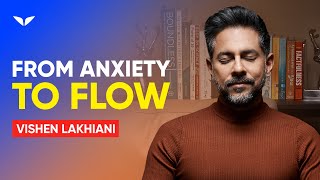
Vishen Lakhiani shares a 2016 call with his mentor Sri Kumar Rao, who read a Rumi poem about desire twice. Rao taught him the difference between 'be-do' (become who you are so what you want comes to you) and 'do-be' (do things to become something).
Chapters
So in 2016, during this moment of great stress, I received an important phone call. And it was from this man, Sri Kumar Rao. He's actually going to be one of our lecturers at Mind Valley University. But what's cool about Sri Kumar is that he is an MBA professor in America. He teaches at Cornell, at Kellogg Business School, at London Business School. But he brings in wisdom from the east into his teachings. So he called me up, he's like, vishen, I notice you've been really, really, really under a lot of stress, right? How can I serve you? And I said, and I spilled my heart out to him. I told him everything I was dealing with. And he said, wait, wait, wait, wait, wait. I want to read you a poem. And I'm like, Raoul, I don't have time to listen to poetry. Like I'm fucking drowning here. And he goes, just listen to this poem. Okay, Now I want you to listen to this poem. The beautiful thing about poetry is that great poetry is a really unique form of art. There's the scene from Bohemian Rhapsody where somebody asks Freddie Mercury, what do you the lyrics of Bohemian Rhapsody mean? And he goes, it means anything the listener wants it to mean. That is the essence of poetry. What you're about to hear is a poem by Rumi, a 13th century Afghan refugee who was fleeing the Mongol invasion. And Rumi wrote some of the most profound works of poetry in the world. This is what Rao Srikumar Rao read to me over the phone that day. When I run after what I think I want, my days are a furnace of distress and anxiety. But if I sit in my own place of patience, what I need flows to me without any pain. From this I understand that what I want also wants me, is looking for me and attracting me. There is a great secret in this for anyone who can grasp it. Let's go back to the first verse. When I run after what I think I want, what is it that you think you want? Often these are elements of the culturescape, elements of human society that have told you you need to do this. You need the garage with two cars, the two kids. You need the title on your business card. You need the bank account with 100 grand in cash. But if you sit in your own place of patience, what I need flows to me. And without any pain. Or in other words, without the kensho moment that is growth through pain. Now, when you can learn to get in this state, there's a great secret for anyone who can grasp it. Now, I didn't understand what the hell this poem was about. Because I was in a different state of mind when Sri Kumar Rao read it to me. But I want you to just reflect on that poem. So if we could just dim the lights and play some roomy reflection meditation music. I like to give our AV boys a challenge because they are so good at what they do. So I want 13th century Rumi Sufi reflection music. Now meditate on that poem. Close your eyes. Remember, each of you might interpret this in a different way. As you do, I'm going to read it out to you one more time. When I run after what I think I want, my days are a furnace of distress and anxiety. If I sit in my own place of patience, what I need flows to me and without any pain. From this I understand that what I want also wants me, is looking for me and attracting me. There is a great secret in this for anyone who can grasp it. And you may open your eyes. I didn't understand what this poem meant back then, but today I think I do. And again, as your awareness grows, you're going to see more and more and more things into the wisdom of Rumi or any other piece of inspirational poetry you read. What I understood then was that I was operating from the do be mechanism. The culturescape says do this to be this. Do the college degree to be that. Do the job promotion to be this. Do the work as the engineer or the doctor, even if it doesn't light you up to be this. It's the do be paradigm. What I realize is that you got to flip it around. What Rumi was talking about when he said, sit in my own place of patience is that what I want comes to me and I understand that what I want wants me too. That is the be do paradigm. You be and you do what I believe Rumi was saying. And again, I can't get into the mind of a 13th century Afghan poetry. So I only have to assume here. But my interpretation is that what Rumi was really saying is that what you really want wants you too. Because what you really want versus what you think you want, what you really want comes from the soul and what you really want. Because your soul is part of this larger universe. It wants you too. And so don't tune in to the rules of the world that tell you who to be or what to want or what to do. Instead, be who you really are. Listen to that soul and know that what the soul wants, the universe wants you to have. And this is when the magic happens.