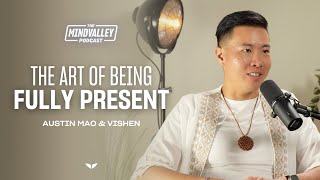
A spoken monologue by Austin Mao reflecting on presence, human connection, and distraction, prompted by a story about the Dalai Lama personally engaging hotel staff. Mao contrasts habitual phone-driven dissociation with authentic presence, introduces two modes of learning (didactic vs. transmission), and links presence work to Internal Family Systems (IFS) parts work—especially protective parts that shield vulnerable inner 'exiles'.
Chapters
What's the last thing you stroke at night and the first thing you caress in the morning? And it's your phone, right? As a couple, we're just on our phones. If you go out to a fine dining restaurant and you just look around the room, how many of us are on our phone? We're so non present. And that was me before. I was constantly addicted to my phone. I was constantly addicted to distraction. I didn't even know I wasn't present because I was dissociated. But there's something that really impacted me. It was the story of the Dalai Lama. The Dalai Lama had this five day event and at the very end of it, he asked the hotel manager to gather the hundred staff in the room because he wants to say goodbye. And they line up and each person, he's just with them in total presence. Ask them about their lives, about their day, about their dreams and their passions. From the CEO down to the waits staff. Just being completely with the human inside of each of them in that moment is that person in front of them is the most important person in the world to the Dalai Lama. I seek to emulate that in my life when I'm with people. But the interesting thing about being present with other people is that it's all about me being with you and your experience. But actually it's about me feeling myself at the same time. The impact that you have on me when you blink or when you move your legs or when you. The way that you're sitting with me right now, like the impact that you're having on me and me being able to relate that back to you and recognition of how I'm impacting you can getting curious about you, et cetera. That's real Presence in connection is presence simply a form of stillness and focus on the person that you're being present with or is there more to it? I think there's so much more to it. Something I'm very passionate about is how do we learn and how do we teach, right? And there are two kinds of learning. There's didactic, AKA from a book, from a lesson from mindvalley. And there's transmission, which is you and me sitting here and me intuitively feeling you, you intuitively feeling me. I believe both are extraordinarily valu especially the didactic to teach other people. And one of the things that I learn is from a field called internal Family Systems ifs, which is the fastest growing psychotherapeutic and psycho spiritual model. And it's all about parts. Parts work. If you've ever said. A part of me feels anger. Part of me feels sad. A part of me is confused. Well, you're kind of speaking that language. And what ifs says is that there are all these protective parts. And what they're protecting you from is future. Feeling yourself. Feeling the tender, wounded, inner child of yourself. Those buried deep down parts that ifs calls exiles. The one that has been most prominent in my life is the one that carries a burden. A voice that says I'm alone.