Ep #011 | From Refugee to Climbing Everest: 5 Lessons to Conquer Any Goal
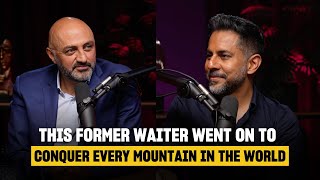
Mustafa Salameh grew up in Palestinian refugee camps before becoming a mountaineer who summited Everest in 2008 and completed the Grand Slam. He shares five principles rooted in Sufi tradition: love, passion, practice, goals, and intention. His expeditions have raised roughly $5M for humanitarian causes.
Questions this video answers
Dreams of a Refugee
2004
2008 (timed to Jordanian Independence Day)
29,028 ft
65 days (South Pole, 2016)
Chapters
Mustafa Salameh went to go from a refugee to a mountain climb. He climbed Mount Everest.
If you get lost, you're dead. Whatever happened, happened. I managed to stand in the top in Jordan, Independence Day. I prayed for peace. And then that's the dream come true.
But he didn't stop there. Mustafa went on to become one of only 20 people in the world to complete the Grand Slam.
That means he climbed the north and.
South pole in all seven summits.
2016 was the hardest things I did. Which is the South Pole, 65 days, which was the first Arab and the first Muslim to cross the Messenger Route. Everything is achievable and nothing is impossible.
What is a mountain in your life that you're seeking to conquer? Maybe it's starting a business, Maybe it's creating a new stream of income. Maybe it's building a family. All of us have mountains to conquer. But what makes Mustafa special is that he started out with the wrong cards in life. A Palestinian refugee growing up in a refugee camp is not an easy thing.
I remember I used to get this trolley and I used to go through the refugee camp and sell the suite and make maybe 5 pence or 10 pence and give my mom.
He went on to write this remarkable book, Dreams of a Refugee, which is about to be turned into a movie. And you're going to learn five principles from his fate as a Sufi, which is a mystical sect, this one that might help you in life. So welcome Mustafa.
Thank you very much. Faisan. It's lovely to be here to be with you and this amazing energy around you.
Thank you. And. And likewise. Now first tell us about the Grand Slam, because that is fascinating.
Grand Slam is, as you said, climbing all the Seven Summit and skiing the south and North Pole. And the whole idea of the. The Seven Summit or any polar adventure, I've never been in my life. I started when I was 34 years old, after I had a dream. I was in Edinburgh working for the Sheraton, working really hard. My dream is to become a general manager for a five star hotel. And that's why my dream. And if I go back a little bit, just to tell you the story, when we moved back to Jordan from Kuwait and we stayed at refugee camp, I was 18 years old. I wanted to help my dad to keep my brother and sister at school. So I start working as a waiter. And then I had the chance where I was serving a table and somebody told me, do you want to go to London? And I said, I would love to go to London. He said, you Know my brother is the Jordanian ambassador there and he wants somebody to work in his house and make coffee and clean. And this is where my ticket to England.
So you went to England as a housekeeper?
A housekeeper. You went from refugee to housekeeper in 1991. And then I stayed one year at the Ambassador resident. But then I run away and I worked in Richmond at a restaurant. I had no English whatsoever, so I used to work in the kitchen washing dishes for five years. And I've learned English by getting up at 7:00 in the morning to watch Sesame Street.
Wow, cards stacked against you. So there's a really powerful lesson here, like no matter how much you think your life sucks, imagine growing up in a refugee camp. How old were you when you got to England?
I was 20. 20. 21?
Yeah, 20. 21 years old. Going to England as a housekeeper, washing dishes for five years, not speaking English, learning English from Sesame Street. What happened next?
And then I was promoted to become a waiter again in the same restaurant where I used to wash dishes. My main objective was to help my family. So 50% of my wages, I used to work a day at night to go to my dad to keep my brother and sister at school. And then 25 I used to hide and 20 other 5% I used to spend. So after seven years I went up to Scotland because I wanted to study. So I did my degree in international hospitality and tourist management for four years and then went to the shirt.
And you paid for that yourself?
I paid all for myself by working, what, seven years? Seven years, five years in the kitchen, two years waiter. And then the idea to become a general manager for a five star hotel. I needed to have the qualification, so. And I did and I joined the Sheraton. I walked through the Sheraton until 2004, when one night in January I wake up and I had a dream. I was in the top of the world, making the AAN and praying for peace. That's how everything started. And I told my friend and everyone thought I was, you know, they said if I took anything last night, I said, no, I didn't. I'm. I'm absolutely 100. This is. I feel there is a big change come in my life and then. And this is where everything turned. So 34 years old, never stepped in a sleeping bag. I used to smoke two packets of cigarettes. The only exercise I used to do is maybe every weekend I go club in and dance for how many hours? And then that's the only things I used to do.
You were a cigarette smoker? And your only form of exercise was dancing at clubs in Edinburgh?
Absolutely.
And you somehow decided you were going to climb Everest?
Yeah, this is the dream. I woke up, I was 34, 34 years old. And I wake up 2 o' clock in the morning. I was totally sweating and I saw myself in the top of the world. I didn't know where Everest was, so I had to go on Google because I thought Everest was in America. And I found out that between Nepal and China. And then I start making more research and I thought, oh, my God, this is going to be. This is. This is not easy. And I was thinking straight away about the sponsorship, because this is very expensive. And then I start asking people, what should I do? They said, oh, contact this company in Sheffield, in England. They told me, you have to do a 5,000, 6,000, 7,008. How much is going to cost all this? Plus ever it's going to cost about $200,000. So I thought, okay, how I'm going to get the money?
So what is it that made you feel that this dream was real, rather than say, a hallucination? Because so many of us have dreams, but we don't act on them. Why were you so convinced?
Because I felt it in my heart, my soul, my mind that this is what I was destined to do. And, you know, I remember reading 1997, reading the Alchemist by Paulo Coelho. And I always believe that the treasure that I am aiming to go for is not just the stu that I am thinking, I'm dreaming. There is other stuff that is there for me. But the time is going to come and I have to be ready. And I think I was very ready for. I was ready spiritually, which is the most important things. Mentally, I wasn't ready physically, but, you know, the physical part came after that. But mentally I was very prepared.
So now you have two challenges. You got to get in shape physically, and you got to raise $200,000.
Yeah.
What did you do?
So, first of all, I wanted to get the money. So I. I tried to get in Jordan, to go in Jordan. And I. I didn't know anybody there much, you know, anybody in the government, so. And then I remember, I remember, you know, Christopher Columbus, when he tried to get some money, in the end, they have to turn to queens and kings. And in the end, Queen Isabel believed in his journey and she supported him. I thought, you have the King of Jordan. Believe in me and believe in an idea. I think I can get so far. So I start, January is my dream. And then I Went to Jordan. Nobody took me seriously. I went back Google King Abdullah, his website, what he does. I've listened to all his speeches. And then I had an idea. He read the Sunday time is to get an article at the Sunday time. So I contact this guy from the Scotsman who come to our hotel, the Fine Dino restaurant. I also always look after him. Said, listen, I had a dream. I want to climb Everest. And he said, okay, we can write an article about you. So he wrote a great article. And then he put me in touch with the Sunday Time. They put a beautiful article. It says, climbing for peace and the King of Jordan. This was in February, and then in March, I have a call from the King office saying, you know why you caught in His Majesty. Da, da, da, you need to come to Jordan. So I fly to Jordan, I sit with His Majesty's advisor, and they said, listen, you have no experience whatsoever. What we're going to do with you, we're going to give you fund for April to go to Meripeak in Nepal and train and go to Tibet in May and then go to Denali, which is the highest point in North America and Alaska. If you climb Denali, then we're going to take you seriously. If you don't climb Denali, take the money, we give you all the equipment and we never want to hear anything from you. I said, okay. So we went back, got everything, went to an outdoor shop. I have no idea what to buy. I have the big list. I give it to the guy and, you know, I said to him, just give me what the best of what I need to get. You know, the real palace paid for it Went to Nepal in April 2004 and to climb Marabique, which is 6400 meter, I didn't make it. I was at 5000 meter. I was feeling sick. Never slept in a sleeping bag. And then straight to Tibet. I had a snow blind. And then I had to come down and then to United States, to Denali. I climbed the highest point in North America.
How high is Denali?
6240.
And ever says, how, how?
8800.
8840.
Okay, so this is, was the turning point because I knew Denali was the one. So when I came back, my name in the news and stuff and you know, His Majesty office said, okay, let's.
Try and help you hit that first goal, Denali. And how long did it take you to train to get there?
I mean, I started the minute I had that dream. I stopped, you know, I stopped smoking, I stopped And I thought I had this, you know, I started doing running and I started doing to try to get fit, but, you know, I wasn't getting to that fitness level. So it took me until 2005 to go to Everest, to climb Everest, and I didn't make it. I went up to 23,000ft, which is 29,000ft is Everest. So 23,000. I had an ulcer, bleeding.
I see.
And I had to come down. I went back again in 2007, and I had the chest infection, dislocated my ribs, and I have to come down. 2008, I went back again, and then I made it to the summit of Everest in Jordan in the bending.
That's 29,028ft is how tall Everest is.
Absolutely. So from 2004 is my dream. 2008, I managed to stay stand in the top in Jordan. Independence Day. I did the Adhan. I prayed for peace. And then that's the dream come true.
And you timed it for Jordanian independence.
Yes.
Now, why Jordan? Because you were raised as a Palatinian refugee in Kuwait. What's the connection with Jordan?
I mean, you know, I, I. Jordan is my identity. Palestine is the blood that ran in my vein. And Scotland is where I always felt home because of everything that I did in Scotland. And, you know, my dream started in Scotland, and I love Scotland. That's why I take three flights. I take the Jordanian to Palestinian and the Scottish everywhere I go. This. I took it up. Yeah. So that's, you know, happened. And then I found out about something called the Seven Summit. I thought, you know, I'll climb the Seven Summit. I went for the Seven Summit. And in 2008, when I came back, I was knighted by His Majesty. And he said, what do you want to do? You know, I said, I would like to go back and do a master degree in outdoor education studies. And this is when I went back to Edinburgh again. I stayed in Edinburgh. And then the, the South North Pole idea came. I've never skied in my life, so I had to go and learn how to ski. In 2014, I skied the North Pole. 2016 was the hardest things I did, which is the South Pole, 65 days, which I was the first Arab and the first Muslim to do the. To, to cross the messenger route. And then I went to Greenland. I crossed Greenland from north to south and then gone to Iceland. And then. Yeah. And then you did the North Pole. I did, yeah.
Did you ever come close to dying?
Just four weeks ago, I was in Argentina leading an expedition. And I had what they call a mini heart attack. So I was evacuated from 6,000 meter, about 22, 500ft from Aconcagua to military hospital. And then I survived the heart attack. And, you know, I went to this trans. On, you know, going into this cloud. And, you know, I was hearing the Quran, I was hearing fat Boy Slim from the other side going right here, right now, and then saw my kids. And, you know, it was, it was. It was an experience of a death life experience. I was struggling for about an hour because I. My whole left body was completely stopped. And then I had a severe pain in my. In my chest. And then I was struggling for an hour. I couldn't find my headlamp. I broke my glasses. But in the end I just, you know, I lay down inside my sleeping bag because I was super cold. And, you know, I said, la ila Allah, Muhammad Rasulullah, this is what you do as a Muslim if you come into debt. And then I thought, you know what? I'm ready to go, it's okay. But, you know, my son came from nowhere and told me, please, Daddy didn't go, you need to buy me the messy football shoes, which he has a big game in Ireland to play for the.
Even your son actually was there or like his.
No, he's spirit. He's spirit. He spirit and I, you know, but, you know, it was really. It was really cool because it's a cool experience because, you know, I went back to where I was when I was a little boy and I. I asked my mom and dad about this, what I was wearing, because I was wearing some sort of a gear, and they said because I was too. I was too. I was too fat when I was a kid, 2 years old, so they have to put this on me. And, you know, I can remember myself going back to that, but still. So.
So your wife is sitting behind me as we film this. Do you mind if I. If I put her on camera and ask her if she thinks you're crazy?
Of course.
Did you ever think your husband was absolutely batshit crazy?
I did not. No, I didn't. I truly believed and still believe in, in all the things that he does. And I always say, you know, people ask me that he goes on mountains and how do you deal with that? And is it difficult? Of course I miss him, but I trust that he's always careful and I always want him to do what he loves. That's really important. I know that's really important for him, and that's also important for me.
That's beautiful. You've got a, you've got a wonderful family.
Thank you. Thank you.
So I want to understand what it was like growing up in as a refugee, as a Palestinian refugee. And then we're going to go on to the lessons from Sufism that has driven this incredible man to do what only 20 people ever have done.
Yeah, I think, you know, growing up as, you know, because my mom and dad was the refugee who had to leave Palestine to go to Jordan and grow out with Jordan refugee camp. And then, you know, I think the, my best memory is when we used to go to Jordan at the refugee camp where mom and dad grow up. And I used to be there in the summer, every summer. And I remember I used to get this trolley and my mom used to do what we call halawi, it's a suite. And I used to go through the refugee camp and sell the suite and make maybe 5 pence or 10 pence and give my mom 50% of it and leave the rest for me. But my dad was a lorry driver in the morning and he used to do theater in the evening. Palestinian theater. My mom was looking after, you know, 10 children. But we had this beautiful, amazing, you know, environment where, you know, education is something very important that my mom and dad put on us and, and, and that, you know, we should never give up. We should always. And you know, we, we were gonna go back to Palestine one day. So all this was there. So we were in a very small place, so, you know, two bedroom flat, my mom and dad in one and nine bunk's bed in another one and then a small room where we all sit down. And I think this is, gave me something that, you know, I was in this small place and I wanted, I always wanted to, to go into the, to do something bigger. This is where this idea came first. And I was really interested in reading especially all up scholars like Razi Ibn Sina Al Arabi. I'm talking about the 11th century and also the golden age of, of Arab and Islam in Baghdad. So this has affected me like Ibn Battuta and how we travel the whole world. So growing up it was great. We had, you know, we had very little but you know, we had my mom and dad. There was so much love. And I think this is what shaped my personality then and made me believe that everything is possible.
Does it anger you how refugees are portrayed in the world today?
100. 100.
What do you think are the biggest misconceptions?
I think the biggest misconception that everyone think the refugee gonna come here to take your money and your. Your, you know, your job. And they're not. They. There is no refugee has left their country because they want to. I mean, they. There because there is fear, there is war, and they had to leave the country. But most of the refugee I met and I know, they all did an absolutely amazing stuff. They made amazing change of the world. I mean, look, Steven Jobs, he's a Syrian refugee and he made a massive change. There is so many refugees that I know. So it's not, you know, I think people think especially now and maybe since the war, after the Iraqi war and the Syrian war, that these people come in to take your job. But they made an amazing.
These are doctors, lawyers, engineers. You know, the very first version of the Mind Valley app was created by two Syrian refugees.
Oh, wow. Amazing. Amazing. No, I think, you know, I think we all refugees, I mean, everyone is refugee. I'm, you know, if I can tell you that we, you know, refugees, the biggest things that we should not give up on our dream. We should not give up in anything. Because this is how you grow up. You grow up that you want a good start, Education, you wanted to do something in your life. So, you know this word. You know, I talk about my mom and dad on this book as a refugee, but, you know, I'm a refugee of the world. I went to, from Jordan to. I lived in Scotland and first in London and Scotland, but I never felt as a refugee. I felt that I belong there. I belong with the people. I understand the culture, the religion, and I fit myself into it. But I kept my identity alive. I kept my what I believe in as a Muslim, as an Arab, alive. But in the same time, I accepted absolutely everyone that I didn't want to. You know, there is a beautiful quote and a great scholar, Khalil Ghazali. I'm going to say it in Arabic first and then I translate in English. He said that what he's saying that, you know, if you. If we go to God because we are fearing from that God and we go there because there's something behind us telling us you have to go there or something bad is going to happen, then you shouldn't. You have to go to God with passion. And God have everyone. It doesn't matter where you're from, if a Muslim, a Christian, a Jew, Buddhist, Hindus, whatever you are, God is for everyone. So what I believe should be for me. I have to believe it in my heart. And this is things I've learned from, you know, Sufism, this is things I've learned through my spiritual journey. Because when I hit the mountain for the first time, I didn't see the mountain with their high altitude, with their battlefield, with all these difficulty, I've treated the mountain as the house of religion, a house of God. I went there to seek refuge. I went there with so much respect. I went there because I know I'm nothing compared to this big mountain. I went there to conquer myself, not to conquer this mountain. I think this is what helped me to have that comfortable being in the mountain and be ease with this high altitude there.
Sufism is a big part of your belief system. And I'm interested in belief systems because you obviously have a very unique belief system to pull off what you did despite your circumstances. Right. So first, what is Sufism?
Sufism is that you. And I've learned this from my sheikh, my Murid. And you know, here is life and there is two type of people. There is people who follow afterlife and you know, they take this and take this and take so much stuff and they walk heavy so much stuff and they don't know where they go and there is no focus. And there is other people whose life behind them, through life trying to catch them. So they have one single things. They take it, they focus 100% on it. They take it in. And then there is one thing, a verse from the Quran. It says bismillahirrahman Rahim in Allah. It means that God does not change the condition in you until you change it. So any change that I want to make in anything in life, I have to start with myself. So when I get into Sufism, 32 years old in India and I couldn't recite the Quran properly and I met this Sufi teacher who said, you need to learn the Quran first. That's the first things you do. I went back to Jordan. I found a Sufi sheikh who taught me the Quran. For two years. I was able to read the Quran, I'm able to understand it, right? So this is one second thing is the intention, which is you know, everything that you do. If there is a good intention in your heart, everything will go so smoothly. If there is something there is not right and your intention is not a good intention, I don't think you're going to go too far. So for me, Sufism is one thing is to be myself, but also to have the knowledge. And the knowledge for me come from the Quran and then come from my shaykh.
So how is Sufism different from regular Islam?
Well, I think. I think Islam itself Like if you, if you go back to Islam, there is a very important things in the Quran. If you want to talk to God, you want to pray, if you want God to talk to you, you read the Quran. Yeah. So any Muslim does this. It doesn't matter if you're a Sufi, if you're Wahhabi, if you're a Sunni, if you are Shia or whatever, we all under that. But you need to under instan the Quran mentally and accept everything around you, then this is what we call Sufi. But if you go on and try to change everything because you believe is different than anybody else, this is where we go wrong. But yeah, I think it's a mystic way.
It's a mystic way.
It's a mystic way. So you see the fruit of everything, right? And then the change that you make, you don't make it outside yourself, you make it within yourself. Because that's the most difficult part. It's easy to change, it's easy to tell people what to do.
So I'm curious from a philosophical viewpoint.
Yeah.
What are the five lessons that our audience here can learn from Sufi tradition to help them conquer whatever mountain in life they want to conquer?
The first things is love. So that you love everything that you do. And you know, it has to start with yourself, which is loving yourself. So the love of God for me is getting up at five o' clock in the morning. I do my meditation, a spiritual meditation that I do it in the morning. And this is something that the first things that I do in the morning that will give me that calm and peace within myself. To be able to love anything that you do, you have to love yourself first, which is you love everything that you do and these things that you do, it has to be something that is good not just for yourself, for everyone around you, for everyone that in touch with you. So this is something that, you know, through my climb and now through everything that I did when I started, started that I didn't know anything about mountaineering, but I fell in love with the mountain, I fall in love with the mountaineer. And then I start doing stuff. In the beginning I did it to go and take a flag, to become the first. And then I've used that mountain, or the love of this mountain to do lots of good things.
So let me ask you a question. I noticed when you were talking about visiting the refugee camp, you mentioned that again you mentioned that you were, you were pushing this cart selling halawi.
Yes.
And you loved it.
Yes.
Now, that isn't typically what most People would associate. They would associate that with a child in the hot sun trying to earn a few bucks. But you mentioned the word love. Now, I'm curious. When you were washing dishes for five years, did you love your life and your job?
Absolutely. I loved it because I was learning, you know, this is. I knew this is. Was a step for something big, and I have to love it. For me, it was. This is the situation. This is where I am now. I know I'm gonna stay here for a while until I learn how to speak English. I used to get up every day to watch Sesame street so I can learn 10 words and three sentences and practice in it every day. But I loved going to work because I know I was earning this money to help my family and go to university. So everything that I've been doing in my life, I would love it. And I will give everything. I will give myself into it.
You fell in love with every. With your life itself, with everything you were doing, not just loving yourself, but whether you were pushing a halawi cart in a refugee camp, whether you were washing dishes and learning English from Sesame street, whether you were climbing mountains, whether you are waking up at 5am to pray. You love that approach. That's a really beautiful lesson.
Absolutely.
I was a dishwasher. When I moved from Malaysia to the United States, I found I could earn US$6 an hour washing dishes. There was nothing for America, but to Malaysia, that was a lot. So I was washing dishes at the cafeteria at my university. And I wouldn't say I loved it. I wasn't as wise as you, but I love the feeling of being able to earn money in an hour. That would take me maybe an entire day in Malaysia.
Yeah.
Now, let's go on to the second idea.
Second for me is passion. So you have to be passionate. I mean, you know, with Sufism, passion is a big thing.
How is this idea of passion different from the first idea of love?
Well, love is, you know, when you go into loving something. For me, passion is different because when you're passionate about something, you're going to learn. You have to have the knowledge for it. You have to have everything, so you have to read about everything to understand it. You have to get. You know, for me, the knowledge was everything about Mountaineer, and I have to understand everything that I do so I can be passionate about. So if I put it this way for you, when I went to the South Pole, I looked at everything negative, right? And then I've learned to turn all the negative to positive. So when I was in the south pole for 60 days. Anything that faced me, I knew exactly how to turn it. But I didn't look at it as negative because I knew now how positive it is and how I can turn it.
So you're talking about passion in the sense of mastery.
Yes.
Becoming so passionate about climbing a mountain or skiing the South Pole that you seek to become a master.
Absolutely. That's exactly. And you know what? There is a beautiful quote by Razi, it's a great Arab scholar, and he said the birth of the brilliance. And when you find your passion, the minute you find what you really passionate about, then because love is something that you feel, passion is something that you learn to feel and learn how to love. And passion is something that you start having the knowledge for it. I needed to know exactly what is high altitude, what my body, how my body react. Okay. I need to go and do some course that I understand the body.
I see what you're saying. It's a passion to learn. It's a passion that leads to a curiosity.
Absolutely. Learning. Learning is the most. You know, I do want to be speaking about something that I did not practice. And I want to go there and tell you about this. That dreams come true because I practice it. That everything you can imagine is real. Because if you practice it, you love it, you're passionate about, then why not be able to do it? Like what will be reason not to do it?
I love that idea. Let's go on to the third idea.
Third is the practice. So everything that we do, we have to start with ourselves. We have to practice ourselves. And I mentioned earlier this beautiful verse of the Quran that I always follow, that God does not change what's in you until you want to change it in anywhere you go in the world. Doesn't matter what the culture, what the religion, what it's. You have to make that change. So and how you're going to make the change is to practice is to be disciplined. You have to discipline yourself. And I think discipline is a massive word that I always. Everything I wanted to do and follow, I always put to myself a red line that I cannot cross. And I have to be disciplined to be able to do it. Then discipline come from practice and might be difficult in the beginning because change for people is always the most difficult things. And you know, for me, I think taking decision to change, but that decision have to have discipline and practice and passion and love. Everything that we talked about that will get you to where you are beautiful number four. And I'll tell everyone has an Everest in their life. And Everest can be absolutely anything in life. It could be your education, can be your work, can be your family, it can be anything. But you can deal with it as a mountain. Now, why would I say that? Is that every time I do something, I feel that I'm climbing a mountain. And I know when I climb a mountain, I have to have some basic things that I need to learn, basic things that I have to have within me. And there is always going to be that sacrifice. But I have to find my goal, I have to find my dream. So anything you do in life, if you don't have something that you see a little bit too further, like not here, close to you, you need to see where you're going. And I think in Sufism, the visualization, when you visualize things, this is where, you know, I can sit, I can do my meditation like Rumi did, like Shamsi Tabrizi did. They did all the visualization. And then Tabrizi met Rumi and Konya and before they met in person, because he visualized it. And I think I visualize everything. So in my life, I have. Every time I do something, for me, it's an Everest. It's not just a mountain, but it's a goal that I put myself. So I always have to have a goal or a dream in front of me for me, able to go through all the process and all the practice that I do to achieve it.
Beautiful. I love what you said. What you're essentially saying is create mini Everest. Mini Everest. Lots of little mountains, goals that you want to accomplish in life, and let these goals be. Be a map to help you navigate life.
Absolutely.
And the final idea?
The final idea is the intention, which is what is your intention by doing any idea you have, any dream, any goal, what is the intention behind it? If this intention is to make a difference to your community, to your people, to the world, then I guess it's always is going to take you so far. Because the good intention, if it's. It's not all about me. It's not, you know, I don't do everything that I do. Everything I do, every time I do it, I do it for somebody else, which is, you know, refugee people in refugee camps, children. For me, I published two children book. I have another five children book coming just to tell children about all over the world that nothing is impossible, that you can achieve your dream. I have the story and especially in the Middle East. When I wrote the children book, it was all about teaching the people to respect Other religion in Everest story. Dare to dream. I was climbing with the Buddhist. His name is Lakba. We were sitting in 23,000ft and 26,000ft in the same tent. He used to pray to the goddess of the mountain, which is just there. And I used to pray for God. And we both were there in this room. And we have one single goal which is to climb that mountain and go. He had the respect. I have to have the respect. He go into this monastery, beautiful monastery. I go inside the monastery and I enjoy it and I take everything they want to give me, all the energy, all, everything that they have and I'll keep what I believe because that's also something that it's giving me a power to go and climb that mountain. So the Goddess of the mountain, this is how I feel. I feel, you know, God is everywhere and I believe the both. But I go with him and we pray together and we accept. So acceptance as well from the intention is the acceptance that you have to accept everything around you that you shouldn't have any wall, you shouldn't, your belief should not affect your. How you look at life.
You're talking essentially about living from intention, having the intention for how you want your day to unfold, the intention for what mountain you want to climb. And even if there's turmoil around you, staying true for that intention.
Absolutely.
Mustafa, thank you so much for this, this beautiful interview. Again, the book is called Dreams of a Refugee. Please go check it out. And I want to say something else which I found very, very, very impressive. Mustafa has helped raise $5 million for charity and he has started numerous charities initiatives. Climb for Quran. I can see. Climb for children of Gaza. See no limits, lowest to highest for cancer. All of these are charitable institutions that you've helped raise millions of dollars for because you are a man with an incredible heart.
So thank you.
Thank you for being who you are, for being a freaking real life Indiana Jones explorer, climbing the seven peaks, skiing in the north and the South Pole. And you've been an inspiration for many.
Thank you. Thank you very much. It's really been lovely chatting to you.
From one former dishwasher to another dishwasher. I'm proud of you.
Thank you so much. Thank you.
I hope you enjoyed this episode of the Mindvalley podcast. I will see you on our next episode with our next inspiring guest. Please leave a comment, share in YouTube or in whatever app you're. You're watching this Share what you learned, what were your key insights and if you have any compliments or, or words of kindness that you'd like to share with Mustafa. Please leave it in the comments. I'm sure he'll enjoy reading that. Thank you all.
More from Vishen




Brown Noise for Deep Focus and Concentration (Best with Headphones) | Gabriel Loynaz



Your Appointment With the Eternal | Guided Meditation with Michael Bernard Beckwith

