Ep #032 | Saba Yussouf: The Scientist Revolutionizing Climate Change Solutions
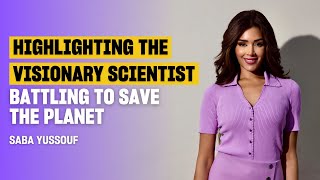
Saba Yussouf, a biotech founder, describes InvisiSmart, an invisible spray coating that uses reactive oxygen species to destroy greenhouse gases and air pollutants. She claims it could decarbonize environments by up to 50% if applied to 20% of the world's surfaces, and says we have five years to avoid irreparable climate damage.
Chapters
And when I told people in my industry that we're going public, they said, oh, congratulations, that's great. And when you go public, then you can put a proper CEO in there so he can run the company. If we're not going to get the feedback and the response we need, how are we going to be motivated to do more?
Welcome to another episode of our new Mindvalley podcast. So today we're going to be talking to Saba Yusov. In a whirlwind span of just two years, Saba built a staggering $60 million biotech business that looks firmly to the horizon of infection prevention. Recognized globally as a visionary futurist, Saba's investment portfolio isn't just impressive in its value, but in its vision.
Be who you are, forget what anyone thinks. You will be successful in whatever the hell you want to do. Thank you very much.
Championing technologies that promise a brighter future for humanity by investing in sustainability, science, education and health. She's worked with Aramco, ufc, the Hard Rock Group, sovereign wealth funds, the nhs, University of Cambridge, American Express and more. So welcome to the podcast, Saba Youssof.
Thank you for having me.
So, Saba, firstly, firstly, tell us, tell us about where you are right now. You moved to Dubai.
Yes. So, born and raised in London. I'm actually third generation British, so my parents were also raised in London. And a few years ago we made the decision to shift to Dubai.
Why Dubai?
I'll tell you. I've been spending a lot of time in and out of Dubai and I notice a difference. When I return to London, I feel a low vibration, I feel a low energy. When I'm at work, before work, after work, I feel when I speak, people don't get me, people don't want to understand me. She's a woman. Why is she not married? Why is she always talking about work? Why is she obsessed with science? I just felt not accepted in London. And anytime in Dubai, people get me, they celebrate me, they encourage me, they want to do stuff, we do stuff together. And it's like this.
What is that thing about Dubai? Because I'm here in Dubai and I've never experienced this level of energy. There's so much excitement, creativity. People are open to possibilities. What is that?
Because I think if you're not open to possibilities, you don't move to a new country, in a new region, a relatively new place. It's been built in the last 40 years. You either have that in you or you don't. You either stay in your. Your hometown and you don't want to explore those opportunities because you're happy in your lane. So if you notice the people that you meet in Dubai, they're from all walks of life, also share economic backgrounds, but they're all here for one thing, to do something with their life.
So what we're talking about right now actually leads perfectly into this conversation because we're going to talk about your technologies, we're going to talk about what you're accomplishing as an investor. But I think a really key part about your story is defying the odds, right? Because you have had the odds stacked against you in some ways, but you've defied those odds culturally in terms of gender stereotypes to become who you are today. So first, let's talk about why did you become an inventor?
So it's an interesting question. My parents got divorced when I was very young. I was 13 years old, and I didn't enjoy being in the house. It was a very tumultuous divorce. It took many years. So what I would do, because back then we didn't have Google, I would just hide in the library and I would just start reading. I would check out books. I would spend hours there because I just didn't want to go home. It was just too much of an unhappy environment. So I started reading and I started reading about Nikola Tesla, all these amazing inventors. I started learning what is E equals MC squared. And my fascination with science began then, around the age of 13. And then my personality is such that things have to make sense to me. Otherwise I feel a bit uneasy. I can't sleep at night, if things. So I was reading about all these amazing inventions, and then I couldn't understand why we weren't using these inventions, science and technology to help our planet. That was in severe decline. And this is over 10 years ago, we noticed that it has started declining. So I thought, I need to match these two up. How am I going to do this? And the thought just stayed with me for many years. And when I had the opportunity to be able to start my own company, this is the first thing I focused on.
So you asked me a question that blew my mind. It had something to do with the hydrogen bomb.
Yes. So you're familiar with the Hiroshima bomb, of which the effects we are still suffering today. The planet's still suffering. So when Hiroshima dropped, it released 63 trillion joules of energy. Now the Earth, as you know, is heating up. You probably read about it, you hear in the news, but we don't really know the extent. So how do we quantify the extent. I'll tell you. I'll pose your question. So Vishen, tell me, how many the equivalent of Hiroshima bombs do you think are being dropped a year?
A year? Okay, take a while.
Guess.
The Hiroshima bomb, 1945. That was in Japan.
Yes. 63 trillion joules of energy was released with that bomb.
Wow. So 63 trillion joules of energy. Explain that viscerally.
So that could possibly power a city of about a million residents for a month.
So you're asking me how many of those bombs are exploding the equivalent per year? I would say maybe 10,000.
Sure. The answer is five Hiroshima bombs a second. And next year is going up to six a second. That is how fast the world is heating up. And nobody notices, Nobody's talking about it, besides a few of us. And thank you for allowing me to share the message today. You know that movie Don't look up on Netflix with Liam?
Right.
So the metaphor was a meteor and it's traveling towards us and we're all going to die. People talk about net zero by 2050. Guys, we have five years left. It's not 2050. We have five years left. Until we reach a point of irreparable damage, we cannot move back. Because what happens is we know the planet's heating up, okay? And we hear about it in the news and then we get on with our life. Because the ramifications of the planet heating up are not really explain to us. So I'll tell you. You sweat, right? And you notice that you sweat. We sweat because that is our mechanism to stay alive. So at some point in five years time, our bodies are going to become too hot. We will get to a point where we can no longer sweat. What happens when humans can't sweat? They die.
But wouldn't that just be fixed by people moving from warmer climate to colder climate?
So an unexpected ramification of the Earth heating up is the refugee crisis. People and communities are already leaving their hometowns because they cannot survive the weather conditions. In five years, where are we all going to congregate? This is why Elon is trying to take people to Mars. I truly do understand the logic behind his wish. But if there's a way we can stay here and actually use the power of Mother Nature to help our planet and undo all the crap that the humans have polluted the planet with. We have the capability using the Earth's minerals, ambient air to reverse all of this harm that us humans have done.
Okay, so what you're saying is that we are basically going to destroy ourselves as a Species. But there is a way to avert that. Let's talk about that.
Yes, there are many amazing technologies out there that use minerals, air ingredients that are ubiquitous. They're not expensive, they're not hard to procure. Let's take that and actually heal the planet through these technologies.
An example, and let's start with your invention.
Yeah, yeah, sure. So we're about to launch our latest invention, which is an invisible coating. You can spray it on your outfit, this table, in your car, your home, airplane, a mall, whatever. What it does is there will be these invisible reacting oxygen species on top of the surface that you sprayed, and they go around in a circle like this. What they do is they just bind to carbon, greenhouse gases, NOx, SOx, methane, and they destroy it. The byproduct is negligible gas and water vapor. That's it. So it's sustainable from A to Z. And it's using Earth's minerals that we've manipulated to stick onto your outfit, to stick onto the table.
What mineral in particular?
Titania, which you find in sunscreen, chocolate, food, food coloring. It's in everything. But we've manipulated it in a way that it can last on a surface and actually do something helpful.
And so you're saying that if people were spraying this spray in their home, on their cars, on their outfits, the spray itself would organically be cleaning the atmosphere. Decarbonizing the atmosphere, exactly.
And we can decarbonize the atmosphere by up to 50% a year.
50% per year?
Yes. We have three years of data on.
Would one need to do that?
Well, well, this is our calculation. If we have to spray 20% of the world, which is, you know, my starting goal, I want to get to 100, then we can reduce the carbon in that environment by 50%. And that is a huge delta that we will benefit from. And also, it's about air pollution. You know, you are probably so careful about what you eat, and you want to eat the best nutrition and antioxidants. You care about what you're putting into your mouth. You take about 20,000 breaths of air a day. If you knew what was in the air you were breathing, you would close your mouth.
So you're saying the side effect of the spray is we are cleaning the air in our homes?
Yes, we're cleaning the air that we breathe. Our lungs are healthier. Our physiology will be healthier. Your cognitive function is better. I mean, that's just the byproduct.
What about cities which are going through massive pollution right now? Right, Like Delhi Would this help in those cities?
Completely, totally. In fact, the more pollution there is in the environment, it actually acts as a catalyst for our coating. So it performs better when the air is dirtier.
Okay, so let's talk about smog. So if, because I grew up in a city with really dirty air, Kuala Lumpur, places like Delhi have horrendous air. So if this was sprayed in an apartment in Delhi, what would happen? Would the air in that apartment be cleansed? Like you have an air purifier and what's the byproduct?
So air purifiers and air filters I recommend everyone to keep in their homes and buildings and offices. But our technology is a bit more powerful. I'll tell you why. It will really attract to the smog and destroy, just completely destroys the molecule. And this has been proven by University of Cambridge UCL Kingsley University. My product is universally bioactive. What that means that it will kill anything that it binds to. So it will decrease the smog. You will notice the difference in the quality of the air, the quality of your breath, and of course the greenhouse gases will be gone.
Is there a byproduct? You mentioned that for that, for carbon. That for carbon is a decarbonizer environment. The byproduct is water vapor. What about for smog?
It's all the same byproduct because the mechanism, mechanism is the same on whatever.
How long does the spray last?
A year. Proven by university trials. And actually our professor, one of the professors on our board who performed the trial, he was so impressed with the results, he submitted my test data to the Wellcome Trust. And we have now peer reviewed public medical journals on my technology.
That's amazing. Where can somebody learn about this technology?
It's all on our website. It's on social media. Invisismart.com invisismart.com awesome.
That's the name of the product. Yes. He smart.
Okay.
So that, that's amazing. And I definitely want people to check that out. What I wanted to share with you was how dire a situation we're in in terms of global warming, but also that there is hope. And they're incredible inventors who are doing great work, but they are not getting attention. I mean, COP27 gets a lot of attention, but technologies like yours and other tech that's emerging deserves that attention too.
Yes.
So I think when it comes to global warming, while I have supreme respect for Greta Thunberg and what she's done, we also need to be paying attention and giving media coverage to inventors. And that's why I wanted to get you on this podcast.
Yes.
Now, that said, let's take this in a different direction. What were some of the biggest challenges that you had to face? Getting here, getting to this level where you've created this crazy technology and might be taking it public.
How much time do you have? Well, you know, growing up, I am of Pakistani descent, and it was tough because it actually started in my own home, in my own environment, in my community. Men, women, old, young, they just didn't understand why I wanted to make an impact in this world. So when I first started working, people would say, oh, but you know, Sabs, what people call me, but you're pretty. You don't need to work, you just need to marry. Well, that was it. And when you keep have to answering these questions, you just don't feel like hanging out with these people anymore. So you naturally distance yourself from people that are not on the same wavelength as you. But then my problems, my challenges, they expanded to my industry. And I had so much verbal sexual harassment when I was growing up. And it got to a point where I stopped wearing makeup. I would tie my hair in a bun. I would wear baggy clothes because I didn't even want to be noticed. I thought, if people don't notice me, I can let my work speak for myself. I was at Ernest and Young after I graduated. I was just a kid. I was 21.
Verbal sexual harassment.
Yes, Yes. I mean, I can give you examples, but I was young, I was naive. I didn't understand what was going on. So I started on the international tax desk at EY and I worked really hard, and I was really into it. And I thought that my boss was happy that I was working so hard and he was noticing, and he took me to a client meeting. We left and he said, great, great work. He fell for it. And I said, what do you mean? He said, the client. He fell for it. The only reason I brought you to the meeting is because you look good. And I needed him to sign a check, and I burst out crying. I was. I was 21. I was young. I was. I didn't understand. I just burst out crying. And I thought, what is? This can't be the world that I'm living in, surely. But actually it is, and we still live in it. And I'm still, till today, faced with so many challenges that, oh, you must not be that good because you don't fit the profile that we are conditioned to want. And when I told people in my industry that we're going public in 12 to 18 months. They said, well, congratulations, that's great. And when you go public, then you can put a proper CEO in there so he can run the company. So there's two problems I had with that, because apparently I'm not a proper CEO, even though I've been a CEO for 10 years. And they immediately went to he, not she or they or whoever. It's our conditioning. And I no longer take it personally. All I do is I try to shed light on what's going on because I know that there are other women facing the problems that I'm facing. And there needs to be a voice, there needs to be a few role models that are helping other women go through this because it's really tough.
What would be your advice to other women and to men so we can help in some way remedy this problem?
I think for women, it's important to understand who you are. It sounds so easy, but it's really difficult for us sometimes. Be yourself. Don't change because you feel that someone is trying to put you in a box at work. Just be yourself and have trust that it will figure out. Let your work speak for you. Let your voice speak for you. Don't feel pressure to change, because that is pressure I've had for 10 years and I've only just come out of it. Now I finally feel I can be myself. Be yourself and. And you will get where you want to. Don't have fear. That's what I would say. Just be fearless. Focus on the goal that you want, then work backwards to achieve that goal. Don't get distracted by all the nonsense that you probably are feeling every single day, because I still feel it. And for men, I think, you know, just embrace what's going on. I told you the other day I was speaking on a women's panel, and I was last in line to speak, and so three women spoke before me and they said, you know, men, this. Men are so crap. Men are rubbish. They did this to me. They were just men bashing the whole time. And I finally had my chance to speak and I said, listen, woman, what's going on? Why is this called a women's panel? I was saying, I said this should just be called panel because by saying women's panel, you are creating a separation. You are creating a separation that you're accusing the men of creating. There should be men on the panel. Where are the men? Let's discuss together, let's talk. Let's actually highlight issues and hear from the men as well. And I Wasn't invited to speak on the panel again.
And so. So that. That's. That's intriguing. Mindy's audience is 60 women.
Okay, nice.
And it tends to be women founders, women CEOs, extremely high level women. And we hear these stories all the time.
Really.
Which is why you sharing this is so. Is so. Is so important for our audience. Now, in addition to those gender stereotypes, I bet you also face other stereotypes and barriers. Being South Asian. I'm South Asian as well. And I've experienced that in some parts of the world. And I cannot imagine what it must be for you, being a South Asian Muslim woman. Those are all three things, like, together. What. What did you experience from that perspective?
I think it was even harder than if I were Caucasian. And because there are so many stereotypes that we have to deal with. I'm over 30. I'm 34. And the fact that I'm not married and I don't have kids, it's just unacceptable. People in my community can't fathom it.
And is that. Is that when you say your community, do you mean.
I know you're Punjabi, Pakistani community, Punjabi Indian, South Asian community. They just can't fathom it. So they think that is wrong. She is wrong. And let's not help, let's not support her. That. That's the mentality. And it's a shame, because if growing up I had more support, I probably would have been able to be a bit more productive. Instead of people in my community trying to tear me down and control me, if they had helped me, I probably wouldn't have. Would have been able to do even better. And I mean, there are so many things. I was in a meeting with one of the banks that we are using for our IPO as the underwriter. And I spoke to him, and he was South Asian. He said, so lovely. And so you're not married? And I said, no. And he said, you don't have kids and when are you getting married? And I thought, why are you asking me these questions? Do you ask men these questions? I don't think so. And then, you know, he said, I really think you should just settle down and give your father some grandkids. And I said, thank you so much for your advice. We will not be working together. Because I had to just tell him to F off. Because what. What is this? Why do you ask such personal questions in a meeting? That has nothing to do with my background.
You're right. That.
Would he have asked you that question?
No.
No. I mean, I get this probably every Two days.
Every two days.
It used to be every day. Now it's every two days. Yep.
Well, so kudos to you for being able to overcome those odds and still launch invisismart, which I'm hoping goes as far as it goes and is as effective as you say it is, because the world needs that type of product. The world needs that type of solution.
You know, it does. And actually, something interesting is that we try to register our product with the carbon registry, such as gold standard and vera. And what that is is that they will give you the stamp of approval. And yes, we agree that your technology is reducing carbon by a million tons a year. Here are a million carbon credits. And you must have heard about the carbon credit industry. So you plant trees, you get carbon credits. You use solar energy, the company gets carbon credits. So I spoke to the registry and I said, give me some carbon credits for all this so I can pass that profit on to charity or something, do something with it. And he said, yeah, you know, actually, your technology is new, so this is going to take four years. And it really pisses me off because I'm trying to innovate, I'm trying to help the world. And it's going to take four years for you to recognize that something is not adding up here. This is right.
And the world has five years, five years before we hit irreversible climate change. Yeah.
So it doesn't make sense. There needs to be more investment, more people to be able to quantify what is going on, because then it will actually inspire more inventors, more entrepreneurs to help the environment. If we're not going to get the feedback and the response we need, how are we going to be motivated to do more? Like you said, there are so many inventors around the world, and I spent a lot of my twenties following them around the world on secret 007 missions, trying to find them and source them and invest in their technology because they were not given a chance. We need to give inventors more of a chance. And that's what I'm trying to do. I'm trying to invest in technologies that perhaps are forgotten and unheard by VC funds and big private equity because there are so many amazing technologies out there that are not given the funds. So I need to close that gap between the startups, even napkin ideas I invest in.
How does one become an inventor?
Well, I studied economics. I didn't even study science for my undergrad. I am doing my PhD in molecular science next year. I'm starting heavily. But one thing I learned When I was in that library, when my parents were getting divorced and I wanted to escape the house, what I learned is that education is free. You can be anything you want. Just read. Now we have the Internet. Read up. Read what fuels your passion. Read how to invent things. Everything is there. And then if you really want to be invented, take the tools that you're given and make it happen. You don't need a big fancy lab. You don't just use. Use your brain and use your laws. I have invested in people that have invented things in their basement. You know, with no tools. If you have the idea, reach out to me, reach out to people that want to help.
How can people reach out to you?
Well, you can email me@sabainvizismart.com because I want to meet these people. And it doesn't just have to be for inventors, people that have scalable businesses, people that are increasing the health equity of our population, making a difference in some way. If you have the opportunity, amazing. If you don't, let's talk and let's see how we can structure this. Let's get your technology out there, because these people do not have the chance that others do. And it's not fair.
That's beautiful. Now what can we do to support you and your mission? Like, if you were to make a great. Ask of the people watching this, I.
Would say, if you wouldn't mind, Maybe just take 30 seconds to look up at your carbon footprint. For example, when you open a webpage, you don't think, but that releases 6 grams of carbon because of the energy it took to open that page. If you could just look up 30 seconds of your day, look up what is your carbon footprint and how can you mitigate it? Make the smallest, tiniest changes and it will change the world. We all together can contribute to evolution together and we can do it for free. It doesn't have to cost us anything. Time, resources, just make tiny changes. Let's contribute to evolution together and let's save our planet. Because we only have five years.
Thank you.
Thank you for having me.
Thank you. You know, the final question I wanted to ask you is you mentioned that we are kind of living the life right now like that movie don't look up.
Yes.
Right. We are facing. We're facing an imminent threat that we're not talking about it.
Yep.
Explain to us the severity of that and how can we be more aware? What. What do we need to be aware of?
So the main problem is that the Earth is heating up too quickly. We need to slow that down and mitigate it. It's nice that cop has these conferences that take 600 jets to fly in to attend the conference. But if you can just focus on heating. What does heating mean? We're not typically told. Heating means that communities are just being wiped out. Wildlife is being wiped out. In the past 40 years, take a guess, what percentage of wildlife do you think have declined?
98%.
Yes. And this is, if this was happening to humans, I think people would be talking about it. Right, because you know what, it's going to be happening to humans very, very soon. So my, my advice would be, is just to be mindful. You're mindful what you eat, you're mindful with who you hang out with, you're mindful of, of how well you want to sleep that night. Just try to be mindful of what is going on and try to collectively talk about it. Tell your friends, tell your families, let's talk about it and let's stand together and contribute to evolution in a positive way, not a negative way. It doesn't have to be. You know, people ask me, oh, but you're not an environmentalist, you're not some tree hugging hippie. I said no, you don't have to be to care about the environment. Be whoever the hell you want, but care about the resources you are taking from every day. How about we give back so that our kids, kids can still be around? That's all. It's a really small ask and if we all just do 1%, that is a lot.
Beautiful. Thank you, Saba.
Thank you.
So that's Saba Yusuf. Go check her out on instagram and on LinkedIn and check out her website, invisismart.com and you can email her directly saba@envisismart and sabarzfeld.s A, B A. Thank you.
Thank you, Vishnu.
More from Vishen




Brown Noise for Deep Focus and Concentration (Best with Headphones) | Gabriel Loynaz



Your Appointment With the Eternal | Guided Meditation with Michael Bernard Beckwith

