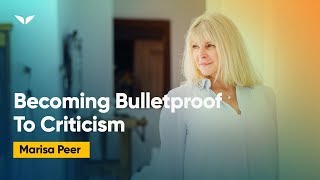
Marisa Peer breaks criticism into three types: self-criticism, destructive criticism from others, and constructive feedback. Replace your inner critic with a supportive voice, dismiss destructive comments with a brief response, and use constructive feedback to improve.
Chapters
It's okay to make mistakes because you learn. It's okay for someone to point out your mistake because then you get better. What's not okay is to beat yourself up. So criticism really comes in three different formats. There's the very destructive negative criticism, and then there's constructive criticism, and then there's the worst one of all, which is you being a critic to yourself. And just as there are three ways of creating criticism coming at you, there are three ways of dealing with it. Let's start with self criticism. That is the worst one. The voice in your head that says, you can't do that. You'll mess it up. You'll never get it right. You're just not good at that. I want you to change that voice to a cheerleader, a parent who dotes on you, a teacher who thinks you are the best thing in the world. And I want you to hear that voice saying, yay, you can do it. You're amazing. This is your area of excellence. You're good at this. You know, if you were a kid running a race at school, you'd want your parent to be there going, come on, come on, you're brilliant. You're amazing. If you were doing an assignment at school, you want the teacher or your parent to go, you're very smart. You're really good at writing. This is your skill set. So I want you to become a loving parent to yourself, a praising teacher, a cheerleader that always goes, yes, you can do this. This is easy for you. This is a walk in the park. Or you have the skills, the talent, you've read that book, you know the answers, you've studied. So that's how you stop being your own worst critic. Flip it over. And if you're saying, I always mess it up, start to go, I get it right? I always forget things. I've got a great memory. That's the most important one. The second one is when you're dealing with a critic who says, oh, I don't know why you ever volunteered to speak. You were so wooden, it's an insult to wood. And now you have to choose to not let that in. Critical people, I promise you, have the most criticism reserved for themselves. Critical people reflect out to you that they're very unhappy with them, and you have to choose to not let it in. So when someone says, oh, that speech you gave was awful, you just go, thanks for sharing. It was my first time. I was learning. I actually really enjoyed it. And they're going to get better and better, so don't get defensive and go, how dare you say that you've hurt me. Just go. Thanks for sharing that there was room for improvement and I'm getting better. If they say really mean things, remember they're having a bad day. Don't let it in. Now let's go to constructive criticism. When your boss says, look, you're really, really good on your own, but you just don't seem to have people skills, or you're really good at sales, but actually you're terrible at presenting, look for the complement in there and decide that you will learn. You know when people give you constructive criticism? When I teach, I say to people, tell me how I can improve. When people read my books, what did you like the most? What did you like the least? I want constructive criticism. It helps me grow. All businesses want feedback, including negative feedback, because that's how you grow. So if your boss or your partner pulls you up and says, I was really disappointed in that, or you're not good at that, or I don't like it when you do that, don't get defensive. Learn and grow. Napoleon said, a man who never made a mistake never made anything. It's okay to make mistakes because you learn. It's okay for someone to point out your mistake because then you get better. What's not okay is to beat yourself up and give yourself a really hard time for making a mistake. If you make a mistake and you learn and you just decide, I'll never do that again, you've now massively enhanced your education and the quality of who you are. It's okay to make mistakes. It's not okay to keep making the same mistake. It's not okay to give yourself a hard time. So remember, don't criticize yourself. Don't let in destructive criticism from other people. And learn and grow and let in constructive criticism because it's there to help you get even better. Thanks for listening.