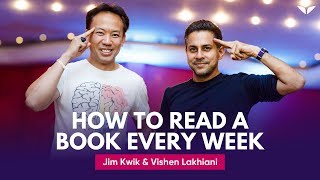
Jim Kwik and Vishen Lakhiani break down how to read a book weekly using the three Rs: read with underlining and scheduled time, relate by teaching what you learned to someone else, and write organized notes. Vishen reads 30 minutes daily before bed and uses audiobooks on commutes, capturing highlights in Bear Notes and posting summaries on Instagram to lock in what sticks.
Chapters
So like most of you, I'm active on Amazon. I have a stack of books by my bedside table that I never seem to find enough time to read. So I asked my friend Jim Quick, who is the speed learning instructor at mindvalley, to give me some tips on how I can read books faster, read more books a year and comprehend more. Jim explained to me this beautiful concept called the three hours of reading.
This is what he said the average person has to read about four hours a day. Emails and websites and blogs and all this information, you can double your reading speed, save two hours a day or even one hour a day. We equated one hour a day equals nine 40 hour work weeks over the course of a year, two months of productivity. So that's the gift you can give to yourself, to your family, to your body, the things that really, really matter. And so remember three Rs. There's three Rs for reading comprehension, okay? The first R is you have to read. Okay? So that's a no brainer. You can't comprehend something unless you actually read it first. The thing with the reading though, because we know readers are leaders, the key though is to use your left hand, is to underline the words and then also schedule it. Because if you don't schedule it, most people want to meditate, they want to journal, but if they don't put it in their calendar, it doesn't get done. And when I write things down in my calendar, I treat it as time with a big client or time with an investor, or time something you would never cancel with anybody, right? So you schedule it in your reading. The second R when it comes to comprehension is you want to relate, you want to relate. And here's really what it comes down to. I believe that questions are the answer. What I'm recommending people is people read exactly as Vishen does, 20 minutes a day.
So pause for a second. This is what I learned and how I applied what Jim just said into my life. So I started scheduling 30 minutes a day just to read on my Kindle. And what I would do is I would block off the same 30 minutes every day. For me, it's the 30 minutes just before I go to bed. And simply doing that would ensure that I could double the amount of books I was consuming in a given year. Now you can do this too. Simply take out your smartphone and set a timer for a specific time every day where you can read. And keep this in mind, it doesn't have to be reading a book visually. You can set a timer to remind you to listen to an audiobook as you're commuting to work. I do that too. And that again adds an extra half an hour every day that I get to call my reading time.
And then the second thing is you get a partner and you relate and you talk about your book. So you're with somebody who's like, yeah, I can't wait to go out this Friday. Real quick, I'm practicing my reading. Let me tell you about this book I'm reading. And for two or three minutes you talk about what you just read. Because something magical happens when you consume information. But you don't just let it stay here, but you teach it to somebody else. You, you reflect on it, you organize it. Because in order for you to talk about what you just read, you're not using the author's word for word verbatim, right language. What you're doing is you're personalizing it using your own words. And in order to be able to express it out, something happens between when the information goes through your eyes, processed by your mind, be able to put out in your mouth. And that's where you understand information. The third R for comprehension is writing. And specifically what I do is I map this out for people and I take notes. Because the challenge is if you take notes and you have 30 pages of notes, something on page 27 could be more important than what's on page number one. But on one page view, using just keywords, you can see how everything is nested into nested and nested. So in order to be able to serve you as a better reader because you're spending so much time reading, use the three Rs and it'll boost your comprehension. You'll get the speed and you'll get the smarts.
So I love that idea. Reflect, relate, and talk about your book. Now this is what I do. What I do. Like many of you, I don't sometimes have a friend who's reading the same book. But I practice a note taking ritual that allows me to then talk to my audience via Instagram. So here's what it looks like. Firstly, I download an app called Bare Notes. It's a phenomenal app for note taking. And as I'm reading a book, if I see a paragraph that excites me, I'll highlight it, I'll take a photo, I'll save it on Bare Apps. I might write my own notes next to it, I give it a title, and over a course of a week, I might end up with 25 different mini notes on Bear app of everything I'm reading and studying. Now, what I then do is I get myself to write one Instagram or Facebook post every single day about something I learned. And Instagram limits it to 2,200 characters, so it doesn't take you long. That's not a lot of words, but if I could extract an idea and share it. Now, I'm not sharing it with one friend. I'm sharing it with tens of thousands of Instagram followers. But even if you have like 300 followers, you're still sharing it with people who are going to comment, who are going to give you feedback. And the beauty of this is you're forcing yourself to teach, you're forcing yourself to write, and so you comprehend better. And you're also getting to share this with the world. So again, you could do this with a friend, or you could do this using social media with the world. So thank you. I hope you enjoyed this conversation with Jim Kwik. If you like this video and want to learn more quick ways to enhance just about every aspect of your life, subscribe to our MindValley YouTube channel.