How to Speak So Everyone Listens to You: The Power of Storytelling | The Mindvalley Podcast | Ep #57
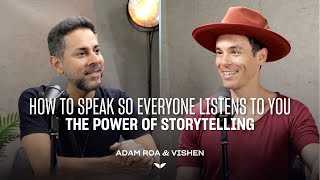
Poet and performer Adam Roa talks about using storytelling to move audiences. He shares how acting training and vulnerability transformed his work, performs poems including one about death, and explains why memorization and clear intention matter more than perfect form.
Questions this video answers
Inside the Great Pyramid in Cairo at ~3am during a private trip (Vishen's account).
Reported as 250+ million views.
Instagram: @adam.roa; Website: Adamroa.com; Podcast: The Creative Path podcast; contact string mentioned as teamdomroa.com.
Tallinn, Estonia.
Chapters
Because the fear of feeling is really.
At the root of every fear, which.
Creates a fear of living, because feeling's why you're here. A chance to feel all of life, from deep sorrow to deep bliss. And you might wish the two would split, but the twist is that they'll always coexist. Because even the heartbreak you hate today had the way paved by a lover's kiss.
I was in the front row and I literally had goosebumps listening to you say that.
I see creativity as our greatest personal development tool. And every time you step into some form of creative expression, you're entering into a ceremonial experience of expanding your consciousness. To intentionally take on the lens of an artist is to say, I am committed to finding the beauty that is available here in this moment and in the past.
In your presence, people feel more. What's causing that?
I put every bit of what I'm feeling right now as I'm sharing with you, I put every bit of it into this moment right now, where I could easily say, hey, can we take a moment and cut this part out? Because I want people to understand that it's okay to go first? And there are some of you right now who feel more connected to me because I've allowed my heart to be seen. There are some of you listening to this that feel more inspired to let your heart be seen. And what the hell else are we doing with our time?
Welcome to this episode of the Mindvalley podcast. Today we're going to be talking to one of the most magnetic personalities I've ever seen on stage. So I just came out of Mindvalley University, Mindvalley's epic 21 day personal growth festival that just happened in Tallinn, Estonia. And this speaker, Adam Roa, was the first speaker we booked for the event. Why? Because I happened to be on a trip with the explorer Robert Grant in Egypt. And Robert had invited some interesting personalities for this trip. And as part of this trip, we got access to the great pyramids. And in the king's chamber of one of the pyramids, Adam Roa spoke some incredible poetic words. It was 3am on a starry Cairo night. I mean, imagine being in the Great Pyramid of Egypt. And those words touched my soul to such a degree that I went to Adam and I said, hey, you're just unbelievably good. In five minutes, you filled me with all of these emotions, all of these different ideas and thoughts. I want you to be the first speaker booked for Mindvalley University. And here we are in Tallinn, Mindvalley University, just Ended. Adam was on stage. He got a standing ovation. The audience absolutely loved him. And I, sitting in the audience, was mesmerized seeing this guy on stage. Adam, just tell us a little bit about yourself. What brought you into this. This. This role as a stage poet?
Well, first of all, thank you for. For all of the kind words, and you've seen some of the best speakers in the world, so to be even considered in that, in your mind, is really an honor. So thank you. And for. For me, I found my way to performance through acting. I moved out to Los Angeles to pursue an acting career. I found my way to acting because I was so shut down emotionally. My father is a very stoic Asian male who told me not to cry like a little girl when I was seven years old. And I just shut down. My emotions. They were not safe. I'm half Filipino. And so my home, when you mix the emotional, the lack of safety emotionally combined with discipline with a belt and things like that, physical lack of safety. I just completely went inward whenever I was at home. And over time, that built up into depression, insomnia, a lot of things that I was struggling with. And I searched for meaning in substances. And so I had. I abused a lot of substances in college, for example. And it was acting. Acting that gave me the. The pressure release valve. Acting was the place where not only was it safe to feel something, but the more I felt, the better I was as an actor. And so that was my first foray into performance, and it. It was my first foray into personal development. It was the first place that I went. I need to understand how to feel, why I feel what I feel. And now I bring that level of. This isn't just about deliver. This is about me channeling. This is about me opening up my heart. This is about me allowing myself permission to feel. And every time I step on stage, that's what I'm doing. And I trust that if I open up my vessel to really be present and really feel and just transmit that authentically, I know the audience will connect.
I loved. I love that you say that. So why I'm fascinated by your process, Adam. Is that okay? When I speak, I'm an engineer, and when I speak, it's about data and knowledge and facts and lessons, and it's great. It's just my style. But you. I saw a different style. You are passing information and wisdom to the crowd by literally touching their soul. And you're doing this in this poetic way. Let's roll this clip so that the.
Audience understands and it's called a message from death.
Hey.
Hey, you over there. I come in peace. I mean it.
Come on.
Put her there. It's okay. I'm not offended. I'm used to it. You see, you humans value life so much, you don't really value me. But the value perceived in the life you lead is inherently tied to me. Because if no one died, it would be tough to see the value in the very breath you breathe. Because while life is the meaning behind every breath, life has no meaning unless it reminds you of death and the life you are leading. It always combines you with death. And life is not deceiving. It always binds you to death. Because even the food that you are eating to keep the heart beating in your chest was once alive but now has died to keep the heart beating in your chest.
Oh, relax.
Don't feel bad. It's nature's cycle. It's okay. We all have a part to play. And when you learn to love it all, you can even love that the decay and decomposition of your body buried deep into the dirt feeds the creepy crawly critters. And the trees that grow up out of the earth. And those creepy crawly critters feed whichever bird can get there first. While those trees grow leaves that feed the needs of animals that breed and then give birth to babies who may be lucky if they see a few hours on the earth before a predator comes and eats them for lunch and then dies and decays back into dirt. See? Why are you so scared? The body you wear is already prepared for the journey it takes when your soul's not in there. And if everything is energy, what is it you are hiding for? It's all in flow and synergy. Which means that you have died before. And in every other century. It means you've been alive before. And on and on for infinity. It means you'll be alive some more. Isn't it beautiful?
What?
You think death can't appreciate beauty? My dear, that's what I want you to understand.
Death amplifies beauty.
The impermanent nature of you determinate creatures is one of your most magnificent features. And the teachers are in the seconds that pass, reminding you this life will not last. Inviting you to let go of the past and bask in the present moment. How much warmer the sun feels, knowing night is on the way. How much brighter those stars do shine, knowing they'll be gone at the dawn of day. How much sweeter that last bite tastes, knowing you can't have anymore. So why not savor every moment knowing it's never been here before and it'll never be here again. But when one ends, another begins. The winds of change bless everything with their sweet caress and with them bring a chance for growth from one chapter to the next. But if you hold on to the past, thinking the last chapter was the best, the present moment's a fight. And soon you will write a new chapter full of regrets. Embracing change is the mechanism that allows you to keep growing. Which isn't always easy because the ego gets quite queasy at the very thought of not knowing. And for some of you, quite queasy is a nice way of saying your.
Ego has a full on freak out.
So terrified it cannot hide, so instead decides to speak out. Shuts you down to new ideas. Tells you that you're right. And if anyone questions your ideas, well, you won't go down without a fight. But what would happen if you let down those walls? What lies on the other side? What would happen, my dear, if you faced your fear and allowed your ego to die like a phoenix, something new would rise and you see the world through brand new eyes. And pretty soon you'd realize you're all butterflies weaving cocoons with threads of identity. Thinking those threads were meant to be forever. But that would make the cocoon a coffin, suffocating you in what you think you know. When you see the cocoon is just a changing room, it becomes a catalyst for you to grow. So take big risks. Live full out love as deeply as you can. Pursue your dreams, release your doubts.
Why?
Because you can celebrate old age. Stop chasing youth. Don't give up before you try. The only constant is change. So embrace this truth. The moment you're born, you've begun to die. The fear of death is the fear of change. The fear of change is the fear of life. Don't live your life in fear of change. Because this life, you won't live twice.
Thank you.
Adam. Tell us, tell us what's happening here.
Well, this is a poem about death and the ways in which our fear of death prevents us from actually living our lives. And so this message that that is put into the poem, I think is a powerful reminder that only through embracing the fact that everything changes, everything dies, everything is reborn. We are a part of this greater flow that unlocks something in us where we are now living our life to the fullest. And so when I'm on stage, for me, it's not about me. It's just not about me. And it's about me at the same time. And there's this paradox, and one of my favorite sayings, is a paradox is as close as we get to God, because God is all of it. God is the victim and the victimizer. God is the one in the golden tower and the one begging outside of it. And so this paradox of how that can be true when we find that in life, where when I'm on stage, this is all about me and not about me at all, somehow simultaneously, that feels true. I know that there's something divine that can be touched in those moments. And so every time I step on stage, it's a moment where I can touch divinity. I really love it. I feel like it's. It's a spiritual experience for me.
I was in the front row and it sent shiver. I literally had goosebumps listening you. Listening to you say that. And the thing is, I'd heard that poem before. You'd shared it at a private gathering at my place. I heard it for the second time, and I still had goosebumps. And that's what leads to the topic of this podcast. How are you able to bring that degree of creativity, that degree of charisma and presence on stage? I'd love to know your process.
I believe that every single human on this planet has the ability to be that confident, charismatic, and passionate about something. And oftentimes the issue is that they just aren't talking about the thing that they. That activates that in them. It doesn't. You find someone on the street, if you ask the right question about a certain subject or a thing, they might be. They might collect stamps, but when they start talking about stamps and why they collect them and what they mean, they will light up. It will activate something in them. And so I think so many people have this idea that they're not good on stage and they're not good as communicators, but it's just they're. They're so often not communicating about something they really love.
You know, that. That really hit me because I realized so often when I go on stage, I'm speaking about the things the organizer asked me to speak about. Right. Speak about scaling your business. But I'm not really speaking about the stuff that I really love. And so that's a really, really powerful idea. So what is it that you really love? Because that poem was about depth. I'm sure you don't love Debt. What is it that you really love? What was that gem of your passion in that poem?
The. The gem for me is helping people shift their perspective. I absolutely. I've been a Coach. Most of my revenue actually has come from one on one, high level coaching, professional athletes, CEOs, et cetera. And I find it almost like this game of tennis back and forth. Because as you, as an example, if I was coaching you, you have so much success. You are a hyper intellectual, you know so much, you've, you've done so much that we'll be in a bit of a chess match as we go back and forth. And so my ability to spot a pattern that you haven't seen yet and, and help you see it is like climbing Mount Everest. There's something about it. I just absolutely love messing with the.
Way we view the world. And yet your poem on death actually does that. Where did that idea come from? I mean, why pick death? I'm sure there are lots of other ideas out there that maybe you feel we get wrong. Why? Why death?
Well, that one in particular was. I was invited to be a part of a performance event. And the entire event was looking at different aspects of life. And so they wanted a perspective on death. And they said, could you write something about death?
And I went, so cool.
Interesting. Yeah, sure. I've never thought about it before. And that took me into a process. Similarly, I have a poem that you love and your father, I think, really loves, called Heaven. And that poem was because a friend wrote a book about abundance. And she said, can you, can you write a poem for the book launch about abundance? And I went into my process and I realized I have tons of poems about breakups and love. I have none about abundance. I don't know what that means. And I literally would sit and just contemplate what does abundance mean to me, what is actually happening. I was in Hawaii at the time. I was in one of the most abundant lands in the world. And yet I was sitting there going, I don't know what abundance, abundance actually even means. Am I abundant right now? Because I can pick fruit from the trees. But there's a part of me that feels like I'm not abundant because I don't have the amount of money in the bank account that I'm comparing myself to. Whatever it is, culturescape, as you've said before. And I think that creativity is the process of putting together patterns that you've never put together before. And every time you step into some form of creative expression, whether you're gonna write a poem or paint, painting, make a new business, whatever it is, you're entering into a ceremonial experience of expanding your consciousness, it will change the way that you look at something. Now, what do you choose to point that creativity at? What is it that you want to shift? And this is why I see creativity as our greatest personal development tool. Because let's look at personal development. You can go into years of therapy, and that person can help reflect to you ways to view your breakup, your divorce, your sexual trauma, whatever. You can view it differently based off of someone asking you deep questions. Also, the moment I decide to write a poem about my sexual abuse when I was five, the moment I do that, I'm forcing my brain to view that experience differently than I've ever viewed it before. And that will loosen the hold of the story that I previously had about it. And as we create new ways of viewing old circumstances, we create new possibilities for how that old event will impact us in the present and impact our future and what we can create.
And not only that, but we start to see that the abuse or the chaos or the failure that we experience actually has a gem of light within it. Because as we share our lesson from it, we are healing other people, right? You, you. You go from the abused to the healer. And I remember Lisa Nichols. Lisa Nichols has a public speaking program in Mindvalley called Speak and Inspire. And she talks about this concept. She said, all your stories, all of the chaos and the shit and the drama that you went through in your past, if you can find the story and the meaning behind it, your lesson, your deep lesson, and there always is a deep lesson, and share that with the world. You help reduce the drama that that story has on you because you are now helping elevate and heal others.
And the most consistent way that you will be able to see beauty in the pain is through art, through creating it. Because artists see the layer of beauty on reality that is available to everyone, but they just haven't tapped into that frequency. The photographer sees the way the light enters the room differently. The musician hears the traffic noise differently. The poet hears the way that people are speaking differently. And it's a layer of beauty. It's saying, wow, this thing that happened is. Can be viewed through a beautiful light. It can become a beautiful song, even if it's a tragic event. And so to intentionally take on the lens of an artist is to say, I am committed to finding the beauty that is available here in this moment and in the past.
The artist is seeing beauty even in tragedy. I love that. Absolutely love that. Adam, that's beautiful. Adam, you mentioned the poem Heaven, right? And there's a line in that poem, heaven is here now, right? That's the poem that my Father loves. I love that poem. You also performed that at mindvalley. With your permission, would we be able to play that poem?
Yeah, absolutely.
The most impactful thing you can do for the world is learn how to.
Love life, all of life.
Show people that being happy doesn't mean turning a blind eye to the pain and the sadness and the suffering that happens here. Show them that choosing love doesn't mean ignoring fear. It just means being willing to feel. And those brave souls will always heal as long as they maintain the courage to feel. Because the fear of feeling is really at the root of every fear, which creates a fear of living. Because feeling's why you're here. So you can fight the fact that feelings past have felt so freaking hard. But it's the very fact that you have felt all that that feels like the part we should celebrate. Investigate. Learn to navigate with ease. Your emotions are the gift God gives you every time you breathe. Energy in motion with the strength to bring a king down to his knees. And yet contained within emotion is the key to set you free. Yes, contained within emotion is the gift of what being human is a chance to feel all of life, from deep sorrow to deep bliss. And you might wish the two would split, but the twist is that they'll always coexist. Because even the heartbreak you hate today had the way paved by a lover's kiss. So you can write your list of how life's a bitch, but don't forget the asterisk. Because for all the times you went.
Through shit, it fertilized a lot of gifts.
But if you only focus on what you lack, you can't appreciate what you've got. But with gratitude for what you have, you can see that it's a lot. And that is the difference between abundance and scarcity. It's not about what you have, it's about what you see. So the next time you forget how blessed you be, take a moment and focus on the next breath you breathe. The next time you forget how blessed you be, take a moment and focus.
On the next breath you breathe.
And notice you're right here with me. A miracle. A great mystery out of hundreds of trillions of stars in hundreds of billions of galaxies. Somehow, someway, you're here today with me. And we all breathe on a spinning sphere of chemicals spiraling through the universe. You were once one of 200 million sperm. You just happened to get there first. So how could you ever say you're cursed? You've been blessed since before your birth. And you might not think you have it best, but it could definitely be worse. And if you don't believe that yet, go tell the deaf what you just heard. If you don't like what you see, go tell the blind how much it hurts. On your hardest day when you really want to walk away, Go tell the.
Paraplegic how it's unfair.
Share how you want to run from all your problems while he's pushed everywhere in a chair. And I'm not saying that life is fair or that it's easy. We all go through a lot. But as you walk through the valley of the shadow of death, don't lose gratitude for the fact that you walk. Celebrate the fact that you can dance and sing. Embrace the abundance in the very act when you talk. Because when you spot abundance in the simplest things, that's when more abundance unlocks the simplest things. Taste, touch, breath, smell. Did you know there are people with something called anosmia, which means their sense of smell is completely lost? So while they literally can't smell the roses, do you want to complain? You don't have the time to stop because this life is the only one that you've got. And there are people who would trade places with you without a second thought. So no matter how many tears, heartbreaks or bad days you pay, the cemetery is full of souls that know living.
Is worth the cost.
Don't wait till it's too late to learn that lesson.
Living is worth the cost.
But make no mistake, Being alive is not the same thing as living. Just like throwing something away is not the same thing as giving. So if you haven't yet found your love of life, I suggest you keep on digging and allow yourself to feel your way through all the hurt and all the rage. And as you feel, allow yourself to finally turn the page. That's how we heal and it might hurt like hell but you'll have shown us we'll be okay to feel it.
All and still love life. That's heaven and you'll have helped pave.
The way.
That'S heaven.
Can you feel it?
Heaven is here today Heaven is here today Adam. I love that. Now, I notice when you're on stage, you have a power and a presence about you. The way you move your hands, the way you make eye contact with the audience, even the way you stand. Tell us about that.
Well, I feel that what's important to share about my stage presence from a very practical standpoint is I trained as an actor for a decade or more, and so many people see the mastery in various places in life, and they go oh, that person was just born that way or that person just had that. I'll never be able to do that. And I always want to remind people I practiced that. I practiced that for years and years and years and years and years to get to that point. And so anyone who wants to do that can. And ultimately I find the secret is in preparing enough that you can let go of all the preparation. And so that preparation happens in the years leading up to it, like I just said of training for a decade as an actor and performer. So I have ability to let go of that. But also the. If I'm doing a poem, for example, if I'm trying to remember the lines of my poem, I can't be present. But if I've memorized that poem so well that I can just go into it on autopilot, what that does is free me up to now be able to be fully present and allow the emotion and the environment to create a truly unique experience that will never happen again. And I think that so many people are not able to get to that state because there's not enough preparation. And they don't know how much preparation it actually takes to get to the point of going, oh, I can actually just let it go. I have my speech figured out well enough, not scripted necessarily, but I know where I'm going with it. I have the poem memorized enough. I have practiced enough on stage to know how to hit my lighting or how to stand or what it looks like, because as an actor, I watched myself on screen and went, wow, don't ever stand like that again, you know, over and over. And now I can just let it all go and be fully, fully present.
So how much practice goes into something like that?
I'm a thousand. What did it say? 10,000 hours? I mean, thousands hours. I was in a conservative conservatory style acting program that I was putting in more than 40 hours a week for years.
I see, I see. So is there any advice you can give me to people listening who want to bring that type of charisma and presence on stage?
Film yourself.
Film yourself.
Film yourself. So it's important for you when you're on stage or you're. You're on camera, you're being interviewed on a podcast. You need to watch yourself. You need to watch yourself and be able to notice and connect what's happening on screen or on stage in that moment to what you were feeling internally. So in a moment where I notice that suddenly I get a little weird with my body, what was going on in that moment? O I forgot my line. I forgot the line of my poem in that moment. That's what was happening.
And that's why you're such a maestro on stage.
Yeah, I appreciate that. Yeah. I think that when you are able to look at what's happening on screen or on camera and connect it to what you're feeling, suddenly you know your coping mechanisms. This is not any different than in personal life, let's say in relationships, I notice, oh, wow, when my partner says this particular thing or brings this particular energy, suddenly I shut down. It's important to be able to notice those things. So the next time that it happens and that energy is present, you can go, ooh, this is that where I want to shut down. And I'm not going to. Well, on stage is no different. I know that when suddenly I feel like I've lost my train of thought or I don't know where I'm going, I can start to do this with my mannerisms, or my voice might change or I'm going to have a tendency to turn my back to the audience to try and whatever like. Knowing how you cope with discomfort is key in life in general and on stage.
So good. So good. But when I look at some of the great speakers out there, I realize that it's beyond just content. You know, it's not about the points they are making. It's about the passion, it's about the energy, it's about the emotion. I was watching Lisa Nichols speak at Mindvalley University just this past week, just a few days before you got on stage. And one thing I noticed that she does is she brings in tons of stories. So to make a point, she won't go, well, sign say it's this, blah, blah, blah. She will tell a personal story, maybe of her experience as a mother raising a son. And as she tells that story, she. She reenacts that story. Right? She reenacts that story. And she brings in body language, she brings in different tonality of voice, and it just really hits you. Do you use tools like that?
Absolutely. A. Storytelling is the foundation of art. It's, it's, it's. It's there because when we tell stories, we're inviting people to project themselves into the story so they're no longer being lectured at. This is. So art is bypassing the logical defense mechanisms of the human mind and penetrating right into someone's emotional body. And when.
That's a great definition.
Absolutely. That that is what art is doing. And so when you understand personal development, you also understand that all real Change has to have an emotional component to it.
Right.
So no matter how shut down someone is, they go into a movie because of how they think it's going to make them feel. They put on music because of how they think it's going to make them feel, not think. And so art gives us permission to shift someone more quickly and more deeply than anything else that I could say to you. That is not being perceived as art. And that is why my poem that went so viral. 250 plus million views. It's about self love. How many people have talked about self love throughout history? How many videos do we have about people lecturing on self love and why it's important? Put it into a poem and suddenly it has the potential to be the most viral poetry in history.
Right, Right.
Because art does something differently. I think of art as a technology to shift human consciousness. That poem completely changed my life. It's the reason why I got invited to Mindvalley A fest was that poem went viral. And as it was going viral, I got the invitation to go to Mind Valley.
So that's also a really cool thing when if you can deliver one speech, right. One speech can change your life. I've seen that happen to so many people. One speech that they really prepared for, that they really positioned for, that they really rehearsed and rehearsed and rehearsed. They got the storytelling right, they got the emotion right, they got the body, body language right. Boom. It changes the trajectory of that person's life 100%.
And that's where story is so amazing. Because when like Lisa telling stories on stage, you don't forget the stories, they happen to you.
Yeah.
So. So again, you are able to just drop into the present moment and tell something that's deeply embodied. You don't have to figure it out. Yes, you can get better with your mannerisms and the way that you craft the story. But it happened. It happened. And that allows you to feel it more deeply. And when you combine your emotion with people's ability to receive art at the emotional level, it's. It's massive. It's. It's why movies are still, still going to be the thing that shifts people so deeply and have changed my life and so many people on the planet. And so figuring out the. The stories that allow you to just be present and show up is key. Because for me and I. I don't know if you feel the same. I'd be curious if you feel the same about this. I feel like you could put me on any stage in the World following any presenter, any person in the world. And if I had the freedom to just speak authentically about what was true for me, I would be able to do a really great job and to the audience and deliver value. And that level of confidence of just who I am and what I have to offer at a root level allows me to get on stage. And even if I forgot every single line, I'm going to be okay. If I forgot everything that I was going to talk about, just me being on that stage, being able to be authentic, I will be able to provide value. And that's self love. That is deep study. That's all of that stuff combined. But I think when you can get to a point where you really feel that about yourself, that you just by being you have value to give, I believe that that changes the way you show up on stage.
Lesson. So you're saying that literally if we took everything away, you've forgotten the lines of your poem, you've forgotten the, the, the flow of your speech. But you know the topic, the topic is self love. You can get on stage and just be yourself and speak about self love and you will still be pretty Damn good.
I 100% believe that. I mean that's what we're doing now, right?
Right. So, so what is that coming from? From, because I think that's, that's very comforting for the audience here because one of the first things that I bet people who are listening are thinking about is man, those poems have a lot of lines. How am I even going to remember that? But really it's more than just knowing the lines. How do we get that, how do we get to that level of presence where I mean, because I bet I could give you any topic, put you on stage in five minutes in front of 800 people. You won't be nervous, you won't face anxiety and you would still probably wow the audience. But how do you get to that level?
I think that takes us back to the all the preparation that allows you to forget the preparation in the moment. And that comes from an acting background where I would prepare when I first started acting, okay. I would look at every single line and I would think, how am I.
Going to say it?
How am I going to say it? What shifted for me was going from how I'm going to say it to why am I saying it. And suddenly every single line became about why, why am I saying it, what's the intention? And that dropped me more deeply into myself. And now suddenly I couldn't get it wrong, right? Because If I had set it up where I need to say it in this way, I could get it wrong. But if I just remembered why I was saying it and I had an intention behind it, I couldn't actually get that wrong. And that shifted a lot for me. So similarly, if you were to throw me on stage with what you've done before, no preparation, say, I want you to do this, like, sure, for me, I come down to what's my intention? And so for everybody who's listening to this, if they were to be brought on stage, I would say, okay, what's the intention that you have right now in this moment? And if your intention is to make people feel seen and heard and loved, that's it. Your intention is to connect to the audience so that they feel seen and heard. Then suddenly you go, what from my life could connect with this audience? The intention is everything, as opposed to, I need to do this thing exactly right. And then it becomes about right or wrong, and it takes you out of the present moment. And. And now what are we drawing from is the next point to this? Cause you're gonna need to draw from something that's your life. And I think too many people undervalue their life experiences when in reality, the things that you've been through in your life are the thing that are going to connect you. And you may not have the accolades and the achievements and the bank account of all these people that you're comparing yourself to, but you have the heartbreak, you have the pain, you have all the times you haven't felt like you fit in or you thought you. You failed. And our traumas, our wounds, our pain connects us more than anything else in the world. It's a. A beautiful paradox again, which is that we all know what it's like to hurt.
You're right. You're right. I had an interesting experience at this mindvalley university. So I was asked to give a speech and I decided I'm not going to go prepared with anything. I'm actually going to sit in front of the audience and allow them to ask me questions. Because I've given so many speeches, right, I didn't want to rehash something and. But what I did have prepared were stories from my life. And this is a technique I use. I learned this from, from great public speaking teachers. I keep a simple list of stories. A story of a conversation with so and so that sparked me to become an entrepreneur. A story of growing up and having a fear of. Of wealthy people. All of these different stories. And as people were asking me questions. I told a story of racism, two stories, back to back of racism and what it's like being my skin color in a country like Estonia, which is predominantly white and blue blonde and blue eyed. And I broke, broke down. As I was telling the story, I teared up because I. I felt that sadness. It wasn't something I planned to do. In fact, I felt like for a while embarrassed that I teared up on stage because I didn't want to get emotional. But it so resonated with the audience. They stood up and I got a big applause because they resonated with that pain. Maybe not necessarily with racism, but they resonated with the pain I was feeling from being deeply misunderstood.
Absolutely. I think vulnerability is the gateway to connection. And when we allow ourselves to be vulnerable, we are actually opening up the possibility for incredibly deep connection. And it's also opening up the possibility of being rejected. And so there's an inherent fear or risk that comes with that vulnerability. But that's also what makes it inspiring in that moment. They may not have experienced racism before, but they're inspired by the fact that you're doing something they understand as human beings could lead to your rejection. There's a courage in what you're doing in that moment that will inspire them to do the same thing or that will open up an opportunity for them to feel something they've never felt before. Because of your courage.
Right?
Yeah.
So that, that was a key lesson for me. And you know what, what you said about, about rehearsing and practicing and being an actor, and what I said about really being able to feel that emotion, if I can give a recommendation to the audience, One thing I think that could be really useful is last year I attended this acting class in LA by Bernard Hiller. I can't remember what it's called, but Bernard Hiller, you guys can google him. And he basically trains actors. And it's only five days, but it's around 10, 12 hours a day. It's super intense. But April 2023, I attended it. And he really gets you to go deep and feel emotions like you've never felt emotions before. So many people, especially men, we put a shield around our emotions. At Bernard's class, I mean, I was like crying, I was breaking down. I was like. It was just wild. And since then, when I get on stage, I feel more and, and the emotions. I feel the emotions even as I'm telling the story. I feel the emotions more rather than. Than try to suppress them. And I found that that Had a huge impact on my stage presence. So just want to recommend that out there. I've no affiliation with the Knot. It's just like a really good, good experience. For those of you who maybe can't afford to go to, you know, do a university. Great course in acting, but could maybe spend five days, look up Bernard Hiller. H I L L E R. Yeah.
And the thing that you said about stories is really important. I lead a incubator program called the Artistic Entrepreneur. And one of the things that we do in there is craft three killer stories. And I think everyone should have three stories in their back pocket that you can pull out on a podcast or in a conversation with new people or on stage. If you were pulled there, what are those stories? And generally speaking, you want to learn how to craft good storytelling, right? A journey, a three act structure. Even if the story is only two minutes long, you have the ability to create the buildup and that sort of thing. So understanding how to tell a good story is really important. But everyone has three.
But what makes a story good?
Well, every. The. The hero's journey. The hero's journey is inherently what we are all on in this life. And I see the universe as being very fractal and holographic. So therefore what we are experiencing in our life is what we want to put into our art. And so when you think about a good story, there's always the context that in Act 1, you're getting to understand who this person is, what they sort of struggle with. And there's a call to action. There's like a journey that they're going to go. When you get into real script writing, you understand there's always a rejection of the journey. So you look at Star wars or Lord of the Rings, the main character, like Frodo in Lord of the Rings is like, nope, not doing it, not gonna do it, not gonna happen. There's always a rejection of it, but there's a deeper calling that pulls them forward. It's a combination of fate and just a knowing and that that protagonist will always say yes to the journey and then they will go on this arc. And all of Act 2 is in experiencing and developing into the person who's capable of achieving the goal. And so Act 2 is all about the skills that you need to acquire by failing, by making bad decisions, by trying something and not getting it. And then eventually you get to this all is lost moment where it seems like things can't get any worse. All of that is everything's screwed up, all the odds are stacked against you. And yet the journey that they've just been on has given them the tools that they now have to use in order to achieve the goal which happens in the resolution of Act 3. And so that is our life.
That. So you're saying you take that hero's journey concept in your entire speech. It's one story that spans the entire one hour speech?
No, it's. It's woven into the fabric of every poem I write. It's woven into the fabric of every story I tell within the speech. And then the speech itself has a meta arc. So in my two hour talk at mindvalley, for example, I'm starting with context. And then I'm going into, in the middle portion, I'm actually going into the feelings and the difficulties and the learnings and everything. And then in the third final piece of that talk, I'm now going into landing the plane. Into what now? How do we resolve all of it? And so the third portion of that is landing the plane, resolving it all with like, okay, now that you've learned all this, with the context, how do we land it? So there's still an arc in it. And when you look at my poems, all the poems that we've played on this podcast, there's a journey, there's a context to all of it. And then there's the teachings kind of in the middle. And then there's the landing to. So where does that leave us now? Where do we go from here? What is the takeaway? And there's an arc to all of it. And I think that because it's so ingrained into what our life is, our life is setting up our context through our childhood. It's the frame with which we view everything. Then we go into this journey of messing things up, screwing things up, trying having some wins, having some losses, whatever. And then eventually, eventually it lands into, okay, here's the legacy we leave behind, here's the resolve. And we have many versions of that. And then we have one big lifetime version of that.
I love it. Now, I guess the best way for the audience to understand this concept is to actually watch that, that two hour talk, which is amazing. This is two hours of time well spent. He got a standing ovation. And what we're going to do is we're going to link to that talk below the description of this podcast. So the talk is going to be on Mindvalley Talks, which is like our TED Talk style channel on YouTube. Hundreds of millions of people watch it, and you can directly click the link and go watch Adam's talk. And if you this talk resonates with you, share it. Let's get Adam's message out now. Adam, for people who want to learn more about you before we wrap up, where can they find out about you?
The best place is through my Instagram. That's my most active platform. Adam.roa. roa. I have Adamroa.com and then I have my own podcast, the Creative Path podcast, which you have been a guest on.
It was such an enjoyable interview.
Yeah. And so all of that, all of the online real estate, basically just Google me, type in my name.
And if someone wanted to book you to speak on their stage, which, by the way, as a seminar organizer, I highly recommend that.
Oh, thank you. I appreciate it. Yeah. So you would just send an email to teamdomroa.com okay.
And do you do any coaching? Do you help people who are looking to get as good as you on stage?
Yeah, absolutely. One of my favorite things to do is coach individuals, High level individuals, CEOs, artists, professional athletes in deepening their connection to their message and being ready to now take that message out in a more effective way out into the world. And so anyone who's interested in that or who are interested in the artistic entrepreneurship journey, they can find out more about that as well through Adamroa.com amazing.
Thank you, Adam. Now, Adam, for my final question, I'm just curious about this. How do we train ourselves to feel more? Because you feel. And here's what I mean, yesterday we had coffee for two hours, right? Yeah. And I find that often when I'm sitting down with my male friends, the conversation gravitates to business. You know, how's the business going? Like, what are you working on? It's very business, businesslike. When I sit down with you, even though you run a thriving business, I mean, as a coach, by the way, this is a guy, as a coach, he gets paid sometimes a million dollars to be someone's coach. So Adam is, like, wildly talented. But we never spoke about business. Rather, we spoke about our heart. We spoke about heartbreak. We spoke about rejection. We spoke about pain. We spoke about wanting to have kids. It was wild. And that level of vulnerability is something that I find I don't have with many men. But with you, it just comes out what's causing that? Because in your presence, people feel more. But this means that there's something that you're radiating what's going on there.
Wow. Well, I take that as a huge compliment. Thank you. I think there's A couple elements. Maybe I can dissect them. I don't think I've ever been asked that question exactly, but there's a few pieces. 1. I was so shut down in my life. I was so disconnected from my emotions. I was so disconnected from my heart. I was molested when I was five. That was a repressed memory that I didn't remember till I was 30. So I spent 25 years thinking, feeling that there was something off in me. But because I didn't know what it was, I assumed that I was off. And when combined with what I shared about my father and just being shut down emotionally, there was no outlet. And so the only safety I had was to really just ignore what was happening inside myself and to get to this place now where, I mean, I could cry right now, if I really just allowed myself to go into this journey that I've been on. And the level of hurt that I've navigated and depression, suicidal ideations, all of it. I know that it's possible for everyone. I. It's not. I wasn't born like this. And I think that life has continued to get more. Life has continued to get more and more beautiful. My friendships have gotten so much more deep. The visions that I feel like I have for what's possible for me in my life, which I never would have been able to imagine, the type of romantic partnership that I'm capable of, all of that is now possible not because of the business I built. It's possible because of how deeply I feel and how deeply I'm willing to be seen and be vulnerable and let my heart be felt by people. And I know it's possible for everyone. And so I think that I want to be a safe space for people to do that. So if there's one thing that I do that creates, that is I lead with it. And so when we sat down for coffee yesterday, I shared a lot about what had been going through, I've been going through personally in my love life and some of the difficulties that I've faced recently and how heartbreaking they've been. And I think that in this world where so many people are scared of being hurt, we live in a world that has not yet proven or shown us evidence that it understands how to treat the human heart as sacred. And so every single time that we are seeking deep connection, which is what I think we all want, every single time, it will require us to go first. Those of us who have the awareness of it, we need to go first. I need to be willing to say to you, hey, can I. Let me just share really deeply what's been going on in my life so that you know that it's safe for you to do the same thing. And that means one of us has to be willing to risk rejection. And I put every bit of what I'm feeling right now as I'm sharing with you. I put every bit of it into my poems and I put every bit of it into my coaching and into my social media, into my podcast, into this moment right now where I could easily say, hey, can we take a moment and cut this part out? Because I want people to understand that it's okay to go first, it's okay to let your heart be seen. It's okay to know that some people might make fun of you, some people might not want you in their life. And there are some of you right now who feel more connected to me because I've allowed my heart to be seen. There are some of you listening to this that feel more inspired to let your heart be seen. And what the hell else are we doing with our time?
Adam, thank you. You're an incredible gift to the world. The reason I keep inviting you back on stage, the reason I invite you to, to gatherings that I'm doing when I'm hosting people, is because you resonate vulnerability, transparency, authenticity. And when someone resonates that at such a level, it sparks everyone else in the group to connect at a deeper level, to bring down their facades, to, to shift the conversation from the size of their business to the size of their heart. And that's something that I really deeply appreciate about you. You are a gift to the world and I'm so grateful to have you in our community. Thank you. Adam Roa. Go check out Adam on Adam your website again. Adam Roa.
Adamroa.com A D A M R O.
A and if you get a chance to get this guy on your stage, go for it. Thank you, Adam. I hope you enjoyed this episode of the Mindvalley podcast. My name is Vishen Latiani. I'm the founder of Mindvalley and if you like this episode, subscribe for more incredible content from mindvalley. By the way, Adam Rowa, what a gem. This guy is just incredible every time we put him on stage. If you like this episode, I want you to know that Adam is going to be one of several incredible teachers speaking at Mindvalley's Future Human Festival happening in Dubai January 10, 11 and 12, 2,025. This is an incredible event with world class teachers focused on the skills to help you gain an Edge in 2025. Go check out mindvalley. Com Future Human, and maybe I'll see you there.
More from Vishen




Brown Noise for Deep Focus and Concentration (Best with Headphones) | Gabriel Loynaz



Your Appointment With the Eternal | Guided Meditation with Michael Bernard Beckwith

