How You Can Make Meditation Work For You With Emily Fletcher
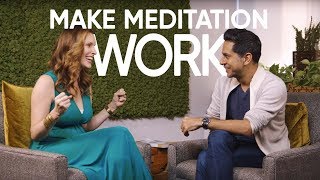
Emily Fletcher explains why meditation isn't mindfulness and how it works for high performers. She covers stress reduction, better sleep, and increased productivity, then walks through learning a replicable technique to actually make it stick.
Chapters
Hi, everyone. I'm here with Emily Fletcher. And the topic we're discussing today is meditation for extraordinary performance. Emily, welcome to mindvalley Studio in New York City.
I'm so happy to have you in the city.
So I want to tell you why. And you guys watching this. You know why this topic is so important. The amount of research on the positive benefits of meditation is going through an exponential rise right now. It improves every everything from your sex life to your longevity to your vision to your skin to your performance at work. But the problem, Emily, as you've stated before, is people aren't meditating. They aren't meditating. Why?
Well, there's some fascinating science coming out suggesting that meditation does not work unless you actually meditate. Like, you have to actually do it.
In order to get the best. What are these people doing if they're not meditating?
Well, I think people are like, I'll have some wine or I'll exercise or I'll cook. Like, cooking is my meditation or exercise is my meditation. I'm like, no, meditation is meditation. That's why it has its own word. What people are saying is, exercise relaxes me. Cooking relaxes me. But the thing is, so does pot. So does wine.
So people are confusing meditation with relaxation.
Yes.
Okay, now, if you want to get the benefits which scientists are seeing with meditation right now, you got to really meditate. But the problem is, and Emily, you've said this before in our previous interviews and conversations, the majority of Americans have tried meditation. But the vast majority of them, after that first try, that is the beginning and the end of their meditation practice. So Today, only around 8% of Americans actually meditate. Roughly. Right. And the reason is, meditation is either boring or they are too busy or. And the third big hurdle is they're having a hard time clearing their mind.
Yes. And this, I find, is the number one obstacle to people committing because they think that they're supposed to be able to clear their minds. I think there's this one dude out there telling everyone that in order to meditate, you have to clear your mind. Your mind and vision. We have to find him, and we have to teach him how to meditate.
We have to make him stop. Because. Because meditation, as you've said, is not about clearing the mind.
Yes. So, because the mind thinks involuntarily, just like the heart beats involuntarily. So trying to give your brain a command to shut up is as impactful as trying to give your heart a command to stop beating. And yet, this is the criteria by which everyone are judging themselves whether or not they can meditate. And then it looks like this. You're like, okay, brain, shut up. There's a really loud truck outside. Now I'm thinking about a truck. Now I'm thinking about. I'm thinking about a truck. I suck at meditation and I quit. And that's the beginning and the end of most people's meditation career. And it makes me sad because they potentially rob themselves of a lifetime of better performance, of a lifetime of bliss and fulfillment, because they're judging themselves based on misinformation.
And so if you're tuning in right now for this video, what we're gonna talk about is really how to make your meditation practice rock. So Emily here is the author of this book, Stressless Accomplish More Meditation for extraordinary performance. I love that sentence, meditation for extraordinary performance. And the reason I love that sentence is because the science is so real right now. Right? Meditation, if you bring it into your life, will add years to your life. It will make you perform better at work. It actually gives you more time. But people don't do it because they say they are too busy. And a big reason for that is because the western world is, has got meditation wrong. So what we're gonna do in this interview with Emily, who in my opinion is one of the best meditation teachers out there by none, because she tells it like it is, she isn't gonna give you some phony ideas, such as it's about clearing your mind or focusing on your breath or praying to crystals or hanging feather earrings around your ears. She's gonna give you the straight up advice on how to make meditation work for you. And Emily, I know you've taught people at Google, you've taught people at Harvard, and you run the Ziva Meditation School, which is just here in New York, down a couple of blocks from where we are filming right now.
Yeah.
Okay, so let's start with the first big barrier. If you want to start meditation, how do we begin?
So step one is realizing that meditation is a skill like any other skill. Because meditation is simple. I think people think they should already know how to do it. But you wouldn't say, all right, I'm going to do a 20 day Japanese challenge. If you've never learned how to speak Japanese. So similarly, why would you do a 20 day challenge meditation challenge if you don't already know how to meditate? And so because meditation is becoming so popular right now, there's a million apps, There's a million YouTube videos. People think that, oh, well, I should just already know how to do it. But to become a self sufficient meditator, to have a technique that is designed for you and I and not designed for a monk, that's step one and then learning how to do that, learning how to become self sufficient is step two. And then step three is really making a promise to yourself and committing to it.
So, Beth, that's a really cool analogy. You're right, because so many people I know jump into these 21 day meditation programs, but they aren't really then they are unable to continue, they struggle. Now, you've said this before, you've said that there's a big difference between hermetic meditation or meditation as it's designed for monks and modern meditation. And I think that's a beautiful distinction because what's happening is that people in the modern world, and by the way, if you're watching this on YouTube on your smartphone, congratulations, you're in the modern world. People in the modern world are trying to meditate like monks, not realizing that there's actually two types of meditations. Explain.
Yes. So basically a lot of what people are doing on their apps on their drop in studios, this is what I would call mindfulness. And mindfulness is derived of monastic styles of meditation. And in mindfulness, you are directing your focus, Someone is guiding you through something you are visualizing. There is a point of direction to your mind. Beautiful. Mindfulness is very good at getting rid of your stress in the now. Meditation, on the other hand, is very good at getting rid of your stress from the past. It's giving your body deep healing rest, which actually de excites the nervous system, which is not only dealing with your stress from today, but also all of that stress you've accumulated your whole life. So the dog that barked in your face when you were 12, your parents divorced when you were 16, all that stuff unfortunately gets stored in our bodies. And if we want to heal that stress from our past, we have to give the body deep healing rest. And that's what the meditation does. So mindfulness and meditation are not synonyms. They're actually quite different. And I think this is why a lot of people feel like they're feeling failing when they meditate because they're trying to clear their mind or focus when actually the technique is designed for rest and relaxation.
So what you're saying is mindfulness and meditation are two different things, and meditation is designed to take people into rest and relaxation. Okay, but I know some people watching are going, well, I like doing that with an afternoon nap.
Yes.
So what's the difference?
Great question. So actually, the meditation that we teach at Ziva is giving your body rest that is two to five times deeper than sleep. And that's not an insignificant point, because when you give your body the rest that it needs, it knows how to heal itself. So when we are sleeping, brain is chilling, body's on guard. Like you're sucking when you're snoring. Because the body has evolved to prepare for predatory attacks. So if it was 10,000 years ago and there was a saber toothed tiger roaming around your cave and it was time for you to sleep, if your body was in black. Sorry. If your brain was in blackout sleep, you would need your body to be on guard. Now, the opposite happens when we meditate. When we meditate, body is getting this deep rest. How do we know? Metabolic rate decreases. That's the rate with which the body consumes oxygen. It's not your fat burning capabilities. Your heart rate slows and your body temperature cools. Now here's the trick. Nature will not let you rest this deeply physically and be in blackout sleep mentally at the same time. Because at this point, you're in evolutionary liability. That tiger comes in your tiger snacks. So basically, one or the other has to be on guard. So basically, it's like we have to take everything we've been taught about meditation and throw it out the window. Because your brain is actually very alert. It's very on guard when you're meditating so that your body can get that deep healing rest. So it's the opposite where you thought, well, I should be focusing or I should be deaf, dumb and blind and I shouldn't hear anything that's going on around me.
I see. So your brain is actually more acutely aware of what's going on. So does this mean that when you're meditating, when you're in meditation, you're more likely to hear that passing truck?
Yes. It's like you have spidey senses.
And this is what people get wrong about meditation. So they hear the passing truck and they go, I suck at this.
Yes, they hear the truck. They have the thought about the truck because they think they shouldn't be thinking. They feel like they're failing and we won't do anything for very long that we feel like we're failing at. So it really can be so much easier.
That's cool. I've never heard anyone explain it that way. So that's the difference between mindfulness and meditation. Okay, now how do we get to that state? So if you're Watching. Maybe you're new to meditation. Now if someone who is new, how would they get to that state of deep body relaxation?
So there's lots of different ways to get there. I mean, you could, a lot of people, you know, like I was saying, you could do cooking or exercise and people think it's relaxing. You could do a bunch of drugs and it will change your state of consciousness. But the trick is when you go back to sobriety, you did not earn that increase in consciousness. Whereas, like going meditating is like taking your brain to the gym. Right. And so what we do at Ziva and what I teach in the book as well, is that I teach you a technique where you give your mind an anchor. It's like you use a tool to help induce this deep healing rest. And some people use a word, some people use a mantra, some people use a sound. And the whole point of it is not to focus on it, but to actually let it go in and de excite the nervous system. So it's, it's simple. It sounds simple because it is.
Now can you learn that in the book?
Yes, that is what I teach in the book. It's part two of the book and also in our course together, the M word.
Right.
And so once you move through it, and this is different than what a lot of people think, is that I believe it's important to be self sufficient, right. That you want to have these tools, that you can practice them on a bus, on a plane, with your kids screaming in the next room, even in the middle of your open floor office plan.
So, so technically you could practice meditation while you're on a New York subway.
I've done it in a New York subway. I've done it backstage in a Broadway theater, I've done it in Times Square. And, and it, and people think, well, I can't meditate because it's too loud around me. But noise is no barrier to meditation because anywhere you can think a thought, you can think the mantra, which is what we use in the book and at Ziva. And if you can think that mantra, then it's going to go in and de excite the nervous system and induce that deep healing rest. So you feel more awake afterwards. You have more consciousness and less stress in your body after the meditation.
Right, so which is why you say the point of meditation isn't to get good at meditation, the point of meditation is to get good at life.
Bingo. And I.
That should be a T shirt, by the way.
Yes, we meditate to get good at life, not to get good at meditation. Sadly, no one cares if you're a good meditator, which is hard for me because I'm very competitive and I really like to be the best at things. But nobody cares if you're a good meditator. But everybody cares if you're good at life. Everyone cares. How kind are you? How compassionate are you? How often do you get sick? How's your sleep? How well are you performing at work? These are the things you can do.
And meditation increases disabilities.
Yes, because stress makes you stupid.
Okay, so quick recap number one. Understand that a lot of people fail to keep up with their meditation practice because they misunderstand what meditation is about. Understand, as Emily said, that there are two types of meditation. Hermetic meditation, often called mindfulness, which is about clearing your mind and focusing on your breathing. And then there's meditation, which is about deep body relaxation. And many people mix up the two. Now, the second thing is that meditation is supremely useful. And the point of meditation isn't to get good at meditation. This isn't an Olympic competitive sport. The point of meditation is to get good at life.
Yes.
Now, what are some of the ways that meditation improves life?
So, like I was just saying, stress makes you stupid. It's just the hard reality. It also makes you sick and slow. And so I think a lot of us think about meditation like it's this luxurious pedicure for your brain. And like, oh, well, once I have more time, then I'll get around to that meditation thing. But we have to flip this on its head because stress is making us sick, sad, and slow. Doctors from Harvard are calling stress the black plague of our century. They're saying it's responsible for somewhere around 90% of all doctors visits. And so I believe that we have an opportunity to learn our lessons on the spiritual plane. And if we don't learn it there, we have to learn it on the psychological plane. It's a little slower, costs a little more money. If we don't learn it on the psychological plane, well, then we have to learn it on the physical plane. Then it shows up as some physical manifestation. It's more expensive and more slow to heal. So even so, basically what I'm suggesting is that we have to take meditation out of this, like, woo, woo, frou frou, I'll get around to it when I'm not so busy category, and instead think about it as the single most important piece of mental hygiene that we all need to be practicing.
You're absolutely right there. And the way I explain it to people. Is this because I've been meditating non stop now for almost two decades.
Just non stop, 24 hours a day.
Meditating every morning for about 20 minutes to 40 minutes every day for decades. Right. Amazing. Now, two decades. But you know, I've met many remarkable people in the world and they don't start their day without meditation. For example, Russell Simmons. Russell Simmons was once voted one of the top 10 most influential entrepreneurs in America today. And I was in a live audience with him where he was mentoring a group of entrepreneurs of which I was part of. And I remember a quote he said, he was giving us advice and he said, meditate. I don't do shit till I meditate. And then of course, people have heard people like Ray Dalio, who recently wrote an incredible book called Principles. One of the top hedge fund managers in the world. He's a big advocate of meditation. Ray Kurzweil, VP of technology at Medicine, Google, big advocate of meditation. Billboard magazine and Ebony magazine just last week had an article on the R and D star Miguel, big advocate of meditation. He spoke about using like a mindvalley form of meditation before getting on stage at concerts.
On stage, he was doing his job. I love it.
So the reason why I meditate every day is because what I found, and I discovered this way back in 2002, is that when I meditate, I do better at work. Meditation may take me 20 to 40 minutes in the morning. Right. And when I'm really rushed, I might do a 15 minute version of it, but it adds one to two hours of my day in terms of higher cognitive functioning, in terms of better emotional states, more feelings of connectivity and joy and unity with people around me in terms of clearer thinking and less stress and anxiety. And so if you think that you're too busy to meditate, that really is an illogical statement because meditation improves your productivity to such a degree that it's actually adding time to your life.
Yes. People who think they're too busy to meditate simply haven't found a technique where the return on investment is worth it for them yet.
Yes, they're often using a technique that just doesn't work for them.
Yes. But once you find a technique that is designed for you and once you start to make that investment, investment, and you see that the return on investment is exponential, that like you said, you have more time in your day, your sleep becomes more efficient, you're more creative, you're more in that flow state, life becomes more effortless. There's a level of synchronicity and serendipity. It feels a little like magic, but it's not magic. It's just you without the stress.
Right. Right. Now I want you to go into a number of topics for our listeners. The first one is what do you do, Emily, if, if you feel you're too busy to meditate?
We know that quote, if I'm too busy to meditate for 20 minutes, I must make sure I meditate for an hour. And that sounds ridiculous to people who don't know how to meditate, but you've seen it to be true. And we see high performer after high performer saying, I won't start my day until I meditate. It's like how many elite performers have to say that this is the secret sauce before we start listening? You know, they're not meditating because they have extra time in their day. They're doing it because they know that stress slows them down. So once you understand the neuroscience behind this, that actually if you're not meditating, you're using your sleep as a time for stress release, which P.S. that's what insomnia is. It's your body releasing stresses in the form of thoughts because that's the only form of rest that you have. Now, once you insert a meditation practice into your day, you use your meditation for stress release so your body can use your sleep as a time for sleep. Now the byproduct of that is that it might shave hours off of how much sleep you need at night. So even if all it did was give you one hour of less sleep, you're already in the black, investment wise. So for a 40 minute time investment, you have 20 minutes back in your day and then let's say mid afternoon, where you would have had the coffee or the chocolate or the nap, you meditate instead. It takes less time and you have this hit of productivity on the other side. You're going to finish your five hours of to do list in three hours and maybe even have a little gas in the tank to enjoy playing with your kids that night or enjoy hanging out with your friends or writing that book versus just coming home exhausted, mentally wiped, and netflixing and drinking wine until you fall asleep on the couch.
It's amazing. And it's not just more time. I mean, if you're doing it for more time, congratulations. But again, vast increase in scientific studies showing that meditation improves just about every aspect of human well being you can think of. And new studies are coming out every single week.
And I think there's a beautiful upward spiral that the More high performers out themselves as meditators. The more neuroscientists want to study it, the more neuroscientists who study it, the more people out themselves because the stigma is going away, which is amazing.
So you run the Ziva Meditation Studio. You published the M Word Quest with mindvalley, which is our mindvalley meditation program on our Quest app. And you wrote the book Stress Less, Accomplish More Meditation for Extraordinary Performance. But you, Emily, used to be on Broadway, and you have a crazy, beautiful, funny, awkward story of how you got into meditation. I'd love for you to share that.
Yes. So I was on Broadway for 10 years. My last show was A Chorus Line, where I was understudying three of the lead roles, which means you show up to the theater and you have no idea which character you're gonna play that night. Some people are good at this job. I am not one of them. So I was living my life in this constant state of fight or flight. Sometimes I would just be chilling in my dressing room, doing my taxes, and someone would get on a loudspeaker and say, emily Fletcher, we need you on stage. And I would start panicking because I didn't know which costume to put on. So I would run down seven flights of stairs, someone would put me in an outfit, and sometimes I would be on stage before I knew which character I was going to play. And so it's basically this level of anxiety led to me going gray at 26 years old. It led to 18 months of debilitating insomnia. I started getting sick and injured, and it was very confusing to me why I was living my dream on Broadway, doing the thing I'd wanted to do since I was a child. And I was miserable. And thankfully, this amazing woman was sitting next to me in the dressing room who had a harder job than I did. And I kept asking her, what do you know that I don't know? Because every song she sang was a celebration. Every dance she danced was a celebration. Every bite of food this woman ate, she would just be like, oh, this is sensational. And she was Australian. And at first, I just wrote it off to her being an Aussie because, like, have you ever met an angry Aussie? No. I don't know what they put in the water down there. But then I realized, like, this is extra. She's extra happy. So I said, hi, I'm gonna need to have some of what you're having. And she said, I meditate. And I was like, oh, God, one of you. And I quickly rolled My eyes. Because there wasn't the neuroscience then that there is now. So finally, I felt so embarrassed about my performance, and I thought, well, I have to try something. So. So I went along with this meditation talk. I liked what I heard. I signed up for this class. And the first day of the first class, I was meditating. I didn't know what that meant, but I was in a different state of consciousness than I had ever been in before. And I liked it. That night. I slept through the night for the first time in 18 months.
Wow.
And I've slept every night since. And that was almost 11 years ago until I have a newborn. But that's not insomnia. That's a beautiful different journey. Anyway, meditation up leveled my life and my performance so dramatically, I stopped going gray at 26. I stopped getting injured, and most importantly, I started enjoying my job again.
And I thought, wait, meditation actually had a biological effect on you? In short, it stopped your hair from going gray.
Yeah, I'm gonna be 40 in March. I have one gray hair, which I promptly pluck out. I was legitimately going gray at 27 years old.
But. Okay, how does that work?
Okay, so. Because stress, it shortens your telomeres. And your telomeres are the little casings at the end of your DNA. And so actually, the woman who won the Nobel Prize a few years ago discovered the impact of stress on telomeres. And the way I like to think about it is like a little plastic casing at the end of your shoelace. So if the plastic casing at the end of your shoelace unravels, then the shoelace unravels more quickly. Same thing with telomeres. If they unravel, then your DNA starts to unravel, which impacts your body, so they age faster.
So meditation, actually, now, legitimately, science has proven that meditation prevents the shortening of your telomeres, which indirectly means that your longevity is increasing.
Yes. And there's certain science from Wake Forest University is suggesting that can reverse body age by eight years. There's science out of Tufts University suggesting that it converts body age by 15 years. Which I was like, this sounds like a crazy fountain of youth. But if we want proof that stress expeditiously ages us, look at any president the day they take office, and that same president, four years later, they all age. And that's not a coincidence. That's stress. So if meditation is the most powerful stress relieving tool that we have, which it is, less stress we have in our body, the more it can heal itself.
And so you were going gray at 26. And when you started meditation, what happened to those gray hairs? Did they.
I mean, I mean, full disclosure, I do color my hair, but, you know, everyone knows who colors their hair. There's like a time where it grows out, right? And so, you know, I'll go a couple months where I don't see my roots, but then when my roots would grow in, they just wouldn't be gray anymore.
That's incredible. And the reason, the reason I ask is because I've been concerned about gray hair. But what I noticed is that my graying too actually stopped as I started going deep into my meditation practice. And I thought it was just me and you.
I mean, you see it like if you go on vacation, you know, you look more youthful, you look more rested, versus if you're pulling all nighters at work and downing coffee all day and drinking all night, you don't look rested, you don't look rejuvenated. And I think then it's not about going gray because, like, who cares if you have gray hair? But the thing we want to highlight is that we want to be as healthy as we can. It's not about chasing youth. It's not about chasing youth. It's about chasing health. It's about us being optimized for whatever age we are. And because stress has become the norm, we think that it's normal to just get sick and die. What if you just die instead of getting sick?
It's a key point. That's a key point. We live in a world where it is the norm to wake up every day with stress, with anxiety, with fears, with negative energy. And we don't do anything about it because we think it's the norm. But if you're meditating, it's like it's a way to clear that from your mind. I mean, think about it this way, right, folks. Would you go to work without showering? You probably wouldn't. But if you go back a hundred years ago, most people showered once a week. Today we have the luxury being able to shower every single day and keep our bodies clean. But at the same time, we wake up every day with stress, with fears, with anxiety in our minds. And we don't rinse that, we don't clean that, and we assume it's normal. Just like a human being a hundred years ago right here in New York City would assume being smelly was normal. Now when you meditate, you clean that. And so you're actually going into the world with a whole different level of mental Clarity.
Yes. And I think this analogy is a very good one. Sometimes you really enjoy showering, right? Sometimes you don't shower anyway. Sometimes you're gonna enjoy meditating. Sometimes you will not do it anyway. Meditate anyway. One of my missions as Ziva is to make it as rude to leave your house without meditating as it is to leave your house without brushing your teeth.
And there's a reason, right? Bad breath might turn off some people, but when you meditate, you actually improve what I call your unity drive. And you've explained this in your book. When you meditate, you develop greater social connectivity with other human beings. You feel more one with the world. And so you become, in your words, a bit less of a dick.
Yes. So what's happening neurologically there is that meditation strengthens the connection between the insula, which is the empathy center of the brain, and the dorsomedial prefrontal cortex, which is really just a fancy way of saying the piece of our brain that processes information about people that we perceive as separate or different. And so if you become more empathetic towards people that you perceive as different, then, yeah, you're going to be less of a dick. You're going to start to see yourself inside of others and others inside of you. And while selfishly, this feels nice, what I'm interested in is the ripple effect of this on the world. How does that mean? You show up with your family. What's the impact of that on your office? What's the impact of that on your town, on your country, and ultimately on consciousness itself? Because I think most of us come to meditation for very selfish reasons. We want to look young. We want to stop going gray. We want to be better at work. We want to make more money. And that all is going to happen because stress makes you stupid. But what's the actual point? I would say that the point is to actually start to experience more unity. What if we started to be identified as a human race instead of a nationality or a. You know, like.
You're right.
Yeah.
Like, the funny thing is, if you. For many people, right, they take drugs for basically every ailment, and especially living in the United States. I mean, right here in New York, every two blocks, there's a pharmacy so that you can get your pills as fast and quick as possible. But the problem with drugs is that they give you side effects. But when you meditate, the side effect is one of the most beautiful side effects you can imagine. It makes you a kinder, more compassionate, nicer human being. And so when you have large groups of people meditating. It actually has a huge benefit on society as a whole because it's making us a more conscious species.
And I think where I hope that neuroscience goes next, because we really don't need any more scientific studies to tell us that meditation is good for us personally. But I think what will be fascinating is the next frontier is how do we get. What if we had a thousand people meditating in Central Park? What's the impact of that on everyone else in New York City?
Right?
What if we get 10,000 people meditating under the Eiffel Tower? What happens to everyone else in Paris? This is where I think the next frontier is going to go.
So the beautiful thing about meditation is that as you meditate, not only do you become more peaceful, but your reaction to other people shifts as well. So when you see someone else do something that might otherwise turn you off or make you feel stressful, there is almost this secondary voice that emerges in your head. And many meditators report this, right? The boss may say something that they perceive as being negative, or a co worker may do something that irritates them without meditation, they react immediately. I can't believe he said this. But when you practice meditation, it's almost as if you have this secondary mind and you can see your normal reaction and go, wait, wait, wait, wait, wait. You don't have to say that. Chill for a moment. Maybe they just had a bad day. It's as if you have this second voice in your head that's talking to you and helping you see what might be a blunt human reaction then to hold that back and then to perceive that other person in a more compassionate, understanding way.
Yes.
Now, when I first started meditating, the second voice freaked me out. I couldn't understand what was going on. It's as if a part of my brain would tell my normal reactive self to calm and chill out. But it was a beautiful feeling and it allowed me to function much better in the world.
So what's happening there is that when we are stressed, the body is in this low grade fight or flight stress reaction. It's constantly preparing for a saber toothed tiger attack. It's preparing for those predatory attacks which used to be our demands, but now our demands are no longer predatory attacks. And yet we're constantly in this fight or flight stress reaction which is now it's maladaptive. It's disallowing us from performing at the top of our game. Like you said, someone comes at you and you just react. You don't Even think about it. But if you start your day with meditation, you get rid of that fight or flight. You get rid of the adrenaline and cortisol and start to flood your brain and body with dopamine and serotonin, which are alkaline in nature. That doesn't just stay with you for the meditation, that seeps into your body for the whole rest of the day. And so like you said there, you get a choice of how you want to choose to that stimuli stimulation. It's not just a involuntary fight or flight stress reaction. It's a choice.
And it's. And it's beautiful and almost magical how this happens. But yes, you're right. This should be the next frontier of science. I cannot wait. If you're a scientist out there watching this and studying meditation, let's start studying why meditation makes us kinder to each other. It's. It's strange, but it's so true. And now let's go on to two other big gaps that people have when they're meditating, right? So the big question we get from you guys is, what's the deal with clearing the mind? It's so hard to do. And this is what makes so many people stop meditating. Your answer?
The mind thinks involuntarily, just like the heart beats involuntarily. I cannot say this enough. The mind thinks involuntarily, just like the heart beats involuntarily. So just to really drive this point home, it might sound a little silly, but let's do an exercise together. On the count of three, I invite you to try to give your heart a command to stop beating. Ready? 1, 2, 3. Please no one die while you're watching this video. Right? Like, we see that that doesn't work. And yet this is what we're all doing when we sit down to meditate, we're like, okay, brain, please stop. Or at least slow down. Because we don't like the quality of our thoughts because our brains and bodies are stressed. So it's not. If I can stop my mind from thinking, then I'll accept experience bliss. What's actually happening is that if you use certain tools and you get a technique to allow you to access your bliss internally, then you're changing the physiology and the chemistry of your brain and body, which changes the quality of the thoughts. So you stop hating the thoughts. You stop thinking that the thoughts are the source of the stress. They're not. The thoughts are just the exhaust trailing behind the plane. It's what we need to do is Give the body rest, get rid of the stress and the feeling physiology. Then the thoughts that we're having are just an indicator of our state of consciousness. It's not the thoughts that are preventing us from being able to meditate. So just like you can't stop your nails from growing, you can't stop your brain from thinking when you experience bliss, the mind cannot conceive of a thought that would bring it greater fulfillment than it's already experiencing. And then the mind falls silent. People have it in reverse. People think, if I can silence my mind, then I'll experience bliss.
I love how you explain that if.
You experience bliss, then the mind falls silent.
And so if we get over this obsession to chase the silencing of the mind, meditation suddenly becomes so much easier, so much simpler.
And it's just like anything, if you're chasing a result, you get further away from it. If you're trying to sing or even trying to orgasm, it's like it gets further and further away. Like to trying, trying to sing. Oh, it's like, no, that's not nice to listen to. But if you just go through the process, go through the steps, it all happens innocently, spontaneously, effortlessly.
That's amazing. I love how you explain that. I love how you use metaphors to make this so much easier for people to understand. Now the final big question that we have, because this is a hang up for so many people and it's essentially this. I find my practice boring. I'm bored the heck out of meditation. So what do you do if you find meditation boring?
I mean, in all honesty, sometimes it is a little boring because, you know, we're so. We've all become bulimic of the brain. You know, we've just got constant inflow in our brains all day, on our phones, in the cabs, in the elevators. We don't even have a moment of silence anymore. So to just have even five seconds of no stimulation might feel a little boring at first. But if we start to understand that the constant stimulation is not good for us and that it's actually disallowing the brain to heal and process in the way that it needs to, that's step one. Step two is finding a technique that is designed for you. Because while there is some stillness in meditation, yes, if you have a technique that is designed for you, it's actually quite enjoyable. And when that brain starts dumping dopamine and serotonin, those are bliss chemicals, that feels delightful. And then that bliss chemistry stays with you, not just during the meditation, but throughout the process rest of your day. So it's sort of like doing drugs for free. You're waking up your own internal pharmacy instead of being reliant on coffee, sugar, sleeping pills, pot, alcohol, whatever you're doing that's better.
You mean waking up your internal pharmacy. I love that. So as we come to the end of this interview, Emily, what would be your closing advice for people?
To acknowledge that meditation really is like any other skill. And to find a meditation that resonates for them, that feels like it's worth the return on investment and to find a teacher that they trust and respect. Because for most of us, if we find a technique that is worth the return on investment, there's gonna be some old stuff that comes up and out. You know, we have stress and trauma in our bodies. It's going to come up and out. Most of us need some guidance through that. And so I think it's important to, to have someone that's been down the road as well to give you some encouragement to help you know when to course correct, and then once you find it, just commit.
Thank you, Emily. And for those of you who want to learn more about Emily, check out her book, Stress Less Accomplish Meditation for extraordinary Performance. And that's what really makes this book powerful. Because for too long, meditation has been positioned as an act of clearing your mind, of focusing on breathing. And all of that is great. But a lot of people who are high performers, who want to do better at their career, who want to do better at life, who have big goals to get to, they have to understand that meditation is really a powerful tool for them. But they fall into this trap thinking that meditation is just another thing that extracts time from their day and they are too busy to meditate. Well, that's because they don't fully get it. And this is why meditation for extraordinary performance. Performance is your thing. And it's so important that people understand this. So go ahead and get the book. Mark Hyman, one of the top medical doctors in the US Said, this book will change your life. So go check it out on Amazon. Emily, I'd love for you to just share a little bit about what you cover in this book.
So the book is basically three parts. Part one is all the selfish reasons that we come to meditation. And I cover the neuroscience behind why it will help you have better self sleep, why it reverses body age, why it can help you have better sex, how it actually gives you more time. So all the selfish reasons. Part two, I actually teach you a technique. I teach you the Z technique, which is actually a trifecta of mindfulness meditation and manifesting. And then part three, we look at the ripple effect of this. How is you performing at the top of your game, impacting your family, your office, your town, your country, and humanity itself?
That sounds fascinating.
Yeah.
Awesome. Awesome. So thank you so much for joining us, Emily.
Thank you for having me. It is a total delight.
Thank you guys for tuning in. I will see you on another episode soon.
More from Vishen




Brown Noise for Deep Focus and Concentration (Best with Headphones) | Gabriel Loynaz



Your Appointment With the Eternal | Guided Meditation with Michael Bernard Beckwith

