Learn The Secret To Getting Better Results From Your Workout | Ronan Oliveira
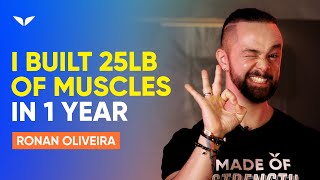
Ronan Oliveira breaks down progressive overload: gradually adding weight, reps, or speed to force your body to adapt. He gained 25 pounds of muscle in one year by tracking lifts in a notebook and deliberately increasing the challenge, then used the same method to win a 21km obstacle race.
Questions this video answers
25 pounds of muscle
Viper Challenge
21 km
Get a notebook, track your favorite exercise's current limit, record feedback after each test, and progressively make it more challenging for at least three months.
Chapters
This notebook is almost 10 years old. And in here is the secret that helped me build 25 pounds of muscle in one year. You know, you may be doing tabata and hiit and bodyweight training every day for months in a row, and then you look at your body and nothing changed. It doesn't matter how much you're working out, if your workouts don't fulfill this one main principle that will never give you results. So I wanna tell you in this video what this principle is and how to apply it. And you want to stick with me until the end, because at the end I'm gonna tell you a result even more unbelievable than that that I achieved through this principle. I learned this when I started strength training in the gym. Although this works for running, for endurance, for stamina and all that. But when I started in the gym, I was training with this guy that he told me this story of muscle confusion. Have you heard that that you need to change your workouts and your exercise all the time to confuse your muscles? Apparently that was a good thing. But then I asked the guy, alright, so how long does it take until I start seeing results in my body? And the guy says, it takes long, man. I'm doing this for like 6 years and I haven't seen much. And then I said, maybe your muscles are too confused. Probably it's not a good technique. And then I started working out with another guy who was this big bodybuilder. And he told me the story of Milo of Croton. Goes like this. Milo of Croton was the ancient wrestler in Greece that was the most legendary wrestler. He was like the Khabib Nurmagomedov of his time. And when he was a teenager, Milo was walking around in the street and then he saw this little calf and he says, oh, a little calf. I'm gonna grab it and walk around with it on my shoulders for the whole day. And he was doing this and people were laughing at him. But he did this for every day for four years. So the calf eventually became this big, powerful ox. And as the calf became an ox and became heavier, Milo got stronger. And then he went like, ha. Losers. Look at me right now. You mother son of a. And this is how he built his strength that allowed him to be the most legendary wrestler. The guy was telling me that story and I was laughing. I was imagining this bodybuilder telling bedtime stories to his children. There's this wrestler, he lift heavyweights, he got huge. But at the end of that story, he told me, I want you to Get a notebook. I want you to write down what is your favorite exercise there? And I wanted to train with that as heavy as you can and write down what is your current limit, what is the heaviest weight you can go on that exercise. Now I want you to train the crap out of that exercise. Every time that you do it, you write a little feedback. And whenever that exercise is not challenging anymore, then you make it more challenging. You either make it heavier or you make it twice as much. Do this for one year and then we talk back again. In that one year, I gained 25 pounds of muscle mass. This principle is called progressive overload. The main idea here is that whenever you impose a challenge on your body, your body will adapt until that is no longer a challenge. And so then you need to level up the challenge to keep getting more adaptations. So let's imagine that you are squatting with a bar and 20 kilos, 40 pounds on your back. In the beginning, you is going to be challenging, and so your body will grow stronger muscle fibers up until the point that that is not challenging anymore. And if you keep doing the same squat with the same weight, there is no reason for your body to go further. So now you need to either make that heavier or make the same exercise, but twice as many repetitions, for example. And then now you're giving a. You're leveling up the challenge, and the body will be forced to adapt to that new one. This is progressive overload. The way that you do this when you're doing on strength training. And I'm gonna talk about endurance as well later on in the end of the video, but if you're doing strength training, you can progressive overload your muscles by increasing the weight of your exercises or increasing the amount of repetitions that you do with the same weight. This is how I applied progressive overload to my training. In this notebook, for example, I took notes of every single training session I had. I was the only guy taking a notebook and a pen to the gym. But, for example, here is a training session that I did on December 28th of 2011. And then there's one exercise that is the deadlift. I used a specific weight, and then I did repetition sets for six repetitions, five repetitions, and four. After I did these four repetitions, I put myself a little feedback. This was not challenging enough. So in the next time that I do this, I will do one more repetition. Now, the next time that I did this exercise, I went for five repetitions on the last set. This is a progressive overload. Another way Is not only by increasing the repetitions, but it can also increase the weight. So here's. For example, when I did bicep curls, I had finished four sets with the same amount of repetitions with a specific weight. And then I put this note here. Level up. That means, to me, that meant increase the weight for the next time that I do this exercise. So if you're doing strength, and if you're interested about endurance, I'm gonna cover how you use this process for endurance as well by the end of the video. But if you're doing strength, you can increase your weight or you can increase the amount of repetitions or the amount of sets. You're making your workout more challenging. And this will put your body in that state that it keeps adapting to a progressively harder challenge. Now you transform your workout into a sequence of progressive workouts, and this is what generates results. But then you ask me, yeah, but I'm not really into strength. I'm doing endurance running. And does that principle also apply? Progressive overload. That's the magic. It applies with any type of exercise, even mobility. When I applied this to endurance to running is when I achieved a result that I could barely believe was possible. It was a mix of endurance and mindset. And this is how it happened. Back in 2015, I was in the house of a friend of mine. He was this big Ukrainian guy called Andy. And Andy arrived home, and I was in the living room, and he was scratched, you know, all dirty. And he stood at the living room of his house, and he was looking at his hands, and he had this powerful pose that was. He was communicating so much energy that I asked Andy, what did you do? Like, you're looking so powerful. He said, man, I just finished the Viper Challenge. It's a obstacle circuit race. You run 21km in the middle of the woods, and then you have obstacles like a Spartan race. You need to climb things and carry things over your head and crawl under barbed wire. And now I feel I'm a superhero. There was so much power in that pose that I decided that I wanted to do the same. I had never trained running in my life back then. And then everything that I did was I got myself a pair of shoes and a notebook, and I was running in Kuala Lumpur from the Mindvalley office to the Petronas Towers two to three times a week. And I was timing it, and my only goal was I would take notes of my total time. The next time that I run, I will make this five seconds shorter, a little bit faster. That was My whole principle of training. I trained for a couple of months, and then I went to the race. It was on a Saturday. There were 11,000 people running that day. And I wasn't even caring about how many people were there, because everything that I had in my mind was the mindset. Every step, I'm gonna try to make it a little bit better. That's the progressive overload type of mindset. When we started running all this, it was 6am you could see all these stars still because it was still dark. And you run in the middle of the woods, and so there are holes and rocks and people are falling on top of each other because everything is dark. And then at some point, I was running in the middle of the forest, and I couldn't see anyone in front of me. I couldn't see anyone behind me. When I reached one obstacle, that was the rope climbing, that was the staff member there. And he told me, hey, you are the third runner to arrive here. And then I thought, this guy must be lying. Probably. They tell this to everyone because it makes them run faster, right? And that motivated me. It worked. So I finished that and start running faster. A few obstacles later, when I reached the barbed wire that you need to crawl under, I meet this guy, this Indian guy, this very big guy, and he was struggling under the barbed wire. And I thought if it was true that I was the third one, maybe the guy is the second. And we helped each other to go through the obstacle. After the obstacle, there was a station with water and banana. The guy stopped to get some. Everything I wanted at that time was to drink some water and eat a little bit of carbs. But in my mind, I had the progressive overload mindset. I'll try to make my race a little bit faster, you know, a little bit better. So I kept running, and I passed the guy. And then I thought, if that guy was really the second, maybe now I am the second. And a few obstacles later, by the end of the race, I meet this other guy that. He was like a. He was like a walking dead, you know, he was like, dragging. He was not running. He was just dragging himself. But then he looked back and he saw me coming. And then life came back to the body of the guy. He started running, said, ha, ha ha. There is something there. We meet at a obstacle that you need to climb a wall and go to the other side. I managed to climb, and he didn't, So I passed him. When I reached the last obstacle, it was a skateboard half pipe. It was right besides the Starting line. You do the starting line, you do a whole circuit, and the finishing line is right besides. So there were more or less 500 people around there watching. And when I reached the half pipe, there was a guy in the microphone and he said, our first runner has arrived. And I said, oh, wow. It was true. All I needed to do was to climb a half pipe and pull myself up. And then I went as fast as I could, but the half pipe was too high and it was too slippery. The previous obstacle was a mud pool, and I was carrying a lot of mud. It was just like sliding down all the time. I tried the second, the third, and the fourth time, and it didn't work. So at some point, I just sat on the floor. And I was grateful for that mindset, that idea of progressive overload, to have me not only finishing a race, but getting to the last obstacle in the first place amongst 11,000 people. But then people started clapping, you know, singing. It was like a freaking Rocky Balboa movie. At some point I said, I'm gonna try this one last time. I stood up. This time I ran a bit slower. And when I reached the bottom of the half pipe, I exploded with all the power that had in my legs. And then I managed to grab the edge with three fingers. And then I put the other hand and then I pulled myself up. And at that time, they played the Eye of the Tiger. And this is when I looked at my hands and I could feel the powerful feeling of that little mindset and that little principle of doing your workouts every time just a little bit better, how far the thing can take you. Today, I have an assignment for you. If you really want to get results from your workout, whether at home or in the gym, get yourself a notebook. Write down your favorite exercise test. What is your limit on it? And then repeat that for at least three months. Every time that you repeat it, put a little feedback and tell yourself how you can make it a little bit more challenging next time. After three months, you come back to this video and leave myself a comment to see how much your strength or how much your endurance and how much your performance went up. But before that, if you like videos like this, subscribe, because we're gonna talk more before these three months are up over. I'm going to meet you in the comment section and I'll see you in the next video. It.
More from Vishen




Brown Noise for Deep Focus and Concentration (Best with Headphones) | Gabriel Loynaz



Your Appointment With the Eternal | Guided Meditation with Michael Bernard Beckwith

