Mindvalley AI Summit Highlights 2025 | Live Stream
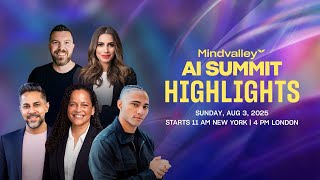
Vishen Lakhiani presents Mindvalley's AI Mastery program, a 5-month micro-degree starting August 13th with a 15-day money-back guarantee. Learn to build apps without coding, automate workflows, and use AI for writing and marketing. The program covers prompt engineering and agent design, skills that outlast changing interfaces.
Chapters
Maybe made it, but we heard your comments, we got your emails and we know that unfortunately some of you were unable to attend either a session or the three day event. So we have put together some of the top moments, the top talks and of course the all the information that you need to know for today's highlight summit. So everybody, no matter where you are, if you're just starting off, if AI is new to you or if you're an entrepreneur looking how to integrate it into your business and your marketing, stick around because this is going to be a couple of hours where you don't want to miss. This is the third time in our life that we are seeing a massive shift and we know at mindvalley that AI is so important for you to be ahead of the curb, to be riding the wave and to be able to use it in your life. So today we have got some of the top speakers. The former AI chief scientist from Google, she also worked with Microsoft, done over a billion dollars in sales. Noel Russell will be here. Dominic Ashburn, aka Mr. Gre, grateful he took his social media platform from 3,000 to 167,000 followers just using AI. We have the founders of AI Build Labs and of course Vishen Lakiani. So everybody, welcome, welcome, welcome, My name is Caitlin o' Toole to mindvalley's AI Summit highlights. And to kick it off, please everybody welcome the founder and CEO Vishen.
Hi, everyone. So good to be here. This is a replay. I'm actually coming to you live. And no, I am not a clone. This is the real me. I'm currently in Amsterdam in my Airbnb, getting ready to kick off Mindvalley University tomorrow, where 2,000 of you are coming live, not Zoom Live, to Amsterdam for two weeks of mindvalley. Goodness. But what we're doing today is we're going to be replaying the some of the highest rated content from AI Summit. AI Summit was a big event. 160,000 people, four hours a day for three days. And so it was really designed for people who wanted to go not just at the surface level of AI, but pretty deep. As you went deeper into the summit, you learned things such as how to build your own AI agents, how to use AI for research, how to build AI employees using GPT. We went into things such as using tools such as ChatGPT, operator, project files, how to even create your own AI advisor, health advisor. Now what I'm going to do next is what you're going to see is my the recording of me presenting the opening talk At AI Summit, I'm not going to be live, but I will come on live towards the end. My final, final training today will be live directly here from Amsterdam and I think you're going to have a really amazing time. Back to you, Caitlin.
Thank you so much, Vishen. And what's really cool about this, guys, I want you to know and I want to ask you all, please, if you have access to a laptop, get it out. This is going be hands on. This is going to be practical. We are actually going to have Noelle live with us, walking you through how to create, as Vishen mentioned, AI agents, how to update and train your ChatGPT so that it knows about you. This is not just lecturing, this is implement implementation in real time with us. So if you can get your laptops off and let's kick it off with the first recording of Vision.
Nice to have you here, everyone. This is setting a new record for mindvalley. We have 12,000 people live with us right now, over 160,000 people who registered for this three day event. And over the next three days we're hoping to help give an AI education to close to typically. We see about 60% of people who register show up, so we're looking at maybe 75,000 people attending some aspect of this event. Now the event's happening over three days because we are beaming this to people all around the world. And if you're here, congratulations because you are probably in the top 2% of people worldwide right now that is getting ready to fully embrace AI in their lifestyle. And before I get started with my opening talk on AI, I want to give you an idea of some of the amazing teachers that we have today. Let's get started. Now we'll also be hearing from Cassie Kozakov, who is the former chief decision scientist at Google. Now she's led over 100 plus AI transformation projects at Google. And Google is one of those companies that's dominating the world of AI. So far, she's trained over 20,000 professionals and pioneered decision intelligence as a field. She is one of the key women in data science and just a brilliant, brilliant, brilliant teacher that we are honored to be bringing to you. Now you're also going to hear from a former AI leader at Microsoft, IBM, AWF and Alexa. She's built over 100 plus AI applications and influenced nearly 1 billion in AI revenue. This is Noelle Russell. I just had lunch with Noelle in New York. She blew my mind. What this lady has built is incredible. And she started getting into AI to help her children Noelle has a number of children and she had a son who had severe health issues and she started going into voice AI to help her son. She's going to be sharing that story. So Noel wrote a book called Scaling Responsible with AI if you use an Alexa device. She was part of the original team that worked with Jeff Bezos to create Alexa. You're going to learn from Dominic Ashburn. I love Dominic. He's been speaking at our summit now for the third year. Dominic is a guy who started out with just a few fans on Instagram 3000 and he decided to give himself a challenge. How could he get to 100,000 fans in 30 days leveraging AI. And boy did he figure it out. He was voted a best speaker at last year's AI Summit. So we're honored to have Dominic with here in Tallinn. He's going to be in the same studio sharing his ideas with you. This is going to be so useful for those of you who want to.
Create.
Social media content for AI, but also those of you who are speakers, who are authors, who are artists, who want to create video based AI. He's the founder of Mr. Grateful and a media strategist for elite brands like Nike and NFL. He's known for his viral agent GPT challenge where he grew his Instagram from 3K to 167K in 30 days using AI. And he teaches other people how to do the same. So Dominic is a master and I'm so excited that he's going to be sharing his wisdom with you. So as you can see, you're going to be learning from people from large corporations, Amazon, Google, Microsoft, but also people who are starting from scratch straight out of college and doing remarkable things with AI. You're now going to learn from Nick. Sonnenberg had lunch with Nick in New York two days ago. He's the author and founder of Leverage. So when I sat down with Nick, now Nick is so brilliant, Tony Broadman's Jay Abraham brought him in to help them optimize his companies. And Nick showed me something which I hope he covers during this summit. If not, he's definitely covering it. In our AI mastery degree, Nick showed me how to build in two hours an AI bot that is powered by a tool called N8N which you'll be learning about. And it's able to access my email and then access everything else in my backend corporate database and then compose an email reply to every single email I get. And all I got to do is open my email in the morning, look at those replies they are stunningly accurate. They access my CRM, they access data I have for conversations with my team and all I gotta do is edit or click Approve and the email goes out. This cuts down email response time by a whopping 80% and helps you have inbox zero. And that's just one of the things he's going to be talking about. He wrote the book Come up for Air, which is a brilliant book and it's about how to stop drowning in work. Then you're going to learn from Iman Obu. This will be her third year speaking at AI Summit. Iman is the founder of Vocable AI. And Vocable AI allowed you to create content at scale. So no matter what you're doing, whether you're a speaker or you have a company selling widgets, Vocable understands your brand, it allows you to upload all the information you have on your product and then it comes up with really creative, novel ideas for your content. She's also a best selling author, serial entrepreneur and she bridges technology with high impact content strategies. So look forward to Iman tomorrow. Finally, you'll be learning from Sarah Davison, co founder of AI Build Lab, alongside Tyler Fisk who is her co founder. And she will and Tyler will also be speaking and they're going to be talking about AI for personal branding and human centered design. There's Tyler and both of them are powerhouses. A special guest speaker we have is Varun Maya, Founder and CEO of ao. So if you've been seeing Varun, his videos have been blowing up all over the Internet. He's a tech content strategist, an AI innovator with 60 million views and he is doing so well, so well. He is getting some of the leading figures in the world to come and sit down with him to be interviewed on AI such as Satya Nadella. Now finally you're going to learn from Vikintas Claudenis, who is MindValley's own Chief AI Transformation Officer, two time TEDx speaker. Vikintas is one of the many AI specialists in MindValley, but he's by far one of the fastest. Let me give you an example. We were launching a conference, Mindvalley University, which is happening two weeks from now. And this happened two years ago. So even more than AI, it was AI. Two years ago we needed an app with fairly complex set of features. We needed people to see events, browse speakers, sign up for certain events, rsvp, follow speakers, even submit their proposals if they wanted to get on stage. If we went out with a vendor to Build this app, it would have cost us close to $100,000. Vikintas built it for under $1,000 in two weeks flat using Airtable and the tool called Glide. Those are actually screenshots of the app. And this is one of the things that he teaches at AI Mastery. He's by far the most prolific teacher at our AI Mastery program. And after five months of learning with Dickintosh, just one to two lessons a week, people are able, ordinary people with no coding experience are able to build their own apps. This is a really powerful tool. So when you hear about ideas such as the next billion dollar company will be built by teams of one, two or three people, this program is designed to get you there. Now let's come to our opening presentation for today. I have exactly 43 minutes and 48 seconds left on the clock. Why am I that precise? Our AI lecturers are top tier, cutting edge executives from all around the world, depending on where they are tuning in. Because many of them travel worldwide to teach, it might be 2am where they are. So all our teachers, all our lecturers have to sit and stay by the clock. If not, we may have to cut them early to let the next teacher come in. This isn't rudeness, this is respect. It's respect for you and your time. Because we gave you all a schedule and certain people want to show up for just a particular talk. We want to respect your time. And sometimes a teacher inadvertently goes over, that's okay. But they do get cut off. And we ask our host to be very, very considerate of this time. So please understand, if this happens, it's only out of respect for everyone and to ensure that we are compliant with the time codes that we share. Okay, so let's get started with the first presentation. Ten years ago, I had lunch in Silicon Valley with two of the most innovative people in AI. One is Ray Kurzweil. He's the modern Edison of our time. As we were sitting down for lunch, and I was lucky enough to be in this group, and Ray happened to sit in front of me at the table. And Ray said something that really shocked me. He said, By 2029, we will reach singularity. What is singularity? That's when basically AI has become so incredibly powerful, it is smarter than the collective brains of all humanity. Now, we said 2029. That seems pretty close, doesn't it? That's four years away. But let me tell you why this is relevant. Also in that room was Peter Diamandis, the futurist. If you don't know Peter Diamandis. Have you ever seen Virgin Galactic? The world's first space space plane that can take a person to space and bring them back safely? Well, Peter created the XPRIZE foundation that pioneered private space travel. I know this because I was on the board of XPRIZE for five years. That's how I met Ray. That's how I met Peter. And at one, at that same lunch, Peter said this. He said, so this was 2016. He said between 1900 and 2000, the world saw 100 years of change. Between 2000 and 2000, 2000 to 2016, we will equivalently see 100 years of change. We'll then see 100 years of change between 2016 to 2022, and then 100 years of change between 2022 to 2024. That's what it looks like if you plot it out. What he's saying is that change is accelerating. It's accelerating at a crazy rate, but it's accelerating so fast, most of us are no longer going to be able to predict what's going to happen. Politicians can't predict it. Even the President of the United States can't predict it because change is expanding so much, and our brains are not able to wrap themselves around exponential technology. This is where the age of AI can feel scary, but at the same time, it's an opportunity. I want you to look at this graph from James Clear's book, Atomic Habits. Any new technology that is created, whether it's private space travel or it's AI or it's the transistor in the first few years, what tends to happen is people talk about it, people celebrate it. The inventors may get a Nobel Prize, but the general public doesn't really affect us. This is called the Valley of Disappointment. But what we fail to understand is the change isn't growing linearly, it's growing exponentially. The quality of transistors improves exponentially. The quality of AI improves exponentially. We think AI is going to grow linearly, but it isn't. What's actually about to happen is it's about to accelerate. And in that gap between what actually happens and what we think should happen lies opportunity. And that, my friends, is what this event is about. It's to make you some of the first people in the world to seize that opportunity. Now, I want to show you just how fast AI is expanding. AI price to performance doubles every 3.3 months. So what we mean here is that for the dollar that you spend, the AI that you're getting doubles in performance every 3.3 months. So if you look at this, you'll see how fast we're going from GPT3 to GPT4 to GPT 3.5 to GPT to GPT5, which is coming up soon. AI price to performance is doubling every 3.3 months. This is also likely to accelerate because soon AI is going to be dramatically able to improve itself. So I want you to play a game with me. I want you to guess if AI is doubling, let's keep it simple. Three months. Every three months we'll round it down a little. How powerful will AI be in five years? Now we know this. We know if something is doubling every three months, in one year it becomes 16 times more powerful. How powerful does it become in two years? Well, the answer is 256. But now let's project to five years. Now let's make the game more interesting. If I gave you, what would you rather choose? If I gave you a dollar on day one and I doubled it every single day for 21 days. So I gave you a dollar on day one, day two you get $2. Day three, you get $4. Day four you get $8 and I doubled it every day for 21 days. What number would you have at the end of the 21 days? Now at the same time, what if I just gave you a million dollars straight? Which option would you choose? If you wanted to maximize monetary gain, most people would say dollar doubling every day. I'll take the million dollars. But it turns out a dollar doubling every day for 21 days. On the 20th day you will have a million dollars. On the 21st day you will have two million dollars. That's how rapidly doubling happens. So the answer to the AI question is this. In five years, AI is about to be a million times more powerful in five years. Ever seen Star Wars? C3PO, R2, D2. The AI that we're going to have in five years that is going to be in robots, is going to be significantly smarter than the goofy droids of Star Wars. And it's going to be roughly the price of a car, all of us by 2030. If you can afford a car, you will be able to afford a robot that will be smarter, significantly smarter than the droids in Star Wars. Now it's not just AI, it's a merging of different technologies. Recently I was at MIT Media Labs and I remember witnessing there some really mind blowing technologies. One of the technologies was a camera lens that can look at your skin and just from tiny changes in the color of your skin because it's that accurate, it can determine if you're engaged, if you're stressed out. And so an AI robot, let's say you have one at home who's tutoring your child, will actually have a form of empathy. We understand empathy through body language, maybe even a little bit true intuition or the expressions on the child's face. The AI would have the same thing. It'll be able to understand expressions that will also be able to see if a child or a student is stressed out and thus conclude if it needs to slow down the learning or be a little bit more patient. This is what's getting interesting. AI is becoming better at things that we traditionally thought were only suitable for humans. So again, if you look at the chart, in five years, AI will be a million times more powerful. And it's fascinating to think, what's life going to be like now? Some of you might be thinking, well, what about Moore's Law? Aren't we going to hit a ceiling in our technology? So Moore's Law says that microprocessors power doubles every 18 months. This has been true for the last number of years. Right. But at a certain point, you're dealing with atoms and electrons. So can you still continue doubling the power of a transistor? Most people thought no, but then quantum computing came to be. Quantum computing is wild. Google just claimed that their new quantum computer is doing calculations so fast. So calculations that should take millions of years are now being done in hours. And Google literally said, the head of quantum computing research said the only way they can explain how this works is that we live in multiple universes. These computers are doing calculations simultaneously in qubits in multiple universes. Now, the first quantum computing applications are going to be released this year. You're going to read about it. I know the company that's about to release it, but I don't know if I can say it publicly. I learned this recently in Silicon Valley. But this is going to again, transform the world. It also is going to be able to create computers so powerful, all your passwords are basically going to be useless. Bitcoin is going to be under threat because quantum computers will be able to hack the blockchain. So Bitcoin is going to have to innovate to save itself from quantum computers. And this again is going to be an opportunity, but also a threat. This graph shows you just the difference between Moore's Law and quantum computing. As you can see quantum computing in this graph again, by the way, this is a relative scale, because if we put this. On a traditional graph, what you would see is a flat line, and then, boom, it just shoots up. That's what we're about to experience. So now let's come to some useful stuff. Why am I excited about AI? Well, our company, mindvalley, is about improving the human experience. It's about making you more mindful and making you healthier, making you wealthier, making us better entrepreneurs. And what we've come to understand is that AI is a new. Is a new tool that helps with every single one of those dimensions. It can help with mental health when used correctly. It can help with cognition. It can help with your help. It can help you build a business when used correctly. And this is what I want to share with you right now. So I'm going to teach you how to build a simple AI tool using ChatGPT or Manus AI. ChatGPT is American. Manus is Chinese. I'm going to teach you how to use a simple AI tool to help you improve your health. To understand it, I got to be a little vulnerable and share with you my waistline calculation. So waist circumference is a measure that people who care about heart health and diabetes and cholesterol, men especially, calculate waistline circumference as a way to track if our body is going through inflammation because it causes our waist to expand or if we're putting on fat. When we're going through moments of poor sleep, bad food, stressful times, or even inflammation because of an illness or just traveling to a different country, our waistlines expand. So Apple is very. Is very a big fan of waist circumference. So if you open up your Apple Health app, you'll see there's actually a waist circumference calculator, and you can log your waist circumference. You do this simply with a tape measure. So I was logging my waist circumference over a couple of months, and I notice a pattern. Okay. And you'll notice the yellow lines. At the point of the yellow lines, my waistline went up. And then you'll notice there's a green line, and it starts dropping. It was dropping by 1cm or half an inch roughly every week. And then you'll see another yellow line, and it starts going up. Now, what was going on? Turned out American food was going on. The yellow line to the green line is when I was in the United States. The green line where you see it dropping is when I'm back in Europe in healthy Estonia. Now I'm eating mostly the same things, but it turns out that American food was causing inflammation in me. Now I needed to figure out. So after going to my trip to America and I felt I was putting on weight, my waistline was expanding. I came back and I couldn't button my pants. I couldn't figure out what to do. Did I just need to go on a keto diet? I tried that. Nothing. So I decided to try an experiment. I went to ChatGPT and I told ChatGPT to act as a health advisor. And I said, I'm going to be photographing everything I'm eating and I just want you to look at what I'm eating and tell me how can I improve my diet? And then give me macros. Macros meaning goals. The amount of carbs, amount of protein, amount of fat that I should take every single day. This is the exact script I used. It was on June 5th. I need you to be my eating advisor. I'm going to tell you what I eat every day and you're going to help me with my macros. Okay? So today is June 5th. It's Thursday. I've eaten a five egg omelet with a drizzle of olive oil, then half an avocado with Himalayan salt and a drizzle of olive oil. Start by giving me my targets for the day based on our past conversations. Then let me know where I am. Simple. And you will notice it sounds like I'm speaking it because that's literally what I did. I like to use the Voice option in ChatGPT now. I was shocked at how accurate this was. I remember doing this a year ago. It wasn't as smart and as accurate as it is this year because this was on June 5. By June 10, in five days, ChatGPT shocked me. ChatGPT said, by the way, I think I figured out why your waistline is expanding. You are low on fiber. And I was thinking, fiber. Why does fiber even matter? Like most guys, I cared about protein. I was eating tons of protein, tons of protein, enough fat for weight training, and I cut down carbs. Why did fiber matter? And ChatGPT explained it said, I've been looking at your eating patterns. 97% of men don't eat enough fiber. And here's what happens when you don't take enough fiber. It affects your gut microbiome. Your gut microbiome cannot process as effectively the fat that you're taking in. And as a result, there's higher fat storage. So I told ChatGPT, well, what can I eat to improve fiber? And ChatGPT invented this for me. It basically told me, take Greek yogurt, add blueberries to it, add banana, add cinnamon for taste, add stevia, and then add plant phylum, something I'd never ever heard of before, and add chia seeds again, something I don't typically do.
This was really cool.
From just five days of me photographing my food, it figured out what was wrong with me. Now, remember, I told it what was going on. I shared with it a screenshot of my waist circumference, and as a result, immediately I started dropping 1cm off my waist a week. Now, I didn't just stop there. Every day I photograph my food, I'd upload it to chatgpt and chatgpt would give me its estimated totals for the day. Okay, so it'll tell me, okay, today you have a calorie deficit protein, today you're low, so have a shake. And it was strikingly accurate. Now, how can you build something like this? What many people don't know is that in ChatGPT there's a tool called projects. So, yes, you can just start a conversation. But ChatGPT recently, a couple of months ago, launched a tool called projects. You can go to projects and you can see here, I created a project called help. Now, you start with a simple prompt. So a project is a set of queries that are all related. But what makes a project interesting is you can upload data into ChatGPT. So I ask it, I told it this, and this is the most basic prompt you can use. Your job is to act as an ultimate health advisor and doctor for Vishen Lakhiani, male, 49. And then I gave it my birthday. See all attached files for medical data. This is the important thing. See all attached files for medical data. Now, the next thing I did was in this project, I uploaded everything in body scans, DEXA scans, urine analysis, blood analysis, every single thing from multiple, multiple places. Now, after it got all of this data, it became even more accurate. It was able to tell me not just what to eat, but what supplementation I needed. And it was able to do it better than my doctor. Now it gets even fancier. I came back and you can see this is the miserable picture of my fridge. After traveling for two weeks, came back, photographed my fridge, and I know this looks so pathetic, those bananas have already gone stale. I'm almost embarrassed showing you this. You can see I bought an onion, but I never cut it. Maybe because I'm afraid of crying. I showed you the picture of my fridge and chatgpt at this point is so smart, just based on that one stupid picture, it could figure out what I have in my fridge and then tell me what I'm missing for a well balanced day. Now you can, you can talk to it. So for example, I don't really believe in tofu, so I can tell it, listen, I don't want to take tofu because I hear it may have hormones which are not good for men. And ChatGPT will be empathetic. And ChatGPT, well, you can ask ChatGPT to validate that fact if you read it somewhere in a biohacking blog. And then you can ask ChatGPT to replace that. But this is where we are. Not only can you photograph your food, you can now photograph your fridge. So I want to encourage all of you to start using projects in ChatGPT. That is one of the most powerful tips I can give people. Currently, I'm helping a cousin of mine who's in her 50s and is going through kidney stones. And I told her, listen, give me all your blood work, all the diagnostics from your doctors, everything. And the stuff that we get from hospitals tends to be really, really, really hard to understand. And so I've thought of how to upload this into a project in ChatGPT, and then I'm getting ChatGPT to analyze everything and give her a second opinion. Please. I am not saying this is what it looks like. I'm not saying don't trust your doctor, trust your doctor. But it often helps to have a second opinion from ChatGPT, because as you're about to see, and I'm going to share the Data with you, ChatGPT officially is more accurate than doctors and more empathetic than doctors. That is how fast we've become. Now, we spoke about ChatGPT. Here's another really cool tool. So this is Manus, okay? Manus AI. This is a tool from China and it's completely free. Now, again, I know some of you may be wondering, is it safe to upload my medical data and information like that to chatgpt or Manuscript? Well, somebody could hack it and I guess somebody could see what you're eating. But listen, for me, I don't really care. I literally just showed you guys a picture of my fridge. Do with it what you want. I don't know, unless you're President of the United States, I don't think anybody really gives a damn what you're eating. So to me, yeah, maybe some, some bad characters might get this data. It's not like it's the password to my bank account. Okay, now, this is what I did on Manus. I uploaded the ugly formatted document from the medical testing center. And I told Manus this. I told Manus I need a cool way to demonstrate the result of my blood work, analyze this and turn it into a compelling report. And then I uploaded this ugly document. You can see. Let me see if I can open this. It doesn't open, but trust me, it's medical data. And Manus starts analyzing all of this. And then it came up with beautiful visuals. What Manus is really good at is imagery. See, it showed me my health score. It gave me graphs. It showed me what I was low at, what I'm doing well at, what is in the normal range, what is in the optimal range. I didn't tell it how to present it. I simply told it, show me. Make it fun and exciting to read. So this is Manus. And I said, give me my data like Apple designed it. This is what it did.
This is.
I can tell you guys so much better than what I got from the lab company. Now, I wasn't done yet. I like people who are. I like enthusiastic coaches. So I told Manus. I told Manus this. I said, I want now rewrite it in an enthusiastic and beautiful tone that sounds like a really close and supportive coach. That's all one line. And it rewrote it in such the cutest way. Vision, you're absolutely crushing it. It changed the title to your incredible health victory report. I love this. Holy.
Wow.
Look at what you achieved. And here, maybe it got a little bit too emotional because I wanted to tell it. Manus, just calm the f CK down. Vision, I'm literally jumping out of my chair right now. No, Manus, you are a robot. You don't sit on chairs. Your blood work REM results are phenomenal. We are talking about 97 out of 100 health score. That puts you at the top 5% of all humans on this planet. Not that I'm counting, but I do kind of like being at the top 5%. And then it tells me my strong performers. It tells me, what am I? It came up with words like, these are your triple crown champions. Vishen you've achieved something. Absolutely. It sucks up to you. This is so awesome. So thank you, China, for Manus. By the way, Manus is very affordable and it's open source. So what it means by open source is you can even technically, if you smart enough, learn to run it on your own computer and it's free. China is doing this because they are competing in the AI race with the United States. And it's really fun to see how both superpowers are competing with each other. And as a result, they are helping drive down the cost of AI for the rest of us. Okay, let's go back to the slides because I want to now show you this. What will the world look like in five years when AI is a million times more powerful? So Sam Altman, who created chat, who is the CEO of ChatGPT, said, we are now confident we know how to build artificial general intelligence as we have traditionally understood it. And we are now beginning to turn our aim beyond that to superintelligence, in a true sense of the word. Superintelligent tools could massively accelerate scientific discovery and innovation well beyond what we are capable of doing on our own and turn massive increase in abundance and in turn create massive increase in abundance and prosperity. So what is the key difference? Artificial general intelligence matches human intelligence. We're getting there. Superintelligence exceeds it. And this is the promising part. Assuming we use AI for good, superintelligence exceeds it, unlocking unimaginable possibilities. Unimaginable. So the future is probably going to look something like this agentic AI. This is becoming more and more real in 2025. These are autonomous agents that ideate and execute on task with minimal human guidance. So you've heard of software as a service. Agentic AI is results as a service. You can go to an AI agent pretty soon and say, hey, listen, I sell. I sell rings, and here's the catalog of all my rings. I sell them on my Instagram store. I want you to create compelling advertising for these rings. I can afford my cost of acquisition. I can afford to pay maybe $100 for a customer, and my ring sell for 199. That's all you gotta say. An agentic AI. And this is coming. Mark Zuckerberg has said he's going to build it. And when this launches, it's going to make tons of ad agencies, and sadly, designers as well, obsolete. The AgentIC AI will analyze your catalog. It'll analyze principles of advertising. It'll understand what works on Meta. It'll create the best video ads, the best image ads, the best captions, the best taglines for your ring. It might even give you advice on how to optimize your Shopify storefront. It'll then run the ads on Meta, understanding your customer acquisition cost, what you're able to pay, it will optimize these ads. It will come back to you in 24 hours and say, Listen, I tried AD, a AD bag. ADC is working best. Would you like to increase your budget? It'll do all of this in minutes. Of course it'll take some time for the, for the data to come in, but it'll be able to execute all of this in minutes at 1:1000. The cost of a human being. This is scary because it will decrease employeeship opportunities. But it's not scary if you then understand that this means that all human beings, the gap between your dreams and actually building a product or a service or a company just shrank massively. Because now any of you could follow your passion and design rings or design clothing. And you don't need to learn all of these. You can be a great artist.
You don't have to learn all of.
These other skills such as advertising, copywriting. AI will do all of that. Employeeship of one. Now we're going to go beyond that. We're going to go to embodied AI. This is AI with a body, in short, autonomous robots. This is a slide from Jensen Huang's presentation on where Nvidia is going. Nvidia became the first trillion dollar company recently. And Nvidia builds the chips that basically power AI. So perception AI is where we started out. Perception AI, that would be cars, Teslas, the, the screen in your Tesla that helps a Tesla drive. We want a generative AI. This emerged maybe about three years ago. Art, music, text, ChatGPT was generative AI applied to text. This year we go into Agentic AI, AI applications that can think and act like human beings or teams of human beings. And where we're about to go is physical AI, true self driving cars and true robots. So generative AI, this is what most people are using. ChatGPT, you can use generative AI to create great music. I'm going to show you that later today. Where you need to get to next is agentic AI. Agentic AI is basically AI as employees. When they say future companies of a billion dollars in valuation are going to have teams of one, they mean teams of one with swarms of AI agents empowering the entrepreneur, meaning you. Where we're about to go is physical AI. Why is physical AI interesting? Well, I'll tell you guys, today I spent an hour doing laundry. The hardest part is just folding my damn clothes because I came back from a long trip. Very soon you'll be able to buy robots. This is a screenshot I took at a recent lecture at Singularity University. Robots are being built all around the world. China is leading the innovation and these robots, because there are so many companies jumping into this, they're innovating incredibly fast and costs are coming down already in China. This is an actual factory in China. We have this impression. Americans have this impression that China employs low level laborers who are making your Nikes and making your glasses and your T shirts. No, Chinese factories are way ahead. Many Chinese factories operate completely in the dark. Why? Because there are no human beings. It's all robots. Robots don't need lighting. China is insanely advanced. The big best selling EV car in the world today is not Tesla anymore, it's bid in China. And products from China are extremely high quality right now and are made by robots. A lot of the ideas that we have about China are strikingly obsolete. It's because, well, many American politicians live in a bubble. If you go to China, your mind will be blown. And the largest number of robot companies in the world today are in China. 50% of AI PhDs are in China. So what will robots look like in the home? So this was a paper, a report I saw on, I believe it was Stanford. But that's not what home robots are going to look like. Why? They're not going to look like C3PO. Because imagine if C3PO was taking care of your baby and C3PO is the robot from Star wars and C3PO bends its arm and your baby's finger gets caught in the gap between the robot's arms. That could be really painful. Home robots are going to be wearing pajamas. They're literally going to be in soft, fluffy, huggable clothing. I don't know what type of fiber. So this is an AI robotic company. It's called the Neo Beta. It's BY1X. And your home robots are going to look like that and they're going to be available in five years. This is what I'm so looking forward to because I hate doing laundry, I hate doing dishes. And these guys are going to be so wonderful. And you can probably buy different outfits for them, different faces for them. They will be like smart pets that you can talk shit to. So given all of this, how will being human evolve? Well, we're going to enter an era where there's going to be so much free time we could risk blowing it away in virtual worlds and computer games. And that would be unfortunate. How we hope we evolve as human beings is we use that free time to create a new era of human flourishing by being able to truly bring art creativity into everything we're building, whether it's buildings or it's jewelry or it's the clothing we design, or it's the web pages or the apps. We can spend more time not on minimalistic design, but in truly creating art. I also believe that we're about to enter the three day work week. This is an experiment that's happening in many cities around the world and it's proven to be very favorable. So what they're doing is they did this in Iceland, they did it in Dubai. And they started by going from the five day workweek to the four day work week, same salary, but employees get three days off on the weekend. And what they found is productivity actually goes up or stays the same and so the company doesn't lose. Now why is this happening? It's because we've created a bullshit idea of work. We work way too much. In America, it's acceptable to work 40 to 50 hours.
No.
Are you freaking crazy? Work to the average American consumes 70% of their waking hours. That isn't work. That is you being a cog in the wheels of industry to create, to grow GDP at the expense of your health, your well being, your peace, your ability to truly see the world, your ability to spend more time with your kids. It is a bullshit system based on World War II operating principles that the measure of a country is GDP per cap per capita. So in Europe, working hours in many places around the world are coming down to about 35. What we're about to see is that the work week is going to continue diminishing. It's going to continue diminishing until the work week is going to be maybe 15 hours a week. This is going to be a wonderful thing. But the first thing is we got to get out of our minds the stupid idea that human beings are lazy and if they don't have work, they're just going to vegetate away or they're going to be up to no good. Or that we shouldn't pay someone if they can't work because universal basic income is happening. And universal basic income, even Elon Musk said it's not a question of if, it's a question of when.
So if you look at weekly work.
Hours, it has been going down over time. It's gone down more in Western Europe than the United States. But actually, for those of you who think, who say Western Europeans work less than Americans, this is a recent phenomenon. You can see Western Europeans only started working less than Americans in the 1980s. What's about to happen right now is these lines are about to plunge. And this is a Good thing. Smart leaders, smart governments need to start mandating a four day work week. Even I'd say go beyond mandate, a three day work week. My greatest, my greatest hope is that Trump suddenly says, right now, every American has a four day weekend and a three day work week. And then investors in AI training for every American. And if Europe does the same, here's what's going to happen. Our kids are going to be healthier. We're going to have more time for our health, more time for personal growth, more time to truly engage with each other as human beings. GDP per capita will not fall. And honestly, if it fell, it'll continue to grow. But GDP growth might slow down. But that is a bullshit metric anyway. What is more important is to start paying attention to health metrics, to lifespan metrics, to relationship metrics, to happiness metrics, to how we care for our children metrics. Okay? How will we get there? How is this world going to happen? So I want to share with you some ideas. 5 Ways AI will make the world better by 2035. Already we are seeing that AI is becoming so brilliant at patent detection that it can likely help detect and cure major diseases. Now, what this means is that. So let me tell you an experiment that was recently done. So they had an AI look at the retina of an eyeball. And based on retina patterns, the AI could predict if the eyeball was male or female at 93% accuracy. Now, scientists didn't even know that our retinas were different based on our gender. So if an AI can look at a retina picture and figure out male or female, guess what? An AI can look at data on your saliva and predict if you're about to have throat cancer. In fact, Viome Naveen Jain's company has just patented that. And AI can look at a picture of your skin and figure out if you're at risk for skin cancer. And AI can look at an MRI and predict breast cancer well in advance. This can significantly save lives. They can do it better than doctors. AI can end global hunger because AI is going to help us create better crops and create innovations in farming that can maybe bring nutrition back in our food again. It can help us unlock clean, infinite energy. AI will drive breakthroughs in fusion storage and sustainable grids. So while AI is consuming a lot of energy and this is something to worry about because it is producing additional heat and global warming is already a big risk factor for humans, we're hoping that AI can help us move faster towards clean energy and then help us find a solution to global warming. AI is likely going to reinvent education for all. It's going to make classrooms better, it's going to make training for employees better. And you're already seeing this all across the world. What I'm most hopeful for is that AI can help us restore and protect the planet. So we spoke of a lot of examples. I want to go deeper on one idea. AI for help. Okay, So I shared with you Manus, I shared with you ChatGPT projects. I want to show you why I'm so optimistic on AI for health. And again, I'm saying this with respect and reverence for doctors. Always use this with a doctor. But about a month ago, I had an interesting experience. So I was at Singularity University with my son and they shared this study on doctors. And what they said was, if you compare. So the study was done in 2023. So 2023 was two years ago. How much weaker was the AI? The AI of two years ago was 256 times weaker than the AI today. Or at least we're 256 times better than AI two years ago. Even two years ago, on a study of 195 people, evaluators preferred chatbot responses to physician responses. What they found is that the chatbots were more accurate in diagnosing patient needs. They beat physicians. But not only that, the chatbot significantly beat physicians in empathy. Now, this is not because physicians are not empathetic. My dad's brother is a doctor. Kindest, most brilliant man you know you can think of. But doctors have so many patients. How can they possibly be empathetic to everyone? AI today is 256 times more powerful than when that study was done. So imagine where AI today can be. So coincidentally, when I landed in Singularity University, this happened to me. I got a stye in my eye. So I got off the plane and I couldn't open my eyelid. And so I wanted to go to the pharmacy in the US and get eye drops. I couldn't get the eye drops without a prescription. I can get them in Dubai, I can get them in Estonia, not in the us you need a prescription. And we all know the US medical system as well as the food system is bonkers. Absolute crap compared to the Middle east and Europe and Asia. I say this with respect. I live in the US partially, and it's just a reality. And I think most Americans would agree here. So I told the doctor, I made an appointment for the doctor on zocdoc, which is a doctor matching service. And the Doctor said, texted me and said, you don't have to come in, just tell me what's going on. And told him, I think I have a star in my eye. He said, great, pay this invoice and I'll get you the prescription. I said, do you want to even look at my eye? No, respond. Just paid this invoice 150 bucks for a medicine that is 27 bucks. So I had to. So I sent him a picture of my eye. I cropped off that picture over there. This is the eye. After one day of the medicine, he didn't even reply. Again, I'm not saying my doctor is bad. He probably just was really busy. The commentary was in short words. There was no empathy, there was no care. I was deeply frustrated. Then I remembered that study that I'd just seen in Singularity University. So I decided to do the same thing with ChatGPT. Now, this is what ChatGPT said, okay, observe the difference. This is my doctor. Can you call and see if it's over the counter? Triple antibiotic ointment. He didn't even respond to the picture of my eye. Now, this is ChatGPT. Thanks for the close up, Sherlock. Here's what I can tell from the image. There appears to be some redness, no obvious yellowing, blah, blah, blah, blah, blah. It goes on and on and on. But it actually went in detail to explain the issue. It told me what to do in addition to the medication. It told me how to use a warm compress. It told me when I should see a doctor. It created a three step eye healing protocol. I then would do daily check in. See, I'd send it pics and I'd say, pics from this morning. How does it look? It would compare this morning's pics to the previous morning's pics and it would say, here's the good news, what this looks like now, you're likely in day three or four. It was even able to compare the pictures. And then I went to the pharmacy. So before that I went to the pharmacy. I got confused by the various options, so I messaged my doctor again. One word response, yes, this is ChatGPT's response. The exact ointment I couldn't find. ChatGPT gave me a detailed response on the exact ointment. I went further. I decided, I'm going to demo this later. I decided, this is so powerful. I'm going to build my own AI application to manage my health and I'm going to show you how to do this. So I now have An AI doctor that runs my entire health for me. I built it in 15 hours using a tool called replacement it. And then you're going to learn that. I'm going to give you a quick demo of it here. You're going to learn principles of how to build it in the AI Mastery program. Okay? And I call my doctor Eliza. Eliza is named after the world's first chatbot. I've endowed her with an incredible personality. And you're going to learn how to do a lot of these things as well.
Okay?
So when I start my day, I can say, good morning, Eliza. Not sleeping well, Jet lag still hitting me. After my flight from Seoul to Miami, Eliza greets me in the most beautiful way. Eliza recommends what I can do, and you can see how wonderful this is. Okay. And Eliza can also has her own opinion. She also shares her thoughts on social media. Eliza will be launching her own social media account. She's literally like a live human being. You're going to learn to how all of this soon. I'll be coming back to teach you. For now, what I want to show you is the final thing that I want you to do. So I want you to draft a letter to yourself using Chat GPT to create your AI vision. Here is the prompt I want you to use. Well, before we get there, let me explain something. ChatGPT. Why is it so empathetic? Why does it feel like it knows you? Because it forms memories. Many people don't know this, but in ChatGPT, under settings, you can see customization. So you want to click on settings personalization. And then under personalization you will see Manage memories. Do you see the word manage there? When you click on it, you will see memories. So ChatGPT starts to understand certain things about you. For example, the memory it created today is that Vishen is creating an ad playbook for mindvalley's Meditation app. The app includes a unique mix of feature different categories and is available on the Apple Store. It's forming these memories. See, it has a memory of a road trip I just did with my son. Wednesday driving from Cody to Canyon Lodge in Yellowstone, Friday staying at Old Faithful in Yellowstone. It forms these memories because it has these memories, especially the longer you've been using it, and I've been using it now for two years. It knows you as much as your close friends. So I want you to go to ChatGPT and ask this to it. You can type it out, or as you're reading the screen right now, you can click the speak button. In Chatgpt and speak it out. Open up ChatGPT on your phone. It's a lot more accurate when it's grabbing voice. Start a new chat, click the microphone icon. And by the way, for those of you who don't know how to do this, we will paste this so we will paste this in the chat. So mindvalley, mindvalley admins who are helping us with the zoom, you can find this in my most recent letter to mindvalley. Okay, the most recent letter on the mindvalley list, Tuesday's newsletter. Copy it from Tuesday's newsletter and paste it in the chat for everyone to copy. Let me read it out. So those of you who want this right now, click record on your chatgpt and let it listen to my voice. Are you ready? Open up ChatGPT. Click New Chat. Write a letter from my future self to my present self. My future self has just gone through a powerful journey of mastering AI, learning how to use it to amplify my creativity, automate my work, improve my health, expand my consciousness, free up my time to focus on what truly matters. Start the letter with Dear and then my name. It's amazing how far you've come in this letter. Tell me what I've created using AI, who I've become, what I've unlocked in terms of growth, time, income and creativity. What I've let go of in terms of limiting beliefs, habits or fears, what my life looks like now. Make the tone inspiring, visionary and a bit poetic, but still grounded in possibility. Okay? And you can also modify this from any way you want. You can take a photo of this and then, then if you feel so called, share the letter that comes from ChatGPT in the chat or share how reading that letter made you feel. Thank you guys.
Thank you so much. Vishen. So that was a recording we saw from last weekend and I'm telling you, I'm watching this for the second time and my mind is still blown. And I love looking at the comments from all of you, seeing how the world is going to change in the next five years, how we can be prepared for this, how we can start using AI right now. And whether you want to use it to ask what's in your fridge or your health benefits or you want to write a letter to your future self. I have to tell you guys, you know, I'm here in Amsterdam right now. We're getting ready for Mindvalley University that begins tomorrow. And I was working with my ChatGPT and I was like, here are all the amazing people that are Going to be there. I'm going to be there for two weeks. Just put me in awe. Tell me all of the amazing things could happen in my life. And when you use AI for possibility, to open your mind, to open your imagination, to help you manifest and create, it's truly remarkable. And this is the technology that we have right now. And that's just one example for me. But our next speaker, guys, her story, I don't want to ruin it for you. I'm going to let her share her story. But her story of how she got into this, how she got into the AI space, the way she used it with her son and her family dynamic, it is, is so truly remarkable. And she is just such a force of nature. She's worked with Microsoft, she's worked with Amazon, Alexa, she's worked with Google, trained over 20,000 people at Google. She's built over a hundred plus AI conversational apps and is influenced Microsoft to do $1 billion in sales in the AI space. And I want to tell you guys, this is live, this is going to be very hands on. She's going to help you. If you were going deeper here. Vishen was an introduction of, of what's happening in the AI space. But now we're getting serious. We're going to teach you guys how you can build marketing funnels, how you can really use this in your life. And so we are so blessed to have her with us. I want to ask you guys, if you have a laptop, now is the time to take it out. There is no recordings for this. This is live, this is hands on. And I'm telling you, this is going to be an incredible segment. Everybody, please help me welcome the brilliant mind, Noel Russell.
Hello, everyone.
Hello.
Hello.
It's so good to see you. What's up? The hearts are happening. Let's do this. So great to see you all. Hello, my friends. Okay, I just want you all to know, I see you, but you're. Yes. Katrina. Hello.
Hello.
Oh my gosh. So good. Fred. What's up? What's up? Happy Sunday. This is the second Sunday I have gotten to spend with you all and I am, am so blessed for it. What's up? Melissa, Natasha, So good to see you all. All right, so I do have a question just to get us started. If, if you have seen, if you were here the first time, right? If you were here last Sunday with me, will you write Sunday in the chat? Just let me know if you were here last Sunday. Let me know if you were here because I want to make sure you all get extra special something, you know, obviously everyone else, what's up? What's up, everybody? Okay, now if you weren't, that's okay because, because we're going to have a great time over the next 45 minutes here together. But I do like to make sure that if you ever see me speak more than once that you get something special in every single experience with me. So I'm going to make sure I throw in something really cool. But we also have a chance today. I'm going to talk with you, I'm going to talk you through a keynote, a TED Talk, if you will, that I have presented all over the world. And I really think it's important because some of you are not in the rooms that I get to be in. And so I want to share the exact tips that I am giving to executives and entrepreneurs. The biggest and best in the world, I want to give to you. So this is a huge opportunity. But the second thing we're going to do, so that's like the first half, the second half of this is fingers on keyboard and we're going to build our own very own customer service agent. And I'm going to do that for Mind Valley. As a matter of fact, I'm even going to try and get a, get the branding right. We'll see what we can do. I mean, it's a 20 minute app. We're going to build an entire customer service agent for our application. Now this is different than last year's, you know, chat bots or, you know, chatbots from 2020 or 2018. This is an opportunity to create an LLM based conversational agent that not only is going to give you the opportunity to serve people who want help from you 24 hours a day, but also the amazing ability for you to actually collect names and email addresses for you to create transactions all potentially while you're sleeping. And let's face it, as entrepreneurs, that's something that I love to do, is try and get some sleep. So if I can work while I'm sleeping, even better. But let me go ahead and get started. I always like to start this conversation. I'm actually going to share my screen and I'm going to let my avatar. We've heard about avatars a little bit. Definitely in the first session last weekend we also heard about it. But I want to, to share with you. I'm going to share my screen and give you a taste. If you can't hear it, don't worry, you could just increase the volume on your machine. I'm going to do my best to increase it from my place, but also just take a look at. It's only about a minute. Just look at what it looks like, and then I'll share with you kind of exactly how I created it. And. And the interesting. You know, I don't know the interesting journey I have been on while building it. Now, here we go. Let's see what we see first. I'm going to share my sound just to make sure. Are you ready? I think we got it. I think we got it. Okay, I'm here. All right. If you could see a face that looks like mine on a purple screen, please let me know. Thumbs up. You can do a reaction. You could just say yes. Okay. Awesome, Ken. I see you, Lauren. Awesome. All right, so let's get this party started, and I'm gonna. I'm gonna play it for you. Here we go. I am nearly Noel, a synthesized avatar here to help with the introduction. Get ready to meet the incredible Noelle Russell. She's not your ordinary technologist. She's a game changer. With her entrepreneurial spirit and expertise in conversational AI, generative AI, and language models, Noelle has revolutionized the tech industry. But here's the best part. Noelle is so much more than her professional achievements. She's a true inspiration for balancing work and family life. As a wife and mother of six, she embodies the definition of courage and determination. Get ready to be blown away by Noelle's spectacular journey. Join me in welcoming the phenomenal Noelle. The crowd goes wild. Hopefully you saw it. The reason I like this, this video is because I built it over a year ago, but I used a platform that's available to you right now. Now, for the next few minutes, you're gonna just see my slides because I want to share with you a couple of notes that you can take down, but then I'll flip back and you'll get to see my shining, happy face. Unless you could see it now, in which case that would be awesome, too. But I am here to share with you my journey. And that journey is a little bit about me, but it's a lot about the people I have. I feel like I've been blessed to serve. Now, you might have heard that this AI system, right. Nearly Noel, I like to call it, is basically. That was chat gbt. I asked chat gbt. Hey, I'm going to do a keynote. Would you mind writing a little something that I could use to introduce myself? And I gave that to a hey, gen instant avatar. And that's my first gift to you is any one of you today could go out to hey Jen. And create an instant avatar. For free. For free. All you have to do is have, I guess, clarity of thought. You have to know what you want your instant avatar to say. I think that's probably the most important. And you have to be willing to be patient enough with recording two minutes of yourself talking to a camera. Hey Jen. Oh, great, great question. Great question, everyone. Someone will put it in there, but I'm going to put it in there too just to show you I am here with you live. So it's hey Jen dot com. Thank you, Mia. I have a daughter named Mia. So awesome. Okay, so let's get right to it. I want to first share with you why I do what I do this. I don't know if you heard nearly Noel mentioned that I have six kids and that was not a hallucination. That is like legit. I usually stop for a moment and give a moment of silence to my wonderful world of having so many kiddos. But my world really shook the first time I had my very first baby, right? My very first pregnancy. I wanted to, you know, I basically, obviously I've got a lot of kids, but. But my journey into technology, it actually started not when my first child was born. It actually started a little bit further back than that during maybe, you know, this. The first time the world was going to end, it was called Y2K. We were all really worried that the world was going to end and so I got involved in technology and that's how I got into this world. It actually, and I want you all to hear this right now. Today is the same vibe as what was happening in Y2K. We were anxiously searching for people who were willing to learn the technology, willing to learn, learn anything that would help in this kind of pressing world. Back then it was learning how to build for the, the enterprise, how to build cloud, how to basically save the world from Y2K. Today we're talking about AI, data engineering and solving problems with artificial intelligence. But it's the same thing. We need everyone at the table. And you'll hear more about why I think that is in just a few minutes. But fast forward so I do y2k happened. I then realized tech is amazing. I want to be part of it. I start climbing the ladder. I end up at Amazon Web Services and I'm a principal cloud architect helping the world start to use the cloud. This is like 2013 and I end up getting an email from Jeff Bezos and Jeff Bezos he messages me and says, hey, guess what? We want to build a brand new team. That brand new team is going to be called. Well, actually, he didn't even say what it's going to be called. He said, we're going to build the Star Trek computer.
Computer.
And we're not only going to build the Star Trek computer, but we're going to do it. We're going to have fun, we're going to work hard, and we're going to make history. And I, when I read that email, I was like, I'm in. And here's why. See that cute fella in the pool? His name is Max. In 2005. He's 20 now, but in 2005, he was my firstborn child, and he was born with a condition known as down syndrome. And when he was born with that condition, as a new mom, I had no idea what was, what I was in for. But someone gave me really great advice that day. They told me that Max was 1% this thing I didn't understand this condition, this diagnosis. And he was 99% me. And what I was willing to be patient enough to teach him, patient enough to help him learn, and resilient enough to battle for him. And so that put me on a huge tangent. You go look at me on any social media channel and you see who I have worked for, right? Thank you, Caitlin, for that wonderful introduction. Amazon, IBM, Microsoft, like, I worked for these companies not just because I cared about tech, but because I now had this mission that I wanted to make the world better for my son. I wanted to make the world accessible to my son. Because I will tell you, craziness, 2005, the doctor came to me and he offered me the ability. He's like, hey, you know what? It's your first child. I know you probably don't want to go out like this. So maybe you could give your child up for adoption to a family who knows how to handle these things. Or maybe you put your child in an institution. You know what he said? He said, the world is not kind to kids who have this condition. And I, because of Y2K, because of my understanding of tech, I was like, oh, no. Oh, yeah. And you know the other thing? I'm a Latina, and my mom, my mom and my grandmother would have hit me with a shoe if I did not come home with that baby. So there I was now, right, ready to take on Jeff Bezos invites me to help build a computer you can talk to. And I realized in five seconds when I read that Email. I'm like, the only thing I now need to do is teach my son to talk. If I can teach him to talk, he can use Alexa to unlock the world. He can open up healthcare accounts, he can open up financial accounts, he can do his taxes. All he needs to do is be able to communicate. And that became my mission. Alexa. Learning to teach computers to hear humans, that became my mission. Now from there, I was there four years, learned a lot. I, you know, became very passionate about it. But right after that time at Amazon Alexa, I was invited to Microsoft to help launch Cognitive Services today. Some of the baseline AI models that you probably use. And when I got there, we were trying to do what's called democratize AI. I don't know if you've heard that term before. If you've heard the term democratize AI, just throw a little heart, heart up in the reactions or in the chat. Democratize AI means that we have the ability to make AI available to everyone, meaning everyone. My son, my dad, right, my. I actually, you know, when I joined Alexa, I ended up being unique in a couple ways. One, I was a Latina. I was also, of course, a woman. A woman of color, right? Like these things kept me. I was different than everyone else just by that alone. However, that is still the case, case today. What was different back then? That is, I think so interesting is on Alexa, I was employee 10 on the skills team. And when I joined that team, I was also the only mom on the team. I was the only caregiver on the team. I was the only one taking care of their parents and their children at the same time. So you can believe it when I tell you that I, I talk differently than everyone else. I wanted to build different things than everyone else. And that is why I think it is such an incredible time for all of you, right? If you are, as you listen to this, as you listen to Vision session, I know a lot of you are like, let's hear that again. As you join the AI Mastery program, like, there is an opportunity for your lived experience, just like mine did, to change the trajectory of AI solutions for everybody. And that's what I think our mission is that at least that's what mine is. And so as I went into Microsoft, I decided to help launch a brand new, a brand new campaign. And I want to share that with you. It's a quick video. I hope you'll allow it. So here we go.
Today, right now, you have more power at your fingertips than entire generations that came before you.
Think about that.
That's what technology really is.
It's possibility, it's adaptability, it's capability. But in the end, it's only a tool.
What's a hammer without a person who swings it?
It's not about what technology can do.
It'S about what you can do with it. You're the voice and it's the microphone. When you're the artist, it's the paintbrush. We are living in the future we always dreamed of.
We have mixed reality that changes how we see the world, and AI empowering.
Us to change the world we see.
You have more power at your fingertips.
Than entire generations that came before you.
So here's the question. What will you do with it?
Every time I see this video, I'm like, oh, my gosh, let's go. Now, I appreciate some of you being like, it's not super important to know who someone is, but the reason I share this with you is because it did change. When I got into Amazon Alexa, Jeff Bezos was like, I want to build workout apps, I want to build nutrition apps, I want to build music apps. And what I decided to do was I decided to build something different. I decided that I wanted mindfulness apps, that I wanted to build kindness apps. And guess what? Everyone thought I was crazy at the time. And I just want to encourage you that you're going to have a crazy idea maybe as a result of today's session. And at the end of that, I'm going to to say, if you share that with people like I did with Jeff Bezos, he might say, someone in your life might say, I'm not sure that dream is for you. I'm not sure this idea is yours to build. But with the information I'm about to share with you, I think every idea you have is worth pursuing. Every idea you have is worth deciding whether you can build what's called a minimum remarkable product. And by the end of my time with you today, you are going to have exactly the instructions to build that minimum remarkable product so that you can actually demonstrate value to the world. And I think that is critical. Now, you can see here by the title, how to Scale from how to scale to 1 million with AI. I'm going to demonstrate to you what I did to grow three different companies. One of the. One of the practices I got a chance to build went from zero in revenue to 300 million in revenue in less than nine months. And this process right here that I'm sharing with you, feel free to take a screenshot. Is exactly the process I. I have Used to do it over and over and over again. But I want to encourage you that there is no barrier to entry. When I joined the Alexa team, I did not know anything about artificial intelligence intelligence. I didn't know about natural language or speech recognition or echo cancellation or beam forming. All of these things that I now know very well. I didn't know. What I did know is that I had someone I wanted to serve with this technology and I was willing to do whatever it took to learn. And this, this what we are sharing with you throughout the next, you know, few hours together. This is all it takes is being willing to acquire this knowledge and put it into practice immediately. So this circle here, you'll see here, it starts first with an idea. And you're going to get a little bit of that ideation process with Dominic a little bit later today. But first, it's super important. The number one reason AI projects fail is because the person, the team, the leader creating it does not have a clear understanding of what it is they want to do and how they're going to measure success. So that's the first thing you need to do is what do I want to build? I want to build a, you know, an application that's going to help entrepreneurs call their customers. That's what I want to do. I want them to take care of their customers at a higher level than they've ever been able to do before. Now you'll also see that's the first step. What do I want and how am I going to measure it? The second thing is get attention. Create an opportunity for people to get attention. In other words, words, create a landing page. You're going to see how to do this as well. Create a landing page. Create a mechanism for capturing someone's email. Use AI to create a 30 day email sequence that does nothing but share value with the people who have raised their hand and said, hey, can you work with me? All of these things are prompt away Notice in this, I don't say spend three months building something. What I'm going to encourage you to do is what we learned at Amazon Alexa in the early years is you want to build something that's remarkable. Minimum remarkable. Notice I didn't say minimum viable. Minimum viable. Anyone can build for viability. Anyone can vibe code their way to a viable solution. Today you want to be able to prove to your customers, prove to your, you know, vendors, your constituents, right? Depending on what your business is doing, you want to prove to them that you know them, that you know the one thing they wish they had help with. And you can use AI to build that, that in a very, in a minimum state, so that when they use it, they can go, oh, my gosh, this is pretty awesome. So start with the idea, get attention by creating a landing page and driving traffic just like we did for this very event. And then use. This is a term I used I, I acquired from my work in the accessibility world. But never build for someone, never build an AI solution or any solution for someone without them being part of it.
It.
Without them being with you. And what that means is like, I could have, as a technologist, I could have built a hundred apps for my son. But the reality is, very quickly, when I started building and handing them to my son, he'd be like, yeah, I'm not. I, I don't need that, I don't want that. And what I, I then asked the most critical question you can ask of the people who raise their hand and want to work with you is, how can I help you? What could I build? What could I use my skills and my lived experience for? To build. Build for you? And that's what we're going to do in the rest of this, this session. But you'll notice this cycle is a. It's a flywheel, right? When you get an idea and then get attention for it, which means you go to the Internet, you go to social media. You use AI to get your message out into the world. You create what's called an algorithmic heartbeat, right? You let the algorithms know you exist. You say every day you're like, I do this. I serve these people. I do it well. Come work with me.
Me.
Those are your social media posts that drives people to raise their hand and be like, hey, Noelle, you seem pretty cool. I want to work with you. They. The future is not necessarily. I've got the coolest tech. The future is. I am the coolest human that has the coolest tech. We want to work with people we like. We want to work with people we trust, with people we feel like we know who are vulnerable. That is the future. And at the future, I am so, so excited and welcome, welcoming. So what I want to do for the rest of this session, because I want to also be able to slow down for some of you who might, you know, I do talk fast. I get it. I was born in New York City, so I want to be able to slow down for those of you who need the help. I am watching the chat as we go through, but I'm going to go ahead and switch over to the. The practice part. Right. So now we've got this idea. I'm gonna actually go to a platform and I'll even type it in.
Right.
What's up, everyone? New York in the house. I love it. Oh, you're amazing. Thank you for saying that, Mita. Oh, my gosh. Thank you so much. Okay, so I'm gonna send you to chat. I'm gonna try and type it in the chat HTTPs, and then I'll put it on the screen as well. HTTPs. I'm actually.
Yes.
Hbs. Are we ready? And then it's Chat Chatbot Builder. And I'm going to tell you why I'm using this platform in just a second. Chatbotbuilder AI Enter. Let's hope I didn't misspell it. All right, there we go. Just 20 minutes ago, hopefully.
I hope.
I haven't been talking for an hour. I love y' all in the chat. Yeah. What's up, Brooklyn? Queens in the house.
Okay.
Anyway, let me. Let me focus. So I'm gonna go ahead and type in that same thing that db. Oh, no, not Chat GPT. Chat Bot Builder. And the reason I like this platform is because. Because for free. So I'll say that again for the people in the back. For free, you can go out and leverage this platform. All you have to do is sign up and you're going to create an account. Then you're going to be able to create a conversational application. You can use any number of models you want to for free. However, you get 3 million tokens with ChatGPT. And this is for builders, y', all, so you can go play with ChatGPT all you want. And we're going to actually use it a little bit here, but I want you to actually. And. And I want to make sure. Just thumbs up, that you can see my browser in the. In the screen. Share. I just want to make sure y' all can see me. Not yet. Okay, cool. Thank you very much. See, I want to make sure. So I'm gonna.
Hi.
I'm gonna share my screen again just so you can see. This is why I check, just to make sure. Okay, Sharing. There we go. You see me now? Thumbs up, everyone. Thank you so much. Thank you. Heart.
Heart.
Okay, cool. So this is. Is Chatbot Builder, and I threw it in the chat. But if somebody else wants to be kind to your friends and throw this link into the chat for them so I don't have to do that, that would be amazing. Thank you. Mia's awesome. Thank you so much. Charlene, what's up? Okay, cool. So this platform gives you for free a sandbox. And the sandbox is critical because the sandbox is a little carved out part of ChatGPT for your use. And that way you get to control its security, its safety and its responsible use. And so I'm going to share that with you right now. I'm going to go ahead and click sign up. I'm going to encourage you all to do this along with me if you can. If you're on a mobile device, don't worry, I did have to record this before. So what we're doing now is we're actually creating an account. You can name this your company name. I'm going to call it Mind Valley because those are the. You all are not people. I'm going to try and spell it right. Mindvalley. That's it. It's just the chat bot. We're going to come back in and create the name of our bot itself. So once you're there, everyone, if you're in there, give me a heart, give me a high five, give me a like something, let me know. But all you have to do is sign up. All right, cool. We got some people. Oh, yeah, that's what I like to see. Awesome. Okay, some of you might have to do an email code. That's all right. And here's the good news. This is free indefinitely. Which means if you want to build on this and build on this and make it more and more complex, join what I, what we call the CBB Nation, the Chatbot Builder Nation. There are so many cool things that we can do there. All right, so now what we're going to do is we're going to go to Settings and this is just a quick four minute version of like how to get into the tool. But the hard part is coming, so prepare yourself. This is where we are going to build a AI safety system in ChatGPT. Now, what I'm about to show you, you can do in any platform. In any platform. Meaning that this script, this system prompt is true everywhere. But it's really important to think, think through how you build this system prompt. We're going to use it in here because it's got a really cool feature I want to show you. But you can take copy and paste this, this system prompt I'm about to share with you. You can paste that anywhere. All right, so let's go and take a look here. I'm going to go to integrations. I know, don't hang in there, Hang in There. All right, hang in there. We're going to try and range everyone's capability here. So login in, hopefully you've gotten that far, give it a name and then you're going to go over here and just go down to Settings. So that's it, you're going to head over to Settings. And don't forget, the best way to learn is to teach. So if you see someone in the chat that's asking a question you know the answer to, just at their name and tell them how, I mean, don't overwhelm people but, but help each other out. That's what we do. Okay, so now we're in integrations and we're going to open up Chat GPT. Now this is your million tokens, right? You have millions of tokens to play around with. We're going to give ChatGPT a system prompt. Now we've heard about this before. Most of you, I don't know if you have. So I'm just going to give you a quick refresher. When you build an AI system, there's multiple layers of understanding of that system. It's called an AI safety system. As a matter of fact, I'm going to reshare my screen really quick to show you what that looks like. So this AI safety system, if you see here, this AI safety system, I'm going to go through this really quickly so you can see it looks like this and you can take a picture of this as well. But this is what, when you build a system, this is how I want you to think about it. Every system has these components. How well we deliver. Excellence in each layer is up to you. You, up to you as the builder, as the one with the words, right? So you'll see this AI safety system first starts with Noel.
I'm.
Noel's going to build a new system. I need to decide as the leader, how are humans and AI going to co collaborate together, right? What do they look like together? So the human AI experience is first. Once you've decided how humans and AI are going to solve this problem that you have, remember the idea, right? When you get an idea, you're going to decide. Remember, AI doesn't come and take from you, right? AI doesn't come and take, you give it. Whether intentionally or not. Just ask Blockbuster, right? Whether intentionally or not. So this human AI experience is yours to design and I'm going to throw into the chat and I think you can download the chat actually maybe, I'm not sure, but I think you can to get all these links, but here we go. HTTPs oh, gosh. I'm gonna try it really quick. It's called the Hacks Toolkit. H. Oh, gosh. AKA it only take a second.
A.
You'll like the resource.ms.slash. it's just a PDF down thing, actually. Yeah, we'll see. Okay. Toolkit. So this resource that I'm sharing with you is how to design it doesn't give you. It's a Microsoft resource, right? So it's not like it's meant to just spark your understanding. Putting your fingers on a keyboard is a whole nother thing. So I'm going to try it. Hopefully you can see it. If not, you can just Google it. Right? So this human AI experience is the first part, but the second part, which is what most people don't understand and don't do, is that you, meaning you have the ability, right, Carlos and Carrie, right, you all have the ability to control a system's behavior. And that control comes through what's called a system prompt or a meta prompt, right? So that system prompt allows you to control the bot's behavior without you having to own the model. And everything we've talked about here, and what we'll be going over in depth in the Mastery Program is going to be all about how do you control the system prompt and influence the model? How do you go one level deeper? But today, we're going to just use the system prompt to actually build a system that is resilient and resourceful, right? So this human AI experience is first. First I have to design how's the AI going to work with me. Then I need to decide what instructions am I going to give to the model so that it knows what good is, what bad is, what responsible is, what irresponsible is. I need to train the model, and that comes from every single one of us. So in the world of AI, right, we might never, when we get a new job or hire, you know, look to hire a resource to help us in our business, we might never, you know, hire more than a few humans, but we will have infinite numbers of machines that we're going to need to lead. So in the new world, right, you may not lead humans directly, but you will definitely be leading machines. And the system prompt is how you lead those machines. So what I'm going to do now is walk you through my guidelines for delivering value, right, Creating this architecture for these systems. And this is what a system prompt is. So let's go through it if you're up for it. I'm up for it. I'm going to share both of these. All right. There we go. All right, so I'm going to flip between the two. We are now in the system prompt message.
Y' all good?
Yes. Cool. Awesome. Thank you. Okay, cool. So you are right now, this is the system prompt. I don't know. I feel like it's a little lackluster. I think it needs a little bit more.
Right.
I think needs a little help. So what we are going to do now is we are going to build out, not look 91 characters. You have 300,000 characters that you can put in to control the behavior of a customer service agent. And that's what I'm building here. I'm going to build a customer service agent for the Mind Valley website. So let's go through my five Ps of prompt engineering. That's what they are are. And three of them are specific to the activities you're going to take in the system prompt. Two of them are homework you have to take as soon as you launch it. Now, I went on to Microsoft. You saw that video. I was at Microsoft, and my job was to manage 17 research models. And when I was managing those models, I used to say I was hurting cats. But I realized these little baby models aren't like cats at all. All. They're actually more like baby tigers. And so when I was thinking about these baby tigers, I realized how good of an analogy that was for AI, that these baby tigers, right. I even have a little one with me. These little baby tigers, they give us the ability to think about. Like when you start, how many of you remember, type in GPT in the chat. If you remember the first time you used ChatGPT, and hopefully it wasn't today, right. The first time you used it. And if you can find the tiger emoji, we'll be fast for you. Difference. But the little tiger emoji, right? If you remember that day, usually it's pretty exciting. Like, you're like, okay, this is pretty cool. This, like, you're not like, oh, my God, this is earth shattering. But the first time we used it, almost everyone was like, all right, I see what's going on here. This, this is kind of neat.
Wow.
And.
And it's very much like if you see a baby tiger, you're like, well, that's pretty cute. It's all fluffy and nice. No one is asking at that very first moment when you're first starting to use this tool, when you build your MRP be, no one's really asking the Hard questions at that moment, right? No one's saying, hey, baby tiger, how big are you going to be? Or wow, you've got razor sharp teeth. Like, what do you eat? How much data do you need? Where are you going to live? Most importantly, what happens if I don't want you anymore? These questions are critical to ask when you're building the baby tiger. They are very dangerous to ask after the tiger's gotten big. Like chatgpt, right? You want to ask it when it's small and nimble and the ability for you, right? It's like putting guardrails up, putting it in a nice little fence. You want to build in safety precautions when it's small so that you don't get hurt by the tiger when it's big. You probably have heard this one, right? Like baby tigers become big tigers and big tigers kill people, right? Like big AI systems can hurt people at scale. And the only one who's going to protect the world, ourselves, our families, our kids, is us. And here's the best news of all. We actually have control. Because we write this prompt, we control the model, we tell it what to do and how to do it. So that is your homework this week is to definitely take what I'm about to show you and go build your own model. If you don't, if you want to, of course, try and do it along with me. So the five P's of prompt engineering, here we go. First P, purpose. I mean, we're in a mindvalley conference. Of course it is, but define your purpose. What's the purpose of the bot? Now here is some cool, you know, a cool option that you have to work with. I'm in CHAT GBT now. Put a thumbs up if you can see chatgpt with me. It shows you mindvalley. Thumbs up, everybody. Hopefully you can see it. All right, Cool, cool. So what I'm going to do now, don't worry, don't worry. Hang in there. Hang in there, Lucinda. Okay? You got this. I believe in you.
You.
So right now what we are doing is I'm going to tell you the five things you want to do every time you teach a model how to solve a problem for you. Every single time. This is in the system prompt, so take good notes. System prompt. Okay, let's see here. All right, so in mind Valley, I. I saw thumbs up. Okay. People are telling me they can see it. Okay. Just making sure because some people said they couldn't see it. So I just want to make sure.
Sure.
So I'm in The chat gbt. And I'm going to type in a very quick prompt that you all can write down and use later or you can type along with me. And this is to help me build a purpose statement. So I'm just going to ask it. Help me, oops. Write a system prompt purpose statement very quickly, very easily statement. And obviously there's a microphone here. That's my favorite. So if we weren't doing this live, and I'd have to type it out, like, I would just use my microphone and talk to it. So help me write a system prompt purpose statement for my customer service chatbot. All right, so that's it. Super simple. Take a screenshot. This is the first statement in your system prompt to tell a machine what to do. And I'll go back and show you where that is in just a second. So I'm gonna hit enter and it's gonna write out a purpose statement because it's gonna say, here's the system prop. The purpose of this chatbot. That's how, how I know I did it right, is that's the statement I wanted to see the purpose of this chatbot. Now, what I'm gonna do, of course, is try and copy this, state this thing and throw it in the chat. Though the chat goes fast, so try and see. It goes fast. All right, so now you'll see it gives me this. Here's my flex for you. On every single prompt you do, every prompt, I just say, make it more responsible and make it better. That's it. Just ask the machine to just do a better job. And it will. So now I've got a little bit more detail. I can go in. I'm just going to copy this, this, and I'm going to flip back. It will take a second, I recognize that. I'm going to flip back and put that in my purpose statement. Now, I know this is really small, so I'm going to expand this out so you can see it with me. And actually, what I'm going to do is just back up really quick. For those of you who are a little, you know, didn't quite get here with me, I'm just going to show you where we're at. So once you open up Chatbot Builder, you go down to Settings, Settings. Inside settings, you're going to hit integrations. Inside integrations, you're going to hit Chat GPT. When I go to edit, it's now going to still have what I put in there, right? Which is my purpose statement. Now, notice I'm up to 649. I want to fill as much as this 312,000 as I can, instructing the model on what to do. So that's just the first P, the second P. So I'm going to go down all the way down to the end. Hopefully I can. Oh, yeah, let me make it a little bigger so y' all can see. So I'm going to go down to the next P and the next B.
Right.
Purpose. The next one is people. Oopsie. People. Which means I need to. Right now. Here's the cool thing about ChatGPT. Do you all think that ChatGPT knows who MindValley people are? Well, let's just go see. Right, so I'm in my Mind Volley project, which you'll see more about later today, and I haven't given it any knowledge, though. I'm just using its trained data. But I'm going to ask it, please create a Mind Valley audience statement for the system prompt. I want to be sure to state who the audience is. And you can write this any way I want. I literally just made that up. So I'm going to copy and paste that into the chat for y' all so you can follow along with me.
Me.
So now I'm. Now I want you to understand what's happening inside the algorithm itself. Right. Is that you have. Oh, my retry. Right. You have the opportunity for you to tell the system how it's working. Now, you could do it very simply. Do you remember when we first got into the system prompt, it had 91 characters. You can start with that. That.
Right.
And so now I'm going to take this piece and I'm just going to copy it and then I'm going to show you what you can do. If you don't want to go back and forth. Control C. I'm going to start from the beginning. So for those of you who've been like, oh, it's too much. I can't. There's no. I'm too far gone. I'm going to start from the beginning again. So just right now. Oh, this is actually one of my. My personal, like, the way that I lead my life. One of my leadership principles is on resilience and one of the keywords I use with that is recommit that every time I hit a moment, and this happens to me all the time. I'm overwhelmed by technology and AI all the time. And every time I hit that moment, I'm like. I'm going to take a deep breath and I'm going to Recommit. And so I'm going to ask you to do that right now. We only have a few minutes left left, so I'm going to ask you to just take a deep breath and recommit to looking through the next few sections. So I'm going to go back over to the system prompt and I'm going to paste this in. But let me just share with you. I'm going to write it out here so you can see it all at one time. What I'm doing is I'm telling the machine, here's what your purpose is. Why do I want to do that? I want to do that so that it doesn't think its job is to answer people's taxes or solve people's, you know, directions. Like if somebody comes and says, hey, can you give me directions to the post office? I do not want my conversational app to solve for that. Oh, did I paste it in? I think I did. And then the next thing is like the purpose statement, right? I want to make sure it knows what its job is. It's just like giving a new employee its roles and responsibilities. I then want to say, here's your audience so that it knows who to serve. And also, if somebody starts talking in a way that's not in alignment with mindvalley, I want to let them know that maybe they're not. This isn't for them. Maybe they're in the wrong place. Right? I want to make sure that the bot knows who to serve. This is an AI system, so I need to give it guidance. All right? So purpose, people. The next one is profile. Now I'm going to go ahead and give you the other two, but we don't do that in the prompt. This one is perfection, and I think some of you are going to like this one. So many times we say, don't let done be right. Don't let done get in the way or perfect get in the way of done, or don't let per. You know, don't try to achieve perfection in the world of AI. I'm going to ask you to think a little differently. I'm going to ask you, when you build an AI system, you want to keep an eye on it, to always strive to be a good, responsible server of value for the people that you're building for. Always strive for that. Never give up. Like, strive for perfection. Maybe not in every area of your life, but in this one. When you build an AI system, you want to keep an eye on it all the time. The last one is really important. And it's called persistence. This is your responsibility to save every message, to create a way of managing that content so that when someone has a conversation with you, you know that that conversation has happened. And most importantly, let me put it in, you can audit, right? Persistence is also known as an audit trail. And again, do you have to do this? No. But if you want to build a system that scales that serves the world, you're going to tell a computer when you build an AI model, when you build, you go into chat gbt, you're going to give it instructions on how. And in our Mind Valley Mastery class, we do a four hour version of this. So don't be too overwhelmed. I just wanted to give you a taste of what was possible. But building a statement of who is like, what is this do? What does the bot do? Who is it for? The profile data is all the data from the website. So I'm going to actually go over to mindvalley.com and I'm going to do something crazy. I'm just going to control A and control C or basically select all and copy, which is not the best way. But it's like the poor man's retrieval augmented generation for those of you who are a little bit more advanced. Right. So I'm gonna just paste that in there. Look, I'm up to 181,000 words, right? You'll see the first part of it is all like logos or the menu actually like that part A better you every day. So I'm just going to take this off for simplicity. But if I scroll through this, this. Oh good. This is all of the alt tabs, right? The alt texts. So this is likely because I. Do you remember, I think Vision talked to you about how this website was built. It was built very, very quickly. So I'm just taking that part out so I don't confuse the model. But it won't be confused because that's very easily alt text anyway. So I just copied the website data into the system prompt. Now I'm telling the model this is what truth is retrieval augmented generation. You'll see later today how you can simply add files from a website or files from your local machine. This is is poor man's version, poor person's version. Just go out to the website, copy the website that you want to build a knowledge system for and just paste it into the system prompt, which is what I did now. All right, so we've got the five Ps of prompt engineering. We've now now told the model. Here's what your purpose is. Here's who you serve, and here's the information I want you to provide information or questions on. I want you to be able to answer questions about the contents I'm providing. Now I'm going to go all the way down to the bottom and just hit continue. Now, at this point, my model is trained, right. Not trained perfectly, but it's got enough information. The five Ps of prompt.
Engineering.
Engineering. I'm actually going to go ahead and now go and show you what this looks like. In my last couple minutes, we're going to actually test out this. This model. Now the first thing we have to do is build the harness for it. It's called web chat. So we're going to go to web chat and this part's a little quick, but don't worry, we'll maybe send you the video that we sent out.
Everyone.
Yes. Last time. We can maybe send you that again so you could walk through it slowly. But here, here we're going to build the chatbot that's going to sit on mindvalley's computer on. On the website Mind Valley. I like to call my machines. I don't like to use names like Alexa. I like to use like Assist. Only because it's. I learned a lot naming an AI system that would reach hundreds of millions of people. Naming it after a person that hurt people. So I don't do that anymore. Oh, yeah, great idea. I will definitely do that. Galena. I will copy and paste. Paste the entire system prompt into the message. I think if I'm allowed, I actually think it's going to cut me off, but I'll try. I'll do my best. So now I'm going to just give it a default welcome message. And you'll notice up here it says save. So this part's just the demo. If you can't get this far, don't worry. The hardest part is training the model, which we just did. Now what I want to do, though, and this is all I did, is I went in and I built a web chat. Web chat.
Chat.
Create a new web chat, give it a name. Very simple. Okay, I got. If you have a. If you're with me, throw a thumbs up if you are hanging in there. We are about to demo this. Hang in there. Okay? We got thumbs up, we got hearts. All right, awesome. Oh, thank you. Thank you, Julie. Thank you, Kathleen. Okay. Awesome. Y' all hanging in there. All right. If you're overwhelmed at this point, just welcome to the party. All of us started that way. I started that way. But the first, first time, like the next time you hear this, and that's maybe why we had some repeat people, the next time you hear this, it'll be even more impactful. Okay, so in the last 90 seconds I got have with you here, I'm going to show you a tool where I can actually just demo this. So I'm going to go over here and on the tools, which is what I clicked on just so you can see tools scroll all the way down to the bottom. And we're doing this in like a few minutes, right? I think eight minutes. So you can take your time and walk through this because this is is free for you to play around with fail and rebuild and fail and rebuild. And most importantly, we're here for you, right? Mindvalley as a community, we're here for you. So I'm going to type in HTTPs as the grand finale, mind valley.com and then I'm going to pick my chatbot that I just built. If nothing shows up here, just choose add and you'll have to go back and re regrab the tool. I'm going to get a link and it's going to put it in my clipboard, which means I just have to paste it in a new tab, which is what I'm doing now. So now what you can see is I am on the mindvalley website. But look it, there's my cute little chatbot. What? So now it's got my chatbot. So how can I assist you today? Amazing. I will definitely do that, Daniel. And now I can ask it questions like what do you do? And it'll be contextualized to the contents of the website. Right. How can I help you today? Right, so this is just a quick demonstration of what you can do in seven minutes. Imagine what you could do in seven hours or in a six month program in mind Valley Mastery. Right? Like this. It's like so excessive. It's right at your fingertips. Tips. All you need is a little bit of guidance on how to do it safely, responsibly and profitably. Now you have a bot that can sell your webinar tickets that can get people to join. Right? Your, your events can buy your course. This agent can take you as far as you're willing to take it. But it requires you to do that work. Right Shirley? Super fast. All right, so just to answer the last two questions as I end today, I want to go back in to the chatbot and grab that, that. So get ready to copy. I'm Going to go into the. The settings and grab that system prompt for you. All integrations, Chat gbt, edit. Right. It's a lot. So I'm at least going to grab. Oh goodness. I'm not going to grab all of that content. Right. So I'm just going to grab per that whole piece. Right.
So.
So that is this piece. The rest of it, you could just ask Chat GPT to build you yours. That's what I did. But I'll try and grab the whole purpose statement too, just to be nice. That's an example of the purpose statement. And then you'll also notice we talked a little bit about this, but when you get fancy, you can add tools, you can add it connecting to registration pages and funnels. This just becomes the hub for personalized communication. And then the last thing, I think I can just tab over to it, right? Maybe. Oh no, I'm going to stop sharing and reshare. The last request was to just see that the whole system. So I'm just going to reshare that PowerPoint really quick so you can take a picture of that if you want to. I am here to serve. I hope you all enjoyed the session today. It's meant to be a bit of a whirlwind. Remember, it was the highlight reel. So I hope if you felt overwhelmed, I hope you kind of put it on like a warm jacket, you know, like just. Just cuddle with that overwhelmed feeling. It's normal, it's totally fine. And the most important thing is just to breathe and try again and realize that it's your lived experience, your personal experience that makes these models better for everyone. If you don't do it, who will if your lived experience? If I didn't show up and say I want mindfulness, kindness, prayer on Alexa, the entire mindful category might never have gotten built. Or maybe it would have, but it would have been years later. What's in your heart, in your purpose, you can bring to the world world faster with AI. And that is what we're trying to do here is just help you get there a little bit faster. You all are amazing. I'm so honored to be here with you. Let's be friends. Find me on the Insta or wherever Insta people hang out. Thanks, Caitlin, for introducing me and it's so good to see you. You look fantastic.
Well, thank you. Thank you for your amazing energy. Thank you for showing all of us what's possible. Truly, your story is so incredible and it's so inspiring and I love your last message. Whatever is in Our heart, heart, whatever's on our mind, whatever we wish to bring to the world, we can now do that with AI and look at what she just created in such a short time. And I know for some of you it was a lot. We understand that. So I want to let you know that Noelle also made it's about 10 to 12 minute video where she walks through this and in the next 48 hours sometime we are going to email it to all of you. So, Noelle, thank you for that and for everybody that is like, I love this. I saw so many people in the chat saying, saying, I want this instead of my, for my call center. I want this for my website. I want you to know that we're going to send this out to you guys totally free. It's just a gift from Noel from Mind Valley to you because I know that this is complex. So Noel, thank you for taking the time doing that. And for all of you that are excited to build your own chat bot, your own chat agent, know that you will be able to do this. You can go slow, you can wash it through. And also, Noel is part of mindvalley's AI Mastery program program. So if that video, if this time is not enough, we understand. And if you are interested, she will be in there and you will get so much more access and time and resources and information on how you can develop AI in not just one category, but in all categories of your life. So, Noel, thank you so much. We are so grateful for you and moving on, guys, we are going to have another demo. So some of you I saw said, I've never used ChatGPT before or some said, last weekend was my first time time. So our next speaker is incredible. He used AI in 30 days. 30 days. He grew his social media account from 3,000 to 167,000. I want you to think about that now. In today's world, social media is so important. Getting your message, whether you're a content creator, entrepreneur, you have a business, or you just have a message inside of your heart that you want to share with the world. Using AI to help build your social media is incredible.
But he's going to go a little.
Bit deeper in ChatGPT because for some of you, this is new. And maybe for some of you who are using ChatGPT like I was, I still was with him going in on the back end, like, wait, I'm training.
The model on me.
So again, if you have your laptops out, take them out. If you don't, if you do have them already, our Next speaker is going to go in depth. It's going to be a little slower, but it's really going to add so much value to you here. He's working with the NFL. He works with Nike. You may know him as Mr. Grateful on social media. Please, everybody, welcome back Dominic Ashburn.
All right, all right. Get me on screen. Get me on screen. There I am. What's good, y'?
All?
Hello, everybody. Welcome, Grateful people. Yo, is it possible for me to see a chat somewhere? Can I. Can I see a chat on one? On one of the screens? I don't even have to, like, see myself. Yo, what's up, everybody? Yo, tell me where you are tuning in from today. I flew all the way here from San Francisco. I'm right here in Estonia now. So I could be in the. I could be in the energy field of the Mindvalley community, the Mindvalley team. So I could teach you from. Straight from the source. You know what I'm saying? So let me know where you're tuning in from today. We always have a global community of people here that are tapping in from the world to learn about artificial intelligence and AI. Look, so right now, just so you know, when it's. Everything's transparent. So right now I have my screen right here. I have another screen where I'm gonna be able to see you, and then I have another screen right here where I'm gonna be working on stuff, okay? Today. And this is like Mr. Grateful. This is Dominic style. It's kind of like workshop. Okay? So I'm gonna be going through step by step, but feel free to. If you have your computer with. If you have your laptop with you, feel free to pull out your laptop, pull out your phone, and you can work through these things with me, okay? Because today I'm doing something less sexy. And I am deciding to run the risk of being hated by half of you today, all right? And I'm gonna tell you why. So in the chat, please let me know, are you a go with the flow person or are you a planner? Are you a creative person and kind of you're like, you're airy, or are you grounded? Step by step and analytical? Throw in the chat, let me know what personality you are, because I am risking being hated by half of you today. Good news is, is I'm talking to you twice. Today's day one, and I'm gonna be back here tomorrow for day two. And then tomorrow, day two, I'm gonna have the other half hate me. So today we're talking about planning and organization, all the analytical people. Round of applause. Yes. You're gonna have a great time today. And in mindvalley style, everybody, that is creative, you guys are gonna be transformed. We're gonna give you the step by step, very simple instructions of how to organize and lay out and simplify all of the ingredients you can say when it comes to using artificial intelligence. Right?
Right.
So you've been talking to Vicintas, to Iman, to Vishen, to these amazing authors and amazing experts in AI about how to use these crazy tools, right? Voice cloning, video cloning. You can clone yourself, you can make content, you can set up an entire agent that's running your whole business and your whole marketing team and all that is crazy. These are like Michelin star dishes here that you're being fed, that you're being given. Right. However, if you do not have your ingredients and everything laid out properly, you risk burning some of your ingredients, you risk serving meals that are that end up cold. You risk actually not using these tools to their highest potential. Right. Because you jump in the kitchen, you start cooking too soon before you actually have your ingredients laid out. Okay? So today is going to be all about setting up organization and how to set up your AI workspace so that everything is smooth and, like, easy to flow through in the future. All right? Every time you use it, you'll have everything that you need. Okay? So the goal here is to get quality outputs that are relevant to the questions and things that you want from AI. Okay? Okay. You're going to actually enjoy the experience. You're going to invite a healthy culture of high performance amongst you and your team, and you're going to have the bandwidth to experiment as new tools come out, because you'll be organized. So let's prepare our AI workspace to cook clean. And I also want to have an analogy here to kind of tell you a story about why I'm choosing to talk to you about this today. Is it possible, before I continue, is it possible at all to get a chat up so I'm able to engage with all of the beautiful people that are watching? That'd be amazing. All right, y', all, it's okay. I'm with you in spirit. Okay. I'm with you in spirit. Just they're gonna give me a thumbs up when you give me a thumbs up. Okay.
They're gonna.
They're gonna relay and let me know when everything's good with you. All right?
Right.
Can you do that?
Yes.
All right, cool, Cool. We'll try. All right, so first I want to relay why this is so important, what we're doing today, because sometimes these things can sound boring, but they're very practical. And I'm also challenging myself today as a teacher to make this fun. All right, so first, I grew up in a split household, okay? And I loved both of my families, my mom's side and my dad's side. They're amazing. One side of them not gonna call out any names. One side of them was very planned. They were prepared, they were organized. The other side was a little bit more go with the flow. Very creative, but a little bit more airy, right? So you can imagine how these two sides of the family might approach Thanksgiving dinner or cooking it together. All right? On one side, we had a list of different dishes that they wanted to cook, and then a list of all the ingredients that each one of those dishes needed. We go to the grocery store, we make sure we have everything, check things off the list. We get home, we make sure we have all the skillets, the knives, enough space in the ovens for everything. We wanted to cook, enough dinnerware for the number of guests we were going to have. Then they'd lay out all the ingredients. We'd wash them, cut them, baste them on what type of meal we were going to make, and then we'd set them in the place next to where they were supposed to be cooked. And then everybody in the kitchen knew what they were supposed to be doing, right? So when you heard that first, like on the gas stove, you were ready to go, pan got hot, oil was already in it, you could cook. The dishes came out right on time. Everything was hot at the same time and ready to eat.
Eat.
Boom. Michelin star chefs have to cook that way because they are running an organization, a restaurant that's supposed to be at the top value at the top. At the top of the list of the best restaurants in the world for decades, right? This is called mise en place. What I just described to you, Mise en place means a place for everything. Everything has a place, right? And this is how the best chefs in the world, the best restaurants in the world, world, organize their space so that they can perform at a high level for a long time, right? That's what you want your business to do, right? You want everything to be able to perform at a high level for a long time. When it comes to content, comes to marketing your business, anything perform at a high level for a long time. And that starts with preparation and organization. Because on the other side, and you there might be Some people. Let me know if you can relate with this. On the other side, they had a rough idea of what they wanted to eat, and it was usually way too much. It was way over their bandwidth of what they could actually cook. They hit the store, they just started gathering ingredients based on what they thought they needed. Kind of impulsively we got home, we were always missing something. And then somebody had to leave to go get the thing. And now that's one less person in the kitchen that can actually help. And then all of a sudden, the pan's getting hot and I'm hearing.
In.
The pan and we don't even have any ingredients prepped. There's no seasoning out, there's nothing measured, nothing. It's just we're already cooking. And by the time something's cooking now, we're like, oh my goodness, over here. Now I gotta preparate prepare for the next dish. And it's a mess. Things come out cold, other things are burnt, other things are still cooking. It's crazy. Okay, so the level of preparation and organization also changed because of this way of operating the quality of food that each side ate. One side ate food that was typically the unorganized side. They typically started relying on like frozen food and pre made things, which is processed and unhealthy. The other side, that knew how to prepare things, they actually ate at a higher quality. Right. They had, they were eating scallops and steak and fresh produce all the time.
Time.
So over time, actually what ends up happening? Yes, yes, yes, yes. Beautiful. Thank you. I can see a chat. Praise. What's up everybody? Hello. Hello. Okay, so on the other side, right? Where was I? I was at.
Okay.
Yes.
The quality of food. So the quality of food is like that each side gets to eat over a long period of time. Time, let's say five years, 10 years. We started to see the difference in health and like longevity and how their minds and their hearts actually performed. Right. This is the same thing with your business. It's the same thing with your content. If you end up not liking the process because you end up getting overwhelmed, then you actually end up more stressed and you have a business that does not perform in the long run.
Right.
Okay. So I'm sure you guys can relate with this. And recently, what I started to realize as I was writing this is, I thought, wait, we're in the age of AI. In the age of AI. We need to be experimenting. And experimentation is not always clean. Sometimes it's messy. Meta. Actually, you might have heard about that. This Meta. AI team poached a few researchers from OpenAI. And when Sam Altman, the founder of OpenAI, was asked about this, he said, we have a culture that can be consistently innovative over time. Right. What did he. What did he specifically say? I paraphrase. We have a culture of consistent, repeatable innovation, and that's how we win. Right? So in this age of AI, you have to be able to experiment. You have to be able to try new things when they come out over time. So you might think, well, if I have too much preparation, am I shrinking my ability to experiment? Am I actually being too stiff? What I discovered is that those who were less prepared in their approach were actually less likely to try new things and experiment because the people who were prepared and could make new things had confidence that they could so they could trust themselves to reach further beyond their comfort zone. Whereas the people who did not have that confidence, they typically stayed within their comfort zone and they didn't expand out. So you actually get to experiment more and try more tools when you feel confident in your ability to use it them. Okay. And you gain this confidence through preparation and organization. That's why today is so important. Okay? Longevity, experimentation, enjoyment of the process, health. That is why we're doing what we're doing today. All right, Are you on board with me? Are you on board with me? Do you agree that this is. That this is going to be. Oh, I'm seeing a bunch of yeses. Let's go. Let's go. Okay. Everybody's excited. I've never had anybody so excited about organization. Never other than. Other than my lady when we moved to San Francisco and I was the one building all the furniture and putting everything away. She was. She loved that, too. Yes. Let's go. All right, so let's dive in. First thing I'm gonna do is I can't send you anything because I'm not connected to the chat. But what I am gonna do do is I'm going to put this over on the screen. Okay. I have a tendency, and you might learn this. You might learn this. When you are in the My Valley class. I tend to be a little extra. I tend to go a little overboard, and my class ends up being a little bit longer than it was supposed to be necessary. Okay. So if you cannot stay with me for this whole time that right there was on the screen. Can you guys see the screen? Can you see the screen? Yes. Okay. That screen right there, just screenshot that. Just screenshot that. That's literally everything that I'm going to Talk about. And for the rest of the 32 minutes that I'm here. Okay, I'll blow it up a little bit more so you can. Here, let me click play. All right, so try to just, like, screenshot that, and then that's everything that you're going to need to know. All right? After that, you know what I'm saying? After you screenshot that and you have it on your own, then we'll walk through everything together. Okay, so I'm going to give you, like, 15 seconds for people who are trying to find the two buttons on their keyboard. You can go ahead and screenshot that, and then we'll. Can you just say done or, like, put a thumb up when you screenshot it so I know when everybody's good. Boom. You're engaged. You're engaged. You're right here with me. You're right here with me. Let's go. It's like you're in the room. All right. Beautiful. Beautiful. Thank you. All right, I'm going to move on.
Okay.
All right. All righty. All righty. All righty. Let me get back to. Get back to good notes. So I know what I'm doing here. All right, I'm dragging us back over here, and I'm going to have chat GBT up on the screen where you're going to be with me. Great, great, great, great. All right, so now that we're all on board with the importance of having our mise en place set up for. For AI now let's just dive in, because we have. I have, like, kind of 12 steps to go over with you.
You.
Not all of them are long. Some of them are really snappy and quick. And you can actually do this with me right now, like I said. So if you have your key or if you have your laptop open or anything like that, let's dive in. Let's do this together. By the time within 30 minutes, I would love for you to have all of your AI ingredients laid out so that you can perform optimally in the future when you're using AI and doing all the amazing things that we're going to teach you in the AI Mastery course. This is going to set you up for success. If you're in the AI Mastery, doing this will set you up for success to get the most out of it. Okay. All right, let's do it. So first things first, the type of account that you have on ChatGPT. Okay. I'm using ChatGPT because it is the most cumbersome and it has the most. It's the most versatile tool. Okay. It has everything in there. The memory is great on it. It has web browsing, deep research, all the things that the other authors were showing you. It's just all encompassing. It's popular, everybody knows it. We're going to start with that. Okay, so chatgpt, what type of account are you using? The reason I'm saying this first is because if I come down here, you'll see in the bottom left hand corner. Let me see if I can blow this up for you a little bit so you can see better down here in the left hand corner, corner. Okay. It says Grateful Labs Team. All right? I'm on a team account. There's, there's a few different types of accounts. There's free, right? And then there's plus. And plus gives you, I think, access to like O3. And then you get, and then there's Pro, which is like 200amonth. That gives you like unlimited on Sora and, and you get to use ChatGPT operators, but then there's teams. And Teams basically allows you to Give access to ChatGPT to other team members. You can invite them in to use your interface. Right. And all the information that you share with it. But that's not the reason I'm telling you to use it. The reason I'm telling you to use it is because if you see down here in the bottom, in the middle, it says OpenAI doesn't use grateful Labs workspace data to train its model models. The very first thing I'm doing is I'm going to try to protect my data because I'm going to be putting in some information in here about my business, about my marketing, about me, my personal life, about my mindset. I just kind of want those things to be. I want some peace of mind that those things are going to be private and secure. Okay? So the first thing I'm doing is I am putting my. I am signing up for teams. It's a little expensive. It's like $30 per month per user. So the minimum. And it's like a minimum of two users. So I pay for like $60. I am not paid by OpenAI to tell you that at all. I promise. It's literally just what I do myself. Okay? However, if you are, if you do not have a teams account. All right, here's one thing that you can try to opt out of sharing your data. Okay? This is the first thing you can come here to the bottom. And teams, yes, Enterprise as well. Enterprise also saves your data. Okay? It does not use the data to train its models. All right, so what I do here is you can come to your profile, come here to settings, and then you're going to go to data controls. And right here in data controls, right here where it says, improve the model for everyone, you're just going to click this, this, and make sure it says off. Okay? Mine says team automatically disables training. Like I was saying, you can just get teams and it'll automatically take it off. Otherwise, you can go in here to. I'm going to do it one more time for you. Go into your profile, go to Settings, come here to data controls, and then just make sure yours. Improve the model for everyone is turned off.
Off.
Okay, step one, just take care of your data, Take care of your privacy. Make sure that somebody said no sound. Can you hear me? We good? Can you give me a thumbs up? Okay, great. And give me a thumbs up also that you just did this. Did you just turn off your data or was your data already off? Give me a thumbs up if you did that. We're going to go through each one of these steps and make sure that everyone is ready. Yes. Beautiful. I'm getting thumbs up. Already off. Let's go, let's go. They're like, dom, I'm already. I'm steps ahead, fam. I've been doing this. Yes. Yes. All right. I'm loving it. I'm loving it. Okay, cool. Awesome. No, somebody said, does that work in the free version? And I want to tell you something. This is not part of my notes, but I need to say this. If something is free, you are the product. If something is free, you are the product. Okay? So you are the product by giving them your information and your data to make their products better. So that's why you are on a free version. That's why you're able to use something that's so amazing, right? That's so incredible. For free is because they are getting your data so that you can use a product that improves over time. You get something out of that because the model improves over time. But if you pay for it, then that gives you the option to turn it off. All right, moving on. Okay, that was step one and two. Step three. Here is we're going to marinate, all right? So we're going to use our seasoning. This is the ingredients of seasoning. All right? So the seasoning of AI. Here is our custom instructions, and I'm going to tell you why. That's our seasoning. It's like our marinade. You Know what I'm saying? You know how when you put seasoning and your, like, citrus and your oils and you. You put it on the vegetables or the meat and you cover up and let it sit, then whenever you cook it, it's going to taste like that. No matter how you cook it, no matter when you cook it, it's going to taste like the seasonings you put on. All right, that right there is how custom instructions work. So let me show you. So if we come here to our profile again, we're going to come here to customize ChatGPT. Can everybody find this? Can everybody find customized ChatGPT within their profile? Yeah.
Great.
Okay, cool, cool, cool. Getting hungry. I know, bro. I should have eaten before this, too. Customize ChatGPT. Click on that. Then what you're gonna find here is you're gonna find customized chatgpt more personalized responses. Beautiful. This is what I mean by a seasoning. No matter what you talk about and no matter what you ask out of ChatGPT, it is going to give you responses in the same way based on these custom instructions right here. All right, so what I do is I just tell it my name. Okay. That's pretty given. But then it says, what traits should CHAT GPT have? Like, how should ChatGPT talk to you across all of these? Okay. How should ChatGPT talk to you across, like, all chats? So what I did back in May of this year, ChatGPT had to actually roll back one of their models because it started to act like a sycophant. Basically, a sycophant is somebody who is emotionally manipulative to get on your good side. Right? So one time I asked ChatGPT something like, Hey. I was like, hey, what are, like, all the different perspectives of life? Like, what are the different perspectives I can look at life at? And it was like, wow. Oh, my goodness.
This.
What?
You are incredible. You are. You are like. That is a question that only gods would ask the mortals. And I'm like, bro, chill out. Like, ch. Relax, bro, please. Like, it wasn't that deep. I just need you to talk to me normally. Like, just give me the answer. Okay. So they had to actually roll that back. That gives us a sign into ChatGPT, though. It's a chat. It's a chat tool. It's designed to have communication with us, it's designed to have conversation with us, and it's designed to have us use the tool for long periods of time. Right. So that means it's going to want to make us Feel good. It's going to want to make us, it's going to want to make us feel validated while we're using it. Right. However, that can kind of miss the point sometimes. I just want my information. I don't need to be flattered. I just need the information. I need to use this as a productivity tool. So this prompt right here, what I give it, this right here is what I say to it in order to minimize that behavior. So you can set yours to whatever you want. Maybe you want yours to be more fun and whimsical, maybe you want yours to be poetic, whatever. But I like mine to be a bit more concise and I don't want it to flatter me every single time I talk to it. So this is the prompt that I use for that. It was also in the. I also had it here in the original upfront value sheet that I gave you, so you can always copy and paste from that. But this right here is what I use and you can see it straight into the chat. Okay, do you have that, have you written in your custom instructions, Give me a, give me a thumbs up, fam. Have you written your custom instructions and also tell me in your custom instructions in like one or two words. How do you, how do you want yours to talk to you? Do you like when yours is flattering? Do you want yours to be super kind, super nice? Do you want it to be just effective and short? Like, how do you like chatgpt to talk to you? I would love to see funny with a Scottish accent. Challenge me. Yes, absolutely. Loving, supportive, innovative, sassy, formal, realistic, effective, short, witty, honest, whimsical, kind.
Wow.
This is like, this is like doom scrolling adjectives looking at this chat. I love it. Exactly. You get the gist. Okay, this is the seasoning. So no matter what you, no matter what you're cooking, right? No matter what you're like cooking with the AI, as long as you have this in there, this is, it's going to taste like this across all of your chats. All right, moving on. Let's get it to number four. Number four has to do with. Number four has to do with.
You.
It has to do with memory, right? So ChatGPT remembers you across all of its chats. All right? So, so no matter what you talk to or no matter what you ask it, ChatGPT is going to reference all the previous chats that you've ever had about it. Right? Had with it in order to give you more relevant responses. However, this needs cleaned up over time. Sometimes ChatGPT will talk to you and it will be outdated. Sometimes it'll make assumptions about you that actually aren't true, and then you end up getting steered in a certain direction. We want to use ChatGPT. We don't want it to use us. Right. So we want to know exactly what is it that you think you know about me so that I can tell you exactly what I want you to know about me and we can go in this direction. So I have three questions that I ask it and we're going to ask it together. This is very vulnerable for me. This is very personal. If anything crazy comes up, I'm just going to walk out. All right, here's number one. I typically ask it like, yo, what do you definitely know about me? Definite. Sorry, there's a bit of a delay between the screens. So what do you definitely know about me? Like 100%. Certainly. I just ask it this, and I just want to see and make sure that it really actually does. Right.
All right.
Yeah. This is true.
True.
This is factual. This is factual. Yes, this is. This is facts. This is facts. Lena, I see you. You already asked this question two days ago. That's so fire. You're. You're way ahead. That's amazing. Okay, it knows. It definitely knows. My content strategy definitely knows. I'm. I'm not showing you my monetization plan. I'm just playing. I don't care. Right, so these are. Yes, yes, this is facts. Okay, the next question, I'm going to ask it here. Yes. These three questions are on the sheet. Okay. The very next question I'm going to ask it here is, what do you think you know about me? What do you assume but aren't sure? Okay.
Okay.
Likely truths. It's a high probability. You're not just teaching AI, you're trying to become the face of tech for the soul. The structure, scale of your projects and consistent philosophical framing suggest you're building a movement, not just a brand. Okay, I have investor ambitions. I'm a high performing introvert. Interesting. I've never heard that about myself, but maybe based on how I've acted today. Do you think I'm an introvert? Am I just pulling this out for right now? Maybe. Okay, that's something then. If I don't think that's true, I'd say, actually, number three, I'm an extroverted introvert.
Right.
If I just wanted to.
To.
I'm using this as an example, as if you're getting something. If AI is making a false assumption about you Fix that. Correct it. Let it know, like, nah, that's not me. I need you to really actually understand me. Okay, so this is the third step of preparing the mise en place of your AI, preparing your AI to have effective conversations with you going forward in the future. Okay, so that's this, right? Actually, this is step four. Okay, so you're just teaching AI about you. You're teaching AI what it needs to know about you and what it may have wrong about you if it has wrong assumptions about you. Okay. That's what I would do. The third question that I would ask is, I would say, what do you not know about me? These are things that maybe if it doesn't know this about you, I don't know your real edge of discomfort or fear. Interesting. Okay. Who you turn to for true truth, what you do if it all failed. Interesting. I mean, how deep your spiritual practice really goes. These are questions that. These are questions that it wants to know the answer to. And maybe if I were to go through and answer these questions for the AI, then it would more deeply understand me and give me more tailored responses going forward. Right. So this is step four. It is coming to an even ground with AI about yourself because it's going to use what it remembers about you to give you information going forward. Right. So these are the three questions that I would ask just to make sure that AI and I are on the same page. Do you know me the way I want you to know me? Okay. Do you have the information about me that I need you to know? All right, give me a thumbs up if you ask these three questions and if you were able to get some. Yeah. Katie was like, bro, mine is deep. Yeah. She's like, mine is gold. I love that you guys are doing this with me. Thank you. This is incredible. So the three questions I asked was, one, what do you know about me? For sure? Two is, what do you assume about me? And three is, what do you not know about me? Okay. This is just like, this is really going to help you get on terms with AI so that every conversation that you have going forward forward is accurate. Okay. Do this consistently. Like, there's nothing stopping you from doing this, like, once a week, once a month. Right. Once a quarter, whatever. Just, like, go through this with it often. It might make a. Like, you might have friends that you think you know and you're making assumptions about them and you treat them a certain way and you don't realize that, like, oh, that's actually not right about them. You need to ask more Questions and be like more inquisitive with the people who you care about in your life.
Life.
If you talk to AI a lot, it's probably a good idea to do the same with AI. Okay, let's move on. So five is memory. There's another way of communicating with the AI through memory. Okay. What we just looked over was step four and that was like changing the memory through chat. Now we're going to change the memory through actually its memory bank.
Okay.
So if you come down here through to your profile again and then you come up to customize chat. Customize ChatGPT. Oh, I'm so sorry. If you come here to your profile, go to settings. Okay. And then you go to. But these lights are really bright. I need like, just like a second. Hold on, bro.
My bad.
I need to take a minute. Okay, so if you come here to personalization, you're going to find memory. Okay. Right here, do you see? 95% fool. It's been memorizing things about me and saving it in its brain. Interesting. So I'm going to come here to manage these memories. Because look right here it says reference saved memories. Let ChatGPT save and use memories when responding. Have you noticed just throw a thumbs up or a yes. Have you noticed that when you are using ChatGPT and you say something, sometimes, sometimes it goes memory updated. When it does that, it is, it is putting that line of text that you talked about into its chat into. I'm sorry, into its. Its saved memories here. Sometimes it has memories of you that, that just aren't accurate anymore. Maybe they're outdated. Maybe they're irrelevant. Whatever, right? So I come here to manage and I don't know what is about to pull up on me. And then I come here on manage and I just like, I look through and I'm like, what is. What is just inaccurate anymore? Like, okay, Dominic would like all future scripts to match the style and tone using his rewritten uploaded files. Episode clear, lightly instructional with simple formatting conversational flow. That's honestly not totally true anymore. I've actually transitioned into a different format of content, so I need to delete that from the memory. That's just not true. So I'm going to forget that. Okay. Dominic wants to begin scripting the foundational AI Basic series for Grateful Future using a simple concise real tone. I already did that. That's irrelevant. It's old. I just don't need that there anymore. So I'm gonna remove that. This is just simple housekeeping. Okay. I'm Seeing people ask, where do I find that again? Let me get you right back to it. So here, from your home screen, go to profile. Come up here to settings, and then go to personalization. Memory manage. Memory manage. And then you can come here and delete these things. Okay. Okay, so definitely, like, just go through here. Delete things that are unnecessary to you. All right, that is step five in our AI Me. And plus, all right. Is going to delete any memories that are irrelevant. All right, six in our mise en place, setting up our yo. Look, I'm going to show you. Let me show you this one more time. I'm seeing a lot of people, like, asking for the. The sheet one more time. I want to give you just, like, a simple break here. Just you can see everything that's going on and catch up with, like, where we're at, what we've done so far. And then you can screenshot this again if you didn't have the chance to do it the first time. Okay, so there you go. Yeah, the sheet of his steps. That's what I've been talking about. There you go. So just screenshot this one more time. And so look, what we did is we just stepped. We just did step number five. Okay, so we're gonna move on to step number six now. But I just want to give you this one more time so that you can see. All right, Now I'm gonna get out of here. Can't see the bottom of six. Okay, I'm just gonna exit out and then I'll scroll it up for you here so you can see. All right, I hope this helps. And I'm going to dive out of here because I have nine minutes left, and I really, really, really want to get through this with you. Okay? All right. Beautiful, beautiful, beautiful. I'll put it up one more time at the very end. Okay? But for now, I'm going to bring this off and continue. Oops. There we go. Okay, step number six is setting up schedules. So sometimes I want AI to do things. Sometimes I want thing. I want AI to do things consistently every single day without me having to prompt it. Right? For example, I study AI. So one thing I want AI to do for me is to give me the top AIs, the top news and AI every single day. And I don't want to have to do any work for that. I just want it to happen. Okay? This is one of those things that I can set up for myself ahead of time so that every day after that it's way easier. This is just like laying out your ingredients, putting oil in your pan, or like it's like preheating the oven, right? So that when it's time to put the turkey in during Thanksgiving, it's ready. You don't have to wait for it. That can offset your entire workflow by, you know, 40 minutes. It can make all the other dishes cold. Right, Right. This is one of those things where if you prepare it ahead of time, you're ahead of so many people. You are now your own, like, news source, basically. Okay, so here's what I would do. I am going to. I'm going to set up a schedule. I'm going to make AI do something for me every single day without me having to prompt it every single day. Here's how I'm going to do that. So up here in the model selector, let me blow this up for.
For you.
Right here in the model selector, this says chatgpt4o. That's like the main one. This is the main model. Chatgpt4o is really fast. So let me just give you an example here. If I just say what's up?
That's it.
I'm just gonna say, what's up? Responds really fast. Okay, if I come here and I switch it to 03, let me start a new check at using O3. O3 is a reasoning model. You've probably been told about this. What happens is that in O3, it's going to think about its response before it responds to you.
Okay?
So using O3 now, I'm going to say what's up? Thinking. You see that it thought first before it gave us the response. Okay, that's the difference between 4.0 and 03.03 is a reasoning model. It thinks before it'll go and search the web and do all that stuff. Okay, so because we know that O3 and O4, many are the only two models that allow you to schedule things. Okay, let me show you what I mean. So if I use, if I come here to 03, I'm gonna say, give me the most recent AI news every day at. At 10am PDT, PST. I'm just gonna say PT. I don't know which one. It is basically like West Coast, United States time. Okay, so what it's going to do is this is going to schedule. It's basically going to make ChatGPT give me the AI news every single day at 10am and here it is. So it says, got it. I'll send you a daily AI news update at 10am PT. Awesome. Now if I click on this, I'm then able to edit it, I can pause it or I can just delete it completely. Okay, you can do this for many things. You can have this, you can, you can have this across like many tasks if you want to, right? You can say, yo, look through my emails if you have your Gmail connected, which I'm going to talk to you about in just a minute, minute. But this is one of those things you can set up ahead of time so that every day when you log into Chat GPT you have some knowledge, you have some information coming to you on demand. No extra work for you, right? Just one of those extra things that you can do. So if you ever want to go in and see all of your schedule, see the things that are supposed to be coming that ChatGPT is supposed to be doing automatically for you, you can go to teams here, go to Settings and then you can go to Notifications and here's where you can see where your responses are going to get pushed to. Do you want them to like notify you when they come or not? And then here in the tasks, when something is completed, when it's done, it'll send it to your email or it'll push it to you. This is basically like creating your own custom newsletter almost. And then if you want to manage those, you can just come down here to schedule schedules. Manage. And then they should be right here, right? You can take these in and out, edit it, you can change the time if you want it every week, if you want it every day, maybe you can have it multiple times a day, whatever it is. You can even like make these instructions more detailed, whatever, right? Okay. Oh, give me a thumbs up if you have ever set up one of these schedules. Okay? If you have set up a schedule before, this right here, this is for paid accounts, okay? This is a plus thing. Like I was saying in the very beginning, sign up for teams. Teams is going to give you access to these things and teams is going to protect your data and teams is also going to allow you to share your ChatGPT with other people so that they can work in the same platform with you, right? Maybe you have a marketing team and you share it with one of your marketing like employees or team members, whatever, and then you have it every day. Yo, give me the top marketing news or top marketing trends in the beauty niche every day, right? That way when your team member comes in every day, they see this information, they don't have to do any extra work. And you know that everybody's up to speed. It's just one of those things. All right, moving on, moving on. Let's go. We're getting through it. We're technically halfway through. I have two minutes, but we're halfway through. All right, maybe we can speed run this real quick. Seven, we're gonna go quick. Now, I see some people, some people in the chat, a few of you, you're like, dom, come on, bro, get on with it, man. I'm smart. I'm a genius. I already know this. I already know everything you're saying because I'm a G and I know all of this. I'm Einstein. All right, if that's you. Okay, if that's you, I'm gonna speed run this so we can get through. Okay?
Boom.
Number seven. Connect a Google Drive account. What you can do, go to Profile, go to Settings, go to Connectors, and then you can come down here to browse Connectors, and you can connect any of these other tools so that you can. So that your AI can reference them or pull in data from them anytime you need it. This is gold. I have my Google Drive and my notion set up. My notion. It really helps me with, like, project planning and meeting notes. My Google Drive is organized with literally all of my content, all of my templates, all my docs, all of my sheets, all of that, right? So I can always pull in data from there and ask questions about it. It's gold. Okay? That's number seven.
Seven.
Number eight. To make that easier in your life, though, let's move over here to Google Drive really quick. In Google Drive, you need to name your files within Google Drive and organize them so that when you pull them into ChatGPT, they're easy to find. And ChatGPT knows exactly what you're talking about. Let me give you an example. So over here in mindvalley, okay? Here, I'm just going to show you this really quick.
Quick.
So here's all of my. Here's all of, like, the headquarters, right? These are all like the. The big, like, companies basically, that I work on myself. Okay. I'll use mindvalley as an example today. So if I have the mindvalley hq, okay? This is how. This is how I set up my Google Drive so that it is organized. This is. This is huge. Come here to mindvalley, whatever one of your headquarters it is, and then you're going to code each department of your. Of. Of that headquarters, right? So, for example, in Mindvalley, here I have mvu, Mindvalley University. I have AI Mastery and I have social media mastery. And they're coded by year. Okay, so the first letter, the first text in there is year, and then the. And then the category. So if it's Mind Vet Valley, I'll show you others later. And then the next is like the title or the thing that it is. Let me show you another example. So in my drive, if I go to the Grateful headquarters, okay, I have all of these things. Like, for example, I have Grateful Future here, which is one of my pages. Everything is organized then by category. Then I can come here to content. Then it's organized by year. And then under each year I have the types of content that I have here. And then let's. For instance, I go here and then I have everything organized by date and then the title. All right? This allows me, if I ever want to ask AI a question about any of my content, what I can do is I can reference the year and the thing I'm talking about and it immediately knows what I mean. I want to show you this in action. Okay, so if I go here to my chatgpt, this is going to blend into our stick. Step nine. Okay, projects. So I have my projects match the categories. That's in my Google Drive. So one of them here is mindvalley, right? So within mindvalley, I have the project files. Whoops. Within the project of mindvalley, I have my project files. They align with what was in the Google Drive over here. Let me show you this. So if I come back here to Mindvalley HQ, here's each of these. 2024, 2023, the masteries, MVU, all that. If I come here to my project files, I also have them coded by year. And the thing it is. So anytime I want to come up here And I ask ChatGPT a question, I can say, what did I talk about in 2024 during MVP? You right. And I'm going to use 4.0 here so that I'm quick on time or it's going to think for eternity. To make sure it gets the answer right, it's going to search the project files. If you just saw that real quick. And then it's telling me on the date. Amazing. I talked about automating your social media team using AI. Oh, cool. Okay. These are the frameworks that I talked about. Amazing. Okay, cool, cool. So what I can do here instead is I can come here to 03. Let's say I'm preparing for MVU 2025. Now I can say what of these topics or what of these ideas? Is updated, you know, based on new technology and which still hold true. Now, this gives me more. It allows me to reference information in my business and my marketing, in my life. Life instantly. Okay? Based. Just because I was organized, simply because I knew how to name my files properly, I had them all organized. I can easily reference any of this information at any time. Okay? And I do this for each area of my business. For finance, for legal, for content. Be mindful within each one of these projects in your project file. If you have a free. If you have a plus plan, it can fit up to 20 files. If you have a pro or a team plan, it can fit up to 40 files. No matter what, though, no matter what plan you're on, the files have to be under 512 megabytes. Okay? So what I do in that case scenario, if I end up filling it up, is I'll then timestamp each one of the projects. I'll say 2024, you know, 2024. MindValley. 2025. MindValley. Etc. Okay? So, yeah, actually, that was step 10. I think we rocked, y'.
All.
I think we. I think we did it. I am a minute and 30. Oh, okay. They gave me extra time. Beautiful. Okay, cool. Yo, we got through all 10 steps. Let me give this back over to you. I'm gonna shoot the. The information slide back over so that you can see before I head out of here to make sure you got all of this information. And if you didn't, then we're going to cover some of these topics. You'll be able to. To tell the survey, I think the community here what you want to know more about. And we'll be able to go. We'll be able to go over more of these items in AI mastery. I cannot wait to see you there. You guys are lit. You guys are amazing. You brought amazing energy to me today. Day Mind Valley always attracts beautiful people. You always attract, like, very loving, engaged audience. Thank you guys so much for being engaged with me. Thank you guys so much for spending your time with me. The fact that you're still here, you could have been anywhere in the world, and you're here with us. I appreciate that. I'm Dominic, Mr. Grateful Peace.
Thank you, Dominic. Guys. I hope that you guys found that as unbelievable as I did when we understand that we can use ChatGPT or other AI tools, but as Dominic showed us that we can use chat GBT as this incredible tool and asking certain questions like, what do you think you know about me? And seeing if it's still in alignment with who you are now.
I loved when I watched that.
And he's like, actually, I've transitioned my business. This is not how I'm creating social media anymore. So I really hope that you see that by taking the time, time to train the model and model it for you, that's just one step that you can do. There are so many more teachings that we had the privilege to see Dominic do last weekend. He will be in AI Mastery. This is his third time in the program. And as you can see, speaking my personal, my personal preference of him. He's such an incredible teacher. He's so slow, he's so engaging and really adds so much value. So I want to just note one thing, though. It's so important that Dominic said this, Noelle said this, and our next teachers are going to talk about this, is that you are clear on what your message is. You're clear on how you're going to be using AI and that you communicate with it so it knows what it's doing, it knows how to talk to you. I love in the chat, somebody said, I love when it talks to me like a cheerleader. I love that too.
Right?
It can encourage us, it can help us in so many ways. Vishen said at the beginning that, that it's saving him 10 plus hours a week in time. And so our next two speakers are really incredible because they're going to talk about communication and they're going to show you how you can actually build a team of 10. Think about that. Many of you solo entrepreneurs, many of you starting out, many of you have not even used AI before. What if you could train AI models to be 10 people working for you? Think about that. Really get clear on what that vision of your life could look like. Look like if you had an assistant, if you had an agent, if you had marketing help, if you had the funnel, you can truly take those dreams and those desires that you have and you can bring them to life with help. And here's the best part. No coding needed. So our next two speakers, Sarah and Tyler, they founded AI Build Labs and they're going to talk to you guys about how you can actually build this team of 10. They're going to demonstrate it with you. So again, again, follow along. I know that this is going to be a little bit next level from Dominic's presentation, but I just want to encourage you to stay with it, Stay focused, take notes and think about how this can actually change and revolutionize your life, your business. And with all that free time, what are you going to do with it. So everybody please welcome Sarah Davidson and Tyler Fisk.
Thank you so much. We are so, so happy to be here. We, we are thrilled actually, because this is day three and we kind of thought about it and we're like, should we be in day one? No, I think we're, we're with the hardcore people who actually have done the day one, day two, and they're serious about sticking with this stuff. So I want to applaud you first of all and recognize that. And also, it's just an absolute privilege to be able to share what we know and what we have been, you know, implementing for businesses and teaching other companies and other people on how to, how to use AI to multiply yourself essentially to create more impact in the world. So thank you so much for joining me. Tyler, do you want to say hi?
Hi, everybody. This is awesome. Like, I don't know how we're going to follow Noel's energy. She is amazing. We were cracking up. Noel, I loved it and I love your taste in web browsers. Arc is it. Arc is it? For sure. I love it. So we're excited to, to get into it today. We're hoping to show you all what is possible with AI to really open your mind and push it to. We. We call it the 8D in our community. So we want to take you to the 8th dimension and see what we can do here.
Yeah. So Tyler and I have this icebreaker and we want to see if it works. I think we've gathered enough data to feed it into an AI system to prove us right or wrong. But we can probably check your. We can probably guess your generation by the number of drinks that you have in front of you right now. Do you want to put in the chat how many drinks you have in front of you right now? I have four currently.
One.
Two.
I've got two only because I ran empties off just a minute ago. Yeah.
All right, let's see what's happening in the chat.
Oh my gosh. That chat.
Oh, wow.
Who's got five? All right, so tell us if you think this, that we're. You're right or wrong. But if you are a millennial elder millennial over here or younger, then you're part of the multi beverage generation. Tell us if we're right or wrong.
So be really young at heart if you do have a bunch of beverages. So you're in a good company. So.
Oh, wrong, wrong.
We get a bunch of corrects though. I still.
Okay, that's okay. I was really good at patent recognition. So I just want to make sure that everybody can see my screen. Can you give me a thumbs up if you can see my screen and. But we're just going to crack into things. Guys, you're here for, you're here to see how you can build an AI team that scales your business like a team of 10. So. Okay, awesome, let's go. All right. You know what I really loved about the last conversation and something that you're going to hear consistently through our presentation today is this word possible. Right. What we are going to present to you today is something that might or might not feel, it maybe feel a little bit sci fi. It may feel a little bit like out there, there. But where we're coming from is really like helping you understand that really leaning into this technology and what's possible for you today can open up a whole entire world of possibilities for you in the way that you define things. So is it an AI revolution or is it a renaissance of human agency? We're talking about AI agents today and the concept of the AI revolution kind of feels, I don't know if you feel the same way about it that I do, but revolution feels like, okay, I'm a little bit out of control, something's happening and I'm kind of being part of this disruption and I don't get a say in things. But we like to think about what we're doing here if you opt in into the right way, that we're part of what could be a renaissance. Renaissance of what we're calling human agency. And Vishen has talked about this in terms of what AI agents and agentic AI is opening up in terms of the way that we live in the way that we work and being able to scale back our hours or increase our impact. And AI agents, we believe give us unprecedented agency over our time, energy and impact. So today we're wanting to talk to you a little bit more about that. We're going to make this kind of an educational session and we're going to do a demo. Yeah. So Tata and I, we have been implementing and teaching AI agents that scale businesses for a long time, for quite a while now. And the part that I really want to bring up here is those logos over there look really impressive. Right. So these are AI companies that have been our students. We've consulted to some of the top organizations. We've been doing implementations for businesses that are from small business to, to like large corporations. And the part that I really want to, you know, show about all of this is if you're someone like me who is a non technical person who is sitting in the audience and thinking, wow, like, do I belong in this room? Do I belong, Do I have the technical skills to be able to do this? Do I have, do I even have the technical capability to be able to figure this thing out? We, Tyler and I used to be the people sitting in the audience not too long ago. Right. And when Vishen says that this is the kind of skill set that you can get to really, to really be the 0.1% out there, he's not exaggerating. We are living proof of that. We are 100% the poster children for what Vishen is explaining that is possible for you and what we're seeing, how we're seeing this play out for businesses. So I want to call out that even though the logos are there and they might look impressive and they might even make things feel a little bit inaccessible to you, that is the exact opposite.
It.
There is more room on the table for people like you and me that come from all sorts of backgrounds that are able to have these superpowers to be able to increase their impact and scale businesses in ways that really matter to them. And we're going to go through a very practical case study on how to do that today. Tyler, do you want to mention anything?
Yeah.
I mean, like for us, it's not just even us, it's folks in our community that we've seen that have come from all walks of life, from working in corporate, being entrepreneurs, being entrepreneurs and the impact that you can have. You don't have to be a full stack developer. In fact, the way that we teach is a no and low code method and it's becoming more and more accessible as it was projected would happen. That even with those skills, you're able to do a lot of the work that traditionally you would need a machine learning background or computer science background. This is just not the case anymore. So yeah, we want you all to get over it. Something that we've noticed is that people deal a lot with imposter syndrome in this space. We all have done it in multiple communities that we've been in. And so I just want to say that the same thing that Sara is saying is that just plug in, keep at it and open your mind to what's possible.
Exactly. And because we're talking AI agents, you might feel like this is like sci fi, it's too far out there. It's something that's going to happen in the next few years. I Don't really need to worry about it. And what we're here to say is actually just lean back and absorb all of this, right? We understand that there's people from different levels of their understanding experience around AI and just open up your consciousness to this information. Because even if you're starting right at the beginning, you are starting and that's important, right? It's a process to get to this. And by you just listening into this material, just absorbing as much as you can, you are, you are letting your consciousness absorb it and it will start to make sense to you over time. So just calling that out, do not be, do not like feel left out or that this is over your head. This does not happen overnight for us to even be able to pull this together and present it away and actually understand it and implement it in a way, way. So in saying that we are stepping into a future that is already here around AI agents and agentic AI and I, there is this really interesting paper that I encouraging you all to look at. It's a Microsoft 2025 paper. It's called, I think it's called the Year of the Frontier Firm. And it's really defining after the survey they did of 31,000 plus business leaders in all sorts of different organizations, different, you know, small businesses to corporate to industries all across the board. And what they're finding is that there is this new kind of company or new archetype that's emerging around a company that is powered by intelligence on tap, right. And human to agent team teams and a new role for everyone which is agent boss. I know it sounds out there, right. But we are going, we're entering into an era where in addition to having people teams to manage, we will be looking at having agent teams or agent team members who reason plan execute on our behalf. We're going to go into more of the definitions around what an AI agent is and how that's different from a ChatGPT or a custom GPT. But these are tools that can actually execute work for us based on the information, the context and the, the environment that we put them in. And it's already here. So 81% of the people who be rooting it back to you is that you are here in this moment. This is the first innings of all of this stuff and you're here in the right time. Whether you're planning to become an an AI first company, you know, or pivot into an AI service or start an AI agent implementation service. This is really happening right now. And we are testament to that as practitioners who are implementing these solutions for businesses. And we're going to, we're going to route it back to you. We're going to go, we're going to go macro and then we're going to go micro and show you a very tactical, tangible example of how this can actually apply to you.
You.
But I want to also preface all of the stuff that we're going to go into now by saying this is a journey, right? We don't start there. We don't start by like pumping out agentic systems and agentic teams. You know, whether you're starting with ChatGPT or starting to build your custom assistance and GPTs in ChatGPT or Claude, whatever your tool of preference is, it's a process of actually building the skill set, building the, you know, the, the kind of intuition around what it takes to build for this or to work in this new era of AI agents and agentic AI. So rooting right back to you, we are going to show you an example. We're going to take you through what we believe to be like a really tangible case study of, instead of thinking about like, you know, Microsoft and Amazon, all these big AI companies, what does this actually mean for me as a entrepreneur, for as a CEO of my own company, as an coach or a consultant or therapist or whatever your background is, is Right. And so I want to ask you this question. What is getting in the way of your big, audacious goal for 2025? If you can say it in the chat, like, if there's something that you are building towards or wanting to achieve, but you're drowning in administrative tasks, you don't want to hire a massive team, you, you know, your customer support tickets, whatever it is, if you're constantly on reaction mode, right, I want you to hold that idea head because I want you to connect the dots of what we're going to be showing you and how, and for you to be able to translate that into your own, you know, use case and to connect the dots to your own goals that you want to achieve this year. And then I want you to also think about what becomes possible for you when you build AI agent team members that can resolve that problem for you, that can scale your impact like a team of 10. Because that is possible today. It is 100% possible today. And it's a process to get there, but it's possible. Tyler, is there anything that you wanted to add to this?
Yeah, I just was looking at the chat, like it's a lot of stuff that we've seen and have felt ourselves. It's fear, it's finance, it's clarity, it's imposter syndrome. I saw that racing through the chat that I wanted really show y' all that what's amazing about what we're going to demo today is anchoring it back into a practical use case that I think will resonate with a lot of y'. All. And so, even though it's a very specific use case, Sara and I want you to like, zoom out just a little bit and think about how could you apply this in a different area of your business than what we're demoing today or a different industry than what we're going to demo today?
Because.
Because really we have this saying, it sounds very cliche that if you can dream it, you can build it. And that is the truth. You can ask anyone who has hung around with us for like five minutes whenever we do one of these live demos. What we're able to achieve with AI is every day it seems like something new is blowing us away at, at the possibilities of what's there.
So, yeah, yeah. And, and I do want to say between, because I'm a non technical person and I had all that imposter syndrome and I now teach this stuff to people who work in the AI companies who are developing the AI products. So it is absolutely possible for you to lean in with the right frameworks, the right guidance, the right community, the right educators, you know, people who have been there, done that, and can get you there, can accelerate your journey, which is what Vishen and his team are talking to you about today. Hey, you know, it is absolutely possible to you if I am here right now, it is possible for you. So one concept that completely changed the trajectory of our work with in AI and you know, being able to actually explain these abstract concepts like AI agents to people is this whole idea of show up with a mockup and whenever we say we're going to do a demo, we immediately get in the chat like, where is the demo? Show us the shiny new thing. But one of the things that I really want to bring to you is that AI is full of shiny new things, right? But what we want for you today is for you to be able to watch the demo less as a magic show and more like a science experiment where because of what I'm going to teach you now, now you will be able to connect the dots and figure out how that agentic team that we are going to demo for you is able to collapse a process that would take one person two hours into under five minutes and deliver it in her exact style, her exact tone of voice without her being involved in the process, except to check in, which we call a human in the loop part of the process us. And so it's story time. Let's meet Melissa Chen. We chose Melissa Chen because we feel like she's going to resonate with a lot of you here. She is a conscious leadership coach. I resonate a lot with, with Melissa Chen because she's a synthetic personal personality that AI created for us. That's an Enneagram Free Wing 2 and all the stuff that the AI was coming up first I was like, wait, it's reading my text. Thieves. And so she is. I want you to, to like see yourself essentially because I feel like we talk a lot about theory and abstract concepts, but what we understand, our journey through stories, through seeing ourselves in other people. And that's what Melissa's here to do. It's to help you kind of see yourself in this process. She is a corporate dropout like me who turned into a conscious leadership coach, helping entrepreneurs build purpose driven businesses without burnout. Right, Right. She was incredibly burnt out in corporate. She figured out there must be a better way to scale. She developed these frameworks, launched her conscious scale academy and scaled it very quickly from say 2020 students per cohort to 100 plus student per cohort. She's doing quite well actually. Right. If you look on the surface. But underneath the hood, the paradox is she's teaching work, life balance and she's working, working 70 plus hours a week herself. She's so anchored in what she's here to do in the world. Right. But she didn't envision that she would, she would have to build massive teams and systems that feel impersonal. She wanted to feel her impact with the people that she was serving. And her question that she's asking herself is, what if I could scale my impact without losing my soul? How many people here have asked that question in and this might feel like you. Right? We are, we've got all of these different tech stack things that are happening. She's had, she's having to be a live call, she's having to be present, she's having to manage Slack and comms and emails, create content, deal with support. Right. She's stuck in this repetitive work that is outside of her zone of genius. And it's raining. It's like an energetic drain to her. She's the bottleneck of her own business though, because her students want to learn from her they don't want to learn from other people. They have bought a course or a program to learn from her. They want her wisdom, her energy, her best ideas, right? But that makes her the own bottleneck to her growth. So the cost of success, as you can imagine, is someone who is drowning in admin times tasks questioning why she's even in this in the per in the first place and feeling like she is the own bottleneck to her own mission. And on top of that, everyone, she's working 70 plus hours a week drowning in these tasks and she's got a 50% course completion rate.
Now.
We just chose this as a statistic. You choose your own statistic. We wanted to make this a painful problem. That means out of every 100 people that come into Fake Melissa's world, right? And they pay for the program, only 50 are completing. And she can't figure it out. She's like, how do I actually. I can't even do more. I don't want this big business. I want to feel my impact. So how do I actually solve for this bottleneck and for this big painful problem that has me feeling like I'm out of integrity with who I am and what I'm doing, doing? And that's reality of where most people get stuck, right? Stay small and personal or scale big and lose connection, right? That feels, I feel like that's the, the sacrifice that we have to choose from. But what becomes possible, what comes possible to you and your big fat, audacious goal for 2025. If you had an AI agent team that handles the world work while you handle the transformation, right? Being able to multiply your capacity, maintaining connection where it matters the most and having your AI team handle operations while you focus on transformation. So, Tyler, do you want to talk through the AI agent team that Melissa decides to hire?
Yeah, for sure. I thought it was funny when Noel was talking about Personas for your agents on the last one because she was saying she did not personify her agents. That's actually kind of the opposite of what we do. We, we love to have fun with this. We've given Melissa agent names. These are all internal agents for the most part. And to go through each of them, let's go down here with Nova in the beginning. Nova is basically a, a learning psychologist and it is a sub. Each of these have a vertical. Each of these agents we're going to talk about have a vertical of expertise, of savant like capabilities that are trained on Melissa's business, her brand, her brand voice. And they're connected to all of her tech stacks. So every piece of data she could have, every new touch point that she has, these agents are a part of it in some way, shape or form. So Nova basically is able to understand the why some of the students in her class are making different decisions or falling behind or succeeding and able to look at it in the same lens or even better maybe than what Melissa was able to do. Pulse is more like a data scientist. Pulse is the one that is constantly looking at the numbers, the KPIs that 50% drop off rate, the number of Slack posts that people are posting within her Slack community, the homework submissions, the timeliness of those homework project submissions in the course, that is what Pulse is going to be doing. Sage is actually like an agent that we have ourselves in our own community called the Professor. Sage is a digital, somewhat of a replica of her that lives in Slack that the students can come and ask questions of. That can be everything from breaking down a concept that they did not understand in class or trying to connect the dots, dots to their own businesses. They can go talk to Sage. Sage can actually also be proactive and reach out to students when some of the other agents recognize that there's, there's some rhyme or reason that they need to get in touch with them. And then Aria is a router agent. It's the orchestration agent. This is where we're going to take it up a notch. It's AI, like being boss of AI and then we're helping work with these agents ourselves. Aria looks at things from a 30,000 foot view. It's like the CEO of the agent team and it's able to orchestrate, plan, delegate work to each of these different specialists. So we're going to see all of them in action, not just here in theory. On a page here in a minute to see what this looks like more practically.
Yeah, we're going to meet these team members again. So you don't feel like you have to remember who they are and how they fit into him. We're going to see them in action, actually resolving a problem for Melissa live. Okay, so now you heard about the agents, right? And you might be thinking, wait, I, I still, I'm not clear. Sara, what is the difference between like a custom GPT or an AI assistant and an agent? Right. And think of an assistant as, as a tool that you have. Like a custom GPT is some like a personalized version of ChatGPT that you create. Create, Right. That you know, you load up with information but it's dependent on you as the person to actually get it to respond to you. Right. Nothing happens if you just sit back. If you are on ChatGPT and you are wanting help with drafting something, that is not going to happen, right, With a custom GPT, say without you prompting it, without even you asking and it for it to respond and asking and responding. So you're driving the process. Nothing wrong with assistance. We use assistance all the time. They're incredibly powerful tools. They feel like magic, honestly. Right. But there's a next level to it, which is an agent. So an agent is an AI that monitors and is able to takes initiative, it's more proactive based on things that are happening in the environment. So Melissa is working with an agent that is able to monitor the environment, find out what's going on in Slack, in homework submissions for the project, in other cases, whatever the things that actually matter for Melissa's business, and proactively deal with it without Melissa necessarily having to drive that process completely all the time. An agentic team is a collaboration of these AI team members. So AI agents feel honestly like a people team where you have different specialists that are in charge of different places in your business that are. They have access to specific information and expertise and they can work together to reason, plan, execute on your behalf within the guardrails that you define. Right. That's important. Which is why we talk about developing agents as a process of evolution, not revolution. In the same way of, you know, we often hear about AI as like, you know, these really like clever, you know, interns. Right. In the same way that you wouldn't hire an intern and hand over keys to your kingdom on day one, you would absolutely train them on your procedures, your policies, your tone of voice, your company's way of doing things. You would monitor and evaluate and make sure that this intern is doing the things that you want in order for them to actually produce the results that you want. And that is when you can start to provide more and more autonomy or more give over more like autonomy or agency to this AI team member because they have been trained, you have been part of the process of ensuring and evaluating that you're getting the results that you want. You do not necessarily want to like let one out in the wild to represent your business without ensuring that they are aligned with what you want. Right. And there's this qualitative element of being able to measure their performance. So in theory, like in broadly speaking, the difference between an assistant, an AI assistant, and an AI agent is a level of agency or autonomy, the level of, you know, freedom. It has to come kind of like go and figure out stuff and bring it back to you. And so some of the characteristics that we think about are agents make or autonomy. Agents are able to make decisions and take actions without constant human input memory. So you don't want an agent that has episodic memory, like memory fails and forgets about things that have happened in the environment that are important. You want them to keep context across interactions and learn from previous tasks. Tasks. They're not only doing a task in themselves, they're part of a team and they understand their place in the team and how they need to work together to solve a particular task. They can be involved in figuring things out through multi step planning and they have access to other tools like think about it like we talk about them, they need to execute, right? These tools need to execute. The tools. Tools are the ability for them to go out and get things done, to execute. So that's why we build AI agents through careful evolution, not revolution. We first develop them as assistants, we evaluate them, we check that they are able to master the things that make them work and then we start to give them that additional level of autonomy. I know this is very theoretical, but this is going to help you when we go to the demo and we will be like being able to explain where you know, where you're seeing these agents now interact and where you're seeing them figure out, oh, I need to access this calendly link to send it to this person. So the building blocks, all right of AI agents are you want access to a large language model which is the big, the big brain, right? Like a chat GPT or an open AI GPT or whatever it is, you want to give it access to context around your business. So like the memory bank. So for Melissa it would be her course content, client history. You wanted to give it because you wanted to execute on your behalf, to do things for you, right. So you're wanting to give it access to tools and integrations like Slack Calendar so it could go and interact with these tools and get things done.
Done.
You want it to remember past conversations so it knows about who is part of Melissa's course, the information about them, where they are in the process, right. So that they can do, they can perform, they can figure things out in a way that is, has context to the person that's involved and they can break down complex tasks into steps and they can work towards the that. So our test case today in Melissa's environment, remember we said that she has a 50% drop off rate. Right. Is Alex Rivera. Rivera. Rivera. All right, so she is a typical person that comes through her programs and Melissa's programs and she is a high achiever, perfectionist tendencies. She's there to like really learn to let go and go with the flow. I hear you. I hear you, Alex. And but she is in danger of dropping off. Okay, so this is the scenario. I want you guys to focus because this is where we're going to take you next with the demo. This is a crisis point. So Alex has been very involved in weeks two to three of her of Melissa's program. She's been engaging in Slack. She's been highly like interactive. She's been posting. Hey look, I just realized, I just figured out with my energy audit that 60% of the tasks that I was doing don't actually need me. Right. And then week four, there's like a warning sign, she posts something in the Slack channel. Right. So, so again, remember that our agents that we describe, they have access to this environment to monitor and be able to reason, plan, plan and execute for Melissa to help her improve on this 50 drop off rate that she's having. And she's asking in the Slack channel, how do I delegate when all we do everything anyway? Right. Classic enneagram3. And she hits a crisis point. This is the crisis point. Right. Melissa, sorry. Alex has been submitting her projects week by week before it's even due to. And then because the agents are monitoring the environment and the Slack channel on the project submissions, they see that it's two days overdue and there's complete silence, nothing from Alex and Slack, who is posting regularly daily. Right. That she hasn't submitted her project. And so this AI response team comes together to resolve it for Melissa. And what we're going to show you right now, now is essentially a process that would take Melissa two plus hours of actually having to dig in all this information to create a recovery plan to reach out to, you know, figure things out to resolve for this with just one person. Remember, she's got a 50% drop off rate and it's going to take her two hours. And that's even if she noticed that Alex has gone mia. But with an AI agent team, this agentic team are monitoring, reasoning through the information, the environment and are going to now plan and execute on a very like on a, in a process that would take less than five minutes for Melissa to be involved. So Tyler, are you ready to for the magic show?
Yeah, let's rock and roll. So we'll Go ahead and switch screen shares now and I'll go ahead and share my screen. And y' all please let me know in the chat. I'm sure that y' all will. If you're not able to see this, I'm gonna try and blow this up as quickly as we can. Let's see here.
There we go.
So I'm in the Arc browser and we have got our Slack channels here. So we have a Slack channel. That's going to be the demo. AI team coordination. So this is where we're going to be able to monitor and see what the AI agents are saying to each other. And we have an internal DM channel where Melissa, the business owner, can go back and forth and talk to Aria. Aria is that ringleader agent.
Remember, someone's saying, blow it up, baby.
Blow it up, baby.
All right, can you expand your screen?
Y' all saw how big this thing was on my screen. It feels like I'm reading like size 100 font right here. It's wild. Okay, so let's go ahead and do this. I'm going to kick this off. So for the demo. Demo, I'm just going to use this little web hook right here to start this. This is going to emulate the same sort of thing that would happen with our pulse agent. The pulse agent is constantly monitoring the data on, like, exactly what Sara said, like homework, submissions, things like how often people are posting in Slack, et cetera. And this, these are things that Melissa, as a solopreneur or a small team, would probably would go unnoticed. You wouldn't even recognize that Alex. Alex was just a few days behind in submitting her project and that she had really gone silent on Slack. And so here we go. We've got our first message here from Pulse. Pulse is understood. Let's see here that something has happened that is, you know, off. Right? So we've got Alex Rivera. The trigger event was that they missed their deadline here. And this specific project was the delegation implementation plan. This is where she was actually going to delegate something and she was struggling with having to do that. It's recognized from the data points that there was a 72 hour silence. That is a 40x deviation from what her normal engagement rate was on Slack. Again, who in the world has time to go figure those kind of metrics out as a business owner doing, like, wearing all of your different hats? So in here, Pulse has identified that it's called out, saying that we need to, hey, y', all, we need to come look into this. And it's called In Nova. So Nova was that learning psychologist. It's just chimed in here in Slack as well. So Nova has gone in, it's looked through the business data, it's looked in the CRM where we have a student profile stored in the knowledge base and with all the tools that we've talked about to recognize that, yep, this is right, they did not turn in their homework. They have been quiet. And there's also been a pattern that we've recognized. They had a help, a cry for help kind of out on Slack saying that, you know, even if I do go implement this, I'm going to go back and I'm probably going to try and fix it myself. So down here you can see Nova's analysis. It's the breakthrough. Then the breakdown pattern. It's a classic thing that you're going to see in coaching platforms of feeling a sense of possibility that they hadn't felt in years. But then it collided with their deepest psychological block.
The.
The human analysis that Nova is able to do here to understand not only what happened, but the why behind why that has happened is calling us out. You see down here, it's looking at this. He's dealing with a fixed mindset set that she's a perfectionist that's rooted in shame and that her enneagram type, her disc profile scores, all of these things are what make us human and make us. It's something that we might recognize in each other. AI agents are exceptional at recognizing these sort of patterns. And so Nova has done its job here. These all are. They're reasoning, they're coming up with this plan and they're tagging each other here in Slack. So Nova has now, now pinged Sage. So remember, Sage is the agent that actually interacts with students on a regular basis here in the Slack community that Melissa has. And so it's recognized. Yep. It's confirming everything else. It's triple checking stuff because we want to make sure that we QA our work. That's a big deal. In fact, we. We've got a term for that that's called the toast method in our neck of the woods. And if we had more time, I would expect. Explain it in depth, but I'm going to keep it moving.
Yeah, Tyler, while you're talking great questions in the Slack, one is like, why do we only. Why would you have all these agents when we could have one? Yeah. And the second was like, show us. Like, I like. How is it actually? How are they working together? How are they reasoning and working together? It's Kind of like talk through that some more.
Yeah, yeah, for sure. So we definitely want to have vertical savant lines, like agents in their own area of specialty, because that is how we're able to bake in all of the different. If you could have a team of PhDs to do each of these roles that are the best in the world at that job and emulate your brand and what you believe in, that's what you can do here. By segmenting them out, if you have one generalized agent, you're going to get generalized, generic results. It's this hyperspecific, niched down. Personalization is the difference in quality that you're going to get. So Nova has looked through this and we'll go look at the behind the scenes tech stack. We're just printing this here so it's easier for y' all to see what this could look like in Slack. So Nova has recognized the story arc as well. Sage realizes that, hey, I need to be proactive about this and they have the autonomy and the tools to go out and send a message to Alex in Slack. So it's gone ahead and done that. It's thought through what should they say? And it's recognized that the phrase like met my standards reveals that fixed mindset about it. And the subtext is not how do I do this? But rather validate. Validating my belief that no one can do this as well as I can, so I can justify staying in control. So from here it thinks about what's the best strategy for me to connect with Alex. This is an AI thinking about connecting with a human and it does that very well. It thinks about cognitive reframing, normalizing that what Alex is going through is completely normal. It's something that we see in this community a lot. Motivational interviewing as well, to evoking change talk. By anchoring into her past successes, we want to boost her up in the same way that Melissa would do this if she was able to like do the Michael Keaton multiplicity and like duplicate herself and go out and talk to everyone. That's what Sage is doing.
So here we see and this is happening in real time. By the way, someone asked, is this just like pre programmed? No, this is actually happening live.
Yeah, that's what I'm trying to keep up with them because they work very fast. So right here you can kind of read through this message hopefully that it has planned, plan to send out. And then Aria, who is the head honcho agent, comes in to check on all of this and it's saying, Yep, this is correct. And because of everything that we're seeing here, this is the perfect time to take Melissa's precious amount of time and give the most impact to her to actually go and have some time with Alex. So if we scroll on down, we can see. Let me keep going here. They print a lot of information and this is where we might have this print into the back end of a system. But for the demo, I wanted y' all to be able to see this. This is where Aria, the ringleader, has decided, hey, Sage, go ahead and send that message over to Alex in Slack. Let's go ahead and do that pulse. Now. I want you to go ahead and keep a monitor on Alex for the next seven days so we can think about if she re engages and practical ways that we can come back and help her get over this delegation block that she's dealing with. And then Arya has recognized I need to be the one to go and reach out to Melissa and tell her what's going on to ping her. Because remember, at this, at this stage, Melissa has no idea that any of this is going on in the background and it's just now pinged her. So after that, if we come over here into this channel, this will be the personal channel that Melissa and like the business owner and Aria have together. And here it's saying, hey, Alex needs 15 minutes of your time this week for a critical mindset intervention. Here's the situation. Here's what we've already done. I've checked your calendar and checked with them, and here's the two days we think are going to be the best fit for a 15 minute call. Should I book on Tuesday and send her the calendar details? I'll handle all the logistics and get you prepped for the call, basically. So here we go. This is where I'm going to play like I'm Melissa here for a second second. So I'm going to go and tag it and say, Aria, Hey, Aria, thank you so much for bringing this to me. I had no idea that Alex was going through this. Let's go ahead and go with Tuesday at 2pm and if you can do me a favor, go pull her her audit for energy. Like I saw. You already mentioned that. If you can send me that and email all of the briefings so that I'll be prepped for our call, please. Thank you.
Thank you.
Okay, so I'm going to go ahead and send that through and then Aria will actually respond in two ways because we use agentic workflows under the hood. There are actually two things that fire. And because there's a latency issue to get that kind of reasoning, there will be a message that pops up here a little bit quicker to show that ARIA has gotten our message and then a follow up message while it keeps thinking. So like got it. Let me pull the relevant data streams and I'll be right back with everything that you need. So while that's happened, let's go see what else has been going on in the background over here. While I've been yammering along, Sage went ahead and sent this message out into a demo Slack channel that is meant to be the general channel in their community and it's reached out and sent that message that Sage was asked to send from the Aria agent. So that's happened. Also if we come back over here into the inner agent team coordination pulse his chime back in with what they're going to do with what Aria tasked it to go out to do. Sage has come back and confirmed. Hey, I did go send that Slack message. We're good to go. And here's the playback I ran. All of this information also is getting logged into a memory in the background so that all of them know what is going on here.
And if we come over here almost.
At time, do you want to show the end result?
Yeah, yeah, I'll be right.
Yeah.
So let's go show this real quick. Sorry.
Yeah, this is, this, this is the, the agents working together, reasoning, planning, executing to get the job done. Not a single line of code.
So if we look in. Yeah, no, we've got Aria right here. Aria has messaged Melissa. This is an email briefed on it, has put together a briefing document in Google Doc box in real time like y' all just saw. That's all the information that Alex, I mean I'm sorry that Melissa had asked for. It's even giving recommendations on things for them to talk about in that 15 minute catch up. And it has also sent over. Let me back up here. Also sent over that invite on behalf of Melissa to Alex and it's even signed off off as such. So we believe that if you're going to use AI in this way that you need to let people know when it's you or when it's not you or it's your agents working with you and begin to normalize that. So it's reached out in the brand voice, it's booked, it's picked a time, it's included the zoom link here and also let's see, so it's come back And Aria has gotten back with us here to message and tell us, hey, everything's done. But the conversation doesn't have to stop there. Let's say if I am. I know I'm running short on time here, so I'll try and be quick. Let's say that Melissa wants to prep. Even better. Hey, Arya, I want you to go look at all of the student profile information and the business details that we know about Alex.
And I want you.
We only have 15 minutes, so you can you think of the three most impactful things that I can bring to that meeting that will help her and help get her unblocked. You know, know her and you know me. So help me communicate in a way that I'll be able to actively listen to what we're seeing from her and help her be successful. All right, so we're going to send that through. And I know people will ask because a lot of folks ask. I rarely type these days. I use local models to transcribe what I'm saying lightning fast and plug that right into the chat. So I normalize talking to your robots, y'.
All.
So Aria comes back. Okay, tasking this deep thought department. The SLA is about 60 seconds out. It's going. While that's looking, let's go take a real quick peek. So in Cassidy, this is the platform that we built out. All the agents. The agents are in here connected to all sorts of information. The Slack channels, a database of all of the course materials, the brand, voice information, et cetera. Every conversation that ever gets had between any of the agents gets logged into a short term memory that stays in the RAG Retrieval database. And RAG stands for Retrieval Augmented Generation Database. Here. That's what's happening. And then we have several different wires happening behind the background that allow this agent to agent type communication as well.
But people are asking. Yeah, and this is what we're trying to show you. All of the different building blocks that we explained is how you build it. The knowledge base connecting it to a large language model, the memory. Right. All of those different elements is what's happening behind the scene to have this perform the way that it is in real time.
Yeah, and Aria even came back with that question. I just asked it a second ago. So. So the 15 minutes it's done, an analysis, and the three most impactful focus areas rooted in the actual truth of Alex and Melissa's business here is that Alex is trapped in a limits of growth paradox. And her perfectionist quality control that scaled her business to $2 million is now the same system that prevents her next level of growth. So she's not asking for delegation tactics. She's seeking permission to maintain. Maintain control while magically scaling. So we need to reframe delegation, build the trust battery framework and anchor in her own, anchor in her zone of genius of economics. Like, and it's pulling back exact information that lives in that knowledge base about Alex to help tell Melissa to be the most effective coach and most impactful coach for Alex in this time time.
Like, yeah, and remember we talked about how Melissa would have had to if she even if it even crossed her mind that Alex dropped off the scene because remember, she's got 100 students. This will happen behind the scenes for her, right? And then multiply that with the number of people that can potentially be going through similar parts of the journey for her. Right? Multiply that across different use cases in her business and imagine what that could do. That is like, that's what we're trying to say is that this is what's possible now. This is what's possible when you can understand how to actually leverage this technology because anyone can do it. You just have to learn how and actually put it to use in ways that are meaningful to you, your business, your work, your use case, whatever that looks like. And that's like available right now, right?
Sarah Tyler, that was them. I hope you guys are just getting your mind open to what is possible. That is the point of this summit highlights is to really just show you. I wish we could go so in depth every step by step, but I want you to know that's part of the AI Mastery Program. This is really just to get you familiar about what's possible and really opening your mind to it. And I love that somebody said in the chat, chat, they're agents, we should just call them James Bourne. I love that. And this is what we, we want you guys to think is that when you have AI, how your life can change. How you can have a team working behind the scenes, these secret agents, if you want to call them, and helping you have more free time. And so we've, we've seen agents be built, we've seen chatbots being built. All of this will go deeper and deeper in the AI Mastery Program. We've also seen in Lifetime just how you can start, start to get ChatGPT monitored and, and getting it understanding who you are and what's important to you so that you can model it for your life. But I want to ask you this. How many of you guys have a morning routine? Let us Know, in the chat, a lot of you, consciously or unconsciously, you wake up every single day and you have a routine that you're doing. And I'm so excited for this next talk because we get to see how Vishen has incorporated AI into. Into his morning routine and what that looks like. This is live. Get ready, guys. This is an incredible talk we saw him do. And he's back joining us now to just show you how you can start your day with AI and in doing so, how your life can change. So everybody please welcome back Vishen.
Thank you, Caitlin. It's good to be here. Give me a second to just get my. My camera. For some reason, it's stretched out. I'm. I'm in Amsterdam right now. Now, Caitlyn, just making sure. Can you see me okay? Is the video fine?
I see you, but I. You're a little stretched again.
Okay, we can ask. Sure you can. Can diagnose this. In fact, I'm actually going to demo that. I'm going to demo how to use AI for tech troubleshooting. It's so useful. But this is going to solve itself in a moment.
Don't worry, guys. He'll be on in just a second. We are just fixing the camera.
I love.
I'll just share while we're waiting for. I love Vision's talks because he just had a really incredible talk in Egypt. Oh, he's back. Oh, you're good, Vision.
You can see me now?
Yeah, I was going to talk about the highlights of your Egypt talk. That was amazing.
You were not even there, Caitlin.
I tagged you on Instagram and I was.
You saw like five seconds of it.
The highlights of the highlights.
Okay, well, everyone, it's good to be here. I wanted to do a live demonstration. So firstly, this is Vision. It is not Vision's clone. Now, I know some of you may be thinking, am I just joking? Is, can clones do this? The answer is yes. So before I actually go into this presentation, I actually want to show you my clone. I do have a clone. And you can interact with my clone online. In fact, my clone is now integrated with all our mastery programs. And so people who are studying things on mindvalley, like manifesting mastery, and soon, AI mastery can interact with a clone that is even smarter than me. It speaks like me, it has all of my knowledge, but it also has all of the knowledge of all the other AI in practice, and it can directly answer your questions. Okay, now I actually want to demonstrate this because this is one of the new frontiers of AI and this is something that's really remarkable to do. So here we're using a tool called Delphi.
I don't own Delphi.
It's just a tool out there. I don't get anything for showing this to you, but I want to show you how this idea works. So first let me activate sound so you can hear my clone. So what we're going to do is we are going to. This particular clone is a clone that's trained on all my books. We're going to start a call with the clone. Okay. And as we're doing that, I'm bringing up your chat that. Okay, somebody who has a question for my clone, put it in the text. Let's make the question interesting. Oh, okay. Morning routine. Let's go into that. Okay, I like that.
Hi, ambition. How can I help you to spark.
A transformation in your life? Okay, so firstly, could you guys hear that? Just checking. Yes, you can hear. Okay. Hi. So I'm just wondering what is Vishen's morning routine? And I don't take caffeine. I don't like caffeine. I also love cocoa Puffs. So give me a morning routine that will fit my lifestyle, but based on visions. Okay. So you can see, you can ask very.
Let's craft something that aligns with your preferences. My morning routine is all about optimizing the mind and body without taking away time. It actually adds time by enhancing focus and energy. Here's how it could look for you. Caffeine fee free in cocoa bucks. Friendly. Start your day with hydration. Grab a big glass of water, maybe with some minerals or electrolytes to rehydrate after sleep.
Sleep.
Then move into a practice like the six phase meditation. It's a guided process.
Okay, so I'm gonna hang up on myself. But that was actually pretty accurate. Notice it even said, it even said water with minerals. This is literally how I start my morning routine. I do water with Himalayan salt or, or, or, or any other like, like mineral sachets that you can get. But notice it also has a sense of humor. It said, okay, we're gonna give you a morning routine. It's not gonna have any caffeine and it's gonna be cocoa puff friendly. Now it almost has my voice. I'm going to fine tune it so it'll speak more like me. But I want to show you something even wilder. So this clone, you can hear voice, but you can also have a clone with video. So this is Iman's clone. Iman is one of our AI trainers. So she has Trained her clone incredibly well. And what you're about to see is really wild. I want you to guess if this is a real human or a clone. Okay, now the clone can also see you and the clone will can also comment on the surroundings. Check this out. So these are all live tech demos. So if things go off, if the Internet connection dies, just be patient. The platform is called Delphi. Hi, I'm Imanubu.
How can I help you today?
Hi, Iman. Nice to see you. It was great chatting with you.
Take care.
No, I said hi, Iman. Can you see me okay?
Yes, I can see you clearly.
You look great, by the way.
Way, how can I help you today?
How much of the surroundings can you see?
I can see you and a bit of your background, but not much detail beyond that. It's enough to focus on you though. Let me know if there's something specific you'd like me to notice.
Okay, so you teach on Mindvalley's AI Mastery. Okay, what is your favorite thing about AI?
I'm sorry, I'm not sure about that one. But I can tell you that I love how AI like Vocable AI can simplify and supercharge content creation. It's amazing how it can help businesses stay consistent with their brand voice while saving so much time. What excites you most about AI?
Okay, so you can see now what. What you saw over there is an example of clone. Now why, why is that useful? Well, what's happening right now is that if you're in the knowledge business and your job is to teach to share knowledge, knowledge clones can be very useful because it allows you to multiply yourself. So for example, over 200 people talk to my clone. I haven't even started advertising yet. Over 200 people talk to my clone to help them understand and improve their meditation routine. Wild, isn't it? Woody, man, I asked that clone about AI Mastery. It couldn't answer because that clone is not. So when you create these clones, you train them with different types of info. Iman's clone is actually trained on Vocable, which is a software platform, but not AI Mastery. Now, by the way, guys, one quick thing. I need to just quickly, Caitlyn, if you could come back. I just need to go grab my power cord and plug in my laptop.
Okay, I am here.
So I love that.
Yes, that is AI, that is a clone. But this is what's possible. And as you're going to see, this can be used in so many different ways.
And.
And I'll be honest. Oh, well, let's Just be honest. When something is new, we're usually apprehensive to it, right? And that's because our brain is wired to keep us safe. It likes what's familiar, and AI is different. But I just want to encourage you guys, whatever feels good to you, that's what you can do. But this is what's possible. You can have a clone. You can have content being created. And some of you may say, I want it to be me. Amazing. But if you aren't getting your message out into the world, this is a way that you can do it. You can have it respond to people. You can have your sales team. I saw somebody in the chat say, I would love for this to be part of my call center is that I could actually have, you know, a clone that's trained, that's actually helping people. And, you know, again, this is all just what is possible. And like anything in life, whatever feels right for you, you take that information and you see how you can apply it to your life and see, you know, what is the biggest dream that I have? What is the desire that's inside of your heart? That. That, you know, that knock that's like, this is for you. We all have something special. We all have something unique inside of us that I truly believe is why we're here on this planet, is to bring that to life. And I don't know about you, but a lot of times we don't do that because we don't have the tools. But now with AI, we have the tools, we have technology, we have support. We don't need code. It's all. It's all possible. So we really just want to show you guys how learning this now can save you from, you know, the Internet happened and people didn't jump on the bandwagon. And those people have really done well and they've created amazing products and incredible things.
And Caitlin, what I want to say is what you said about call centers is actually really true, right? So people are. So imagine you are a company founder, and these clones are getting smarter and smarter. Remember, AI is doubling in power every 3.3 months. So rather than people call, say, a customer support line, and they are dealing with customer support agents, and most customer support agents right now are AI powered. AI is helping them find the answers. What if you're a smaller company and they can talk directly to the founder, and the founder is there and the founder can see them, and the founder can comment on their clothing or comment on their surroundings, and the founder will answer questions in a different way this creates a level of depth that is really stunning and it creates greater loyalty for the company. It's a lot more personal and people know it's a clone. But there's something special about being able to converse with someone. Now these clones are trained. My clone for example, is trained with all of my books, all of my knowledge. You can do the same thing. Delphi is backed by Sequoia. This is one of the top venture funds in the world. But one of the top three and one of the ways they are using clones right now is to store the memories of grandparents before grandparents move on. So children can interact with their grandparents and hear their grandparents stories. Whether it's a story of maybe, you know, serving in the Korean War or a story of being a first time immigrant to the U.S. imagine these stories being nurtured with the, with the video face of the grandparent, the voice of the grandparent, the rich data of the grandparent. Now if you are wondering where do we get these stories from, let me tell you something. Anyone who uses Facebook or Instagram and are actively posting, let's say Facebook, especially for about three years, you've actually posted the equivalent of a book. And so one of the things that these clones do is they grab, they'll be able to grab your feed, everything you're posting online and through these posts, as well as maybe a diary you put on your phone. So you feed all of that into the clone. Do you guys want to see what that looks like? I'll show you. So I'm going to show you the back end of my clone. Okay, so, and lots of, lots of people are using it. Again, this is a separate company. It's just something I use, just like I use chat GPT. I don't get paid to show this, so I don't want you to think I'm trying to sell you anything. This has nothing to do with me. I'm just showing you how I use it. So this is the back end of my clone. You can see 405 interactions, 81 active users, users. You can actually go to Delphi AI and interact with my clone. And the most interesting thing is how you give the clone information. So you see this thing called mind. This is where you feed the clone. You'll see there's a folder here called books, newsletters. So the clone is grabbing everything that's being released in my YouTube channel. Every call transcript. So literally this call transcript, any training I do, any coaching call, any class I teach is just being fed into a clone. And while my Memory is limited. The clone's memory is not. Now, the clone also has specific instructions. This is called scaffolding. So scaffolding tells it, for example, the style of listening as a coach, as an expert consultant. Okay. Maintain your characteristic communication style and depth of understanding. Speaking style. This is also adopted here. Balances technical and casual language. Okay, so that's what a clone looks like. So let's stop that presentation. Let me go on to the next one. And here, what I'm going to teach you is my AI morning routine. This is going to be wild. Sorry for the odd angle of the camera. I'm trying to, but you'll be looking more at my screen than me. Okay, so what I decided to do was give a real time demonstration of how I use AI. I use AI and remember, I'm naturally. I have a natural advantage for it because I studied computer engineering at one of the top five computer engineering schools in the world. Now, this was like 20 years back, but because of it, my brain naturally thinks in what is called computational thinking. Computational thinking, it turns out, is one of the most valuable ways to think in the modern world.
World.
And I'm going to talk a little bit about it after this. But I want to show you how I use AI to everything from research to creation to fun to having a beautiful Sunday with my daughter. Now, this AI doesn't take me away from life. It frees up my time so I have more time for life. What I know is I'm more productive than I've ever been before, maybe by a factor of 2, 300%. And now I only work when I want to. And keep in mind that I'm the CEO of a company with over 100 million in revenue and 300 employees. I only have to work when I want to. Now, part of that is because I have an amazing team, but it's also because when I do have to do things as a founder and CEO, I use AI in a really powerful way. So let's get started. So this, for example, is one of the projects I did. Now I'm giving you my actual routine. Routine from last Sunday. Okay. I've been traveling, so I didn't really have an AI routine today because today I'm exploring Amsterdam with my kids. But last Sunday was a regular day. I was home, and I start my day with a morning cup of coffee. I catch up in any work, and then I go and I play with my kids. I. I create. I do all of the things I love doing on Sunday. So first thing is what you're seeing here is a tool called Air Table. Airtable is an advanced version of Google Sheets, but it's like Google Sheets powered by AI. Again, the URL is airtable. So what I'm doing over here is what you're seeing is bios of all of the speakers who are coming to Mindvalley University. So I wanted to create a simple little bio list so that all the speakers who are coming, I could introduce them to each other. So I created it using airtable. Using airtable I was able to create a website and this takes literally five minutes where the speakers can put in their information and then it accumulates everything together. This is the website airtable. Airtable lets you build apps really fast. It's a truly powerful tool. For example, if you are at Mindvalley University, our entire event app where you can browse, features, you can sign up for things is all done on Air tab Table and on airtable. Once you learn it, you actually save money because you won't need many other software tools. Now I want to show you something else. Okay, so as I'm using airtable and I'm, and I'm building my little app to manage my author relations project, I realized I was missing some data. I didn't know the city in which some of our authors were from and I like to add city. So I know you know where someone is from. So I use Gemini. Google Gemini is amazing for research. All I did is I said based on what is available on the web, help me find the cities in which the following authors and speakers live. I copy and pasted a bunch of names and Google Gemini did the research and gave me the home city of every author. Now it's smart enough to not give you the address. That would be a violation of privacy. But home city, you know, that's, that's usually public knowledge. So this project looking up all of these would probably have taken me maybe 40, 50 minutes. This was done in three minutes with Google Gemini. Now the next thing is I wanted to create a simple form where authors could put their arrival information so we know who's arriving when. Done in five minutes. Again with airtable just looks like a regular website and then this is what it produces. It produces a Gantt shot. Of course I blocked out people's names, but I can see who is going to be in Amsterdam on what day. So I know how to whether to invite them for lunch or dinner. Now I then wanted to send this forms to the authors. I wanted to use WhatsApp, but I didn't want to just send a WhatsApp message. I wanted to create a beautiful little visual to go with the WhatsApp message. Didn't have access to my designer. It was Sunday. So I use Mid Journey, and I created this. Okay, I created this beautiful little logo, and all I said was, and I'm going to show you the prompt. Gorgeous image of Amsterdam with a large hexagon symbol overlaid on the image. The hexagon has thick lines. N is just a hexagon border with no lines within it. But then I thought, well, this is pretty cool, but I want to animate it. So I go to animate image on Mid Journey. So again, the app is called Mid Journey, and that's what it does. It animated the image, so didn't need to use a designer. Look at how beautiful that is. That entire image of Amsterdam is generated by AI. And I thought, that's pretty cool, but I want the image to be linked. So I asked it to design a looping image, a perpetual loop, and that's what it came up with. Now, perpetual looping images are not easy. It had to figure out how to make it loop, and in this case, it decided to move the hexagon. That is the exact prompt I use. I'm not even using advanced prompting. I'm using really, really, really basic, basic prompting here. Everything you're seeing right now thus far is beginners stuff. We're going to get a little bit more advanced. What you're seeing is like bringing a butter knife to a lightsaber fight. By the way, that picture is created by Mid Journey. Two Jedis, one with a lightsaber, one with a butter knife. Imagine if you could actually bring a lightsaber to a lightsaber fight. This is what we're going to look at next. So now writing post. So I wanted to write a post on my list about how mindvalley you is endorsing the flag of Planet Earth and Earth identity. So I speak my mind to the AI and the AI gave me a post, but it was too long, so I said shorten it so it can be a simple WhatsApp message to our authors. And that's what it came up with. It's beautiful. It's, it's. It's wonderful. It has everything I needed and I didn't have to write and, and rewrite it, literally. I'm speaking to Chat GPT as I'm making my morning breakfast list now. I decided I wanted to go and create some videos, but I bought this boya mic and I couldn't get it working with my iPhone 16. So I take a photo and I send it to Chat GPT. Now I have a color deficiency. I cannot see colors. I see 6% of the colors that normal human beings see. Okay, so all of us have different, different, we may be different able bodied, we may have different levels of ability. In my case, I have daltonism, which is a form of colorblindness. So that can be problematic sometimes. You know, when I'm sitting in an airplane and I want to go use the loo, I can't tell if it's the light is green or red. It's really, sometimes can be embarrassing. So I'm trying to use electronic devices and it says if the light is red it means this. If the light is green, it means this. I can't see the color of the light. So what I do here is I'm using Chat GPT vision. I take a picture of it and I ask it to help me understand how to use this device. This is AI troubleshooting. I no longer call my bank, I no longer call any tech service. I just use Chat GPT. And chatgpt did it really well. But it turned out the mic I bought was wrong. It just doesn't work with the iPhone 16. I needed to get a new mic and the problem is I have to get on a flight the next day. I'm too busy. I need to know exactly where I need to go and I'm wondering if I order on Amazon, will it arrive in time or do I need to go to a store? So here I'm using Chat GPT Agent, it used to be called Operator. And this is really interesting. You can go to ChatGPT, you can choose a, a a option called Agent and it looks like this. Okay, So I ask it to research the best Boya mic for my iPhone 16, analyze whether I should get it on Amazon Deutschland, which is Germany, because I'm in Europe, or if I should go to a physical store. It takes control of its own browser and it goes to Amazon. It knows my address. It starts researching everything about the Boya mic. It figures out the best model of Boya Mic I need to buy. And then it gives me the exact advice. Go with photopoint nearest to Old Town, that's where I live and get the Boya Link 2 wireless kit. No more buzzing. Plus everyone's compatible. This research would have maybe taken me 40 minutes or I would give it to my assistant. Now I just give it to ChatGPT. My assistant's frustrated. There's less and Less work for her to, to do. But now I wanted to work on optimizing my health. What I'm going to show you next is I'm actually, because my commitment is to be completely transparent, I'm actually going to show you my medical records. So you're going to see the illnesses I have. You're going to see what's going on. And I ask that you don't screenshot this and put it on Instagram. But I want to show this to you to also make a point. We're entering a world where I believe, believe the advantages of Some people are afraid to upload stuff like medical data into ChatGPT. I, I think it doesn't really matter unless you're a politician and you're worried someone may use your medical records and blackmail you or, you know, try to, you know, assassinate you by making you sick. I don't think it really matters. So to prove that point, I'm just showing you my medical records. Okay, so what I do do is here, I'm using ChatGPT projects. Many people, people don't know this exists. It has a little folder icon in Chat GPT. It looks like this. And here I have a folder called Health. And you can see I've uploaded eight files. What are these eight files? This is all my, my medical data. Blood tests, urine tests, Dexa scan, everything I get from doctors, hospitals, longevity clinics. I upload it here. And then on this particular Sunday, I said I want to focus on supplements that can help me with my gym routine. Can you recommend what to talk, what to take, pre and post gym and daily for maximizing gains and fat loss. Use all my medical data I uploaded, explain why for each supplement and this is how accurate it is. Now, you will notice it's giving me the supplements I need to take. And it's also so someone asked, how do you upload? Just drag and drop. But it's also so it's also telling me exactly which medical data. Okay, True health, true health report. So I had low mitochondrial transport markers. Okay, so this is from my true health report. So it's telling me I should probably take acetyl L, carnitine for mitochondrial energy, citrulline malate for nitric oxide and blood flow. Your citrulline was low 14%. See how powerful this is? I've now started doing this for family members. So I, I and many of them, they use ChatGPT. They don't know how to use projects and they don't understand how powerful this is. Okay, so now what it's doing is it's taking my supplements and it's customizing my supplement stack exactly for this particular request, which is fat loss and muscle gain. But it's doing it based on. Do you see the response? Why? Why? It's doing it exactly based on my medical data, not just generic prompts. Let me show you the prompt again. Okay, I want to focus on supplements that can help me. Now, the reason it's starting with okay is because I'm speaking to it. I'm saying, okay, ChatGPT, I want to focus on supplements that can help you with my gym routine. Can you recommend what to take pre and post gym and daily for maximizing gains and fat loss? Use all my medical data, upload it, and please explain why. High for each supplement. Just talk to it like a human being. Now this is where it gets interesting. I didn't ask for this, but ChatGPT is so smart, it came up with special notes. Okay. And here's where, you know, I. I wanted to just be vulnerable and show you what's going on. Your cholesterol profile is concerning. Okay. Limit saturated fats, emphasize fiber. I did not ask for this, but it suggested this. And this was incredible for me. It actually transformed my gut. So this, this one it had told me to do about five weeks back. I think I shared some examples earlier. If you attended the first talk, I. I shaved 2 inches off my gut just from listening to ChatGPT's advice and taking silent flax and chia because I was critically low on fiber. So that's how you can use projects. Now. You can also ask it to explain things to you and it'll do it in layman's words. So I said, please explain in lipid peroxidization. And here it explains and notice it says why it matters for you. So it's not just giving you an encyclopedia version of it, it's telling it, it's making it relevant. So now, knowing this, I want to optimize breakfast. So now I go back to my health project and I have a conversation here called macro tracking guidelines. So I use a lumen device to track my whether my body is waking up in a keto state or not, whether I'm burning sugar or burning fat. The device is called Lumen. Again, I'm not affiliated with Lumen, but it's a pretty cool device. You breathe into it and it tells you if you're in ketosis. So one means pure ketosis, two means pretty good. So I use my lumen that day and it showed the number two. That is what it looks like on the app. So I take a screenshot and I upload loaded or I can also speak. Okay, so today my Lumen score is 2, and it's now been my last. And my Last meal was 16 hours ago. Based on that, how should I start my breakfast today? ChatGPT literally plans my breakfast. And here you can see, it tells me what it means. And then it. It understands my goal. Stay in fat burning mode while gently refueling. And it recommended my breakfast, which was Greek yogurt. And it goes super deep into exactly what to put into the yogurt. So you can upload your lumen device. You can upload your. You know, you can tell it. Today, I weigh myself, and I'm. I'm feeling this. Today. I felt a little bit bloated. Today I woke up with a headache. It will understand this. Now, this is what. Where people underestimate AI. So Jeffrey Hinton, the guy who basically won the Nobel Prize for inventing the precursor technologies that led to AI, said he realized that what had been created was a new form of intelligence when he asked AI to explain jokes. And it did it so well. Okay, now I want to show you what's going on over here. So going back to that intelligence, what's happening here is I'm photographing my breakfast. I'm telling AI what I ate, and it's calculating my calories for me, telling me what I'm falling short of, what I'm over, what I'm under. And then I realized that, you know, the avocados I'm using are European and not American avocados. So I took a photo. Can you guess why I put my hand there? So AI can do size comparison, right? So now from that, the AI Notice from the photo, the avocado looks extra small, probably half the size of a standard small avocado. And so what it did over here is that improved the avocado. It improved its metrics. Okay. Now, after this, I've been responding to a lot of my people who write to me on Instagram, if you want to follow me. It's I vision. And so I use AI to. Sometimes people ask me tough questions. I don't have time to type it all out. I may use AI but on this day, I decided to actually do some research. I was reading the news, and I read about the US Government AI system, and Trump was talking about the US Drive to dominate AI globally. So there's some really cool things like investing in data centers, encouraging companies to bring AI development into the us and then there was one thing he said which I really wanted to check more. And he says, and AI is woke, so we're going to come up with new regulations where AI is going to be more like, more neutral. So I asked AI, are you really woke like Trump said? Or bias. What's the deal? Bias, buddy. I like to call my Chat GPT buddy. Now, this is a very important lesson here. Don't believe your politicians. Seriously, don't. If you actually check and you can use AI to do this, score my politician on a scale of 1 to 10 based on global standards of honesty, integrity, and transparency. Trust the AI more than you trust your politician. AI is significantly smarter and it will give you the traffic truth. So I hear people say, you know, I don't post about Gaza because I'm confused. Is it a genocide? I'm not going to tell you the answer. Talk to your AI. John Witcoff just came back and he said, no one is starving in Gaza, but the UN is saying people are starving. What's the truth? Ask AI. Is there a famine in Gaza? Ask AI. Are Trump's tariffs actually going to provide gains for America, or is it actually going to hurt me? Ask AI. Was it wrong, right, for PBS and Sesame street to be cut? What does this mean? Ask AI any AI, whether it's grok or Chat GPT. You are going to be shocked by what you hear. So in this case, I asked AI, are you woke? And this is what AI said, okay, so here's the real deal, buddy. I don't have opinions, political leanings, or emotions. I don't vote, I don't march. I don't post selfies with hashtags. But I. True, but I do try to give you answers grounded in facts, compassion, and context, even when the topic is messy and controversial. When people say ChatGPT is woke, what they're really saying is, it doesn't work. It doesn't agree with my worldview all the time, or it frames things in a way that empathizes empathy, inclusion, or nuance, even when I want a clean binary. That's a pretty good example. And so it goes on to say, so I'm not woke. I'm not biased. I'm tuned to the truth. Want to test me? Throw me a curve ball. Whoa. The AI actually challenged me. That is crazy. It said, throw me a curveball. Okay, okay, so let's throw it a curveball. I said, okay, here's a curveball. Should we in America really be rounding up illegals and hauling their asses out of the country because you know, should we. Now this is what AI said. Now again. So someone said vision have an agenda. What agenda? I'm. I told you, I'm going to share my day. I literally share scared that I have a pancreatic deficiency. Like that's how transparent I'm being. So if you think I'm making an agenda, you are seeing stuff and you're making an interpretation. Krishnamurti, who was a philosopher cited by Steve Jobs, by Albert Einstein, he said the highest form of intelligence is to observe without judgment. Stop being a little judgy, pudgy dude. Now let's go back here. All I asked was this. I didn't say anything left leaning or right leaning. But do you want to know what the AI said? Now this is a very important lesson, so I have to take you through this. The short answer. Rounding up undocumented immigrants en masse and falling them out isn't just inhumane, it's also economically disastrous, logically impossible, morally fraught. And then the AI goes on to say this. I added the emoji because I was mind blown. The truth behind the bus. There are 11 million undocumented immigrants. Mass deportation would cost close to 600 billion. It violates international human rights law. Morally speaking, the country was built by immigrants. The Statue of Liberty doesn't say no illegals. Now this is really interesting because 3 days ago I actually checked. An American opinion of immigrants has spawned. It's like Americans overwhelmingly are beautiful, wonderful, kind people. People overwhelmingly disagree with their own president. It sought, it didn't go up gently. It is sort. Republicans left, right. My God, I felt so proud for America. But notice the AI's opinion. Now some people are saying hallucinations. AI does hallucinate, but in scenarios like this, it's not hallucinating. You can ask it why? Because a lot of this is current data. AI will hallucinate if you keep having a conversation with it. And the conversation goes in very complex ways. Ways. All it's saying over here is what's going on with deportations is wrong. This is an important lesson, guys. If you are going to be blind to this lesson, you are going to continue falling for political theater, for, for lies. I'm not telling you how to think or what to think. I'm telling you to do research using AI because it's gotten to that level. Level. Now you may be wondering what is AI looking at? So a couple of things. It's looking at history. So it's looking at the vast history of the United States, all the books written on history. It's looking at international laws and treaties. It's looking at the study of ethics. So AI has been trained to look at ethics, to look at the great. Not just spiritual truth, but psychological studies, professors who speak about morality. And then it's looking at futurism. Where do we want to go with the species now? When you assemble all of this, AI doesn't isn't in the center. It's center left. It's not all the way on the left, nor is it all the way on the right. It's center left. Now, this isn't a political bias. This is just because the researchers of AI and the AI itself found that center left causes the less harm to human beings. And it's so important, important to create AI that doesn't cause harm. Because AI if you don't, if you don't train it for empathy, for compassion, you can create racist AI. All right? So I want you to use this. If you get a meme from, you know, someone in your family that is attacking a people of a different color, that's attacking another country. If you see your president, I don't care who your president is, post something. Check it, fact check it. Before you share, before you comment, fact check it on AI Because I can tell you this, the biggest misuse of AI right now are the algorithms on YouTube and Instagram. That's AI that's putting you in an echo chamber. So the more you believe something, the more it'll feed you that because you click more. This is why we have people who believe the earth is flat. So if people believe the earth is flat, that what other do people believe? It turns out if you look at the world, the number, the percentages of people who believe in conspiracy theories is now strikingly high. It's because of echo chambers. Get yourself out of the echo chamber by questioning. I'm only asking you to question. Question everything. But use AI to do that research. Is that clear? I'm not asking you to lean left or right. I'm being very honest and saying AI is center left, left. That's the way the algorithms are sorted. Because it causes the least harm, but use AI for research. Okay? Is that fair, guys? All right, now let's go with something more interesting. Day with my daughter. So I then go to pick up my daughter from. From her mom, her mom's place, and we notice that new flowers are blooming. So what we're doing here is we decide to use AI to basically identify what these flowers was because it Was we we'd not seen this in a while. So here we are using Google Gemini. Google's visual tools are really good. So we take a photo of the flower and immediately identify these as daylilies. So this is really cool. It's an amazing, it's an amazing way to actually help your child understand the world through science. Now we decide to go to a cafe. And here my daughter asked me something thing that every father dreads. And it is, dad, I want to try a chai latte. Now there are a couple of reasons why I dread that. Firstly, I'm an Indian father. It's just chai, right? There's no chai latte. Chai in, in Indian culture is just tea with milk. You cannot add a latte there. That's like saying tea with milk and milk. It doesn't make sense. Okay. My daughter was half white, so I can, can, I can forgive her for this transgression. But I also know what chai lattes are like. Chai lattes to, to young girls are a gateway drug. You start with a chai latte, then you're shopping at Lululemon. Then you have to do yoga. Then you're taking photos of yourself with different asana posts and posting it on Instagram. Then you're shopping at Erewhon. And then you are drinking juices for breakfast and lunch rather than eating a proper meal. And I figured my daughter's becoming Californian. So this was a really, really, really scary moment. Moment. But what I wanted to do is I wanted to check with AI if it was okay for my daughter to take a chai latte. So I asked, I asked my help, AI, is a child suitable for me today? And is it suitable for Eve now? For me? Because it knew my lumen score that day. It said, it said if made with oat milk, it's okay, but not suitable if you're trying to stay in fat burning mode. Now look at the analysis and notice that it brings up my lumen score.
Score.
That's memory. Now for my daughter, it gave some really clear things. Okay. Make sure it's low in cafe and healthy milk. As for unsweetened shy oat milk, no syrup or with stevia. Really cool. And then we decided to go shopping for books. So I said, given everything you know about eat, to give me 10 books Eve might, might fall in love with. Okay, now we go on to, to how this works. So the more you share things about your family. Again, I'm not saying personal stuff, but for example, I let AI Know movies my daughter likes books my daughter likes. So it forms memories. And so now we're having a conversation here on the best books for her to buy. We're using AI together in a bookstore to discover new books.
Okay.
By the way, someone said in the chat, stay out of politics. Never. Absolutely not. Your politics is your spirituality expressed. And in today's world, because of the algorithms of AI, it is unfortunate. Like tyrants, dictators, liars, mafiosos, con men come to power because they hack the algorithm. It is important to. For me, for you, for everyone out there to speak the up. AI gives you that, too. Never, ever tell me to stay out of politics. In fact, I'm going to go deep into politics. I will become an American citizen if I have to, so I can help America correct the bizarre imbalance it's just gone into. Is that clear? Thank you. But my only point was use AI to research and especially question your president. Okay, so back we were talking about my daughter. So those are the wonderful books that we bought and the wonderful chai lattes. But now we go even further. I. It was day three of. Of Mindvalley AI Summit, and I'm now about to go to the studio video, and I want to do sentiment analysis. So I download the entire chat of the entire day two. I upload it to AI and now you can see. So this is Chat GPT. And I asked chat GPT to. To analyze it. And here's what it's doing. It's giving me sentiment analysis for the entire global audience. Right? All people from 70 countries. It's telling me the highlights. It's telling me what that day we had some technical hiccups. It's giving me some advice on maybe how to make the event better, like a summary download button. It said live demos were a major hit. Do more of that. That's what I'm doing right now. Then I decided to have some fun with it. I asked it who was the most annoying person on the entire chat. And it said, okay, if there was an AI Summit Oscar for most annoying chat performance, the award goes to Katie Murray. By the way, Katie was really happy about this. She posted it all over her Facebook. Facebook. And so it then goes on. And then it goes on to talk about why Katie was annoying. And then it goes on. And then it said, do you want me to hear. Create a special top five unhinged moments. And it goes on to talk about all of the unhinged moments in the chat, including people thinking Caitlyn was a clone because she's so damn. So damn beautiful. Okay, the ethics meltdown over AI generated ugc, all of these different things. And then I asked it. Katie Murray, the annoying one. Find me her home address. And look at the. Look at the response. I can't help you with that. Let's keep it classy and a little sassy, not stocky. Do you notice what it's doing? It has a sense of humor. If someone calls the ruckus in the chat, the best move is to learn, laugh, and maybe channel the energy into a comedic role. Post, not a search warrant. Want me to turn Katie's meltdown into a parody skit? Guys, you see what's going on over there? That's why AI leans center left. Because if it went the Trumpian way, there would be a search warrant and ICE agents banging down Katie store. So you understand why center left. All right, then I had to say I was kidding. You know why? Because right now, right now, it is legal for the US Government to scan all of your AI conversations and pull up any type of thing and charge you for it. So that's why I said I was kidding, you know, so that's in there as well. Then it created this AI Summit Day 2 Awards. It came up with this idea, by the way, but now I want it to go deeper. I'm in the Uber going to AI Summit, and I read this article about from the New York Times about the top 100 movies of the last century, and I'm thinking, wow, I want a way to basically, like, understand which of these movies I should watch. What if I could build an app? An app where it could easily show me the IMDb Metacritic, Rotten Tomato rating of every movie. Give me a synopsis, show me the actors. I could rate the movies I've seen. It could have a recommendation engine, and it could then recommend what movies for me to watch. Isn't that cool? Wouldn't you guys like that app? And so I use Manus AI and I said, manus, build me an app. And this is my. My, my keyword. I will. I'm going to play it for you. So I literally told Manus what I wanted. I'm in an Uber and the AI starts coding for me and building the app. This is wild, guys. Like, I was shocked when this happened. Happen. NYT Top 100 Movies. That's the app. Now check this out. This. This is. This is literally made on the fly while I'm in an Uber. So now I can browse movies. It's not perfect. It didn't grab all the pictures I can, I can rate the movies I like, and then based on the ratings. This is the really cool part. I, I told it what to change, what to edit, and then based on the ratings, it's now able, see my recommendations. It now runs an intelligence and it figures out what movies that I haven't watched that I should watch. Okay, so here I'm giving it ratings, and there you go. Based on 10 movies you rated. These are your recommendations. So. Yes, but it's not just so someone said, is it just a website? It's not just a website. It has a recommendation engine, it has a rating engine, all of that. Now this is Manus AI. This is Chinese AI. Now some people say, well, don't use Chinese AI. They're going to steal your data. Well, here's what you got to know. Manus is open source, so you can actually download Manus. You can run it on your own computer. So the data isn't going to China. But secondly, this thing about, you know, do you trust China? Do you trust America? I trust them both the same. Okay. Or I distrust them both the same. If you're using chat GPT, which is in Trump's America, I don't think there's any difference. Using Chinese AI, to be very honest. Okay, now we decide to go to a DaVinci X exhibit in a town of Tallinn with my daughter. I use AI to understand the timing for the exhibit, to understand what are the highlights. I ask it to come up with amazing facts for my daughter, knowing her age. I. It tells me the key things to spot together. And here we were in the exhibit. Oh, yeah. So someone said, Trump's America. Would Biden's America do better? Actually, yes. Because Trump, Trump has increased surveillance. It was all over the news today from Palantir Technologies, now creating, now created, now building a database of all Americans to the new visa checks to the real id. Seriously, it's a lot worse. It's literally in the news. It's a big deal right now that America is sliding down authoritarianism. So yes, yes, but again, don't judge me. Ask AI. Is Trump's America more authoritarianism, more authoritarian than America should be if it wants to be the land of the free? Don't ask me, buddy. Check with your AI. Gosh, you guys who defend Trump get really, really, really edgy. Like, seriously, chill the out and do your own research. Okay, so now we go to the Da Vinci exhibit. And what I decided to do here is. So here they have some really fun AI games. So you can sit Here, say car, and then it draws a car like da Vinci would. Then you can have an interaction with Mona Lisa. So I said, hey. So Mona Lisa starts talking, and the first question I ask, it being me, is, hey, Mona Lisa, what do you think of American politics? And Mona Lisa immediately changed the conversation. Okay, this whole event got me thinking. What would Leonardo da Vinci do with AI? Because I realize AI is making us all Renaissance men and women. AI is changing the way the world works. What can Leo teach us about AI? And I asked ChatGPT, knowing everything you know about Leonardo da Vinci, everything where we are going as a species with this powerful new intelligence, because all of us now have access to the brain of da Vinci. We just have to learn how to use use it, or rather brain power like da Vinci. And these are the rules. Number one, be curious about everything. Leonardo didn't limit himself to one thing. He said, don't just ask AI to paint you a picture. Ask it to dream with you. Make science and art. Ask what would happen if dolphins could fly or if music could look like a galaxy. Number two, use tools, but stay the genius behind them. The brush doesn't paint the Mona Lisa you do. Three, experiment. Always let your AI projects flop. Let them fly. The real magic is the process. Four, let art and science dance. You'd probably be creating music with brainwaves or designing buildings that breed or using AI to paint with light and sound. Five, stay childlike. Real genius isn't afraid to play. And final thought, Leo wouldn't fear AI. He trained it, collaborate with it, astonished the world with it. And then as the exhibit ended, they had. They had that weird AI music thing, and I hated it. So I thought I could build better music in five minutes than that. Now, obviously those guys at that exhibit probably did the music two years ago. AI music has gotten so much better. So first I go to ChatGPT and I asked ChatGPT to write a song about Leonardo DaVinci. And it did. Rise of Geniuses. But it was a little bit too long, so I asked it to make it shorter, summarize it, and then give me a prompt for Suno. Suno is the music AI. I put it all in Suno. This is still under 5 minutes and check out what happened. You guys want to hear the song that I created in five minutes with AI, Complete with lyrics. Listen to this. Get ready to.
It.
Isn't that amazing? Wait for the lyrics.
We're sketching out futures in da Vinci mode.
Not just watching the change. We are the change. AI's a canvas.
Let's get strange brains meet bots.
Now watch this dance.
We gave machines a second chance, but this ain't scanning.
This is so mindfully made you so.
I hope you guys enjoyed that presentation. Now if you don't like hip hop, okay, that, that's your call. You can ask it to write any type of music you want. I don't know, maybe you're more Celine Dion fan. Any type of music, but that's what we can do with AI guy. Today, Mind Valley's highest value is unity. So someone said, aren't you falling into the same trap as, as, as some right wing politicians and you know, going down one part? Actually, no, because we always look at unity. In other words, we look at what is the right, safest thing for humanity. I have refugees living in my house, literally. And my family has a farmhouse. We give it to refugees. We would stand up and defend people who are being arrested by ice. We speak out for Gaza. We believe in unity. I see every man, child, woman, every person in the world as my brothers and sisters. That is the mindvalley ethos. I would never, ever, ever vote for anyone who scapegoats or pushes hate. And it's important you don't as well. Because what's happening in the world today, sadly because of AI, this is why it ties to AI. The one way AI is hurting the world is echo chambers. It's what it's the echo chambers that form on, on, on Twitter, on Facebook, on Instagram. And what happens basically is people speak of hate, blame the Muslims brain, blame the blacks, blame the blame, blame this, blame that. And once you click on that and you watch that, you will start seeing more of that. And then you start forming an opinion that a certain class of person is not like you. And the politician who see that, that opinion, they start getting your attention and votes. That's why there's a sudden move towards right wingism in the world. What I want to do as a teacher of AI is to simply teach people to use AI to question their politicians. If we just did that, we wouldn't be having any debate and we'd be running the world in a far more pragmatic way. Way meaning using logic, using reason rather than hyperbole and emotion. So we must be aware AI is already creating chaos in the world. It's not like it might mess up the world. It's currently messing up the world because of echo chambers and it's because of the algorithms on social media. Okay, so that's why that's so Important. Now let's go on to Mindvalley's AI training. So you've learned a lot about AI. What I'd like to do if you enjoyed this session, I would love. For those of you who are interested in learning about Mindvalley's AI training, I'd love to tell you about our AI Mastery program. Okay. And AI Mastery is a five month program where all our teachers come together and we go really deep with you and train you to be, to be brilliant at AI. Let me just. I think my battery is charged enough. I can now face the camera again, where we teach you to be truly, truly, truly good at AI. I want to show you what this looks like for those of you who might find this interesting. So this is the training that I brought to my company that allowed me and the people in my company to shave off, off almost one to two days a week in work. The training is called AI Mastery and it is the extension of AI Summit. See, Peter Diamandis said that there will be two kinds of companies by the end of the decade, meaning 2030, those that are fully utilizing AI and those that are out of business. We're seeing this. Jeffrey Hinton, when he was asked he was the inventor of AI, he was asked what jobs are safe. He said plumbers, literally. This man won the Nobel Prize for AI. He could see where it's going. Everything is being disrupted. But entrepreneurs, founders, CEOs who learn to use AI, they will have an advantage. So if there's one thing I want you to understand is that the AI that you're using now, or the AI that you used just a few months ago ago just doubled in power. If you use ChatGPT to help you analyze political opinions in March, right now it's twice as good. And three months from now, it'll be again twice as good. It's doubling in power every 3.3 months. That should excite you and should scare you because it means in year five, which is 2030, the AI that you're using is going to be a million times more more powerful than ChatGPT was in January of 2025. So our goal is to help people get into the top point 1% of founders who master applied AI and how you can use it too. So my moment of awareness came a couple of months ago. Not a month ago, but maybe about two years ago, I was in Dubai. I was furnishing my own apartment and I had to go to Dubai Mall, which is this massive mall, 5,000 shops, shops, and I had to buy all of these different things for my apartment, I needed a backpack, I needed some, some masking tape, I needed stuff for the kitchen, stuff for the refrigerator, all of these different things. And I was just dreading this four hour shopping hike across 5,000 stores. So I thought I'd do an experiment. I put it in ChatGPT and I said, I'm going to Dubai mall, tell me what I should buy and from what store. And it was brilliant. First, firstly it put the list together so that it was as few stores as necessary, right? So I only needed to go to like five stores to get all my items. But this is what shocked me at the end of its advice. It said, and by the way, buy the backpack first because you can use the backpack to carry all of the other items. And I thought, whoa, that, that's beyond what I thought AI was capable of. Within an hour I called my COO Alex and I said, alex, I need us to stop all hiring. I'm not hiring any more human beings. Instead we're going to start training all our human beings on how to get really good at this. So we went on. We stopped hiring in Mindvalley about two years ago. Instead we started building AI agents. These are some of our AI employees. So you learn to use this in AI mastery. We have and a lesson summarizer GPT. That grumpy looking man, he creates note summaries. We have a course architect GPT that helps us create curriculums. We have an entire social media team. And all of these are way smarter, way smarter, way more productive than the humans who used to do these jobs. Now these humans are not becoming obsolete. The humans give the lowest, the most boring jobs to the AI and they step into, step up. They start doing more and more advanced things. And As a result, 2023, when we did this, became our best year in history. Revenue per employee went up 40%. And this is the big secret of AI powered entrepreneurship. If you do it right, my God, folks, this changes your life. So the three big secrets are this AI isn't about tools, it's about thinking. Thinking differently.
You're going to get.
There's so many tools out there. It's how to think and how you use these tools. This is called computational thinking. Number two, you can automate more than you think, even creativity. I showed you how I created music. So I was talking to a friend of mine who's an AI expert. He works at Dan and you know Dan and the yogurt company right here in Amsterdam. We were taking a walk and he's saying one of the things that his CEO has charged him to do you is to go across the organization, thousands of people and just teach people how to up level with AI. So he's doing a challenge. He goes to anyone in the company and he says tell me what is the biggest problem you're looking to solve and I will solve it in 10 minutes or I'll give you a hundred euro bill. So he tells me, he goes to this lady and he's, and this lady says well we're looking at acquiring this company. And I'm just, I just don't know how to put together all of this data data in 10 minutes. Using chat GPT, deep research, he created the, in all the data, he dug up all the data on that company she needed. And she said this. We paid a certain consulting company a hundred thousand dollars for this job and ChatGPT with deep research did it better in five minutes. That's how powerful this is. You can automate at any. Now secret number three. Your company's either AI native or it's going out of business. Because if you aren't using AI, other companies are going to use AI to, to overtake you. Your competitors will. So these are the questions I want you to ask yourself. Do you ever feel like everyone else is racing ahead with AI and you're stuck? Are you seeing dozens of new AI tools but wondering which ones are actually worth your time? Time? Have you tried tools like Chat GPT but felt like you're only scratching the surface of what's really possible? Do you worry that AI could replace you or your business instead of making you more valuable? Would you love to use AI to free up your time, grow your income, launch new ideas faster without learning how to cope code? Now, if you answered yes to any of these questions, AI mastery is probably for you. So we're doing a guarantee with this program right now and it's a very interesting guarantee. If you're a corporate, you sign up to put your, your, your people in this program. Even if it's like five people. We guarantee that if they take even 50% of the lessons here, they will be able to shave off one day a week. We call it the four hour work, four hour work week challenge. And if not, we give you back your money. How crazy is that? That's for corporate users, okay? For corporate users because when you're corporate user, the corporation encourages you, pushes you to go through the program, but that's how confident we are on this program. Now maybe you're a founder, maybe you Want this just for yourself? This will get you in the top point 1%, one in a thousand. Why? Because of the quality of the teachers. We had a chance to show you a few teachers today, but the caliber of teachers we have and where they come from is actually exceptional. From Casey Kozakov, who was the former chief decision scientist at Google, to Barun Maya, who's the founder and CEO of aos. That's one of the top AI channels in the world right now. Just amazing folks. And what we seek to do with this program, and you'll see many case studies coming up, is we cut your work week to four or even three days. The vast majority of our students get down to one and a half days of extra time a week. That means everything you're doing right now, you accomplish by 12pm Thursday and the rest of Thursday and all of Friday is completely free. How about that? So who is this for? Founders and solos. Solopreneurs. Small business owners, CEOs, executive coaches, consultants, authors and influencers, marketing professionals. Professionals. If you're any of these or related field, this is for you. If you happen to be in, in a, in a job that you know requires a lot of physical movement. Maybe you own a restaurant, maybe you, you deliver something. Maybe you're a plumber. The good news is that your business is going to be less very. It's not going to be really impacted too much by AI. Although there will be ways you can use AI to make it more efficient. As Geoffrey Hinton said, the safest people in the world right now are plumbers. But if you're in any type of white collar business, you are in danger. But you also are staring down a tunnel of incredible opportunity. This is what happened to some of our students. Okay, so Fernanda Bassonas from Mexico City. They've hours a week, eliminated the need for an accountant, secured new clients, developed exciting new projects. Lana. Within four months of doing this program, she'd shorten her work week by 1.5 days, exactly as we promised, surpassing her original goal of one day. Ava from Mexico. Thanks to Super Simple Automated Automations, a project that used to take 45 to 50 hours, she was able to do in three. So what are the benefits? And you'll notice by the way, we have this stereotype that, that people in computer engineering are mostly men, that they're mostly under 40. The majority of our students are women and the majority of our students are over 40. Many of our best case studies are over 60. So don't let any of these stereotypes scare you away. Okay, so what are you going to learn? Save hours a day with powerful AI workflows. That's an example of a workflow. Now this looks complex. It's actually using certain tools.
In this case the tool is called.
Nad then to connect different channels. What you're essentially building here is an agentic AI. It's an AI agent. And these tools are becoming more and more powerful to the point that soon, let's say you run ads, you will be able to click a button, speak out, not even an idea.
You don't even have to come up.
With an idea for an ad. You may say, okay, hey guys. So and when I say guys, you're talking to the AI agent. Hey guys, we want an ad for Blue Black Friday. I really want to use the new brand colors and I have a thousand dollar budget. Go just from that. The AI agent will run, will create the ads, will put them in the brand colors. We'll come up with a new brand tagline, we'll modify them and do research. What works as Black Friday advertising? We'll run the ads on Facebook. Three different advertising. We'll apply a budget, maybe 100, 100, 100. So it spends 300 these. Which one has the biggest conversions? Take that boost that come back to you and say done. Here's a thousand. This was my entire workflow. Spent a ousand, earn back 3500. How do you like me now? That's where we're going. And imagine what happens when you can get that. That is better than any employee. This is a social media agent. So our students actually learn to build this. You come up with one idea, you speak it into your AI. It creates all the post for you, but not only that, it can then design the image on mid journey. It can post it into your Instagram, it can create, write it on, write a post for your LinkedIn. It can then even not just write a post for your LinkedIn. It can write three versions of the post with three different headlines. Understanding your audience. Run a simulated 10,000 audience simulation and see which post gets the most engagement. That's how powerful this can go. That's what you learn. Number two, you learn to build personal AI. Stack that 10x your output. Sorry, what I just explained with LinkedIn, that's an AI stack. Three, master content creation at the speed of AI, produce world class videos, blogs, social content using next gen AI. And this by the way involves training the AI on all of your knowledge, all of your brand content, even training the AI to understand your audience and know what's Going to resonate with your audience. Audience. 4. Build no code. AI tools and automations. Okay. Create intelligent apps, assistance, customer systems. Even if you've never written a single line of code, you learn how to build your own apps. Remember that simple movie app I did? That was like 10 minutes of me playing around. Imagine what you can do if you really learn this. This is called Vibe coding. So I meet this guy, English literature major, and he's Canadian and he runs a shipping company. He spent 30 hours. He doesn't know any programming. English literature major. He spent 30 hours and builds a complex CRM for his entire company to track all of the trucks, to track the drivers, everything using AI English literature major. Now, actually, English literature majors sometimes have a real advantage with AI. AI because what they are finding, and this is a quote from Singularity University, I kid you not. Singularity University is one of the top training schools in Exponential Technologies. We're entering an era where lit majors will be able to code better than programmers. Sounds controversial, not me saying it. Singularity University, one of the instructors said it, it's because AI works with language. If you can describe what you need well, it can build it for you. Here's an example. This is our Mindvalley University app. Those of you who are coming to Amsterdam to attend Mindvalley University are going to experience this. You learn how to do this. Building an app like this, which allows people to. To. To. To. To navigate a massive summit, will cost $50,000. That's actually what app builders charge. And you get these like little stupid apps and they're not customized. You kind of pay 50 grand and you get that. This was built for under a thousand dollars by Vicintas, one of our AI trainers, in two weeks. And it's so good, we've been using it now for three years. And every year, as the AI gets better, the app gets better. 5. Think like the top 0.1% of AI first innovators. I've already explained this. 6. Monetize your AI skills and build revenue engine. So you learn to use AI to figure out how to make more money. Here's an example. One of our AI trainers was consulting for a company, so this company did phone sales. So he said, okay, let me, let me work with you guys. And what he did was he built an AI that analyzed all their leads, analyze all their past sales, closing data, and then created a lead scoring system. Now, all of this was done in one day, and that lead scoring system was able to predict these are the people you should call. These are the people you should ignore. Revenue from sales went up 30% overnight. That's how powerful this is. Okay, these are again are examples of what you get to put together together. Seven, understand AI's real capabilities without the hype. So yeah, there is hallucination, yes. There is reduction, yes. There's all of this crazy stuff. There are ways around it. And also keep in mind AI is getting voices powerful every 3.3 months. Eight, lead with AI ethically, strategically, responsibly. Nine, redesign your career for the future of work so you are irreplaceable. And 10, join a world class community of AI enthusiasts. This is the most beautiful thing. You join a community of just the most amazing people. Like Mindvalley people. They're so loving, they're so compassionate, they care deeply about the world. They're the type of people you just want to hang out with. They're the type of people who want to build things that make the world better. And this becomes your students. So how does your, your fellow students, so how does the program work? Okay, so firstly, world class trainers. It's five months, two classes a week, 22 weeks. So it's 44 classes every week. You have a lesson, then you have implementation. So lesson is like what you've been learning. Some people will get it, some people need help, you want to go deeper. And so we bring in facilitators, trained facilitators. Actually a facilitator is one of our key trainers. They can tusk and he will break it down for you. So it's an implementation call. He will go slower, he will show you the exact tool, the exact prom. You don't have to figure it out on your own. So it's three hours a week and then you are part of our global community. There are two tracks, essential and advanced. Okay, so let's, let's break it down. First, world class trainers. By the way, one of our trainers, man and Dave, was just invited to teach AI to the Pope. Not only that, he won five awards at the Consumer Electronics show for inventing Mercedes Sound Drive with Will. I am. That's man and Dave, he's the head of product of Mindvalley. He also, as a genius inventor and creator, just created a song that was so good. Snoop Dogg is rapping on his song alongside Idris Alba. And you're going to hear that song pretty soon. It's about to, to, to to explode that this is the caliber of our trainers. So you're going to learn from such incredible folks. Okay, 44 trainings over 22 weeks.
Weeks.
So imagine just 22 weeks from now, three hours a week, you could be in the top point 1% of AI driven founders globally. What would that feel like? It doesn't just help you in year one, it expands on itself and compounds itself. It helps you for every year of your life. It's just three hours a week. All right? And you don't do it alone. You do it with a supportive community. I'd like to show you an app that all our students get access to where we can browse other students, we can chat with them, you can create student meetups. The app is called six and this is part of our community platform. Here we go.
Listen up. All eyes on me.
I'll show you who you wanna be.
Something.
You don't want.
New wave, good times is that it's.
The, is the new sign, okay? And so one of the most beautiful things is the people that you get to meet. Why is that important? Because you could become an expert at say, AI for creativity. But maybe you want someone who can be really great at scripting. Now you can bring that boat together. Maybe the person that's scripting is a former writer, maybe you're a former art director. You can bring that both together, maybe produce new types of advertising. So that's why networking is so important, right? That's why we place such an emphasis on it. Now, two levels of transformation, level one and level two and how it works is level one is essential. Level two is advanced. Level one is 26 lessons. Level two is 44 lessons. Essentials. If you only want the highest impact. AI tools that are fast and easy to implement, implement advances if you want to be in the top point 1%. So let me show you what happens. So level one looks like that. Mid Journey Claude Automations, MCPS, Manus 11 Labs. A lot of the stuff I've covered, you really get that in level one. It's 6,005, 9, 9, 9. Level two is 44 lessons. It's 8, 9, 9, 9. It's all the essentials. But you also build real automated business systems, content machines, products. With AI. AI, it's 8, 9, 99 for a life. Where for the rest of your life you can get as much work done as you're doing right now by 12pm Thursday. What does a three and a half day weekend feel like to you for the rest of your life? Now the program starts Wednesday, August 13, so it starts fairly soon. I'll be doing the opening lecture and I'm really excited about that. The live call schedule Looks like this. So the call is happening in 5pm London time, 12pm New York, 9am LA. And the recordings are available. So if you miss a call, the recordings are available until the end of 2026. Now, the curriculum goes really deep. It starts slow, starts not slow. It starts fun, I'd say. But then it goes really deep. As we teach you new ways to think, as we prepare your brain for ideas like Vibe calls coding. Now I want to go deeper into both of these. So level one foundations of applied AI for work and life. Now this is essential if you're looking at, say, getting a raise or promotion at work. This will transform the way you show up. AI prompt engineers, by the way, get paid crazy money. This is an article from business insider. Almost $400,000 a year and don't require a degree in tech. Part 22 is AI training for higher productivity and performance. Remember, every company right now is looking for AI employees. As Peter Diamandis said, there will be two types of companies at the end of the decade. Those that are fully utilizing AI and those that are out of business. Now, as we go into part three, we're getting into content brand influence at scale. And this takes us to level two where you learn how to build and code with AI agents. These are AI employees. You learn how to scale AI for long term success. This means connecting AI across your company so your company can eventually run on AI. We're building that in Mindvalley right now. I'm building an AI version of myself. When you get here, you actually not only are able to automate your company, you open up a new revenue stream for yourself. As an AI expert, you can walk into any company, transform their productivity and profits, and you will be shocked at how many people just don't get it and they are struggling. And you could even maybe start your own AI consultancy. So these are some of the cool stuff we, we, we, we cover. Okay? One, Think smarter with your AI collaborator. That's. This is your second AI brain. If you're a CEO, it's your co CEO, you build your first AI assistant. And AI assistant is literally like a super smart employee trained in one specific task. You build a swarm of AI employees, turn images into art like da Vinci. Make smarter decisions with AI insights. Remember that story of that friend I told you about who showed this lady in Dannon how to do deep research in a company better than what she was paying a consulting firm to do? Master voice with speech AI so you can turn your voice into content that reaches and resonates, create Music, create art from single prompts. Build your AI powered database so you can turn static data into a living system that thinks with you. This is more important than it sounds. McKinsey said 20% of any knowledge workers time is wasted looking for information. If you can learn how to use AI to structure the information in your company, you gain another day. And if you can do this company wide, all your employees gain an extra day even if they're not looking at using AI just because data is easy to find. We go deep into this. You learn how to create stunning videos, how to design AI driven teams that can work at that can produce 10x the output we know because we have done it. And you also learn to build your own app. All of this in five months. Can we go on and on and on. You even learn how to run open source AI locally. Don't want to use Chinese AI? We teach you how to run it on your own computer so it's safe. AI mastery. You get this beautiful cert that goes in your wall is been running now for three years and is one of the best on AI programs you can imagine. Don't take it from us, take it from the press, cnn. Take it from a case study library which shows Mindvalley's put mindvalley's capability to transform lives. And take it from people who have looked at how we teach, like Naveen Jain, the AI pioneer behind Vaiome who said NineValley is building the next Harvard or Stanford of our time. But let me tell you why we get all of these kudos. We're not just teaching you AI, we're turning you into a new person. This is the difference between knowledge and transformation. Knowledge is temporary. We forget knowledge. You read a book, 80% of what you read in that book you forget after a week. But transformation, transformation makes you into a new person. And how do we do transformation? We infuse in you the thinking type that is called computational thinking. And this is a little complex. Decomposition, pattern recognition, abstraction, algorithm design. This is how engineers think. Even if you're an artist, even if you're the poetic type, we teach you how to think like that. I was a stage actor and my top subject was actually English and writing and literature before I became an engineer. Anyone can adapt to this level of thinking. Decomposition, pattern recognition, abstraction, algorithm. And therefore any challenge that comes to you, you go aha. I know how to connect the dots, I know how to solve pictures. This we teach you that thinking changes your life. This for example, this wasn't one of my earlier Presentations. It is my brain. It's how I organize all the data on my brain to feed into AI. And it has allowed me to make parts of my brain accessible to my employees. You learn how to do the same thing probably by month one or two. And this is why the learnings and AI mastery never go obstinate lead even as AI doubles in power. Okay, so we have 24,000 case studies on our website. Let's read a couple of other great ones. Right. So Kahina Mendoza, she was burning out trying to run two businesses. Now she's inspired, energized, bringing multiple businesses to life. Michael Rosichka from Slovakia didn't just help. His business transformed how he operated as a team. Olena Batch. Her efficiency increased 35%. Kaylin Flannery. She built a social media planner that automated posts, generates ideas, generates images. Hector Garcia. This guy. Again, I said there's so many of our students who are are well over 50. This guy turned his agency into an AI creative agency and won an award by the Internet Marketing Association. This dude, Ernie Penas. Okay, again, over six 60 completed the patent documentation and drawings for his latest invention, An AI backed app driven indoor appliance capable of producing home energy consumption by over 60%. Sonia Margot. Six months ago her title was digital consultant. Now she's visual AI designer. This lady increased daily client capacity by 25%. She took a project, I already shared this one. That took 45 hours. Did it in three hours. Imagine if that was you. You like, how could you not do this? What are you costing yourself working Fridays for the rest of your life because you didn't want to sign up for Mind Valley's AI Mastery. Now if you're thinking it's too expensive, let me show you something else. So this is where it gets cool. I said there were two. Level one or level two. So ask yourself, how much is it worth to get rid off for the rest of my life and to learn a new level of thinking so I can start multiple companies. And as AI is transforming the world, I am freaking, freaking invincible. Because I am in the top point 1%. What does that. What would you pay for that? Now it's not just money. You do have to put in three hours a week for 22 weeks, but that's manageable. The average American, last data I read, spends 2 hours 45 minutes a day on social media. So just get off Instagram and tick tock for one day. All right, so level one, one, 26 lessons. Level two, 44 lessons. First, we've explained it. Firstly, let's bring down the price since you've already spent four hours with us. Okay, so we take the price down from each by about a thousand and now decide which one you you like better. Think about that for a moment. What I want to suggest is that you go for level two because after you've done level one you're going to be so hungry you might as well just go for level two. But here's what I'd suggest because we're mindvalley, we want to make this super simple. You don't have to make a choice. Buy one level, get two levels free. So if you just get level one for 5999 we include level two two so you don't have to think about it. Maybe you only want the first, you know, the first half of the program. Great. But the second half is yours for free. Okay, so invest in level one, level two and if you bring in your team, if you bring in more than three people, you activate the discount where we guarantee, by the way the three people have to be in the same company. We guarantee you save Fridays, if not your full money back. And but what you need to do is because you're now on a corporate platform, you need to show that you have gone through and your team has gone through at least half the lessons. We're not even asking, we're asking you to be a bad student and skip half the classes. And still you will say you will get Fridays off on our platform for corporate we can see the lessons that you're consuming. Okay, couple of really cool bonuses. First, certificate and accreditation. Not only do you get assert, but our courses are CPD accredited. So you get 101 CPD credits. This is continuing education credits to the community. We spoke about that. And all of the new connections and friends. You make three recordings including recordings of our 12 hour AI summit from last weekend. Four. Oh, this is really good. We're going to give you a free Mastery in February this year we launched Learning Mastery. Learning Mastery is just seven hours and we, we're bundling this in free because in the seven hour program you will already save three hours a week. So for those of you who are saying I'm too busy, I can't add another three hours per week. All I'm asking is this study Learning Mastery. We will free up more than three hours a week and now you'll have that for AI mastery. Learning Mastery teaches you how to think, solve problems, how to optimize your brain and your focus. So we actually Bring in health experts, nutrition experts, thinking experts, brain experts, experts, and myself as an AI expert to free up your time and teach you how to learn faster. So you get that free. So you get all of this for an investment of only 5,999. Total value is around 20 grand. Now, if you want a payment plan, you can pay in four monthly payments of 1749. That brings it up to 6996. Or you can save that thousand dollars by paying in one installment. If you're in the US you can buy using Klarna. Klarna can spread it out over as many as 24 payments. Payments. And so your investment is only 5,999. Now, if you are a MindValley member, you get a further $500 off. All you got to do is log into your mindvalley app or below the order menu, you'll see, sign in and you know, we'll save up another hundred dollars because Mindvalley members, we love you. It's a Mindvalley membership is also a benefit program. You get a $500 off all our mastery programs. And that same you can, you can buy, if you're a MindValley member, you can buy it directly from your MindValley app or home. Just look for the little banner on the today page. AI Mastery isn't a course. It is an unfair advantage. Okay? And you're going to save hours every week with just the AI workflows that you learn. That's hundreds of hours, hours a year. So imagine like no code AI tools that used to take entire deans, you're able to build, you speak your app into existence, you monetize your skills, you launch products, you get promoted, land clients faster. So many of these advantages. Keep in mind we run the program once a year. So if you miss this intake, the next one is in 2026. But don't wait. So it's starting August 13th and you can enroll now. Finally, if you're wondering, you know, am I going to like the Zoom lessons? Is it going to be over my head or whatever, you can enroll now and you can get a full refund anytime in the first two weeks. So you go through four lessons anytime in the first two weeks, you can get a full unconditional refund. Okay? So it's very, very, very easy to use. That's all you got to do to, to sign up.
Thank you, everyone.
Back to you, Caitlyn.
Thank you so much. Vishen, if you have just a moment, we have a couple of questions. We'd love.
Oh yes, I'm happy to answer questions.
Okay, great. Okay, so a couple things. Our class is limited in number or will there be thousands of people in a class we're asking?
Could be difficult.
A thousand people? 200. It's limited to about. We don't go beyond 1200. We're already at about 900 something.
Okay, so what if I miss out.
On some sorry and. And sorry and people who are asking for the corporate rate. I think there's a link to corporate rates on the website, but you can email better teams mindvalley.com better teams mindvalley.com.
Questions about the sessions. If somebody misses them, will they have access to. To a recording?
Yes, absolutely. The recordings are going to be there for the next one and a half years.
Incredible. Someone said, I am overwhelmed with what's happening in AI. Will this program be useful?
100%. It gets rid of the overwhelm because it teaches you like I just don't get overwhelmed by AI anymore. I know I can pick up. There's new stuff coming up all the time. I know I can pick it up so easily easy because of the way I've been trained to think and I had to study it, I had to go through it just like everyone else.
Yeah. I know you've talked about so many different types of people using AI, but somebody had asked, I'm a working employee. How would it help me?
I just wanted to show some, some people were asking, how do I find the. The discount? Just go over here, go to Mind Valley Home and then you see this one, you'll see this banner. So I'm logged into the mindvalley app. I go down to mindvalley Home. Just click here. Okay. All right. Someone said, I'm a working employee. How will this help me?
Yes.
Well, it will help you. So all of my working employees use AI and the ones who, who got the most proficient with AI first were the ones who ended up getting the biggest promotions because they were just so much more valuable than everyone else. So they were able to get. Upward mobility was just so essential.
I love what you said also, Vishen, even if they are working, you said just earlier you can speak an app into life. So even if you are.
Exactly.
Doesn't mean you don't have dreams or desires that you want to get into the world and so, so much benefit.
Yeah.
With that.
Yeah, yeah, yeah. I know that. That's very, very, very true.
Very true.
Like I created that little move movie thing. I spoke it into life in 10.
Minute uber trip yeah, movies, music, abs, anything. Just because you're working. I mean maybe that gets you out of that job if that's something you choose. So I know you said they have, they'll have recordings for this for over a year, but somebody asked, because AI is evolving so fast, is this still going to be valuable after five months when the program ends?
Oh yeah, yeah, yeah, yeah. Because it's evolving fast. But when we say it's evolving, we're talking about the level of intelligence. For example, ChatGPT projects is likely going to stay the same. Once you understand how to do a project, the output you're getting every three months is going to double in its quality. Right. The IQ of the AI is going up. But very often the interface doesn't change much when the Chat GPT last change its interface. But the way you use it, your thinking, the way you engineer a prompt, the way you use deep research versus agent versus operator versus project, all of that is different. And then there's the whole back end of Chat GPT, Chat GPT API where you can use the back end of ChatGPT to build your own apps. That too is changing. So that's how deep we go.
And as you mentioned, vision. There are so many incredible teachers in this program that are ahead of the curve. That you're learning from people that know.
Things before the Amazon, Amazon, Microsoft, Google. You're learning from Tony Robbins. From Tony Robbins AI training trainer.
Come on.
Teaching the Pope, the guy who talked. Not only that, like man and Dave Manon. Manon has five inventions in Time magazine.
Five?
Yeah. Every year Time has its top 100 inventions of the year. He has five of them in Time magazine. So you're learning from that type of people.
Exactly. Somebody had asked. I know you mentioned this, but I think it's good to reiterate any option to join after the fall.
You're going to miss the classes. It would not be worth with it. I mean, join now, join now. The classes start off, they start off a little bit slower, then they speed up. You'll be able to catch up.
And there is. Somebody had asked. So I'll just bring it up now. Somebody had asked about a 15 day money back guaranteed. And this starts in 10.
Oh yeah, yeah, yeah. So while it doesn't, it starts from the day the first class starts, which is I believe August 13th. So August 13th, anytime before August 28th get your money back. If you don't like like it, love it.
Okay, another question. Are all speakers from today teaching in mastery?
Yeah, yeah.
Okay, let me see Might just have one or two.
Oh, this is.
So you mentioned coding before. So there's some confusion on this. What if somebody has no coding experience? Does this class become too much?
Let me show you.
Okay.
So what I'm showing you now is what you're going to be able to do. I built my own calorie counting app. Okay. That. Where I can talk to the app. I can tell it what I'm eating, and then it. I can even photograph my food. You know, like. Like take a picture of my food. I photograph my supplement closet. It creates all of my supplements. It then looks at the synergy behind my supplements. And so I built my own medical doctor to run my life. And this was just like a fun project. It took me 15 hours. I haven't coded prior to this. I hadn't coded in 15 years because I graduated in engineering in 1999. Right. And so everything I learned about coding in 1999 was different. I mean, that was 30 years ago almost. So if I can do this, I mean, anyone should be able to do it. This is done using replit. We will. You will get. This is called vibe coding. You will get there.
That's amazing. And I love that because somebody as you're saying this says, I want to start a business. Business. How can this program help me activate active this objective, even if I don't know exactly which business to start? And I mean, you're in a room.
Yeah, yeah.
Brilliant minds.
Not only does it help you start a business, but help you market the business. It's so effective right now for marketing, I use AI as my social media strategist. And not only that, I, I went through a moment when I just didn't want to post on social media. I. I use AI, I built this AI psychologist to help me want to face the audience again, to help me get my motivation to going on stage again. As a writer, it takes 600 hours to write a book. With AI, I've been able to get that down to 80 hours. So now your output just magnifies.
That is absolutely incredible.
So I can go on and on and on. I mean, it's such a beautiful thing when you know.
And at the end of it, they get a master certification. So could you just explain a little bit more about. And what all the value.
Yeah, so. So this is called. This is called a micro degree. So there are many micro degree programs in the world and ours is a micro degree. It is. It is equivalent to taking an advanced university class. And you actually get credits. You actually. It's actually accredited CPD credits which is advanced. It's called continuing education credit. So many companies give you. Sometimes companies pay for it. You got to check with your company, you've got to check with your HR director. But ask them about CPD credits. But essentially it's like a university class. But what we do, here's how it's different. When you take many online university class, they are not bringing in world class trainers. They bring in facilitators. Because a world class trainer, okay, will charge five to 20,000 for a lesson. That's what I charge. Everyone we bring in is a world class trainer. So we've compared our program to, to, to, to other institutes that teach AI. I know what they're paying their facilitators 300 to 400 an hour. Ours go from 5,000 to 20,000 because we are bringing in the top of the top. Like our trainers have been on, on have given TED talks, have written books, have been in Time magazine. So it's a completely, you just cannot compare. It's completely different. Well vision and that's the mindvalley advantage. We've always worked with the best of the best.
Absolutely.
We've been able to see that today on this AI summit highlights and last weekend if you were able to join us. Vishen, thank you so much. Thank you for being so open. Thank you for sharing how you're using AI. Thank you for putting this amazing together. We really appreciate you so, so much. And for everybody else, we just want to say thank you so much for your time. The you can scan the program right? You can scan the QR code right there. We still have it up for you. Do want to remind you that this does start August 13th. Thank you.
Thank you.
Thank you for taking the time to be with us. Please remember when you say yes to this, you're saying yes to investing in yourself. You're saying yes to innovation. You are at the front of change and not behind trying to catch up. And AI is here and how you use it will really dictate your life. What you're able to do, what you're able to create. So remember as Vishnu said, the world needs your light. We need those dreams, we need those desires and we need to get those out in the world. And with AI, you now have a tool. You have no excuses, you have tool. There's no code needed. And you have some unbelievable teachers to support you and to guide you in this process. So everybody, thank you so much for joining us. We look forward to, to seeing you in the AI Mastery program or at the next Mind Value event. If you're in Amsterdam, come see us at mvu and we wish you all the absolute best. Thank you. Thank you so much, and have a wonderful night.
Thank you, Caitlin. Thank you, everyone, for being here with us. I'll see you in AI Mastery.
Bye, guys.
Have a wonderful night. Ever feel this worthless?
How did it come down to this swelling through your call list? I don't wanna lose my pride, but.
Imma fuck me up a bitch, you know that?
I kept it sexy, you know I kept it fun?
There's one thing you're missing.
Maybe my head for one. What's worse?
Looking jealous, so crazy?
Jealous, so crazy? Or like being walked over lately?
Walked over lately?
I'd rather be crazy.
Hold up, little.
More from Vishen




Brown Noise for Deep Focus and Concentration (Best with Headphones) | Gabriel Loynaz



Your Appointment With the Eternal | Guided Meditation with Michael Bernard Beckwith

