Reinvent Yourself in 2 Weeks | A Radical Reset for Your Career, Identity & Purpose
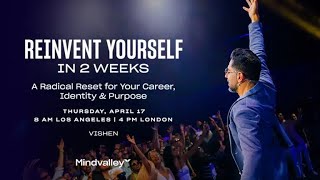
Vishen Lakhiani argues the world is improving despite what the news shows, citing drops in poverty and crime. He forecasts rapid AI-driven change and outlines three core values for reinvention: Transformation, Envisioning, and Unity.
Chapters
A special presentation today on reinventing yourself and Mindvalley University. That's our host, Bianca, who suddenly popped in on the screen with a surprise. Super happy. I don't want to make it just about mvu. Some of you may be here to learn about Mindvalley University, a big project that's happening this summer. But others are also coming for a presentation on reinvention. And so what I wanted to do is I want to share a talk that I've been giving around the world for the last 24 months or so on the topic of reinvention. There are three ideas I want to share in this talk on what we can do as entrepreneurs, as members of a team, as employees, as executives, as coaches, as people who just want to do good in the world to cope with the massive amount of change that's happening right now. And we're talking about change that's happening geopolitically, change that's happening based on new exponential technologies, and just change that's happening all around. So first, let's just do a quick survey of the people who's here. I can see your chat messages, and I just want to ask you guys, do you feel the world is changing really rapidly? And I'd love for you to share in the chat, what change are you perceiving? Like, what's changing for you? Feel free to be a little bit more specific. You can go into details. So some people are saying technology, others are saying walls are going up globally. Some people are saying there's less humanity. Jobs. Jobs are changing. Violence. There's too much change. Frequency. My thoughts are changing. AI. Okay, So I want to do I. Based on what you're saying, I actually want to. I want to deviate a little from what I was initially planning on speaking to you about. I want to talk to you about. About change. Okay. And I want to maybe share some insights and some thoughts that are helping me stay rooted in this time of exchange of extreme change. I put together a presentation with insights from three people who have, in a really powerful way, helped me navigate change. And I hope that their words of wisdom that they shared with me will resonate with you too. But first, I want to share something really interesting. Yes, the world is changing. Humanity has always been changing, always evolving. But what's happening right now is change is happening faster and faster because technology is evolving technology, and it's creating these flywheels where the change is becoming exponential. In short, if you look at AI, for example, AI is writing and improving upon AI and thus, in the years 2022 to 2026, we are seeing as much change as the years 1900 to 2000. And that's what can be really disruptive. But the good news is this. Most of what you think is bad change actually isn't bad. The world is getting better, but we don't see it. And we don't see it because of the news cycle. So let me give you an example, okay? I was in a taxi in Estonia. I live in Estonia, and I live in Malaysia, which is where I am right now. This is Malaysia. And I live in Dubai. And I also spend a lot of time in the US So I don't really have a home anymore. I just travel a lot, though. What you're seeing over here, this is my Malaysian home. Those books on the wall, many of these books I grew up with. Books that introduced me to personal growth. But here's something that happened. So I'm in a. I'm in a. A taxi in Estonia, and the taxi driver asked me, where am I from? And I go, oh, I'm. I'm ethnically Indian. And he goes, ah, India. India. So poor. Such friendly people. But your country is so poor. So, so, so poor. I went there 20 years ago, and I saw people, like, people peeing on the streets with no, no homes. And so it was too complex of me to mention to this taxi driver that I'm not actually from India. I'm from Malaysia. I happen to be of Indian heritage because people move countries, right? So I. I didn't go there, and I just nodded my head and, you know, and kind of agreed with him. He was sympathetic, he was nice. But this is what the taxi driver didn't know. I want you all to play a little game with me. What is the rate of extreme poverty in India? So extreme poverty means that you literally don't have a roof over your head. You're peeing in the street. What's the rate of extreme poverty in India? Put it down in the chat. You're what you think it is. 20%, 70%, 5%, 15%, 60% Indians. You're not allowed to play this game. Okay, let me give you the. The exact answer. Notice. Notice the range. Okay, let me give you the exact answer. It's less than 2% in 20, 23, 24. Now it's less than 1%, the rate of extreme poverty in India, which means people earning under $2 is less than. It's close to 1% in India. Between 2015 and 2019 alone, 100 million people came out of poverty in India. Now, guess the rate of extreme poverty in Estonia. Estonia is one of the most technologically advanced countries in the world. It is in Europe. It is part of the European Union. Guess the rate of extreme poverty in Estonia. Based on government statistics, 3%. The Estonian taxi driver lived in a country with a higher rate of extreme poverty than in India. What happened? What happened is that in 20 years the world transform, primarily in Asia, Africa, Middle East, Latin America. And Westerners don't see that. They don't see that because, well, no matter where you are in the world, we are hit with news media that's designed to make. And no one, no one writes about it. So what's really going on is that. Sorry, can you guys hear me? Yes, Vishen, we got you off stage for like 10, 15 seconds. So if you can reply a little bit and repeat what you just said would be awesome. Got it. So I said, the news media tricks us. When a plane crashes, we all read about it. We all hear it on the news over and over and over and over and over again. But we don't. We don't read about the millions of planes that land safely every single week. We just don't. Because the news media drives on scandals. Now, here are a couple of other statistics. I want you to again play this game with me. We hear about borders and people streaming across borders and crime going up. Primarily if you're in the US or in Europe, is crime going up? So let's talk about America and Europe. Is crime going up or is crime going down? Let's look at the 20 year perspective. Those probably. It's plummeting and plummeting and plummeting. It's plummeting so much that cities. Hey, Vishen, I think we are. Yeah, we've lost you a little bit again. I'm back. We can change the connection. Yes, I got it. Bianca, I'm back. I think it's just an occasional Internet issue. We're good. Okay. Okay. So crime's actually going down. Now we hear about illegal immigrants coming across the border in the United States, stealing jobs, creating crime waves. All bullshit. The average illegal immigrant, illegal immigrant in the US contributes $10,000 a month to America, a year to America, and in their lifetime, about 100,000. Almost all the stuff that we think is off about the world is actually made up. China is not the enemy. China is a freaking incredible source of technology and innovation. It is growing in a massive scale and will be the biggest economy in the world by 2035, with India number two and America number three. So we learn about all of these things that are actually not true. The world is getting safer. Poverty is plummeting. We are not going through an overpopulation crisis. So again, two more questions. All right. We were talking about poverty in India in the year 2000 or so. Global poverty was 40%. What is it now? What is global poverty right now? Put the number in the chat. Play this game with me. 25%, 8%, 15%, 20%, 7% and 30%. Has it gone up or down? Most of you are recognizing, well that it's gone down. Global poverty rates in the year 2019 were 9%. Now, it's probably. It went up a little bit during COVID but now it's probably hovering around 7%. Global poverty is only 7%. It is plummeted. Now, another question. So if you, if you go to the average, to the Western world, one of the reasons. So I want to share a really interesting thing, okay. But this might trigger some of you. Are you guys okay if I. If I just. It's not political, but it is something that happened and it may make some of you feel uncomfortable. So I went to dinner recently, and I was sitting next to a member of the British government, so this was in Europe. And she started speaking about immigrants flooding across Britain. And she said something really interesting. She said, do you know Muhammad is the most common name in the UK right now? And soon, I mean, they're producing so many kids. So I asked her, well, what do you mean by they're producing so many kids? And she goes, well, know, outside, outside Europe, people have a lot of kids, and if we don't have loose borders, we're going to be replaced. So I asked her a question, and I want to ask you this question as well. What do you think is the average? So in Europe, the average number of child, children per woman is about 1.8, 1.9. Just a little bit below the replacement level. Right. It's hovering around 2. What is it for the rest of the world? And we're going to include the Bangladesh and Nigeria and Pakistan. What is the number of kids per woman? Okay. So many people are saying 4, 2.5, 3, 3, 3, 3. Okay? Knowing that Europe is about 1.9, it's 2.1. Even if you count Bangladesh, Pakistan, Nigeria, you average everything out, it's 2.1, except for the 9% of countries living in poverty. Because what happens is when you're in poverty, there's a high rate of infant mortality, so you tend to have more kids. But again, the world is Getting better. We are not. The human population is going to grow. It's going to plateau. It's going to go down again. Okay, so the reason I share all of this is that Hans Rosling, in his book Factfulness, so Hans Rosling is a Swedish researcher. He did a really interesting experiment. He created questions on the state of the world. And he went and he asked these questions to PhDs and government officials and CEOs in America and Europe. And he wanted to see what percentage of them would actually guess correctly. It was less than 25. He said a monkey tossing dots made more accurate guesses on the true state of the world than the average PhD in Europe. Now, it's not because these Ph DS are wrong. It's because of something called probability bias. If you read in the press that immigrants are taking jobs during Brexit, for example, if you see Nigel Farage, if you're England, you see Nigel Farage putting up those billboards of brown people in a line trying to enter the country saying, we must protect our borders. Now, that's complete nonsense. You see that and you think the world is unsafe. The world is getting more chaotic that that there's a population crisis, that there's an immigrant crisis, that there's a refugee crisis. And so you conclude that we're going into dangerous territory. But what I want to swear to you is that the world is getting better and better and better. Yes, change is happening, but overall, as humanity, we are getting so much better. Our lifespans are going up, our health is going up. They are exceptions. Globally, health is going up. In America, it's gone down a little bit post Covid, but again, it'll continue rising again. We are getting wealthier, we're getting richer, we're getting more connected. Yes, there's that tariff war which they predict, that Trump has launched, that they predict will reduce global gdp. And it will, especially according to predictions by Morgan Stanley, 60% chance lead to a recession in the United States. So I believe that tariff war is absolutely dumb and will harm America more than any other country, and it'll harm all, all of us. But at the same time, other companies, other institutes are saying that we're going to see a 7% bump in global GDP because of AI. Okay, so overall, we're still growing, we're still getting better. Now, when you understand this, you start to see that the world is so much more beautiful, it's so much better, it's so much more loving, special, peaceful and safe than what the media makes you believe. And I just wanted to Start with that before we get to the rest of this presentation. So now what I want to share before we go into this presentation is. Well, firstly, we're going to talk about a project that's very dear to me. That's Mindvalley University. It's a project where about a thousand or so Mindvalley members come and live in the city together for two weeks. And it's incredibly fun. And in those two weeks we co create over 100 talks, 200 workshops, schools for our kids, special projects, incredible parties, festivals, concerts, and it's just a way to fully embrace personal growth, embrace community and discover the world. It's happening in August in Amsterdam. I'll tell you a little bit about that. But right now what I want to do is I want to share some insights with you that I think will be very useful. So firstly, did you find what I just shared useful? Let me know in the chat. Awesome. Now let's get to some other fun bits of information on the topic of reinvention. So the first thing I want you to know is that you're good, you're safe. There will be occasional dips in how we're progressing as humanity. But the overall pathway of humanity is always upwards towards betterment, towards progress, towards peace, love, harmony. Now let's talk about reinvention. In an exciting and scary world of exponential change, what tends to happen is most of us live in default mode. Default mode basically means that we continue doing what we're doing over and over and over and over again. But what's really happening is that change is not slowing down. I want to give you another statistic if you like these numbers games. Okay? You guys ready for another numbers game? Okay, so here's the stat. Don't use a calculator. I want you to try to do this in your head. Okay, so the stat is the power of AI is doubling every 3.3 months. It's doubling every 3.3 months. Okay, that means the chat GPT you use now in three months will be twice as powerful and in another three months, in six months will be four times as powerful. Now knowing that, how powerful will AI be in five years? Put a number on, put a number down. 30. 180%. 10,000%. 1,000%. Someone said a gazillion beyond countable. Someone said a million, someone said thooey. Someone said 100. Okay, so you want to know the answer if you continue this rate, okay, it's. It's approximately 20 doublings. Four times five, right? It's doubling. It's it has four doublings a year, five years out, that's 20 doublings. AI will be a million times more powerful, one million times more powerful in five years. That's about the time if you're just graduating high school now, that's about the time you graduate college. Now what does this mean? As powerful as AI is right now, and we're all seeing that, it's going to be a million times more powerful five years from now, five years from now, they will be embodied AI we will have robots. These robots will be insanely smart combined. AI will be smarter than the collective, the collective intelligence of all of humanity. AI will be solving global warming. AI will be help, will be helping us solve cancer. AI will allow us to, to will know that we are ill before we are ill. You will see the rise of something called ambient AI which is AI in your home that is so sharp it can see you. And based on coloration changes in your skin, it can calculate your heart rate, your heart rate variability. You won't have to wear a device. It can see changes in your skin and conclude if you're going through anxiety, if you're stressed, how you've slept, and what happens is that this AI, if programmed well, and I'm pretty sure it will be, will be able to help you guide and navigate through life. You want a movie. You don't. You won't be watching traditional movies. You turn on what is a television five years out and simply describe what you want to see. I want an action flick where I'm in a car with, with, with Matt Dillon, okay. And, and Ben Affleck. And it's a space adventure, sort of a combination between Ghostbusters and, and Mission to Mars. And the movie will be created instantaneously. Why? Because AI is a million times more powerful. Work will pretty much disappear, which means that almost any type of work that we need to do will be gone. We'll be living in a world where the work week will be two days, five day weekends, two day work week. And it's going to be really interesting. People still haven't fully grasped this, but that is where we're going, and it's happening in five years. All right, now, with all of this stuff. Now, firstly, I now want to ask you a question. Okay. Knowing what I just said, and this is actual data, this data is from Singularity University. I just got back from the Executive Program. They didn't say the work week is going down to two days a week. That's my prediction based on what I'm seeing. Because I've been advising governments on AI and I'm deploying AI in my own company. And this is what I'm seeing. What often used to take us to six months to do, we now do in one hour. Six months to one hour. That is what I'm seeing right now. Okay, so let's play a little game. What I just said, does that make you. Is it comforting or is it scary? Put in comforting or scary in the chat. It's scary. I can tell you my, my initial assumption is I don't know if it's comforting. I like the idea of a two day work week. I can think of so many things I'd love to do with that time. But it's scary because I wonder what will happen to my business, my projects, my jobs, Will I be even necessary? I wonder. And we all should wonder. But that is the way the world is going and all of us. And nobody knows. Nobody. There's no one. So here's the crazy thing. There's no one steering the ship. Governments are absolutely clueless. In the US Trump is talking about bringing back coal mining. If, if the, if any government really gets this, if I can, if I can say the governments that really get this, China, China gets it. You know, most of the new robotics companies being built right now coming out from China, not the us, not Europe, China. Okay, so how do we cope with this change? Now I want to share with you a quote. This happened to me about 12 years ago, so I was going through a very stressful time. Even back then there was a lot of change happening. New things like the iPhone, YouTube, inventions like that would still disrupt my business because I was in publishing and a mentor of mine, Srikhwa Rao, the great MBA professor, once we were having a late night meeting. It was 11pm My time, sort of what it is right now here in my apartment in Malaysia. Rao was in New York, so it was early for him. And as he got in the call with me, he detected I was stressed. So he said, vishen, you know, before we start a business call, I'd like to read you a poem from Rumi. And Rao said, just listen and reflect. You don't have to try to decipher it. I just want you to reflect on this. And that's my request for all of you as well. Okay? When I run after what I think I want, my days are a furnace of distress and anxiety. But if I sit in my own place of patience, what I need flows to me. And without any pain from this I understand that what I want also wants me is looking for me and attracting me. There is a great secret in this for anyone who can grasp it. Let me repeat those final lines. The first part is simple. You chase. It results in distress and anxiety. But if you can sit in your own place of patience, what you need flows to you and without any pain. From this, I understand that what I want also wants me is looking for me and attracting me. There's a great secret in this for anyone who can grasp it. What Rao was really saying is that we've built a society of hustle culture. Do, do, do, so we can be. Do, do, do so we can be. He's saying, rather do be so we can do. And that is essentially what Rumi is saying as well. Sometimes progress doesn't mean moving forward. Sometimes progress means sitting still. Sometimes progress isn't being on your laptop and coding. Sometimes progress is closing your eyes, turning off all equipment, and thinking. Today I had a really interesting experience. So I injured my, my wrist in the gym. When I see a doctor two days ago, and the doctor said, you know, just to be safe, we got to give you an MRI scan. So I show up at the hospital this morning, literally this morning, to do an MRI scan, and I'm super busy. And I thought it was a five minute procedure. The nurse said, Nope, it's 40 minutes. So you know what my response was? 40 minutes. Can I, can I listen to podcasts on my phone? She goes, no, you can't have any, any electronics in an MRI machine. Are you crazy? So I'm thinking, what do I do for 40 minutes? And then I realized, my God, I'm so hooked on electronics. Okay, I'm just gonna try to think for 40 minutes. So my hand is wrapped up in this device. I'm in an MRI machine. I'm lying on my. I'm lying on my chest, and I have 40 minutes to kill with the most annoying sound in my head. So you can't meditate, right? It's loud, you're wearing earbuds. But in that 40 minutes, the most insane business idea comes to me. I was trying to solve a business problem, and I was going round and round and round for two weeks with this, with this thing that I was coding. And in that 40 minutes, no devices, eyes closed in a noisy MRI, in stillness, the answer comes to me. And I think that was a big lesson for me. We don't have to be in constant hustle mode. Sometimes to make progress, you got to experience, you got to be still. You got to get out of Hustle. And so with that, I want to give you three powerful values that I've personally learned to adopt that help me when I'm going through constant change. I've had the same value model for about 12, 13 years right now. And these three values, transformation, envisioning, unity, have been my bedrock. These are values that help you navigate change, help you move through chaos, that help you move from the hustle culture to stillness. And I want to share this with you one by one. So what if reinvention doesn't need to take five years or even one year? Remember, in my case, I got out of my office, it was a freaking MRI that had to pull me out of that. But the most amazing idea came while I was in that MRI machine. No laptop, nothing. That idea, by the way, is going to be an app that will be on the App Store maybe in about six months. And I'm going to invite you all to check it out. And I'm really excited about it because I think it's, it's going to be incredible for human mental health. But the idea came in 40 minutes, not 40 days of like, like meeting with my team and being in boardrooms. So sometimes reinvention doesn't need to take five years or even one. It has to do with shifting your identity. So in the book Atomic Habits, James Clear, the author, says that if you want to change anything about yourself, you can push for outcome, process, or identity. Okay, outcome is, let's say you want to build muscle and lose weight. So outcome is, I want to lose 5kg at 2kg, lose 5kg of fat at 3kg of muscle. That's not bad. But there are going to be days when you just aren't going to be able to get yourself out of bed to go to the gym. They're going to be days when you aren't going to be able to resist that delicious slice of pizza. So the second one is process. So process is better than outcome based goals. So process goals are things such as, all right, I'm going to be super disciplined, block it out in my calendar. I will be at the gym for one hour on Monday, Wednesday, Friday, and I, I am going to only allow myself Saturdays when I can eat ice cream and pizza. Better process. But they will still be moments when you don't sleep enough. You can't pull yourself out of bed. You're meant to go to the gym, but you're thinking, oh, God, I hear sleep is good. I think I'll just give myself an extra hour. I'll do the Gym tomorrow. So process is still tough. But according to James Clear, if you can shift identity, if you can take on the identity. I'm an athlete and my body loves exercise. My body just needs to move. You will never want to skip your gym. If your identity is, my body just loves healthy food, you will never have a craving for pizza. So the trick is to shift identity. Okay? And these are the four rules. So I said, there's transformation, envisioning and unity. Let's start with the first rule. All of these rules I learned from a mentor. All of these rules you can layer on top of each other. And all of these rules will shift your identity of who you are. Transformation. The transformation rule comes from this. So back to Sri Kumara. He's the professor who taught me that, that poem from Rumi. In another lesson from Rao. This was several years after Rumi, okay? Rao came to me. We were in San Diego at that time. And he said, you know, vision, you know what they don't teach in business school? And I go, what? And he goes, he says, the problem with MBA business school. So he is an MBA professor. He was teaching at Cornell, London Business School, Kellogg, all these elite schools. And he says, they don't teach consciousness. So I go, yeah, but, but they do. And he goes, no, no, no, you're confusing ethics with consciousness. Ethics is one thing. After Enron, all business schools teach ethics. Consciousness is different. So I said, well, do explain. What do you mean by consciousness? And he goes, business people and MBA programs, they make you think that your life is all about your company. It isn't. Whether your company fails or your company becomes a billion dollars, it doesn't matter. So I asked him, what, what then what's the point? He goes, let me tell you this vision. The point isn't failure. The point isn't a billion dollars. The point is, are you growing? The Most important lesson MBAs need to understand is this. Your business is the greatest vehicle for your growth, and your growth is the most important thing. If you are growing, everything else is growing with you. This is the transformation rule. Your work is not about your work. Rather, your work is nothing more than the greatest vehicle for your personal evolution. Now, when you think about it this way, I at least found that it helps greatly when you're going through down times. When AI is disrupting your business, your business may shrink a bit. Are you growing? And at the same time, if your business is exploding, it doesn't go to your head. The most important thing is, are you growing your work, your company, your job, is equivalent to a gym. When you step out of a gym, the most important thing is, did you get your gains? Did you grow? It's the same with business. This is the rule of. This is rule number one, the rule of transformation. Your work is not about your work. Rather, your work is nothing more than the greatest vehicle for your personal growth. If your business disappears because of AI or shrinks because of AI, does it really matter? If you can find another way to grow, you're good. Now, this resonates with you. I. I want to do a quick poll on a scale of 1 to 5. I want to see if this idea resonates with you. I'm going to ask you to rate all the three ideas here. Scale of one to five. Rule one. Put the number down and maybe it's a one. That's okay, too. Maybe it's a four. Okay, so this is rule one for dealing, for reinvention. When you make things about growth, do you see how fast you start reinventing yourself because you're not attached to any outcome? But this brings us to Rule 2. Rule 2 is really interesting. Rule 2 is called Envisioning. Rule 2 says this. When you dream big, your problems become small. So many of us get obsessed with small problems. But what if. What if we could be bothered by big problems? When you're bothered by big problems, you're more likely to tackle the things that truly matter. This rule comes from Naveen Jain, another author in Mindvalley, founder of Biome. So I was at an event called chs, and Naveen gave this incredible speech on stage, too. And this, this was a consumer health summit. That's chs. It was doctors, health coaches, longevity, authors in the room. And Naveen said this. When you do something audacious, it becomes easier because you get the best people to join you. The problem you're solving is worth solving. You have the magnets and you get the money. Because then investors call and then you can tell you don't need their money. Now like a bull, they charge. So sell the benefit to humanity. Cult leaders say loyalty lies with me. Entrepreneurs say loyalty lies with the cause. What's Naveen really saying? He's talking about this rule. When you dream big, your problems become small. What he means by this is always go for boldness. In fact, Naveen has a program on mindvalley called the Power of Boldness. Rao also has a program in mindvalley called the Path to Self, the Quest for Self, for Personal Mastery. Both amazing programs, right? And both of these men are incredible individuals. So Naveen says, always aim for something big. Aim, just push yourself. A little boldness has power in it. When you dream big, your problems become small. Now of course you can dream too big and put yourself in a stressful mode. So what I always suggest is that you have a combination of big goals and self fueled goals. Self fueled goals are goals that you can, you know, turn into a lofty question. They are goals such as to be always surrounded by love, to be learning and growing, to witness the universe unfolding. For me in the most amazing way, day by day, these are really simple things. These are mindset shifts. You can adopt them immediately. But with the mix of this, you have what I call Google goals. So Google Goals is a, is a goal setting methodology from Google. It means 50% of your goals should have a 50% chance of failure. Which means your goals, if you have four, four big goals for your company, two should be achievable, two should be a coin flip. And in Google, you know, they don't want their teams to do, to get 100% of their goals, their teams must hit 70% because if you're hitting 100%, you're thinking too small. So boldness, boldness has power in it. So let's go back to this idea. When you dream big, your problems become small. This is insight number two, rate this on a scale of one to five in terms of how it resonates with you, how it lands. Beautiful. Mostly fives, a few fours. Now let's come to the third idea. Unity. Unity. This is the third idea for reinvention. So again, let's, let's put it all together, right? To reinvent. In a world that's rapidly changing, you want to change and evolve rapidly too. The first thing is make growth your number one goal. So your business becomes the vehicle for your growth. In a week, you are dedicating time to growth. Number two, aim for boldness. And especially by the way, with AI, what was once difficult is now becoming easier and easier. All of us can compose music, all of us can create great art. Right now it's get coding is becoming automated by AI. English literatures, literature majors, because they understand natural language, are able to code their own apps because of tools like replit. Do you know any of you can now go and just create your own app? Google just launched a tool that allows this so you can think boldly. But this brings us to the third rule. Unity. And my God, guys, this is so important in the world right now. When we're being told to be divided, when we're being told that we can trust people who look different or who sit across the border. Rule number three is this. And it comes from. It comes from Neil Donald Walsh. So Mindvalley University started out in Barcelona in 2016. One of the great teachers who came was Neil Donald Walsh, the guy who wrote Conversations with God. Any one of you read that book? So Neel is a. Is a legend, right? Sold 15 million books. It was in the New York Times bestsellers list for five years. This book changed the lives of so many people, it was even turned into a movie. Conversations with God. So Neil came in and gave three days of the most profound lectures at Mind Valley University. And after day three, a lady stood up and said, neelai, I get what you're saying. Yes, you know, on. But what do I do on those days when I just wake up and I'm feeling miserable and I'm feeling worried and I'm feeling anxious? And Neil said, well, stop making your life about you. And the crowd went, because it just seemed insensitive. But Neil continued. He said, remember, your life is not about you. Rather, your life is about the lives of everyone you touch. And when you think like that, you will never, ever, ever wake up feeling worried, anxious, or stressed out again. And then the crowd got. It was powerful. It was a truly powerful moment. There's a powerful idea here, and I think Martin Luther King speaks about it. We're told in life to chase power, but Martin Luther King spoke about the interface of power and love. He said power without love is reckless and abusive. Love without power is sentimental and anemic. Power at its best is love implementing the demands of justice. And justice at its best is power correcting everything that stands against love. Deep quote. But what he's talking about here is that unity drive boldness, growth give you power. Unity gives you love. And power without love can be reckless. Love without power, anemic, meaning useless, hippie, dippy. Power at its best is love implementing the demands of justice. And justice at its best is power correcting everything that stands against love. I love this quote because it brings together all three ideas. And this brings us to Mindvalley University. But before we go there, I now want to ask you to rate this third idea. So we spoke about the concept of transformation, growth. We spoke about boldness, and now we're speaking about unity, living our lives so that we can serve others. Wow, I see this one really hit, hit home for a lot of you. Many of you guys are putting 10 out of five beautiful. So I hope you got something out of the last 42 minutes. And now what I'd love to do, what I'd love to do is share with you the project that I've put together to bring all of these ideas together. A project that involves me bringing a lot of these Mind Valley teachers together in one city with our community to go deep into these ideas and many, many, many more. We mentioned Sri Kumar Rao, he's been a big part of this project. Mindvalley University. Naveen Jain has attended for the last two years mindvalley University and he plays all out. Neil daughter Walsh came and opened up first mindvalley University and he was amazing. The next one is happening in August, August 4 to 17 at the biggest conference center in Amsterdam. We have space for about 1500 people and it's a really amazing, amazing event. I want to give you an idea of what happens at Mind Value University because it's not a conference, it's. It's something very unusual. It started out because in 2016, in 2016 or 2015, some somewhere around there, the dates are escaping me. Before my book had come out, before I was well known, I wanted to find a way to expose my kids to different cultures, right? We were living here in Malaysia and I thought, wouldn't it be nice to go and live in a different city for about one month and truly experience the culture of the city. But my kids love hanging out with other children their age. I love community, I love meeting adults. So I thought, well, you know, we'd get bored. Why don't we invite other people to join us? So I got on Facebook and I kid you not, I put up a Facebook post inviting people to move with me and my family to Barcelona. 170 people commented and said they would do it. And I thought, liars, they're not going to come to Barcelona. But in the end, a thousand people, no, not a thousand. 300 people moved to Barcelona with me. So I moved to Barcelona in 2020, 2017 with 300 people and I got a team together. We got a co working space. We created spaces for people to work, we created studios for people to teach and we created a kids program where we adults would go and educate each other's children. Lisa Nichols came by. Marissa Pierre came by. We had celebrities, Tony Gonzalez and his wife. So Tony is one of the top NFL footballers in America, one of the top 100. He came with his wife and went on to say it was the one of the favorite holidays of his life and that was how Mind Value started. Now I want to play A little video to give you an idea of what to expect. Oh, the videos. It is working. Let's see. Hang on. Let's see if this video is working. I think we have a. It's jammed. I'll. I'll play it. The connection. Maybe we should wait a couple of seconds. We're good. We're good. I think it's just. It's an issue. It looks like an issue with keynote. Let me just stop the share. I know another way to play the video. It's all good. Okay, so we'll play the video in a moment. In the meanwhile, I just want to show you what is going on with Mindvalley University. So the program. So the program happens in Amsterdam, one of the most beautiful cities in the world. It's happening August 4th. And by the way, the weekend before is the Gay Pride parade in Amsterdam, which is amazing. It is one of the best events you can attend in Europe. So this is designed to be a cultural experience. So it's happening in the gorgeous Vertical Arch Conference Center. That's what it looks like. It literally looks like a full on university. There are three halls, there are events happening every single day. And what happens is people move there. 80% of the people who come are coming as individuals or with a group of friends. 20% come with their children. We have a children's program, 6 to 9, 9 to 12, and then 13 to 18. It always sells out. So if you're coming with your kids, you want to book early. And what happens is that we bring in 50amazing Mindvalley authors and we create 50 additional spots for people who have bought tickets to come and share their. Their, their speeches, their insights, their workshops. So out of a thousand people to 1500 people who buy tickets, maybe about 500 will apply to speak. And we choose 50. And that's also how we discover a lot of talent. So the schedule is really powerful. It's adults, teens, kids, and 50 plus main stage sections. 50 plus community stage sessions. It's just massive. These are some of the teachers we've confirmed so far. I'll be there. Paul McKenna. I don't know if you guys know Roxina Fousey. She just wrote a book called Manifest that sold a million copies. Marie Diamond, Brendan Kane, who is one of the top social media consultants in the world. Jimmy Narrain, Linda Clements. Linda was best speaker, voted best speaker last year and a lot more. There'll be at least five times as many speakers confirmed in the next two months. And then of course, an incredible youth program where Kids learn not just from a really cool academic institution, learn life, but from Mindvalley authors and I designed this program initially really for my children. I designed it because I wanted Hayden and Eve to have something really different to experience. So I'll skip through all of this and I'm going to take you straight to the website. But there's a lot that happens at Mind Valley University. Okay? And let's go to the website and let me show you what you can expect. And then we'll come back here and I'll show you everything you need to know about tickets and stuff. So firstly, mindvalley University is not a commercial project. It's designed for. I designed it for my kids and I opened it up to the world and it's something that means a lot to me. We never do it for the money. It's simply too complex and too complex to operate that way. But because it is done with love and it's done with, with, with so much community, we're able to get incredible speakers to come and volunteer their time to deliver to our audience. So that's something that makes it work. It cannot work in any other way. And so we also make the tickets super, super, super affordable. So this is the website mindvalley.com forward/you and let's play this little video so you get an idea of what to expect. The most impactful thing, this is the after movie from last year you can do for the world is learn how to love life, all of life. Show people that people being happy doesn't mean turning a blind eye to the pain and the sadness and the suffering that happens. Show them that choosing love doesn't mean ignoring fear. It just means being willing to feel. Because we suffer from an epidemic of loneliness and we need to find community to feel connected. And Mindvalley creates that community that makes you feel like you're never alone with Mindvalley. It's going to be epic. Mindvalley attracts a very brilliant, active, hungry entrepreneur and a learner because it introduced the coexistence of massive growth and massive fun. Try with it so you get the idea, right? Kind of hot to put in the box, but it's. You can go to mindvalley.com to, to. To. To learn more. So what I want to encourage you guys to do, if you find these ideas interesting, if you love the topic of reinvention, go here and check it out and maybe I'll see you in Amsterdam. And by the way, this presentation is not 90 minutes. It's. It's one hour, so we'll end in seven minutes. So on mindvalley.com you, you will see all the information and you can go ahead, read all about it. You can see the speakers, there are many speakers that so, so almost all the legendary Mind Valley speakers that you love start to come at least whether they, they, they come for a day or they're there for the entire week. And the schedule, the event is all up there for you. You'll also notice a lot of parties because we believe in celebration. And so almost every week you will see. So this is last year's agenda. The announcements, the parties, the concert for this year are still being announced. But if you go here, you will see an example of what happened last year. Now if you guys want to know about tickets, let me show that to you, okay? Because it's really affordable. Let me get you that information. There we go. Okay, so the two types of tickets for Mind Value, children's tickets and everything that depends on the age of your kid. You'll find it on the website. But a ticket for one week is about 2,000 and for two weeks it's about 4,000. These are VIP tickets for early bird. And then so VIP ticket it gives you access to front row seats. So this is the most expensive tier, front row seats. And it gives you access to a private party every week with the Mindvalley authors. So when we do these events with the Mindvalley authors, the private parties we can maximum allow like 200 people because they are, they are smaller. The authors actually come to all our events, even the bigger parties. Those bigger parties are, and celebrations are huge. But for more intimate setting we do these smaller parties and front row seats. And these tickets are about 2000 for one week and 4000 for two weeks. Now if you're a member automatically, whatever you paid for the, the average price you paid for membership, which globally is around 300 bucks, you get that back. So as you know, membership, Mindvalley membership right now gives you special perks and privileges at all Mindvalley events. All Mindvalley mastery. So if you remember, it's a VIP ticket, it's only 1699. And then if you don't want a VIP ticket, that means you don't care about where you sit and you just want to attend the big party, but not the smaller VIP party. It's just 1,400 for one week. See, many conferences charge that much for two days. This is one week. And in that one week there are six days of activities. Now you don't have to Come for the entire week. Some people come for three days. Some people come for. Some people stay the entire one week. You choose. And we'll be releasing the agenda shortly so you can see exactly what's happening on each day. But I can tell you this, it's not even about the agenda. It's all about the community. So no matter when you come, you're going to have a good time. Interestingly, most people who come in for one week end up extending. The majority of people extend, and if you happen to be a member, it's just 1199 for one week. So it's insanely affordable. And what happens at Mind Value that doesn't happen at many other events is that they are no barriers. There's no backstage. The authors are sitting in the audience with you. Then they get on stage, then they come back. The authors are at the party. I'm just walking around and roaming about. There's no security. There's no. There's. There's no. We're all there with our families. So everyone is just so deeply connected. And that's why it's one of the most amazing community events that we've ever created. So I want to encourage you guys to check it out. All the information is. Is there. And what we'll do is, as a thank you for attending this webinar, you get an extra 25% off. So whatever the pricing that I showed earlier, you get 25% off. Just scan that QR code. Okay. So if you find this interesting, if you're considering coming, if you think this is something you'd want to experience because you've always wanted to attend a Mind Valley event, this, by the way, is best. It is the best value. It is the most special. And it's something that. That leaves a lifelong memory. Then go ahead and check that out. Put a yes if you're interested. So why does this connect to reinvention? Mindvalley University is designed to give you the tools you need. Those special skills. I love seeing all those css, those special skills to transform every part of yourself. The great teachers, the insights. But one of the most interesting things is transformation doesn't come from just books. It doesn't come from just sitting in an audience. It comes from immersion. It comes from creating friendships with the people to your left and to your right. It comes from the community that you connect with. And then there's boldness. And when you see the people you're surrounded with, when you see deep, when you get the insights from mbu, you're Empowered to dream bolder. And finally, there's community unity. MindValleyU gives you a community of friends, of connections that stay with you for life. One of my college buddies. So I graduated from college 25 years ago, and a college friend of mine attended the event, and she said, you know, at every other friend event I attend, I meet acquaintances. At your event's vision, I meet my best friends. So she's there, she meets a guy, they become friends. And several years later, this. This college buddy of mine, she is going through a hard time. She's living in America, and she gets breast cancer, and she has to have a full mastectomy. She couldn't afford it. A person she met at a mindvalley event who became a close friend, paid for entire surgery. That's how deep the connections are. And that's something that gives me great pleasure because I just love bringing people together. So if you find these ideas interesting, if you like the project interest, if. If you'd like the project, and if you think this might be great for you, your family, your kids, go to mindvalley.com forward/you and check out the tickets. Okay? And in the. The last minute, I have. All I'll say is all the Information is on mindvalley.com forward/you. Amsterdam is an amazing city. So a big highlight is not just mindvalley, it is the city of Amsterdam. And if you haven't been there, you gotta go. So if you're thinking about a great place to go for a holiday this summer, yeah, you could do the usual thing. You could go to, you know, you go on a road trip somewhere. But what makes this fun is it is a holiday. You get to experience this amazing city, this amazing culture, but you also get to meet people. You get to learn. You have to grow. You get to grow. And if you have kids, they get to go through one of the most powerful transformations of their life. So thank you, guys. Thank you for joining me today. I hope you enjoyed this event and I will see you guys at mindvalley. You. Thank you so much, everyone, for joining.
More from Vishen




Brown Noise for Deep Focus and Concentration (Best with Headphones) | Gabriel Loynaz



Your Appointment With the Eternal | Guided Meditation with Michael Bernard Beckwith

