The Creators Edge: How Sahil Bloom Built a Media Empire | Ep #75
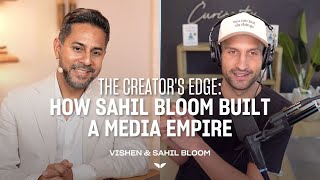
Sahil Bloom left finance to build a media empire through consistency and iteration. He wakes at 4am for creative work, treats content like an athlete treats training, and credits a chance meeting with Tim Cook at a gym in 2014 as a turning point that led to mentorship.
Questions this video answers
The Five Types of Wealth
Number two on the New York Times list; on the list for seven straight weeks.
Over 900,000 subscribers.
About 1,000,000 followers on Twitter (X) and 1,000,000 on LinkedIn; Instagram noted at approximately 813,000 in this conversation (and described as close to 1 million).
2014.
Chapters
Our next speaker is an absolutely fascinating guy. His name is Sahil Bloom. And what's really unique about Sahil is this guy's multi platform. He's about to hit a million followers on Instagram. But what's unique is he has a million followers on Twitter now x.com and a million followers on LinkedIn. These are all extremely distinct platforms with very different audiences, with very different use cases. But Sahil somehow has been able to go cross platform. But what's even greater about Sahil is he's also really crushing it as an author. Right now his book is number two on the New York Times. Congratulations Sahil. And the book is called the Five Types of Wealth. It has been on the New York Times for seven straight weeks. As an author, I can say that is not an easy thing to do. Sahil has absolutely exploded into the world and people are going nuts for his wisdom and, and what he represents. So welcome Sahil Bloom.
Thank you so much for having me.
So, a couple other things I want to say about you, Sahil. So he's the best selling author of the Five Types of Wealth. A transformative guide to design your dream life. An inspirational writer, content creator captivates millions through his insights and his bi weekly newsletter, the Curiosity Chronicle, which has grown to over 900,000 subscribers. That's really impressive. So email, Email is another medium that you're really crushing.
It's been an interesting journey to say the least. I'm looking forward to sharing more about the entire experience today.
Well, let's start by how did you get started?
I was working in a very traditional track. I was working at a private equity fund. Really like rising through the ranks of a traditional industry. I come from a background with an Indian mother, so taking the job that would impress her and make her feel good about the career path I was on was very important. I'm sure there are some people out there listening that resonate with that idea that there's like the family and kind of cultural pressures to do the, the normal track, if you will. And stepping off of that to go do something different was, was very difficult.
Now by the way, Sahil, so you're Indian. So I get that. Where does the last name Bloom come from?
My father is from his family I guess is from the Ukraine if you go, go back several generations. But my dad is white so I'm sort of half and half.
Bloom doesn't sound like, like a Ukrainian name either. But it's, it's amazing personal branding. I absolutely love it.
Yeah, it is very unique background I suppose I do think that the combination, sort of the collision of two worlds that I had in my background as, as an individual was pretty formative in terms of my own journey and my own path. I feel like, you know, my parents story of how they met sort of going against their family's wishes to get married and build their life together. And the way that, that created this ripple effect into my sister in my life of constantly questioning these common conventions has been very powerful.
So I'm really curious, why do you think you're so captivating? What I mean by that is, look, it's not easy to get to 900,000 people on email than a million people on LinkedIn. You are somehow able to do it cross channel. Most people are on one channel. What is it about your content?
I think there's an element of content and then there's an element of mindset and just mentality around this. And look, I mean, my fundamental belief, I come from an athletic background, so I played baseball my entire life. I got a scholarship to play baseball in college at Stanford. I was not very talented. Like, if I'm just being completely honest, I was not particularly talented. I was convinced from a young age that, that it would be impossible to lose if I just kept showing up. And from a young age, I just decided that the way that I was gonna stand out in anything that I did was that I was gonna show up over and over and over again. And in particular, I have the belief that not every day is created equal. Days when you don't feel like it count 2x. And days when you really don't feel like it count 10x. Because those are the days when you convince yourself, when you instill this identity that you are the type of person that shows up even when you don't feel like it. And at the end of the day, the key to life is showing up. You got to show up when it's messy, show up when it's hard, show up when no one is watching over and over and over again, even when the rewards are uncertain. And I took that same mindset that I had applied in my athletic career and in my life and in school and applied it to this new thing that I was doing. And, you know, look, for everyone out there that's listening to this, one of the things that really is advantageous to someone, when you start marching down the path within the world of social media, within the world of content, within the world of monetizing that is that creative people, quote unquote, are not very consistent on Average. Your competition in the world of online creation versus your competition if you were going to go and work in the hedge fund or finance world is dramatically different in terms of their willingness to work hard over long periods of time. That is a great thing for all of you. You're all the type of people who clearly are consistent. You're clearly hardworking because you're on a webinar on a Sunday. Like, that is the type of person that all of you are. And if you can take that and apply it, you are immediately standing out. You're immediately in the top 10% just by being someone who is willing to show up day in, day out, over and over again. And so when you ask like, what made me captivating, clearly I was getting better and better every single rep. I was maniacally focused on how I could improve. Every single time I go, like every. If I look back six months at any point in my journey over the last four or five years, I would cringe at the things that my six month ago self had created. That feeling of cringe is a sign that you have grown, that you have improved, that you've iterated on your craft and gotten better at it. I have always done that. And so I've pounded my head into a wall consistently over and over and over again, but also gotten smarter with every new insight or piece of data that has come back to me along that journey.
So, you know, when you first started, I'm sure there were some fears, there were some blocks, and we were talking about this earlier with our audience. What blocks or fears did you have to overcome and how the number one.
Fear is just the fear of hitting send. I had a piece of advice from a mentor that fundamentally changed my life in this regard, which was two words, nobody cares. And that sounds harsh, but that is the reality. You are not afraid of failure. You are not afraid of failure, at least not really. You're afraid of what other people will think of you if you fail. It's the fear of the judgment, it's the fear of the scrutiny, it's the fear of the whispers, it's the fear of the little bits of silence of what they might think or what they might say to you. You are not afraid of actually failing. You're afraid of that reality. If you're going to shine a light on that monster, is that those things don't exist because people don't care when you're winning, people don't care when you're losing, people don't care. People just don't care. Nobody is looking at you. The spotlight effect is this psychological phenomenon. We all assume that other people are staring at us, that they're noticing our habits, our actions, our behaviors. The reality is that if even if they do, they quickly forget about it and move on to something in their own life because we're all too busy thinking about ourselves. So that fear when you're first starting, that fear that holds you back, you don't hit send on the content you created. You shy away from sharing your ideas in a meeting. You know, you don't start until you have the perfect plan for your podcast or for your content. Those fears are all completely made up in your mind. They are a manifestation of the mind, and you can change your mind on that. Recognize that nobody cares. Nobody's watching. If you send a piece of content and it gets 0 likes by definition, based on how the algorithms work, nobody saw it. And so those fears, we need to shine a light on them, recognize them for what they are, and remember that nobody cares. So that should be empowering. That is not. It is not a depressing thought. That's empowering because it reminds you that you need to just continue to hit the hit send on the thing.
You know, I love what you just said. It's very true. We forget that if you put out something that sucks, the algorithms are going to figure it out and they're going to show it to not that many people. So your suckiness is actually being restricted. In that case, the algorithm is totally protecting your ego. Love it. Now. So many entrepreneurs struggle to be consistent. I know I face this like I sometimes go three weeks and I and there's stuff happening, but I'm not posting, I'm not creating because I get busy. As a father, as the owner of a business, how do you create consistency?
I would say the number one thing when it comes to consistency is this recognition that every single day is actually easier than most days. And what I mean by that is we have this assumption in our minds that doing something most days is sort of a good starting point for consistency. The reality is that every single day is easier than doing it most days, because every single day becomes an identity. Single day becomes who you are as a human being, that you are a consistent person, where most days it becomes very easy to have those little chinks in the armor, those little dings into your consistency. So every single day, what that means is that you need to figure out a system for doing something every single day. My approach to that is to hold your feet to the fire when it comes to the action, but give yourself grace when it comes to the amount. What I mean by that is hold your feet to the fire to do the thing every single day. Let's say that my thing is writing. I wanna make sure I'm putting out content, so I need to write every single day. I'm gonna make sure I'm gonna hold my feet to the fire when it comes to the action of writing every single day. But I'm going to give myself grace in the amount of that thing that I do. Meaning I could spend two minutes on writing and that's better than nothing. I could spend 30 minutes one day and that's clearly better than nothing. But I'm not going to hold myself to some insane standard and say, oh, I have to write for two hours a day in order for this to be optimal. And the reason behind this is a psychological thing, which is ambitious. People, all of you that are listening to this are highly ambitious. You wouldn't be on a webinar on a Sunday if you weren't ambitious. People are the absolute worst at allowing optimal to get in the way of beneficial. All day we do that. We allow optimal to get in the way of beneficial. We say, I don't have an hour to work out, so I'm just not going to work out. I don't have two hours for deep work, so I'm just going to do email instead. I don't have 30 minutes to call my parents, so I'm just not going to call at all. Anything above zero compounds. Remember that tattoo that on your body. Anything above zero compounds. 2 minutes of writing is better than zero minutes of writing. 10 minutes of deep focus work is better than zero. So hold yourself to the fire in terms of doing the thing, but give yourself grace in terms of how much you need to do.
How do you structure your day?
I am very big on knocking out the most important tasks to start the morning first thing in the day. Anyone who has followed me knows that I'm sort of an early riser, morning person. I get up around 4am every single day. That's not me not sleeping. I go to bed at about 8. I try to finish my most important creative tasks by 8am so from like about 4:30 or 5 to 8 is when I'm sort of locked in on whatever my most important creative task is. Reason for that is I know that I am not creative. Later in the day there's too much chaos happening. There's like, I have a son about 3 years old, all sorts of emails, notifications, your Day kind of goes like. If you were to map it, your day kind of goes to hell over the course of a day, just because of the way that stimulus is. There's too much stimulus that builds up as the day goes on. So knocking out your most important thing to start the day is, for me, a tried and true path to actually making sure I get that thing done.
I love that advice. Yes. And also, it's great to hear that you have a kid, because that makes you so much more relatable to. To so many of us. I have children as well. My kids are teenagers now. They refuse to go to bed till 11, so I end up staying up with them. But I hear you, Sahil. I get that. Now I want to ask you about your Instagram. And for those of you who want to check out Sahil's Instagram, go to Sahil Bloom. S A H I L B L O O M. Okay. Sahil bloom. Sahil's at 813k followers right now. And I noticed you're using a really interesting framework here, a consistent style. It looks like old school drawings from Life magazine from the 1950s. So is this a style that you found was working for you?
Yeah, my big thing with all of these platforms is you find something that works, you execute on it, and you need to be adaptable to recognize when it no longer works. And this is applied to every single platform that I've built on. You know, like, Twitter was my first platform, and I was probably the first person that really did threads consistently on Twitter, like the longer form writing. That was an enormous arbitrage opportunity from 2020, when I started, until early 2022, maybe. At which point, like any market, the opportunity gets exploited because people see that there's clearly robust growth. The platform is prioritizing the thing, everyone start it, and then it no longer stands out. It's no longer a structure or format that exists at all times on all platforms. There's always something that is working. And your job, if you were going to be a creator consistently, if you want to grow and want to reach more people, is to identify those things. It doesn't mean that you necessarily have to create the thing. Sometimes creating the thing ends up being just pure luck. You know, I would say in the case of threads, there was much more luck than it was me actually thinking and identifying it. But you can spot what those things are at different points in time on different platforms. I think the people that opportunistically got into reels early on Instagram that identified specific trends with those reels, it worked. I would say that within Instagram, there's always these little sort of pockets of opportunity. These images have been working really well for me recently. I don't think they will always work like I never.
You're constantly experimenting and trying, trying different things.
Exactly. I mean, my, my fundamental belief is that preparation always beats planning. Planning is sort of based on the expectation of order, like the expectation that the seas are going to be calm and that you can plan from point A to point B. Preparation is about expecting chaos. Like you expect that there is going to be change and you need to be adaptable. You need to prepare for whatever, whatever comes. And I think that allowing yourself to be nimble, not getting too tied to a format, not getting too tied to a structure or a style is really important in the modern day.
So this, this story about you getting up at 4am Firstly, I. You were telling me when I asked you, sahil, tell me interesting facts about yourself. There was a story that you shared, which I'd love for you to expand upon, about how you bumped into Tim Cook, the famous CEO of Apple, in a gym at 4am and he ended up becoming a mentor of yours. Tell us about that.
I am big on the idea of expanding your luck surface area, meaning taking actions that expand the opportunity in your life to get lucky. Quote, unquote. Waking up early and putting yourself into sort of spaces where you might meet interesting people is one of the ways that you do that. This happened in my own life. When I first started my first job, I had to be in the office by about 6, 6:30 in the morning. And, and I had played baseball at a high level. I wanted to keep up my fitness habit. So I knew if I was going to continue working out, I had to go to the gym at like 4:30 or 4:45 every single day. And so I started showing up to this local gym in Palo Alto where I was every day at 4:45 in the morning. And at that time of morning there's only about five or six people that are crazy enough to show up at the gym every single day at that time. It turned out that one of them was the new CEO at the time, Tim Cook. This is in 2014. He was not nearly as famous as he is now. He didn't have bodyguards. There was no, you know, pomp and ceremony around him and we ended up becoming friends. He's been a mentor. He was one of the main people that encouraged me to go leave the path I was on and walk down this new one. He was the first reader of my book. He was the first endorsement on the back cover of the book. Um, he's been an incredible, incredible friend in research.
What was the greatest piece of advice you got from Tim Cook that's worth sharing with our audience here?
Yeah, lean into your pattern interrupts. Tim has a, you know, very unique story himself that not a lot of people know, which is he was marching down a very traditional path. You know, he was at IBM on this track. Basically, he was going to be one of the executives. And Steve Jobs looked at his resume while Steve Jobs was recruiting for a role at Apple and saw this, like, longtime career IBM guy and was like, nah, big company guy, probably not a fit for Apple, and passed. Six months later, he saw his resume again, but this time, Tim had left IBM to go take a job at this small computer startup called Compaq. And it was kind of weird. It was like Steve was now looking at it. He was like, oh, I thought this guy was a big company guy, but now he's like.
More from Vishen




Brown Noise for Deep Focus and Concentration (Best with Headphones) | Gabriel Loynaz



Your Appointment With the Eternal | Guided Meditation with Michael Bernard Beckwith

