The Problem With Modern Diet And How You Can Help Change The Food Industry | Eric Edmeades
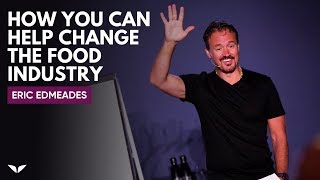
Eric Edmeades lost 35 pounds and cleared his allergies by changing what he ate, and argues the food industry deliberately makes hyper-palatable, unsatiating products to maximize profit. Every species has a specific diet, but modern manufacturing ignores this. He pushes consumers to vote with their dollars by refusing added sugar and artificial ingredients.
Chapters
Let's talk and let's talk quick because I've got a limited window here to deliver. I think what's a really important message and that is that I want to suggest to you that almost all the suffering that humans endure, almost all the suffering that humans endure today is because of one thing and that is there's a difference between the pace of change in our society and our evolution. So for 99.999% of our history, we're living one way, which involved a lot of trees and fresh air and hunting and gathering and being in nature. And then we invented glass and electricity and power and Internet and, you know, a whole lot of other things. And we haven't necessarily kept pace with that. And so our instincts haven't kept pace with that. Does this make sense? For example, how many people in this room have ever actually faced death? I mean really faced it. Now keep your hand up if you meet. By face it, I don't mean the car came too close. I don't mean that the doctor said you might have a problem. I don't mean that the bus almost hit you. I mean that you were in a moment where within about four minutes you were certain you were going to die. Then leave your hand up. Notice this room, it's less than 10% of the room. Less than 10% of these people have ever faced the reality of possible immediate pending death. Why does that matter? Well, as somebody who's faced it a few times, I've had white Rhinos charging at me and turn around at 15ft away. I was not in a jeep and I was in a casino in Nassau in the Bahamas when four men walked in with automatic assault rifles and started shooting everywhere. So I've faced it. But here's what's interesting. If you have faced it, then your adrenal system has been calibrated properly. See, I get a visa bill and I never look at the visa bill and go, shit man, I think it's gonna kill me. Never happens. But I think for a lot of people that is what goes on. See, what happens is if you have a miscalibrated system, then anything can give you stress that is life threatening. Does this make sense? Alright, so when we consider that that is ultimately one of the challenges we have is that our software and our hardware evolved for one lifestyle. And now we're living in this new lifestyle which. How fast is it changing by the way, as a parent of a 20 year old boy and an 18 month old girl. Yes. As a parent of a 20 year old boy and An 18 month old girl. Here's what I can tell you. My son has a car and a driver's license. In fact, I called him. I was in Vancouver a few weeks ago, I'd go, daniel, can I please borrow your car? He goes, how far are you going? Surreal, right? But my daughter might never need a driver's license. See, that's how fast things are changing. But our DNA doesn't change that fast. We can evolve spiritually as fast as we want, but we can't change our physiology. And that is a problem because there was a moment, nobody really knows when the moment was, but it was say 15ish thousand years ago. And some people were zooming around, doing their normal hunting and gathering thing. And then they noticed, they noticed something. And one of them turned to the other one and he said something like this, okay, it was probably she, it was a detail thing to notice, you know, and she said to her friend, hey, the last time, last year when we were here, that's where we threw all the stuff when we were done with it, you know, all the rinds and stuff. And look, there's plants growing there. Do you think we could grow plants with intention? And in that moment, we changed everything. In that moment, we changed food production forever. Here's an example. If you suddenly realize that you can grow the food that you want to eat, do you grow the bitter green stuff or do you grow the really tasty stuff? You start growing the tasty stuff and at that point in time everything starts to go wrong. At the point in time when you start to choose what you're going to grow, when you start to influence the environment, you start to take the wrong left turn and that continues right out to the point where you end up in a situation where you have food manufacturing companies that today are all about profit. And if they want to make profit, then what do they need to get you to do? Anybody in here? You want to get more sales in your business, how do you get more sales? Sell more stuff. Who can you sell more stuff to? New people and then you can sell more stuff to your existing clients. In order to get your existing clients to buy more stuff, you have to get them to want more stuff. Well, if you're a food manufacturer, that means you need to make food that people want more, more than they need. You need to build food that when they eat it, they feel unsatiated. You need to manufacture food that doesn't satisfy their nutritional requirements so that they will keep eating. You need to make food that has substances in it that are addictive in nature so that the people don't have a choice about how much they eat and when they eat it. Does this sound familiar to anybody? I was 21 years old and I was sick. I mean, really sick. Like, I mean, I'm not talking facing death sick. I'm talking that I'd been. I couldn't breathe through my own sinuses. I had. I had, you know, gut pains that were so bad that I couldn't think. I had horrible cystic acne that was painful to smile. And it was my life. I always had that tissue. I was that kid that always had the tissue in their pocket. You know the one. You know, I was that kid. And I went to doctors. Did doctors want to help me? Yeah, they did. They did. They wanted to. They didn't go spend six, eight years in medical school because they didn't want to help people. But were they empowered at medical school to help me? No. No, they weren't. But I didn't know that. Hell, my dad was a famous orthopedic surgeon. My uncle was a well recognized orthopedic surgeon. We had doctors all over the family. And so I trusted doctors and I visited them for year upon year upon year. And you know what? They gave me pills, inhalants, injections, and then finally surgery. Yeah, you know what it seems like God or evolution, whatever your belief, Accidentally put tonsils in my throat. Total accident. Got to take those babies out. That's what they said to me. Luckily for me, some friends of mine sat me down and said, eric, I think you need to consider some changes to your diet just for a month. And so I did. And over the next, I'm telling you, two weeks, my body started to change. Any of you who suffered with acne will know the difference between new acne and old acne. The way that works. In case for those of you who didn't have this problem is new acne are these little red spots that are coming up, and old acne are the ones that are healing. And I looked in the mirror one day and I realized I only had old acne. There was nothing new coming up. This is after two weeks of making change. Also, one morning I woke up and I breathed through my own nose. Yeah. Now I know some of you know exactly what I'm talking. Some of you are going, that's a bit weird, right? But let's back up for a moment. Who here has had that flu? You know the flu I'm talking about the one that you've had for Just long enough that you start questioning whether it's worth being alive. Who's had that flu? Imagine, then you wake up in the morning one day and the first time you breathe through your nose at the end of that flu, doesn't that feel amazing? Life suddenly becomes worth living again. Well, I'd like you to imagine what that's like when you haven't breathed through your own nose for seven or eight years. It hurt. Room temperature, air hurt. The tissue wasn't used to it. Two weeks later, no acne, no allergies. I had dropped 35 pounds off my body. I was completely transformed. And then I became deeply curious. I mean, deeply curious. How is it. How is it that I could spend year upon year upon year visiting doctors and get no result and that I could just simply change what I put in my body and I could get all the results? And so I asked a doctor one day. I did. I asked a doctor. I've now asked hundreds of doctors in countries all around the world the same question. But I asked the doctor one day, how long did you go to medical school? Now, the first problem with asking that question when you're 21, like I was at the time. And by the way, when I was 21, I looked about 14. My whole life, I've always looked about 10 years younger than I really was until I bought a movie studio. That'll fix that real quick. That's enough stress that you catch up with your years. Right? But when I was 21, I looked 16. Can you imagine being a doctor? And a kid says, how long did you go to medical school? Six years. And how much time did you spend studying food? Not very much. How much specifically? Well, none, by the way. Go ask your doctor this question and you will find that the answer is none, unless they took an elective. In every country around the world, I've asked this question. I'm in an event in Germany about a year ago. There's about a thousand and a half people in the room, and there's a doctor sitting just about here. And in the middle of my talk, I go to doctor's in the house. He raised his hand, he's here. I get a microphone to him. And in front of a thousand people in Germany, where I've never asked this question before, I asked him, how long did you go to medical school? He was a general practitioner. Six years. I asked him again, how long did you study food? Microphone in his hand, cameras around, thousand and a half people watching. He says, none. And for many of the people in the room, the penny dropped. They suddenly realized what the significance of that question was. And I'll put it to you another way, in case you're still wondering what the significance is. How many of you would be happy to take your car to a mechanic who had never studied fuel? It's funny, right? Had never studied oil, had never studied antifreeze. Would you take your car to that mechanic? Then I suggest you rethink your relationship with your doctor. And so I found myself with this deep seated curiosity. But you know what they didn't have? This was BG before Google. And so I couldn't just walk up to my computer and go, what the hell is going on? There was no. There was no answer for me. There was no Ask Jeeves. This was even before Yahoo. I mean, there was no solution for me. And I don't know if any of you had this, but sometimes you have a pervasive question. You've got this pervasive question and there's no way to answer it. And so pretty soon you start living your life through that question. It's like everywhere. And even if it's not conscious, it's is that that's not the answer. And then one day I'm on a plane and I'm on my way to Africa doing a wildlife photography thing, and I'm reading this article. And in the article they talk about elephants being captured and put in zoos and circuses, which I'm no fan of. So I was curious because the article was the history of it. And it said that 100 years ago, when they took these elephants and they put them in the zoos and circuses, they would make a lot of money because they would attract the audience, right? But the elephants would only live for six or seven or eight years, maybe 10. But nobody knew that that was a problem. I mean, they made their money back in that 10 years. And that was the main concern for them until they found out that elephants in the wild could live 70 years. And suddenly they became deeply concerned about their investment. I'm sure some of them were concerned about the elephant, but I'm thinking it was mostly a profit and loss question. And once they had that profit and loss question, they were forced to do the very simplest thing. They were forced to evaluate elephants in the wild. Sure, they could have conducted a multi generational macronutrition and micronutritional study on elephants to try to figure what's wrong, or they could just go and look at the ones that are getting the result and duplicate that. Does this make sense? And so that's what they did. And they found out that elephants in the wild eat 200 kg, 500 pounds of fresh grass and bark and fruit when it's in season. And they drink 70 liters, I don't know how many gallons that is. It's a lot, every single day. And when they duplicated that for the elephants in captivity, look at that, 70 or 80 years, I became fascinated because as I was reading this article, they were making a massive grammatical mistake in the article. They kept referring to the elephant's wild diet and the elephant's captive diet. Let me just back up for a minute. The elephant was on a captive diet, which was on the zoo. And. And when it was in nature, it was on what, the elephant diet? Not the wild elephant diet, the elephant diet. And the grammarian in me wanted to take out a red pen and circle every instance of this wild diet rubbish in the thing. Like, that's not. It's the elephant diet. And as I want to do this, I start thinking to myself, oh, elephants have a diet. So does every other organism on Earth. Every organism on earth has a diet. An oak tree has a diet. A cheetah has a diet. Its diet is 2.5 kg of fresh meat every day. It won't eat existing meat, it has to kill it itself. A hyena doesn't have that issue, right? They have different diets. The leaf cutter ant has a diet. What does it eat? You might think so, but they don't. They go out and they collect leaves and they bring them back and they compost them and grow fungus because they're fungivores and if you try to make them eat leaves, they would die. And then I go off, I'm doing some work with cheetahs and I'm studying cheetahs. You guys understand that a cheetah, the only production car on the road that can outrun a cheetah from 0 to 60 miles per hour is the Tesla. Do you get that? Can you imagine a four legged little animal can outrun any of your cars from 0 to 60? That is evolution for you. Or God, just in case we can ask Neil later, see if he can find out for us. But the point is that I'm studying these cheetahs and here's what's fascinating. They're trying to breed them because we are pushing them into extinction and they want to breed them and be able to reintroduce them to the wild and all this kind of stuff. And then they find out, well, okay, we have to breed Them? Well, the first problem, when they were breeding the wild dogs and wolves, that's really easy. You put a male and a female together in their pen, somebody gets pregnant, it's done. But with the cheetahs, it's very complicated. Cheetahs don't mate easily. What you do is you take a bunch of male cheetahs and you put them in pens in big enclosures, and then you take the female cheetah on a leash, and you walk her up and down the pen, and she sniffs each of the pens. She checks out the boys, you know, has to take what they do for a living. You know, got to check out a few things, see what they got in the driveway, you know, figure it all out. And then the female, she'll take a look and figure out one that she wants to, you know, get to know better. And they let her into the cage, and then they close the door. And what's going to happen at this point is she's either going to kill him or mate him. It's a lot like human dating similar. And so then they got them to go through the motions, but no pregnancies were occurring. And so why are there no pregnancies occurring? And so they brought doctors in and they took a look at a couple of things, and they compared liveblood analysis of wild cheetahs versus captive cheetahs. They're eating the same food, so they're really confused as to what's going on here. They're both eating meat. They're carnivores, they're eating meat. Is meat good or bad? Yes. I want to be clear. The answer to that is yes, there is both good and bad meat. And here's what happened. The cheetahs in the wild are eating antelope, antelope that run for a living, and they're 4% fat. And the cheetahs in captivity are eating donated cows and horses and pigs that are generally 30 to 40% fat. And that was making enough of a difference that they could not get pregnant. Oh, incidentally, check out how easy it is for people to get pregnant. Now, think about that. That's called evolution. Again, only evolution preventing stuff. And so once they figured that out, the cheetahs started getting pregnant. And so that started making me think about, okay, so first of all, every species on Earth has a diet. Secondly, diet looks a lot more specific than I thought. I mean, it's not even that they weren't trying to make these cheetahs vegetarians. They were just feeding them the wrong meat. And then I go and I find out about the Mahaliesburg vultures. Oh, my God. They're beautiful. Beautiful high cliff vultures. They live on the mountains and they're going extinct like everything else. And the local farmers were nostalgic for these vultures and so they created what they called. They figured the reason they were losing all the vultures was because as all the farmland was spreading, there was less wilderness and less wild animals. And so what they did is they created vulture restaurants. No, really, they cleared out big chunks of the forest so that the vultures would feel safe to land. And when a cow died or a horse died, they would leave it there for them. And the vultures came down and they ate, but nothing changed. The numbers kept going down until one day somebody was studying the vultures and he watched a young vulture standing at the edge of the cliff because they're way up high in the mountains. And the young vulture standing at the edge of the cliff and it was getting ready to take its first flight and it stepped off the cliff and one of its wings snapped. Why did its wings snap? Calcium deficiency. Now, in America, that happened to the condors because of the DDTs and insecticides that were in the water and in the systems. But they don't use those there. So what was going on? I'll tell you what was going on. When do vultures get to eat? Do vultures often swoop down, kill a wildebeest? No, no, they eat after who? After the lions, after the hyenas. And don't buy into this whole. The lions have good PR agencies. They have. You believe that the lions go do all the hunting and then the cheetah comes along and steals it. No, what really happens is the cheetah, or not the cheetah, the hyena. The hyena will often be the one to go do the kill. Then the lion steals it, then the photographers show up, then the hyena has to try to steal it back. That's what really happens. But I want you to consider. It's what happens. I want you to consider that a hyena can crush a giraffe's thigh bones with its teeth. They're strong. So after the hyena is all finished, now the vulture is eating nothing. The flesh. I mean, a vulture can't even open an animal. Only maybe the lappet faced vulture maybe can open an animal. It's got a big, big beak, but most of them can't. I often think about. I don't know if you guys remember those Far side comics, Gary Larson. But I want you to imagine you've got this hippo lion. It's dead. You know, its feet are up in the air. And you got these two vultures, and don't they sometimes look like they're wearing tuxedos? You got these two vultures standing there waiting for dinner. And he goes, do you know when this place opens? Because they can't open it. They need the lion to open it. They need the lion, they need the hyena. And so what was happening is that the trouble they were having is that by letting the vultures eat first, the vultures are eating all the meat, which they're happy to eat, but they were filling up eating basically good stuff, but they were getting full before they got to the needed stuff. And so the farmers learned this and they started taking the carcasses and smashing them up and breaking the bones open. And after they started doing that and allowing the vultures to eat what they were supposed to be eating, then the numbers started going up. Diet is specific. And humans have one. Humans have one. And I know some of you are going to go, yeah, but what about the blood type diet? And what about the genome testing diet? Okay, raise your hand if you need vitamin C. That should be everybody. Okay, and then how about omega fats? Who needs those? Oh, everybody again. And how about this? Anybody need calcium? Anybody up for. Okay, hang on a minute. What about the blood type diet? What about the genome diet? And what I want to suggest to you is that every Homo sapien on Earth needs the same stuff. We have some different production capacity. Some of you are gluten intolerant, some of you have issues with lactose, and I get that. But what I would suggest to you is that so many of us have an issue with lactose is a clue. And that if you are not sensitive to lactose, I feel bad for you because it means the alarm's been turned off. You don't have the pain, so you just keep having it. And that will give you, according to Harvard nurses school, a 30% uplift in your opportunity to develop ovarian or prostate cancer. Milk, it does a body good. It does not. That's why you will never see those ads again. You look, you will not in Britain, Canada or America ever see an advertisement from the dairy industry ever again telling you that milk is good for you. I went through something when I turned my life around and I found this truth. I went through something, and that was, the planet's in trouble for a million reasons, but really, one of the biggest single Biggest troubles we have is that our food production system is fundamentally broken and our governments are fundamentally broken relative to our food production. And I started thinking, how can I change that? How can I make a dent? As Vishen put it, how can I do that? And I started thinking, that's it, I'm going to go and I'm going to get involved in government. I really, I was living in England, I'm Canadian, which makes me a member of the Commonwealth, which means I can actually run for government there. And I seriously thought about it and then I found out how government works. Or wait, that doesn't make sense. I found out how government works. No, no, I've got that wrong. I found out that it doesn't. Think about it. This is how I want you to run your company from onwards. I want you to hire people for four year terms and then at the two year mark, I want you to get them to interview for two years to get their job back. It doesn't work, it's too slow. And then I started thinking, where can I create influence? And I realized the very simple answer, and that is people. I've been writing a book recently about public speaking and the stage effect. And one of the things I found out is that Roosevelt at one point was trying to put through some legislation in the American political system and Congress was not going to have it. It just wasn't going to happen. And at this point, radio and television and stuff, being able to speak directly to the people was beginning to be a big deal. And so he decided, I'm not going to try to influence the House of Representatives, I'm going to influence people. And his bill passed with only three dissenting votes in the House because he went directly to the people. And so I am going directly to the people. And I want you to go directly to the people. But in order to get directly to the people, we're going to have to do something else. And that is we're going to have to get them to actually change. And here's the joke. The average person in America knows they should be eating more fruits and vegetables. Is this true? The average person knows that they should be getting high quality proteins from some or other source. Is this true? The average person knows that they should not be eating refined sugar, pesticides, herbicides, artificial this and artificial that. Is that true? The average person is still eating those things. Why? I mean, it makes me, you know, humans, most intelligent species on Earth really. Name a species that suffers with more disease than we do. The only one that might come close Is our pets. Guess who feeds them? We do. And so the change. And I wanted again, I want to touch on this specificity. I want you to think about something. What do elephants eat again? Do you guys know? What are they? What kind of an elephant? Are they a herbivore? Are they an omnivore? Are they a carnivore? They're herbivores, okay? They're herbivores. 200 kg of grass, bark and fruit every day. Really? Have you ever peeled the bark off a tree? Grubs, eggs and insects? You ever tried to eat that much grass and pieces of fruit with worms and wasps eggs in them and hornets that are in the fruit? If you drink 70 liters of water out of the day, tell me you're not getting insects and eggs and small fish. Is that true? So what do you think would happen to the elephant if we decided, you know what, he should really stop with the animal protein. That's just wrong. Killing all those insects and we stripped out all the insects from his food. What do you think would anemia or something? Diet is specific guys, but what we have to do is get to behavior. And that's what truly gave birth to Wildfit. And I gotta tell you something, that whole conversation, you know, Vishen and Alan Watts and inspiration and Emily Fletcher, like I want you to hear something. When I created Wildfit, I knew that what I wanted to do was have a massive impact. Like we need to turn around the lives and the healths of billions of people on this planet for the planet. It has to be done. We're arguing about Obamacare, trump care, national health care in all your different countries. Stop it. Who here would be happy to buy car insurance from a company that charges the same amount to you as to a 16 year old child with five accidents under their belt? Who wants that insurance? I'm sorry? You want insurance based on your risk factors? I'm not interested in universal healthcare. I'm interested in universal self care. So one day I observed something and that was that there was the capacity to make real change for people. And I want to tell you guys, any of you that are into coaching and transformation, I'm going to give you some clues as to why Wildfit works so well for so many people for such a high percentage. You know how the diet industry works. You write a diet book, 10,000 people buy it. Five people get really good results. You get their before and after pictures, you sell more books. What if instead that every hundred people that does it, 90 of them get really good Results, what would happen then? Big change. And I want to tell you why we're able to create that, and that is that lasting transformation is not about giving people a bunch of restrictive rules. It's not about telling people you can and can't do this. It's about changing their psychology. How many of you would really like to not like sugar anymore? How many of you would like that? It can be done. How many people have already had that done to them recently? Look at that. Oh, we even got at least a yes, yes out of that one. So what I'm saying to you is that the first thing you have to do is change the way people think. The second thing you have to do is you have to give them community. You have to give them community. When we created WildFit, it was really simple. I knew I could coach people one on one. But what I knew I had to do is I had to put them together. And so we created community, and that really gelled people together. And it's one of the big reasons we've been so successful. So I want you to think about that. When you're creating transformation for people, you want to make sure you're changing the way they think. You want to make sure they have community. But here's the big need to treat them like the whole frog in the hot water thing. How many of you that have done WildFit showed up on week one and thought that I was actually crazy? How many people, how many of you realize that it's not crazy at all, it's just crazy enough to be making a dent in the universe? That's what week one is all about. It's about easing in and learning some things. Because if we want to get different results, we're going to have to do different things. And that's exactly what that's all about. And what I want to challenge you guys to consider is whether you do it with us through WildFit or whether you go and do this on your own. What I want you to consider is that if you want the food industry to change, you must change, because they are simply responding to your spending habits. Your health is far more determined by you getting enough of what your body needs than by removing stuff. The elephant. If we remove all those insects, that elephant's gonna have a problem. If we tell dung beetles, dung beetles stop eating poop. That's gross. They will get sick. They need what they need, and you need what you need. Does this make sense to you? And so all I'm gonna say to you, even for those of you who haven't even begun yet, the Wildfit quest, what I wanna suggest to you is just do this before you eat the other garbage, get all the stuff you need in first. That is the primary thing you need to be doing to turn things around. And with that, you can begin to change the industry. We had a butcher tell us that he stopped making sausages with sugar and syrup in it because two of our clients kept asking for custom orders. And one day they decided to sample the custom order and they realized, holy crap, these taste just as good without. And we're not doing it anymore. Vote with your dollars, vote with your rubles, Vote with your pounds. Vote with your euros. Vote with your money. If it's got sugar in it, don't buy it. If it's got artificial rubbish in it, don't buy it. And if you stop buying it, they'll stop making it. And we will change the world together. Thank you very much. Thank you. Thank you so much.
More from Vishen




Brown Noise for Deep Focus and Concentration (Best with Headphones) | Gabriel Loynaz



Your Appointment With the Eternal | Guided Meditation with Michael Bernard Beckwith

