Ultimate Step By Step Guide To Creating A Highly Effective Home Workout Routine - Only 12 Minutes!
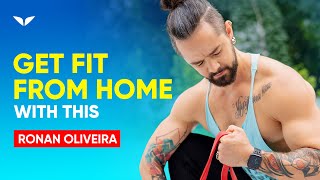
Build a home workout routine around three pillars: strength training with 5-6 compound exercises twice weekly, circuit-style conditioning for 15 minutes, and mobility work 1-3 times per week. Train to near-failure to build muscle and metabolism.
Chapters
Can you get fit at home? And the answer is, yes, you can. But you don't need a workout. What you need is a workout plan. This is like a fitness poem. The main problem here is that we have so many random workouts on YouTube and people are following at home. But how do you know if you should do bodyweight exercises or cardio or how much of these things you should do? These are the answers that we're gonna cover in this video. And in this video, we're gonna create your weekly schedule of workout. Let's get started. The main thing here is that we need to break down fitness into different areas. One area is your strength, your muscle mass. The other area is your cardiovascular fitness. And then also have mobility in the middle. And we need exercises and routines that address each one of those. We prioritizing and planning strength training. But then you say, ah, but I don't care about being strong or muscular and all these things. And you don't need to. But still, strength training will be a priority because of a cascade effect that it has. Strength training is not only building muscle mass, but it's even getting your bone structure more dense and stronger. It's improving the way that your body metabolizes sugar. There are different areas of your health that are improved for a higher amount of muscle mass. So this is why we prioritize. But then the second question that you ask me is, yeah, but what I care about is burning fat. You know, that's why I'm doing hiit and tabata and all this kind. Will strength training help me there? Not only it will help you keep your muscle mass while you're losing weight, so that you prioritize burning fat, your body prioritizes that. But a body with more muscle mass is the body that has a higher metabolism. When you're doing cardio to burn fat, you are burning energy. Only while you're doing those 30 minutes of cardio, you finish that, you finish burning that energy. When you build muscle, you build this active tissue that is burning energy even when you are sleeping. So you're not only burning energy while you're doing strength training, but that muscle mass that you build burns fat on autopilot. And that is the amazing thing that you want. So how do you do this? What types of exercises do you need? The main thing that we want to focus is on five to six main exercises that we call them compound exercises that will work your full body. These are the minimum, the basic exercises. You divide your body into upper body and lower body. And in your upper Body, you can push things and pull things horizontally. So here are two movements. Now push things and pull things vertically. More. Two movements. And with your lower body, you can push things like when you are standing up from a chair, or you can like pull things. Imagine that you are grabbing this heavy box from the ground and then you pull this up. The six movements. Now we need to find exercises to fulfill them because they are the ones that work your entire body. If you want examples of what these exercises are, stay with me until the end of the video, because I'm going to give all the exercises that you can do. But once you have those exercises, now you have a routine with five to six movements. When you are doing your training, you want to do them to the point of fatigue, to the point of failure. So for example, if you're doing a push up, that is a horizontal push, you want to do this to a point that you can no longer do another repetition with a good form, because this is stimulating the muscle fibers off your chest of your shoulders and triceps and sending the signal to the brain saying, hey, this amount of strength is no longer enough for what we need in our daily lives. So please, body, grow a bit more muscle, become a little bit stronger, because I'm reaching the point of fatigue. And then the body will adapt and build stronger and bigger muscles, muscles. So training to failure is a very important thing. And then if the question is, should I train with my body weight, should I train with resistance bands, free weights, all of these options are possible. It depends on what is more convenient for you, what you like the best, and what is the methodology that you can reach failure. So for example, if you are doing squats for your leg, right, and you can do like 100 squats and your heart is getting tired, but your leg is not, then it's hard for you to get muscular failure only with your body weight. You can try to do squats with only one leg, or you can add a little bit of weight, get a pair of dumbbells that you hold while doing squats, or a resistance band that makes it harder. So this equipment or this methodology is to help you reach fatigue in the ways that you're doing this exercise. Now you get those five to six exercises to failure and do them at least twice a week, because the frequent enough signal to the body that will suggest to the body to build stronger and more muscle fiber. So now you have strong, now you have strength that's covered. The next area that we are going to is conditioning. You know, I have a client that was talking to me. In the weekend she went for a walk to her daughter's house and was 2.5km walk. When she came back, she said, rona, I was, I was just done exhausted for the whole day. I came back, it was like midday. I just laid in bed because I was too tired. Conditioning will solve that part of your fitness. Now your heart can keep up with more activity. The main question that comes here is, ah, yeah, but I don't like to do cardio. I don't have a bicycle. I don't like to do treadmills or this stuff like, or I cannot do much jumping or burping because maybe I'm overweight, it hurts my knees. And the good news is you don't need that. You can practice conditioning with muscle building exercises. Now, if that is good news, I want to know if you like this. If that is good news to you, go to the like button and click on like. Because I want to know how many people like the idea of not needing to do cardio. I'm one of them. The way that you do this is that you again select five to six muscle building exercises. A few of them will be compounds like your squat, maybe your pull up or your push up. And a few of them will be isolation exercises. You know, something for your shoulders, like a lateral raise for the bicep or something for the hamstrings, for example. Pick five to six of those exercises and you do them in a row without rest as a circuit. So once you finish those six exercises, you go back to the first one, do another round, and once you finish the six again, you go back to the first one and do a third round. This will keep your heart rate up, you see, that will be at some point challenging to breathe. If you keep your heart rate up for more or less 15 minutes, that will give your brain a signal to adapt your heart's capability. Now you will be increasing your conditioning. Your heart will be able to provide your body with oxygen for a higher level of activity. So this is how you improve conditioning, using strength movements. And if you want to know, okay, what are some of the examples of exercises, stay with me until the end of the video because I'm gonna give you the exercises even that you can do in this schedule, this routine for conditioning. You do all there, more or less two times in a week. And that covers your needs for improving the area. And then with the remaining days, we work on mobility because we don't want to be, you know, when you bend over to grab something, you don't want that pain on the lower back or you don't want that stiffness. You want your body to be flexible, to be mobile. And this is when routines like a yoga routine will be very helpful. And the good news here is that the the YouTube is filled with different yoga challenges. This is how I came up with my own yoga routine without being a yoga instructor or anything. I tried a couple of those 30 day challenges. They are amazing because every day there's a different yoga routine, a different type of exercise or positions that you do. And then I found that a couple of these positions were a bit harder for me, especially when it comes to me in the hips. My hips were super stiff, you know, when there was something on the upper body was super easy. But then I realized, ah, the positions that involve opening the hips, these are the ones that I need to focus on. So after finishing 30 days, I had my lists of different stretches and yoga asanas that would help me get more mobility where my body needed the most. And this would be different for me and for you and for anyone else. So the best thing to try a challenge for 30 days, take notes of the most challenging positions and then build your own yoga routine based on the challenging ones. So now every morning I go out in the sun, I do my 20, 25 minute yoga routine every day with those challenging movements that are no longer challenging because I target exactly what would give my body a little bit more mobility. And this you can do once to three times a week even. It's not something that is intense, that will make you tired. It's more like a recovery practice. And with this you have an overview of a weekly schedule, what types of training, of workouts you do to work out smart at home and how much you should do them. Now I have something that can make this even easier. You know, if you're wondering what are the exercises that I put in this routine? I already build this whole routine with all these exercises and recorded videos of all of them and follow along workouts and it's for free. For free. Sounds good to me. I'm giving you a link in the description to the Advanced to Home Workouts Mini quest that will guide you through this whole schedule of training. But before you click there, I want you to open that link in a new tab. Because in this tab I'll have a assignment for you. If you're here, it's because you are interested in learning more about fitness and about exercise. And one thing that I do with all my clients is that we always dedicate time to learn more about fitness and exercise. If you have one hour per day to exercise, we exercise, for example, 50 minutes. And the other 10 you read a book, you watch videos, or you listen to podcasts. So what I did is that I created this playlist that you can see on the screen right now with all the videos that I made talking about exercises and fitness, types of exercises, how to do, how to build muscle and strength, and all of that. The assignment is watch the playlist, you know, while you're cooking, while you're doing something, let it play and absorb the knowledge because this will help you improve. Improve the exercises that you do in your home workout program to make you work out smarter and get more results from home. If you have a different routine or different exercises and you have questions about this, let me know in the comments and let's address that to make sure that your workout schedule is perfect and if you like the things that you learned. If this was helpful in this video, subscribe for the channel. Subscribe because I create more videos on exercise and fitness and every Wednesday there's another one. Subscribe with passion. Recruit your triceps to click on that button. I'll talk to you in the comments and I'll see you in the next video.
More from Vishen




Brown Noise for Deep Focus and Concentration (Best with Headphones) | Gabriel Loynaz



Your Appointment With the Eternal | Guided Meditation with Michael Bernard Beckwith

