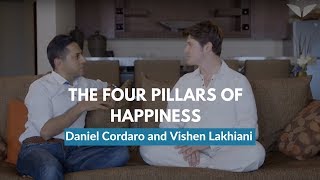
Daniel Cordaro argues that "happiness" is too vague a word, lumping together pride, shame, and desire. He proposes contentment philosophy instead: accepting what you feel right now rather than chasing happiness. Suffering comes from resisting unpleasant emotions; curiosity about your internal experience builds resilience.
Chapters
Well, it turns out this concept of happiness that we have in the west is not exactly very well understood. There are other emotions, like pride, for example, which is a high sense of our self worth, or shame, which is alternatively a low sense of self worth. Sadness, which is the experience of loss. Or desire, which is a craving for something that we don't have. Happiness, however, is used colloquially as a blanket term for all pleasant experiences. When you're feeling joyful, you might say you're happy. When you're feeling prideful, you might say you're happy. When you're feeling triumphant, you might say I'm happy. So in a sense, the more we try to uncover what happiness is, the more elusive it becomes. It's like a shadow that dissolves when we shine our light on it. There's question, especially for me and my team, that happiness really exists at all. That it might just be an illusion of our Western culture and that there are deeper sensations or deeper philosophies that are a bit more precise and that withstand the test of time and are a part of our human lineage of well being. This notion that we can be, well, indestructibly at the bottom of our hearts, at the bottom of our souls, is a birthright that all human beings are entitled to. And this notion that happiness is somehow outside of us, that we have to chase it, that it's not already here, is really an illusion. It's just some thought patterns of the mind that are a unhealthy or not really in line with the nature of reality. And so what we offer here with contentment philosophy is that for those who are chasing happiness but finding it hard to catch, that perhaps there's another way to conceive it where there's actually nowhere to run. We're right here, right now, in this moment, at this time, you're absolutely perfect, exactly as you are in this moment.
So if we're absolutely perfect, exactly as we are, why do so many of us have so much pain, so much longing for something different?
This is one of the deepest questions that we could ask as a species, and you've been asking this for tens of thousands of generations. What does it mean to be happy? What does it mean to feel well? What does it mean to sustain that happiness once I found it? This notion of suffering comes from a few places, but one of the most potent ones that I've seen in this work is, is when we resist certain sensations or emotions. So some people might feel sad and really not want to feel that sadness. You feel lonely and you don't want to feel that loneliness. And in that resistance where we go get something to eat or we check our phone just so that we can numb ourselves a little bit from the pain of that sensation. This is one of the origins of suffering, when we're really resisting what is current and what's present.
Okay, so we are resisting. Now you've got me really intrigued, but also a little bit confused. If we are resisting that suffering that we are feeling, what are we meant to do?
So let's take an example. Let's say this interview. So we're trying to get some philosophy into the world. We're trying to communicate this notion of well being to as many people as we possibly can. And let's say something gets derailed in the middle of this interview. Maybe I'm not speaking well, maybe I get nervous, maybe I'm afraid. And so there's some problems. So we have some goal that we're trying to achieve, which is to really put out a great interview. But something's going wrong. And now something else comes in here. It's not just the problem that maybe I'm nervous or I'm not speaking well.
Right.
There's this other problem now of I don't want to feel the fear and embarrassment of putting out a bad interview. So now we have two issues that we're dealing with. And the question really becomes, do we want to double all of the problems that we have in our life, or do we just want to stick with what we're here to do and what really, really makes us feel passionate about being vigilant? So there are so many methods when it comes to being emotionally resilient. So many coping strategies, so many ways of dealing with the more unpleasant sensations of what it means to be a human being. But where contentment philosophy really shines is this notion of unconditional acceptance of all that is so within this human body, we have this incredible thing called the brain, where every single moment of every single day, we're experiencing emotional reactions to all of our surroundings. Everything that you see, everything that you hear, everything that you touch, everything that you smell is paired with an emotion. It's what it means to be human. However, because of our cultural upbringing, because of our experiences, some of those sensations we tend to resist. 99% of them throughout the day, we just allow to pass through like waves in the ocean. But then a small 1% are the ones that really, really matter. That, as you say, vishen kind of derails us. And those are the ones that are really interesting. To look at.
Why? Why are they interesting?
They're interesting because they give you insights into how your mind is working. And one of the most powerful tools that we can use is this notion of curiosity about the self. So instead of saying, oh, I'm feeling uncomfortable. I don't want to feel that, I want to change it. I want to be happy instead of sad. Instead we can activate our curiosity muscle and say, wow, isn't it interesting that I'm feeling this way right now? Isn't it fascinating that in this moment I felt hijacked? I felt afraid that my palms started sweating, that my heart started racing, that my throat felt tight? What was going on there? What was happening in my mind? How was I perceiving my world? And this is the notion of growth as a human being when we can start to unravel and decode the subtle psychology of our mind by asking radical questions that penetrate even the most firm belief systems that we can possibly hold.