Why Diets Don’t Work — And What You Can Do Instead | Eric Edmeades
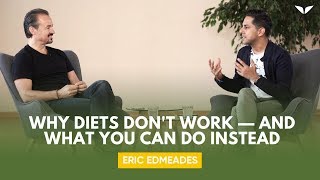
Eric Edmeades explains why calorie-counting diets fail and introduces WildFit, a 90-day program that rewires your relationship with food instead of restricting calories. It focuses on nutrition science and breaking emotional eating patterns to create lasting change.
Questions this video answers
90 days
Approximately 7 kg
51 pounds
The Canadian Senate
Chapters
So, Eric, you've always said that diets simply do not work.
No, the entire diet industry is a scam. If ever somebody had come up with a diet, you know, say 10, 20 years ago, they'd come up with a diet that actually worked. There would be no diets. The millions and millions and millions of dollars that the diet industry makes is largely people spending money that they have to spend because the last money they spent didn't get them anywhere. Think about it this way. The vast majority of people are malnourished to begin with. That is to say that they eat too much of the wrong stuff and not enough of the good stuff. Then we put them on a diet, for example, calorie restriction. There's a scam. Let's go on to calorie counting and calorie restriction. So now you've got somebody that was eating too much of the wrong stuff, not enough of the good stuff. In other words, they're undernourished, and now we put them in a calorie restriction program so they eat even less nutrients. That's never going to work. Oh, and then how about this? Let's sell them a gym membership. Now, look, there's nothing wrong with a gym membership. I think that fitness, physical fitness is incredibly important. But, but it's not going to make anybody healthy. It's going to maybe make them healthier if they get their nutrition handled correctly first.
Right. Because science is showing that 80 to 90% of your body shape has to do with what you eat and not exercise.
Absolutely right. If you think of it, that if you aren't putting the correct nutrition into the body, then very often the very exercise that people are doing in order to improve their health is actually damaging them. You know, they're making massive physical demands on their body while not meeting the body's massive nutritional demands that are resulting from that. And so it's a loop of pain. So the average American will go on five diets in their lifetime and they won't work. In fact, I read once that diets will on average cause somebody to gain three pounds every time they go on one. So, yes, they might have an immediate loss if weight loss was their purpose for going on a diet, which is generally the biggest driver. And then they, they'll go on the diet. And even if they experience some weight loss in the short term, they're going to often do that by some form of starvation, which means when the diet is over, they're going to overeat to compensate for that, and they're going to Regain the weight.
Wow. Now you created wildfit. Isn't that a diet in a way.
I don't know how else to put it other than it's the non diet diet. It isn't about a diet. It isn't about a set of rules. It's about food freedom. It's about recognizing that the food industry works because it doesn't work. Look, I'm not saying there's any one person out there that's evil. I'm not saying there's one evil person out there that's saying we must make profits at the cost of people's health. But the reality is, is that companies become these large organic things that serve their shareholders. And so the shareholders are sitting there looking at the quarterly reports and saying, how are we going to make more profits? How are we going to hire more people? How are we going to grow? And the problem is that once people have eaten enough food, you can't sell them more food. Unless of course, you sell them food that's nutritionally empty so that they stay perpetually hungry. Or in case maybe you put so much sugar in their food that it's constantly stimulating their appetite and causing them to buy more food. Look, in the marketing world, we know that one of the ways that you boost your revenue is by increasing the number of transactions by getting the clients to buy more and more often. Well, in food, what that means is getting people to overeat. And the way you get people to overeat is you sell them food they that is nutritionally empty, so they're perpetually hungry. And then you put things in the food that make them hungry, like sugar. We're at a place now where something like 75% of the food produced in the western world has some form of refined sugar or corn syrup or something like that in it. Why? Why is it there? It's not there for flavor. You don't even know it's in most of those things. It's there because sugar stimulates your appetite and makes you hungry. And that's extremely good for food industry profitability.
Okay? Now Wildfit has got some incredible success stories. I've lost close to 7kg of wildfit. And you just got awarded a medal at the Senate, at the Canadian Senate. Now, what is going on there? You are criticizing diets, but isn't wildfit in some way a diet, I suppose.
In the strictest sense of the word, in the strictest sense of the word, diet. What we've done is gone out and created a health transformation program. That people would want to categorize as a diet. What we are doing is so dramatically different, though. First, yes, we've done some incredible research into what we'd call, say, nutritional anthropology to identify some of the core nutritional needs that humans have. Of course we've done that. What we've done that's so very different, though, is taken a look at people's psychology, we've taken a look at why it is that they're eating food the way they are. And we've then been able to change that for people, if you really think about it. And I have to wake myself up and pinch myself in the morning sometimes, because if you realize that 95% of people who go on a diet or rate that diet later and say they failed, 95% of people, they don't succeed. And even the 5% that do ask them a year later, they still don't feel like they've had a huge success where we have something like an 80 to 90% success rate. And the reason is not because of the food rules that we created. Look, the reality is the food rules are out there. We all know, eat a wide variety of plant based foods, eat some good, healthy proteins in our life, make sure we're really well hydrated. We know all this stuff, but we're not doing it. And we're not doing it because of a variety of reasons, like our parents accidentally conditioned us when we were children. WildFit is a perfect intersection between rational nutritional principles and food psychology, changing the way you decide to eat. And so our clients will come to us and they'll say, I have a list of foods that I wish that I was wanting to eat more often. And I have a list of foods that I wish that I didn't want to eat so often. And three months later, those wishes are granted.
And how is this happening?
Well, through a very carefully constructed program.
And I can vouch for this because I went on WildFit in 2016 and now it's been two years later and I'm still at that same weight loss stage. I haven't put on the 7kg I've lost. In fact, I continued losing more and getting into the best shape in my life. And the funny thing is, I no longer crave the things that I used to crave before. I no longer go to Starbucks and order a mocha filled with skim milk. I like Americanos. And I could never stand the taste of pure black coffee before without adding milk or sugar to it. But I know it flips something in my Brain. And I'm fundamentally a different human being. Now, I hear rumors that you're using behavioral modification, that you're using neuro linguistic programming. Explain what's really going on there.
I'll give you a perfect example. If you ask the average person why they're eating a dysfunctional food, they'll tell you that really it's because it makes them feel good. That's really what it is. It's making them feel better. But if you really analyze it, you will find that they start to feel better before they even start to eat it. It's the permission. So for example, the child skins and falls and skins their knee. They trip skin their knee and they're crying. The parent comes up and gives them a cookie. The cookie makes them feel better. Now they're 35 years old and they're kind of having a down day and they go, oh, I could use a cookie. The minute they decide to give themselves permission to have that cookie, they start to feel good. They haven't even put it in their mouth. There's nothing about the cookie that's making them feel good. It's the emotional return. But the problem is this, is that the minute they eat that cookie, they were already feeling good. They were already producing dopamine and serotonin. They were already making themselves feel good. Then they put the cookie in. Well, now they link up the feeling good to the cookie. It was never the cookie. And so when people begin to recognize that a huge amount of the food decisions they make are emotional and not nutritional, then they begin to be able to make a change. Now people kind of know this, but we go through some very specific process that deframe those emotional linkages so that they look at some food that only three weeks ago they were powerless over. Because let's be clear, many people have foods that they are powerless over. And, and now they look at it and they're not only powerless over it, but they don't even regard it as food. And then they walk up to me and they go, thank you for my freedom.
I've experienced that. It's so remarkable to see because I put a hundred people, 100 of my employees on WildFit. The record was 51 pounds lost. It was remarkable to see people from all around the world fundamentally changing their relationship with food. We had one guy from Egypt who told me that in Egypt he is used. He's been growing up like this, having a glass of Coke with every meal. Now he cannot stand Coca Cola. And something in his brain flipped after 30 years three decades of that type of conditioning, something flips. So whatever's going on there, the results are astonishing. How is this different from a traditional diet?
It's different from a traditional diet in that we are working specifically with their food psychology. So a traditional diet says, eat this, don't eat this, and use your willpower to make it work. Willpower simply doesn't work. At best, it works in a very short time frame. And what we do is make it so that willpower isn't part of the equation, that you simply don't want the foods that you shouldn't be eating, and you do want the foods that you should be eating. And we need to do that.
This has to do with the 90 day program that WildFit is based on, with behavioral modifications and specific conditioning that you go through every week during those 90 days with a community of people.
What we are subtly doing over the course that 90 Days is making the correct nutritional enhancements and the correct psychological enhancements so that we are building their self esteem, we're building their sense of success, and we are creating lasting change. By the time they get to week 10, they're saying, I will this. I will never go back. I will never go back. I am done.
And I've witnessed that. Thank you, Eric. Sa.
More from Vishen




Brown Noise for Deep Focus and Concentration (Best with Headphones) | Gabriel Loynaz



Your Appointment With the Eternal | Guided Meditation with Michael Bernard Beckwith

