Why You Should Resist Institutions for the Sake of Your Children | The Mindvalley Podcast | Ep #53
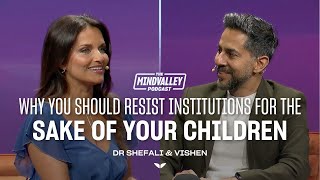
Vishen Lakhiani and Dr. Shefali discuss why parents should resist mainstream institutions and cultural trends. Dr. Shefali argues that fostering individual consciousness in children matters more than conforming to institutional expectations, while they explore how AI and social media reshape what it means to raise conscious kids.
Chapters
The reason why we belong to these countries and we go into war is because we were raised unconsciously. But no one seems to be learning lessons from the past.
The woman Oprah called revolutionary and life changing, the astounding Dr. Shefali.
Her name is Dr. Shefali. Dr. Shefali. Doctor Shefali, defy the tide. Because the most dangerous thing is just going with the tide. America has not done its reparative healing work till today. And therefore the blood that stained the backs of the oppressed will still run through and ink the stories it tells of its future.
That's a very powerful statement. What would you like to see America do to heal that part of its soul?
The first thing America should do is we have two brilliant minds serving us their greatness. Today we have vishen Lakhiani and Dr. Shefali. Dr. Shefali is known as a conscious parenting expert. She's about to give her presentation tomorrow and dive deeper into parenting our kids. And today I she is gonna sit down with Vishen for a thought provoking chat. Dr. Shefali is known as a bestselling author. She has four books, three bestsellers. She's also just launched her new podcast, Parentina Now. And we are so happy to have her at Mindvalley Stage. Welcome. Thank you. Thank you, thank you. And let's welcome Vishen back on stage. Yeah.
Hi, Shefali.
Hello. Hello. I'm excited to be here.
Can I call you Shefali or do I have to call you doctor?
Just call me Shefali.
Okay.
I know you want to call me far, you know, worse things. So just let's, let's settle with Shefali. I will be so honored.
The interviews between me and Dr. Shefali are known for strange forms of passive aggressive joking that we have with each other.
From vision to me. Yes, right. It's okay when people feel insecure when they are in the midst and in the presence of, you know, people who are smarter, it's tough. So we're going to have a lot of compassion and cheer. Cheer him on.
Thank you. Guys, I need your support.
I told you he can be passive aggressive.
This lady is fierce. Are you attending the jungle party tonight? You should just come as yourself.
That's the plan. See, I don't even have to dress up wild as I am.
Okay, so seriously, congratulations.
Seriously.
Shefali is an expert in many things from parenting to evolutionary a woman to making fun of me. But where would you like, what would you like to talk about today?
I would like to talk about how this is completely unscripted. I had no idea he's going to ask me to tell him what we're going to talk about. But I think what I would like to talk about, because it's at the core of most of what I teach, is how not to go on the ride of the Matrix, how to resist just flying off with the current trends, how to find a way to stay grounded without following the maddening crowd. I think that could be a key piece of what we could weave into all what we talk about.
Thank you. And I love that topic. So when you say the Matrix, what do you mean by that?
Well, to put it simply, I think that culture has a mainstream trend. And for me, that trend typically is pivoted and directed toward domination, competition, materialism, a dogmatic greed, separation. And it sets up a dynamic where those who are hungry for that win and those who want to live another way of life can't. And so that's what I would refer to as the Matrix. These trends that go towards acute greed and capitalism and domination and achievement and competition and separation of. Of us as humans against each other, leaving other ways of being invisible or suppressed.
What are some examples you're seeing in the world right now where you feel the Matrix is really poking us?
I know tomorrow you have an AI summit, so I don't want to talk too much about that, but to me personally, trends like that, you know, 10 years ago, we didn't know how pernicious and treacherous social media would be for its children. And here we are now, and it's hard to backtrack. I feel that we are at that precipice for this AI wave, and we're not seeing and learning from the lessons we just discovered and should have learned. And we aren't pressing the pause. And we're going with the tidal wave of this matrix to the same direction that I just talked about, which will end up in extreme separation, competition, and a real disintegration of what it means to be human.
I mean, I guess you're really right there, because culture is changing at a crazy rapid pace. I mean, when we think about culture, we think about, okay, there's this religious culture, how you pray, when you pray. There is our. Our respective national culture and the foods we eat. Then you look at social media, and that is part of culture. The fact that it's not just Americans who spend two hours a day on social media. It's people all around the developed world. 5 billion people with access to the Internet, and they spend more time on social media than they do on eating their national food on their own way of life. And we are only beginning to realize that while there are good things about social media, there are bad things. For example, teenage suicide is up 300%, especially among young teenage girls.
Right? But even just what you just said, you referred to religion and nationalism and then social media. All those three institutions are designed for the same thing, which ultimately at its core, bring about separation between each other. Nationalism, you know, any ism, even if you're patriotic, you're patriotic to your ideals set forth by your geographical location, your country sounds like a wonderful ideal, but it creates separation because if someone else attacks your nationalist identity, you then want to protect it. Similarly with religion, again creates domination, separation, hierarchy between us pits us against each other. And now social media does the same thing. So social media is just one more resonance and echo of the same institutions that have been for eons creating separation between us humans. Social media is at its pinnacle of creating comparison. It's a comparison culture that it creates. And AI is taking that one iteration, thousand iterations, even further to create again, not just separation, not just comparison, but what I believe isolation and therefore a multitude of emotional repercussions that we aren't being wise enough to harness back and pull back right now. We're already too late. But at least we are at the starting point of this tidal wave. But no one seems to be learning lessons from the past. We are inviting it, we're celebrating it, we're extolling it, and we're just going with it. And this is how we are part of culture. Culture is not this evil entity out there. It's us. We are participating, we are colluding. We are co creating it right now. And then 10 years later, like we are doing with social media and seeing its effects on our children, we're going to be like, oh, why didn't we stop it? Because people like us back then were like, oh, this is the greatest thing since sliced bread. And we went with it. We're doing the same thing. And so the core of what I teach in conscious parenting as an example, because conscious parenting so goes against the tide, so goes against the matrix that when I wrote my first book, people told me like I was crazy, like, no one's going to read this book. No one cares. You're going against Holy Grail, the holy grail of parenting, which was to keep the parent at the pedestal. And I was attacking that and people cautioned me, but I didn't listen. And in the same way I speak up now about things like AI and social media, because these are just the current institutions that we idolize. These are the new gods of today, the technological gods, but these are just different iterations of other institutions gone by that promoted, at their core, deep separation between human beings.
I think what you're saying is really true, and you got me thinking as well. You know, they say our beliefs create our reality, while social media now creates your beliefs. Because the way the AI algorithms work is that they need to get you hooked on scrolling through Instagram. So if you look at TikTok, whatever is your political view on TikTok, TikTok will reinforce your political view. And Facebook and Instagram and LinkedIn do the same thing. If, if there is a war and there's side A and side B and you're on side B and you're watching videos about why side B is right, what you will see on TikTok is more about why side B is right. And so you become convinced that side B or your side is correct and the other side, they are wrong, they are evil, they are bad. And so in a way, social media, while Mark Zuckerberg might want to think it's bringing the world together, it's actually, in a way dividing us even more, 100%.
And we can't blame him because again, we are ready, willing, able participants on a moment by moment basis. And therefore, in communities like this, it behooves us that here too, we have an other side that not everyone just jumps on. Whatever the bandwagon of the person on the pulpit is that we challenge, that we question, that we defy, that we rebel, because that makes a healthy learning environment. So here too, at Mindvalley, the people on the stage are not the Holy Grail either. I mean, no offense to either of us, but we should defy the tide, because the most dangerous thing is just going with the tide. And so the new tide today is AI. And for me personally, you know, what's the polite way of saying it? I mean, it is just ghastly. It's. It's a travesty if we just go on it thinking it's the next medication, when actually we will find out, just like we did with social media, that it was the toxicity that we would, we should have protected ourselves and our children from.
I would say I partially agree, partially disagree. I think when we look at AI and how it's influencing the algorithms of social media, AI is not optimizing for our well being. No, it's optimizing for the advertiser. And the more it optimizes for the advertiser, the more the advertiser pays meta. And so the richer meta and TikTok their bank accounts become, right? And so the more you get hooked on why your side is right, the more you are doom scrolling and the more you end up seeing ads and the more you end up buying the. So that's an example of bad uses of AI. And the crazy thing about that is that, you know, Yuhal Hariri recently gave an interview and he said we no longer fight wars for land or for water. We fight wars for magical imaginary stories. Israel and Gaza are two people with a lot in common. They are fighting each other because of crazy stories that they believe from thousands of years ago.
Well, it's for what you just said.
Same with India and Pakistan, same with Russia and Ukraine.
Right? But for what you said religion and nationalism, right? So through propaganda. So it's exactly what we just started with, that these institutions do nothing but cause separation. And they do it through a very compelling way of creating a doomsday mentality that if you don't get on the wave, you will be left behind. And that is our greatest fear as humans, that we don't want to be left behind. It challenges a primal fear that we have that we want to be part of. We want to belong, we want to be with the trend, we want to be with culture. And culture uses that to propagate itself. So therefore it takes humans who are strong from within to not follow the tide like stray sheep to the slaughterhouse.
So how do we unculture ourselves?
It's really easy if you understand how dysfunctional culture really is, once you understand its lies and its illusions, which I'll talk more about tomorrow in my talk on stage. But once you uncover how dysfunctional culture is, once you can see it for its greed, capitalism, domination, hierarchical separation and oppression of the earth and its animals and its weak and it's brown. You will not follow culture. The reason we follow culture and we are beguiled by it is because we haven't done the inner work to deconstruct its pernicious toxicity. Once you see that this is a flammable liquid about to devour you, you won't even bother with it. You won't be seduced by it. We are seduced because we are still asleep and we are drinking the Kool Aid. So how do you. Culture is to debunk it, to defy it, to provoke it, to challenge it.
But there are good things about culture, right? And how do we. How do we separate the good from the bad? How? Because, I mean, at the same time, I'm in Estonia because I wanted my kids to have an Estonian education. I wanted them to speak the language of their heritage. I wanted them to be able to appreciate the culture.
And.
And I always said I wanted them to be in Estonia because I didn't want them to be like Americans, America. There's nothing wrong with American culture. I'm more in terms of American culture. I only speak English. I pretty much only read English books, watch American shows, but I don't have a tie to my own culture. And I wanted my kids to have a tie to their own culture. And so there are good things about culture. Otherwise you end up being part of this global collective with no identity, don't you?
Right, but understand what you're saying. You did not grow up feeling that you belonged. So. And this is what we parents do. So to compensate, you're like, I'm going to give my children that which I miss. You've decided that a nationalist identity of being Estonian is a better than American. And I may have to agree, but it's still an identity. And you've decided because you felt untethered in this global community that that is better. So you've given a value judgment to this when it could be completely false. You've decided because it came from your inner untethered sense growing up. In my opinion, what you said, oh, my goodness, then they're going to be part of a global collective. To me, that sounds like an amazing thing, but to each their own. However, it's not whether it's good or bad, it's the degree of awareness you have as to how you're making decisions. Culture is not good, culture is not bad. Culture is the mirror of us. So you've decided that being Estonian is fantastic, great. But don't think arbitrarily that that's true. It's just something you have placed value.
Judgment on just to correct something. I didn't say Estonian culture is better than American culture. I said American culture is sort of a global mash up of culture. Yes, and that's because of the. I mean, America's greatest export is its culture. And American culture is really addictive in a good way. American TV shows and Hollywood movies are amazing. America is. Most of the Internet is in English. America has a great output of books and thinkers, and these are wonderful things, and they are embraced everywhere. And then the downside of that American culture is that you are part of something so big. But, you know, most Americans, when I ask them, what is your heritage? They can't really answer. They're like, I'm a little bit of this, a little bit of that, and they only speak one language. And I thought it was wonderful to allow my kids to have a mother tongue, Estonian, even though it's only spoken by a few million people, to have a connection with their land, to have a connection with their food, to have a connection with the culture of their great grandparents. Isn't that a good thing?
It is. See, it's not good or bad. Meaning if a person doesn't have it, is that bad. None of this really matters at the end. What matters is the level of conscious connections they have with themselves and with their environment. You can do it with 10 languages. You can do it with one language. You can do it with 10 Bentleys, you can do it with a bicycle. In the rural farms of India. Don't attach to the external identifications of what makes you who you are. It's an internal connection, and it's deep, and it's embedded in how your caregivers interact with you and how you are with yourself and the earth. So it sounds like you find that you can do it best here, and that's amazing. But I don't think if you look at it the other way, like, if somebody doesn't have it, that means they're lacking. It's the level of consciousness that you infuse into the environment that matters.
Yeah, I agree with you there. Yeah.
I will say, and, you know, because I like to talk about the other side that may not be talked about American culture. For me, if somebody said, what is American culture? And maybe I would say it about Indian culture. So it's not, you know, I would say that its roots are steeped in oppression, in slavery, and in the blood of those who were oppressed. So when you have that as the birthing of a nation that doesn't leave, it was founded on the exploitation of people who couldn't protect themselves. And that, to me, living in America, and I live there, and I love it, but I see it for its invisible, oppressive nature. And it's still part of its fabric, of its capitalism, of its entrepreneurship, of its industry is rooted in its foundation. You cannot leave our foundation. And that's why I teach conscious parenting, because no matter where you go to school, no matter who you marry, how many cars are in your driveway, how many air conditioners adorn your house, and how many jewelries are in your safe, it is the consciousness of your earliest foundational years. That will infuse the rest of your life unless you restore and heal those early beginnings. In the same way, how cultures begin is how cultures are until you restore and heal. And America has not done its reparative healing work till today. And therefore the blood that stained the backs of, of the oppressed will still run through and ink the stories it tells of its future.
That, that's a, that's a very powerful statement. I agree partially. But I'd like to ask you. So I understand, because I think American culture is great. Recently my, my son with, with encouragement from me, decided that he wants to go study at Stanford because he felt that an American education is what's going to make him a great entrepreneur. And that's also my belief. I had an American education. I lived in the US for almost a decade. But what would you like to see America do to remove that stain? Yes. I mean, land was taken from the Native Americans. Yes. Black Americans were enslaved for almost 400 years and there's still a wide, wide, wide gap between whites and blacks. What would you like to see America do to heal that part of its soul?
The first thing America should do is that it needs to own its blood stained history. First you have to speak it and own its role in the perpetration of millions and the decimation of millions. It stole the African slaves of their heritage. It stole the Native Americans from their land. So if I stole Vishen's phone, the first thing I would need to say is I am a thief. And not color it through any lens. Except that until it can say that there is no healing, then once it's willing to own, and that's for all of us in human relationships. I hurt you because I was unconscious. I stole your joy, I took your phone. I betrayed you. Yes, I deceived you. Yes, I manipulated you. Yes, I used you to garner wealth for my future children and ignored the beauty and well being of your heritage. Yes, I stamped on you. Yes, I oppressed you and I didn't give a shit. And I called it something else. And I've lied. I've lied to myself and to the rest of you for generations. Until that kind of language is spoken by the oppressor to itself and then to its public, only then can we then realize that if I have done all this now, I need to go and return it in some way. And people say, oh, it's too late and I didn't do anything. That was my great, great, great, great great grandfather. No, you didn't do anything now. But you're living off the land now and you're earning its rewards now. So you owe it, you owe it to give back. And it's at a micro level. It's as simple as me going and finding the money and making it up to Vishen that I took his phone and he was at a loss for the last 24 hours. I owe it to him and then I owe it to myself to put myself into reparation and healing for why I would do that and then have great empathy and compassion and for the next how many ever years, I will make it up in every way I can. Do you see any of that conversation happening in America? None of it. Not even a placard to say we were racist or not even, you know, token thing that you may see in Australia or you may see in Germany. You don't see any of that in America because it's not owned. Because you see, to own the shadow would mean to sit with the fact that we as humans are capable, fully capable of such evil.
Right?
And not that we were capable, that we are capable and no one wants to look in the mirror. So we all pretend that America is so great and we just continue lying to each other.
And I think what you just touched on is the essential difference between patriotism and nationalism. Both are love of your country. But nationalism says my country can do no wrong. Patriotism is. I love my country and I recognize that it's done shitty things in the past. And I'm not going to swear in allegiance to everything my leader says. The people who oppressed the Vietnam War were not nationalists, they were patriots. Right? And of course, the word patriot on the right, on the American right, the Fox News right has been hijacked, so even that word gets condulated. But if you look at many countries, many countries are afraid to do this. I mean, Russia oppressed and destroyed Estonia. We have relatives on my children's mother's side that were murdered, shot in the head because they were landowners by the Soviets. Russia has never apologized for that. America has yet to provide enough, in my opinion, reparations or whatever you want to call it, to give black, black Americans an equal footing against whites with whites. Japan has not acknowledged the rape of Nanking. Israel has not acknowledged they have stolen land from the people of Palestine. And countries like France and Mongolia honor their old conquerors, Napoleon or Genghis Khan. But these men were not conquerors. They were fucking murderous. Read the history. Why is it so important? And how do we make this shift? Because you can love France. You can love Mongolia, you can love the US but how do we make the shift that maybe the Germans made? I think the Germans are the only country I can think of right now off the top of my head, that actually truly ignores their past and said, we really, really, really messed up and we are sorry. How do we get other people to step up this way?
The reason why that's really difficult to answer is because. So as people like, so you and I are like, let's go get people to change. And I'll be like, fall back. Like, don't even waste your time because. And not that we shouldn't be activists, and not that we shouldn't have these pivotal, crucial conversations and bring things to light, but don't have the illusion that that's how people are going to change. Yes, it does take a movement and sadly, only the oppressed can change things, sadly. Why? Because the oppressor will never. They're too comfortable. So yes, movements are crucial. That's the only way things do change. But it's not easy as getting it done right. It's not like a 1, 2, 3. It takes decades and eons and Mahatma Gandhis and Nelson Mandelas and Martin Luther Kings to die and for us to forget about them. And we repeat the same history. What's happening now in Gaza and Israel is a repetition of traumas unhealed. So if we have to get anything to be done, we first need to go against the tide, we need to go against the mainstream. We need to not go with the populist view, which is comfortable and easy. We need to speak up against any ism. All these are isms, right? And what the oppressor does in turn is they will say, oh, you are anti Semitic or you are anti patriotic. Right? It's smart. It's a reversal of the role so that it obscures reality. So then you feel scared and you fall back. So speaking up the unpopular, the uncomfortable truth over and over until there's a tidal wave of change is the only way. But you see, like Mother Teresa said, you will not catch me in an anti war rally. You will catch me in the pro peace. So don't go to the Donald Trumps and the oppressor because they are already blind, deaf, numb, zombie like, and only, you know, deluded by greed. Don't go there, don't waste your time changing them. Join forces with others who are conscious and enlightened and activate them into a mass movement so that this, the oppressed will rise strong. All change comes from the oppressed. Women shouldn't wait for men to change, we have to change. Brown people shouldn't wait for white people to give them permission and freedoms. We have to harness our strength and our courage together. So never wait for the other, especially the one in power to give you your freedom. You have to collect yourselves and your sisters and your brothers together to activate change. So instead of focusing on getting them to change, go with people who are like minded and conscious like you, and rise up and raise that vibration louder.
Thank you, Shabbard. So there's a, there's an interesting framework of understanding the world from Ken Wilber who has a program in mind they call Integral Vision. So Ken Wilber says that 70% of the world population is, and it's around. 70% is ethnocentric. And ethnocentric means my religion, my culture, my nationality. Right? 30% is world centric. 30% says, hey, you know, I'm, I may have religion, I may have a nationality, but I really belong to the world and I'm not going to fight a war against someone else just because they have a different religion. I see. Bullshit. Mr. Politician. And world centric is a different stage of being human. It's an evolutionary stage, but it doesn't happen overnight. It can take decades for someone to change, if even decades. I think I stepped into world centrism slowly. I think it's because I went to an international school. So I met people from all around the world. But I think one of the things that really got me thinking about it was a quote by Gandhi. And this quote made me decide I was no longer going to be a Hindu. So the quote was this. Gandhi said, I'm a Hindu and I'm a Muslim and I'm a Christian and I'm a Jewish. And that quote takes a while to process. But what he was saying is, I don't belong to. I don't care what religion you belong to. Like I respect all religions. I'm simply one of you and I will not fight for my religion over your religion. Gandhi was really upset when India was split into the Hindu India and Muslim Pakistan. I mean that war, a million people died. And that quote really made me wake up. And so I told my dad and my mom when I was 19 years old, no longer. And I still have lots of beautiful things about the Hindu culture that I love. I mean, meditation, yoga, they all came from Hinduism. But I refuse to have a religion and I refuse to have a nationality. I currently am getting my third passport and I have residency in three countries. But it takes a while.
Well, I think that the reason why people become ethnocentric and the reason why people join a cult or a religion or a congregation of faith is because when they were raised, they were raised to identify with these things, as if those things made up the self. And that's why I teach conscious parenting, because it's not about the child that I teach. I teach parents to divorce themselves from external labels so that they teach their children to belong to themselves. And the reason why we belong to these tribes, these countries, and we go into war for the Holy Land or whatever we have in our mind is because we were raised unconsciously. And that's why I teach conscious parenting, because I believe it is the consciousness of the parent that defines the evolution of the future. If what is going into the child's mind is a whole load of pollution and contamination, then you will get the racist, sexist, ageist, ethnocentric adult who will spill blood because they were taught that this is who it is they are. Like you said, I'm not a Hindu. You were never a Hindu. It was put on you by others who thought they were Hindu, but it was put on them. There is no such thing as someone born a Hindu. You become a Hindu because of what people tell you. You are. So. You are very. You know, you went through this whole process, although it was quite unnecessary to dethrone yourself of Hinduism, but that should have never been put on you in the first place. Right? So this is what evolution, sadly, is about. And you're right, it takes time. Sadly, we're wasting time because all we're doing is taking out all the labels of bullshit that were put on us that should never have been put on us in the first place. So I'm saving parents so much time. I'm like, don't spend all this money on future therapy. Just listen to me now so your kid. Your kid doesn't have to go to Mindvalley and spend all your money at Mindvalley University taking out. Taking out labels that you shouldn't put on them. So my. My mission and message in conscious parenting is not about like, oh, you know, coochie cooing with your child and take them on a date. And what is the good thing to say to your child to eat their green beans? I'm like, f all that I care about what shit you're putting into their mind so that later in life they're not taking it off. That's all. That's what we're all doing here. Taking off all the layers of crap that they put on us, the emotional inheritance from childhood, which was so unnecessary, but here, that's what our life is all about, undoing all of that. So the Trumps and the Netanyahu of this world, they're just fully indoctrinated by what bullshit they were put. That was put into their mind as children. They were just tethered and taken like little robots and dummies to this way of thinking. So we have compassion for that. We understand that. And now we think strategically. How do I debunk that? I don't debunk it by saying, I hate you, because that's not going to do anything. We debunk it by rising in consciousness. And the opposition is not opposing Netanyahu or the Trumps or the Putins. The opposition is opposing the unconsciousness. And that's why a rise in consciousness, which will take eons, is the only way. But saying I hate you and fighting with them in the war of today does nothing for the tomorrow. It is only the tidal wave of consciousness that will erode the unconsciousness in the world. And this tidal wave of AI that's coming is another tidal wave of potential unconsciousness. The good of AI to me, and this is just me, a fool here, is such a sliver compared to the downsides. Just like social media, we were like, it can do this and it can do that. It did none of that. It did none of that. It made what was unconscious within us more unconscious. Why would AI be different? Let's not be seduced in a naive optimism that we're going to use AI consciously. We have never used anything consciously. We don't even use marriage consciously. We don't even use parenting consciously. If we cannot even parent our children consciously, you think we're going to do anything else consciously?
Yes. I disagree with you there.
Okay, go ahead.
So.
Because it has to be different. No mission has to be different.
No, because I disagree with you.
Okay, go ahead.
So, so firstly, already that we have gone from 70% ethnocentric to 30% world centric. And that stat, by the way, is from 20 years ago. It's increasing. I'd say now we are about 35, 40% world centric, and it's increasing with every generation. There is a measurement that's being used, and it's called Enlightenment values. And Enlightenment values looks at how cultures and countries, how they support concepts such as women's rights, transparency in government, LGBT rights, religious freedom, and so on. And what we are seeing across the world is that Overwhelmingly, across the world, people are becoming more and more and more open and progressive. So, for example, one of the most common beliefs that Westerners have about the Muslim world is that it is backward in terms of values. If you actually look at the Enlightenment scale, the Enlightenment value scale of. I'm talking about average, you group, Egypt and Morocco and Saudi Arabia, in terms of Enlightenment values, they are actually right as of 2017 at the same level as France of 1970. Now, France of 1970 was France of Brigitte Bardot. It was sexy, it was dicey, it was incredible. But that's where the Islamic world is today. And it's increasing. It's increasing to the point where by 2030, if you actually continue drawing the lines, the Islamic world is going to be as open to LGBT values, to women's rights as the US possibly in 1995-2000. And even in the US it's changing. In 1991, a survey of Americans found that 54% of Americans felt that marriage between a black and a white was wrong. Right now, it's 4%. So wherever we look, people are becoming more enlightened. We are shedding the shackles of blind allegiance to religion, ethnicity and culture. The only place where we see this tightening is places that go through trauma and where the leader isn't wise enough and the leader is more backward thinking. And the leader labels that trauma as an attack from the other. That's what Netanyahu has done with Israel. Israelis are becoming more racist. That's what Putin has done with Russia. Russians are becoming increasingly racist towards Ukrainians. This is not the people. These people actually need saving. These leaders are awful, corrupt, and like you said, they have gone through their own trauma. Right? I don't want to use the word evil, but people like Netanyahu and Putin are rightfully on the. Are rightfully charged by the World Criminal Court as criminals because they are. The greatest harm they're doing are to their own people. But what we need to do is be very alert that as human beings, we can get swayed by leaders and leaders that are populous and leaders that use the excuse of the other. That is the one thing, if you pay attention to that one thing, is your leader blaming other people for your misery. Whether it's a leader on the left or it's a leader on the right. If your leader is blaming other people, your leader is tapping into a primal basic instinct inherent to all of us that says, we're under attack. Fight. And that's when things get really screwed up. You want to know who to vote for. Don't vote for the person who's blaming another. And so I don't care if you vote for Biden or Trump, but when Trump says, blame the Mexicans, blame the Muslims, blame this. You already know he's unfit to lead. And the same would be true to any leader on the left who said the same thing. Pay attention to your leader's words. The worst, the one clue that frees you is, are they blaming the other? If you recognize that, you recognize a charlatan from a true leader. True leaders unite. Think about. Think about Nelson Mandela. He said, I forgave my jailers. The people who jailed him for 27 years. He invited them to break bread with him. Think about Martin Luther King. Think about Gandhi. All of these great leaders chose to see beyond any type of illusory human boundary, and they were uniters. Vote for uniters, reject separators. Very good.
You know, you said you disagreed, but tell me more. Except for that enlightenment scale, because there's so many scales that we are deteriorating in.
I disagree with where you said it's going to take eons. I predict it's going to take 50 years.
Oh, for what? Consciousness to rise.
50 years? 50 years. So there's a concept that I coined called the 50 year blind side, right? We know who we are as human beings right now, and we are awfully bad at predicting the future. Think about this. 1945, France has been. France and Germany have been at war, completely devastated. You ask the average French person and the average German person, in 50 years, do you think we'll be friends? They'll probably go, no. What those Nazis did to us is horrible. 50 years later, you have the European Union. You don't even need a passport to go between France and Germany. 1963, Sammy Davis Jr. Was banned from coming to the White House because as a black musician, he dared to marry the white woman. JFK, who was a progressive leader, uninvited Sammy Davis Jr. From the White House. Fifty years later, Obama is in the.
White House and then Trump. So it's right.
It's a cycle, we as human beings.
But it's not a straight line.
It's not a. No one says it's a straight line. Like, you know, like the stock market. Things go up and down and up and down and up and down. We do take a few steps backward, but over the long term, we are moving forward as a species. It's not going to take eons. 50 years from now, the world is going to be different. So I'll tell you something else. I believe 50 years from now, the majority of human beings will. We're going to see unifications of countries. Charles Darwin predicted this in 1873. He said we are going to be moving towards what you see as the European Union is going to encompass the entire planet. Borders are going to disappear. It sounds crazy right now, but that's because you can't see 50 years forward. 50 years forward is two generations. Your kids are going to be so different from you and their beliefs are going to feel alien to you. We can't see it. But 50 years is a massive amount of time in modern human history.
So why can't we just agree that we can't see the future? Neither you nor I nor any seer.
Because we can extrapolate.
Okay, you're extrapolating that it's going to be better based on what?
Based on, based on Enlightenment value scales, Based on the examples I gave, based on the 50 year blind side. Based on the idea that two generations is a long time in human history. So I'm not. All I'm saying is I agree with you. I think we can disagreeing with the timeline and with AI. I also disagree with you. I think it's overwhelmingly good. AI is going to lead to a shortening of our work week. It's going to lead to incredible productivity and. And because the human mind is flawed, AI complementing the human mind might actually be the tool we need to help solve global warming, to help get us out of our petty allegiances to our own nationality or religion or crazy political leaders. And it might actually help create a better world. So that's where I respectfully disagree. We have the same values. I simply have a little bit more hope.
Yes, you do. I shall leave you with a hope. I think it's a beautiful thing to be an optimist, but it's also to me more compelling to be a realist and to see the data on the ground. Right. So maybe I sound like such a negativist Debbie Downer, but I'm really not. I'm just speaking to our propensity as a species to veer off the path of consciousness. We do that so easily. And that's why we're undoing all these isms, because we put them onto us. So now we create a whole new set of isms that we don't even know about. So not to be an alarmist, but not to be a naive optimist either. To be very, very aware of the principles underlying the next wave. And if the principles underlying the Next wave. So you highlighted the good of AI to me, the principles what is driving us to find AI to find a replacement for our flawed human mind is a thirst for impermanence and perfection. And if we are driving technology because we are so flawed and we cannot accept our limitations, that to me is a disaster in the making because it comes from a resistance of accepting. We are decaying, we are rotting, we are dying, we're aging and we are meant to. And this resistance against nature, that this is who we are as a human species. Freaking we're supposed to die, we are supposed to live in a mess. And yes, we should increase global scales of well being and poverty and we should rise in economic standards. But the reasons why we are there is not because of a lack of AI the reasons we are so disparate in economy and in treatment and well being of different races is because of the same principles that underlie what now the AI thirst is. So if we don't uncover the unconsciousness underneath, we're just creating one more better looking iteration of the same garbage that has been running the machinery of humanity into the gutter. It's the unconscious elements underneath AI, underneath social media that we need to be aware of, not how it looks on the surface. Because social media looked so amazing. It was such tasty fruit. I bit of all its apples when it first came out. And now we see that the underlying machinery was for them to abduct our children and our minds. And they've succeeded. So will AI. AI is not going to abduct it. AI says blatantly we will replace it. So then what happens to our mind? Because it's flawed. We are meant to be flawed. What happens? Why are we questing for this degree of perfectionism and this dire need to be impermanent? We're hacking away everything. Why? We have to ask why? And until we can confront the why. But why? But why do you need to live longer? But why do you want to live forever? But why do you want to look youthful forever? But why? And if you don't at least touch that is driven by an ego that wants to be here perfectly forever.
That's a point worth pondering. Final question. Final question. And then we do have to wrap up because we're out of time. But do you think it is right or wrong for parents to teach their religion to their children?
I think it is extremely unconscious of parents to have their own attachment to a mythical, unproven existence of an external never seen being and then force their children to believe in that mythical, never before seed.
But if we did that, don't you think religion would die out in one or two generations?
Yes.
And the world would be such a.
Peaceful place, A better place for sure.
Because religion and spirituality are not the same thing. Spirituality wouldn't die out. Belief in God wouldn't die out. But our crazy understanding that God operates in a certain specific way and all other ways are wrong, that would probably end. Yes.
And that would be a very good thing indeed. But we would replace it by something else, a new God. Because we're good at creating new things to attach to and then obsess over and then fight over and then die over. We're so good, we're very bored. You know, that's where all this is coming from. Like, what do we do with our time? Let's create some more nonsense in the world. Because our inability to be still, to die, to allow the death and the awareness that we will die and there's nothing anyone can do about it. That is the confrontation of the truth that we are avoiding through all this distraction.
Thank you, Shefali. And we end here. That was a great discussion.
Thank you.
More from Vishen




Brown Noise for Deep Focus and Concentration (Best with Headphones) | Gabriel Loynaz



Your Appointment With the Eternal | Guided Meditation with Michael Bernard Beckwith

