How to Calculate Position Size & Risk Management on cTrader (Step-by-Step Guide)
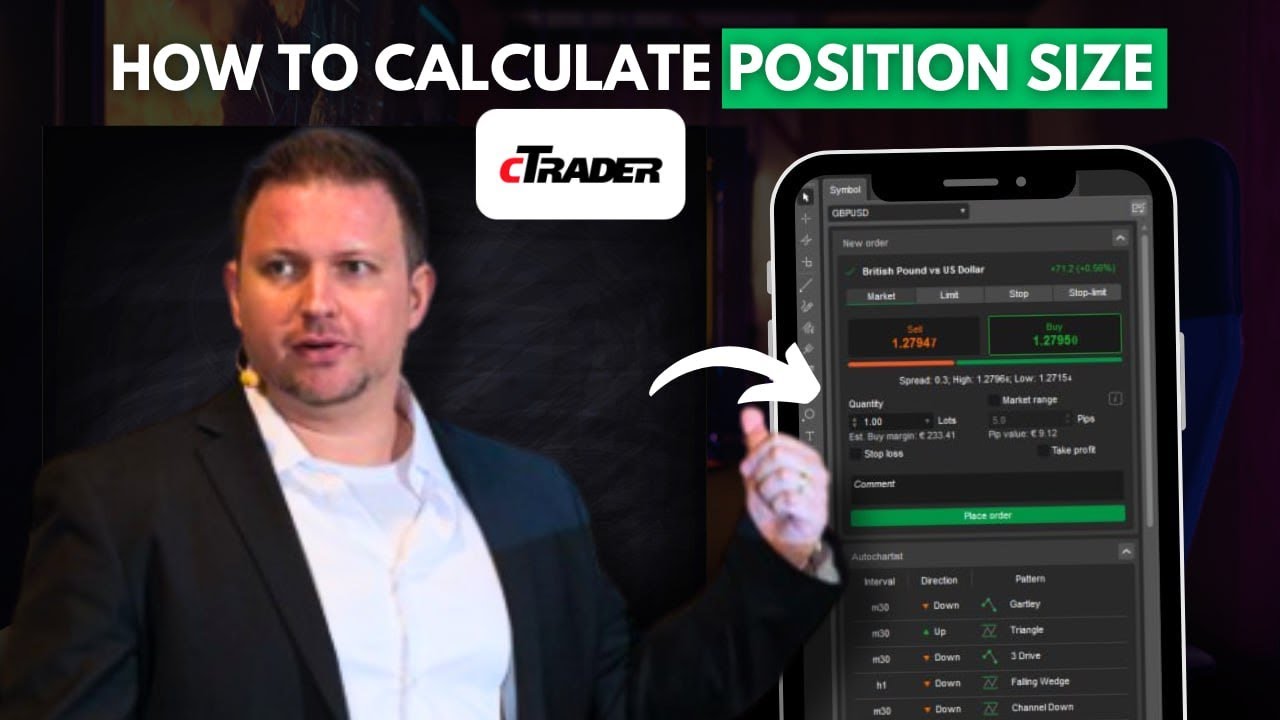
Vladimir Ribakov shows how to use cTrader's risk-reward tool to size positions and manage money. Risk 1% per trade with a reward greater than risk, and you profit even at 50% win rate. High leverage like 1:100 can wipe out a $1,000 account in one bad move.
Chapters
Risk-reward ratio, risk management, and money management. That's what it takes to become successful traders. While so many traders waste months, years, sometimes, believe it or not, decades on the next indicator, the next trading concept, the next Fibonacci, secret Fibonacci key level, The next hike and the next whatever promised on the online, that I would say the real secret is all about the numbers, money management and risk management. That's what take— will take your trading from here to here and then to the highs you actually want to achieve. What's up, traders? Vladimir here from Home Trader Club. As I explained at the beginning, it's all about the numbers. You probably heard that in different life aspects, in different life situations, numbers never lie. Well, sometimes they do, but they don't lie. They don't tell the whole story. And this story This very story, untold story about trading, it's all in the numbers. What do I mean by that? You probably heard the term risk and reward, right? If you didn't, the logic here is how much you risk, how much you reward in a given trade, or given week, or given months, or given any other period you are working with. Risk-reward ratio is the ratio you get between what you risk and what you can expect in reward, in return. While this term by itself sounds bombastic and sounds confusing to too many traders, or I would say most traders, the beginners of course, when they hear that, yeah, yeah, yeah, yeah, yeah, yeah, numbers are important, risk-reward is important, and so on and so on. But when it comes to real trading, all the focus goes to another indicator, to another trend line, to another concept, method, and so on and so on. And exactly like in any other, any other life aspect, it's all about the numbers. What do I mean by that? It doesn't matter if your salary is $1,000, $10,000, or $100,000. If you do not control your expenses versus your income and you control your numbers and your balance, you would end up losing money. Of course. Having more money gives you more flexibility and much easier control. Absolutely right, no argument about that. However, if you do not treat the money properly, you would stay with no money. It's that simple. And that's why you heard so many people who make tons of money suddenly go bankrupt, and because they have no clue how to maintain their money, how it all works. With what you get versus what you expect. So, uh, when it comes to trading, the money management and risk management will basically define who will make it into successful trading at some point and who would always stay in the amateur level. It's all about the numbers. When you learn to control that, when you let the numbers work for you That's when your trading goes from good to amazing, or from terrible to solid to stable, then to good, and then to amazing. Remember my words in your trading. You would always come back to the same— it's all about the numbers. When it comes to the numbers, it's important to understand what these numbers represent, of course, but also it is important to have tools that will help you controlling these numbers. If you are absolutely new to this world of numbers, I want to explain that in a very, very simple way so you can understand the logic behind it. After that, of course, if you want more of that, you can watch this very video that will explain you how you can make a lot of profits with only 50% success rate. Sounds unbelievable and sounds impossible, right? However, it's all about the numbers. So let me go blank screen and I want to explain the logic here. Very simple. Excuse me for my drawings. It's, it's not an art lesson. It's about trading, right? But think about it in the most simple way. Plus, minus. What you make, what you lose. Let's say you have $1,000 account, okay? And you want to risk 1% per trade, which is $10. Okay, so this is your risk. Your reward should be bigger than $10. If, if you maintain these numbers— I'm talking about the average, of course, right? If you maintain the numbers and your risk, which is $10, and the reward, let's say even $11, then every single time with 50% you would be making money. You lose trade, you win trade, you lose trade, you win trade, and voilà. You make money. It's that simple. And if your reward is bigger than $11, let's say $12, or even better $20, if you maintain positive risk-reward ratio, then you would start make more money with 50% success rate. Because if you keep losing $10 per losing trades and you make more on your winning trades, on average you actually would find yourself making money. It is that simple. So when you understand this concept, how do you actually work with that? So most traders, what they do, they just go with crazy volumes, crazy lot sizes, without understanding how much they risk. Why? Because they can. Why? Because brokers offer them the leverage of their dream. You get— you put only $1,000 in your account, here you go, 1:1 100 leverage sounds magical. Now I can trade with $100,000—a dream come true. I don't need to bring $100,000 to trade it. However, the bigger the numbers you trade, the bigger the volume you use, the bigger the value of every single point. How much in one lot? 1 pip would equal $10. Of course, in average, because in different trades it might be slightly lower or slightly bigger. If it's yen pairs, it would be lower. If it's franc pairs, it would be bigger. Depends on the value of the instruments, but it will average the $10. Okay, about so. So think about it, you have $1,000 account But thanks to the leverage 1 to 100, you would be actually trading $100,000. Okay, which means every single point would be— one point would be $10 with $100,000 or one lot. That means all it takes is 100 pips move against you And your thousand dollars are gone. Why? Because 100 pips multiplied by $10 per pip gives you $1,000, and your account is bye-bye, and you would reach margin call, and you would see, oh my God, trading is not for me. Trading is a scam. Trading is a spam. Blah blah blah blah blah blah. So this is where majority of beginners fall over and over and over and over and over and over again. You got it. So in order to leave that place of being an amateur and step into the real world of trading, you have to accept that it's all about the numbers. You have to accept that you have to respect money management and risk management. And if you don't, you would continue say bye-bye to your amounts and accounts, um, every single time. It is that Simple. And please don't tell yourself or me or anyone else, it will never happen to me, I know better, I have another indicator, someone promised me the sky, someone— I found the best, uh, trader, copier, robot, whatever. We all been there, we all tried, we all failed, including myself many, many times in the past. That's why I'm recording this video to share with you my experience. So how do we work with that? So once you understand the importance of numbers, the tools exist today, nowadays, come to help you to maintain your accounts correctly, to manage your accounts correctly, and to use smart risk management. I will present this video on cTrader platform. Why cTrader? I can talk about it for hours and hours. Here is the list of the reasons why I love this platform. Their built-in risk management is another amazing feature they have to make trading simpler for you. The, the speed of the execution on give guaranteed market price is phenomenal. So the way it works is you go on this toolbar and there is here this tool risk reward buy and sell. So whatever you want to do by yourself Just click that, and then on any place on the chart, just click the left button on the mouse, and it— you got it. Then you can move this range, of course. Okay, and voilà, you got the numbers. Now here comes the magic. If you can, of course, take it here and increase on this chart as much as you want, and so on and so on. You can increase and decrease the risk. The red is the risk. And the reward, you can change it as you want. But if you want to play with the settings and set it according to your trading style, just click the right button on the window and go to the settings. Here you can also work with the colors. You can lock it so it doesn't move by, by any chance. You can duplicate it and take it to other places as well, and you can of course remove that. Inside the settings, that's where your real control— sorry, the real control happens. Uh, you can basically choose your order type. If you would work with market, if it's buy or sell limit, buy or sell stop, or stop limit. You can choose a direction, sell or buy, and you can basically work with any of your preferred calculation mode. The risk is the most popular. You can do it by a reward as well, or you can do it by size. Okay, if you want to learn more, you click here and you would get more information. You can also choose if you go by volumes, percentage of balance of equity and how much you risk per trade. You can see on this test account I have $1,000, so I will be risking 2% per trade. If I want to risk 1% per trade, of course I'll just make it smaller. It's that simple. Okay, so you can adjust it as you wish. You want play with more settings, here you go. You can also do it by fixed risk-reward ratio, meaning if I say, okay, I want to trade with 1:2. I put 2 here, risk-reward ratio. I click OK. And now look what happens if I increase my stop loss. My reward increases automatically as well according to the required risk-reward. Okay, this is amazing feature, super easy to follow and to use. If you don't want the risk— the fixed risk-reward ratio, you just remove that. Unselected from here. Additional settings allow you to choose your quantity, or basically the traded volume. You can also adjust the stop loss and take profit from here. And you can see that the— you see what happens on the screen here? That it adjusts on this range automatically. It's that comfortable. Okay, you can, uh, select the maximum deviation from the price you want to allow the trade for the execution. And of course, choose your preferred style and colors for that. Absolutely amazing. So once you have it here, you can see that it will show you the risk, it will show you the, um, the, the, the lot size it will be doing at that point. Of course, if you go with the market, it will automatically execute. So if you choose, like for example here, you want to trade but the price is here, cTrader will adjust it automatically for you. The risk would not change. The lot size will according to the market price. Okay, that's how classical it is. The best part of that also, that is, it is suitable for backtesting. From my point of view, when you are new to trading or when you are testing out a strategy, backtesting is crucial. And one way you can do that is, again, you implement the risk-reward ratio here, right? The, the range, of course. And you can go and scroll down. Let's say I love to trade false breakouts, okay? So I found some, uh, some movement here, some bearish divergence, and I want to trade after the fake out because it bounces from resistance. And I want to give this shot, right? So I want to test how the false breakout would work for me. So let's assume the false breakout happens to be right here at the end of the red candle, right? So I would basically put it at the, at the end of the red candle here. Uh, the protection would be above the last high and the target would be to the next key level, which is in our case here around this zone. So I can check that, okay, in this trade based on the false breakout, that would be my risk. That would be my reward, and in that case I would gain profits. So when I do backtesting, this, this tool is absolutely amazing. It helps me to figure out and understand what lot sizes I would be doing if I'm risking $20, or if I'm making $10 or $100, whatever is coming there for you, uh, in terms of the numbers, uh, and helps you to prepare basically visual proven numbers on how the strategy you implement would work for you. The more you will backtest, of course, the more reliable it will be for you. You don't need to double-guess, you just work. Here is another false breakout that happened in that place, right, because it is bouncing off key supply level. Doesn't matter the reason, just a false breakout with divergence. That's just for example. Yeah, so, um, here we go. Bearish divergence, higher highs on the chart, lower highs on the MACD. I'm not teaching the strategy, I'm just explaining an example here. So once again, the false breakout happened to be here with the red candle, so I put it at that place. I adjust the numbers. This is the close, so the open of the next candle is the entry. Protection about the last high, target around the next level. Do I have a positive risk-reward ratio? Positive means your reward is bigger than your risk, as simple as that. So the answer here, of course— and you can see that, by the way, here the ratio is marked out automatically for you— in that case of course, uh, on this example, the market would pay me well. Uh, another, uh, example, if we can find any with the false breakout. Here we are, another example. Okay, so bearish divergence, right? False breakout happens to be here. So in that case, let's plot the numbers. Once again, false breakout happens to be at that candle. This is the protection, the reward around the next key level. Again, risk-reward ratio is positive. Sorry, a little bit wrong here. Uh, the risk-reward ratio is positive, and I would be cashed out at that zone. So I'm not showing that to impress you with the strategy. That's not the case, of course. It's just a successful example. So Of course it can also fail, but I wanted to explain you how this tool can help you figure out will the strategy work well for you and do proper backtest. Invest your time in backtesting any single strategy. It will save you a lot of wrong executions later on. Give it a practice, prove if it works for you, and you believe me These tools would save me thousands of dollars in the past if they would exist when I started. Unfortunately, uh, they did not. So use this tool wisely, use this tool smart, um, and assist yourself in doing successful trading. So how do you actually execute a trade? Uh, so again, this is my test account, so I'll just show you. You can see that the numbers dropped a little bit here because I was pressing some, some buttons. Uh, to, to, uh, for that, uh, presentation for the video. So once again, let's say I just want to go for a sell. So I dropped it down here, right? And let's say I want to calculate— this is my market price, I want to trade here, and I want my reward around this level. If I want to increase the range a little bit more visual, okay? So just for the example, I want to go here, market sell. The risk-reward ratio is pretty much positive. I can choose once again in the settings every single thing I want. If it's market, limit, or stop order, how much am I risking, if I want fixed ratio. Okay, as I said at the beginning, and once I decided, I can click sell. Once I click the sell, you can see here in the terminal the trade would be showing, and, uh, basically executed as easy as, as clicking one button. It's that simple. That's why, seriously, once again, I wish these tools were there when I started. Unfortunately, they were not, but they are available for you. Use these tools because they are absolutely amazing. It helps you to control your money management, the risk management Smart, professional, easy. Okay, um, if you have any questions about what I just presented or anything else you want to ask, don't hesitate to ask in the comment section. That's it for this video. I hope it explains how to use this absolutely amazing feature cTrader has built in. Um, I'm there for you for any questions, and thanks for watching. I hope you find value in this video. Please don't forget, hit the like button if you enjoyed this video and the other section. I also want to remind you that I have a dedicated playlist for cTrader platform— different features, different uses, trading concepts, trading strategies, trading methods. Watch the playlist of cTrader I have on my channel right here. If, uh, you are new to this channel, also please consider to subscribe with the subscribe button below. This video. And I want to invite you to our trading family, the Home Trader Club, where you will get your access to our full courses, rich comprehensive media zone, real-time education, and real-time trading opportunities. Join us with the link below this video in the description. Thanks for watching. Best to you and yours. I'll see you soon with more. Good trading. Bye for now.
More from Vladimir



Stop Buying USDJPY: The Critical Resistance You Need To See #forex #tradingstrategy #shorts